|
|
|
|

Kaiser Wilhelm II
Page 9
|
|
| ||||||||||||
|
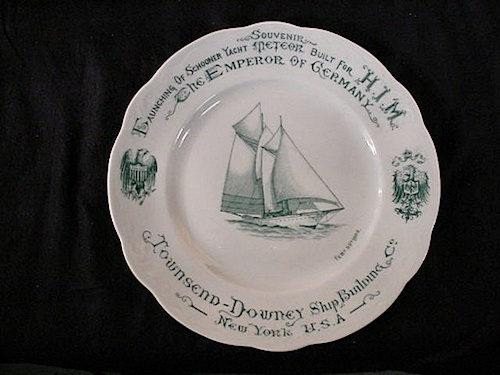
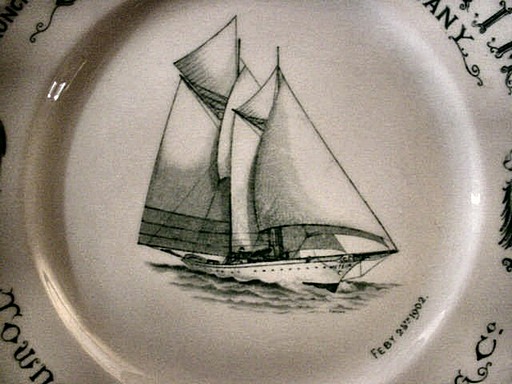
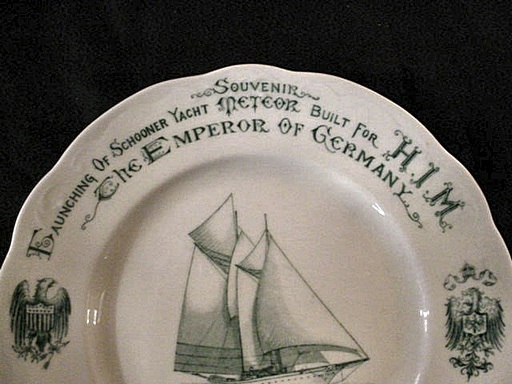
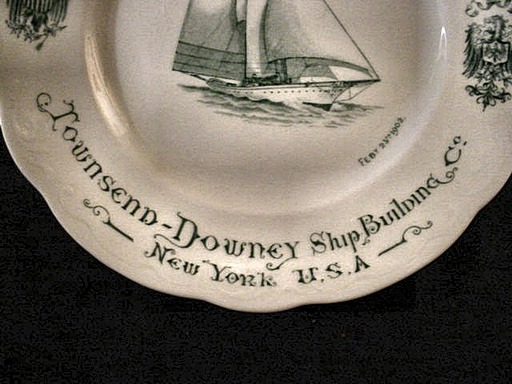
Souvenir Plate Commemorating the Launching of the Kaiser’s Yacht Meteor (Item WILHELM 9-1) |
||||||||||||
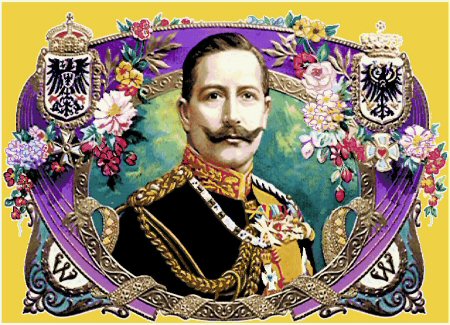
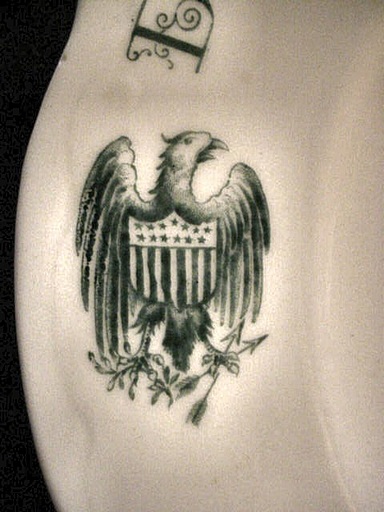
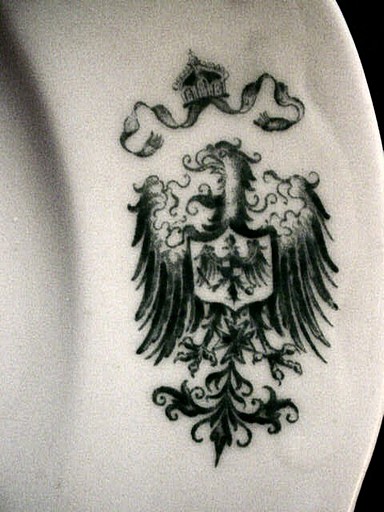
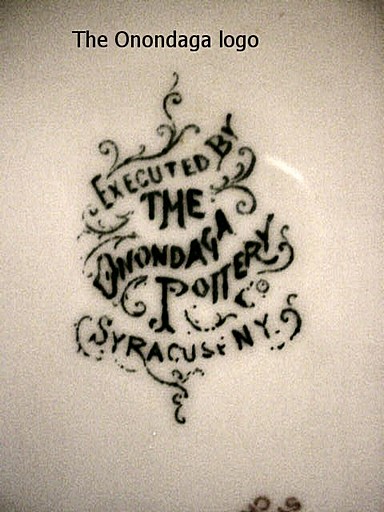
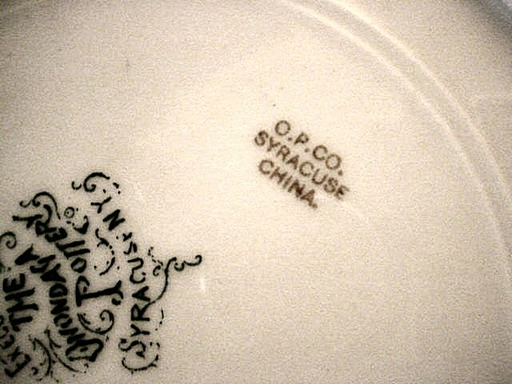
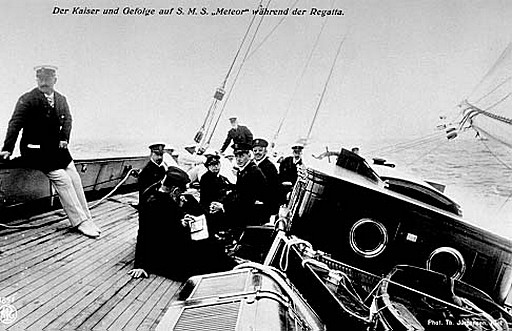
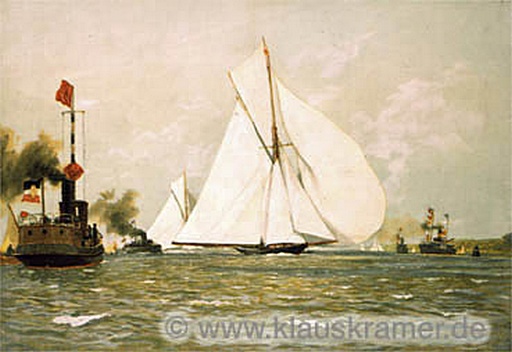
| DESCRIPTION: The Kaiser of Prussia and Emperor of Germany, Wilhelm Hohenzollern II, had two yachts built for himself, Meteor and Germania. The Kaiser played an important part in the creation of prestigious yacht clubs and the launching of international regattas. He was always the sailor, loving the sea and this rubbed off on one of his sons (Prince Adelbert). In 1901, the Kaiser ordered the schooner-yacht to be built for him by the firm of Townsend & Downey Shipbuilding Co., on Shooter Island. The designers were H. G. Barbey & A. Carey Smith. The launching was a major event and it was Alice Roosevelt, the wife of Teddy, who broke the bottle and christened the ship on February 25, 1902. Meteor’s racing record was not impressive and in 1909, she was sold to Dr. Carl Dietrich Harries, who rechristened her Nordstern. In 1921, she was sold to Maurice Bunau-Varilla, owner of the Paris newspaper Le Matin. In 1924, she was bought by an Italian baron named Alberto Fassini. In 1932, Fassini sold the yacht to a man named Gillett, who shortly turned her over to Campbel & Nicholsons, British yacht brokers. After a few months of idleness, she was bought by an American named Francis Taylor. Taylor sailed her for several years and sold her to Sterling Hayden, who returned her to her former owner. In 1940, Taylor sold her to Gerald S. Foley, who in turn sold her to David Fienberg. Fienberg sold her to Nicholas Allan. That year, the Navy requisitioned her. Today, Meteor III, , whose name was changed to Aldebaron, lies in the yard of a ship's broker by the name of John Witte, only a few miles from where she was built. The souvenir plate was made by the Onandaga Pottery Co. of Syracuse, N.Y>, which the leading exponent of fine china since 1871. Today, Onondaga is known as Syracuse China and it is the leading supplier of commercial china for the food-service industry. The plate says around its edges: “Souvenir--Launching of Schooner Yacht Meteor built for H.I.M. (His Imperial Majesty) the Emperor of Germany.” At the bottom it says” “Townsend-Downey Ship Building Co., New York, USA.” It has the American eagle and the German Imperial eagle under the Prussian crown both of which are to the side of the picture of the yacht. The plate measures 9 1/2 inches in diameter and is in A1 perfect condition. It also has the date “Febr. 25th, 1902.” On the back is the logo of the Onondaga Pottery Co. and an imprint of Syracuse China, as well. This is a beautiful representative piece illustrative of the obvious fact that the U.S., then mostly a Germanic nation (at least in majority) should have remained in brotherly association with the old fatherland averting a horrible fratricidal war.
PRICE: SOLD |

| |||||||||||||
|
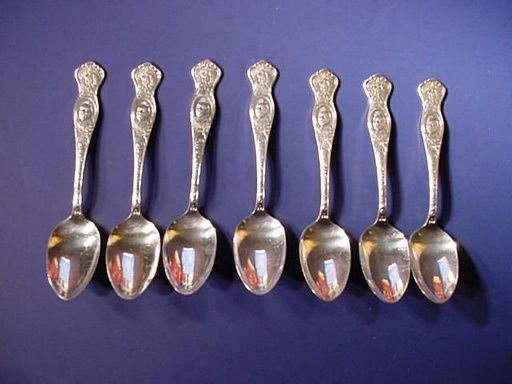
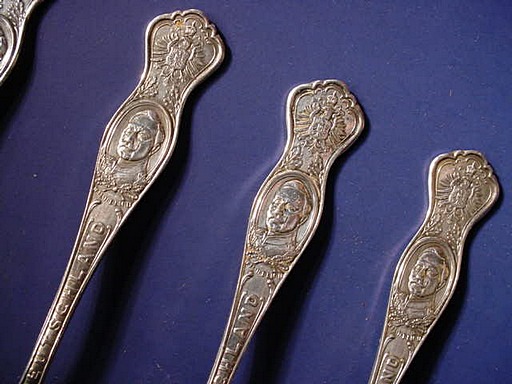
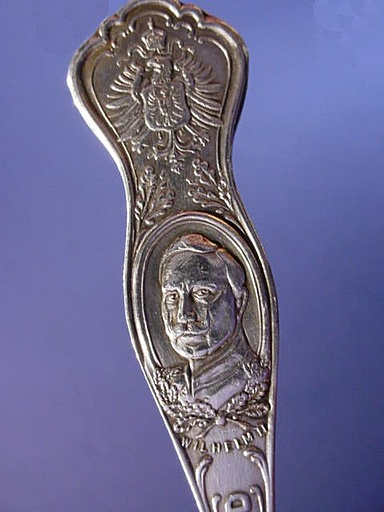
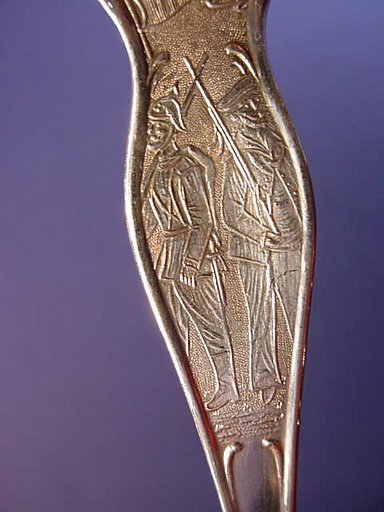
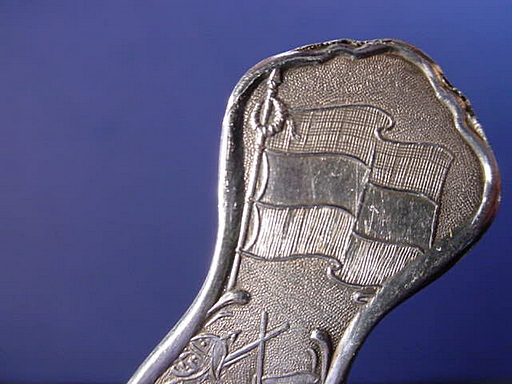
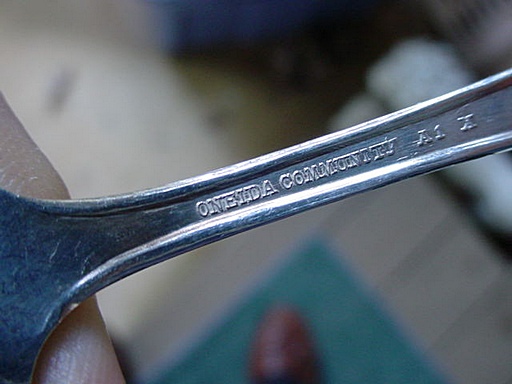
Kaiser Wilhelm Spoons (Item WILHELM 9-2; SPOONS 1-7) |
|||||||||||||
| DESCRIPTION: We have recently acquired several souvenir spoons in mint condition as described in SPOONS 1-5 above. Please read the information seen there. The only difference is that these spoons are in mint condition having been preserved in a stately Syracuse, New York mansion wrapped in a special velvet-lined box all these years. They are exactly like the one pictured above and we bought them right so we will pass the benefit to you.
PRICE: $90.00 each |



| ||||||
|
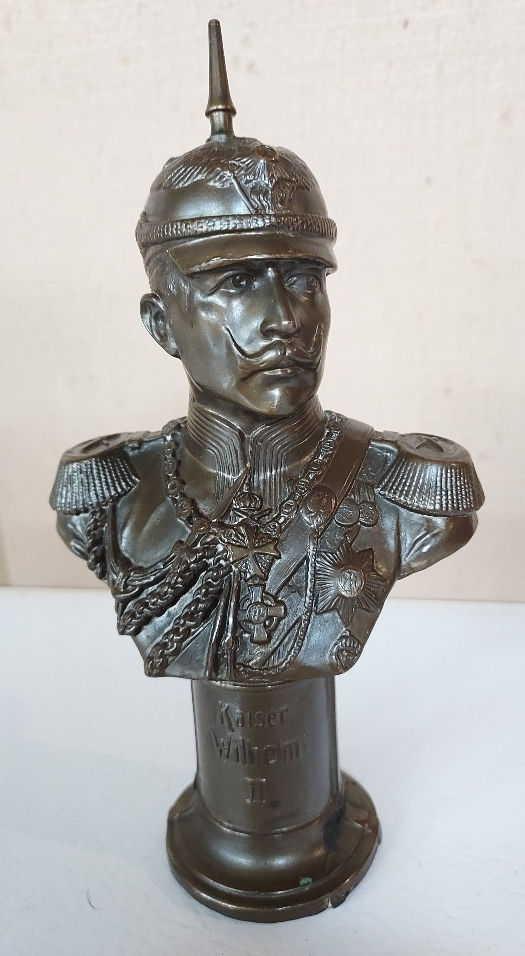
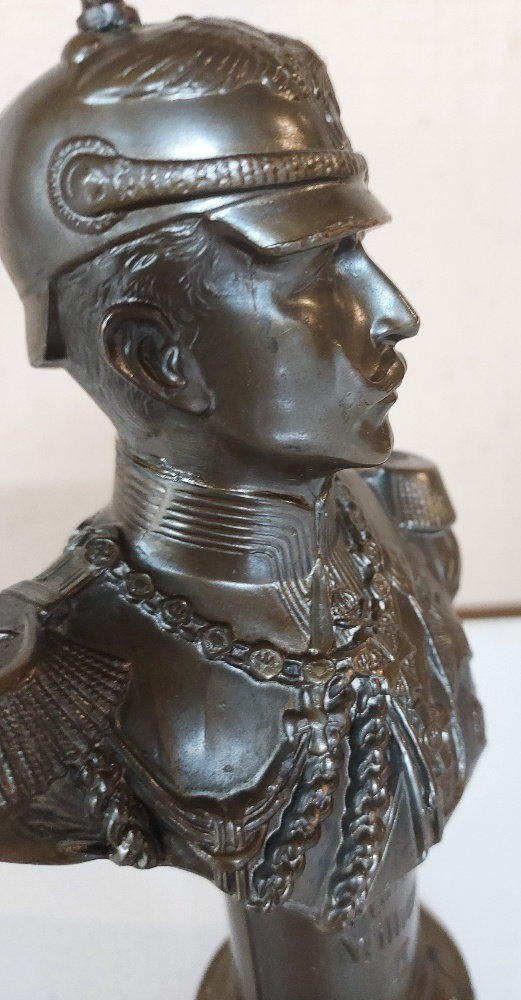
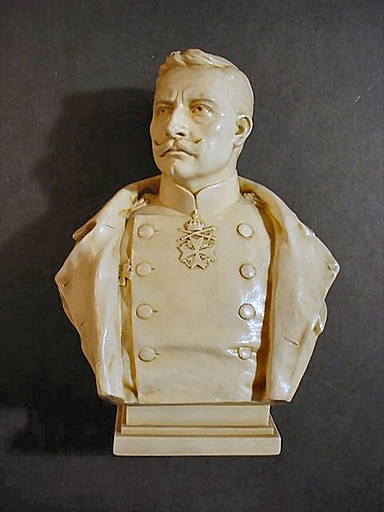
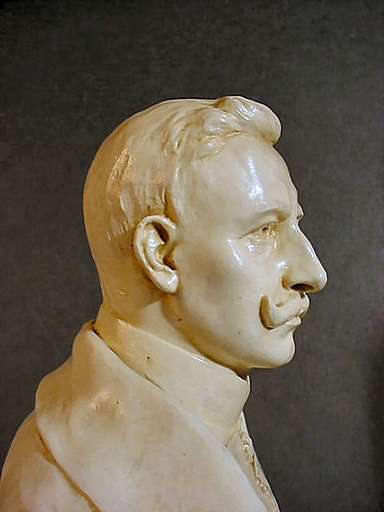
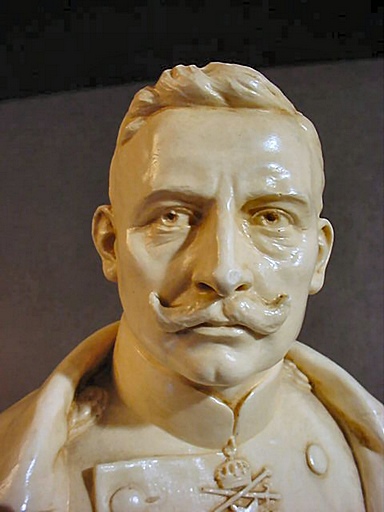
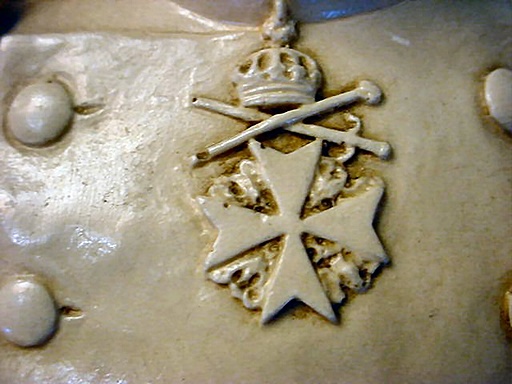
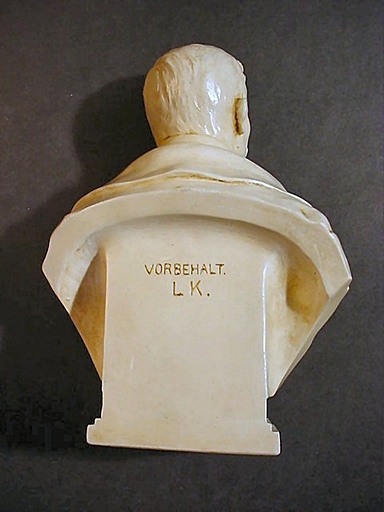
Bust of Kaiser Wilhelm Hohenzollern II (Item WILHELM 9-3) |
||||||
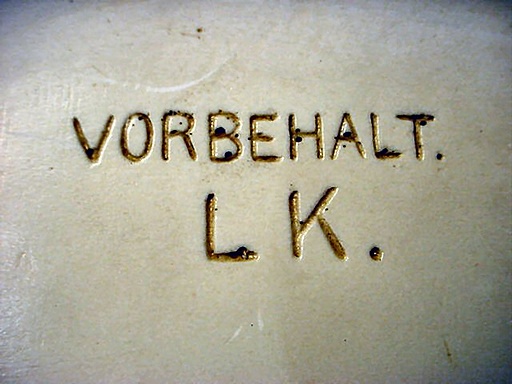
| DESCRIPTION: This is a very fine likeness of the Prussian Kaiser and emperor of Germany. It is a young depiction of him showing him at about 25 years old. He wears around his neck the Prussian Order of the Black Eagle. The piece is in terracotta and is in fine, unchipped condition. The Kaiser is handsome and noble looking, as he surely was, indeed. The figure is about 8 1/2 inches high and about 6 inches across the shoulders. It’s signed ‘Vorbehalt L.K.’ on the back. This is just the right size and quality to be placed on a desk or what-not cabinet. A resplendent figure always, Wilhelm represented a time of splendor and high ideals. Tragically he was a bit too arrogant and impulsive—good qualities when correctly and timely employed. The great war for civilization ??? was the beginning of the end for the Imperial German Reich.
PRICE: SOLD |
| |||||||||||||
|
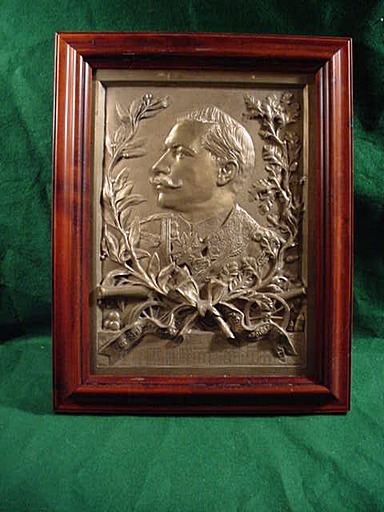
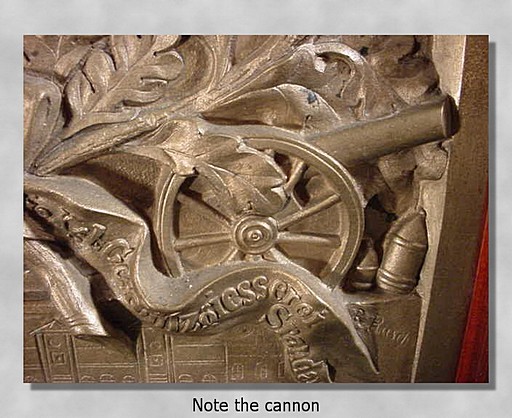
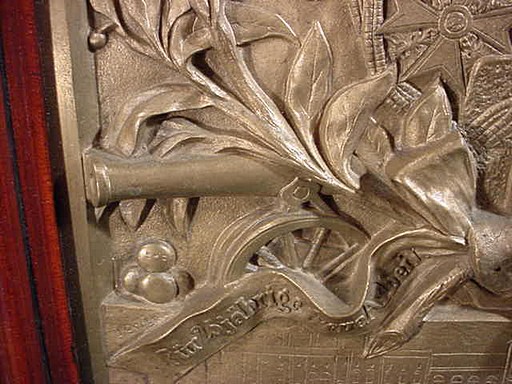
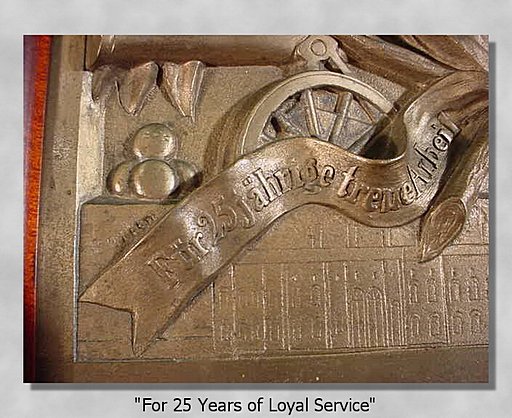
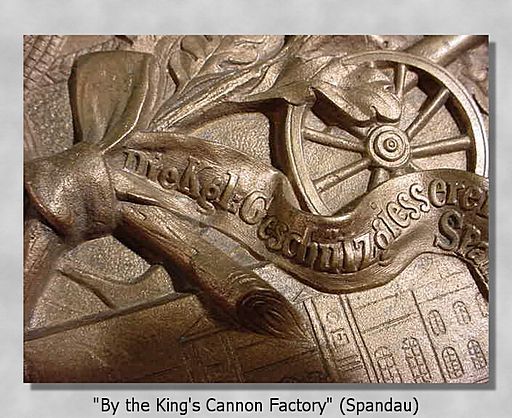
German Kaiser’s Appreciation Plaque to the Cannon Factory at Spandau (Item WILHELM 9-5; WWI 10-13) |
|||||||||||||
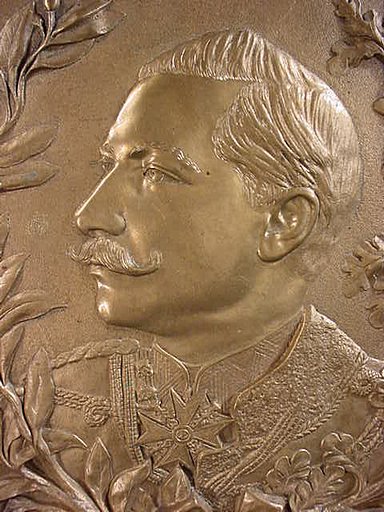
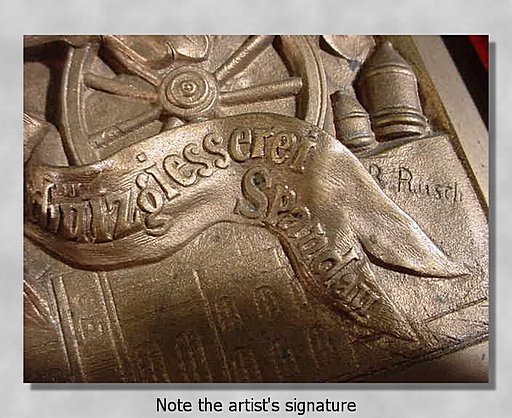
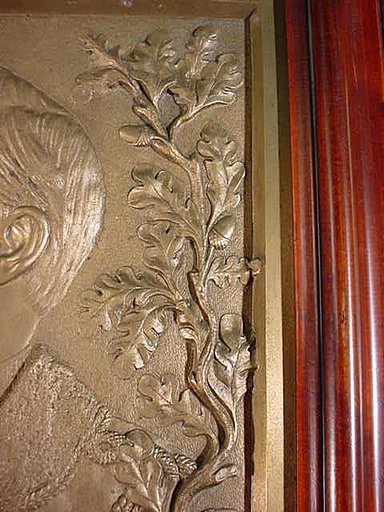
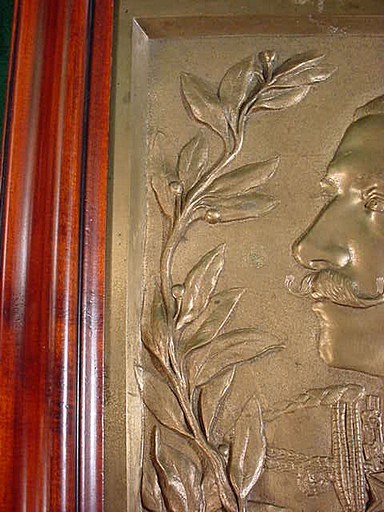
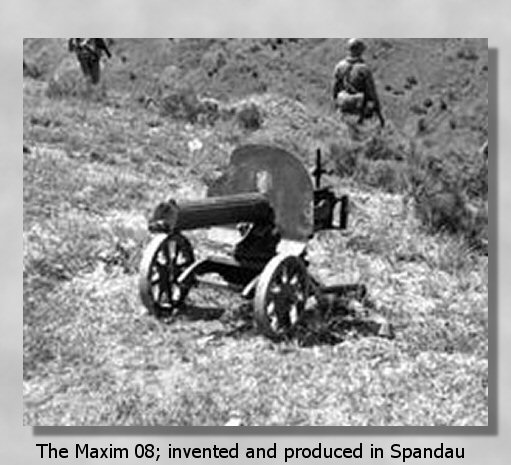
| DESCRIPTION: Before World War I Spandau was the seat of large, government cannon foundries. These were factories for making gunpowder and other munitions of war-making at the center of the arms industry in the German Reich. It was also a garrison town with numerous barracks; home of the Fifth Guard Infantry Brigade and the Fifth Guard Foot Regiment of the German Army. It was also the town where Spandau Prison was located. This was where the “prisoner of peace,” Rudolf Hess, was incarcerated for over 40 years only to be murdered by British MI-5 agents; don't get me started! This, when viewed in the light of rational thinking, is clearly horrible. This man only tried to bring peace to the world as did another man from Nazareth centuries before. They were both crucified by the same traditional enemy. Back to the plaque. This beautiful bronze picture of the Kaiser was granted to the Spandau Armaments Factory for years of dedicated service to the German Reich. It no doubt hung in the office of the President of the famous firm. The scroll at the border at the bottom says: “For 25 years’ true labors in the king’s “Geschuizgiesserei Spandau.” This translates to “cannon factory.” The plaque is in fine condition and the consigner had it beautifully framed. It says ‘Berlin’ in one corner. The entire frame measures 16 x 20 inches; the plaque alone is 12 x 16 inches. The piece is signed, Rusch (the sculptor). It truly is a historically important relic of the Kaiser Reich—a better time!
PRICE: SOLD |



| ||||||||||||
|
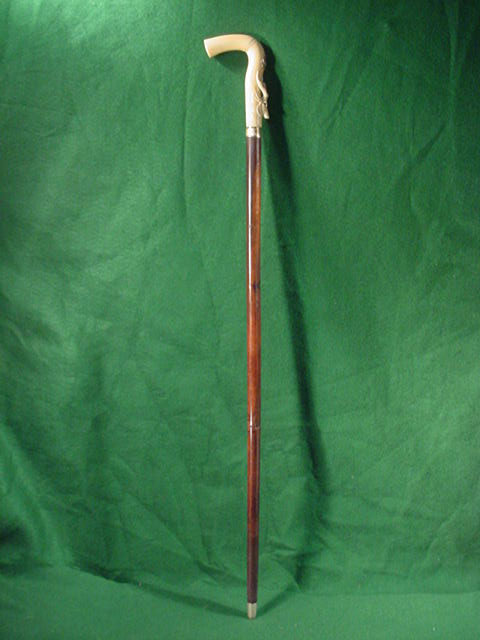
Personal Cane of Kaiser Wilhelm II (in gold and buffalo horn(Item WILHELM 9-6) |
||||||||||||
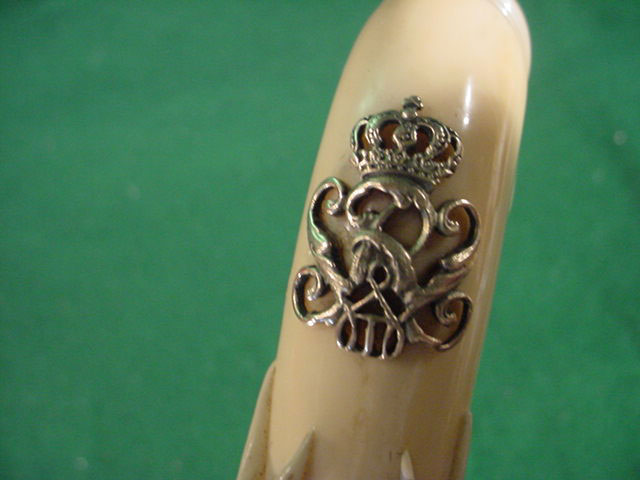
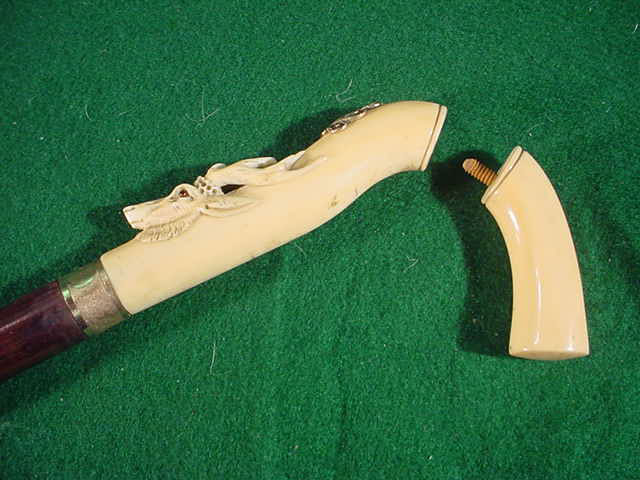
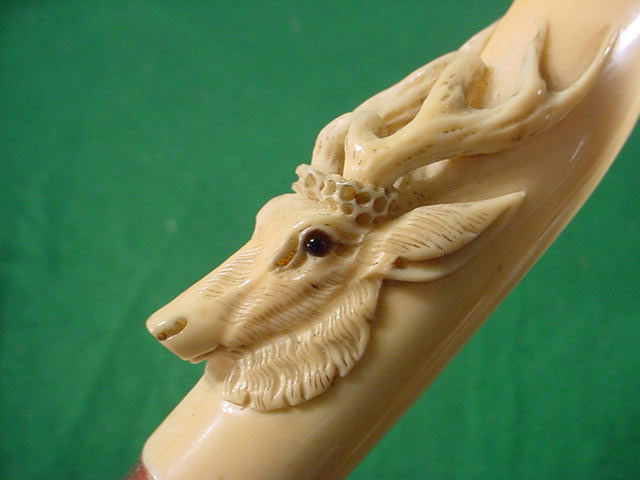
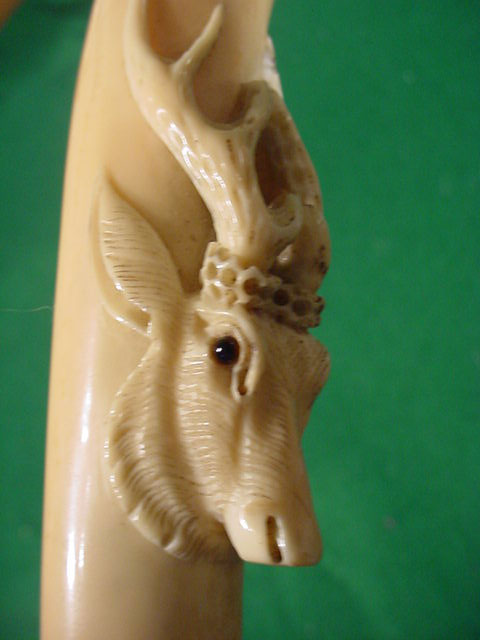
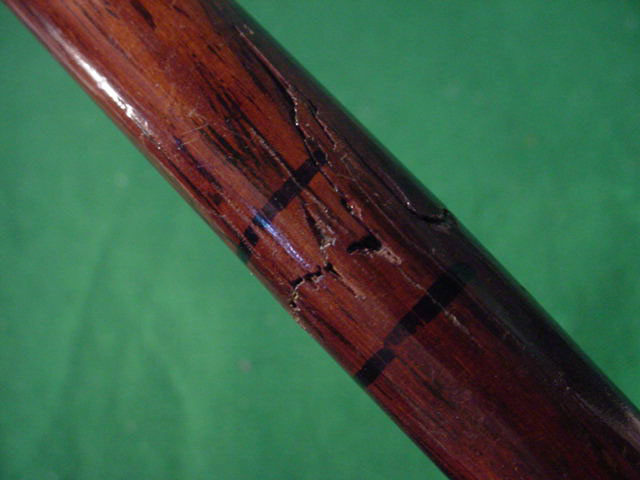
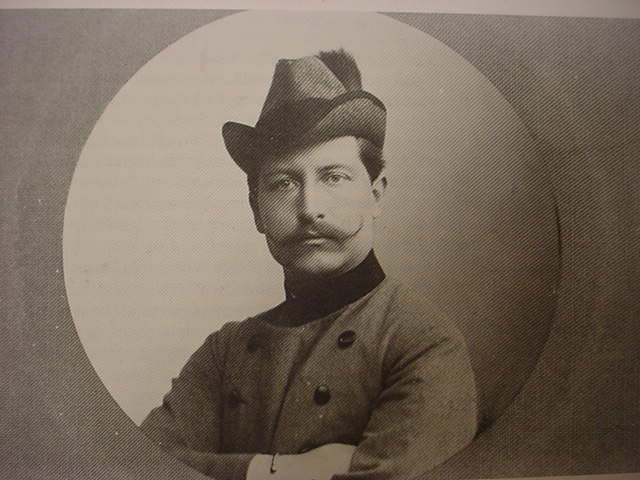
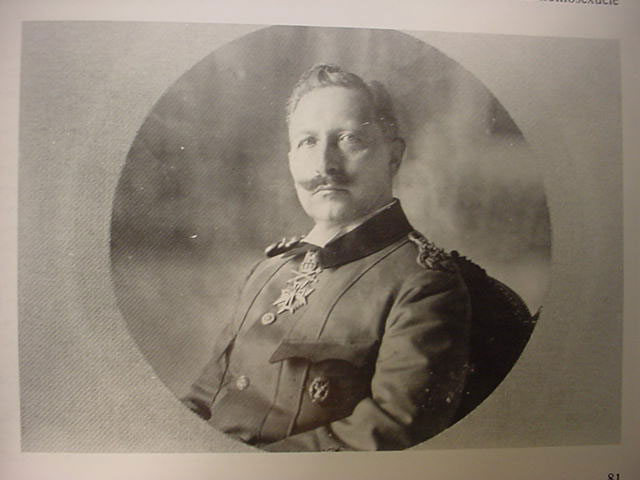
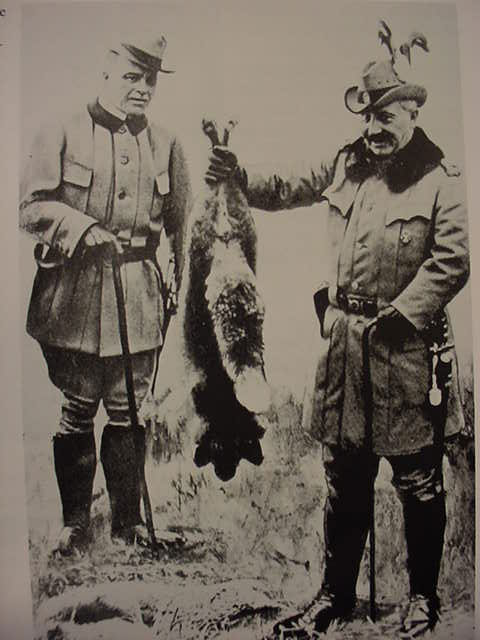
| DESCRIPTION: This beautiful walking stick was the personal possession of Kaiser Wilhelm Hohenzollenn emperor of all Germany and King (Kaiser) of Prussia. Wilhelm was an avid hunter and official records show that he killed a total of 78,330 animals on his forest estates in Prussia, Saxony and Mecklenburg. One of the Kaisers favorite hunting lodges was in the Harz Mountains and it is believed that this is either where he was presented this walking stick or he might have kept it there for walking in the beautiful country-side. The cane has a solid gold ring set below the carved bone grip. Where the buffalo horn meets the wood on this ring there is a hand engraved legend in one word and date (Harz 1906). The bone handle has an utterly lovely carving depicting what we think might be the red deer that still abound in central Germany and especially in the Harz Mountains. The detail of this animal is fantastic; no doubt by a master carver. Every hair is in place in this profound relic carving. The eyes are enchanting. The entire carving is “life like”. Above this carving is a solid gold cipher of Kaiser Wilhelm II with the W.R. for “Wilhelm Reign” ! and above is the Prussian Crown. At one time the stick itself must have been broken but excellently repaired and is very sound at this point in time. The crooked part of the handle will screw off (for what reason we do not know). The length is about 34 inches. This is a magnificent and prodigiously historically important relic of the glorious Imperial Period of German history. And the man who history has often vilified but reversionary explorationand research finds him to have been ill advised but a good family man, a devout Christian, and a monarch who loved his people and Fatherland.
PRICE: SOLD |


| ||
An Original Studio Card of Kaiser Wilhelm (Item WILHELM 9-7) |
||
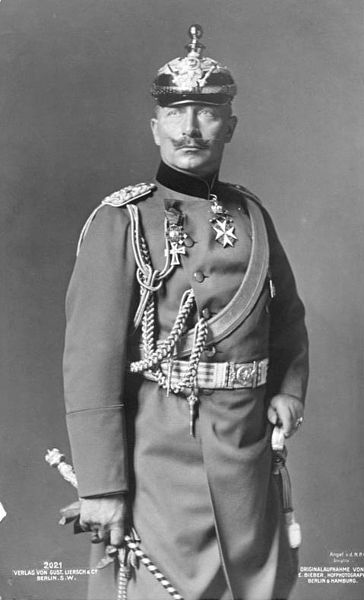
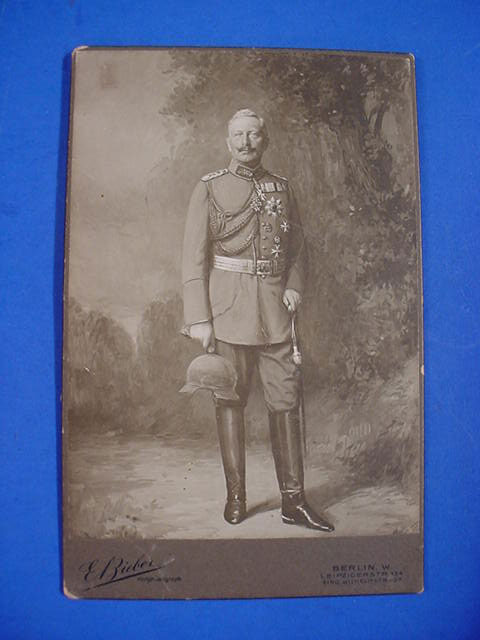
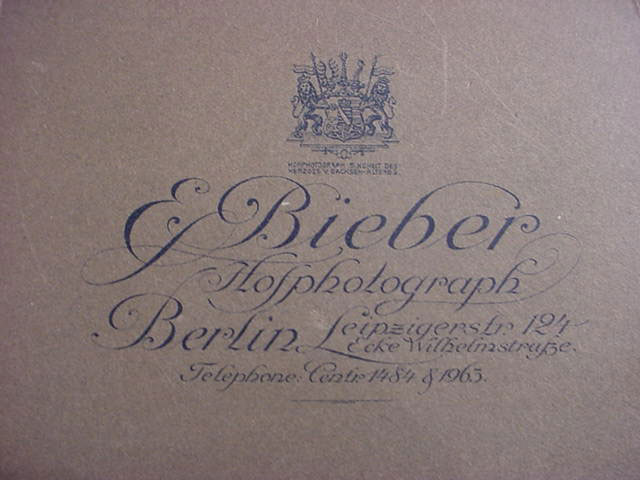
| DESCRIPTION: Here is a nice studio card image of Kaiser Wilhelm II in very good shape produced in a Berlin photography studio on the Leipziger Strasse. It is marked E. Bieber “Hofphotograph”. The word ‘Hof’ generally means (palace). This would indicate that this photographer was granted the entitlement to be able to photograph the Royals. The card stock photo measures 4 ¼ x 6 ¾ and depicts the war time Kaiser in his uniform of a German Field Marshal. A really regal pose with helmet and sword. The picture has one minor crack that isn’t going anywhere in the left corner. Actually, this wonderful picture should be framed or sealed in plastic as it is rare and beautiful and should be carefully preserved.
PRICE: $125.00 |
| |
The Grandfather of Kaiser Wilhelm II (Item WILHELM 9-8) |
|
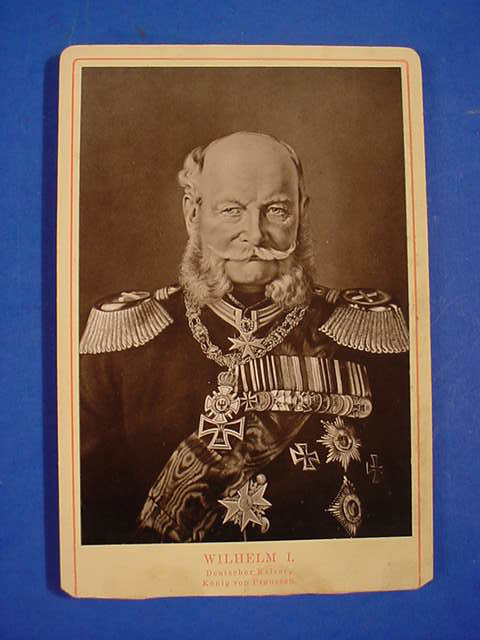
| DESCRIPTION: This is a great studio card depicting in great photographic detail, the “Soldier King” Wilhelm the First of Prussia with all his many medals and orders. This was produced in Prussia and it says underneath the portrait, Wilhelm I Deutschen Kaiser King of Prussia. The card measures 4 ¼ by 6 ½ and is probably over 135 years old in spectacular condition. Here was Germanys’greastist ruler since the Alte Fritz, Fredrick the Great!
PRICE: $125.00 |
 |
 |
 |
 |
 |
 Note ridge edging for picture |
 |
 |
 The bottom |
 Surrender of Napoleon III after the Battle of Sedan |
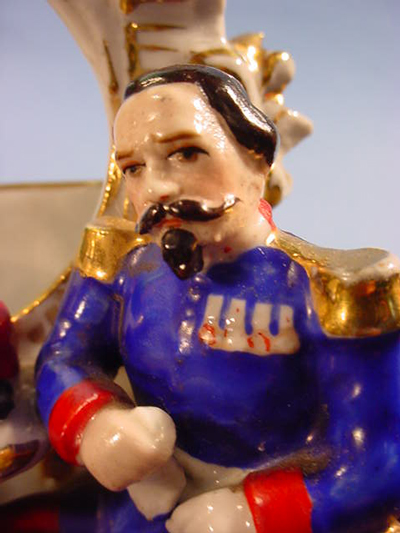
 Napoleon III |
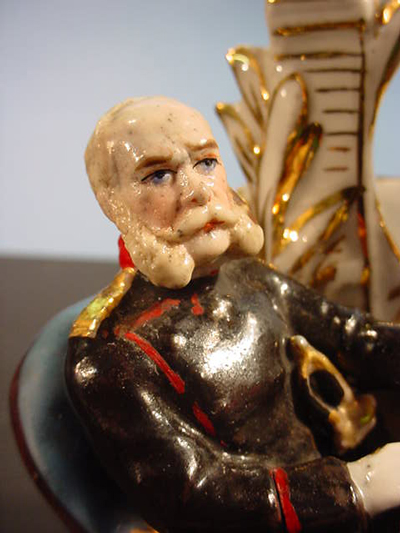
 Prussian Kaiser Wilhelm I |
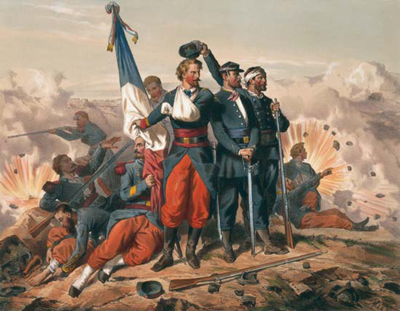 Romanticized scene from the Battle of Sedan |
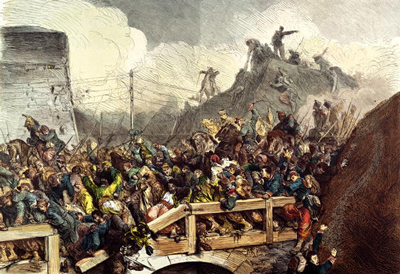 The defeated French troops at the Battle of Sedan |
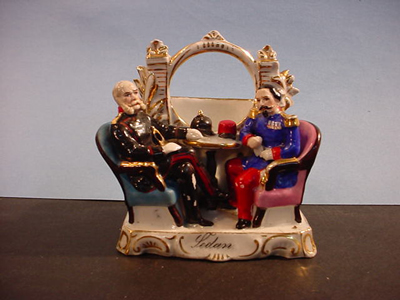
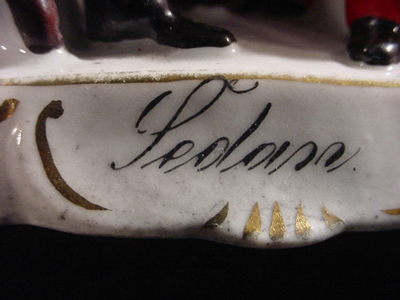
A Beautiful Porcelain Figural Vase Depicting Wilhelm I Taking the Surrender of Napolean III at Sedan (Item WILHELM 9-9) |
||
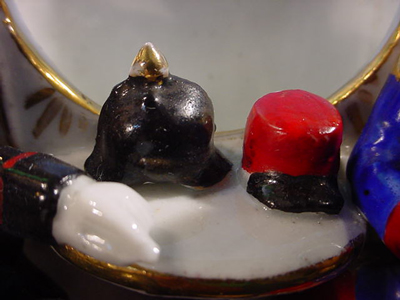
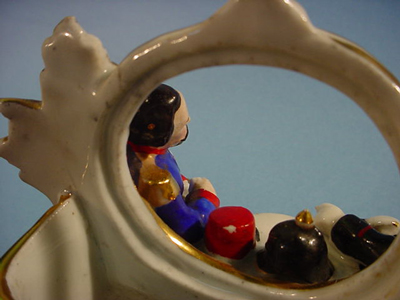
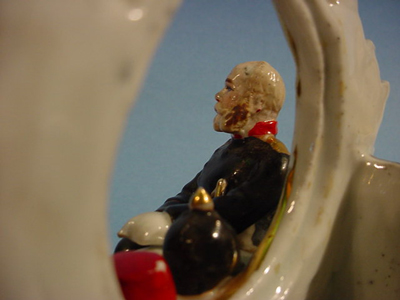
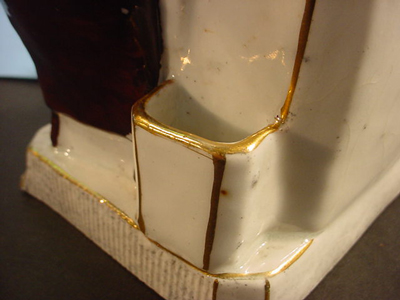
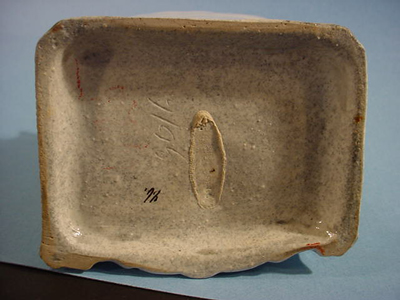
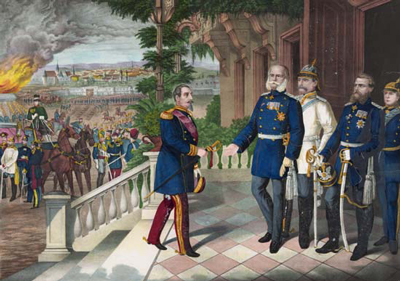
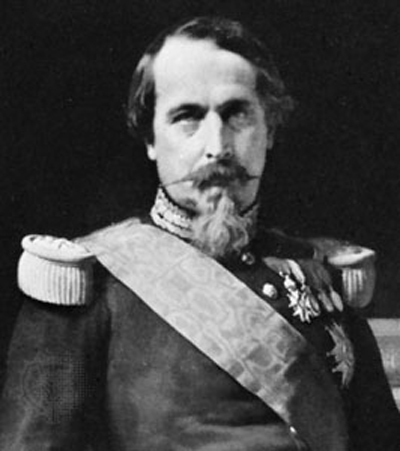
DESCRIPTION: This is a real charming piece of German porcelain of the 19th century. It represents the surrender of France and her armies to Prussia as a result of the Franco Prussian War of 1870-71. This war was a conflict between France and Prussia. Prussia was backed up by a North German Federation of which it was a member and the Southern one of Baden, Wurtemberg and Barvaria. The complete Germanic victory brought about the unification of Germany under Kaiser Wilhelm I of Prussia. It also marked the downfall of Napolean III and the end of the 2nd French empire. The conflict was a culmination of years of tension between the two powers. The superiority of the Prussian and German forces was soon evident, due in part to efficient use of railways and impressively superior Krupp Steel artillery. A series of swift Prussian and German victories in Eastern France culminated in the Battle of Sedan at which Napolean III was captured with his whole army on the 2nd of September. This little porcelain piece colorfully commemorates this victory and the famed surrender. It is a rather petite piece -- 5 1/2" high and about 4 3/4" wide. It depicts Kaiser Wilhelm and Napolean III seated at a little round table top where the spiked helmet and the red Kepi of Napolean are seen. Behind them is a beautiful frame -- my theory is that this would be meant to hold a picture of a soldier who might have served in Germany's Army. Behind this is a vase type arrangement that could hold flowers, but more likely note pads, which a small container to the right could be for a pen...we do not know for sure, but the question is fascinating in itself. In any case, it is quite a beautiful little porcelain and very worthy of display in a fine collection. There is a number, 46, on the bottom of the base, otherwise no other markings, which is typical of the era. PRICE: $375.00 |
||
 |
 |
 |
 The back of the card |
 |
 The young Kaiser |
 The old Kaiser |
 The family at Doorn |
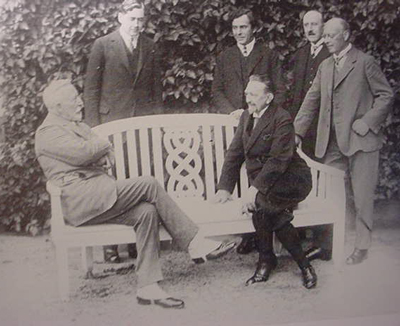 Kaiser interview at Doorn |
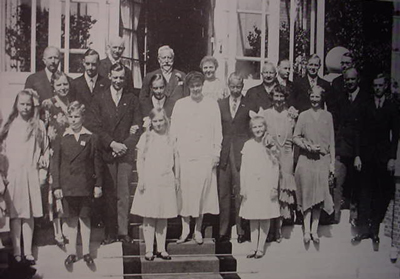 Doorn 1935 |
 Haus Doorn |
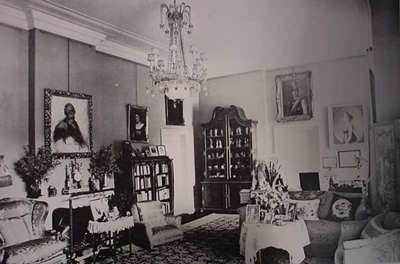 Interior view |
 Dining room |
Kaiser Wilhelm II Signature Postcard (Item WILHELM 9-10) |
||||
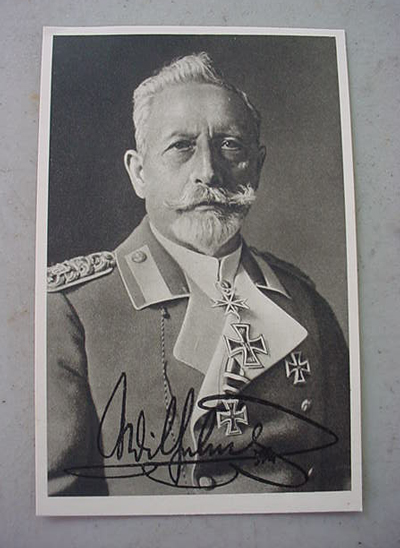
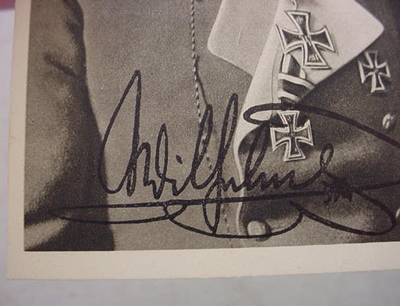
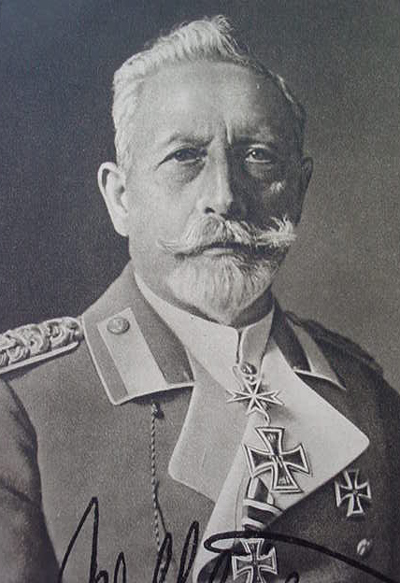
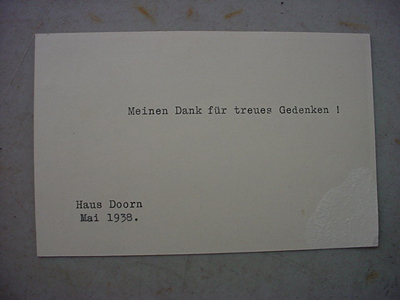
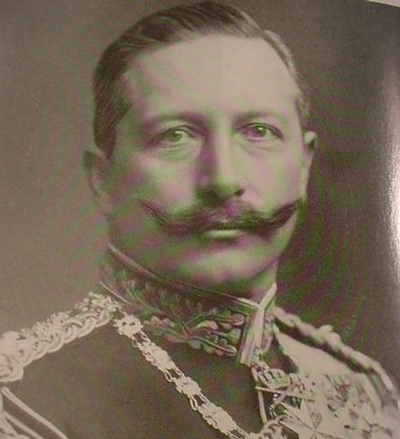
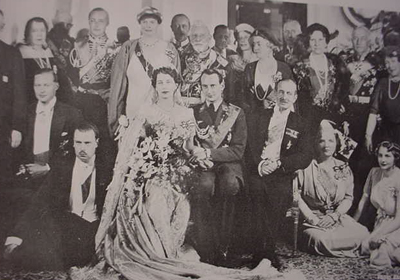
DESCRIPTION: Here is a very nice postcard in excellent condition bearing the signature of Kaiser Wilhelm II King of Prussia and German Emperor born 27 January 1859, died 5 June 1941. He was the last German Royal ruler of the German Empire and the Kingdom of Prussia. There is much about this Royal personage on the world wide net so we will not write a biography of Wilhelm II. We will point out, however, that this card was signed at Doorn in the Netherlands where he was exiled. Although the house at Doorn seems to be a palatial estate with most all the comforts of the Hohenzollern castles, Wilhelm however was not happy with it and complained bitterly about being exiled there. He wrote to his closest friend, General August Von Mackensen in Dec. 1919 denouncing his abdication as the “deepest most disgusting shame ever perpetrated by a person in history. The Germans have done this to themselves.” egged on and misled by the Tribe of Judah, let no German ever forget this nor rest until these parasites have been destroyed and exterminated from German soil. In the early 1930’s, Wilhelm apparently hoped that the successes of the NSDAP would stimulate interest in the revival of the Monarchy. In the wake of the German victory over Poland in September 1939, Wilhelm’s adjutant General Von Domes wrote on his behalf to Adolf Hitler stating that the House of Hohenzollern “remained loyal" and noted that nine Prussian Princes (one son and eight grandchildren) were stationed at the front. Wilhelm stayed in regular contact with Hitler through General Von Domes, who represented the family in Germany. Wilhelm greatly admired the success which Hitler was able to achieve in the opening months of the Second World War, and personally sent a congratulatory telegram on the fall of Paris stating, "Congratulations; you have won using my glorious and brave solders.” During his last year at Haus Dorn, Wilhelm believed that Germany was the land of the holy Monarchy and therefore of Christ and that England was the land of liberalism and therefore of Satan and the anti-Christ. He observed that the English ruling classes were for the most part Freemasons thoroughly infiltrated by Judea.” He believed that the Masons and Jews had caused the Two World Wars, aiming at a World Jewish Empire with British and American gold but that Judea’s plan has been smashed to pieces by the NSDAP and they themselves were sweeped out of the European continent. In a letter to his sister, Princess Margaret in 1940, Wilhelm wrote, “the Hand of God is creating a New World and working miracles…We are becoming the U.S. of Europe under German leadership, a United European continent.” He added the Jews are being thrust out of their nefarious positions in all countries, that they have driven to hostility to them for centuries. Wilhelm II died in Doorn on 4 June 1941 aged 82 with German Wehmacht soldiers at the gates of his estate. His body was interned in a mausoleum on the grounds of Haus Doorn, which has since become a place of pilgrimage for German monarchists. To this day, small but enthusiastic numbers of them gather at Haus Doorn every year on the anniversary of his death to pay sacred homage to this, the last German Emperor. This card offered is the standard postcard size with a crisp, clear signature boldly written. On the back of the card is a typewritten short message that translates, "My thanks for true remembrance" Haus Doorn Mai 1938. This is a great remembrance in itself of a great and good monarch but an ineffective and misadvised warlord. PRICE: SOLD |
||||
 |
 |
 |
 |
 |
 |
 |
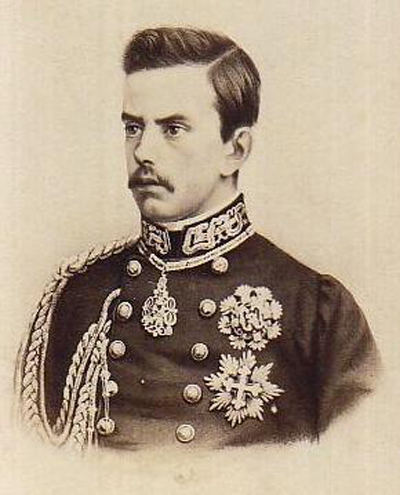 Young King Unberto |
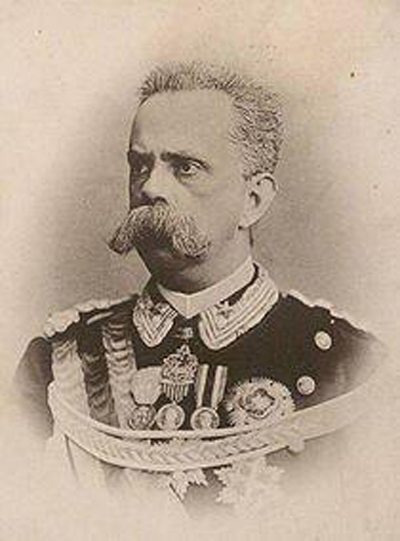 Aged King Umberto |
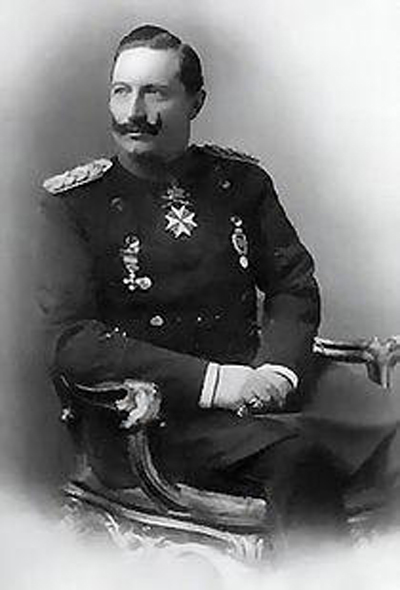 Wilhelm II |
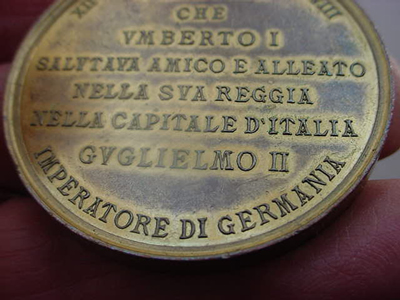
Beautiful Commemorative Medallion (Non-Portable Award) (Item WILHELM 9-12 & IFAS 4-11) |
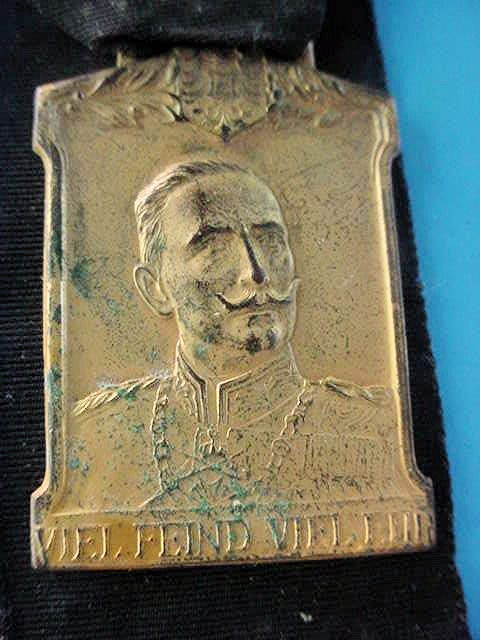
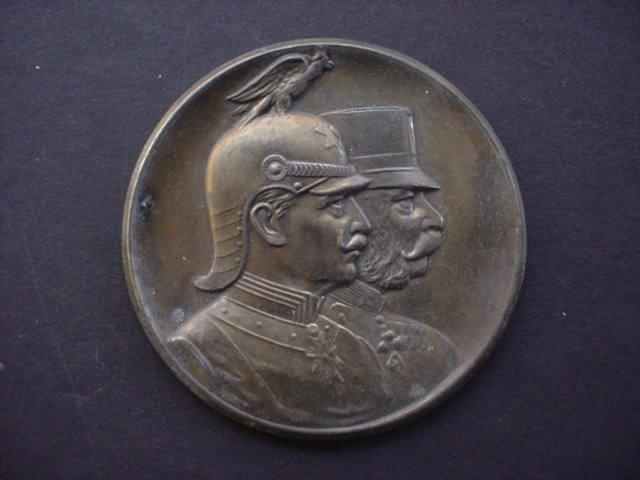
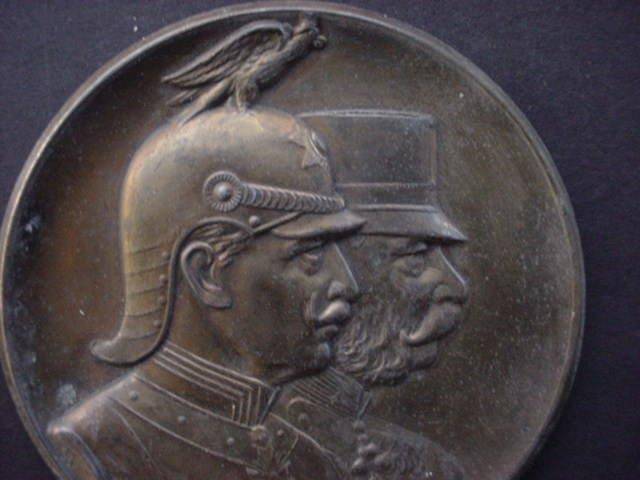
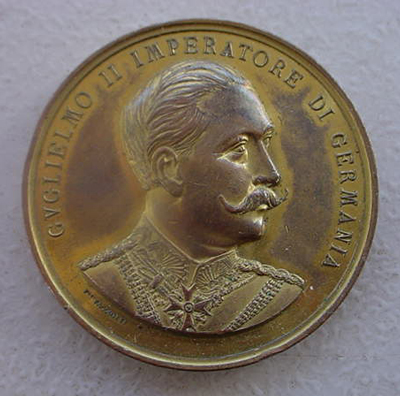
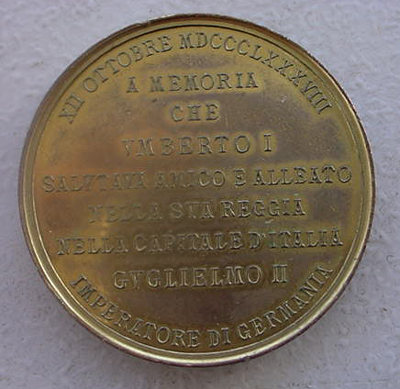
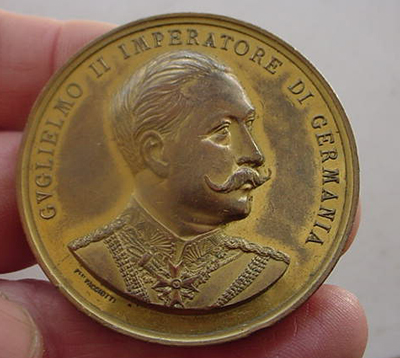
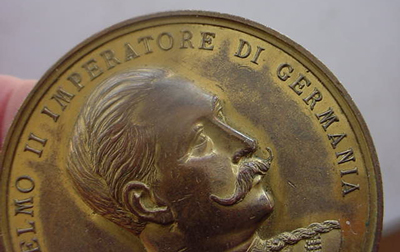
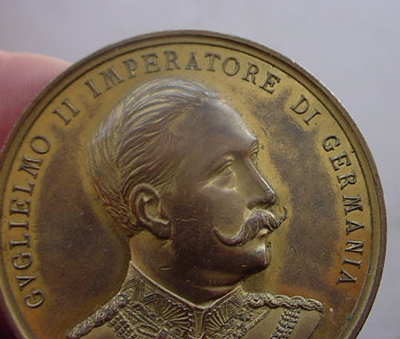
DESCRIPTION: This beautiful gilded bronze medallion was presented to Italian and German Diplomatic Officials to commemorate the Triple Alliance (May 20, 1882 ) of Italy with Germany and Austria-Hungary and in consolidating the pact. King Umberto 1 of Italy made repeated visits to Berlin and Vienna. There was a great friendship struck between the Italian King and the German Emperor, Kaiser Wilhelm II. King Umberto was predisposed toward authoritarian and Imperialist policies and this found him in disfavor with Anarchist, Communist and Zionist groups, eventually he was assassinated by silk weaver Gretano Bresci who was an anarchist criminal. Arrested and after serving less than a year of his life sentence he was found “very dead” in his cell under extremely suspicious circumstances. How strange! Now, as to the medallion, the obverse has a fine depiction of the German Kaiser although he looks just a little bit “Italian.” around the edges it says Guglielmo II Imperatore Di Germania (Wilhelm (Guglielmo) Emperor or of Germany; on the reverse is as best we can make out (12 Oct 1888) (MDCCCLXXX VIII) and it mentions in the words “A Momoriam from Umberto 1 to the great friend and ally from the capital of Italy to Wilhelm II Emperor of Germany”. The medallion measures 2 inches in diameter. It is signed by the artist on the obverse under the portrait. PRICE: $225.00 |
 |
 |
 |
 |
 |
 |
 |
 |
 |
 |
 |
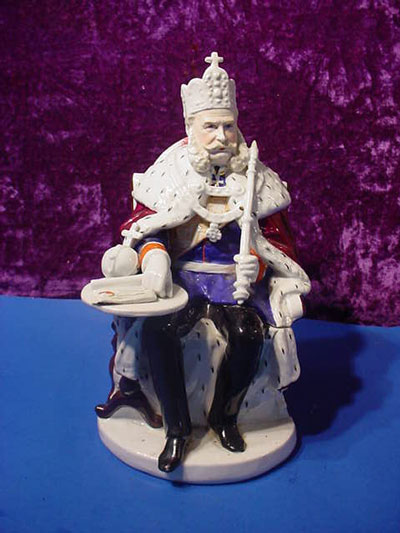
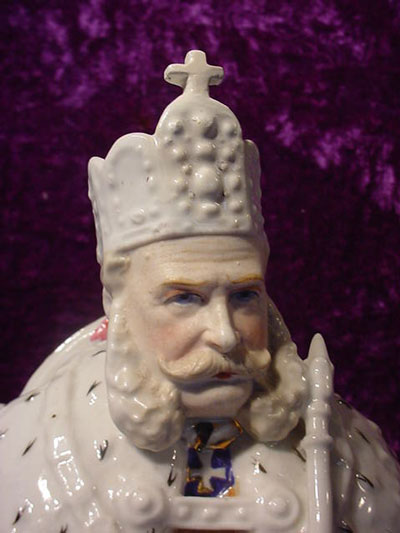
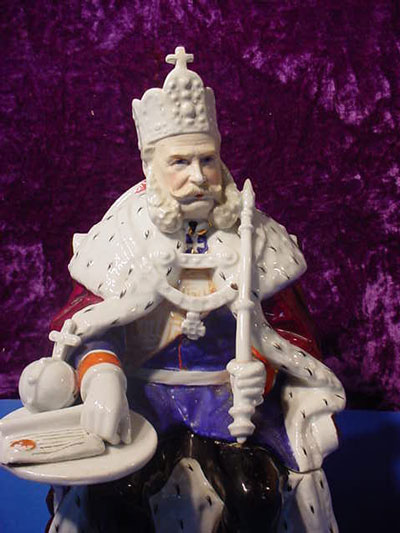
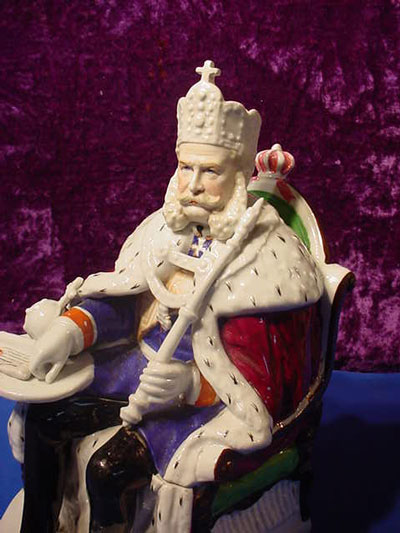
Kaiser Wilhelm I Tobacco Humidor (Grandfather of Kaiser Wilhelm II) (Item WILHELM 9-13 & KSPEC 1-2; Special Sales) |
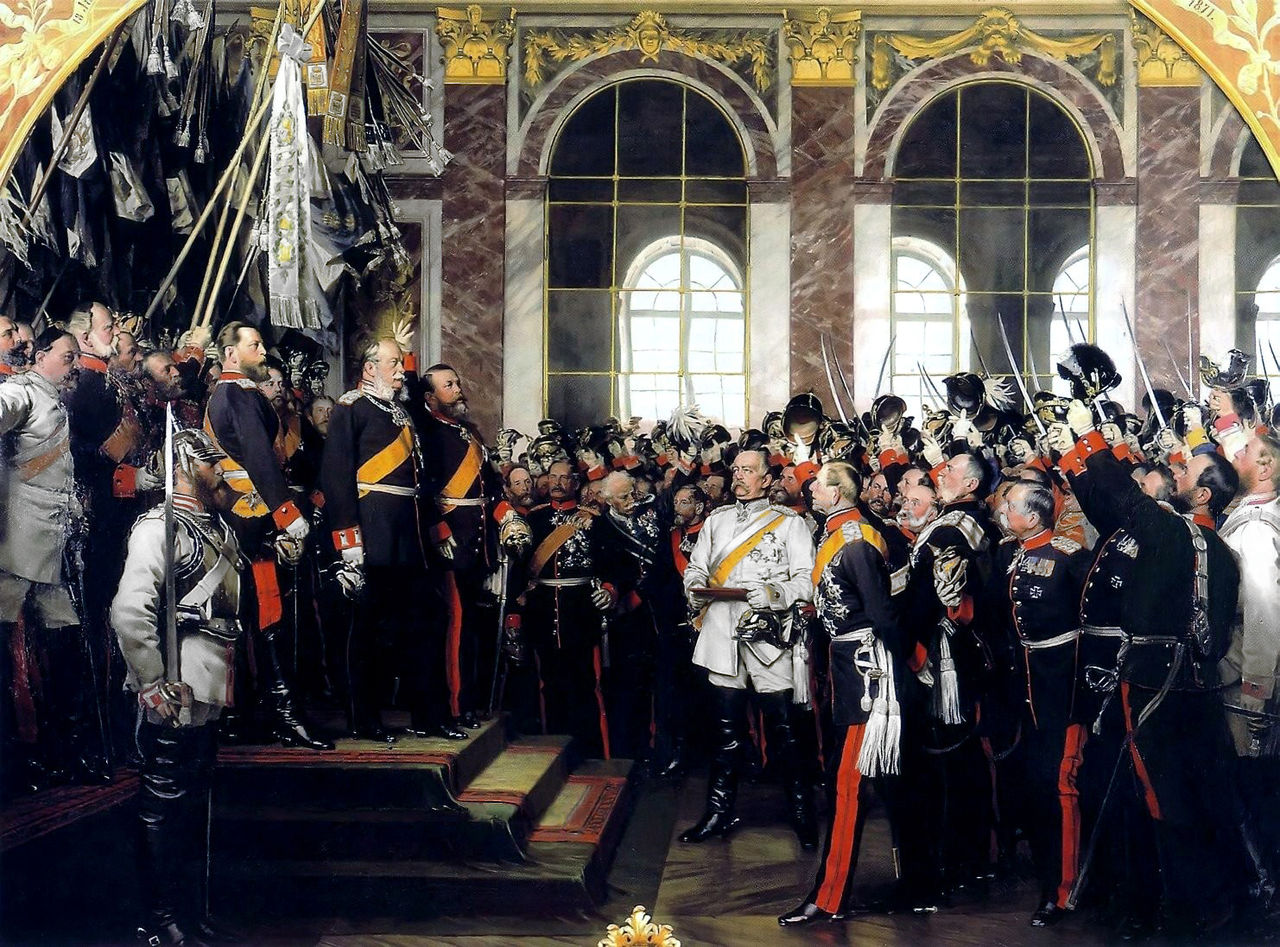
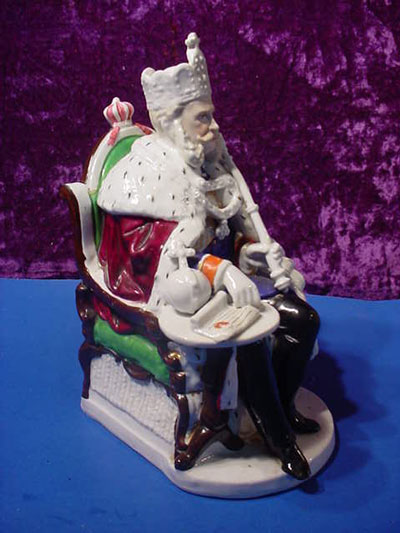
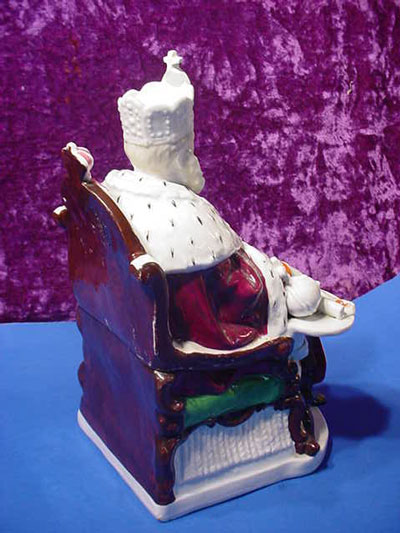
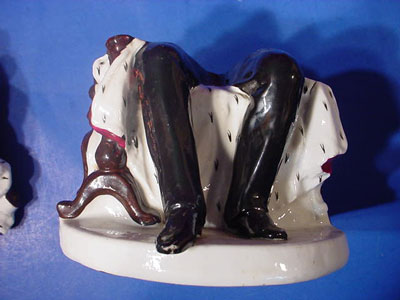
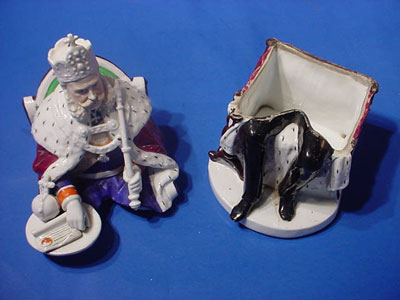
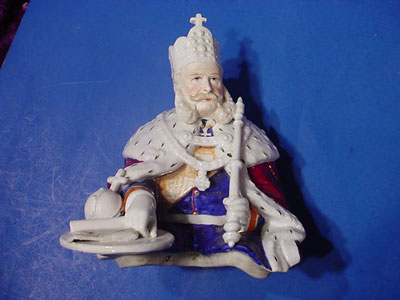
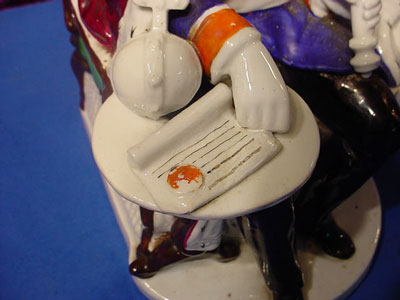
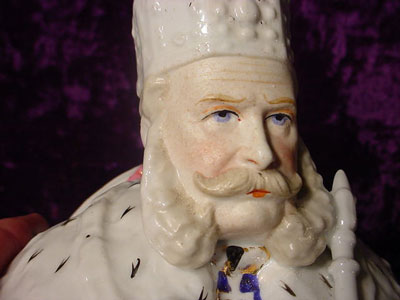
DESCRIPTION: This is a magnificent likeness of Kaiser Wilhelm I, King of Prussia and Emperor of Germany, often called the Warrior King by his loving public. It was he who reigned over the union of all the Germanic states into the united German Empire. He did this at Versailles along with Bismarck, the Iron Chancellor and all of his Marshalls in attendance. He was the greatest of European royalty and was a kindly and just monarch and certainly the greatest of the Hohenzollern royal line, He is shown while seated upon the Royal Prussian throne chair. He holds the royal scepter while the orb of Empire sits upon the table beside him. Also on the table is the royal edict of unity that joined all the states of the great German confederation. The royal Prussian crown of Charlemagne rests on his head and the medals of knightly service decorate his tunic. He wears the ermine decorated cloak of the dynasty. The face of the emperor is so life like that it is remarkable in the porcelain arts. The figure comes apart in the middle to expose the compartment for the storage of tobacco; there are no markings or company names on the piece. It stands about 16 inches high and is about 6 ½ inches wide at the base by 5 ½ inches. The condition is perfect for the most part (no breaks or repairs). There is a bit of tiny scratches in the paint -- almost not noticeable at all. This is a treasure from the Grossezeit (the Great Time) of Germany’s glory and majesty. PRICE: $1,200.00 Special Sale: Reduced to $989.00 |
 |
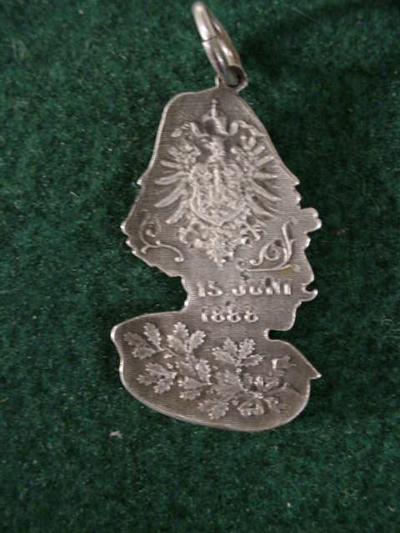 |
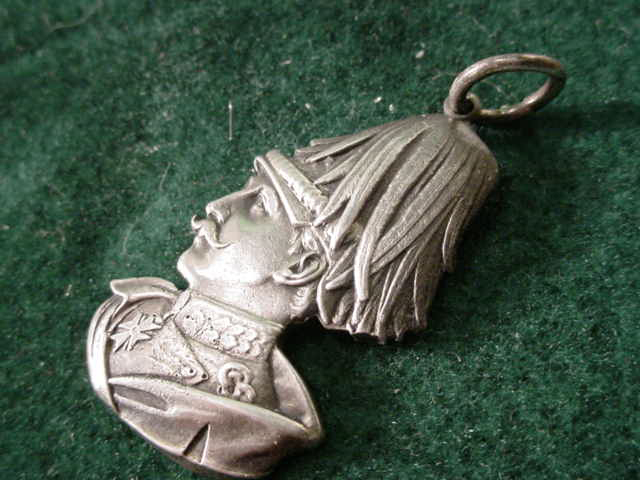 Shows jump ring |
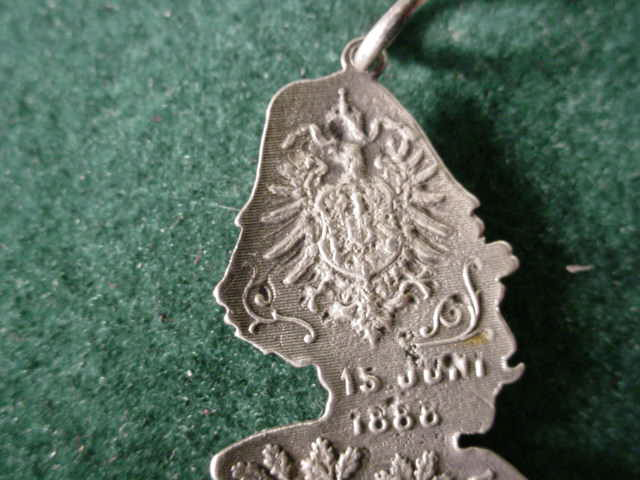 |
 |
 |
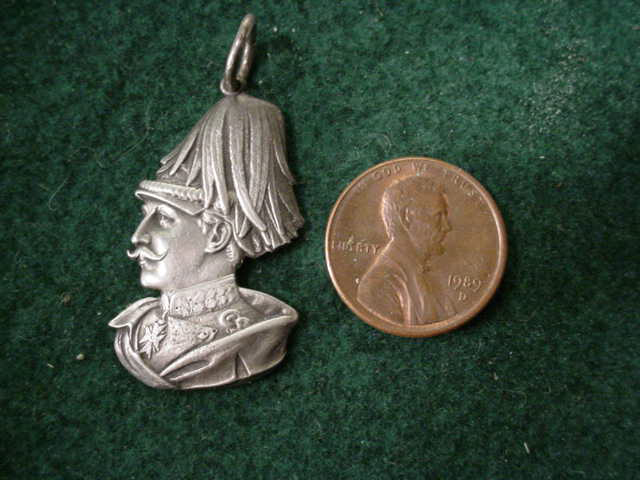 Size comparison |
Kaiser Wilhelm II Medallion (Item WILHELM 9-14 & KJEWELRY 2-30) |
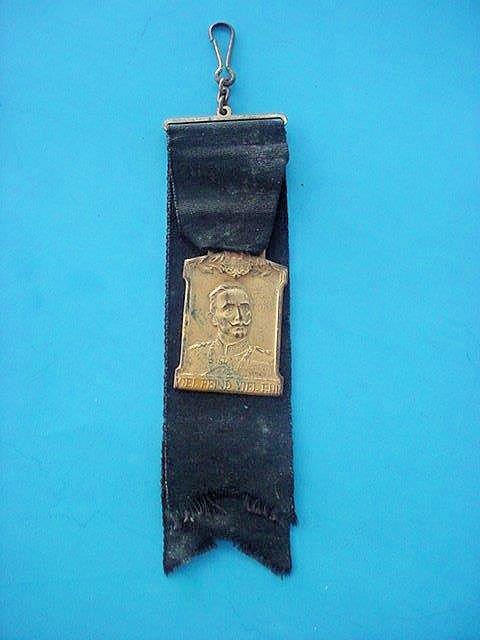
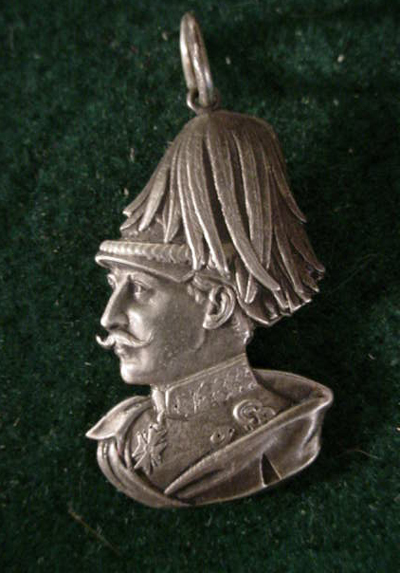
DESCRIPTION: A silver medallion commemorating the ascendancy of Kaiser Wilhelm II who was the last emperor of Germany, ruling the German empire and the kingdom of Prussia from 15 June 1888 to November 1918. He was the grandson of Queen Victoria of England and was related to many monarchs and princes of Europe. Crowned in 1888, he unfortunately launched Germany after his dismissal of Prince Otto von Bismarck on a rather bellicose new course in foreign affairs that accumulated in his support for Austria, Hungary in the crisis of July 1914 that led to World War One. He didn’t have much choice in that since Germanic Austria was the blood relation to the German Reich. The silver medallion here is of the type worn by ladies as a pendant and gentlemen might use it on a watch fob. It is struck in pure 800 silver and bears the astounding likeness of the young Kaiser dressed in the helmet and uniform of the Imperial Dragoons. Around his collar he wears the Grand Order of the Black Eagle of Prussia. On the back of the medallion you can see the Imperial Prussian eagle with the Hohenzollern family crest in the middle of the chest below this the date 15 June 1888 with a cluster of the sacred German oak leaves below. Kaiser Wilhelm had abdicated to Doorn, Holland but there was still strong patriotic feeling for him throughout the Reich by monarchists but even some of the National Socialists revered his memory. He was an endearing monarch and on the flip side a strict authoritarian (Both N.S. attitudes). The medallion is beautiful in its coin like sculpted detail and should stir the hearts of Germanophiles here and in the Fatherland as well. The war was unfortunate and the ‘Kaiserzeit’ in Germany was a Golden Time indeed. A time of progress in industry, architecture and the arts. Gone never to return. All we have of it are tokens such as this but we can dream, can’t we? PRICE: $550.00 a true Gem of the Past! |
| |||
|
Oil painting on Canvas from the Franco-Prussian-War Period (Item WILHELM 9-15; KPAINTING 1-19; Special Sales) |
|||
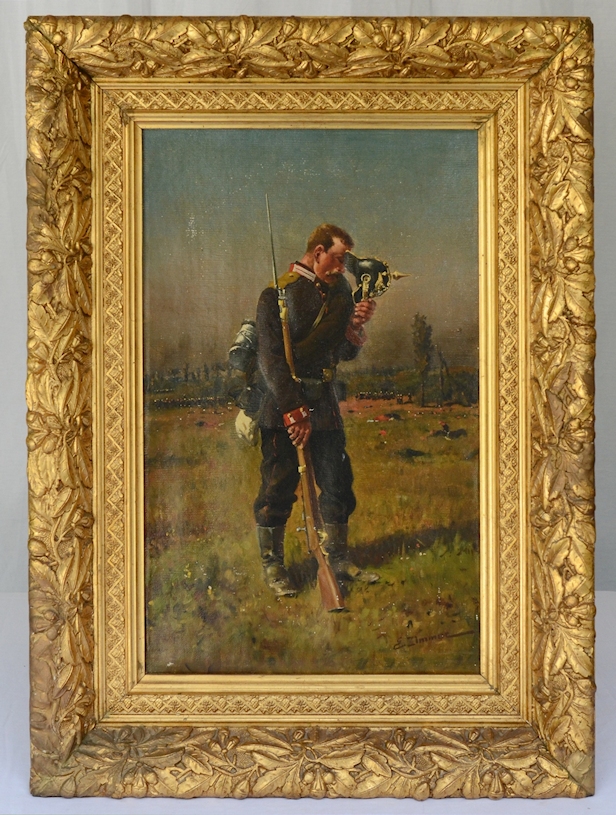
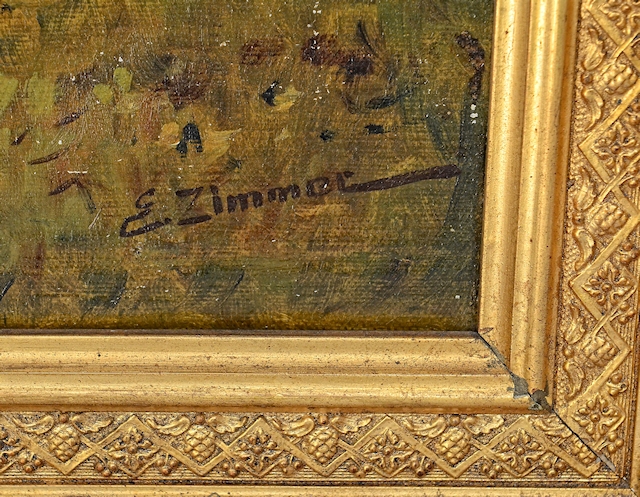
| DESCRIPTION: This is a very charming picture that depicts a Prussian soldier—probably an infantryman—as he is seen tipping his Pickelhaube (helmet) and bows his head in prayer. He stands in the forefront of impending battle and implores his God to care for him and his comrades, and procure victory for his Fatherland. The buckles of the Prussian army and later the entire German army proclaimed Gott mit uns (God with us) and God was certainly with them in this 1870-71 war with France. The combined German forces under the leadership of Prussia and Kaiser Wilhelm I utterly trounced the French forces of Napoleon II there, and because of the solidarity and cooperation of the other Germanic states, which joined Prussia in the fight, the way was paved for the great unity and brought forth for the first time the unified German nation; this was proclaimed at the Versailles Hall of Mirrors in 1871. This soldier personifies the deep religious feeling as experienced by the average German solider. This man is, however, an officer as evidenced by his uniform and helmet fittings. The presentation is certainly charming, compelling, and inspiring. Here is the brave Teutonic warrior speaking to his creator with an appeal on his own behalf and for heavenly protection for his soldier comrades that we can perceive in the background of the scene. The frame is a precious relic on its own and is as German as sauerkraut! It employs deep-relief oak leaves and acorns all around its framing; absolutely beautiful in its overall presentation. Inside the outer frame parameters is a beautiful Victorian-style motif that serves as an inner bezel. The frame measures 28 x 20 inches and is about 3 ½ inches wide including the bezel. The painting measures about 12 by 20 inches and is in really fine condition considering that it is probably over 142 years old. It is 100 percent original to the period, as is the frame. This is a real museum piece and it brings an important truism!: A fact from the past that gives a revisionist perspective that flies in the face of so much dubious propaganda (so-called facts) about the German war machine and the so-called German propensity for cruelty and antireligious leanings. In other words, so much Hogwash! Here is the typical God-fearing “Deutscher Soldat” in direct communication with his lord. “Gott mit uns."
PRICE: SOLD |

|
|
|
|
|
|
|
|
|

|
|
|
|
|
|
|


|
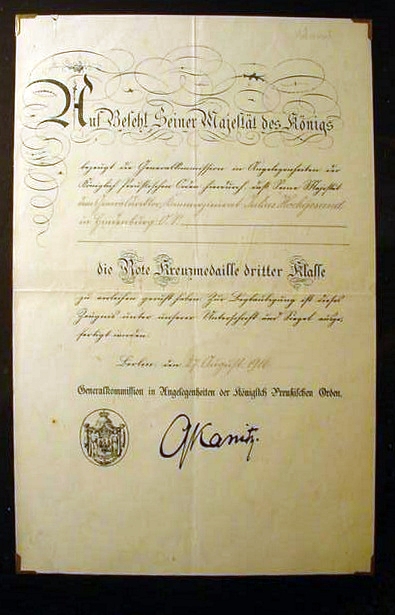
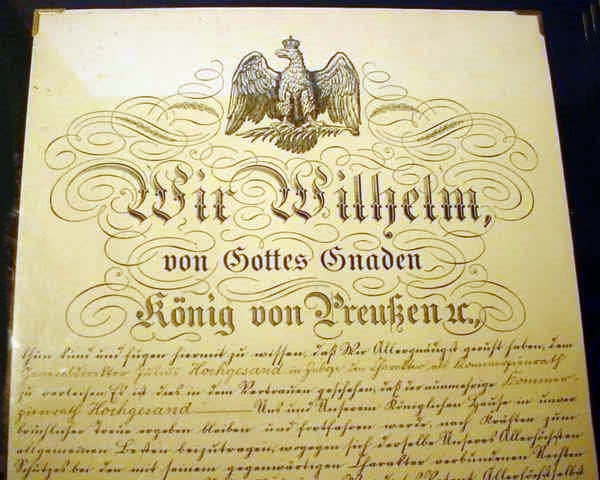
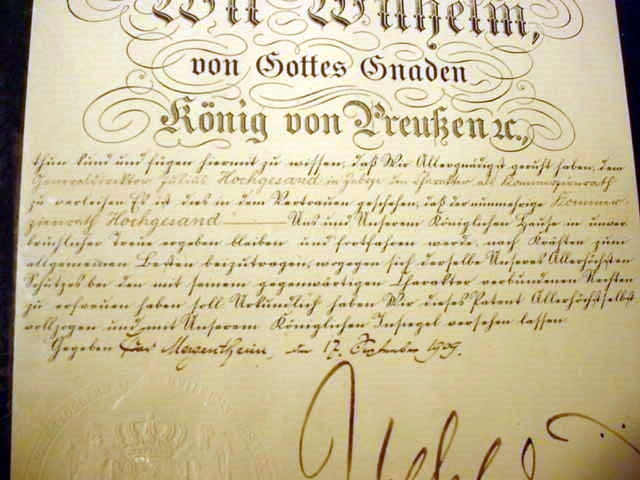
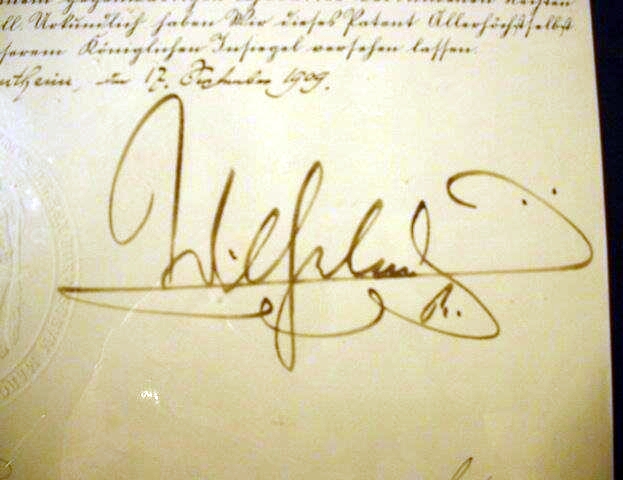
Hand-signed Document by Kaiser Wilhelm II (Item WILHELM 9-16) |
|
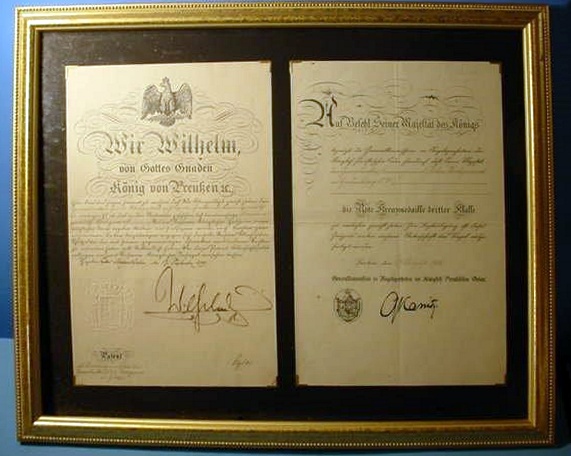
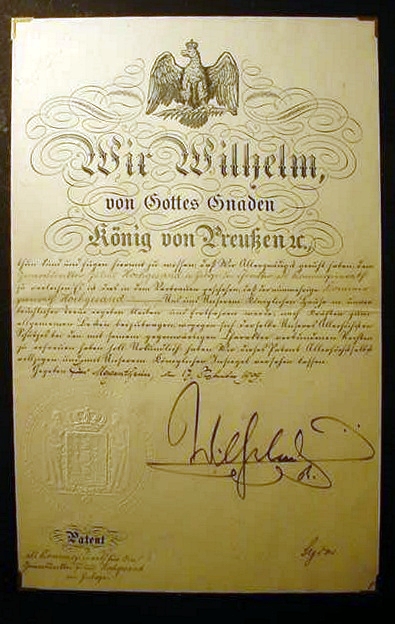
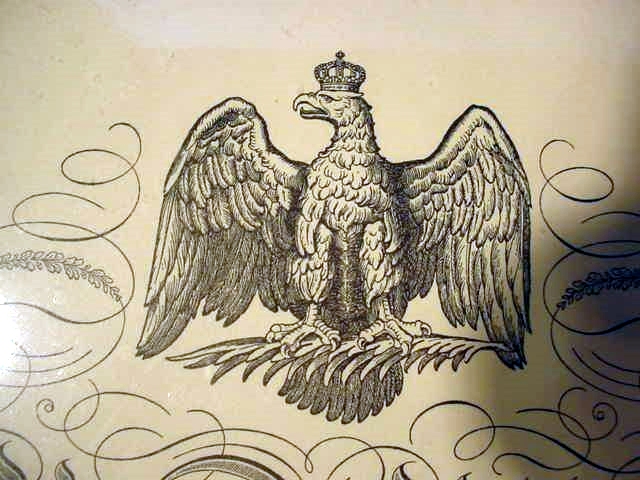
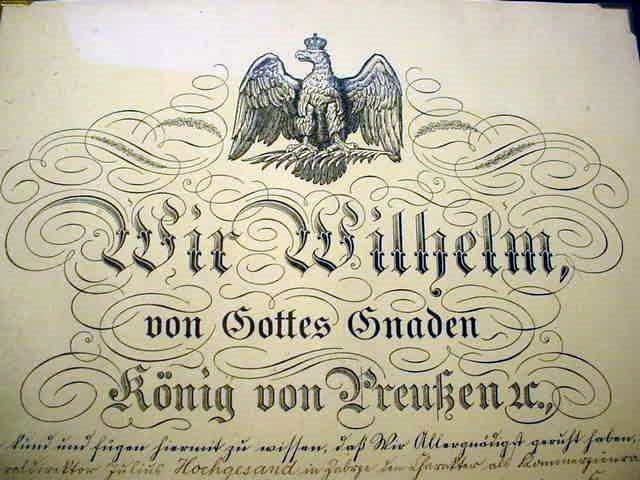
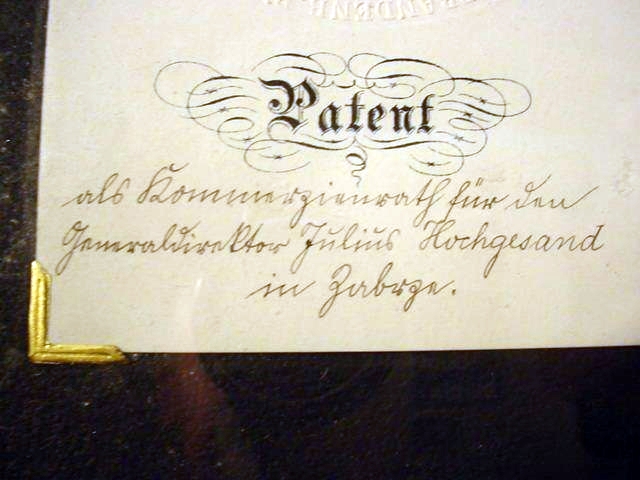
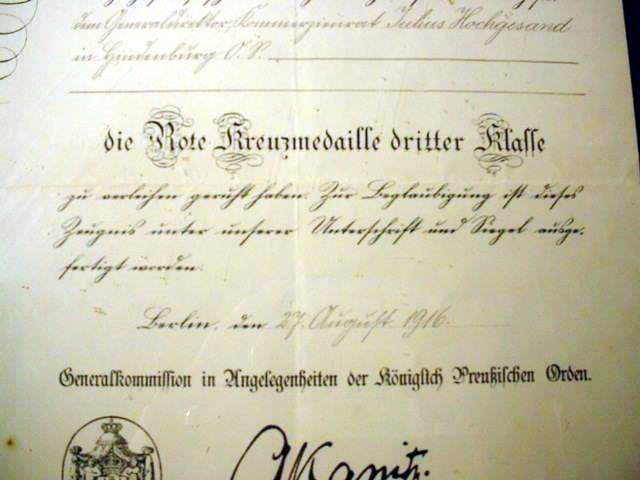
DESCRIPTION: This is a framed document in two parts hand signed by the Kaiser himself in his broad and bold handwriting. Many said in those times that the Kaiser’s signature on something as innocuous as a personal check was a ‘declaration of war’ but then, they said the same about his rakish moustache as well! This parchment paper order is the bestowal of the Red Cross Medal Third class, which at the time was considered an important award given to men and women who distinguished themselves in this necessary and admirable service to König und Vaterland. The title states as follows: “By order of his Majesty the King. We the official commission involved in the matter of Royal Prussian award bestowment certify that his Majesty has awarded to the General Director and Commerce Official Julius Hochgesand in Hindenburg OP The Red Cross Medal Third Class as confirmation to this award we do hereby certify this with our signature and seal-Berlin 27 August 1916. By the General Commission. (Signed by the Director).” The other document to the left in the frame is the actual Kaiser-signed official award and a patent of nobility conferred on Herr Hochgesand. Besides the official signature is the Royal Prussian embossed seal. The title of the document as seen at the top under the Prussian eagle says: “I Wilhelm by God’s Grace King of Prussia . . .” The documents are nicely framed in museum mountings (not glued). The frame measures 22 x 18 inches and the individual documents are measured at 8 ¼ x 13 inches. The documents are in pristine condition considering that they are about 100 years old. This set is very historically important and rare. PRICE: $1,200.00 |
 |
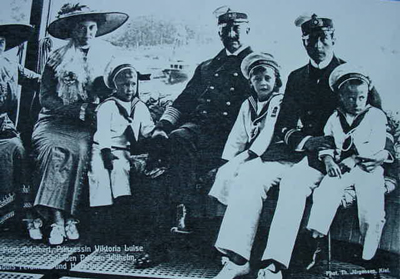
 Prince Adalbert with his mother and the Princess |
 |
 |
 |
 |
 |
 |
 |
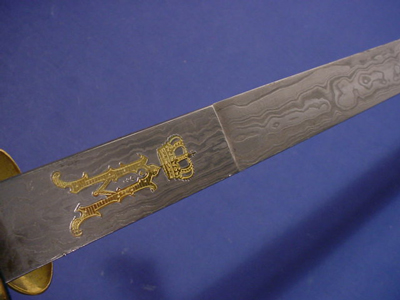
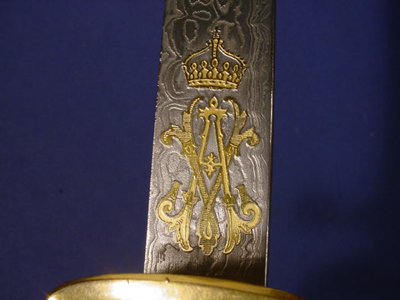 Auguste Victoria intials |
 A for Prince Adalbert |
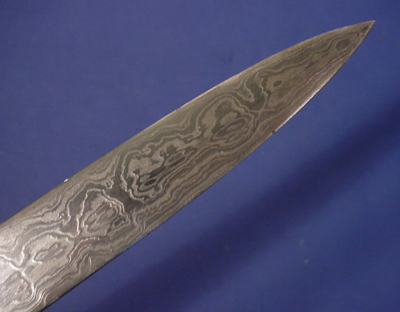
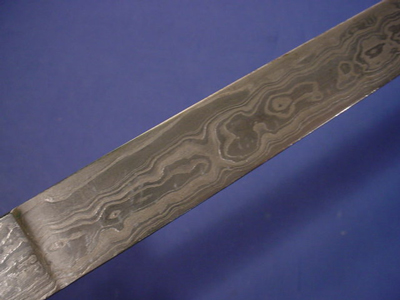 Finest of Damascus steel |
 |
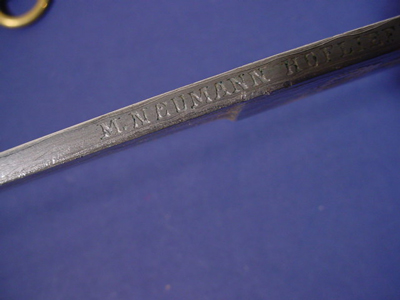 Neumann, the maker |
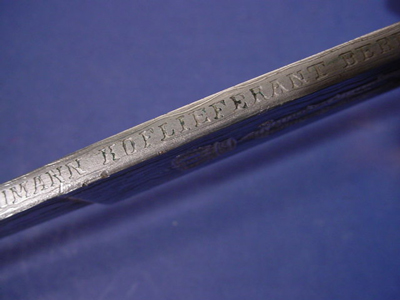 Maker to the palace |
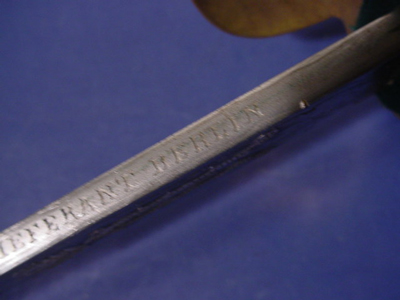 Berlin |
 |
 |
 |
 |
 |
 |
 |
 |
 |
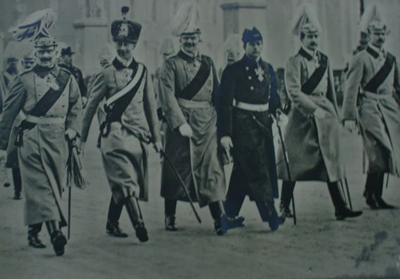 The Kaiser and his five sons |
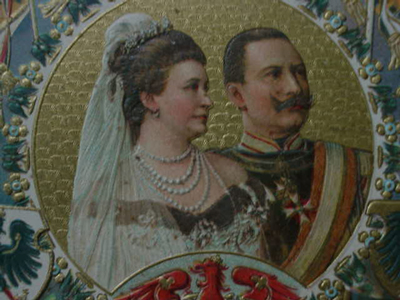 Kaiser & Kaiserin |
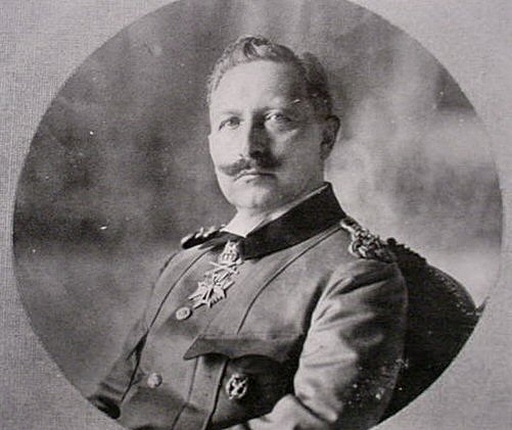
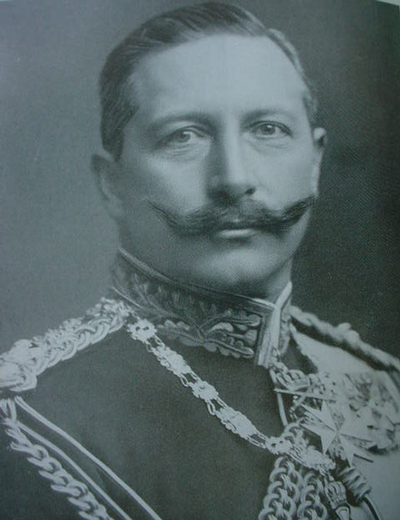 Kaiser Wilhelm II |
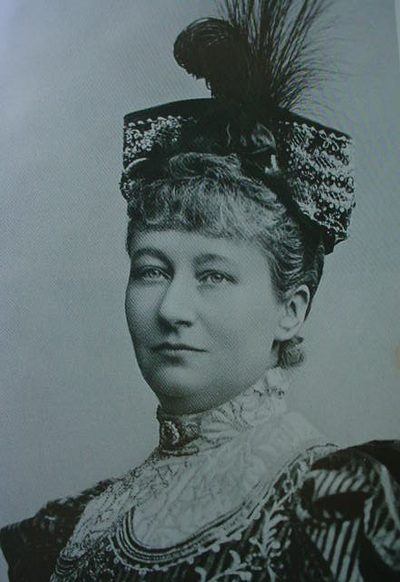 Kaiserin Auguste Victoria |
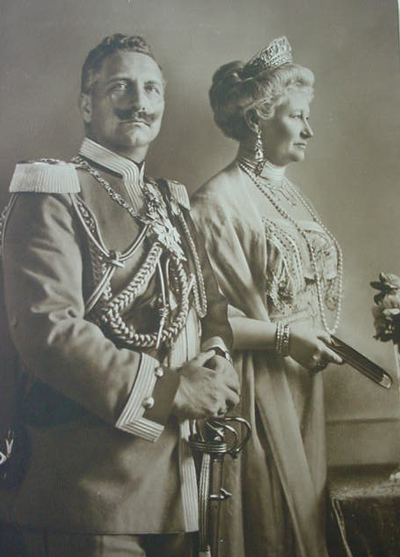 |
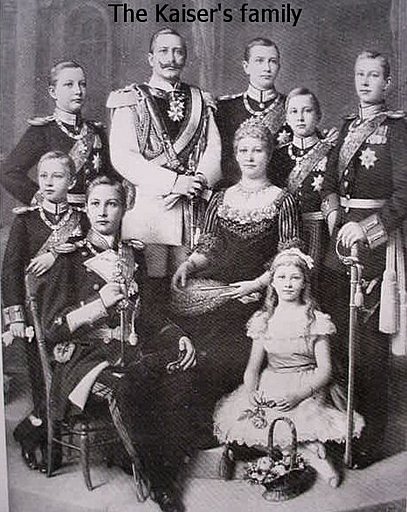
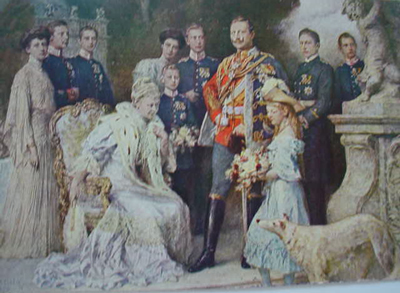 The Kaiser & family |
 Auguste Victoria 1912 |
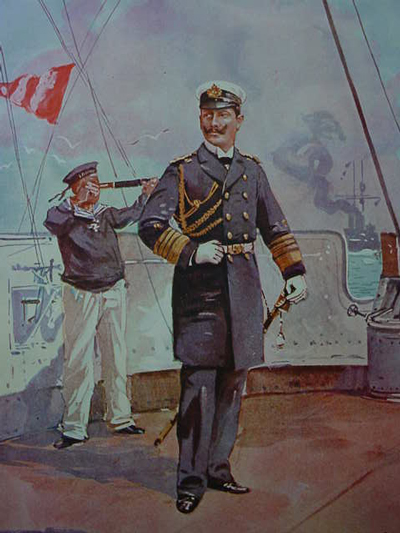 The Kaiser loved the sea |
 The Adalbert naval dagger |
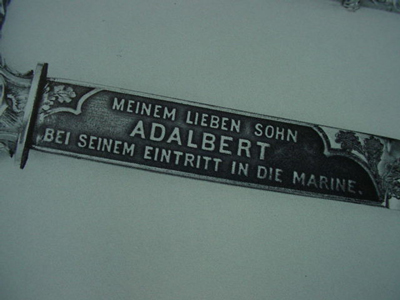 My dear son Adalbert on your entrance into the navy |
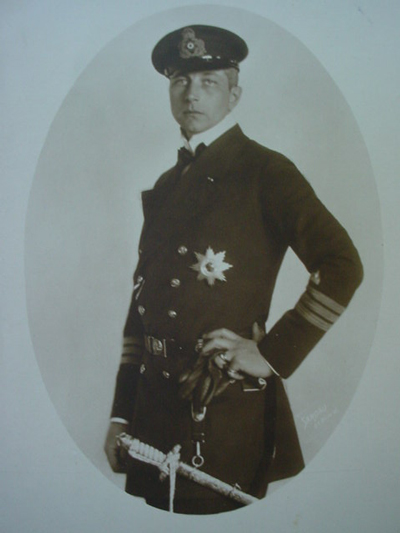 Adalbert wearing the dagger |
 |
 |
 |
 |
 His family |
 |
 |
 |
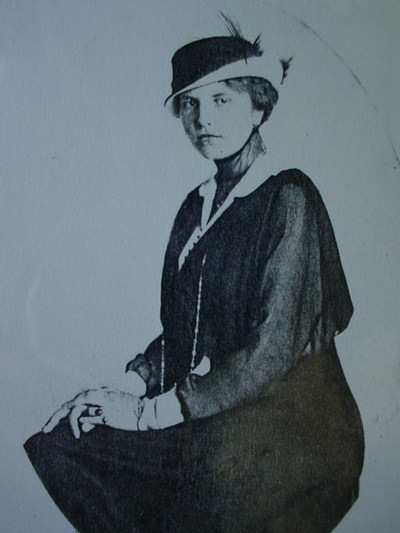 Princess Adelheid "Adi" |
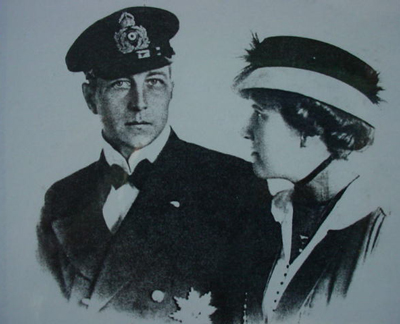 The royal pair |
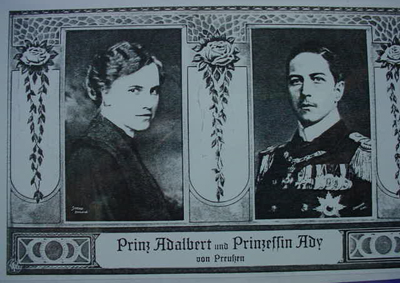 The wedding picture |
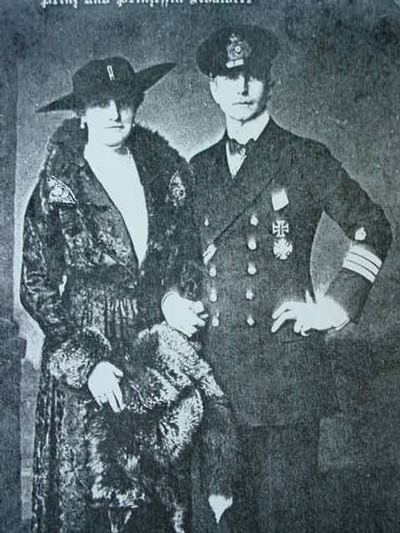 |
 |
 Adalbert, his four brothers & father |
 |
 |
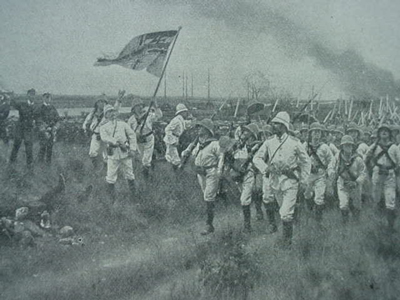
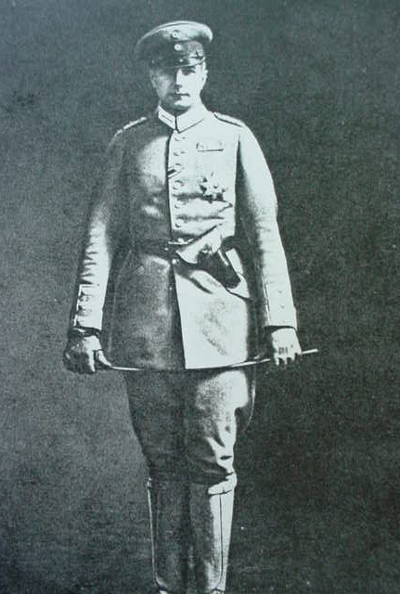 Prince Adalbert in marine landing force |
|
Special Falconry Dagger Presented to Prince Adalbert of Prussia by His Mother The Prussian Kaiserin Auguste Victoria (Item WILHELM 9-17; KWEP 5-1; ANTWEP 3-7) |
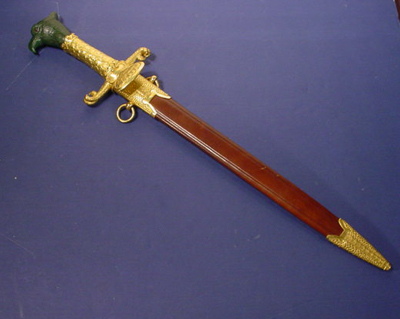
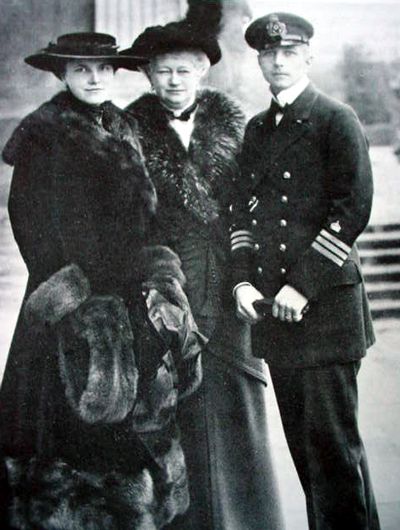
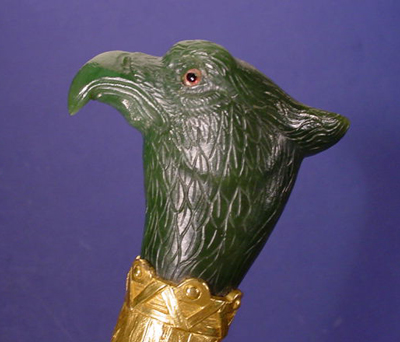
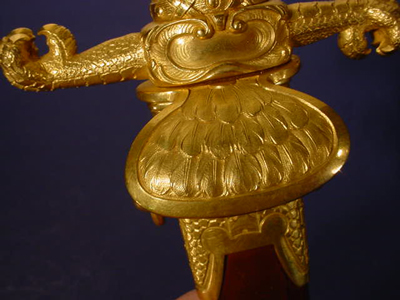
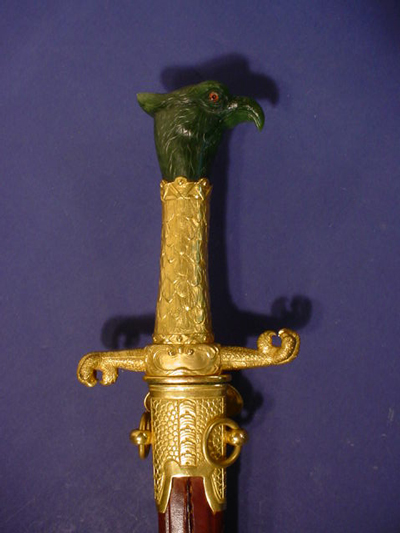
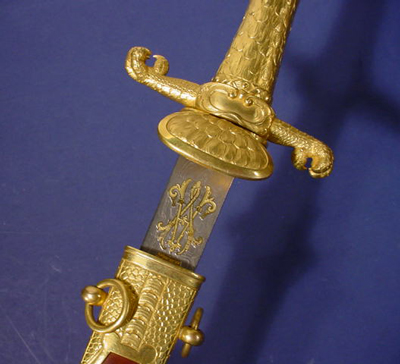
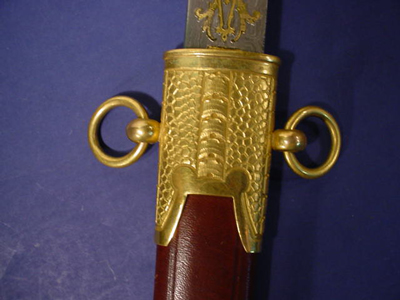
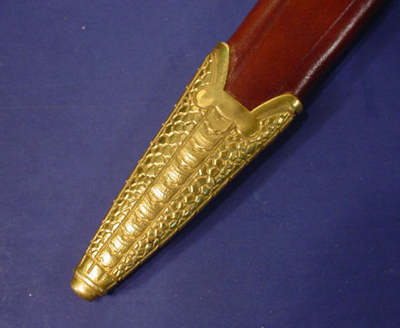
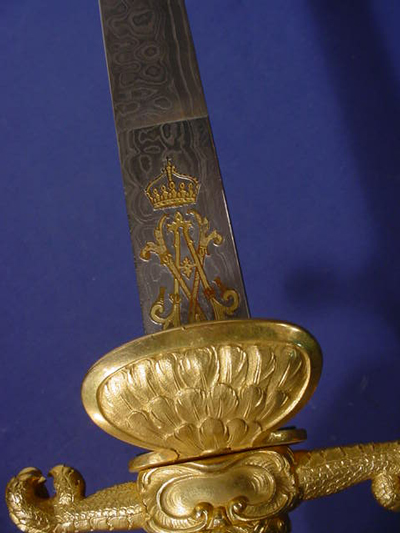
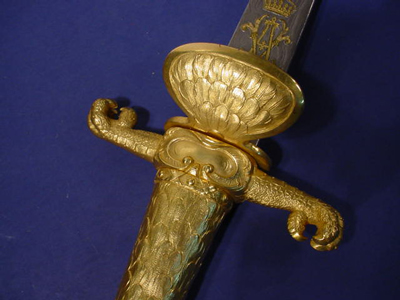
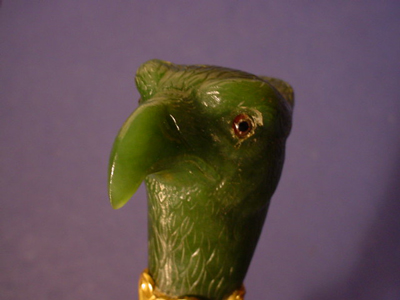
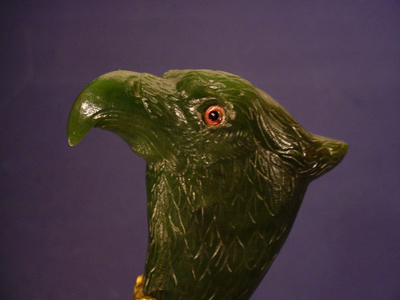
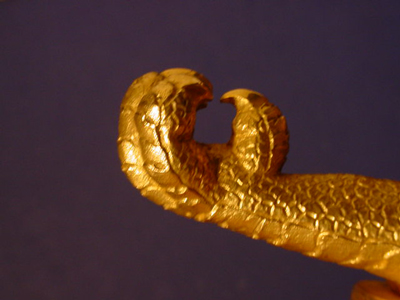
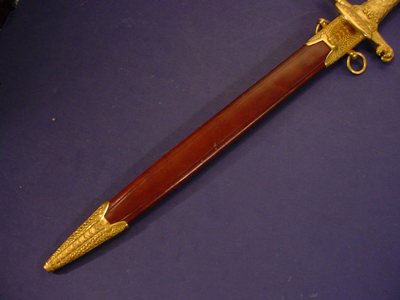
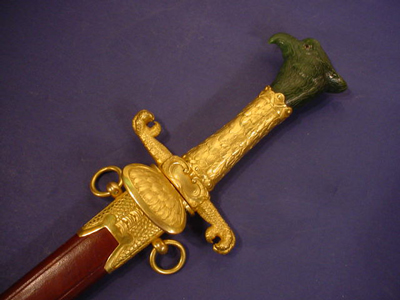
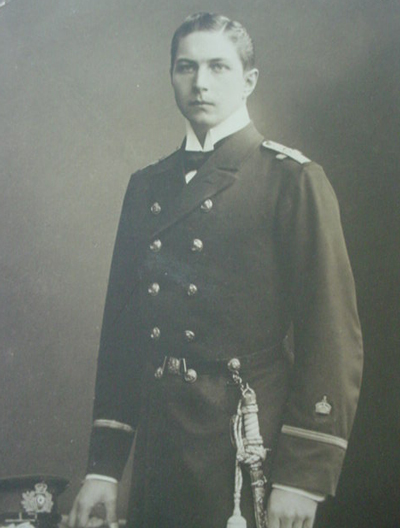
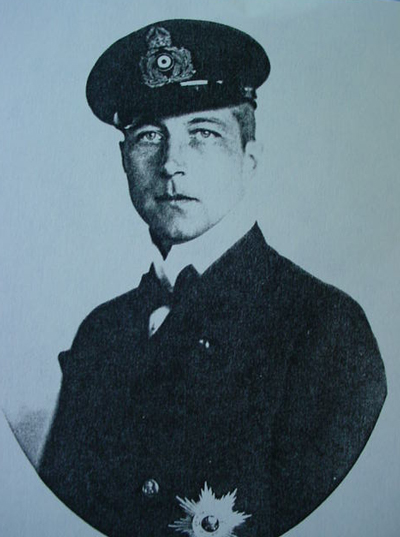
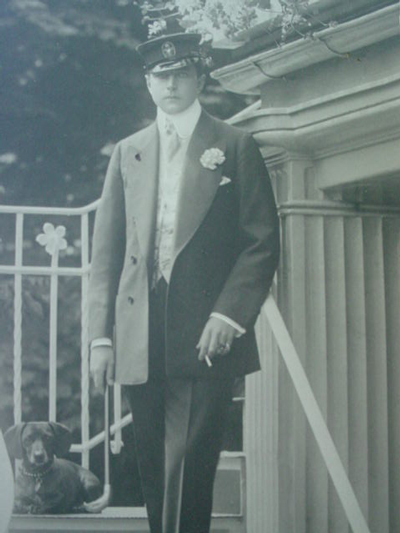
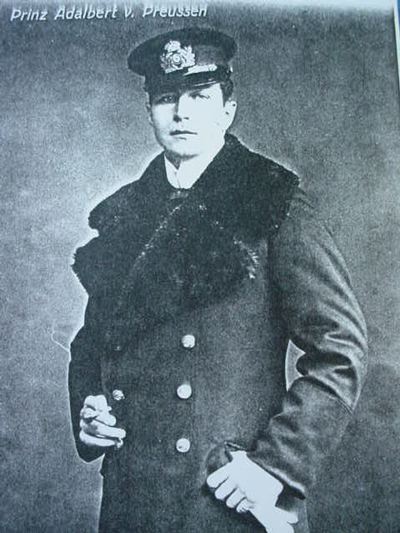
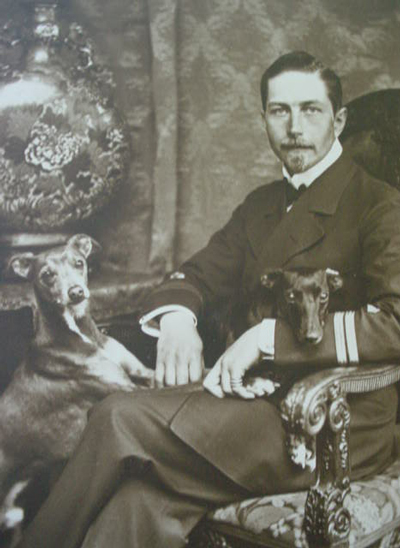
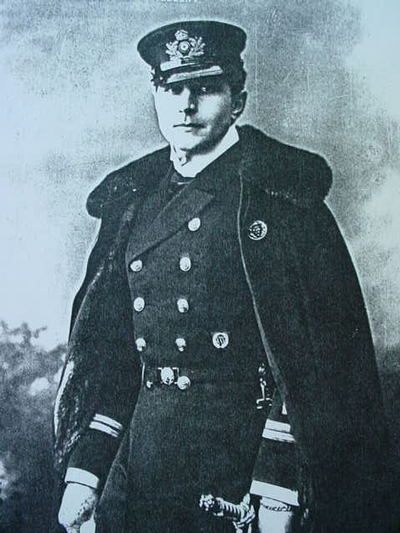
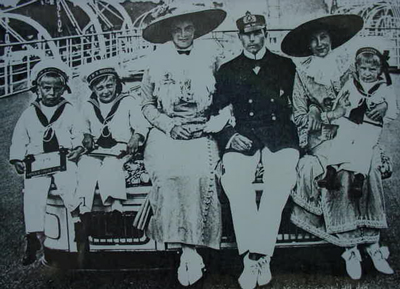
DESCRIPTION: Here is the ultimate in royal gifts when it comes to weapons -- this is the actual falconry dagger that was presented to Prince Adalbert of Prussia 1884-1948 by his mother, the wife of Kaiser Wilhelm II (Empress Auguste Victoria) of Schleswig Holstein 1858-1921. She gave birth to seven children by Kaiser Wilhelm II, German Emperor and King of Prussia: Crown Prince Wilhelm 1882-1951, Prince Eitel Fredrich 1883-1942, Prince Adalbert 1884-1948, Prince August Wilhelm 1887-1949, Prince Oskar 1888-1958, Prince Joachim 1890-1920, and Princess Viktoria Luise 1892-1980. The Kaiserin dearly loved all of her children and she absolutely hero worshipped her husband, but the child she seemed to favor most was Prince Adalbert and she was often seen with him at Royal occasions and rallies prior to the war years and during WWI as well. They were often seen together at major events and even at minor fund raisers, etc. She was a good mother and wife and she was extremely conscientious in carrying out the public relations, plus charitable and welfare work that of course was an expected part of Royal duties. She had great interest in German cultural pursuits and a definite engrossment and actually a vivid affection for the arts. There was a genuine and widespread sense of loss and mourning amongst ordinary Germans when she died. Her funeral was marked with much spontaneous public grieving as well as the more formal solemn rituals of the Imperial Prussian state. Prince Adalbert, the third eldest son of Wilhelm and Auguste Victoria was born in the Hohenzollern Palace at Potsdam on 22 September 1884 and died in Switzerland 22 April 1948. He married Princess Adelheid (Adi) of Saxe Meninigen (1891-1971) on the 3rd of August 1914 in Wilhelmshaven, Germany. The young Prince had a passion for the tales and swashbuckling sagas of the sea and of course we know he was named after the earlier Prince Adalbert (1811-1873) who through the Hohenzollern Hierarchy was his distant relative. This Prince Heinrich Wilhelm Adalbert was the commander in chief of the Prussian Navy, as well as a great naval theorist and admiral of great renown in the turbulent 1840's and 50's. He was instrumental in the revolutions of 1848 and in founding the first unified German fleet, the Reichsflotte. During the 1850's he did much to form and establish the Prussian Navy as an independent naval power. The dream of our young Prince Adalbert, Ferdinand, Berenger Viktor, “Hohenzollern” was to become a naval officer in the tradition of his illustrious ancestor and he was ever cognizant of the fact that the Kaiser, his father was extremely obsessed with the sea and naval affairs. In 1889 at the inauguration of a new seaport in Stettin on September 1898, the Kaiser stated these prophetic words: "Unser Zukunft Liegt auf dem Wasser." (Our future lies on the water!”) And three years later Prince Adalbert officially joined the Kaiserliche Imperial Marine. It was the greatest day of his life and he entered as an officer having earned his rank in the naval reserve. On this auspicious occasion his father, the exceedingly proud Kaiser, presented him with a magnificent (one of a kind) cased and heavy naval dagger and ‘What a dagger’!!! Unlike any other dagger of the Imperial Navy, this one was entirely constructed in silver (800), not brass as would be usual and it had a genuine ivory grip. The blade was made by the WKC Company - “Weyersberg und Kirschbaum” who were so proud of it that they featured it in their turn of the century catalog as a prime example of their mastery of the art in the production of swords and daggers. The fittings and scabbard were by the famed Berlin jeweler to the royal palace, Sy & Wagner. In very highly raised letters the legend on the blade said “Meinem Lieben Sohn Adalbert Bei Seinem Entritt In Die Marine." Even the scabbard is a work of art. In the mid-section of the scabbard is the letter (A) and above it the typical crown of the Prussian prince. Originally Prince Adalbert was presented to the German admiralty on 24 June 1894 at the tender age of 10 years old. On this occasion the Kaiser said of his son “This moment when Prince Adalbert becomes one of you is of the most eminent importance to the entire history of the Fatherland!” One can only imagine the effect such a statement must have had on the formation of such a young mind. Thomas Wittmann in his book Collecting the Edged Weapons of Imperial Germany Volume One is to be credited with some of this information. Wittmann also said of the Prince that when Adalbert was an unmarried officer he traveled extensively throughout the world on German war ships as well as on the Royal Yacht “Hohenzollern.” It is said that the Prince was rather a rake with the ladies in his seafaring days, but please understand this activity was absolutely not approved nor condoned by the Kaiser or the royal house of Hohenzollern! Later when his earlier passions cooled, he married Princess Adelaide and he became a Korvetten Kapitan and was the Commander of His majesty’s ship, the Dresden, at war’s end in 1918. At one point in his naval career, he led a German Naval Marine landing party in heavy hand-to-hand combat action, thus he won the Iron Cross. This was worn by him at all times after it was ceremoniously awarded personally by his father along with an impressive scattering of Royal orders that he received from many of the countries allied with Germany. We counted 20 to include of course the Prussian Black Eagle, Red Eagle, House Order of Hohenzollern and Order of the Prussian Crown. Besides these he received the highest decorations of Italy, Netherlands, Austria-Hungary, Portugal, Romania, Imperial Russia, Turkey, Zanzibar, etc. He was a genuine hero and probably the noblest son of the German Hohenzollern Dynasty. The Prince’s Falconry dagger: We have said previously that the Empress favored Prince Adalbert as the dearest of all her children. Not to say that she didn’t love each and every one of them individually but Adalbert possessed the distinct possibility that his ecstatic love of the sea and his great fervent ambition to be a naval officer that was always first and foremost in his young mind, somewhat advanced him in the great favor of his mother. The Kaiser rather favored the Crown Prince Wilhelm, his namesake and heir to the throne, but he lavished attention all over his young sailor son as well. The Prince yearned to gain this nautical dream of his so adamantly that both mother and father thought him to be the most ambitious and dedicated of all their sons. His impassioned aspiration was most genuine and this young lad was admired by all in the Imperial court who knew him. Thus when the Kaiser gave him the fantastic naval dagger, the Empress was so impressed having seen the great joy it brought to the prince she immediately decided she would also present him a dagger that would have appeal to him as a royal Hohenzolleren prince! When Adalbert was still a child it was toy ships, toy sailors, that were his favorite playthings and he had his personal pond on the Imperial palace grounds where he could sail his tiny ships. But his greatest prizes later as an adult were these daggers presented by his loving parents to celebrate his reaching his ever present dream. Adalbert was a noble seaman and a true gentleman. However, his one vice seems to have been his consistent seeking of rather amorous adventures in his various travels even though these were before his marriage. Eventually there were more amorous conquests; unfortunately for him the word got back to Papa. We are all unfortunately subject to human frailties! *Authors note! His father we know was a very strict religious Lutheran adherent and a very strict authoritarian and he insisted that his sons “tow the mark”! Discipline and order were implemented in them from an early age and he expected that this rigid discipline would continue to be observed throughout their entire lives. Adalbert, however, was the only sailor in the family and maybe the lust of those who “go down to the sea in ships” was acquired in his many cruises to foreign lands. He was handsome, rich, regal, and important and the girls flocked to him like the mermaids of the deep flocked to Poseidon! Unfortunately, this led to his downfall not so different than if he had been shipwrecked by the beckoned call of the beautiful siren known as the Lorelei of the Rhine! Today we look at this as rather risqué but forgivable, after all it was just a young man sewing his oats! But at the Royal Hohenzollern palace in Berlin, this turned out to be a scandal of gigantic proportion! When news of his more infamous intimate escapades got back to the Kaiser even while the war was raging, the Emperor was livid and Prince Adalbert was banished from the Palace. He never saw his father again, and the only one contact (a sad one) was when he came to Haus Doorn in Holland where the Kaiser who was exiled there in 1918 died June 4, 1941. The Prince arrived there and we are told he did not speak to his brothers and sister but simply went to the bed that the Kaiser died upon (then empty) and placed a single red rose upon the pillow with a note that said: “Gott Segnen Meinen Vater Das Kaiser- Sein Sohn Adalbert.”(“God bless my father the Kaiser - His son Adalbert”). After this he turned and immediately left and did not visit the Bier of his father. Before this he actually sold his entire estate, his house, his other possessions, his medals, his naval uniform, and obviously this included the two beloved daggers and several swords. He then moved to Switzerland where he lived in seclusion for many years. The Prince died in the Swiss Canton of La Tour de Peilz on 22 September 1948. His wife, Adi, lived until 1971 and while she had always hoped a spirit of forgiveness would be forthcoming from the German Emperor during her husband’s lifetime but it was simply not to be. How the daggers finally came to the U.S. is still a mystery to us. The naval dagger has a fascinating post-war history to it but the fascinating story is just too lengthy for us to unravel here, but it involved the grandson of Prince Adalbert who unfortunately is not particularly a credit to the family name. It involves one of our chief historical advisors in an intriguing adventure 25 years ago who by the way was one of the last custodians of both daggers. It is a story of international intrigue, attempted fraud on the part of “sub-royalty” and rather high adventure that must be reveled someday. We have the highest respect and regard for the memory of Prince Adalbert and his Hohenzollern family but in my estimation he was not really the black sheep of the dynasty -- it was much later that a said to be royal personage entered the picture who still carries the family name (a fascinating story that will be tabled for now!). The Royal Falconry Dagger of Prince Adelbert: It should first be noted that the dagger has a pommel that has the carved head of a hunting falcon that is fashioned in genuine green jade. Now as we have noted that our Prince Adalbert was named after the great Prince Adalbert who was the Supreme Commander of the Prussian Navy in the 1850’s and the young son of the Kaiser attempted to emulate this eminent naval hero in every way he could. In 20 July 1853 the naval commander Prince Heinrich Adelbert worked diligently to bring about a superior German navy and he arranged for the hand-over of 340 hectares of Oldenburg territory at what is now Wilhelmshaven to the Kingdom of Prussia. This is in the eastern shore of the “Jade” estuary east of Bremerhaven; it was considered the best natural deep water port in the German North Sea coast and a good place for the naval base Prussia wished to build. The “jade bay” area offered deep water, a good base and anchorage and no ice in the winter. Oldenburg welcomed the idea of Prussia as a powerful ally. This was a major event that went far in securing practically the entire North Sea coast for German shipping and harbors for war ships. It was an event celebrated by the Prussian people as a major event in their history. We do not know how the estuary received this name but the spelling of jade is the same in English as it is in German and it refers to a metamorphic rock that is found mostly in the Orient and is considered a sacred stone in China. It is a gemstone of unique symbolic energy and also unique in the myths that surround it. With its beauty and wide ranging expressiveness, jade has held a special attraction for mankind for thousands of years. The other place where fine jade was found and revered was in the South American Amazon region with the Pre-Columbian people of the Mesoamerica regions and especially among the Mayan people , the “Ya’ax” chick or Jade meant life, fertility and power; it was considered greater and more valuable than gold. Could the fact that the royal mother chose to have the pommel decorated with jade have any connection with the first Prince Adalbert's accomplishments in securing this exceedingly important acquisition for Germany? Did the name of the Jade estuary influence her artistic and historical thinking and final decision in design? Always remember that “tradition” has been ever sacrosanct in the hearts of Imperial German rulers. Now, like his namesake, the young Price Adalbert was a world traveler vising many countries. One of the most noteworthy voyages made by the earlier Prince Adalbert was his expedition up the Amazon River and the Xingu in 1849. It is said that when he returned from this intriguing journey he brought many souvenirs and important relics home with him to include some examples of Brazilian jade carved by the ancient Mayas. Also, he brought some perfect examples of uncut jade. It does not take much speculation or extrapolation to figure out who might have acquired some of these treasures. His most ardent admirer, the young son of the Kaiser, Prince Adelbert was elated to finally receive these gifts that had belonged to his illustrious relative. It is also not difficult to imagine that the Prince bequeathed a spectacular piece of this jade down through the family and that it very well could have eventually became the property of Kaiser Wilhelm II and the Empress Auguste Victoria who no doubt turned it over to an extremely talented carver who fashioned the Falcon's head to be the crowning finial to the fantastic dagger. Yes, this theory is extrapolation from several sources but we believe it is logical for we know that in our cumulative historical knowledge amassed over periods of many long years in pursuit of such items and learning about them we can say that we know of absolutely no instance other than this one where jade was utilized in the construction of a German edged weapon. This piece is unambiguously and consummately unique and unprecedented in the history of edged weaponry. It emblematizes Royalty like no other edged weapon that we have ever heard of. It actually seems to emit power, majesty, Imperial dynamism and seeming omnipotence. To hold it in one’s hand brings about in the mind of true Germanophiles an extrasensory perception, a distinct feeling and sensation born of passion for the aesthetically beautiful and the profoundly important. But what would George Bush or Al Frankin get out of holding it? (Answer- Nothing!) The dagger with the Falcon's head pommel has glass eyes and a very pronounced beak and has gorgeous carved feathering throughout. The gilt bronze feathered grip works down to the cross guard that has the claws open to clutch the prey! The very pronounced clam shell also has fine simulated feathering. The blade measures 13-1/16" in length with the monogram set in gold that depicts the Crown of the Kaiserin and that is centered over the cyphers (AV) Auguste Victoria and on the reverse side is the (A) for Adalbert under a typical Prussian Princes crown also set in gold lettering. The spine is marked M. Neumann Hoflieferant-Berlin. The word Hoflieferant means that Herr Neumann was a maker to the royal palace or Hof. The scabbard is in high quality brown leather with a gold bronze two ring throat with an engraved mosaic like pattern and matching boot (or tip). The entire dagger is in excellent plus condition including the fabulous Damascus blade that is an example of the ultimate in German Damascus mastery. The dagger was certainly a regal gift by an adoring Mother but what of its general usage? Falconry was practiced and enjoyed by the European nobility for centuries but especially and notably in Germany. We know that Prince Adalbert was an aficionado extraordinaire in this the sport of kings. When he was not sailing he was the ultimate falconer! The dagger certainly does take on the outward appearance of a medieval falconer’s weapon as seen in museums in Europe. This without a doubt would have been the ultimate gift to this young practitioner of falconry. Certainly the dagger had no actual utilitarian use but was proudly worn as a resplendent part of the outfit that was donned when the Prussian Prince would be indulging in this his favorite pastime. So in closing this narrative, the longest description we have ever given on any dagger or sword, we can only say we are practically euphoric to be privileged to handle this awesome and priceless relic of the history of the age of great opulence, refinement, pomp, glory and high adventure! However we now have to sadly say that the days of the proud and glorious Hohenzollern regime are now past tense never to return! If any priceless relic would unequivocally summon up memories of that eloquent era of Teutonic Imperial glory and splendor it would have to be this dagger since we don’t have the Royal Prussian Hohenzollern crown to offer. When I view this magnificent relic, I am reminded of the wonderful book by author Margaret Mitchell about the fall of the noble Antebellum South and the subsequent film that evolved. The quote was: “Look for it only in books for it is no more than a dream remembered. A civilization GONE WITH THE WIND”! PRICE: SOLD |
|
|
|
|
|
|


|
|
|

|
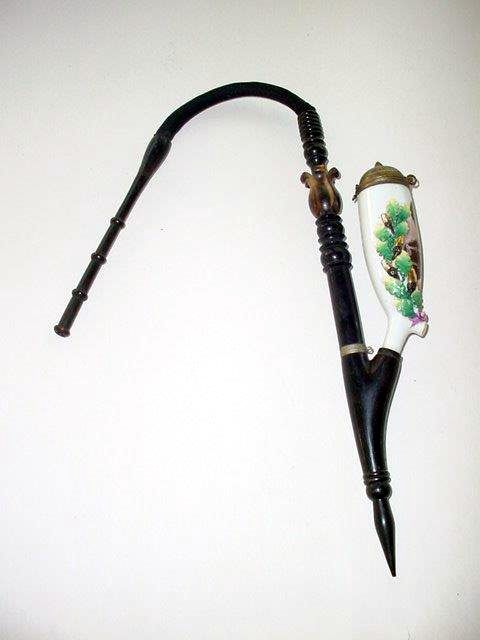
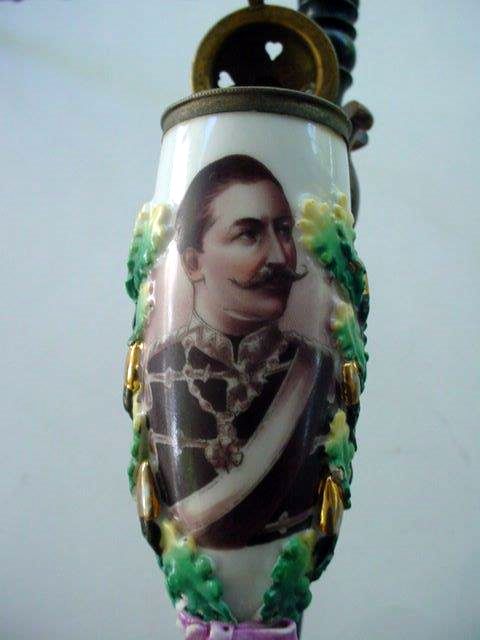
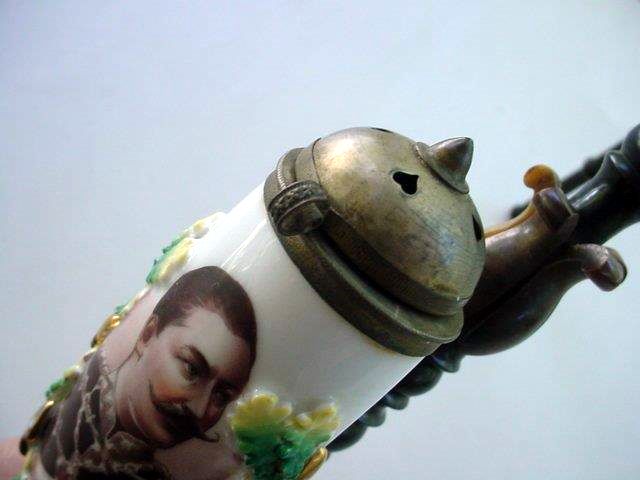
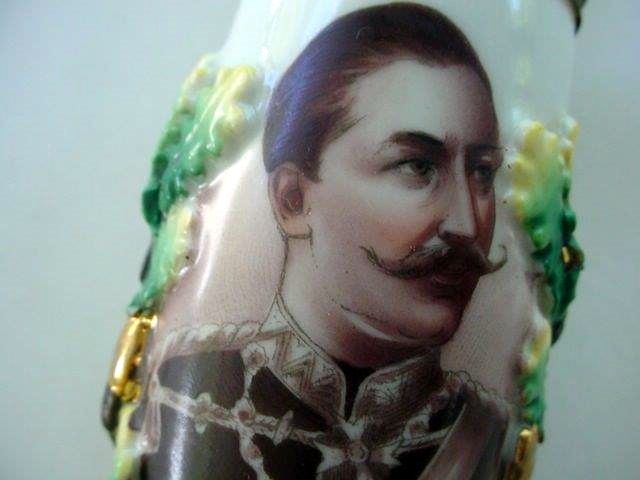
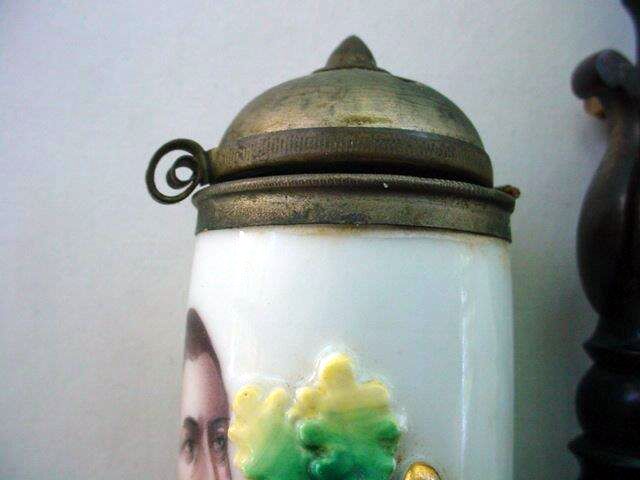
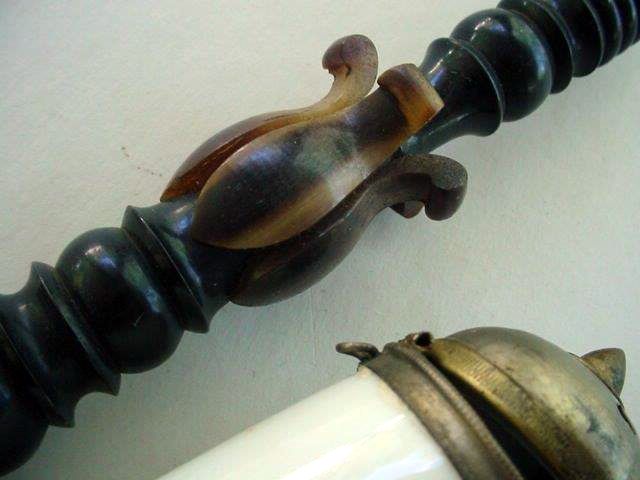
Beautiful German WWI Period Smoking Pipe (Item WILHELM 9-19; KMISC 2-5; KGLASS 3-18) |
|
DESCRIPTION: Here is a smaller version of the gigantically long commemorative pipes that were purchased in the 1870s to the beginning of WWI by graduating students from regimental academies and such. They are invariably beautiful and were costly, even in their day. The new officer candidates were very proud of these beautiful memory objects from their service time. This one is particularly spiffy in that is has the depiction of Kaiser Wilhelm II as its central theme on the pipe bowl surrounded by raised oak leaves and acorns tied together by a bow at the bottom. The cap on the bowl is reminiscent of a stylized German spike helmet. The stem is of hand-carved bone or horn (elaborately carved). The tip of the stem is of a material that freely bends mounted over a spring that is quite flexible. When laid out straight the whole piece measures 2 feet long. The pipe bowl itself is about 5 inches tall and about 2 inches wide. This is really a gorgeous item and reminds one of the glories of the Hohenzollern Reich at its peak.
PRICE: $285.00; a very modest price |
|
||||||||||||||||||||
|
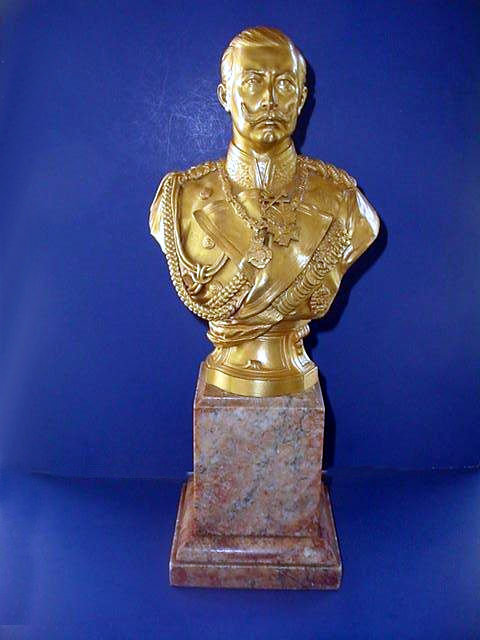
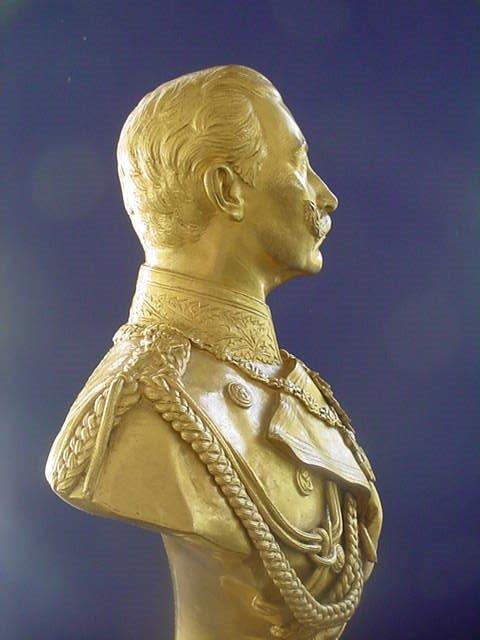
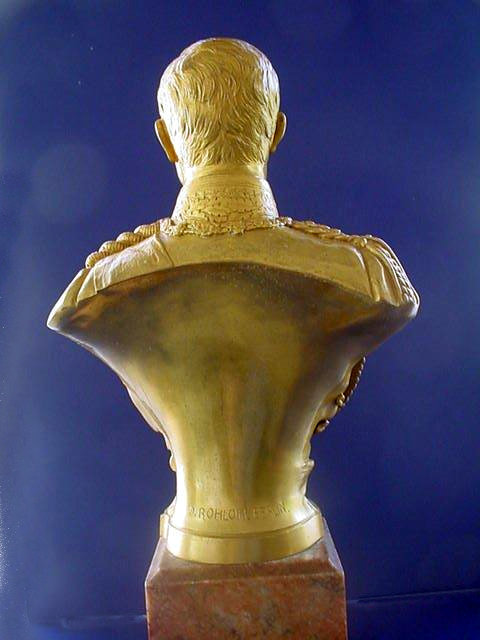
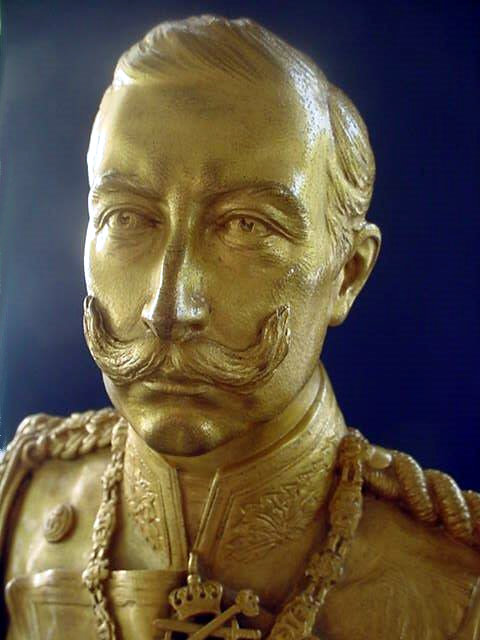
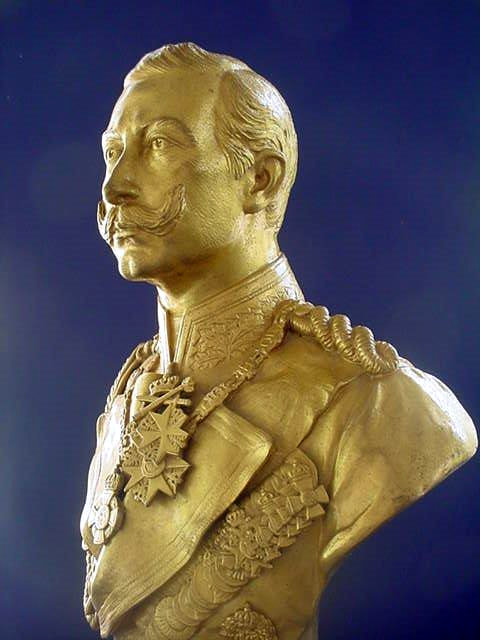
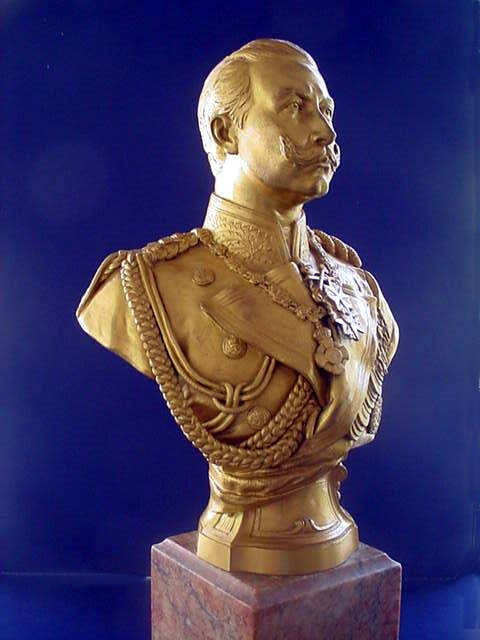
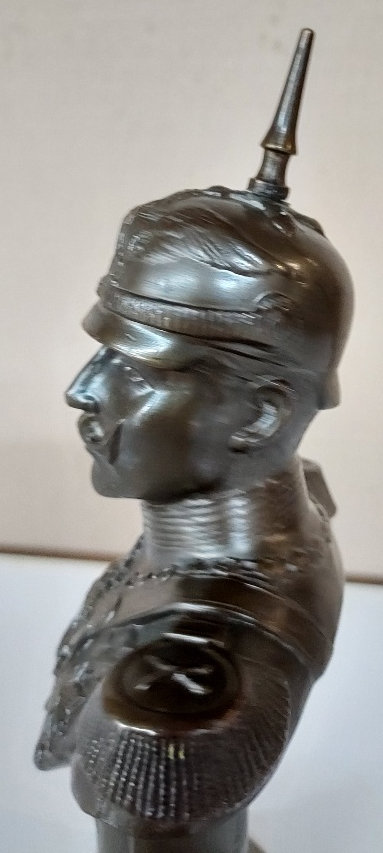
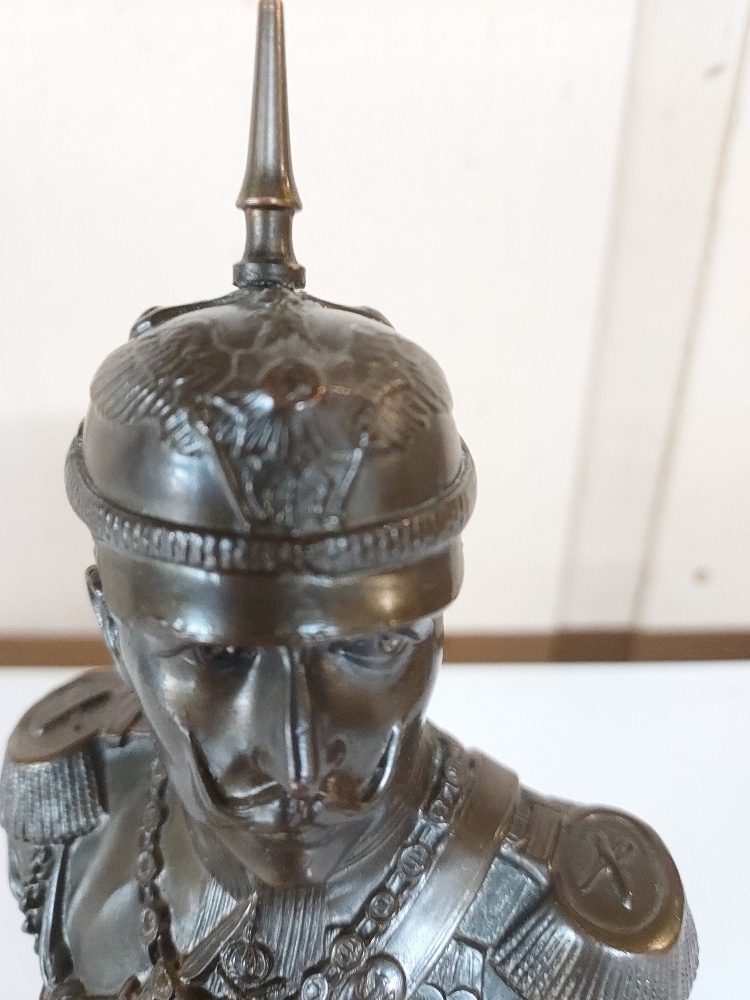
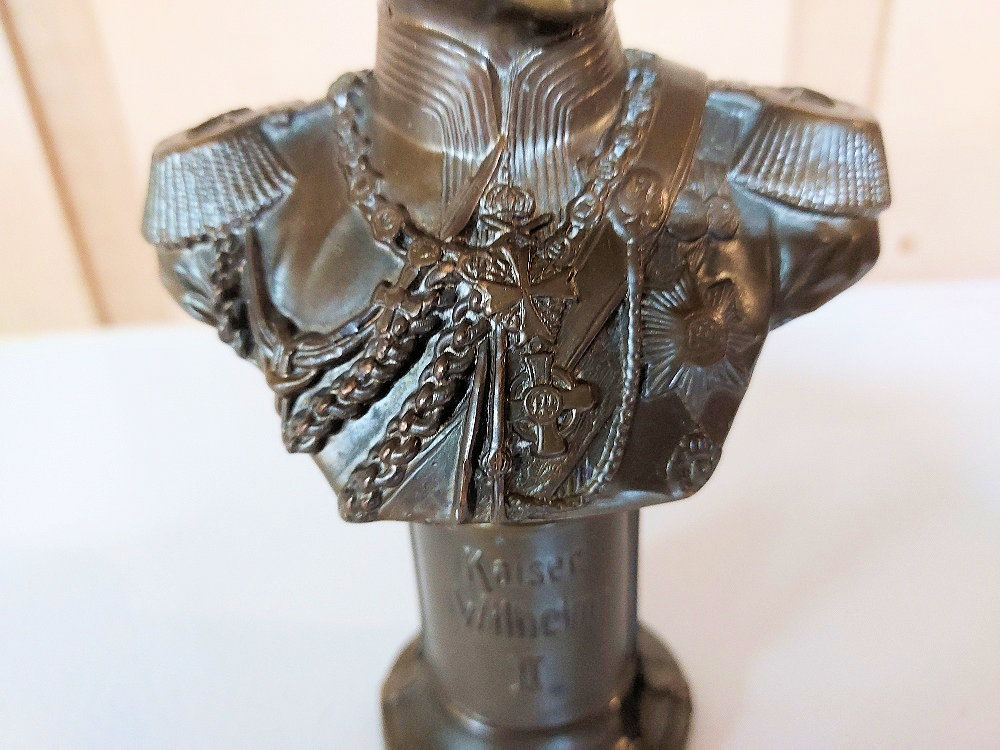
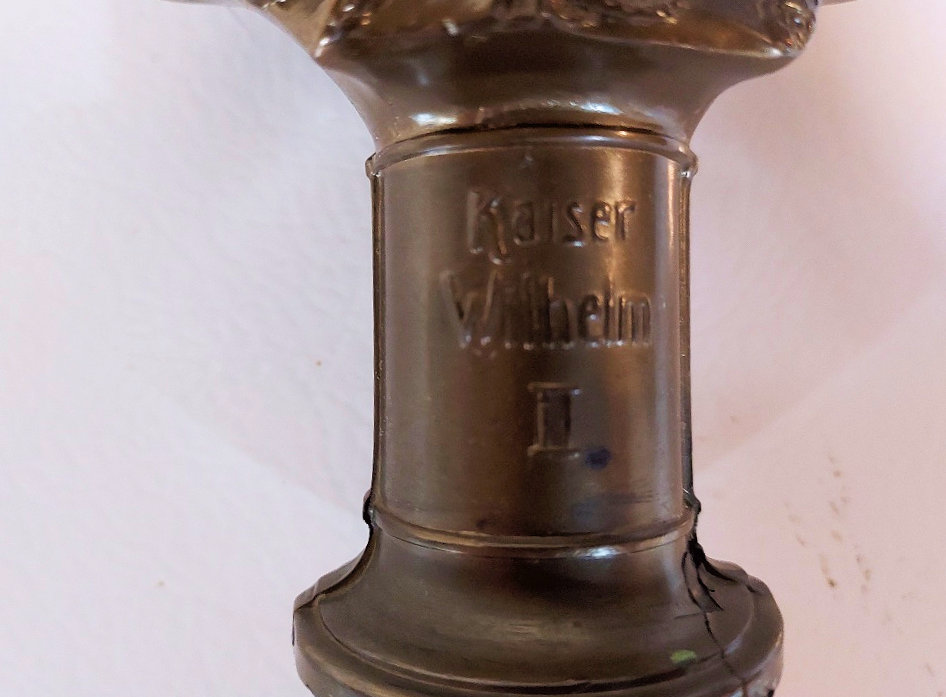
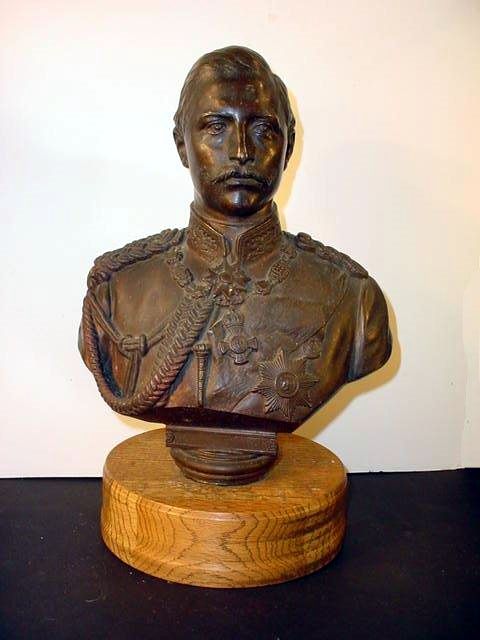
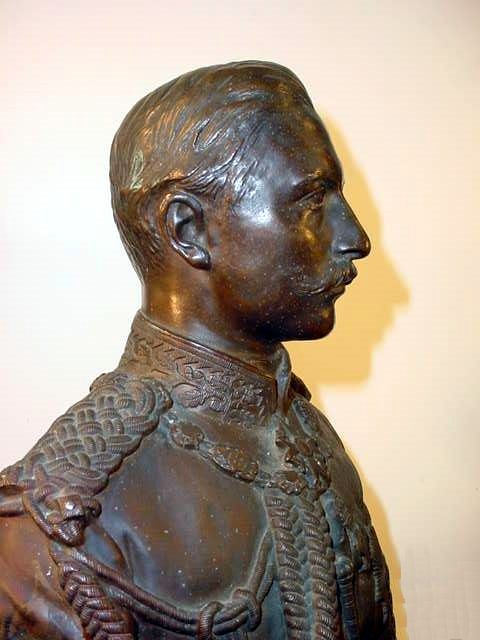
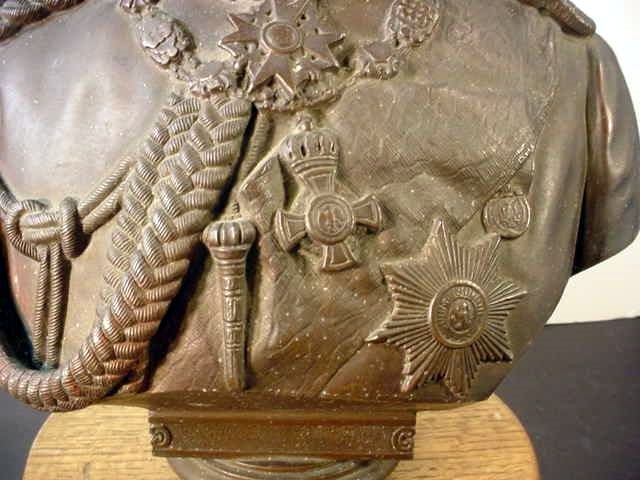
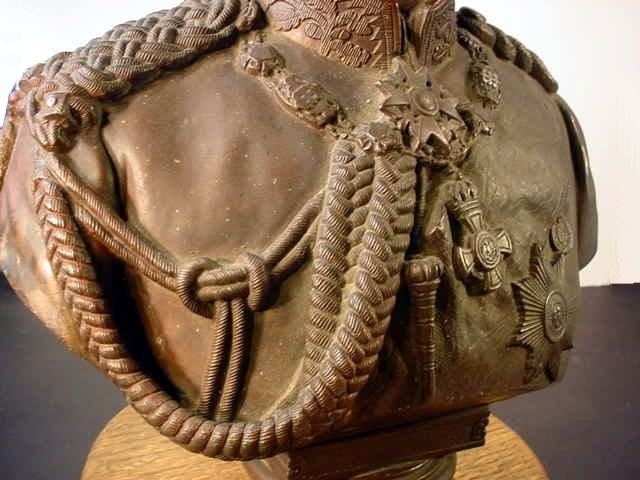
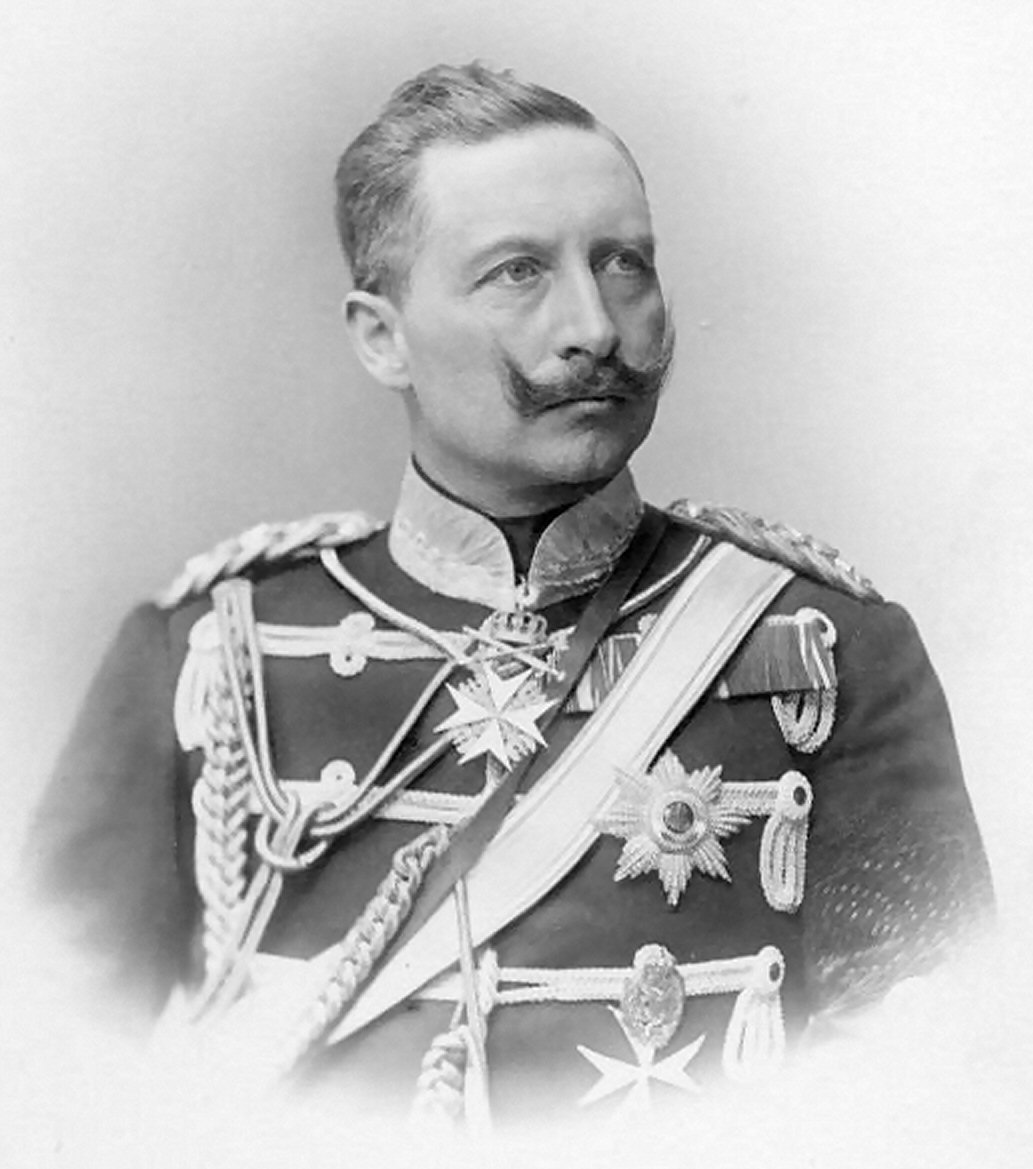
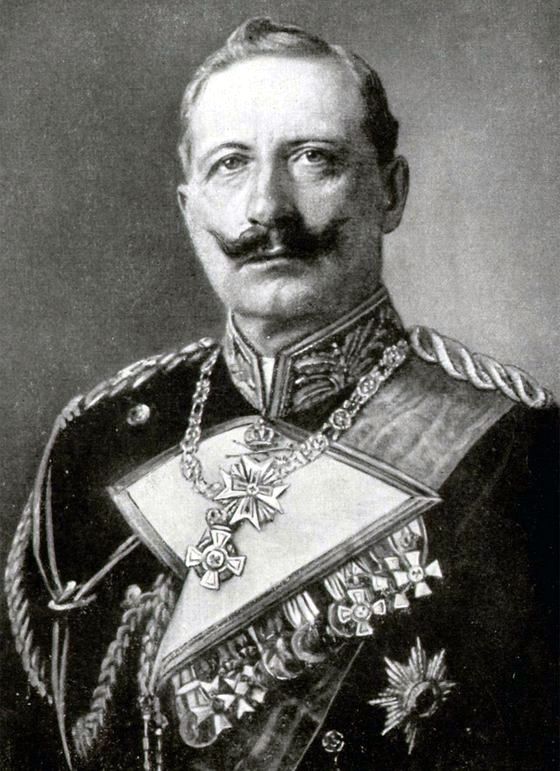
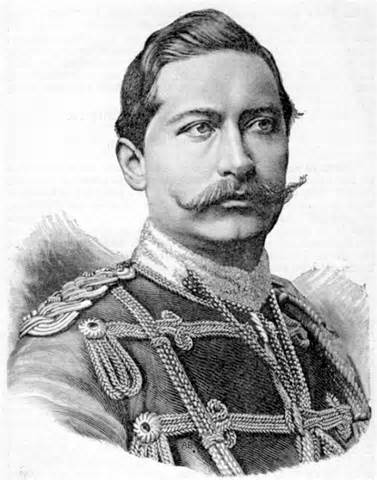
Great Bust of Kaiser Wilhelm II (Item WILHELM 9-20) |
||||||||||||||||||||
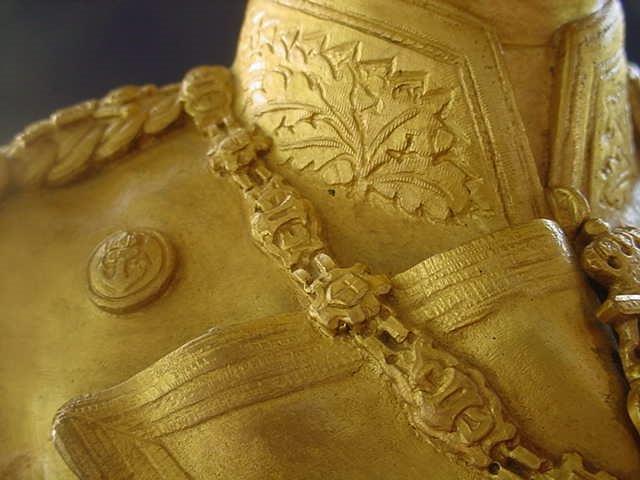
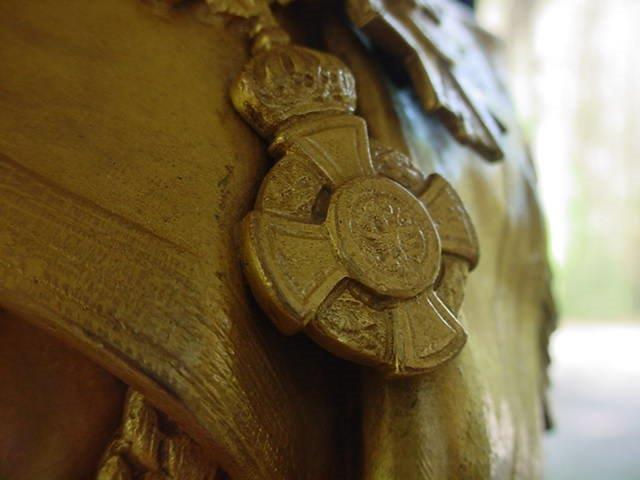
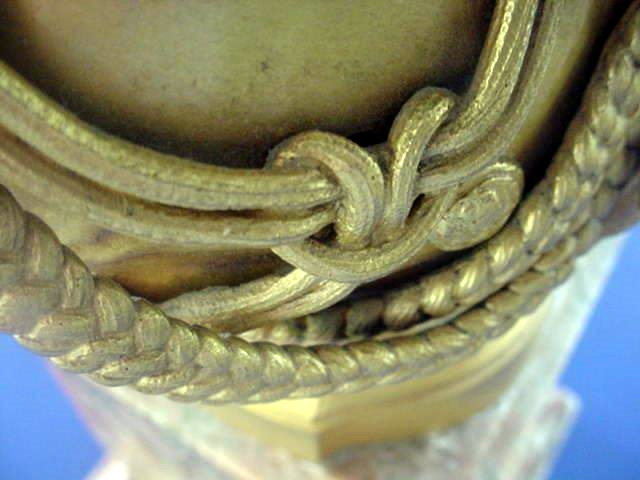
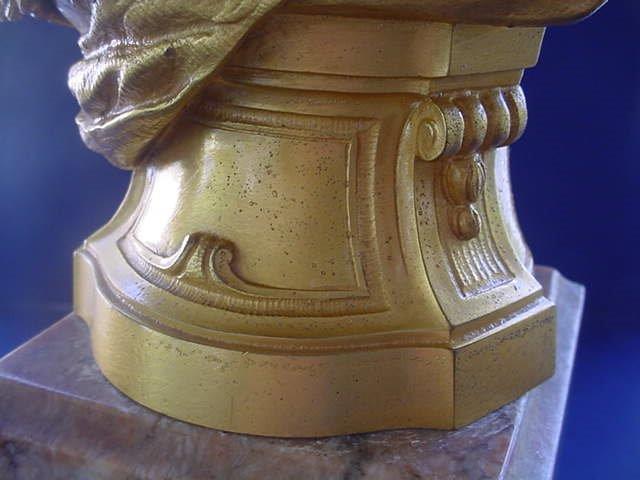
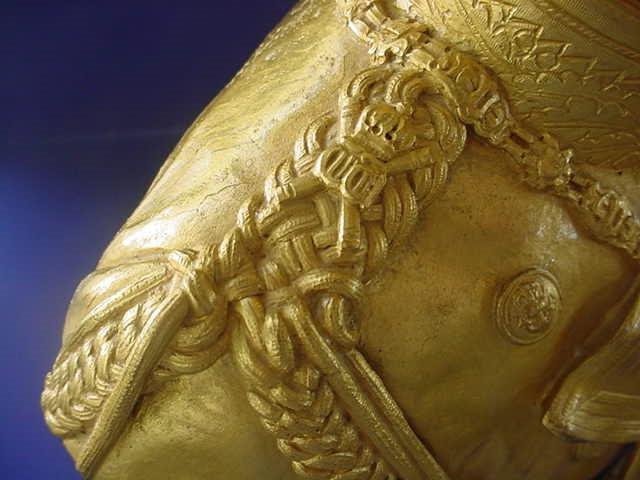
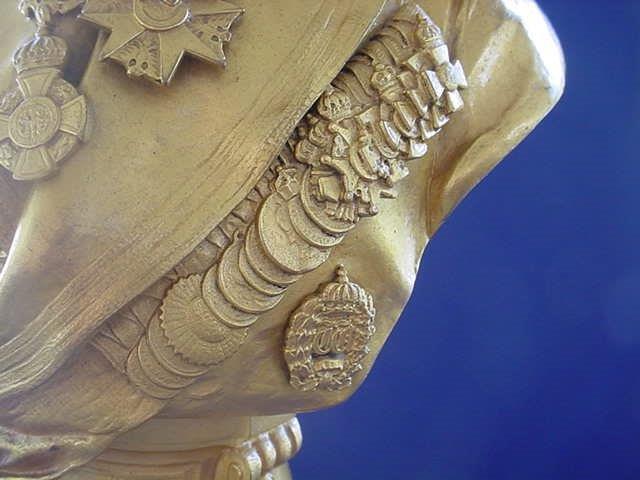
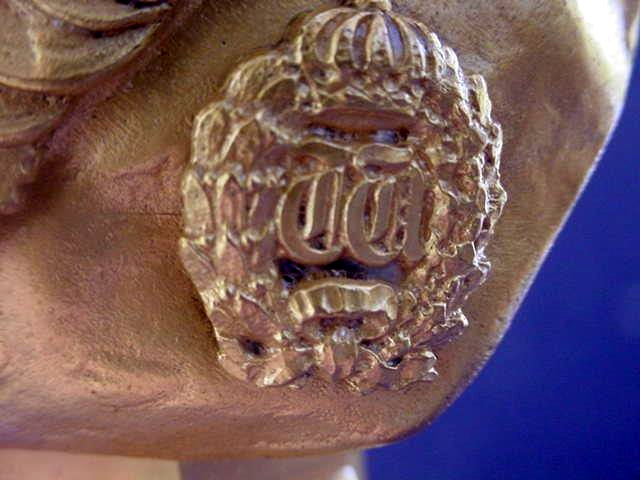
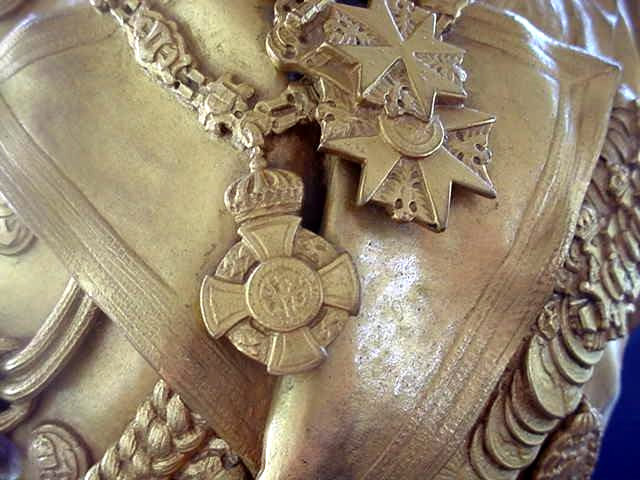
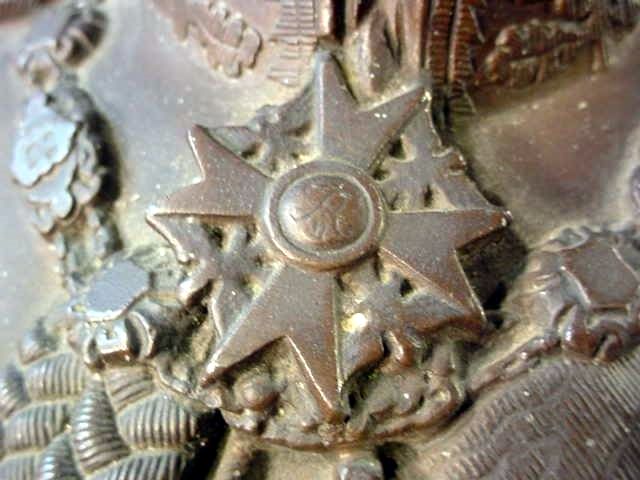
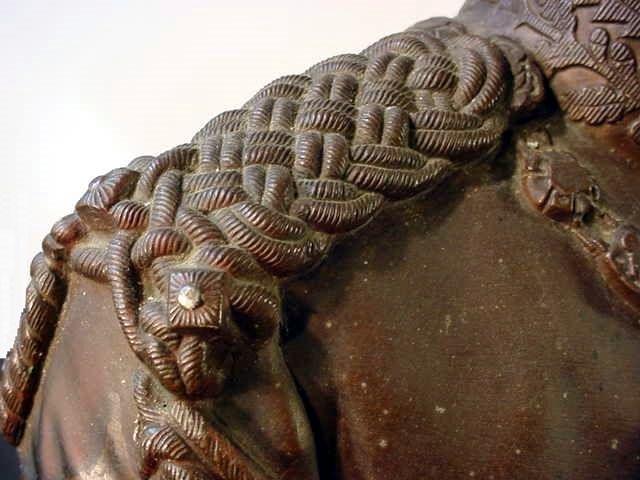
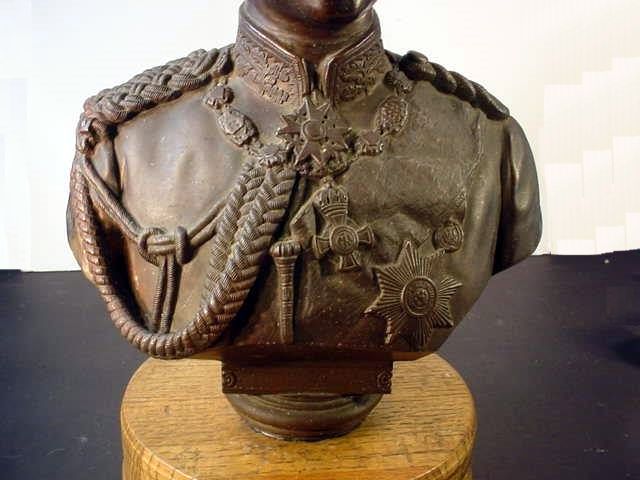
| DESCRIPTION: Here is a fine, original-period bust of the last king of Prussia and Emperor of the Germans, Kaiser Wilhelm II. It was handed down from three family successions in Germany and finally sadly it fell into the hands of some family members who were totally devoid of historical or cultural concepts. Many of today’s Germans have absolutely no sense of or liking for Germany’s glorious past or Teutonic values.
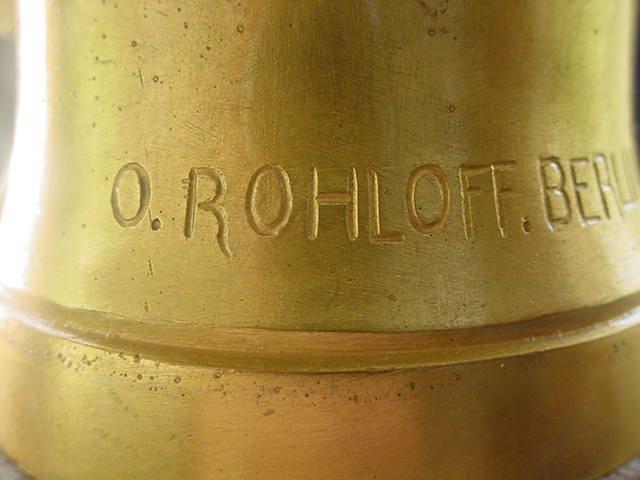
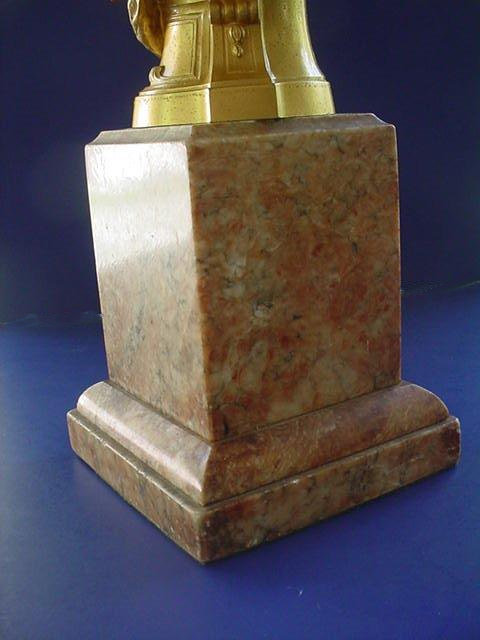
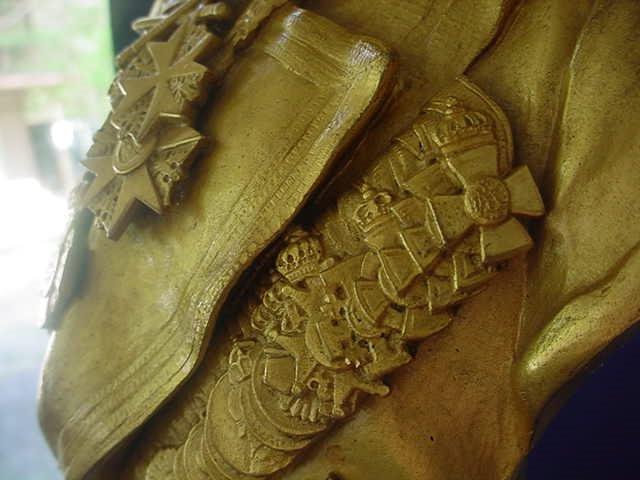
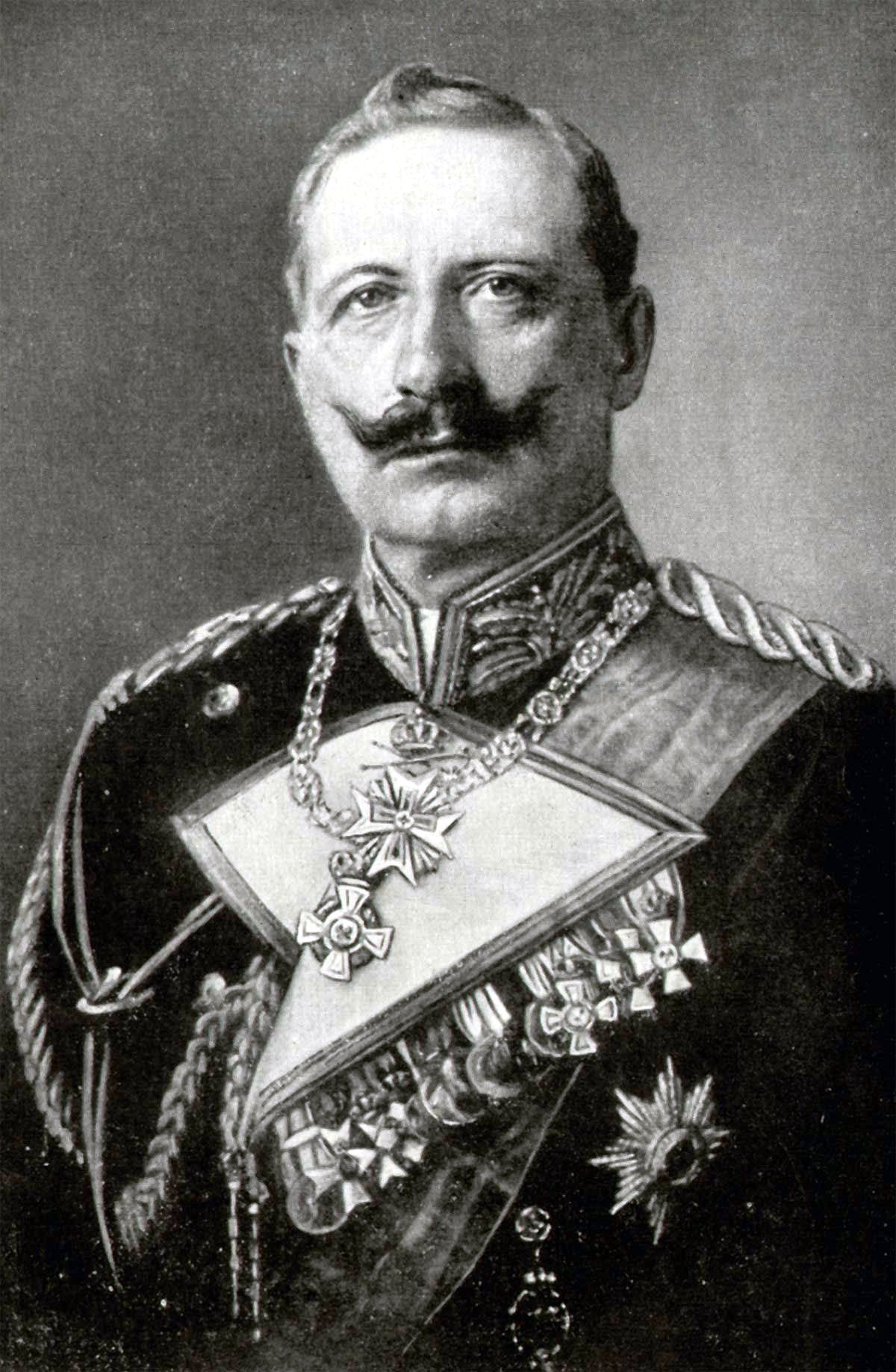
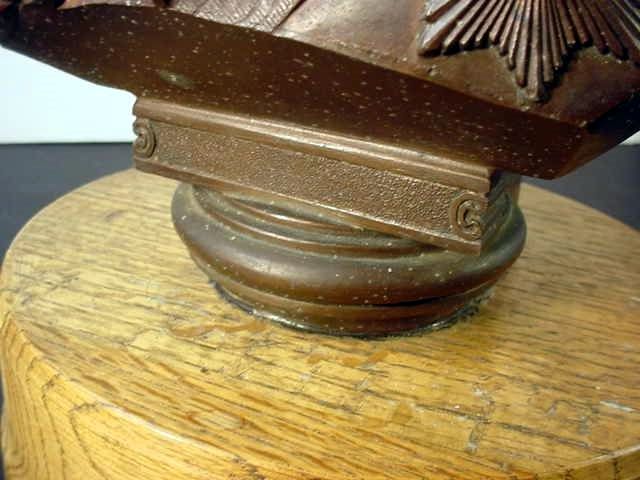
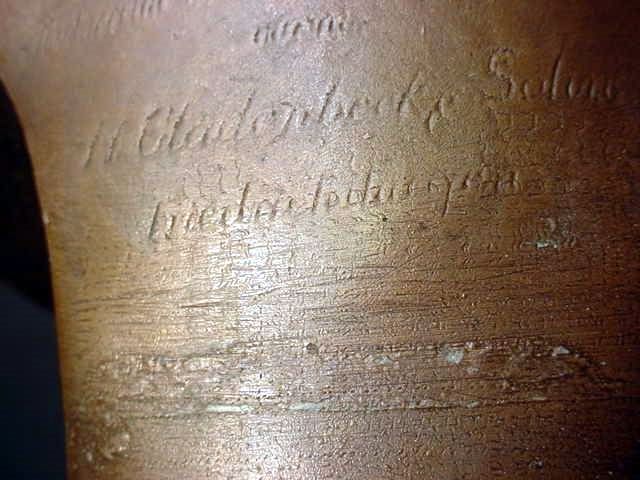
So fortunately, we have rescued it and perhaps you would like to help in the preservation of this magnificent art piece. The bust stands about 12 inches high and Wilhelm II measures about 10 inches across the shoulders. It is a very accurate depiction of the handsome Hohenzollern ruler. He wears the medals of empire on his gorgeous tunic. At the collar he wears the Prussian Black Eagle Order and around his neck is the highest chained Hohenzollern House Order and pinned to the breast is the grand star of the Order of the Black Eagle. The bust is mounted on a wooden plinth because we are told that the original granite one was broken years ago and the third-generation folks had the replacement plinth made for it. On the back there is some writing and it probably was the signature of the company that produced it, but through the handling of it with many hands it is practically worn away.
It is at this point that an appreciator would grab it for inspection so as not to touch the physiognomy of the countenance or the uniform. This is an extremely fine depiction of the young Kaiser and well worth preserving and decorating your study.
We are going to offer it at a very reasonable price so it will go out soon I would think.
PRICE: $1,550.00; We have seen lesser ones go for much more. The consigner of this one just wants it to go to a collector who will appreciate it. |





|
|||||||||||
|
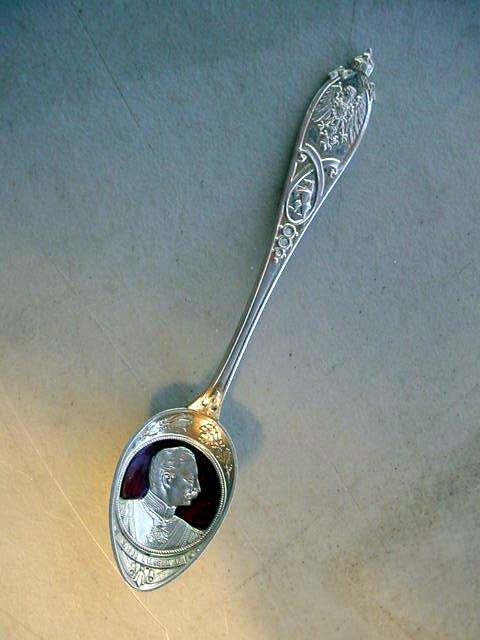
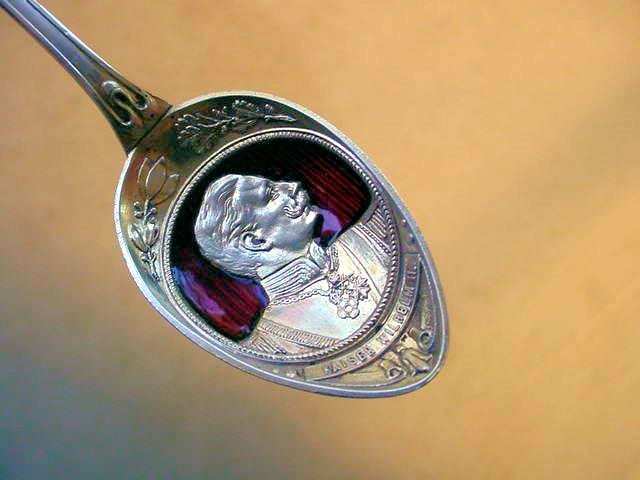
Beautiful Special Edition Art Spoon Depicting the Kaiser and his Imperial Berlin (Item WILHELM 9-21; SPOONS 1-8) |
|||||||||||
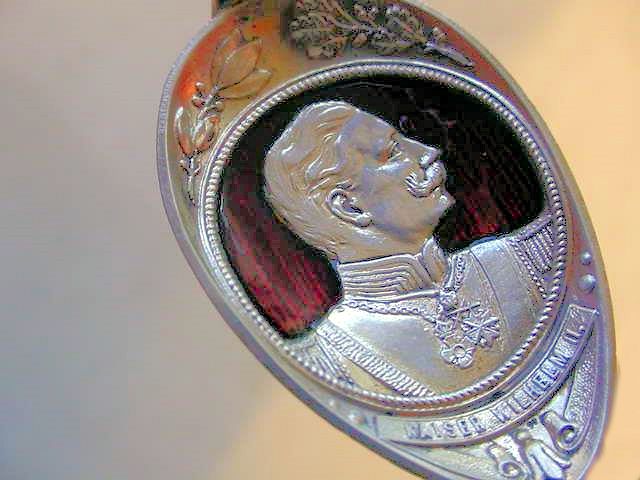
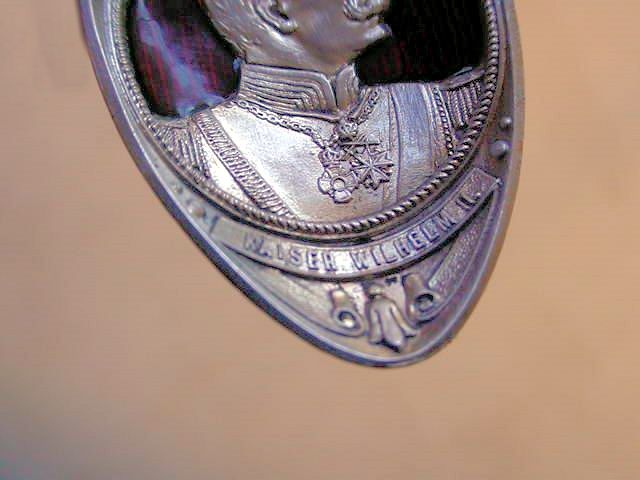
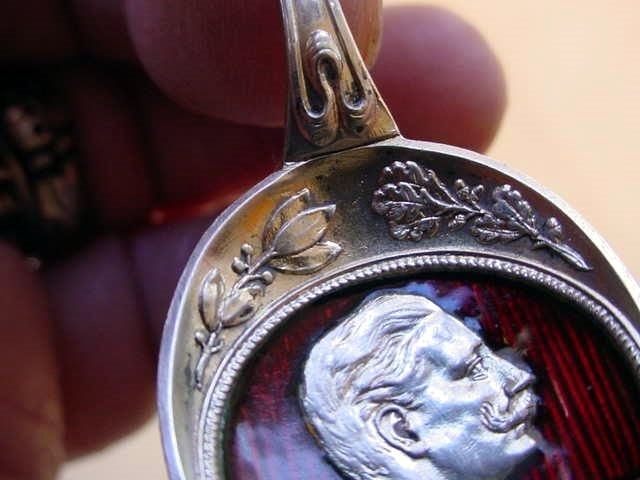
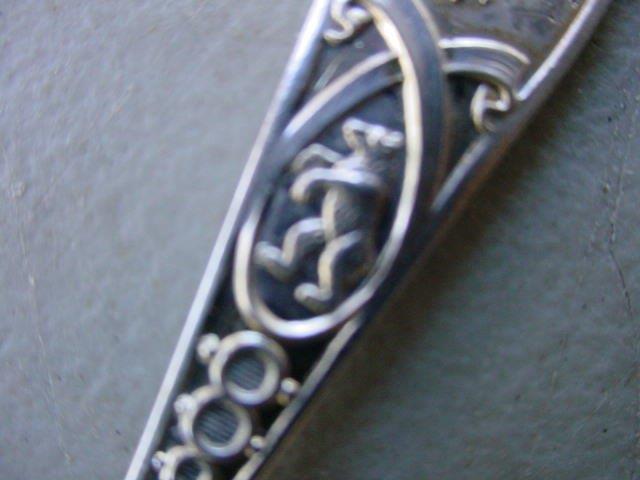
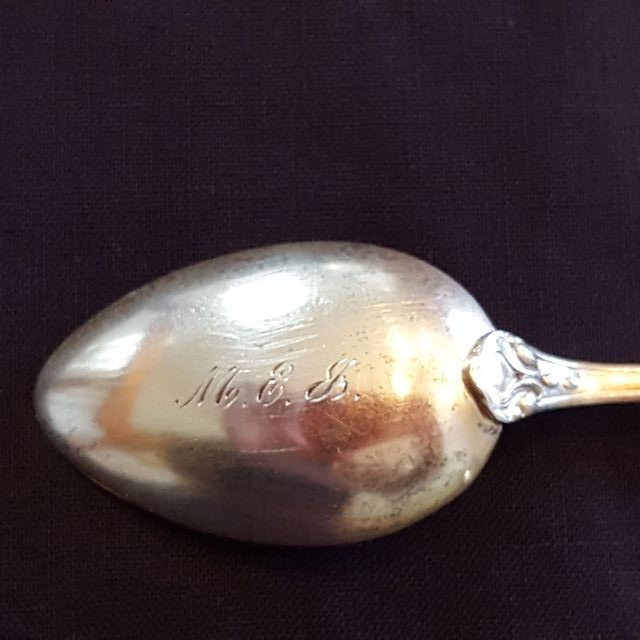
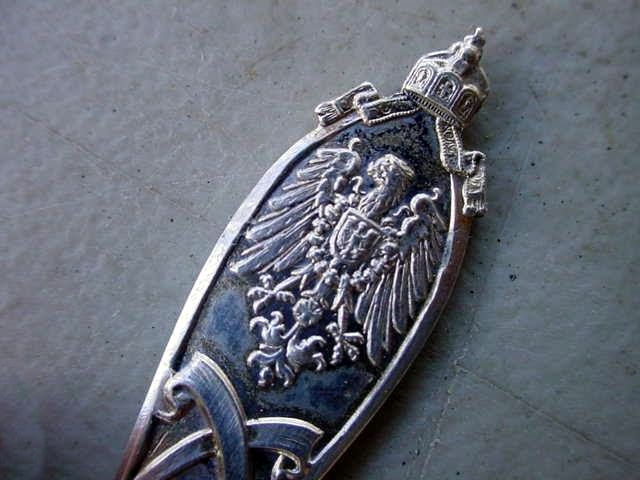
| DESCRIPTION: This is an exceptional silver spoon of the Andenken (memory) type in the 1800s and through the first quarter of the twentieth century. The collecting of art spoons was a well-respected tradition of travelers throughout the world. The price and quality of these souvenirs were commensurate with the pocketbook of the tourist. Spoons could be expensive, such as this one, and hand-painted examples were very expensive such as the spoons we show elsewhere on this page; spoons that were absolutely beautiful and made in Germany and even in the U.S. See “SPOONS 1-5” above. A wealthy visitor to the Imperial city of Berlin would have bought the particular piece we offer; this spoon would have been expensive in its day. It was crafted in genuine “800” silver and is so marked along with the required half-moon and crown stamping. It also has a manufacturer’s logo on the stem. The bowl has a wonderful likeness of Kaiser Wilhelm II wearing a cruisier chest plate and the House Order of Hohenzollern and the Black Eagle Order. Over his head are pictured the oak leaves of honor and the palm leaves of victory. Near the pinnacle of the piece is the raised word “Berlin” and above this is the crown of the Hohenzollern dynasty. The crown can be seen even more clearly in the picture of the magnificent Kaiserlich Adler (Imperial Eagle) that is seen on the front top of the spoon. On the back of the spoon’s bowl are the initials of the person who owned the spoon—“M.E.S.” Midway up the shank, you can see the rampant Berlin Bear. The background of the likeness of the Kaiser is in red enamel. This is highly unusual, indeed. I have seen many Andenkenlöffel over the last 50 years, but never one like this. This is an exceptional and rare Imperial piece worthy of the finest collection.
PRICE: $295.00 |


|
||||||||||||||||
|
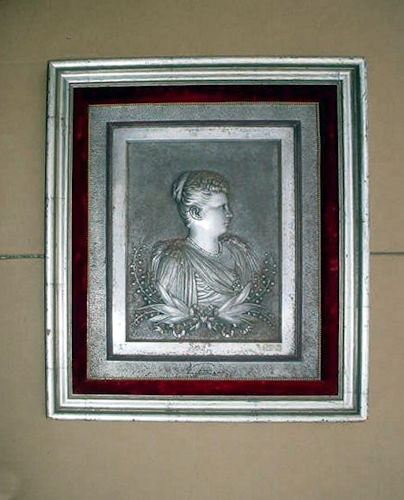
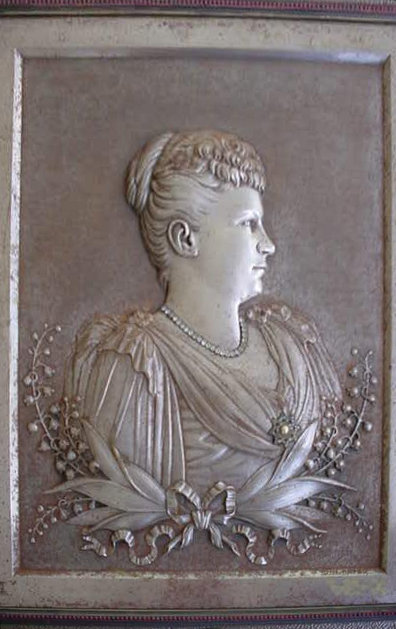
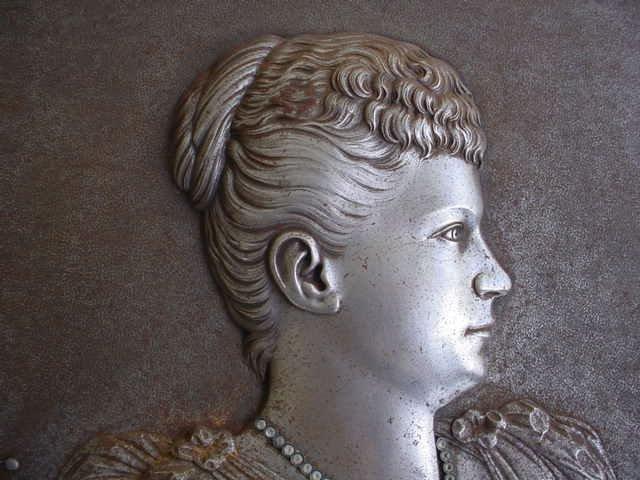
Metallic Framed Plaque Depicting Auguste Viktoria, Wife of Kaiser Wilhelm II (Item WILHELM 9-22) |
||||||||||||||||
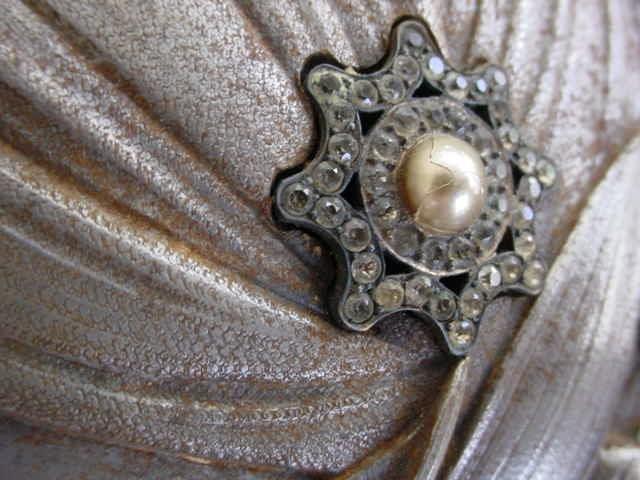
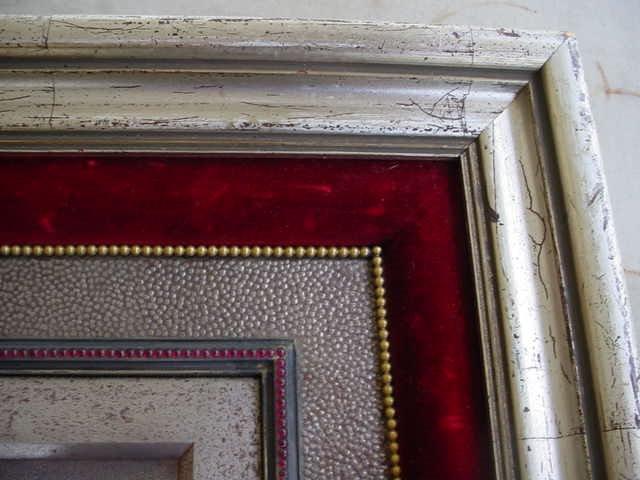
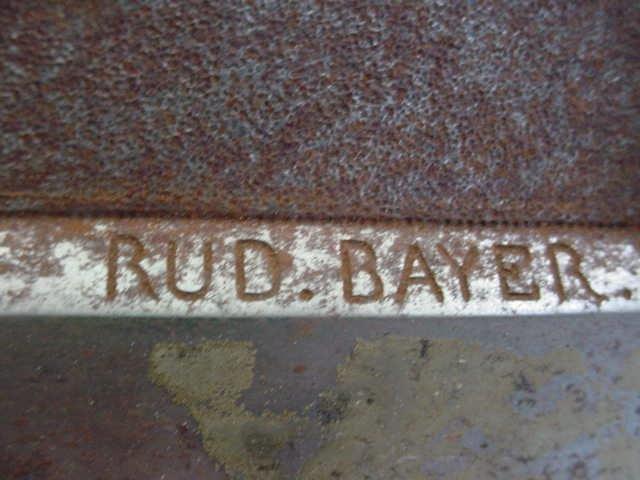
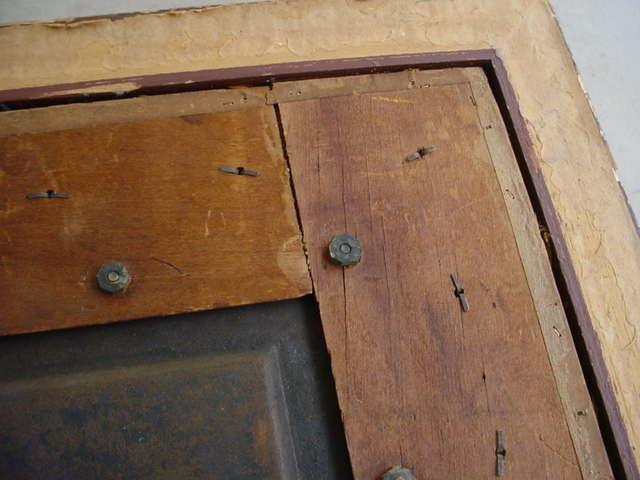
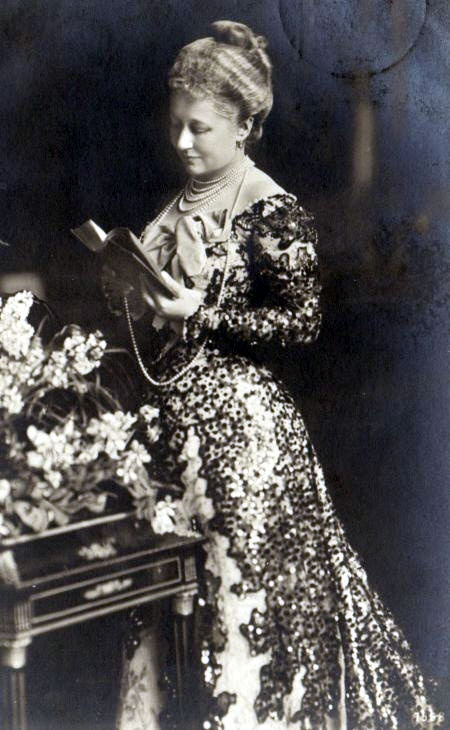
| DESCRIPTION: Auguste Viktoria was the first wife of Kaiser Wilhelm II, and the last empress of Germany and Queen of Prussia. She was born October 22, 1858. She was a great niece of Queen Victoria of England. She was known as Auguste Viktoria of Schleswig-Holstein-Sonderburg-Augustenburg. Her pet name was “Dona.” In 1868, she met Prince Wilhelm of Prussia; she was 10 years old. Later, in 1881 in Berlin, they were married, and Dona and Wilhelm had a very happy marriage. Wilhelm was a man who needed to be pampered and since Dona adored him, she had no trouble indulging him. She actually had more artistic interests than he did, but they shared very conservative political views and a deep religious faith. The couple had seven children: six sons and a daughter. After Wilhelm lost the throne in 1918, the couple went into exile in the town of Doorn in the Netherlands. Dona died at Huis Doorn on April 11, 1921. Wilhelm survived Dona by 20 years. When he died in 1941, he was buried in a mausoleum on the grounds of Huis Doorn. The plaque in its frame measures 21 x 24 inches. The plaque itself is surrounded by red velvet and measures 16 x 12 inches. The frame is exquisitely accomplished and is a period piece. That is all as elaborate as an 1890s precious royal presentation would be. It looks like three separate framings merging into one. What is unusual about this piece of classic art is that the jewelry, including the star-shaped brooch with what looks like a pearl, is separately affixed to her gown (three dimensional) in the same way her jeweled necklace is separate, as are the flowers that gather in a bow at her waist. The depiction is superb; there is some light rusting at the frame’s bottom portion where the signature of Rudolf Bayer, the artist, is located, but it can certainly be cleaned. We usually leave that to the buyer who might have a preferred methodology. This is a great and very important historic item.
PRICE: $1,200.00 |




|
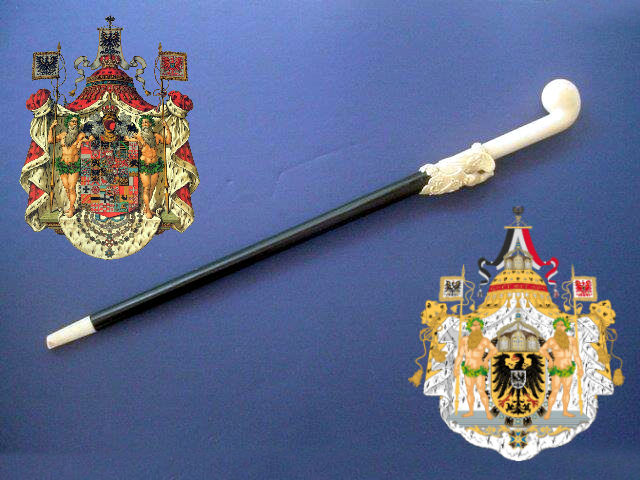
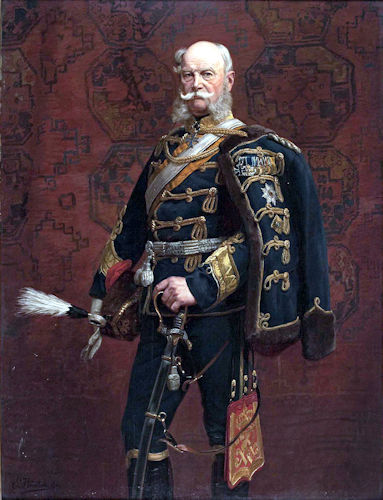
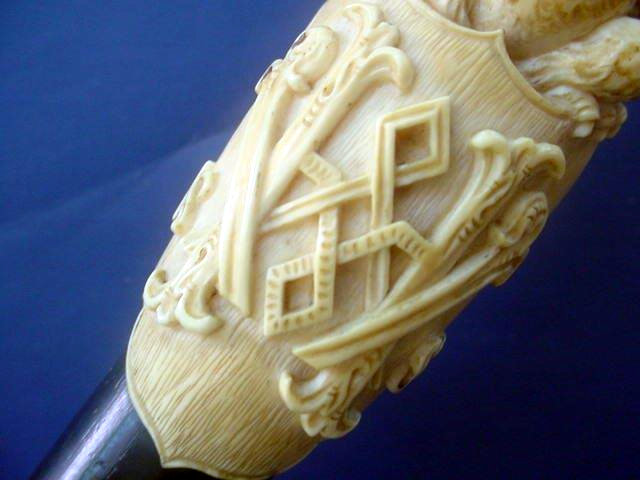
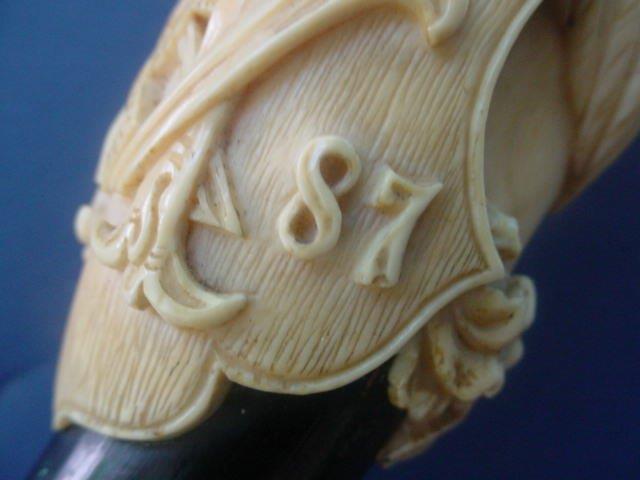
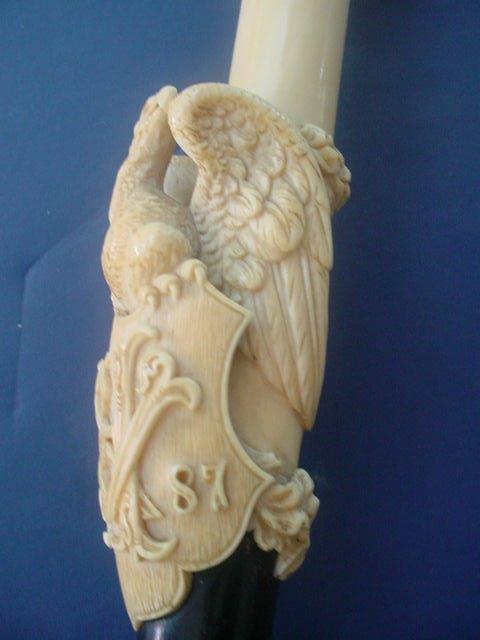
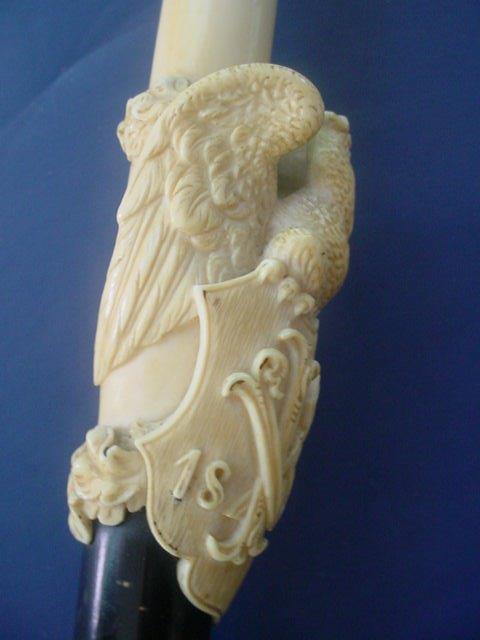
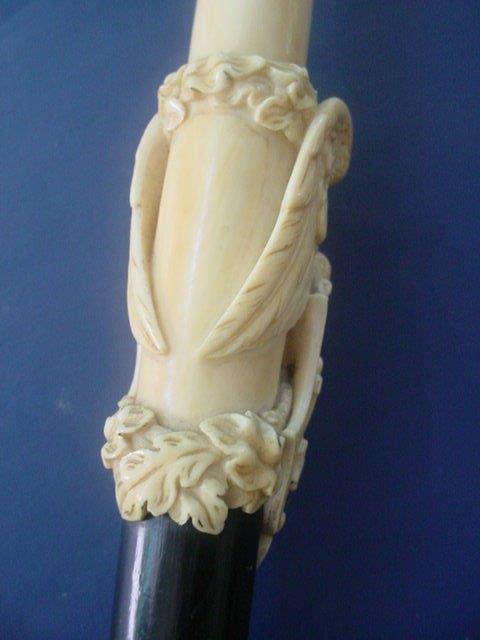
Baton, or Swagger Stick that Belonged to Kaiser Wilhelm I, Emperor of Germany (Item WILHELM 9-23; KSPEC 1-7; KHISTORY 1-18) DESCRIPTION: Deutscher Kaiser Wilhelm Friedrich Ludwig von Hohenzollern was born March 22, 1797; he died March 9, 1888. He certainly excelled as King of Prussia from 1861 until his death, and as German Emperor from 1871 until his death. He was a sovereign whose conscientiousness and self-restraint were instrumental in his wise collaboration as the strong statesman responsible for the rise to prominence of his monarchy and the House of Hohenzollern. This imperial rule in Germany was literally created at Versailles in the Hall of Mirrors at the end of the Franco-Prussian War. Wilhelm was acclaimed as German Emperor and, along with Otto von Bismarck, succeeded in bringing the divided Germany to a new united German Empire (Deutsches Reich). He was much loved and adored and in 1888, when he died, many memorials and statuary depicting him were erected all over Germany. The best known of these is the Kyffhäuser Monument in Thuringia, and the beautiful mounted statue of Wilhelm at the Deutsches Eck in Koblenz. Between 1887 and 1918, more than a thousand memorials to Wilhelm I were erected. |
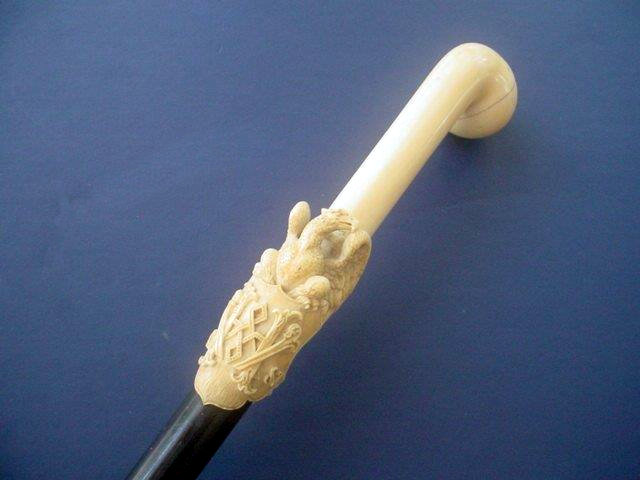
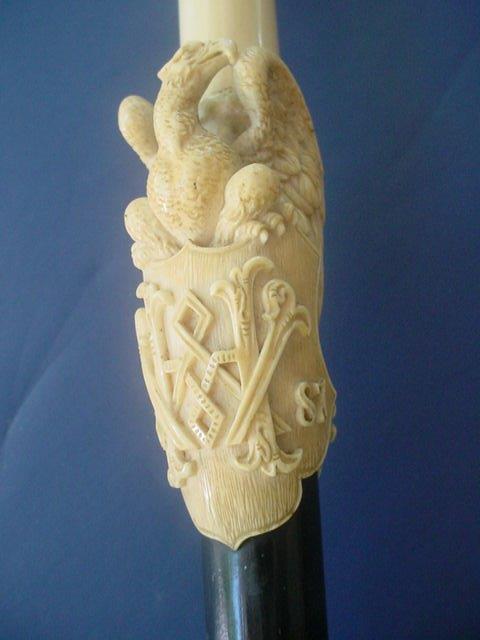
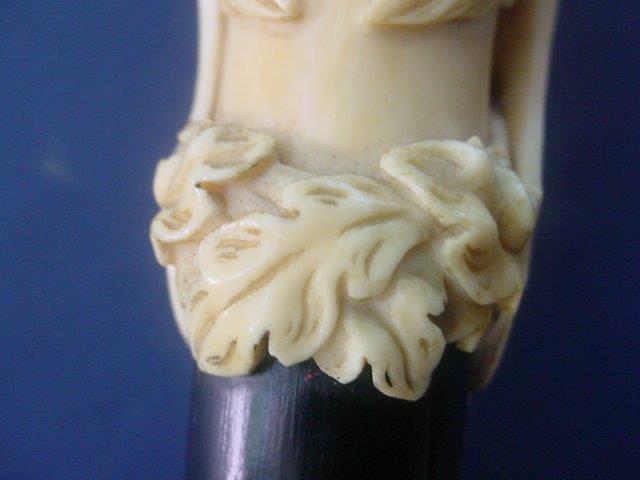
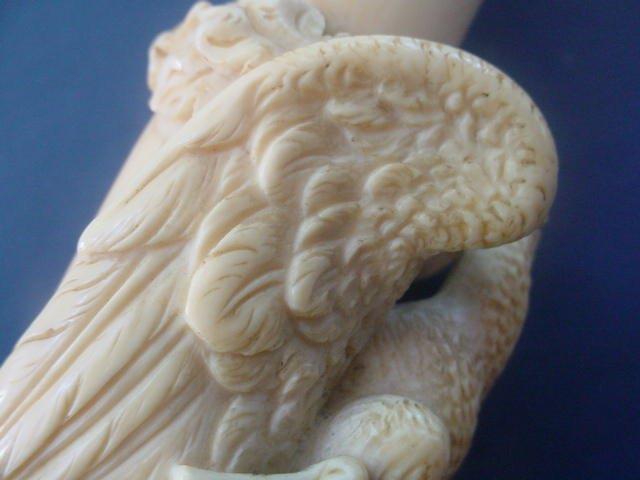
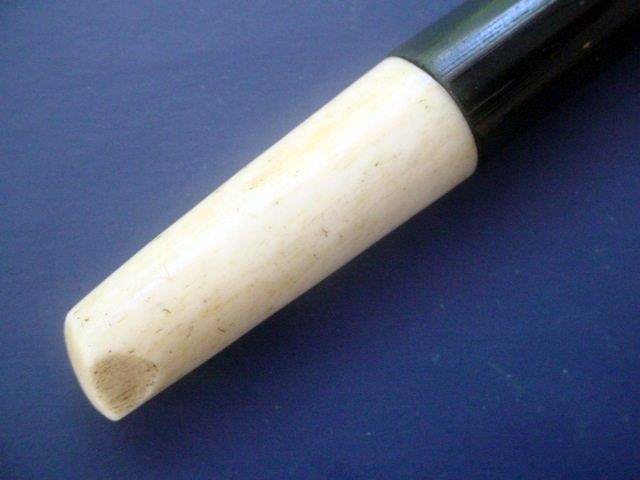
The Baton, or Swagger Stick This beautiful instrument has a fantastic rendering in carved bone with a ball-style top smooth to the touch and view; however, the most noticeable feature is seen below this as the most fantastic carving is seen depicting the German (Prussian eagle) carved in the most minute detail with every feather in full delineation. The wings of this noble bird wrap around the stock of this magnificent piece and you can see ornately carved bands of oak leaves below the folded wings. Even the head of the eagle is fine and realistic. This Deutscher Adler perches upon a shield that has the entwined, crystal-clear letters “WH.” These obviously stand for “Wilhelm of Hohenzollern.” Along with the letters, you can see the date “1887.” Kaiser Wilhelm I died in 1888, and his son, Frederick III, was proclaimed Emperor, but most sadly, this great Hohenzollern crown prince was already suffering from throat cancer and died after only 99 days as the German ruler. The last Kaiser, Wilhelm II, ascended to the throne on June 15, 1888, and ruled until November 9, 1918. The Baton The swagger stick, in lieu of a better word, measures two feet long with the earlier-described magnificent carved-bone eagle escutcheon. The shaft is a rather plain piece of unadorned wood that tapers slightly as it flows onto the tip. The tip is an additional piece fashioned in bone that seems to show some use. Why do we call it a baton or swagger stick? It could hardly be termed a cane, as the Kaiser was a very tall man towering well over six feet. Our theory is this: The eagle is reminiscent of the eagle of Frederick II, King of Prussian, who ruled as Hohenzollern King from 1740 to 1786. Could this swagger stick have been a gift to Kaiser Wilhelm I from some other royal personage in commemoration of Frederick II’s reign? This could have been a sort of get-well gift to the monarch. It might have been an exact replica of a baton that was once the possession of the one and only “Der Alte Fritz” (Frederick the Great of Prussia). Many relics found that were the personal property of the Fritz have featured realistic-looking eagles and lions and other noble creatures. This beautiful piece might possibly have been an item that was presented to the Emperor by a carver extraordinaire, possibly a man who had done detailed artwork for the House of Hohenzollern, before. The date “1887” is a year before the people’s beloved Kaiser passed away. It was a time when his adoring public brought presents to the palace in way of tribute to this old warrior king. These gifts were usually masterwork editions such as this piece of outstanding artistry. Any question of its being the property of Wilhelm I is moot as the eagles, the distinct Prussian style, and the obvious and conspicuous “WH” configuration would firmly have us believe that it is indeed a treasure of one of the most admired and greatest sovereigns of the Hohenzollern Dynasty. PRICE: $25,000.00
Please refer to item designator in parentheses in all correspondence. Please E-mail for any additional information you may need.If you prefer, contact 'Germania' at PO Box 68, Lakemont, GA 30552 or call at 706.782.1668 or 706.782.4398. Please! do not call during the wee hours of the morning. The best time for calling us is between 9 and 11 am and between 9 and 11 pm eastern time. |