
|
|
|
|
|
|
|
Page 12
 |
 |
 |
 |
 |
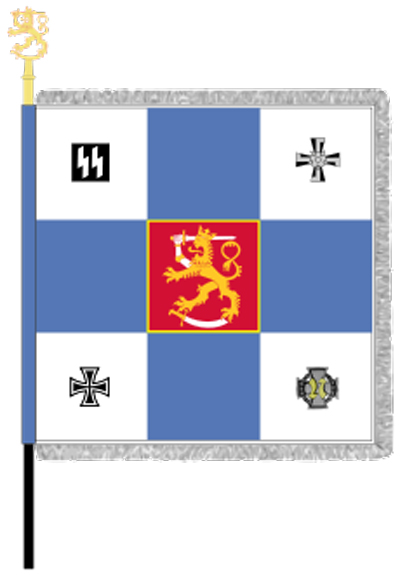 Finnish SS Volunteer Banner |
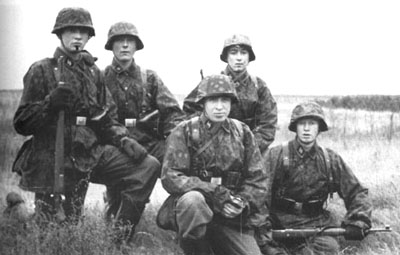 Finns of the 1st KP Finnisches BN D. Waffen SS 1942 |
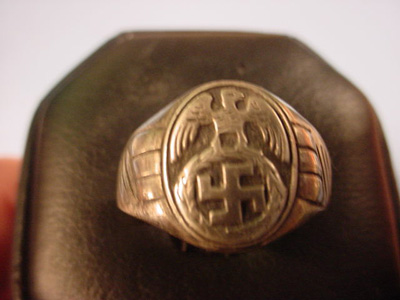
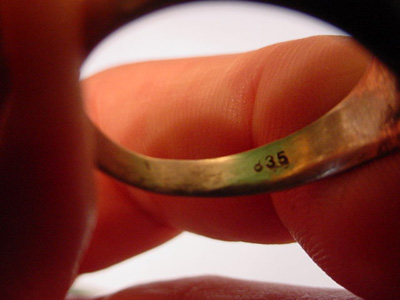
Ring of the Finnish Volunteer Battalion of the Waffen  (Item WAF 12-1) (Item WAF 12-1) |
DESCRIPTION: This volunteer combat battalion of the Waffen SS saw action on the Eastern Front during WWII. Many Finns were already serving with the SS Divsion Wiking, but this battalion, formed in 1941, was staffed with Finnish officers and NCO's while Wiking was commanded by Germans. The battalion was made up of 1,200 Finnish volunteers who signed up to fight the Sovient Union for two years. After initial training in Vienna, the batalion was transferred to Stralsund in June 1941, and at the beginning of August, to the infantry barracks at Cross-Born, Pomerania for more training and where it was attached to SS Division Wiking. The battalion was sent to the Eastern Front in January 1942 forming the vanguard of the furthest south made by the Germans during the campaign, reaching the Grozny oil field in a heroic action, although badly outnumbered, but then were pushed back by the Reds. In May 1943, the battalion was transferred away from the Front, as the two years was at an end, and was disbanded in July 1943. Many members of the battalion wanted to further serve in the Waffen SS and they joined the SS Freiwilligen-Panzergrenadier Division Nordland or SS Standarte Kurt Eggers. The battalion was praised by many Waffen SS Commanders, even by Heinrich Himmler, for its combat performance. Himmler said, "Where a Finnish SS man stood, the enemy was always defeated." The ring is a smaller dimension style, but bold looking nonetheless. It has the eagle and swastika. The swastika, of course, was used as a symbol of Finland as the official national marking between 1918 and April 1, 1945 and it was used by the Finnish Air Force. So, it was only natural that the Finnish volunteers would have used the Germanic eagle with swastika as their symbol. The ring is in tip-top condition. This is a very rare ring. PRICE: $625.00 |
 |
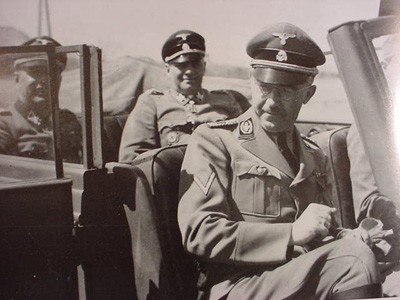 Himmler (front seat) with Felix Steiner |
 |
 |
 |
 |
 |
 |
 |
 |
 |
 |
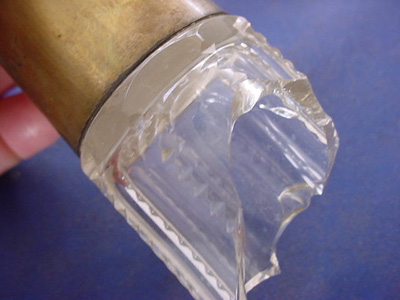 Glass broken but not sharp; has been ground |
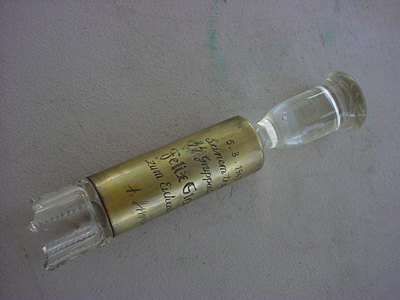 |
 The Sonnenrad Hakenkreuz |
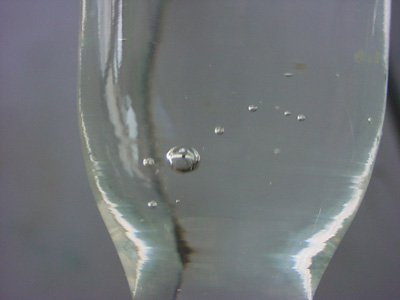 Note bubbles in this genuine crystal top |
 |
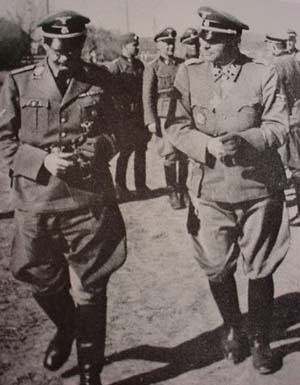 Himmler with Steiner |
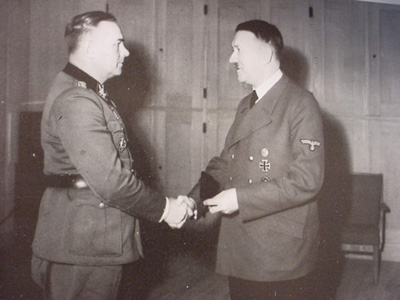 Steiner receives the K.C. with swords |
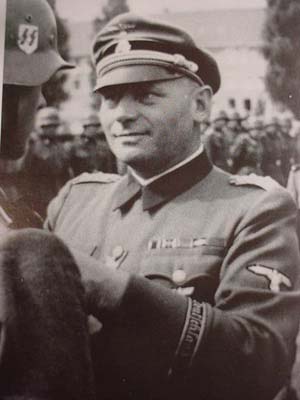
 Steiner decorates his men |
 |
 |
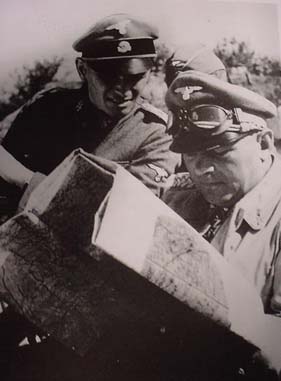 In the front lines |
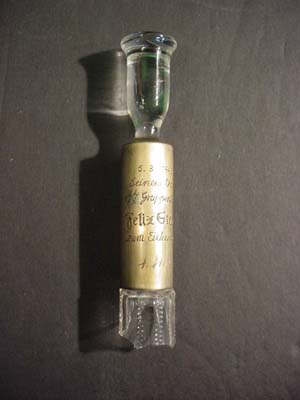
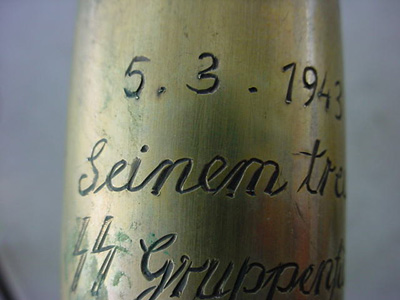
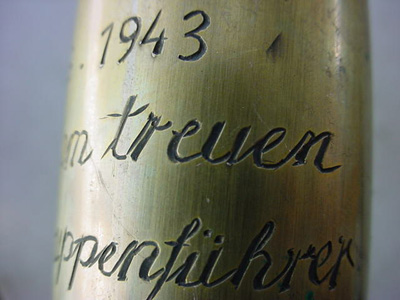
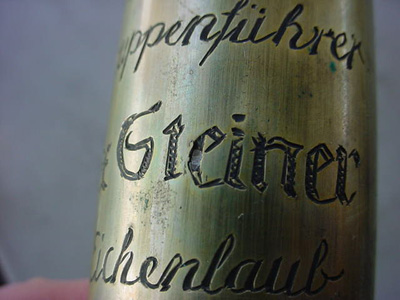
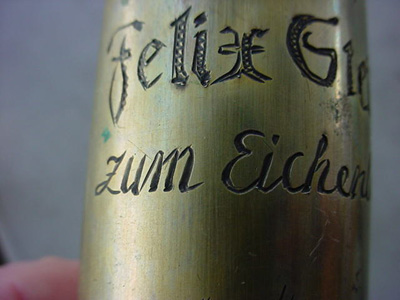
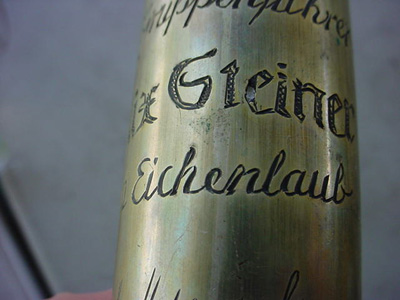
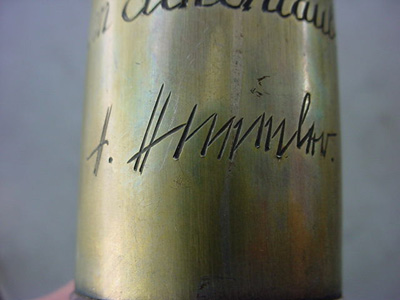
Presentation Wine Decanter to Felix Steiner From SS Reichsfuhrer Heinrich Himmler in 1943 (WAF 12-11) |
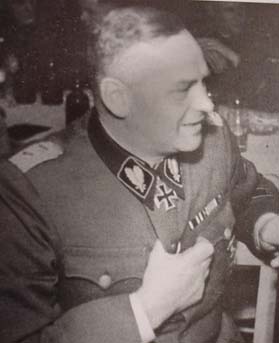
DESCRIPTION: This very important historical piece was unforntuantely broken and only part of it remains. Undoubtedly it was once a very large crystal wine decanter that was presented to Felix Steiner on March 5th 1943. We believe it was one of several that Himmler commissioned to present to winners of the Knights Cross and the subsequent awards of the Oak Leaves and the Swords. On the neck of the bottle is the following insertion: 5.13.43 The bottle neck is in silver and is so marked with the half moon, crown, and 800; there is a company logo and the separate letter (a-k) is seen there as well. The reference to the Eichenlaub (oak leaves) is a reference to the Knights Cross he won on Dec 23rd 1942. Later on Aug 10, 1944 he won the swords; however at the time of this gift being given by the SS Reichsfuhrer. Steiner was an SS Gruppenfuhrer and General Lt. of the the Waffen SS and Commander of the Vol. Division ‘Wiking.’ The crystal stopper to this decanter is also quite beautiful with a cut glass Sonnenrad Hakenkreuz (sun wheel swastika) at the top (glass engraved) by hand. The whole decanter must have been quite beautiful. Felix Steiner was a very remarkable soldier, but we will not go into his entire illustrious history. You can pick that up on the internet by ‘Googling.’ But his career began in WW 1 and he then served in the Reichswehr, he fought the Poles and Communists in the Frei Korps and after his years with the army he joined the SS Verfugnngstruppe and was very instrumental in building up the SS Standarte ‘Deutshland’ in Munich and at the training camp at Dachau. In 1936, he took command of the Deutschland Standarte and molded it into a competent fighting unit and a very elite formation. From 1941 to 1943, he led the Wiking Division which consisted of Germans and West European volunteers who under his command lived through incredible actions on the Russian front. In 1943, using German and other European volunteers (including Latvians), Steiner formed the 3rd Germanic SS Panzer Corps which saw action at critical points of the Russian Front. His Army group “Steiner’ was given the task in 1945 of breaking through the Soviet Ring around Berlin. Steiner refrained from committing his troops to the attack however, because the units he commanded in reality no longer had the strength which was erroneously indicated on paper. The divisions had suffered terribly heavy losses. He now made a realistic appraisal of the situation and acted accordingly; gathering together the remnants of his once proud divisions he led them westward towards the Elbe and surrendered to the Americans. In doing so he saved the lives of a few thousand European Volunteers and prevented them from falling into Soviet captivity and moreover it was still ‘chancy’ because the Americans under the Soviet loving General Eisenhower usually turned over such prisoners to the Stalinist thugs for certain torture and execution. After the war, Steiner continued to openly stand by his men whom he had led from 1935 to 1945. He wrote several books that have retained an intense interest for today’s armies. The last years of his life were spent in Munich and they were lonely ones. He preferred to meet together with a small company of comrades. On one occasion when he failed to open the door for his visitors, the police were summoned in order to legally enter his home and the General was found dead, alone in his apartment. “Another hero has entered Valhalla.” The decanter is an item that was removed from the apartment by a former Waffen SS soldier who was in Wiking. What had occurred that resulted in the item being broken? This the veteran was not able to tell our collector friend. Possibly the old soldier had somehow accidently knocked it off the shelf and threw out the broken body of the decanter but preserved the neck of the bottle as a memory of the times of glory? We will never know. The old veteran sold it or gave it to the collector that we have previously mentioned in our pages who collected engraved items of historical importance. The vet thought since he also was getting up there in age it would be well that this Himmler-Steiner item would be better off in a collection than lying there in the bottom of a drawer in his home. So, this is how it came to be on the pages of Germania. We are proud to offer it and it is hoped it will go to a collector who will be proud to own this remembrance of one of the finest and most brilliant German soldiers in Teutonic military history. PRICE: SOLD |
 |
 |
 |
 |
 Note dueling scar |
 |
 |
 |
 |
 |
 |
 |
 |
 |
 |
Cap for size perspectiveonly |
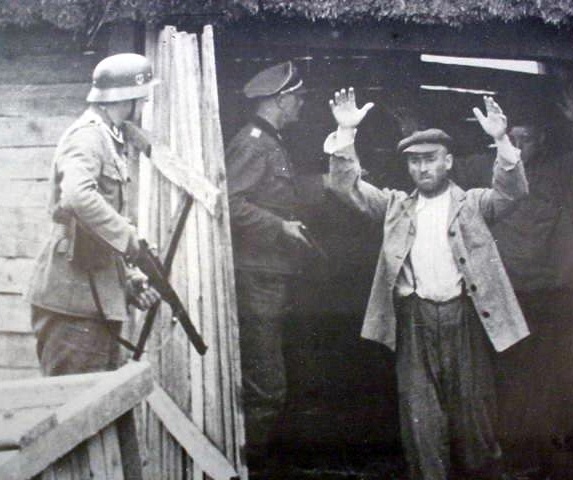
 Arrest of Partisans |
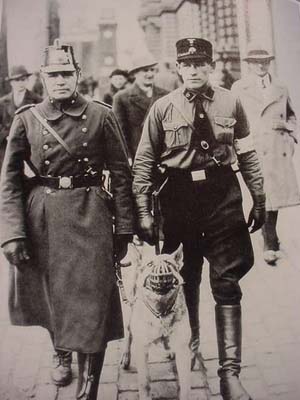 Early SS use of dogs |
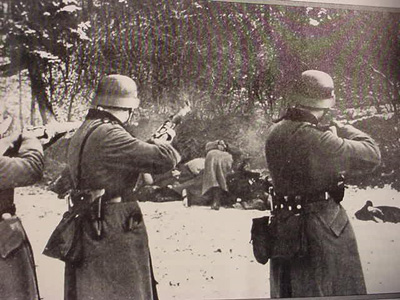 Partisans dispatched |
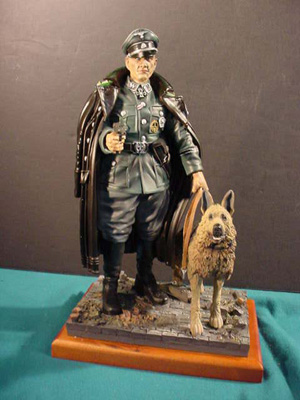
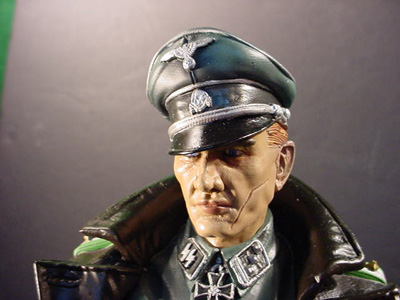
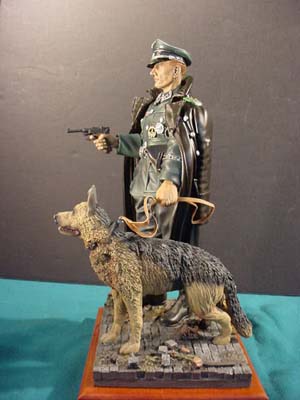
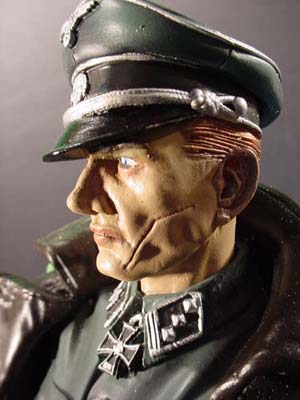
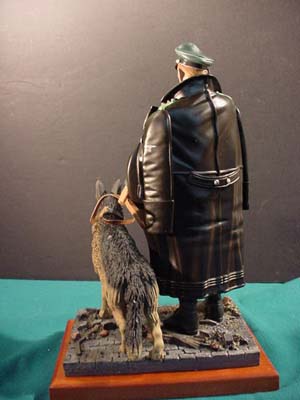
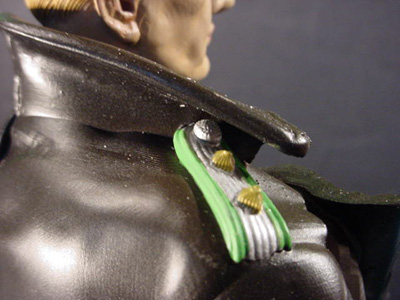
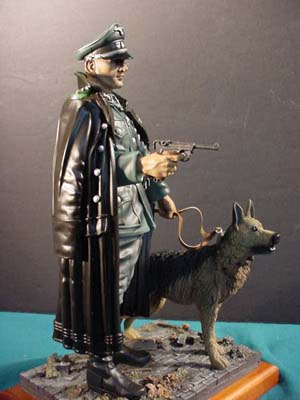
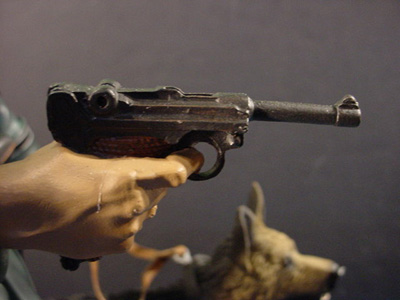
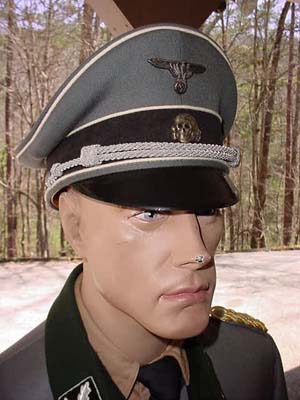
A Model of a SS Oberstrumfuhrer with Schaferhund (WAF 12-12) |
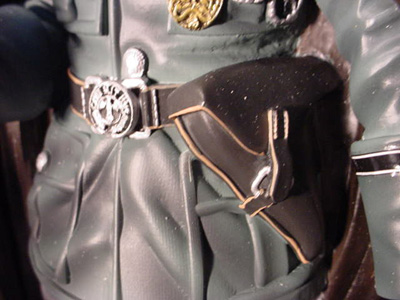
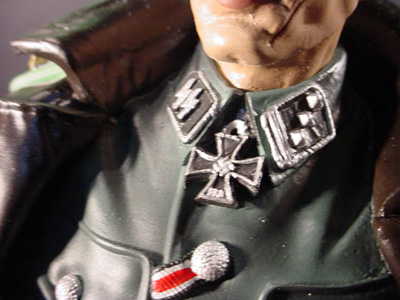
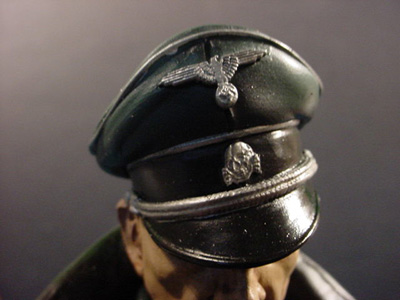
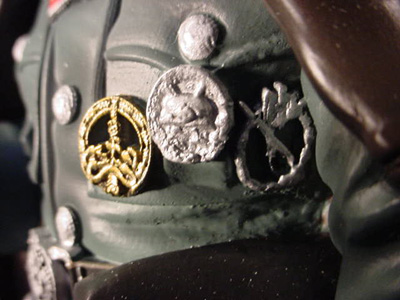
DESCRIPTION: Again folks, Germania generally stays away from reproductions or newly made products but this actually is a model and ‘What a model’. We couldn’t resist. This guy has something to say and so does ‘Fang’ his Schaferhund. Pity the poor Partisan rounded up by this pair! No, don’t pity him. Partisans, especially Tito’s Yugoslavian scum, were murderers and torturers of the first order and it would delight this stalwart Trooper and canine to find one or two hiding in the woodpile. The doggy would be especially elated for the chance to chew the bastard up -- filth notwithstanding. Would that it was Tito himself! The accuracy of the model is astounding. It is completely hand painted to lifelike appearance. The detail is amazing, look at the Knights Cross and Adolf Hitler Leibstandarte sleeve band (Incredible!) Look at the medals, and Partisan badge, silver wound badge, Infantry Assault badge, the lethal Lugar at the ready. Wow! There were only 300 of these produced and this one is one of them produced on 10/08. So, there may be none that can be re-ordered. Better grab it fellows.What a great center piece for a WWII German collection. PRICE: SOLD |
 |
 |
 |
 |
 |
 |
 |
 |
|
 |
 Inside cap |
 |
 |
 |
 |
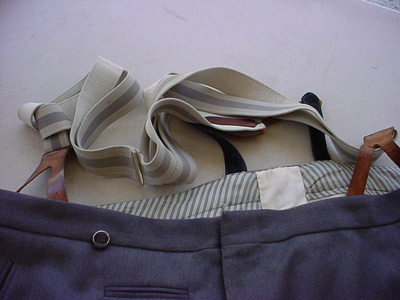 Original period suspenders |
 |
 |
 |
 |
 LAH |
 |
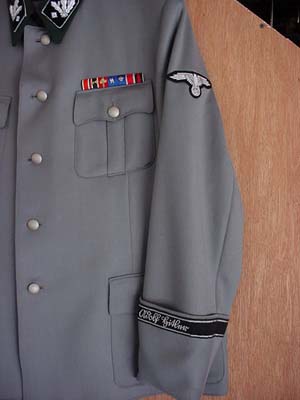
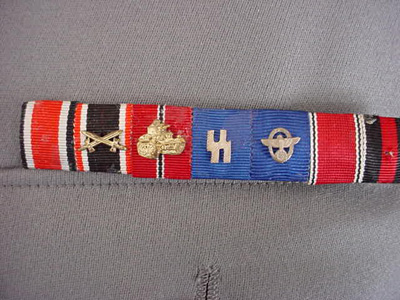 The ribbon bar |
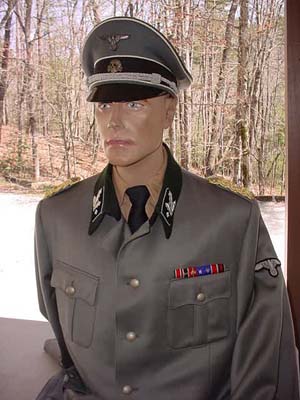
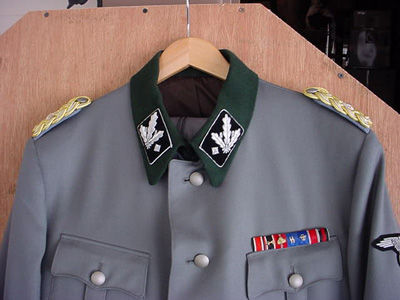
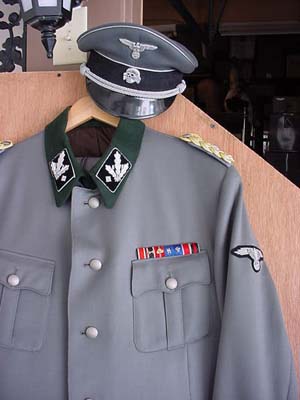
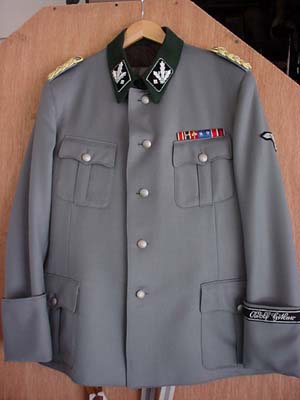
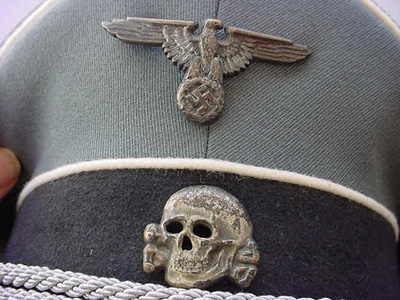
A Waffen SS Generals Uniform (Absolutely Perfect Reproduction) (Item WAF 12-13) |
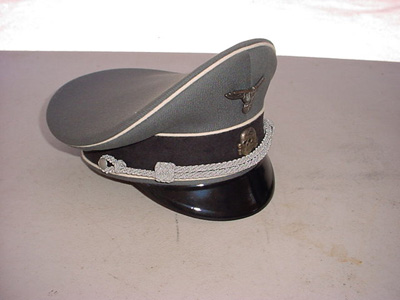
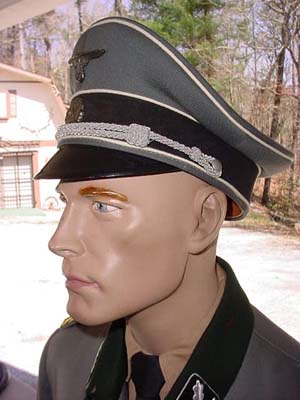
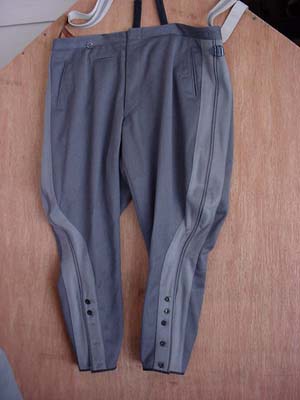
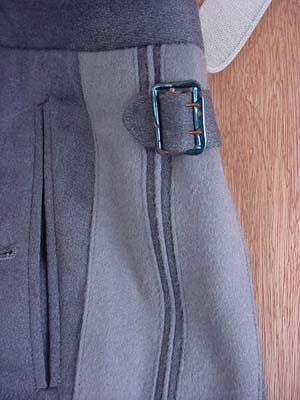
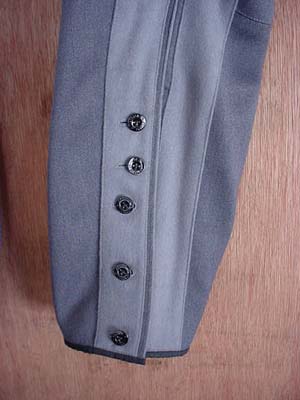
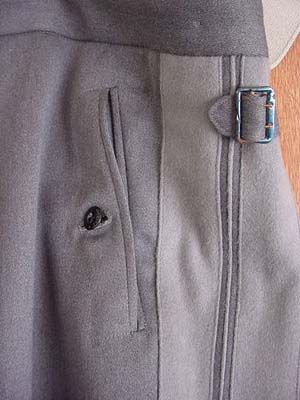
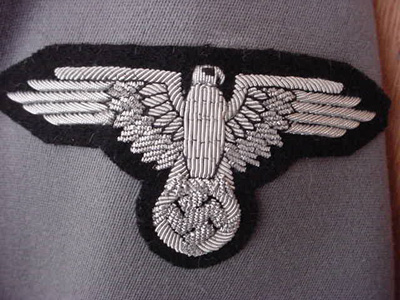
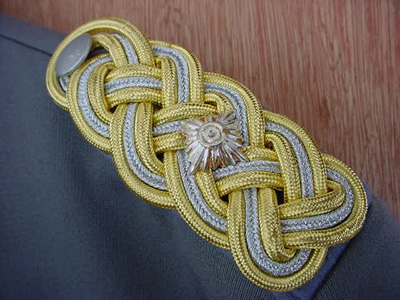
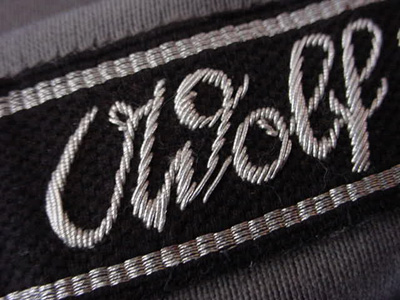
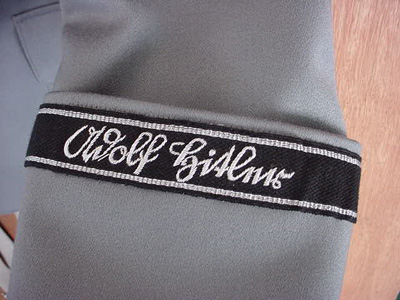
DESCRIPTION: We do not generally handle reproductions on Germania’s site, but we were so absolutely taken by this magnificent outfit that we just had to take it in trade and knowing it was tailored from mostly original cloth by the master uniform maker Michael Janke, we simply had to grab it and feature it. It is spectacular and 100% accurate for a SS Gruppenfuhrer and General Leutnant der Waffen SS attached to the LAH Leibstandarte Adolf Hitler. Unfortunately, Janke’s work is so good that several well-known dealers have aged some of the pieces and sold them as originals. They are that good. (Perhaps unfortunately.) But, they are also “rare.” Michael Janke works only for a few select individuals and avoids most public contact. To purchase a complete Janke Generals’ uniform like this would be fortunate for the potential buyer. The bullion work is superb also... in arm eagle, sleeve band, collar tabs, etc. The cap is also quite sharp looking, the ribbon bar has the following awards looking from left to right – Iron Cross 2nd Class, War Service Cross w/swords, Eastern Front medal with tank device, SS long service medal, Police long Service medal, Austrian Anschluss medal & Memel medal. The trousers have the general rank, wide divided light grey striping. There is even a pair of period suspenders with them. Inside the pocket of the tunic there is a reinforced slit for the suspension of a sword or dagger.All in all, you are looking at an absolutely marvelous grouping unexcelled for authenticity and quality. Nothing made in the Third Reich could have been better. As we have said before, collectors, if you can’t see laying out about $15,000 to $20,000 for a period's generals uniform (if one could be found) then this is an excellent second choice. A rather large size -- the trousers for instance are for a 42 waist. PRICE: SOLD |
 |
 |
 |
 |
 |
 |
 |
 |
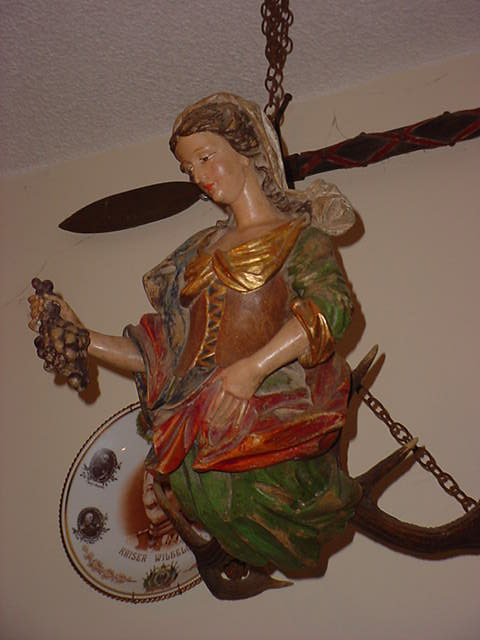 Other such chandeliers |
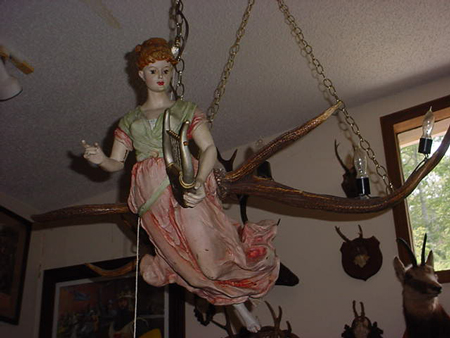 Lusterweibchen |
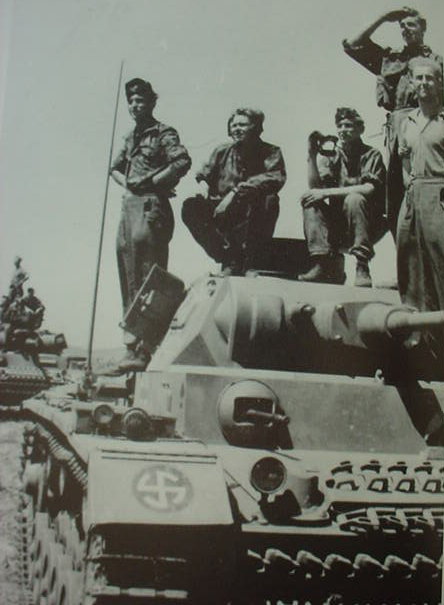 Wiking panzers (note symbol) |
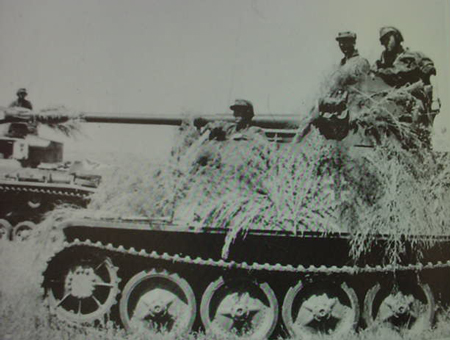 Wiking Vorwarts |
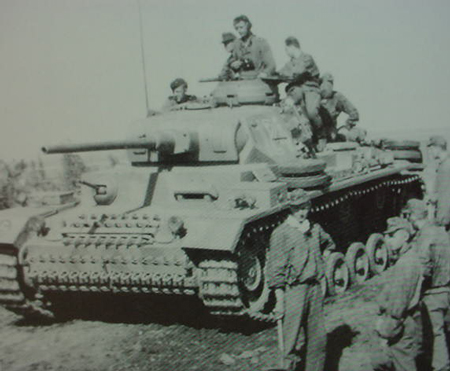 |
 Wiking in Einsatz |
 Fritz Witt 1st Company |
 |
 |
SS Wiking Division Headquarters Hand Carved Chandelier From the War in the East (Item WAF 12-14) |
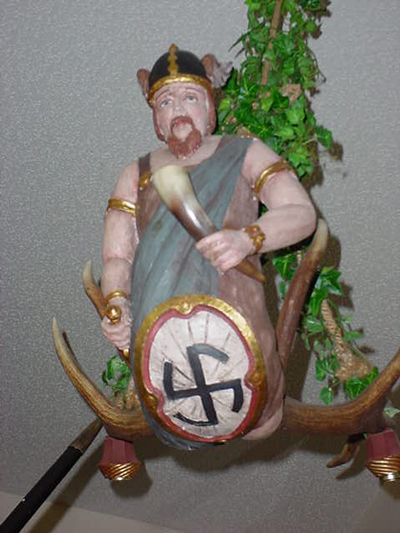
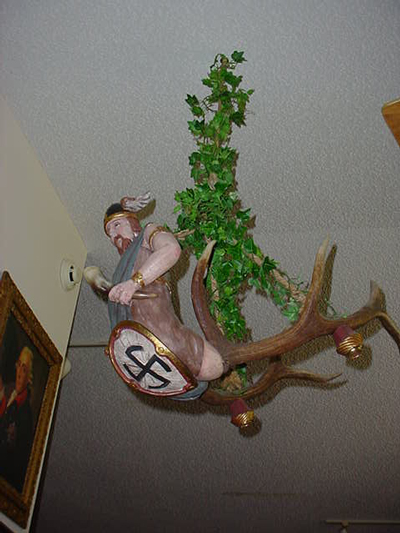
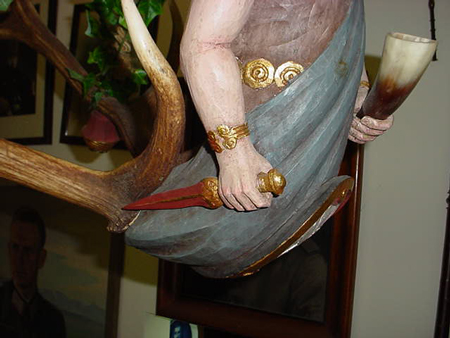
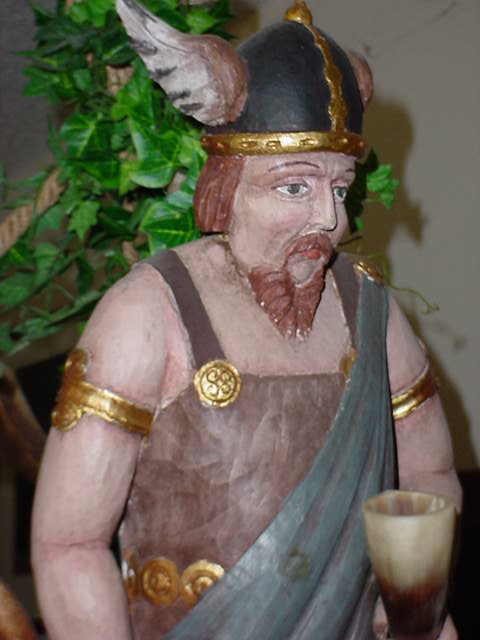
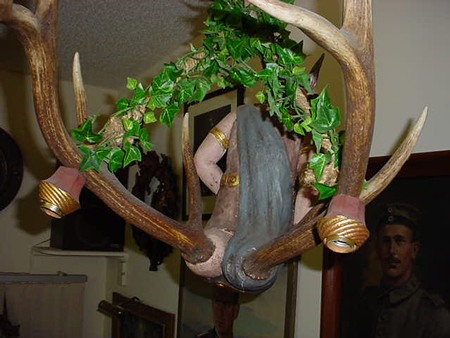
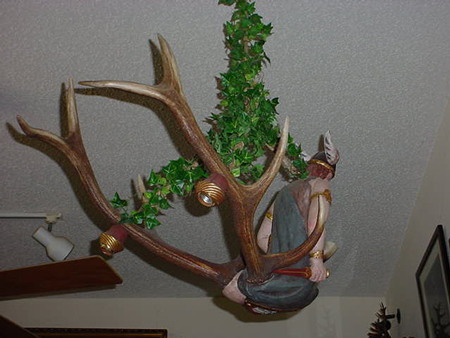
DESCRIPTION: This is an absolutely unique chandelier from the headquarters of the Wiking (Viking) Division Waffen SS. This elite division was comprised of volunteers from several of the Nordic lands. This was the famed 5th Panzer Division, one of the most famous of the 35 Waffen SS Divisions. Scandinavians, Finish, Estonian, Hollanders and Belgium volunteers made up this brigade of heroic stalwart young soldiers of the Reich. The officers were for the most part German; the Division progressed from a motorized infantry division to a full fledged Panzer division and served mostly on the Eastern Front during the war. Background on the Corp history of this unit can be seen by entering 5th SS Panzer Division (Viking) on Google. These gallant soldiers fought bravely and relentlessly throughout the war all the way up to May 1945. The bloody battles that took place due to Operation Barbarossa would test the mettle of saints or supermen. The struggles in the Caucasus produced numerous heroes of military renown. The battles of Kharkov and Kursk as well as the Korsun Pocket and Warsaw plus the Kovel Encirclement and the Budapest relief efforts cost deeply and tragically in fallen comrades but the glory of the saga will be recognized someday and appreciated by those nations from which these Teutonic warriors volunteered. They were the bravest of the brave and they fought for Europe against the greatest Evil Empire that this world has ever seen. If it were not for these men and all the other soldiers of the Reich, the Soviet Beomuth would have spread its tentacles all across the European homelands and ushered in the Devil's era of sheer horror “personified.” Yes, we have read about the alleged war crimes of the Viking Division and they were not alone in this type of action -- sometime you should read about partisan and unrestricted warfare as practiced by America and their British Allies. The regular army troops from these two countries also participated in outright murder when they out of hand executed common German officers and men who had surrendered and were unarmed. All in all, in my opinion, Germany ran a much more clean and chivalrous war than their enemies. “Die Ganze Welt Gegen Uns.” The Divisional Headquarters of The Wiking Divisions was the Starobesheve in the Ukraine. Not much is known about their HQ there. Starobesheve is a small village, one of those that detested the Communists and their Brutish system. It is only natural that this Waffen SS Division would have been welcome there. But imagine the fate of these Russian patriots when the Red beasts finally took over. We know that the Wiking Corps was a proud unit of the Wehrmacht and that brings us to this wonderful chandelier now offered. It was probably carved by a talented member of the Division or possibly an unknown artist locally in the Ukraine. In any case, what you see here is positively unique (one of a kind!) It is entirely carved in wood except for the drinking horn and that is actually the tip of an actual cow horn. It was constructed with two light bulb bases but we think it was never used electronically. You see it suspended from the consigner's ceiling with ropes and there are green vines weaved into the ropes. Those vines are not part of the original but the consigner will include them with your purchase should you so desire. The stag antlers are from a trophy Red Stag buck. The figure from the warrior's face to the end of the antlers is about 3 feet and the figure itself is about 2 ½ feet long. In German this would be called a Wiking ‘Lustermannchen’ and it has been traditional in Germany for a hunter to display his trophy in this way and one will see antique chandeliers done in this way in hunting lodges and beer halls all over the Reich. This one is of course very unusual considering the subject. The accompanying dagger, jewelry and winged helmet suggest a Viking Chieftain. The shield is adorned with the Sonnenrad peculiar to Nordic Sagas and lore -- Sonnenrad means Sun Wheel. This swastika-like symbol was of course the logo or symbol of the Wiking Division from their inception until the tragic end. But this jolly chief is truly reminiscent of the glory days of the 5th Panzer Division (Wiking)...the toughest of the tough! Imagine this one suspended from the ceiling of your den, magnificent beautiful and prodigiously historically important as well. PRICE: $4,900.00; Wonderful? Absolutely! |
 |
 |
 |
 |
 |
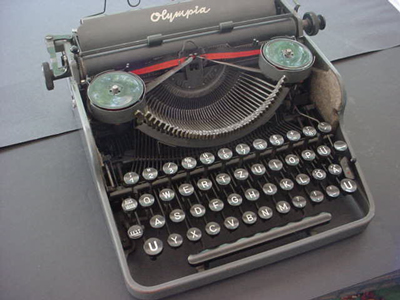
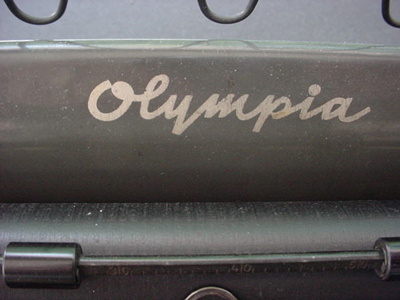
| Typewriter (Item WAF 12-15 & SS 35-9) |
DESCRIPTION: This is a portable, 1930's Olympic office style typewriter as used by SS personnel, both Allgemeine and Waffen SS. The key #5 is also the PRICE: SOLD |
 |
 |
 |
 |
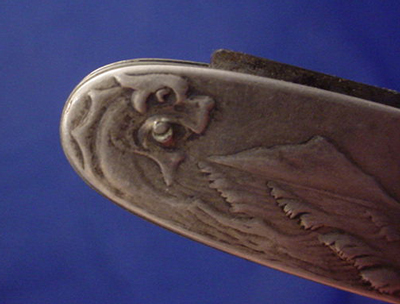 |
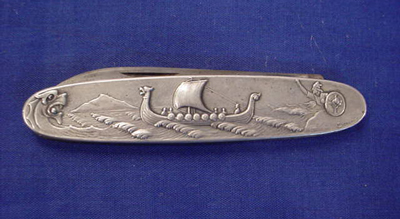
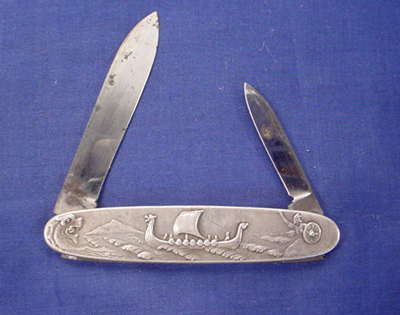
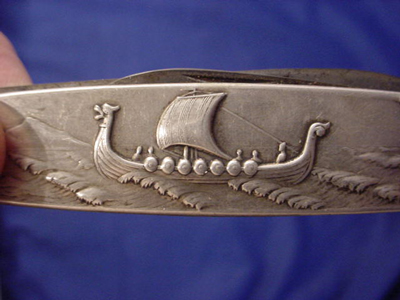
A Viking Pocket Knife (Item WAF 12-16 & VIKING 1-6) |
DESCRIPTION: This little pen knife is in bright steel and bears the image of a Viking Long Ship in the Norwegian Fiords. It is the same depiction on both sides; it also has at one end the Sea Dragon from Norse legend, at the other end is the Viking warrior with sword and shield at the ready to slay the beast. A well-made little knife that was worthy of being signed and under magnification you can see a company logo beneath and back of the warrior. 3 ¼ inches long (closed) and 5 ½ inches long with the larger blade extended. Blade has some age spots but will clean up. Probably from the 1930’s or 40’s. Might have been a token Christmas gift to the men of the SS Wiking Division? PRICE: SOLD |
 |
 |
 |
 |
 |
 |
 |
 |
 |
 |
 |
 |
 |
 |
 |
 Back cover |
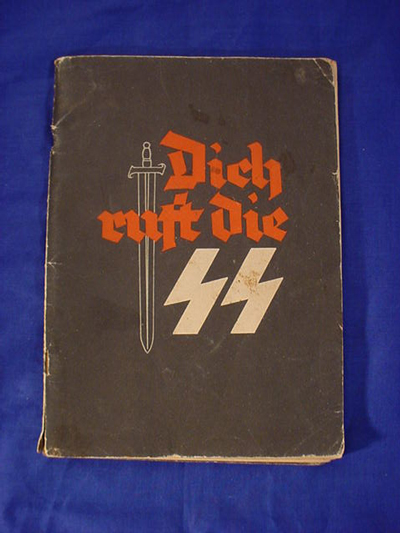
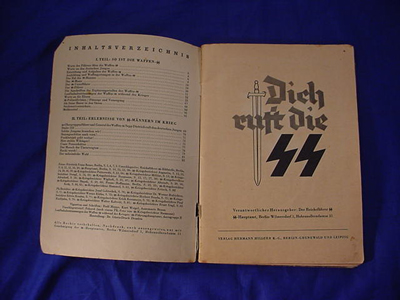
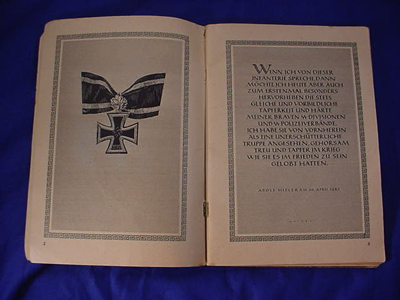
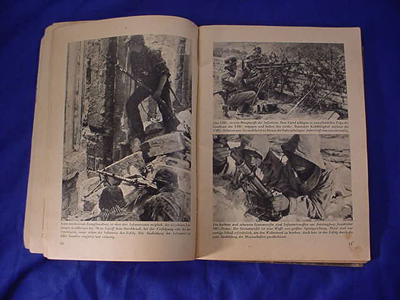
Book: Dich Ruft Die (Item WAF 12-17 & SS 35-10) |
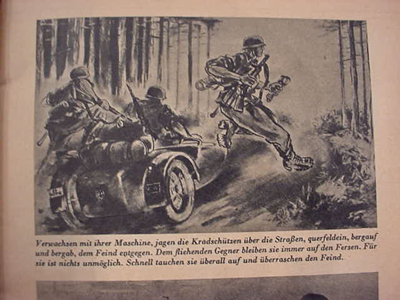
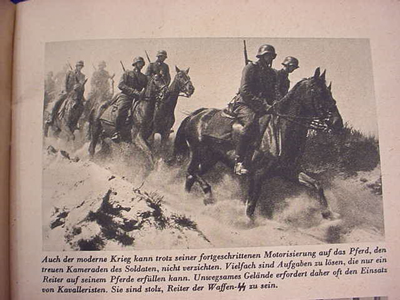
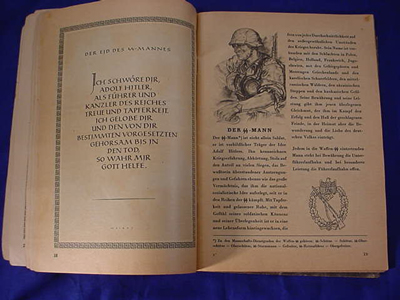
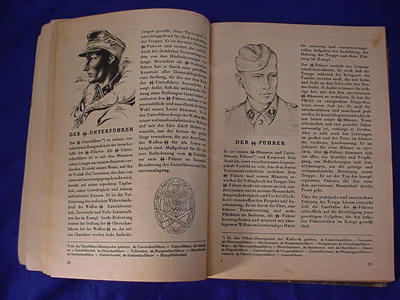
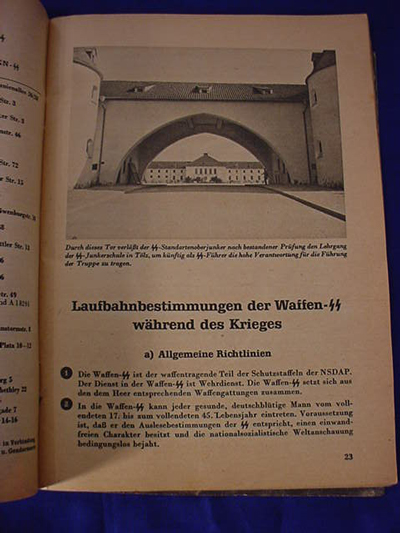
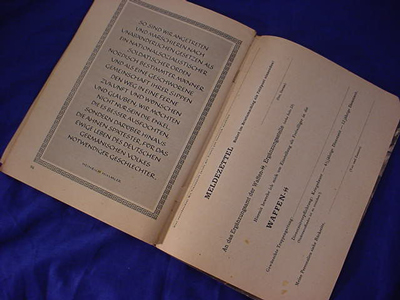
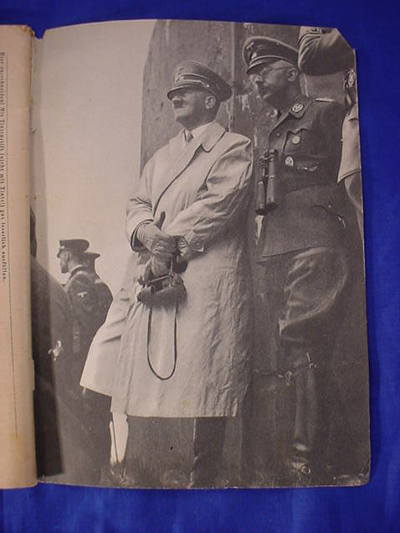
DESCRIPTION: This soft cover book whose title is translated as “You Call the SS” was produced at the SS Headquarters in Berlin under the supervision of the Reichs-Fuhrer SS Heinrich Himmler probably in the late 40’s. It was basically a primer for recruitment in the ranks of the Waffen SS. It is soft cover with 96 pages. It measures 6" x 8" and is in very decent shape overall. It is filled with pictures and text that is designed to show the reader what glories can be achieved while saving the European continent from Bolshevism. Germany and other nations sought to achieve this through the promotion of the SS ideals and the participation of the young men of the Reich and European kin whose bravery, dedication and chivalry was seen in battle for culture, country, and Fuhrer. There are many sayings, speeches and statements by Adolf Hitler, Heinrich Himmler, Sepp Dietrich. Particualry interesting is the oath that the SS recruit verbalizes upon his entrance into the SS organization.”Ich Schwore Dir Adolf Hitler Als Fuhrer." The various elevation of military grades are explained. The SS Junkerschule Bad Tolz is shown and the training of the Waffen SS recruits is explained. The various recruitment HQ of the Waffen SS are listed with addresses and phone numbers for potential recruits. This list explains the title “Dich Ruft Die SS." The young man who wished to join or get information would actually telephone one of these offices and talk to a recruiter. There are also forms at the back of the book that one could send in for information to any of these offices. The book is loaded with information about the Waffen SS, such as ranks, job titles, Waffenfarben (colors) of piping on uniforms of the Wehrmacht. Equivalent ranks between SS and army and many pictures of SS in action. Plus maps, and there is a great center spread of the Fuhrer with his Leibstandarte A.H. at the front. This is the ultimate book on the men whose motto was Mein Ehre Heist Treue! My Honor is Loyalty. PRICE: $485.00 Expensive??’ Say,”RARE” instead of expensive! Say “GREAT” instead of mediocre. |
 |
 |
 |
 |
 |
 |
 |
 |
 |
 |
 |
 |
 |
|||
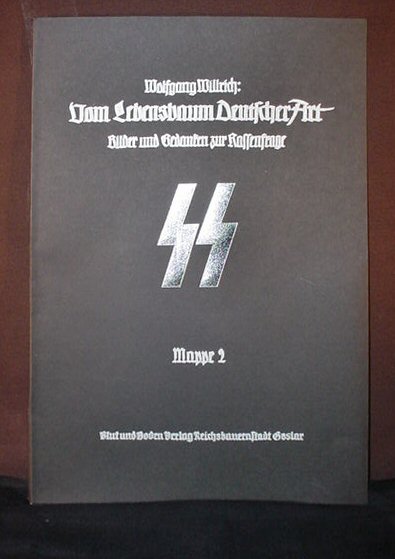
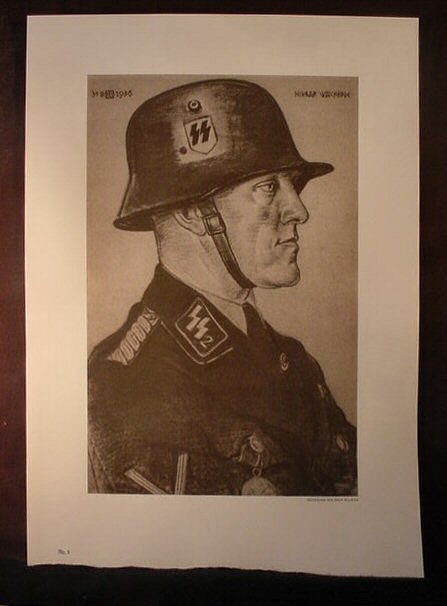
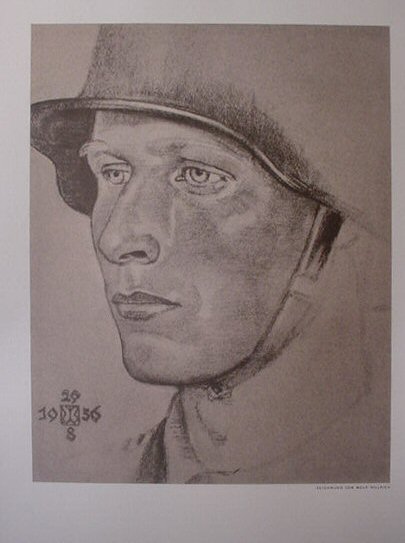
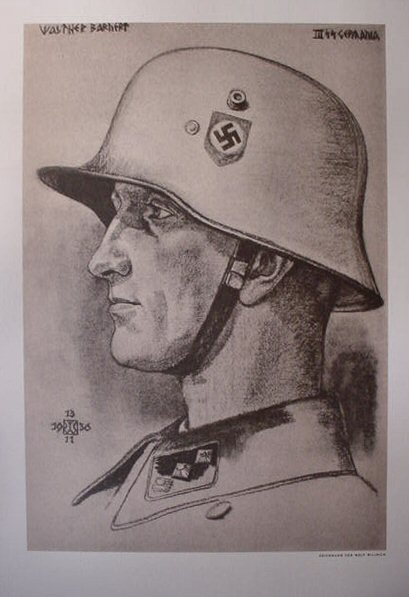
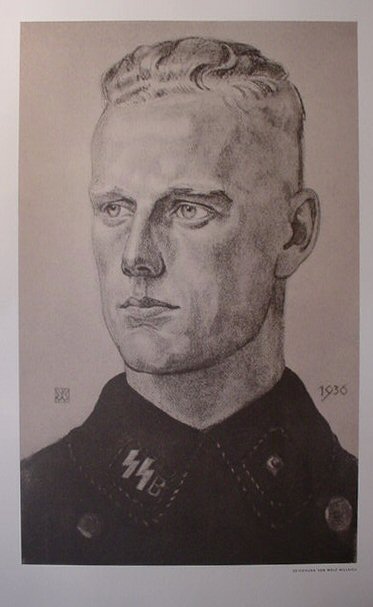
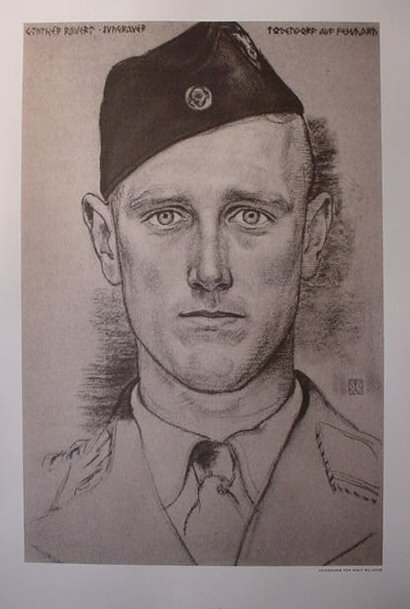
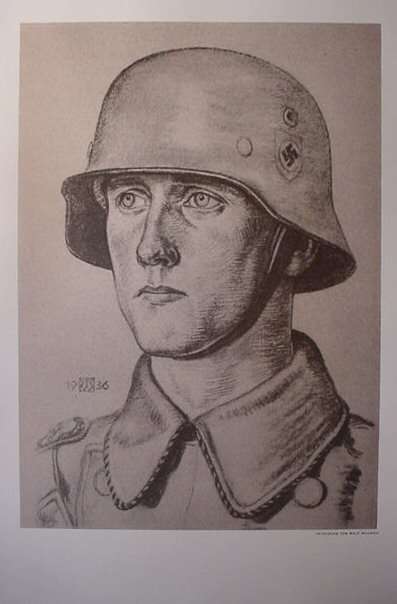
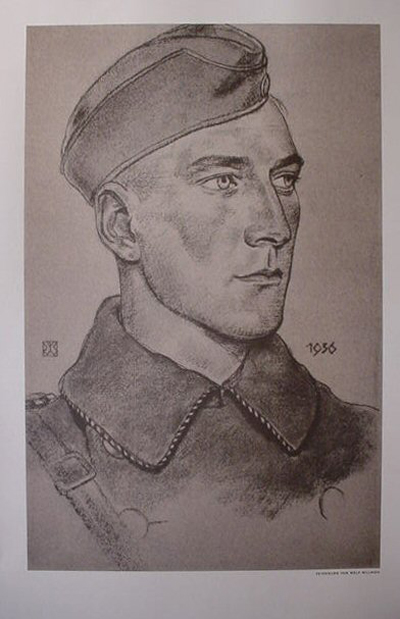
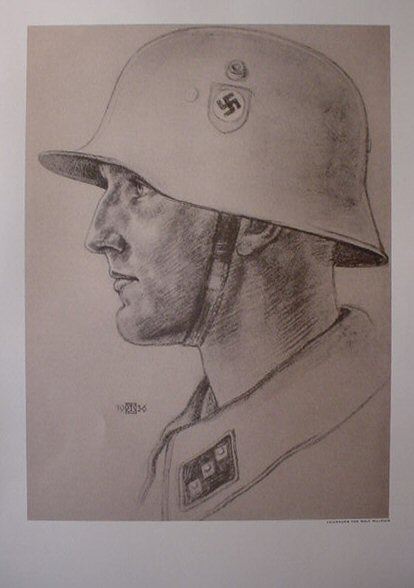
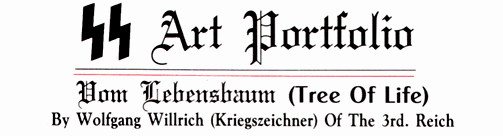
SS Art Portfolio by Wolfgang Willrich in Embossed Cover (Item WAF 12-18; SS 35-17; LEIBSS 2-5) |
|||
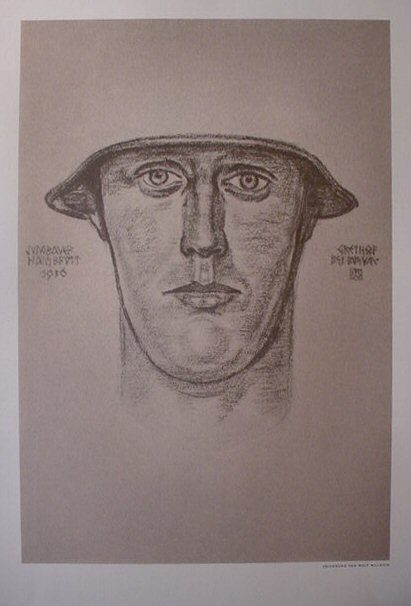
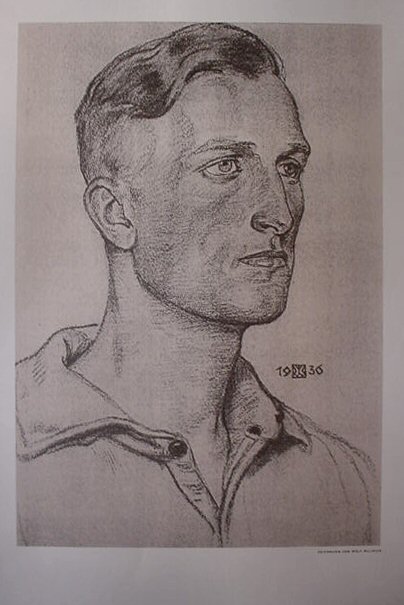
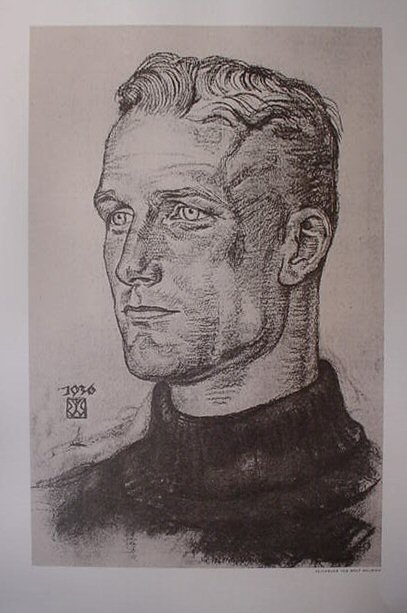
DESCRIPTION: We proudly present an exquisite reduplication of Wolfgang Willrich’s folder of 12 prints produced in 1936 featuring the bust portraits of both Allgemeine and V.T. Troopers. Although Willrich was one of the most gifted and prolific artists of the Third Reich, this particular offering is so rare that only 3 original sets are known of in collections today. Therefore, we are extremely pleased to offer this magnificent reproduction that is accurate in every detail including size, sepia tones, and the finest printing quality available anywhere. We have a limited quantity available and because of the beauty and rarity of this portfolio, we are sure that it will become valuable in a short time; a real collector’s opportunity. The prints are individually presented and not bound (suitable for framing) and measure 11 1/2 x 16 1/2 inches with a page of the same dimensions containing a foreword by Heinrich Himmler concerning the importance of this set of prints to the ideology of the Nazi Movement. All are enclosed inside a heavy and handsome black folder boldly embossed with the SS runes and legend. PRICE: $39.95 plus postage and handling - dealer inquiries solicited - very good lot prices available |
|||
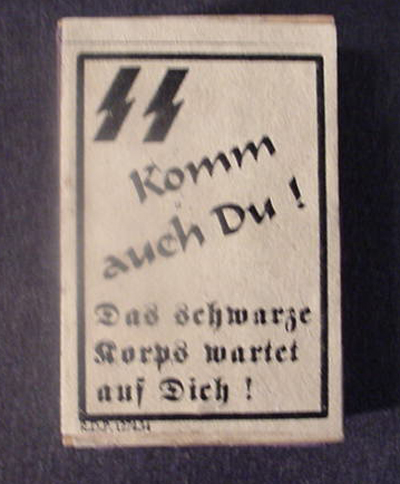 Translation of what it says on the box top -- The SS wants you! The Black Corps waits for you! |
 |
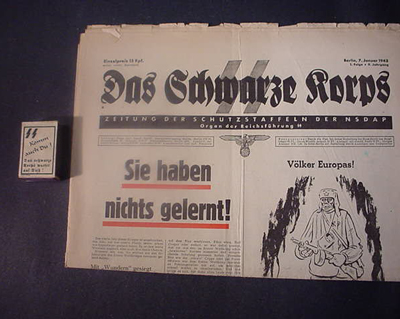 |
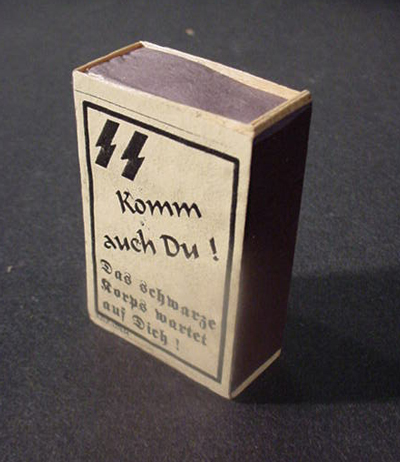
Matchbox from the Schwarze Korps (Item WAF 12-19) |
|
DESCRIPTION: Collectors, do you want something neat and original from the PRICE: $220.00 plus postage in the US for $7 priority mail. Genuine and interesting! Do not mention "SS" on PayPal (Only matchbox) |
|
 |
 |
 |
 |
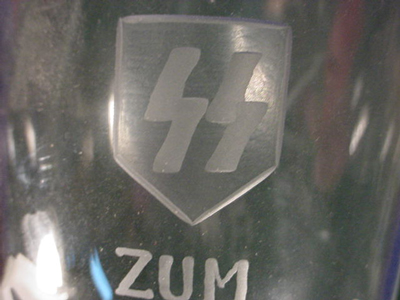 |
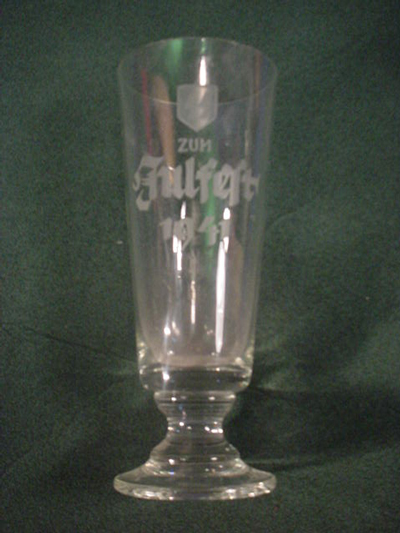
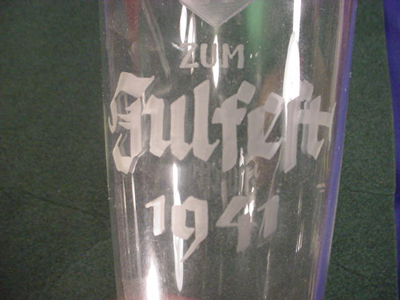
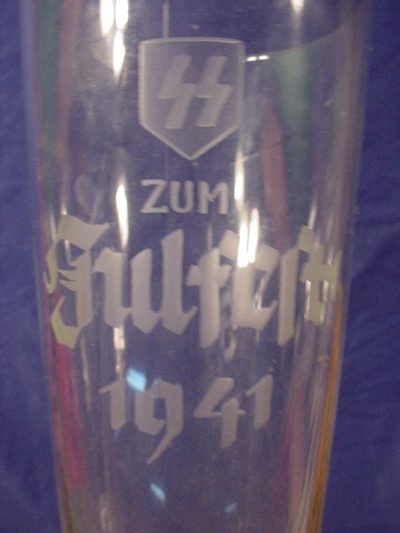
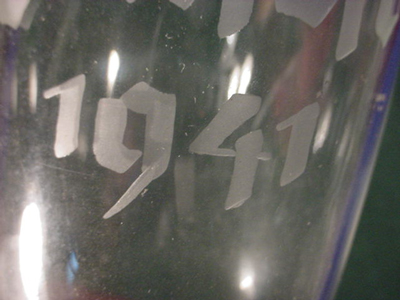
| Yule Fest Beer Glass (Item WAF 12-20 & SS 35-18) |
DESCRIPTION: This is a fine crystal beer glass 9 ¼ inches tall of the type that was made first for and distributed to men of the Allgemeine SS to celebrate the occasion of the winter Solstice. In a 1936 memoranda, SS Reichsfuhrer Heinrich Himmler set forth a list of approved holidays based upon both Christian and Pagan political precedents, and besides Hitler’s birthday and the November 9th Beer Hall Putsch Anniversary, Christmas and Yuletide were ultra-important. The Yuletide or winter solstice brought together practically the entire SS Fraternity at candlelight banquet tables and around raging bonfires, observances that harked back to Teutonic tribal rites. At those banquets the one liquid most served and consumed was traditional German beer in steins and beer glasses. In 1941 in the 2nd year of the war, the men of the Panzer Grenadier Division SS Leibstandarte celebrated the Julfest and the beer glasses were once again brought out and of course new ones were made for a celebration of the ancient ritual at the front. Now the men imbibing the delicious nectar were dressed in the grey green of the Waffen SS The silly tales about the SS under Himmler trying to move the men away from Christianity is “hog wash.” The Waffen SS even had Catholic and Protestant Chaplains. The celebration of the so-called pagan rituals was to simply honor the Teutonic past of the Germanic people. Kein Volk Lebt Langer Als Die Dockumente Seiner Kultur! ("No people live longer than the documentation of their culture", Adolf Hitler quoted . . . in the opening of Der Haus Der Deutschen Kunst 1937.) The glass is hand etched with the SS symbol in a shield at the top and Zum Julefest 1942 deeply engraved in beautiful calligraphy letters. A beautiful memento of an “Iron Time”. PRICE: $1,150.00 |
 |
 |
 |
 |
 |
 |
|
 |
 |
 |
 |
 |
 |
 |
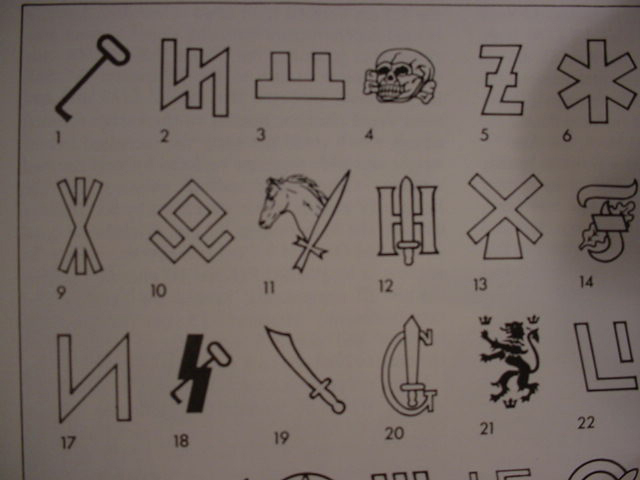 Note #2 on chart |
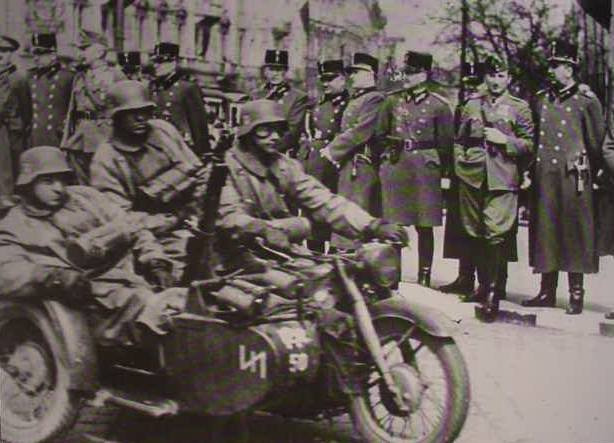
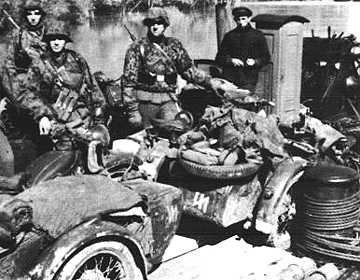 Note the Wolfsangle symbol on SS vehicle |
 |
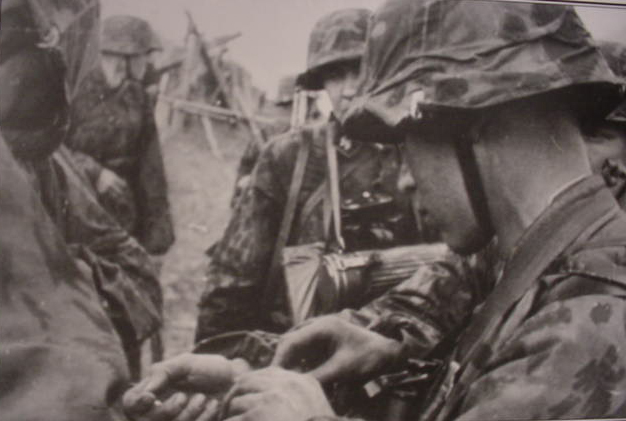 Das Reich soldiers |
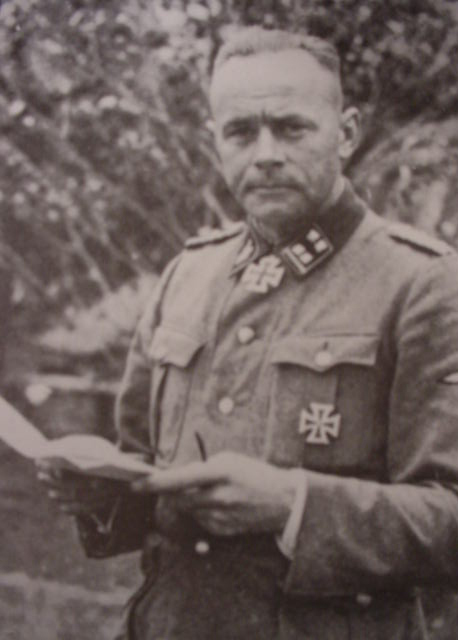 Obst. Werner Ostendorff, Commander in 1944 |
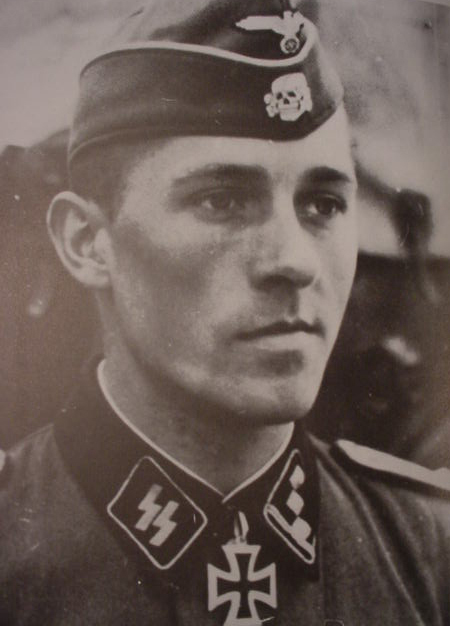 KC Winner Fritz Rentrop (das Reich) captured, tortured & murdered by Russians |
 |
 |
 |
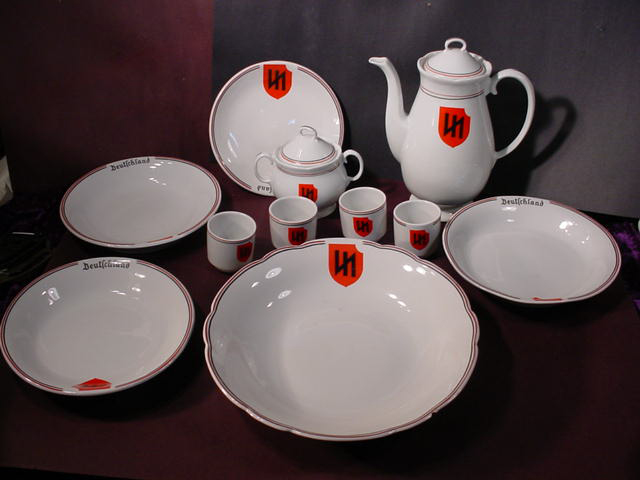
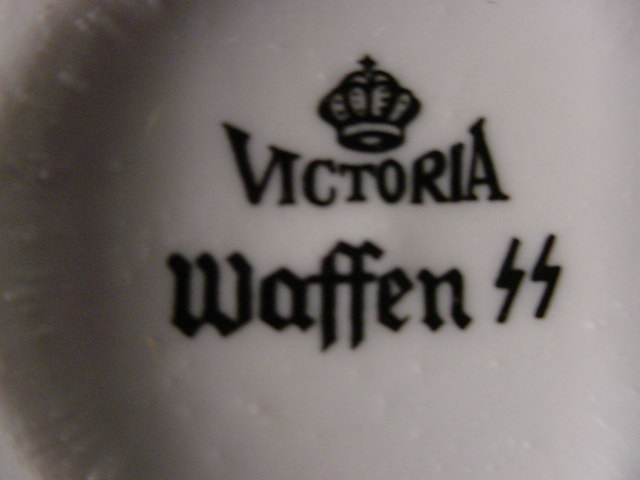
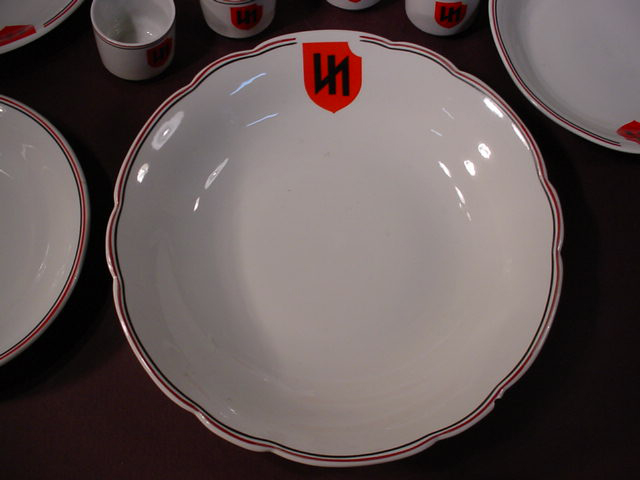
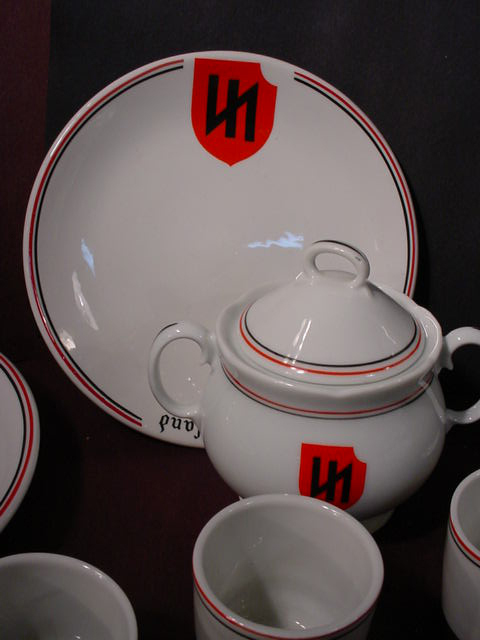
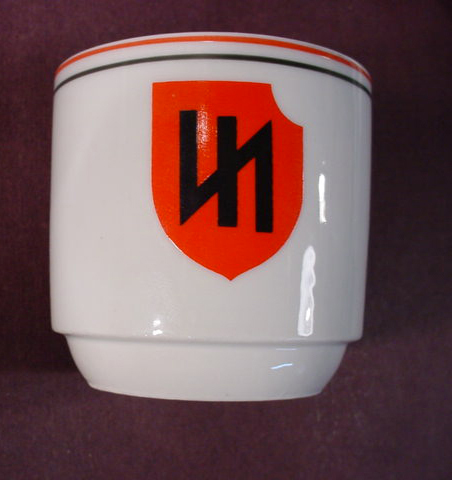
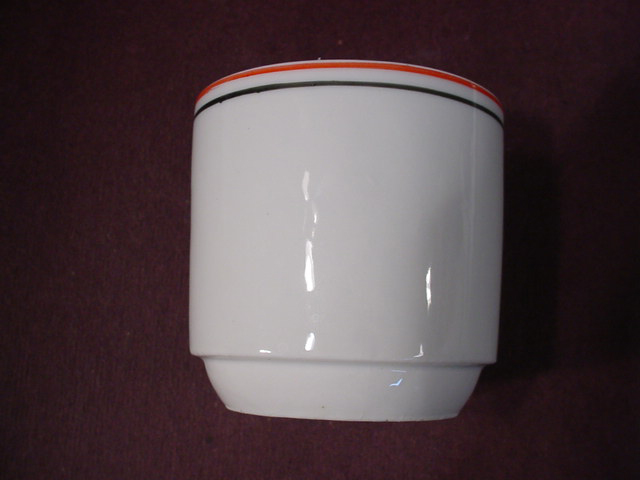
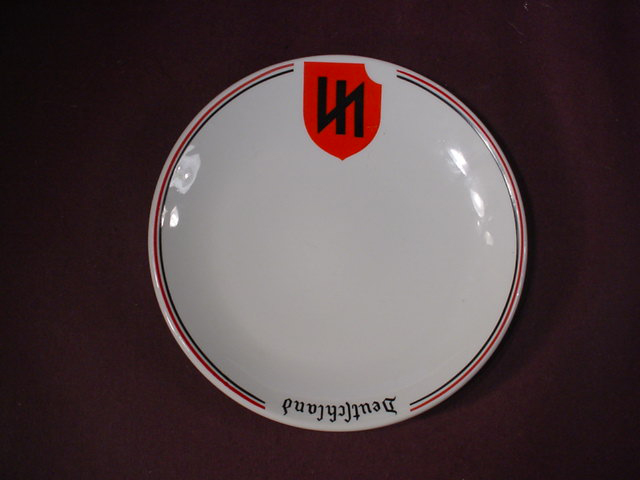
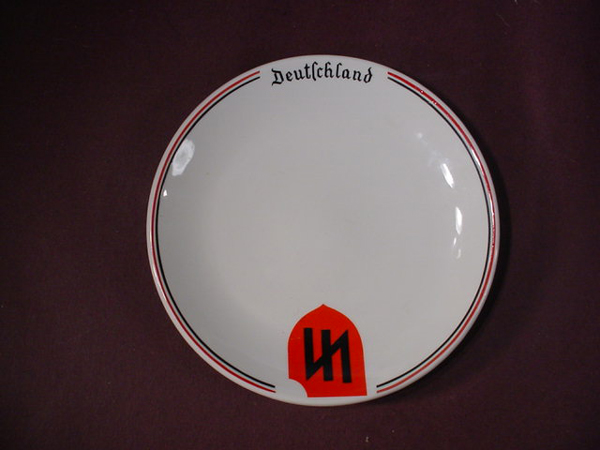
SS Officers Mess Porcelain Tableware from the Elite Deutschland Waffen SS Division (Item WAF 12-23 & SS 35-25) |
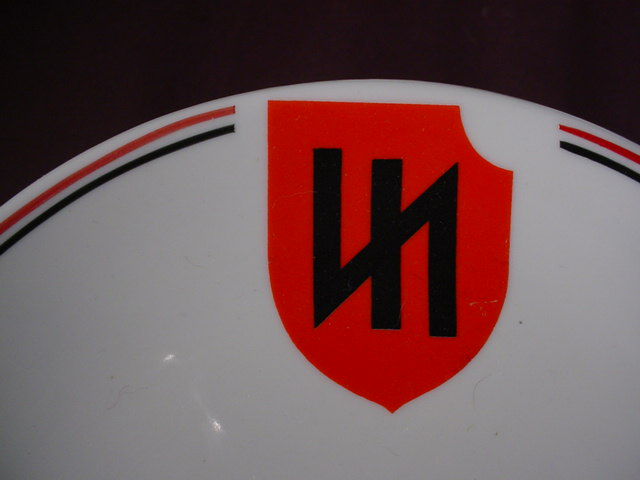
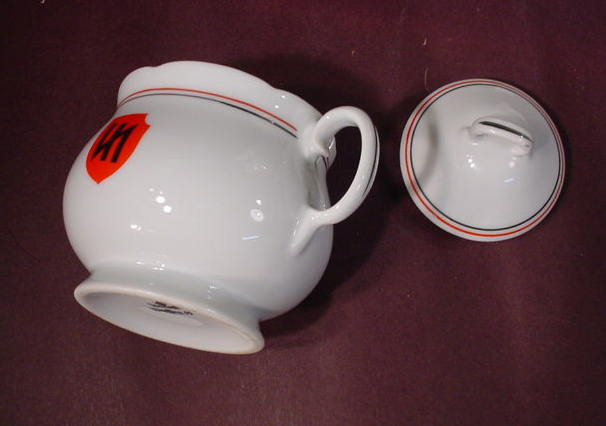
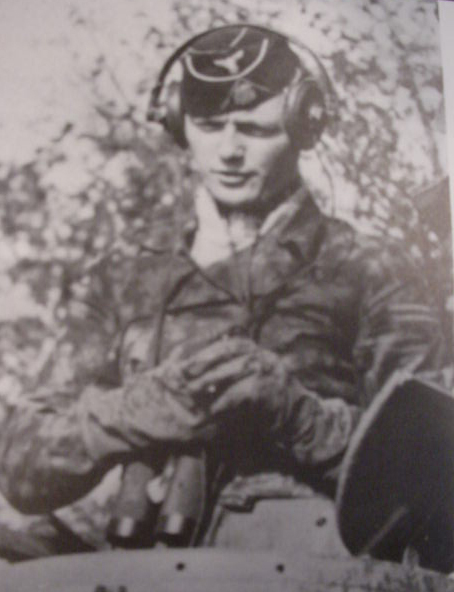
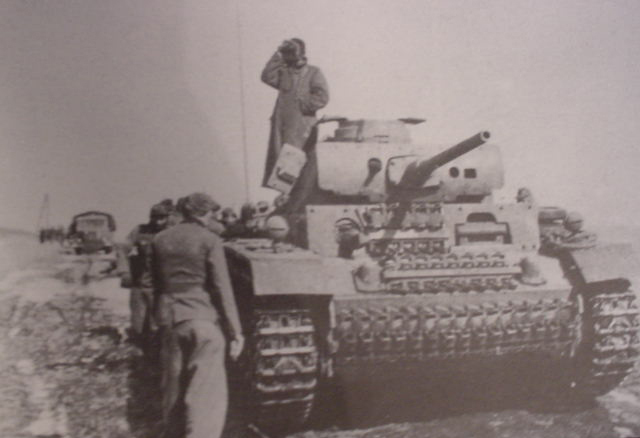
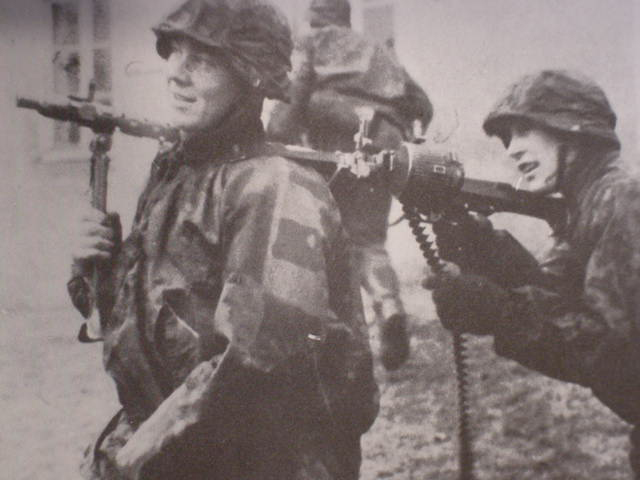
DESCRIPTION: This is a great grouping of fine porcelain china from the HQ of the 2nd Waffen SS Division “Deutschland”. All white bone china pieces that are trimmed in black and red striping on white background (the National colors). Each piece also bears the division's emblem -- a large red shield with a clipped upper right corner holding a reverse ‘n’ with a vertical center bar. Included are: * No. 1 - a mocha pot 9-5/8" tall with a ‘swan neck’ spout and removable lid The Victoria Porcelain Company: The company was founded in 1183 by Lazarus Rosenfeld Ltd. The Victoria Porcelain factory was located in Altrouhlau, Austria and it was sold to Franz Schmidt two years later and became the finest and most productive porcelain factory of its time; the pieces manufactured by the Victoria Company were considered commercial products, at the time they were not considered to have great artistic value. However, the company also produced many pieces that are of high quality and are considered by today’s collectors to have great artistic merit. In addition to porcelain pieces, the Victoria Company also produced a ceramic product called porcelite. Although this type of porcelain is considered a lower quality ceramic product, it was used all the way up and through WWII because of its durability and strength. Das Reich: This was the 2nd Panzer Division -- considered an elite formation amongst the thirty-eight divisions fielded by the Waffen SS. It served during the invasion of France and took part in several battles on the Eastern Front (they particularly won combat laurels in the battle of Prokhorovka against the 5th Guards tank Army at the Titanic battle of Kursk where the young Spartans of the SS fought valiantly against massive odds. Afterwards they were transferred to the west and took part in the desperate attempt to turn back the forces of Stalin’s “willing helpers” at Normandy and the Battle of the Bulge and the ending the war with the last stand in Hungary and Austria.) The symbol for the Das Reich Division (formally Deutschland) was the Wolf’s Hook or Wolfsangel. The division fought with honor and ever loyal to their oath “Wenn Alle Untreu Werden so Bleiben wir doch treue” (English: If all become unfaithful we remain loyal). Yes, yes, we are familiar with the executions at the French village of Oradour Sur-Glane and it was sheer horror personified but to every war story there are invariably two sides and thereby hangs the tale. There are dozens of sites with the words “massacre and murder” regarding this incident and not much has been said about legal reprisals against terrorists and unlawful partisans. If you the reader has an inquiring mind you can see the other side of some of this story by going online and typing in Oradur Sur Glane, The SS version of the story. And you can make up your own mind about the incident. There is much to consider. Again these relics are merely things from the turbulent past but they must be preserved for the sake of history. Revisionism is perceived as bringing history into accord with the facts! We are proud to bring you this awesome grouping of beautiful porcelain pieces and hope you will pour yourself and a companion a couple of nice cups of mocha and think of the past glories and tragedies of the W-SS fighting in a terrible fratricidal war and hope that there would never be another of this magnitude. PRICE: SOLD |
 |
 |
 |
 |
 |
 |
 |
 |
 |
 |
 |
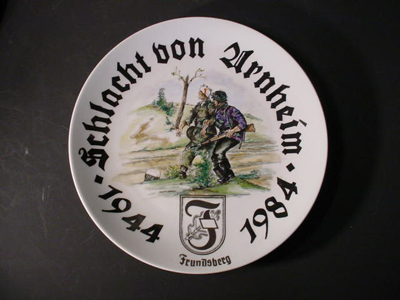
Commemorative Plate Hand Painted in Memory of The Battle of Arnheim in 1944 (Item WAF 12-24 & ART 17-4) |
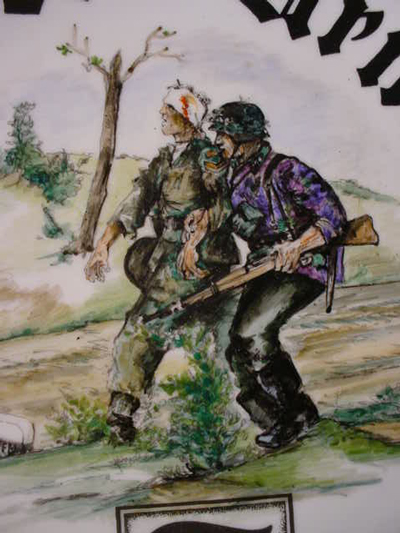
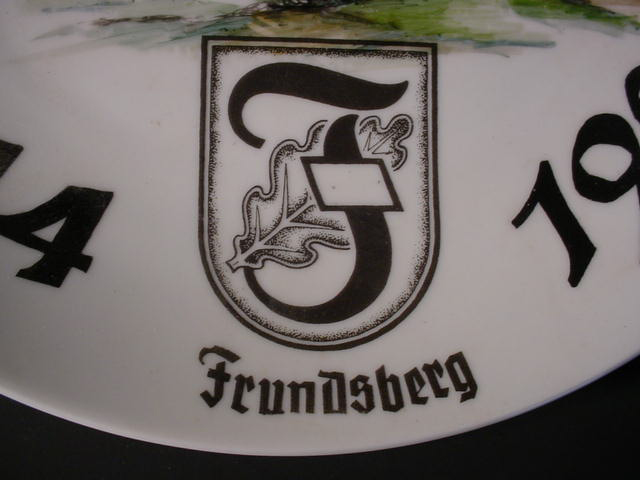
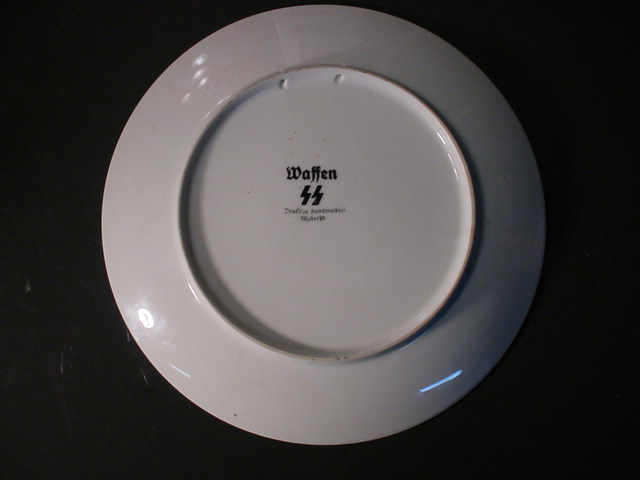
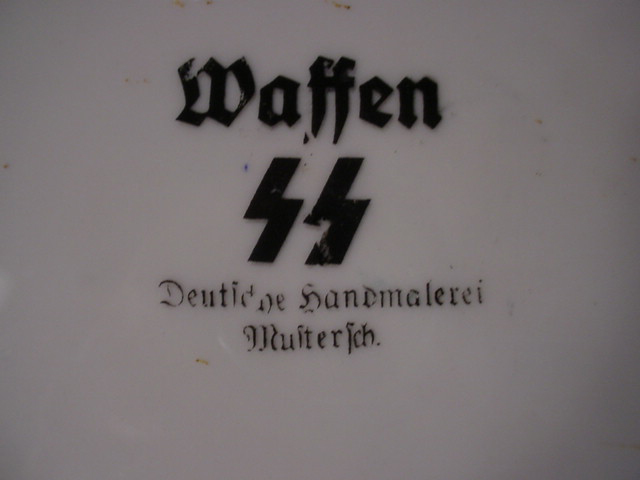
DESCRIPTION: The 19th Panzer Division Frundsberg was an elite armored unit whose 1st campaign was in the Ukraine in April 1944 they were highly motivated after combat success and the unit was transported to the west where they valiantly fought the Allied invaders in France and at Arnheim. The movie (A Bridge too Far) attempted to record the incidents of this battle with the Allies of course portrayed as “good Guys” and the Waffen SS soldiers shown as bumbling idiots who blatantly offered themselves as bumbling fools who offered their bodies as swell targets. Of course this was for the pleasure of the ‘real idiots’ who enjoyed watching this distortion of history as long as enough German blood would flow even in screen portrayal. The efforts of the SS Frundsberg heroes was unfortunately to no avail for they were hopelessly out gunned and overwhelmingly outnumbered but they lived up to their motto ‘Meine Ehre Heist Treue! And their by -words Wenn alle Untrue werden so bleiben wir doch treue – (When all were untrue we remain loyal!) The plate has a hand painted depiction of a Waffen SS trooper helping a wounded comrade off the field. Below this is the runic looking (F) in the shield surmounted over the oak leaf of the unit and around the edges are the words Schlacht Von Arnheim (Battle at Arnheim) this was a tragic battle where most of the brave German defenders were killed or wounded but still does the fame of their glory remain. They fought for Europe and the west, they gave their lives to defeat evil Bolshevism that horrid system that was aided abetted and joined by the so-called Democracies. Let this plate be a small memorial to these heroic soldiers of the Reich. The plate is measured at 10 ½ inches in diameter. On the back it says Waffen SS and -Deutsches Hand-Maleri (hand painted). A beautiful piece of art it was painted in 1984 -40 years after the battle. We don’t know who the artist was but he certainly caught the spirit of the “Helden Deutschen Soldaten”this rendering is not an item from the years of the Third Reich but it richly captures the Geist of the turbulent times. This could have been produced by the artist to commemorate the reunion of the veterans of the Frundsberg Panzer division in 1984. PRICE: SOLD |
 |
 |
 |
 |
 |
 |
 |
 |
 |
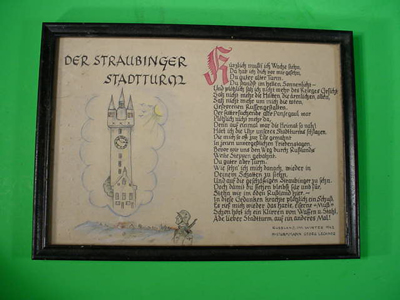
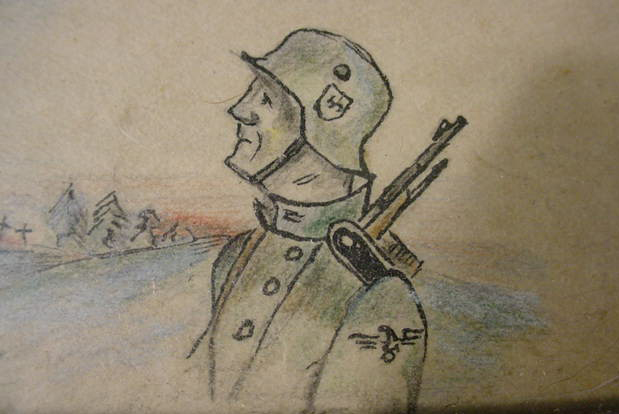
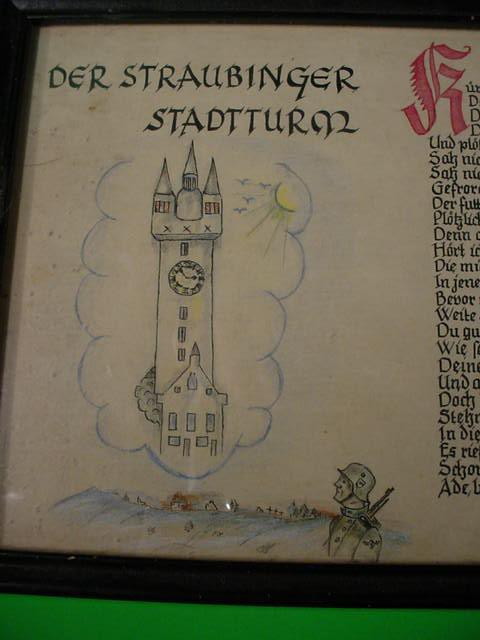
Memorable War Time Poem and Art Work Written by a Waffen SS Soldier in Russia 1942 (Item WAF 12-25) |
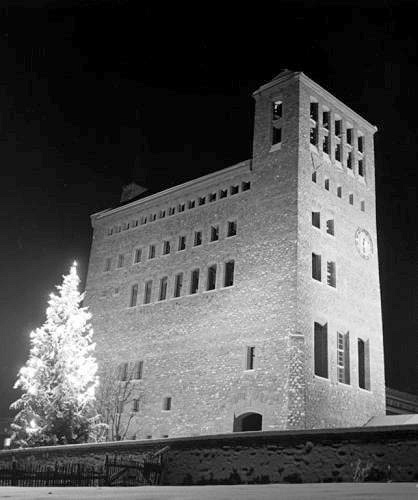
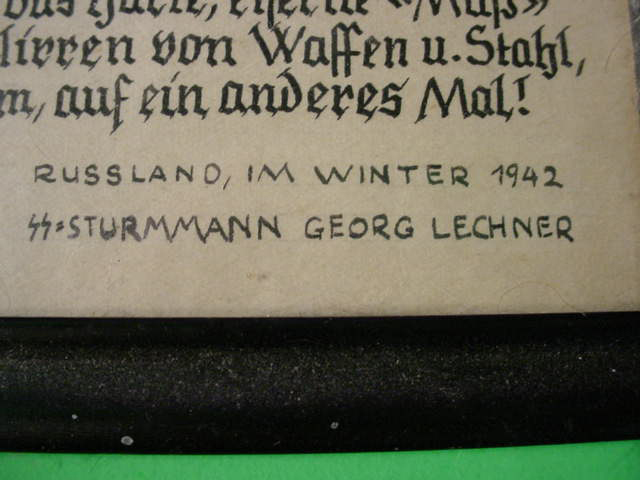
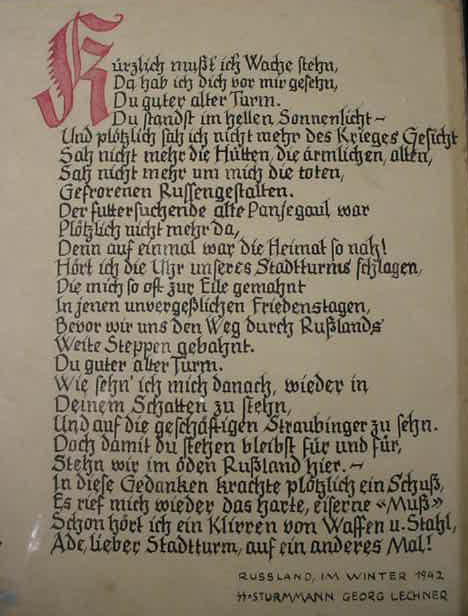
DESCRIPTION: This is a poem from an SS Man,who came from Straubing and longed to see his home town landmark, the Straubinger Turm. Built around 1380, I think, I have been in it 23 years ago. Stands in the town center square. Here the translation: Recently, I stood on guard, and I saw you in front of me. Russia –Winter 1942 SS-Sturmmann Georg Lechner The art work and poem are not copied, they are the original work of the Waffen SS soldier Lechner. This could have been the sentiments of any soldier in a far off foreign war. They are words of hope -- practically prayer. It is my hope that Georg survived this horrid experience that would test men’s souls, but in any case had not the valiant German soldiers done their duty in the frozen wastes of Russia it is for sure that the evil Soviet Behemoth would have overrun Europe from the eastern border of Germany right to the coast of France, after that England would have fallen quickly and the entire west would have been just an extension of Stalin’s horrible regime. They almost managed this with the aid of the western allies. All that stopped them was the bravery and selfless sacrifice of soldiers like this unknown hero. We don’t know where this little poem was found in the flotsam and jetsam of the war; we have had it since 1969 and it turned up in a Berlin Book shop. The frame measures 12 x 9 and I consider this to be a greater and more meaningful remembrance and important historical item than any field helmet or bayonet or even an M-43 cap. Here is a monument to Der Helden Deutschen Soldat! Mein Ehre Heist Treue! PRICE: SOLD |
 |
 |
 |
 |
 |
 |
 |
 |
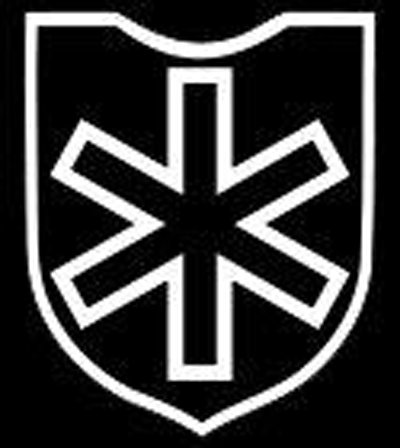 Waffen SS Division NORD |
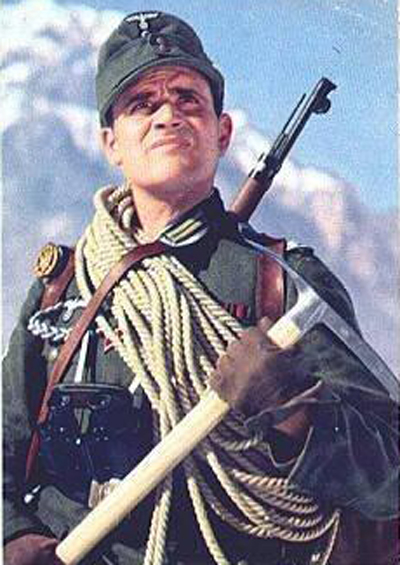 Army Mountain Trooper |
 Cap badge from SS Mountain Division NORD |
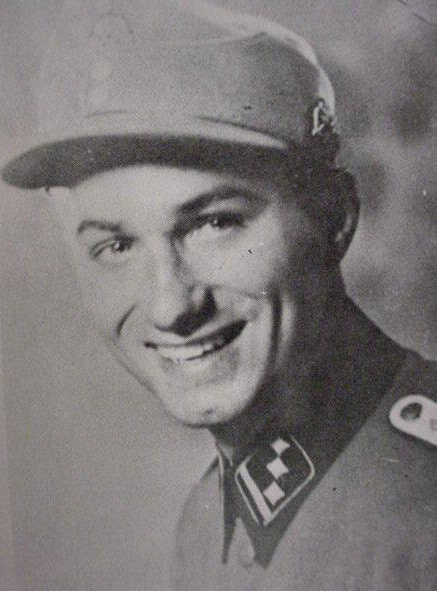 Trooper from SS Mountain Division NORD |
 |
 |
 |
 |
 |
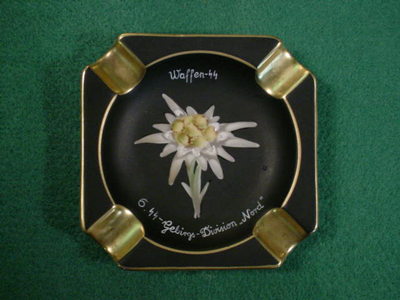
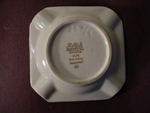
Ashtray from the Kaserne of the Mountain Troops (Nord) (Item WAF 12-26 & WEHR 32-3) |
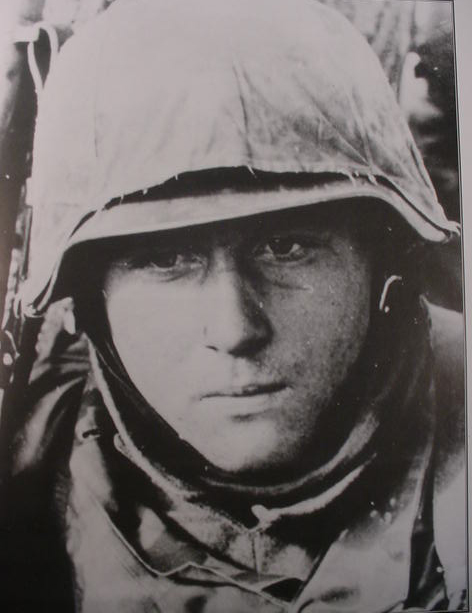
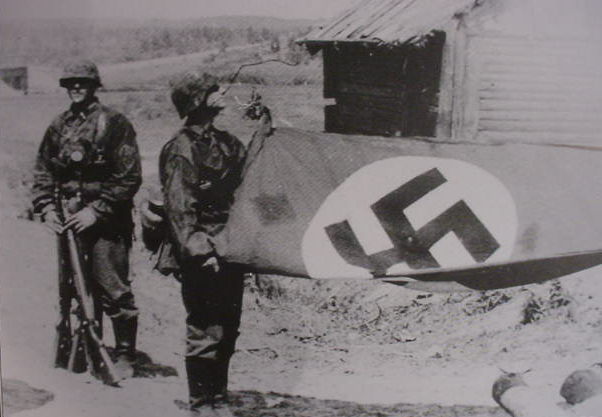
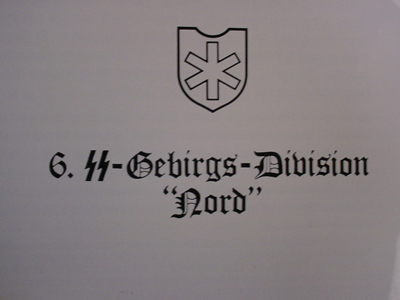
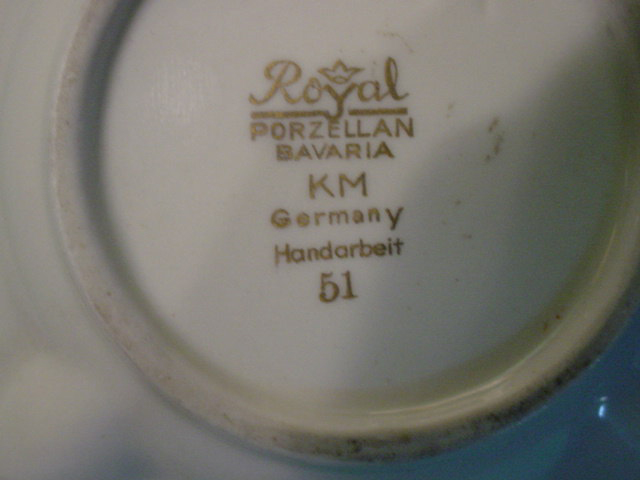
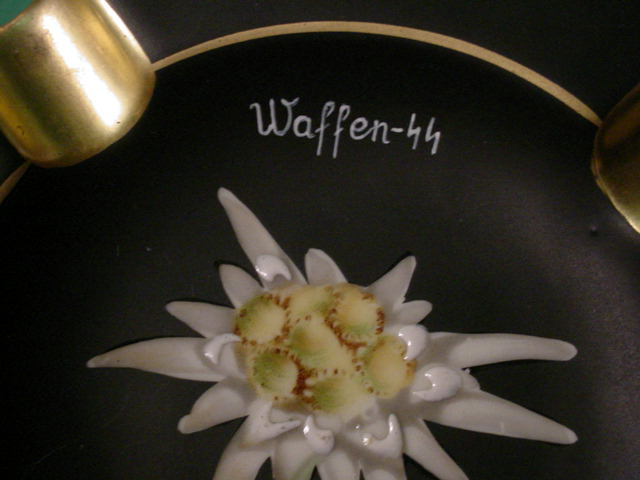
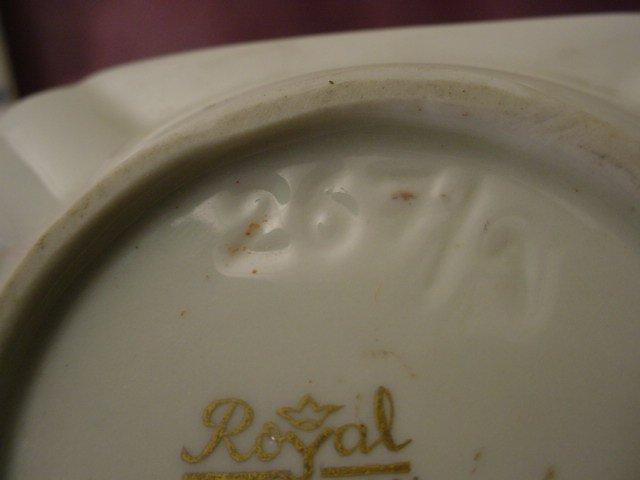
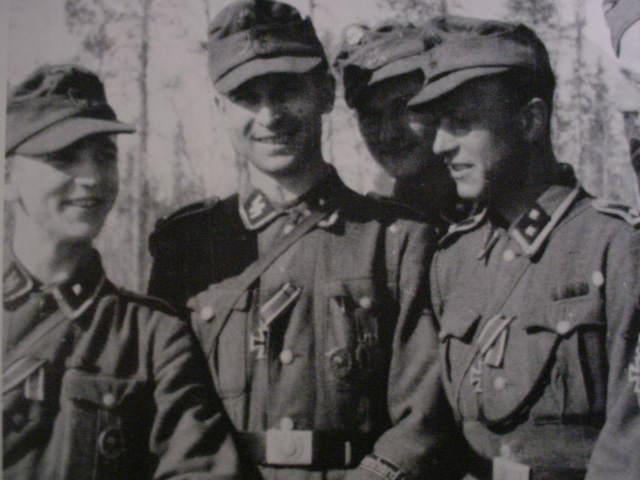
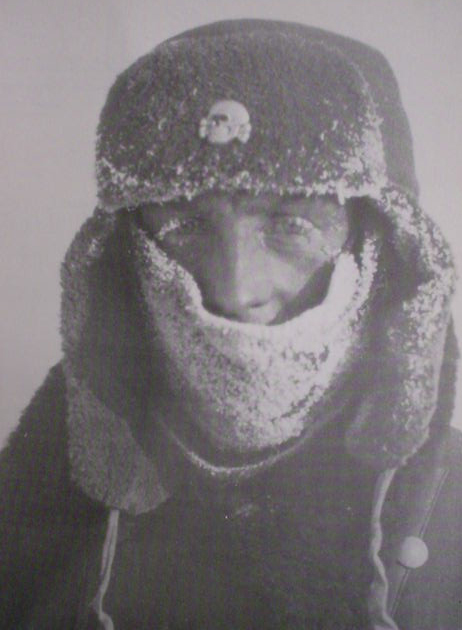
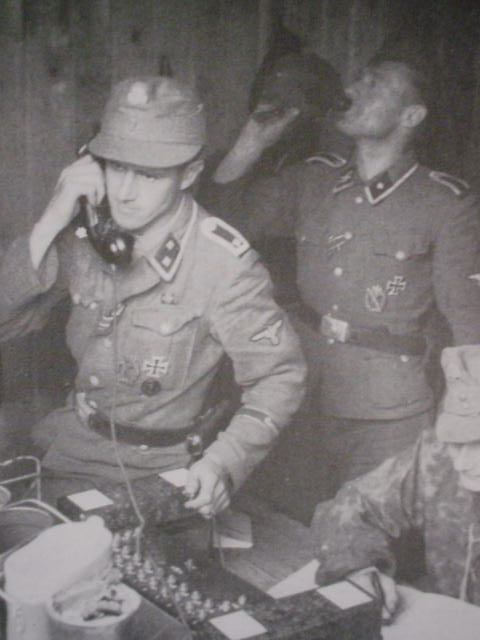
DESCRIPTION: This is a neat little ashtray that is from the mountain troop Kaserne of the 6th SS Mountain Division Nord. It measures 3 ½ x 3 ½ inches square, and has the edelweiss flower in its center, that is hand painted. The Edelweiss is a beautiful white flower that only thrives in the wild in mountain heights and has been the symbol and insignia of mountaineers and mountain troop soldiers. At the top of the flower are the words Waffen SS and at the bottom it says 6- SS- Geburgs Division Nord”. The piece was created by the Royal Porzellan Bavaria (KM) Germany and it says handarbeit (handmade). It is a lovely little piece of kitsch but historically important as this division was the only Waffen SS unit to fight in the Arctic Circle where it was stationed in Finland and northern Russia, between June and November 1941. It fought in Karelia until the Finish Armistice in Sept 1944 when it marched on foot 1,600 m- through Finland and Norway. It arrived in Denmark in December and then transferred to western Germany. It fought in the Nordwind Offensive in Jan. 1945 where it suffered heavy losses and surrendered to American forces in Austria at the end of the war. PRICE: SOLD |
 |
 |
 |
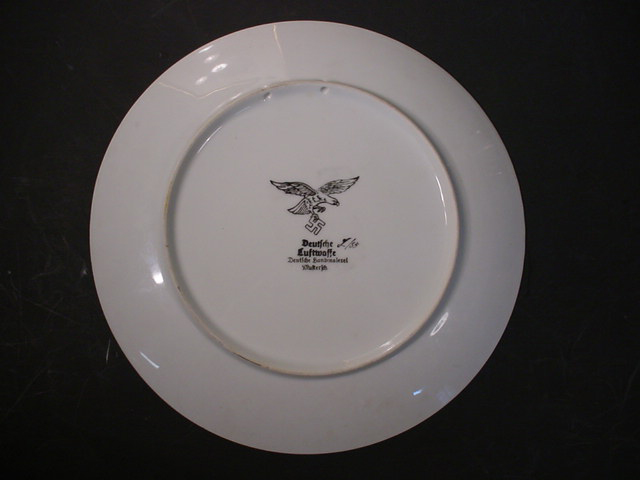 |
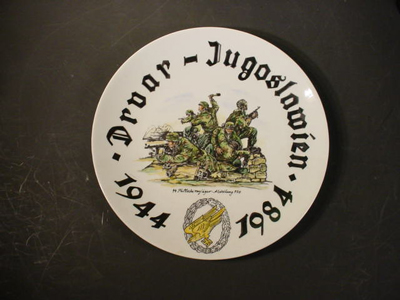
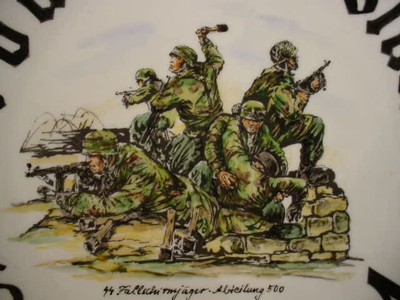
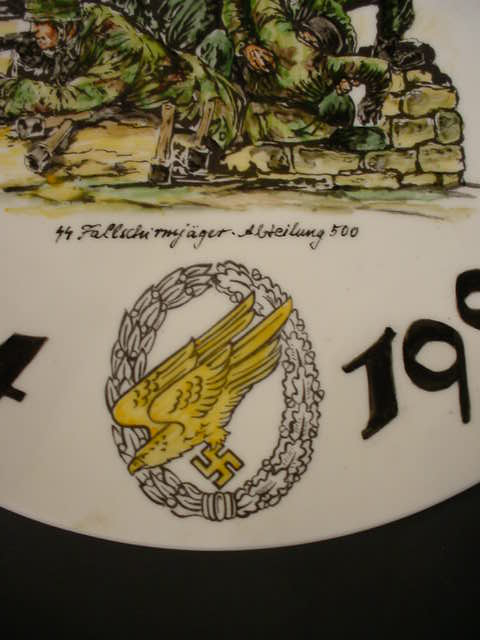
Commemorative Hand Painted Art Plate SS Paratrooper Regiment 500 (Item WAF 12-27 & ART 17-6) |
DESCRIPTION: This maybe the only memorial to the bravery and daring-do of the elite of the elite, the SS Fallshirmjager unit 500. This battalion was formed out of the ‘Operation Eiche (oak)” that resulted in the rescue of Mussolini form the Italian Gran Sasso led by Otto Skorzeny. The operation was planned by Kurt Student. We all know of this successful operation that was pulled off with only one shot fired. The organization of this unit can be found on the web by putting in 505th SS parachute battalion. The plate that we offer is a commemorative of one particular incident and that was the raid on the headquarters of the bloodiest monster to ever draw a breath. This filthy rodent was so despicable that it is difficult to mention his full name without provoking vomit. The 500th was led by SS Haupstumführer Kurt Rybka during its daring parachute and glider-borne assault on Tito's H.Q. outside the town of Drvar on 25 May 1944. The raid was called Operation Rosselsprung (the spring of the Knights). Two companies were dropped directly on the headquarters where the other two were landed by DFS 230 glider. Their first wave of paratroopers following a heavy bombardment by the Luftwaffe, landed in between the area of the cave, Tito’s hideout and the town of Drvar on open ground and many were gunned down by members of the partisan HQ Escort Battalion, a company numbering fewer than 100 Communist partisans. The second wave of paratroopers missed their target altogether and landed a few miles outside the town. Tito was long gone when the paratroopers captured the cave. Next to the cave’s exit, there was a path leading to a railroad where Tito boarded a train that very unfortunately took him to safety in Jajce. Tito had been forewarned and evaded capture while the numerically superior partisan forces that now joined the action drove off the SS paratroopers. Over 800 of the 1,000 German personnel who participated in the operation were killed or wounded. Thus ended one of the bravest exploits of the war. This raid was the basis of the later movie The Dirty Dozen but of course we know that Red Hollywood would manipulate this crusade of crusaders by the simple rewritten change- over from the heroic (Knight) Kurt Rybka and his valiant soldiers to the likes of Lee Marvin and Borgnine. It is easy to see that the plot of this cinema trash was lifted directly from the Drvar Raid. Substitute the Germans purpose that was to capture or kill the biggest Communist terrorist rodent to the mission of convicted murderers of the lowest animal species out to murder German officers in the most heinous fashion. Of course that is what Hollywood does isn’t it? Take for example the filthy cinema exercise in murder portrayal named appropriately (Inglorious Bastards). That was the absolute height of an anti-German tirade produced by a ‘Bastard’ named Quentin Tarrantino a scumbag Hollywood director who looks like and acts like Tito himself. The Tito regime killed in cold blood more than 500,000 people besides German soldiers. They murdered those they suspected of collaboration, anti-communists, Ustachi, and even critics. While he was U.S. President Jimmy Carter highly praised Marshal Tito as a great world leader, an inspiration to his people blah, blah, blah. - -DUH !!!! Queen Elisabeth that poor old comical figurehead welcomed with red carpet treatment this demon straight from hell with blood still on his claws to England. The silly wench even gave him a Rolls Royce as an official royal gift. A Dingbat personified! So much for the history lesson, suffice to say had the crusading mission of the SS 500 gone off as planned the monstrous Gargoyle would have been prevented from murdering untold thousands and maybe Germania International might have had the opportunity of offering his skinned out hide. Do you suppose I harbor some animosity against this slimy creature? Well I just don’t know where you might get that idea! The plate measures 10 ½ inches in diameter it has the great depiction done by hand of the paratroopers in combat position. In the center it commemorates the 40th anniversary of the raid and around the edges are the words Drvar-Jugoslavion 1944-1984 at the bottom is the Luftwaffe paratroopers combat badge why Luftwaffe? Because the training of the SS men and the original planning of the raid was all Luftwaffe. On the back of the plate you will see the Luftwaffe eagle with L/35 and the words (Deutsche Hand-malerei) Hand Painted. This is not an item painted in the war years. Still, it is a relic directly influenced by the gallant and valiant epic mission. We have never come across another so we assume it might be unique. But it does stand as a memorial to these brave soldaten of the Reich. PRICE: $250.00 |
 |
 |
 |
 |
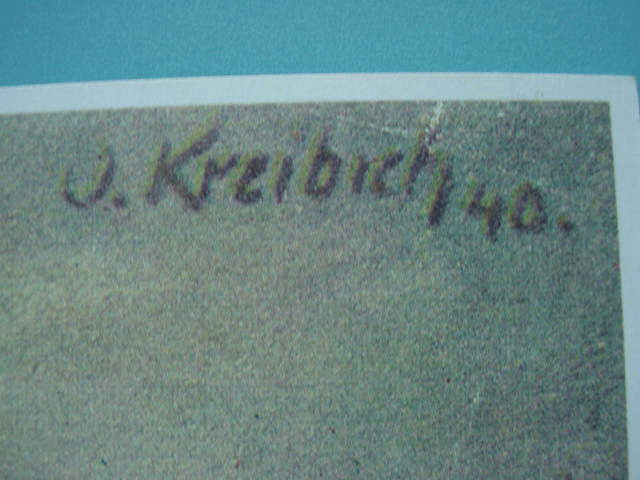 |
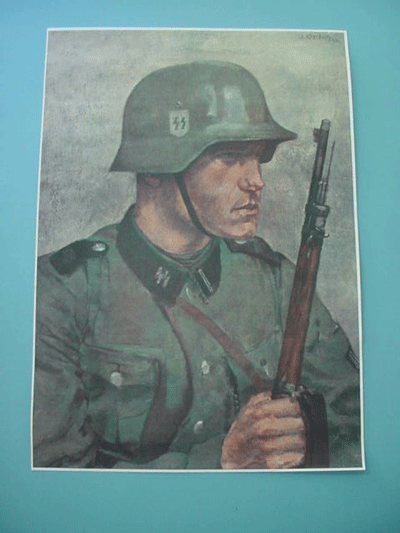
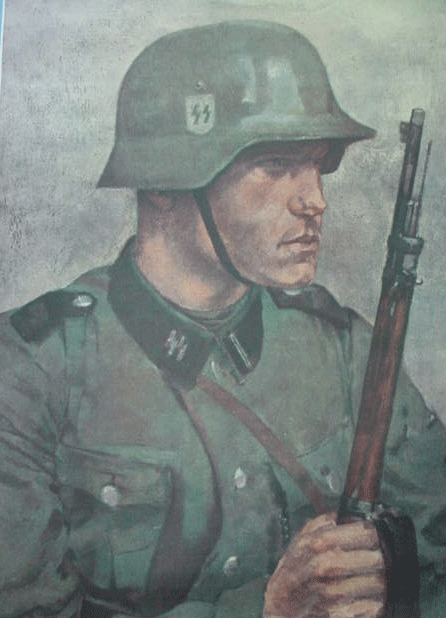
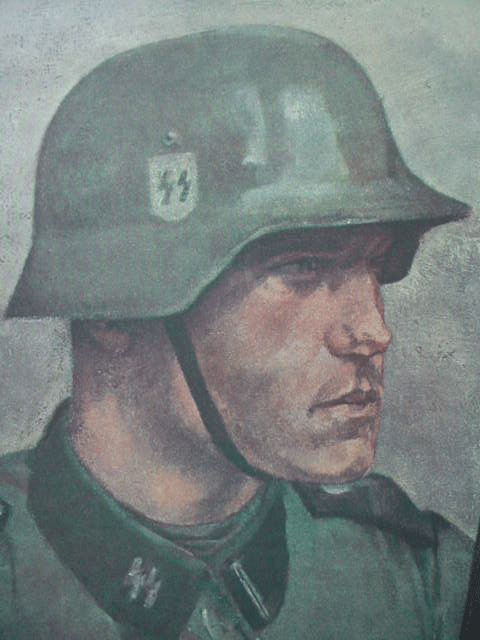
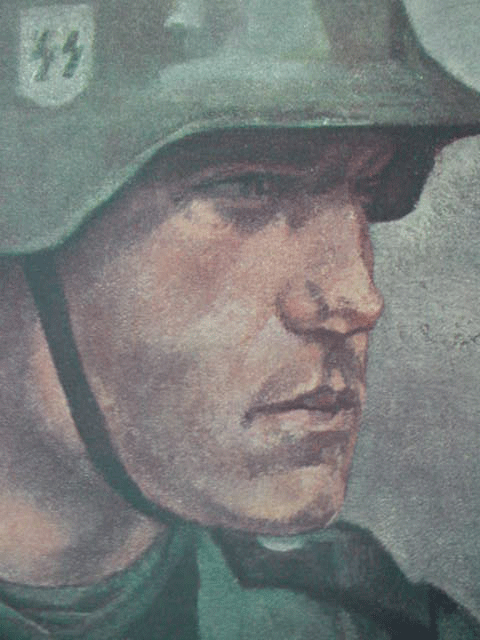
Print of Waffen-SS Soldier from the Original Oil by Kreibich (Item WAF 12-28) |
DESCRIPTION: Here is a beautiful print suitable for framing of a great WWII (1940) painting by J. Kreibich. The artist captures the iron will and resolve of these young warriors who fought and died for their Fatherland and against Asian Bolshevism that threatened the entire west. The Waffen SS was actually formed in 1940 and in 1940 was the true military formation of the larger SS parent organization. It was formed from the SS Verfungstruppe after the campaign in France in 1940. The Waffen SS would become an elite military formation of nearly 600,000 men and by the time the war was over its units would spearhead some of the most crucial battles of WWII. While its dauntless soldiers would shoulder some of the most terrible and difficult combat operations of all the units of the German military (Wehrmacht). The soldiers of the Waffen SS numbered in their ranks many foreign volunteers and the service recruited Danes, Swedes, Latvians, Ukrainians, Finns, Russians, even Muslims. It truly was a struggle for Europe and due to the cooperation of Roosevelt and Churchill Uncle Joe’s Communists prevailed. But the memory of the Spartan like stand of the Waffen SS and their brothers in arms will be immortal, and due to them the Reds were prevented from spreading their poison tentacles from the Volga to the coast of France. All Europe and the world would be speaking Russian and Mongol if it were not for these heroes in field grey. The print is a nice size – 1 foot by 16 ½ inches with a white border to facilitate framing. The colors are superb -- normally Germania does not handle new items but here is another exception due to our admiration of the art and the message. PRICE: $39.00 and postage -- Wenn alle untreu werden so bleiben wir doch treu! |
|
|
|
|
|
|
|
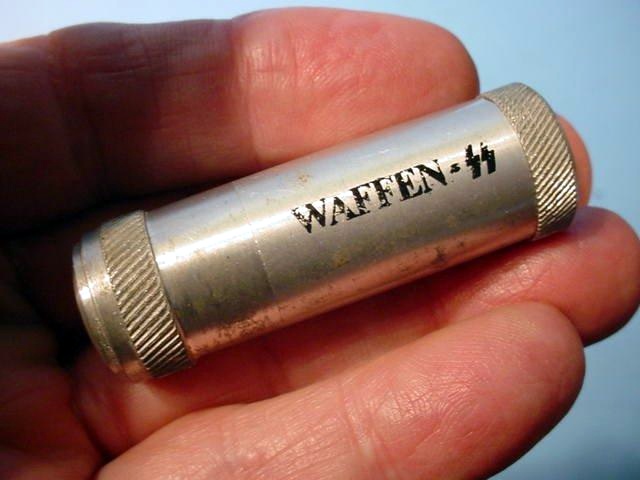
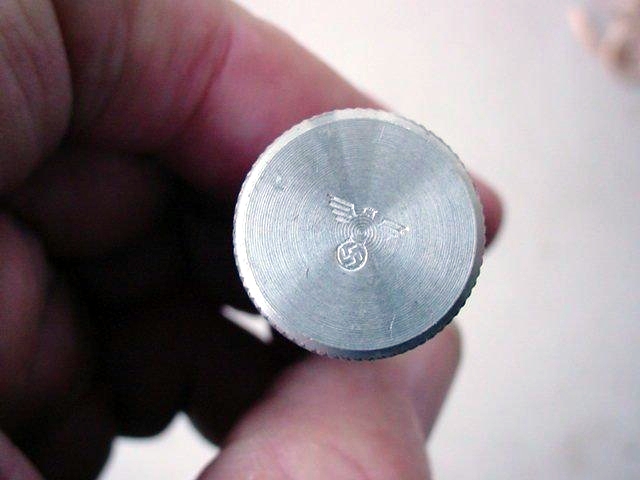
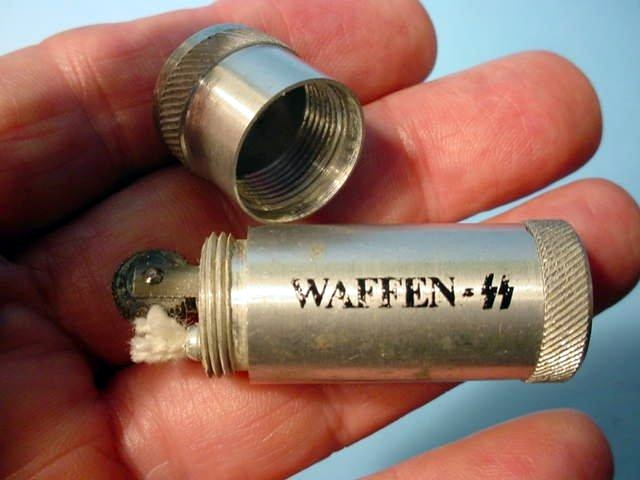
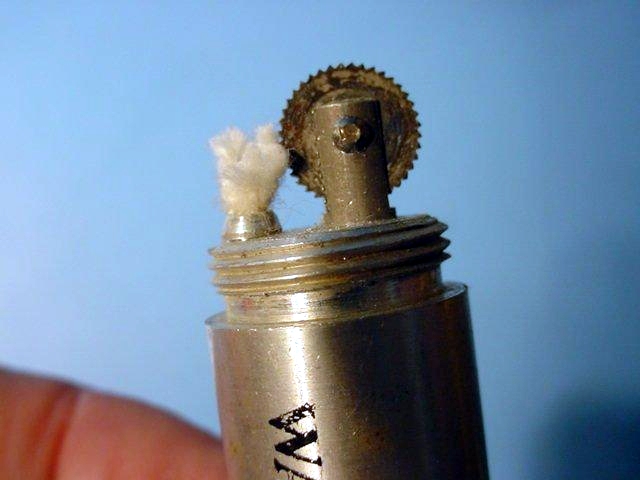
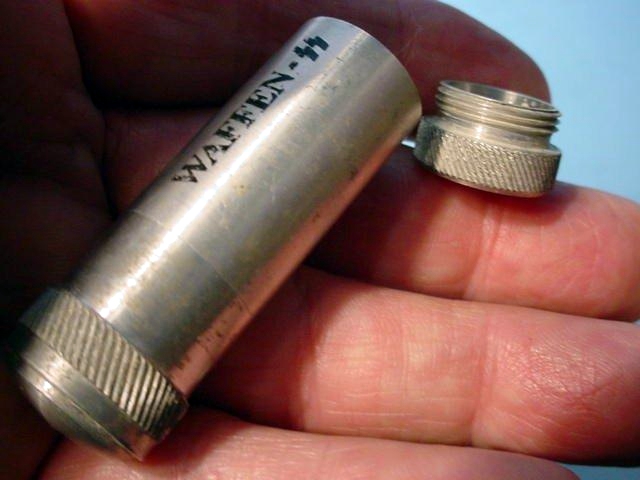
Field-Issued Cigarette Lighter for the Waffen-SS (Item WAF 12-29) |
|
DESCRIPTION: Here is something seldom encountered–an aluminum cigarette lighter. This would never be issued to Allgemeine-SS men as smoking was verboten, but an exception was made for the hard-fighting elite units of the Waffen-SS. There is even a tiny N.S. eagle stamped on the base area where the lighter fluid would be added when screwed off. It’s about 2 ¼ inches long and in fine condition. If you had $100.00 to spend on one you probably could not find one this rare!
PRICE: SOLD |
|
|
|
|
|
|
|
|
|
|
|
|
|
|
|
|
|
|
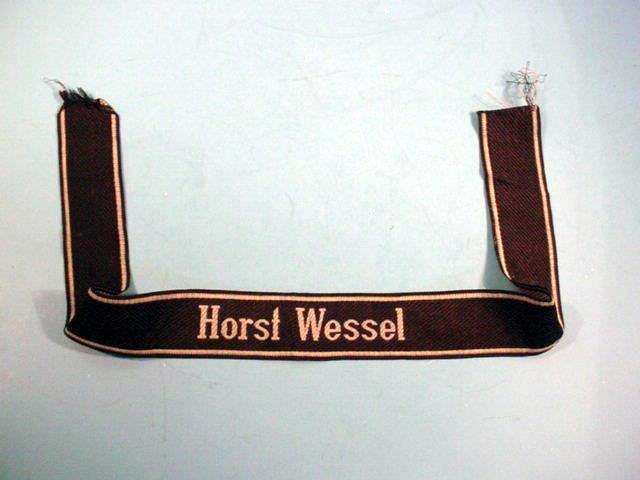
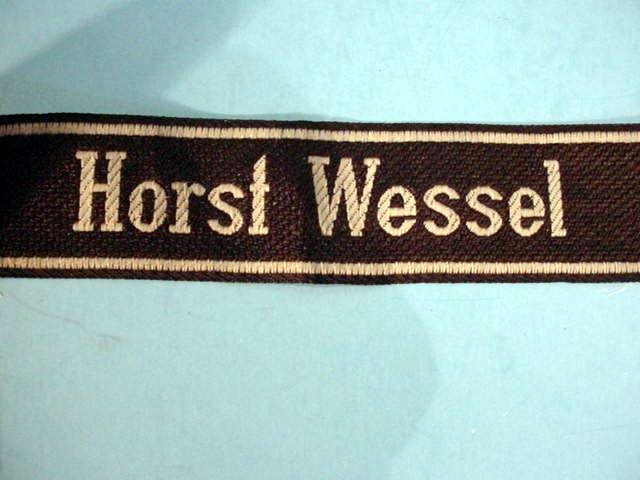
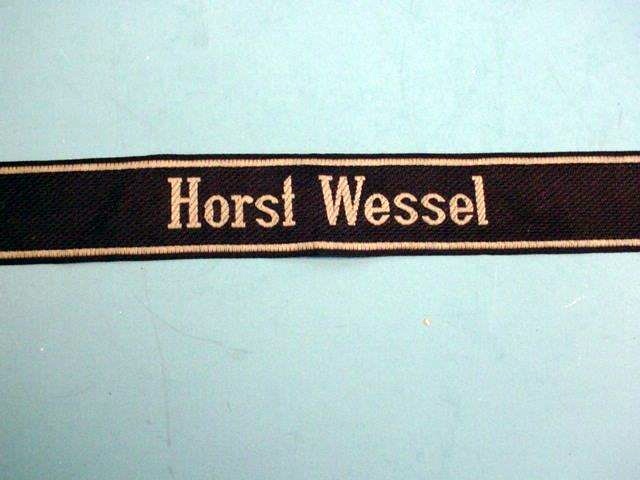
Cuff Title for the Waffen Grenadier Division “Horst Wessel” (Item WAF 12-30) |
|
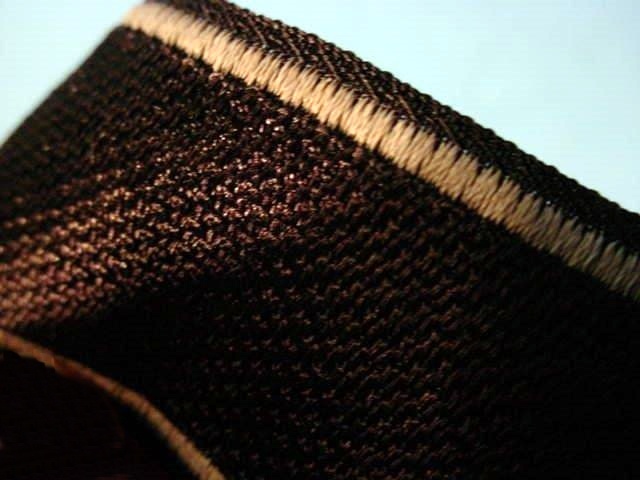
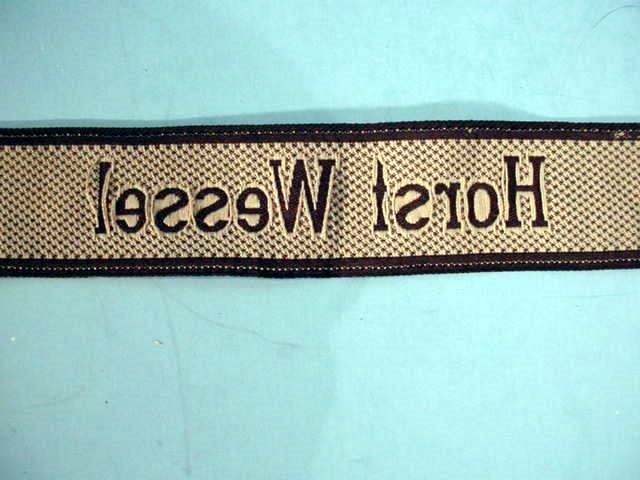
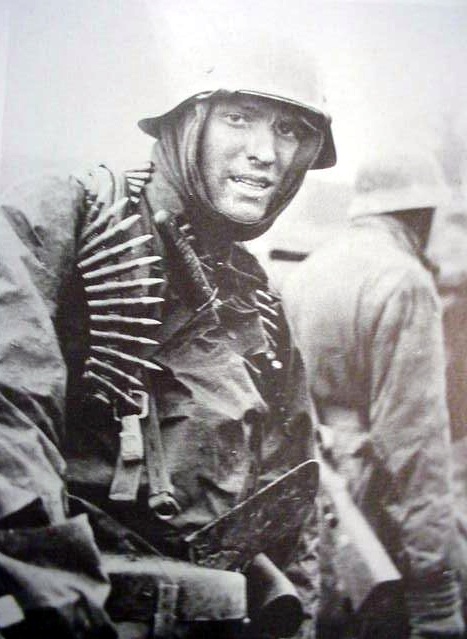
DESCRIPTION: Here is a genuine machine-woven (bevo) Waffen-SS enlisted-man’s cuff title for the 18th SS Volunteer Panzer Grenadier Division Horst Wessel. This division was comprised mostly of Volksdeutsche (ethnic Germans). The letters are clear. The woven material is clearly thin and this, of course, is usual in bevo weaving. The reverse of this title has the correct salt-and-pepper pattern. Each end of this band has some fraying; this is usually expected, especially if the cuff title was worn, but it is full length except for possibly a half inch at the left end. The Horst Wessel Division was mostly used as antipartisan units hunting the motley scum who were murdering German soldiers all over the Balkans. Then later they were sent to the Eastern Front with the exception of one regiment that fought the Slovaks in the National Uprising in August 1944. They fought bravely in the good fight against demons straight from the communist hell! The division, of course, was named after the SA martyr of the NSDAP, Horst Wessel. This dedicated-and-true young storm trooper, who was murdered by the communists, wrote the lyrics to the song “Die Fahne hoch” which became the anthem of the N.S. movement.
PRICE: $1,150.00; a most reasonable price for a rare cuff title |
|
Please refer to item designator in parentheses in all correspondence. Please E-mail for any additional information you may need.If you prefer, contact 'Germania' at PO Box 68, Lakemont, GA 30552 or call at 706.782.1668. Please! do not call during the wee hours of the morning. The best time for calling us is between 10am and 12 noon and between 9 and 11 pm eastern time. |