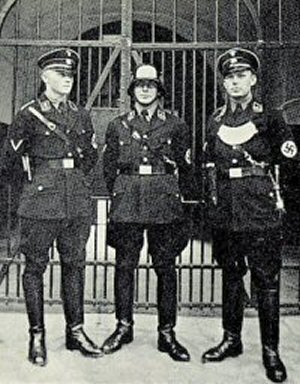
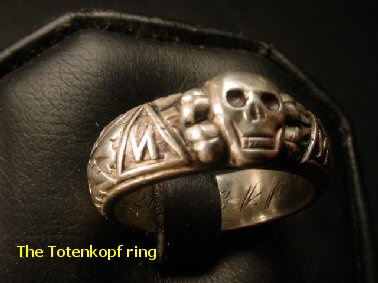
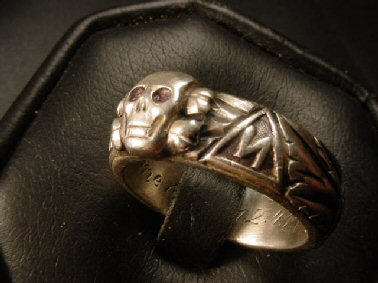
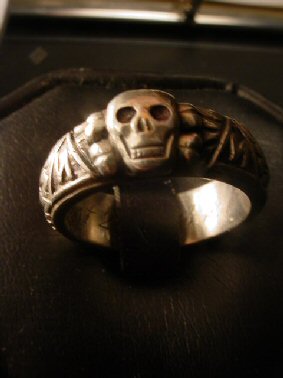
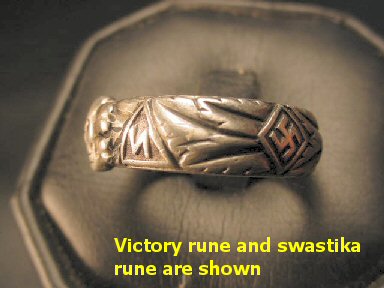
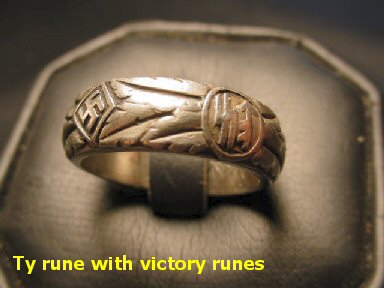
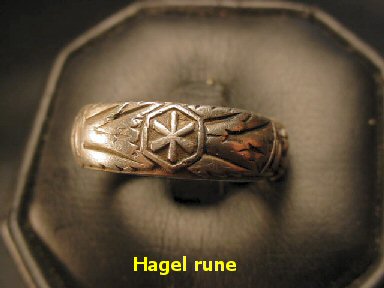
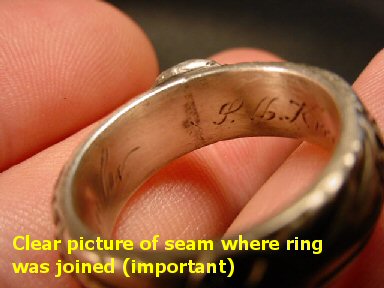
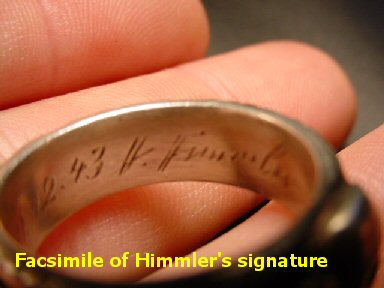
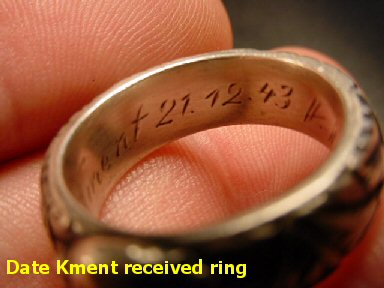
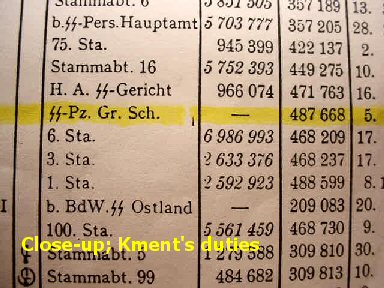
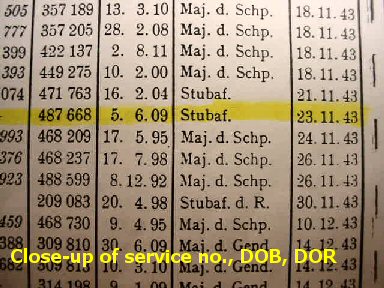
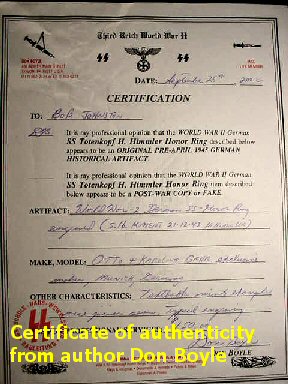
DESCRIPTION: Reichsführer- Heinrich Himmler was the commander in chief of the much-dreaded, but also revered, during the Third Reich era. This organization was divided into several branches that made up the brotherhood of the Schutzstaffel. This corps of elite guards was first formed to provide for Adolf Hitler a small, highly mobile and thoroughly reliable bodyguard unit. Later, it grew into a very complex organization numbering well over a million men responsible for, among other things, the police, the concentration camps, and a virtual Party Army, which effectively became the fourth branch of the German Armed Forces (Wehrmacht). This last referenced group was known as the Waffen- or armed SS. The man responsible for this was Heinrich Himmler, a man who looked much like a librarian or an intelligent elementary schoolteacher, not like the "war lord" leader of the toughest police and military units that ever carried the weapons of war. Himmler was also an academically eccentric would-be artist with a penchant for organized trivia, obsessive detail, and creativeness in art and cultural pursuits. Symbolism became a very important and necessary bonding device within the leadership and rank and file of the . Himmler is quoted as having said, "The two Sigrunes stand for the name of our . The Swastika and Hagel-rune represent our unshakeable faith in the ultimate victory of our philosophy". We know of course that the death's head also was equally as important in this philosophy. Contrary to the usual opinion, this particular symbol was not chosen to strike terror into the hearts of wary observers. Rather, it was adopted to be a direct and emotional link with the treasured Teutonic past and in particular with the elite military units of the various Imperial Reich's from the time of Frederick the Great to the skulls worn by the 1st and 2nd bodyguard regiments of Hussars in the time of Kaisers Wilhelm I and II. These men were known as the Schwartze-Totenkopfhussaren, whose battle song was: "In black we dressed/In blood we are drenched/Death's head on our helmets/Hurrah! Hurrah!/We stand unshaken!" Many of the world's elite forces have, in the past, and presently wear the death's head as a symbol of "Death or Victory." All of this presents a thumbnail sketch of the meaning of one of the most important of all the symbolic articles of the . Cufflinks, like the ring, were presented by Himmler as Chief of the . They were considered extremely important in that a recipient would have to be considered an important enough person whom the Reichsführer wished to single out as a friend or meant to especially honor. Other persons who might have received these cufflinks would possibly be members of the Freundeskreis Heinrich Himmler (circle of friends of Heinrich Himmler). It was made up of associated benefactor members, the so-called Fordernde Mitglieder (members). These people, often industrialists and aristocrats, gave considerable financial assistance in the form of donations to the cultural and social work of the Reichsführer-. It is probable that such obliging patrons would have received the cufflinks directly from the hand of the Reichsheini, as Himmler was often affectionately called. The links themselves are of 800 silver and so marked and they are stamped with the crown and crescent-moon design, which was the official acceptance mark of silver makers for centuries in Germany. Inside the circular band side of the roundel itself is the date of the presentation along with the year. So far, we have encountered in archives and from viewing actual sets of these links various dates--either a famous date such as the 9 November date of the abortive Putsch in Munich, or Hitler's birthday, April 20. However, the usual dating would be indicative of the birth date of the recipient. That leads us to believe that the Reichsführer gave them out personally on the receivers' birthdays. The book by Arthur Meyers and Heinrich W. Schilds on Third Reich jewelry includes these cufflinks. The title is Otto and Karolina Gahr-die Silberschmiede der NSDAP und der SS, published in 1993. Unfortunately, the book has been published only in the German language. We know of several sets of these cufflinks that are in private collections to include the very famous set owned by Mr. Don Boyle. These were the ones that formerly belonged to Jacob Grimminger, the bearer of the famous Nazi "blood flag." The sets having belonged to Reinhard Heydrich and his assistant and Secretary of State Karl Hermann Frank, were located in 1990 in a group of their personal belongings in Czechoslovakia at the Cerninsky Palace in Prague. This was the central office for the Nazi occupation of Bohemia and Moravia. Another set was recently purchased that belonged to Ulrich Graf, the man who, during the famous Putsch by the Feldherrenhalle on November 9, 1929, threw himself in front of Hitler and was seriously wounded, but in so doing, prevented the bullets of the Reichswehr soldiers from possibly ending the Führer's life that day. The set that we have here belonged to Obergrupenführer Gottlob Berger, 1897-1975. He was a lieutenant general in charge of the main office and he was Heinrich Himmler's representative to Rosenberg's ministry and from 1944 was in charge of all POW affairs. He was born July 16, 1897 in Gerstetten, Wurttemberg. The son of a sawmill owner, he volunteered for service in WWII and was subsequently severely wounded in action while commanding a battle group. After the war Berger became an athletic instructor and studied military tactics in his spare time. With a skill that would have awed Machiavellians, Berger insinuated himself into Heinrich Himmler's confidence and became his chief advisor as well as an advisor to Alfred Rosenberg. He was an early member of the SS, but after seeing plainly that Staff Chief Ernst Röhm was plotting a Putsch against the Führer he changed his loyalty to the . With the Reichsführer's approval and by this time a general, Gottlob Berger started to organize the Waffen-. He has been called the father of that elite fighting force. In August 1944 General Berger was put in charge of military operations in Slovakia. His greatest achievement, however, was in the recruiting for the aforementioned Waffen-, obtaining the manpower needed to create many of the foreign volunteer units. He became a highly decorated officer. He was wounded several times earning the rare Wound Badge in Gold. He was awarded the Knight's Cross to the War Service Cross with swords on September 26, 1944; the Knight's Cross to the War Merit Cross with Swords on November 15th, 1944; the German Cross in silver on July 1, 1943; the Gold Party Badge on January 30, 1943; the Gold Hitler Youth Badge January 30, 1944. Previously he had the Olympic Games decoration First Class awarded on August 16, 1936. He also had been presented numerous foreign awards. He always had great energy an drive as well as being an excellent administrator. Charles Hamilton in his book Leaders and Personalities of the Third Reich tries to demonize him, but more recent and better researched works such as Allgemeine-SS The Commands, Units and Leaders of the General SS by Mark Yerger serve nobly to set the record straight. Gottlob Berger was a man true to his chosen mission and his subsequent hearings at the infamous Nuremberg Trials showed within his testimony that he believed the motto and stuck with it: "Meine Ehre heist Treue!." The cufflinks were purchased by a German Kameraden of mine from the sister of the general who wanted them to be put in a museum or a collection where they would be respected and cared for as a momento of this great German general of the Waffen-.
PRICE: $4,200.00
|