|
|
|
|

Kriegsmarine
Page 9
|
|
 |
|
|
|
|
|
 |
 |
 |
|
 |
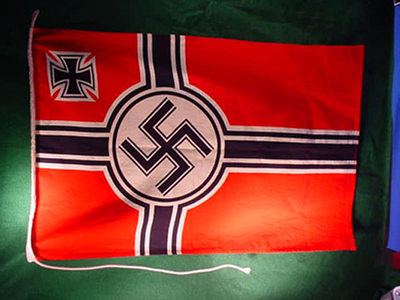
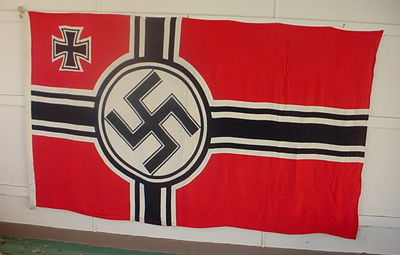
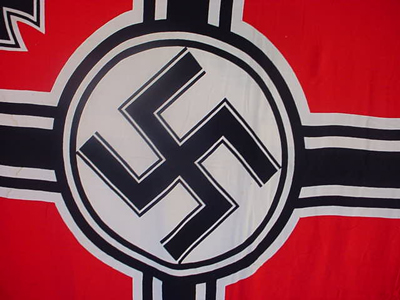
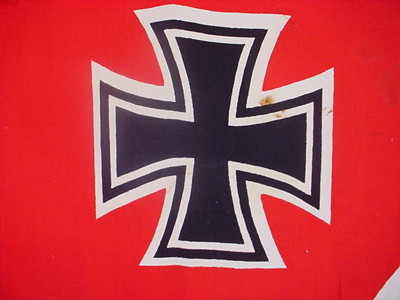
Small Kriegsfahne or Reichs War Flag (Item KRIEG 9-1 & FLAG 1-5) |
||||
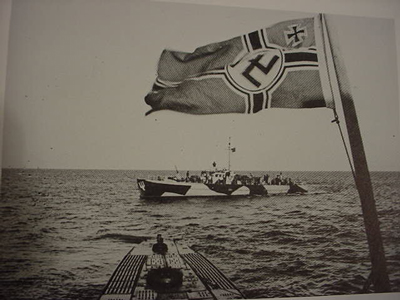
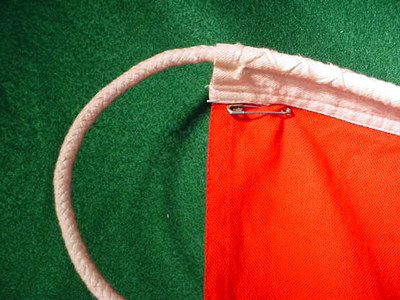
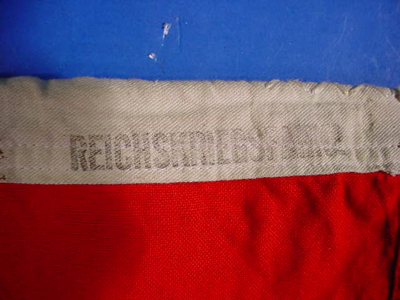
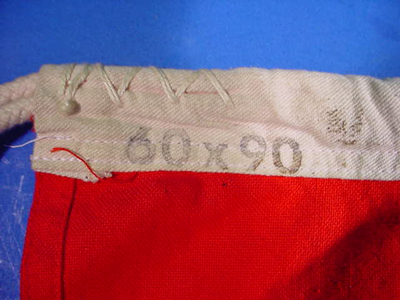
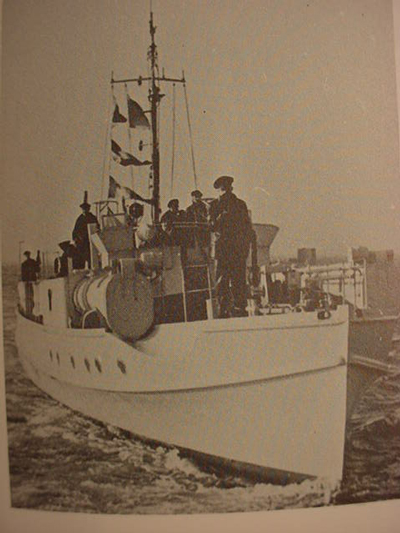
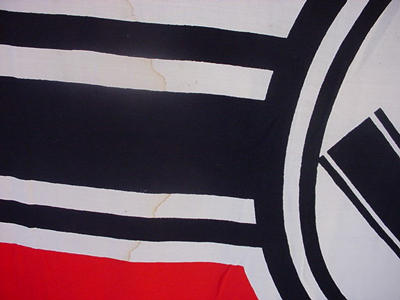
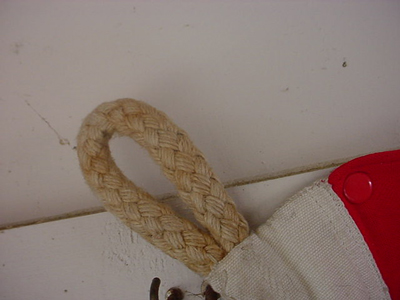
| DESCRIPTION: This is an absolute gem of a flag in perfect shape with no moth holes, rips or tears. It is the perfect collectors dream small enough to show in any collection room yet large enough to be a dramatic addition to the best of collections. Measures 31 x 24 (60 x 90mm). It has the words Reichskriegs-fahne on the edging. This has the full staff rope intact. It probably was a “Schnellboot” flag. A PT boat-type ship, Schnellboot, is a German word for ‘fast-boat’ They don’t come better than this one. Don’t hesitate -- it won’t last long on our pages. PRICE: SOLD |
||||


 |
 |
 |
 |
 |
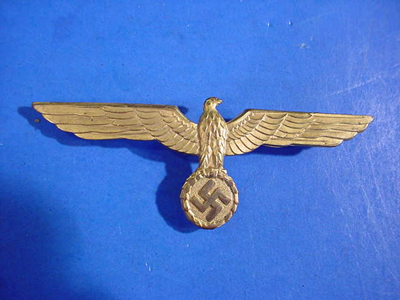
A German Naval Officer Breast Eagle in Metal (Item KRIEG 9-2) |
||
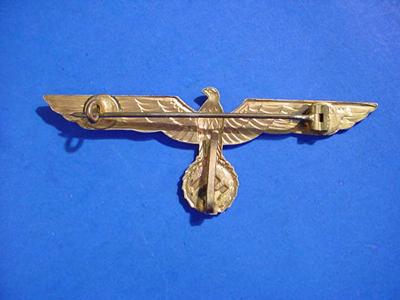
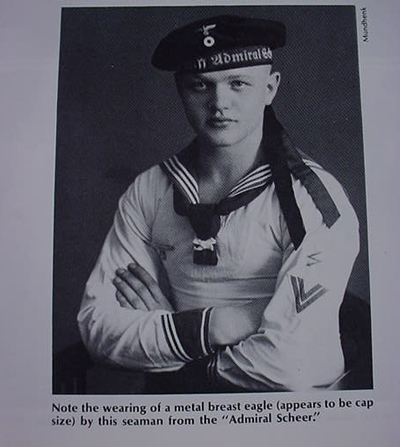
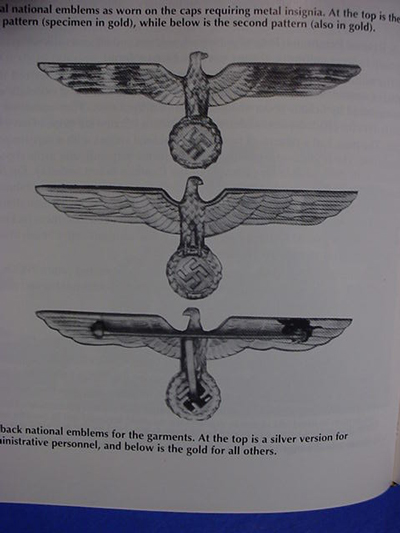
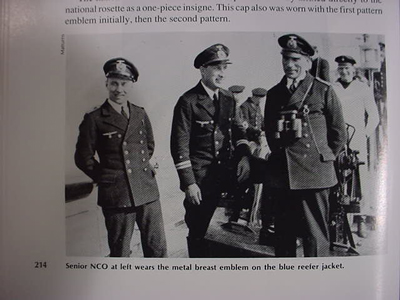
DESCRIPTION: This eagle is for a Naval official probably a Paymaster since the usual eagle of this type was normally in silver and contrary to all normal official navy regulations, Paymasters wore all insignia of the officer pattern and of gold color including this pin with National eagle for the white tunic. Naval officials did not posses the status of soldiers but were nevertheless members of the armed forces. The status of such officials may be regarded as a custom typical of the German armies. Its roots probably go back to the customs of the 17th century when noblemen appointed themselves as colonels to raise regiments of soldiers and conducted the economical affairs of their regiments as a business enterprise. Since the 18th century, officials have worn uniforms with distinctive insignia. In this case, only the Navy Paymasters (Marinezahlmeister) were military officials; all other navy civil officials were of what can be considered civilian statues. The eagle's wing span is nearly 4" and from the top of the eagle's head to the bottom of the wreath that holds the swastika it measures about 1 3/4". The bar pin is in place in back as well. There is also an upright flange that hold the eagle in place neatly when worn. PRICE: $225.00 Rare in gold color. |
||
 |
 |
 |
 |
 |
 |
 |
 |
 |
 |
 |
 |
 |
 |
 The ship |
 |
 The fouled anchor |
 |
 Page 366 of Wittman book |
 |
 |
 |
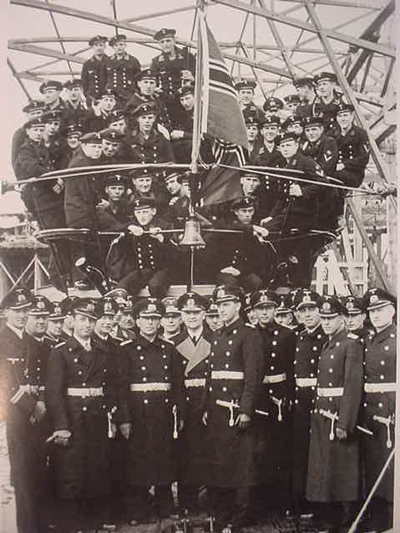 Victorious U-boat crew |
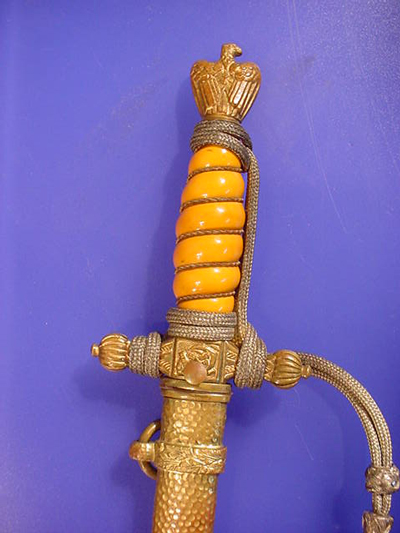
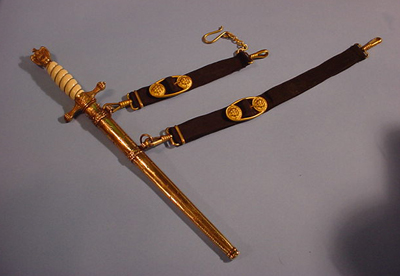
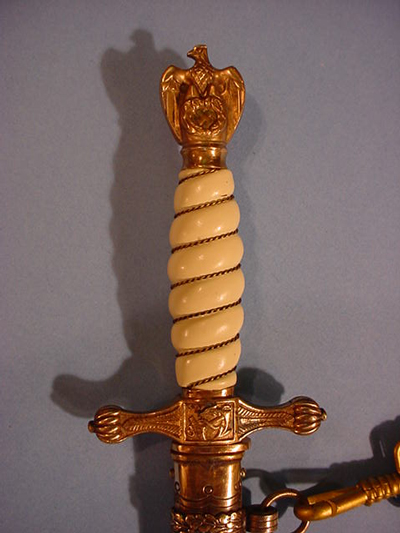
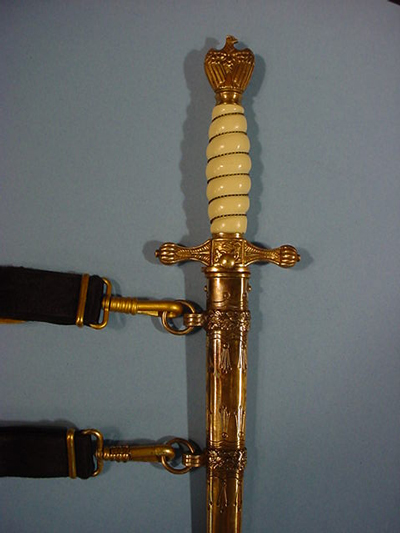
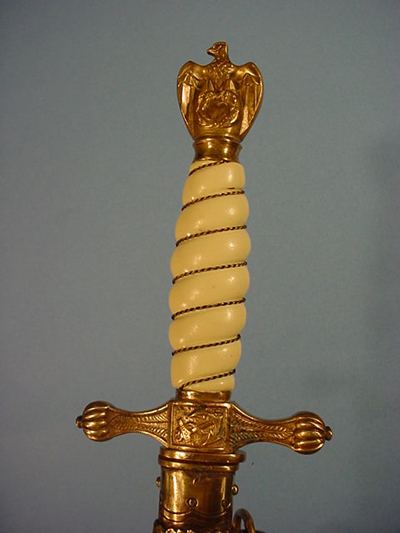
2nd Model Naval Dagger with Orange Grip and Hammered Scabbard (Item KRIEG 9-3) |
||
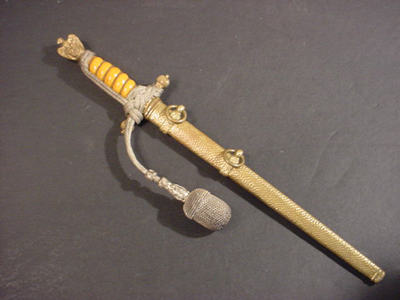
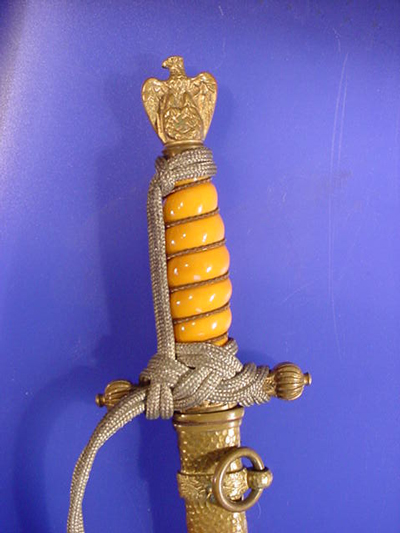
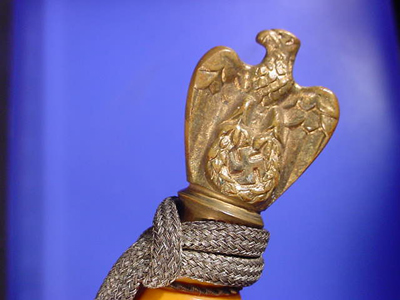
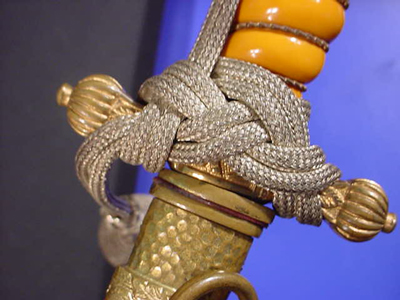
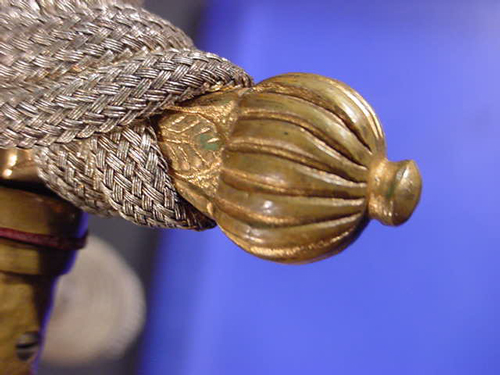
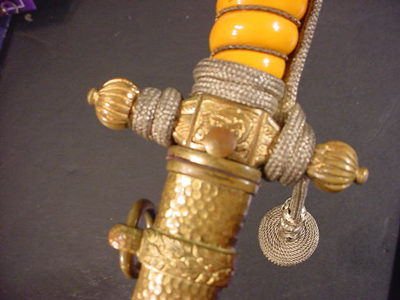
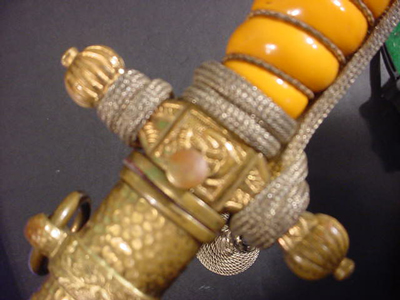
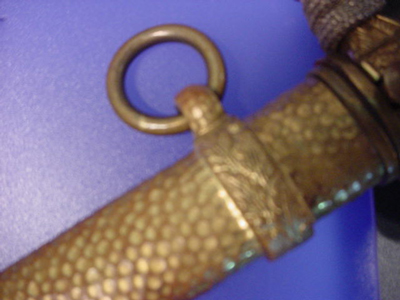
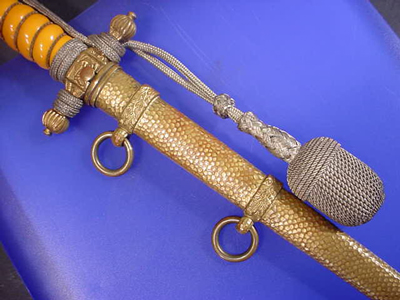
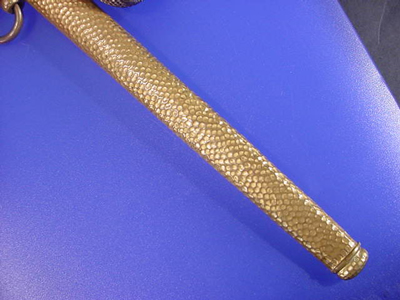
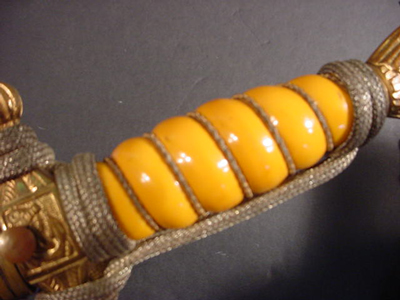
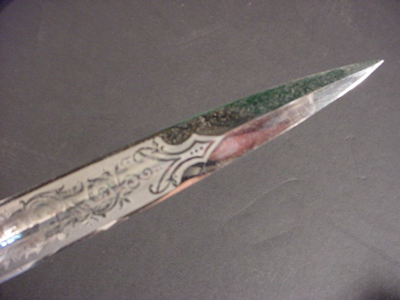
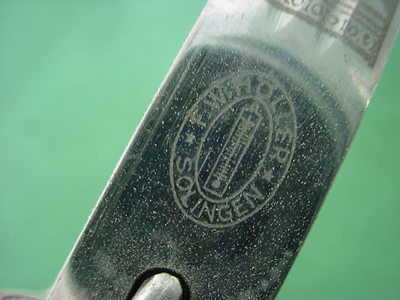
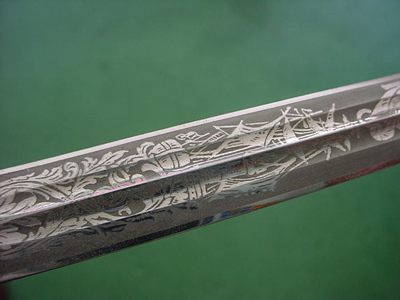
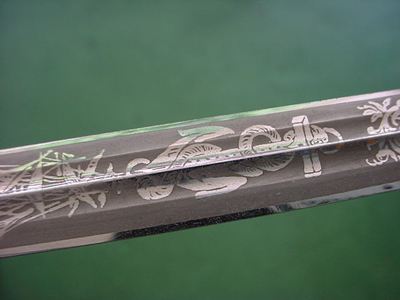
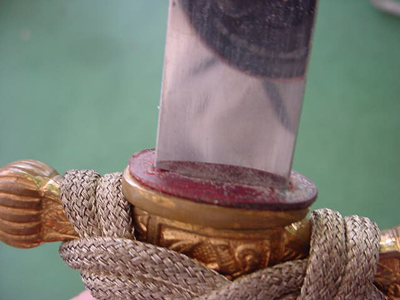
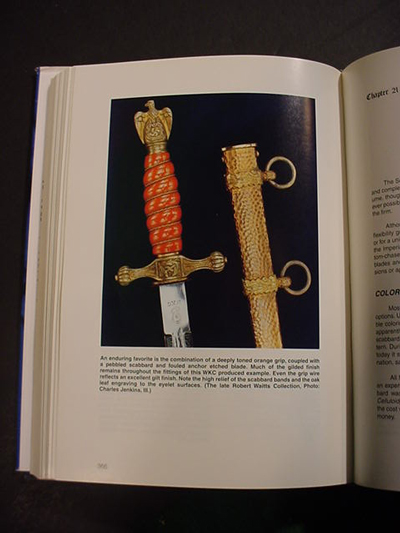
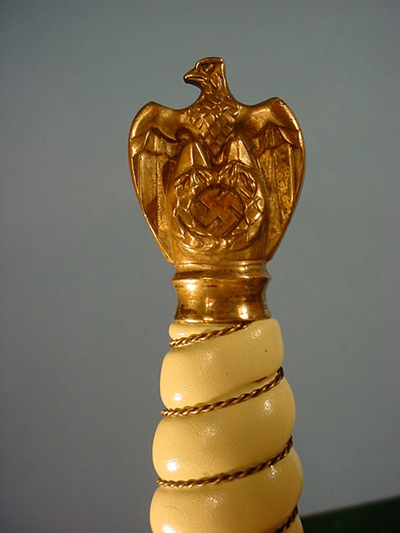
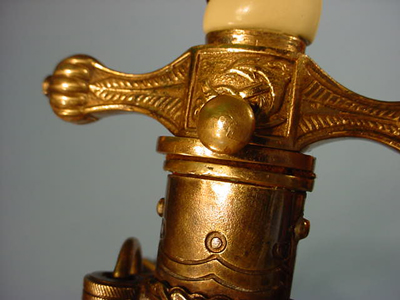
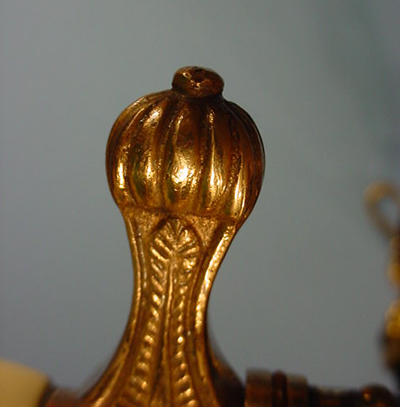
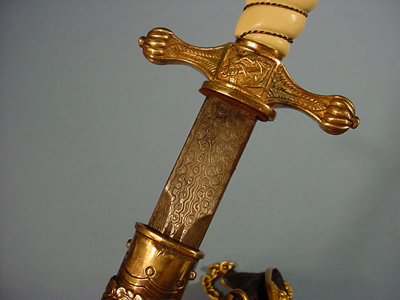
DESCRIPTION: This 2nd Model Naval dirk has it all! Just the type that collectors dream about and look for, it is similar to the one pictured in color in Thomas Wittman’s book “Exploring the Dress Daggers of the German Navy” on page 366. The pommel and cross guard have a very nice pattination across their surfaces. The detail is exceptional to the pommel; having a great look to the eagle's head, breast, feathering, half closed wings, talons, wreath and raised out swastika. The cross guard is a fine looking example featuring etched anchors on both sides, with cross guard arms featuring acanthus leaves and nice cuts to the button quilions. The grip of this example is a most pleasing deep tangerine orange color. The color is even throughout the grip and there are no cracks, chips, or problems anywhere. This beautiful and prodigiously impressive grip is tightly wrapped with patined twisted brass wire. There is a fine toned nylon portepee still in the intricate naval knot tie. The portepee is 100% original to the dagger. It has taken on with its age a toning that is antique silver in hue.When you take your finger and fold over any part of the knot that would be covered you will see that the underlying now exposed section will be bright silver color. This is “proof” positive that the knot has been there from the first day when issued. The knot shows soft age only and no fraying. The ball of the knot is perfect and the little slide so often missing is there; the scabbard is straight with no ‘door dents.’ It has a very fine hammered surface, identical to the one on page 366 of the Wittman book. The scabbard has the bands that are the high off the surface style, and have outstanding detail to the oak leaf and acorn mix. The throat is retained by two dome head brass side screws. Both the throat and side screws have turned to a very nice plum color. The blade is mirror bright and in mint condition. It has the highly desirable sailing ship on both sides. The beautiful blade has been perfectly protected by the leather washer. The elegant blade has 100% of the frosted backgrounds that really gives a great accent look to the raised work. The blade features sea plants and the “Clipper Ship” and the large fouled anchor as well. The ricasso is just as nice as the rest of the dagger, and it is deeply stamped on the obverse with the logo of F.W. Holler Solingen with the “Thermometer logo” that is familiar to Holler examples. This piece is the best conditioned Kriegsmarine dagger you will ever find. It is the closest to that elusive word ‘mint’ that we have ever encountered. This is your greatest opportunity to acquire a good, sound, period Holler dagger in practically an untouched state. This is the fulfillment of the collectors dream! If we ‘wax poetic’ a bit, it is only because it is so seldom that we get to see one quite so elegant and fine. You will be more than pleased with this piece. If ever there was a comparable piece it would be the Eickhorn example at Krieg 7-12 on our pages -- up to now it was the best. PRICE: SOLD |
||
 |
 |
 Backside |
 |
 |
 |
 |
 |
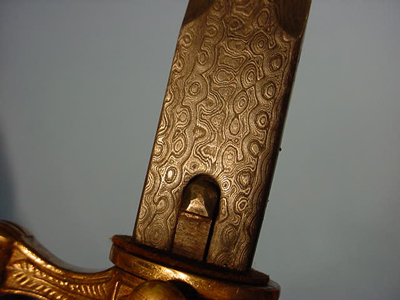 Rose Pattern |
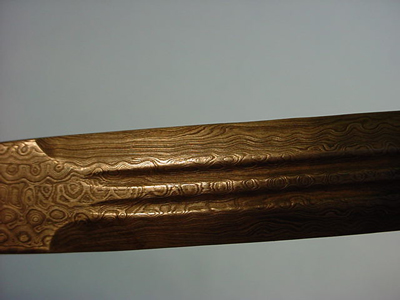 Water Wave Pattern |
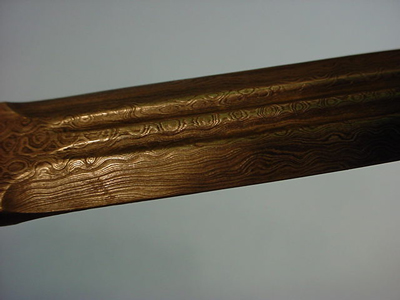 Maiden Hair Pattern |
 |
 Tri-pattern Image |
 Incredible damascus work |
 |
 |
 |
 |
|
A Beautiful Damascus Bladed Kriegsmarine Dagger (KRIEG 9-4) |
||||
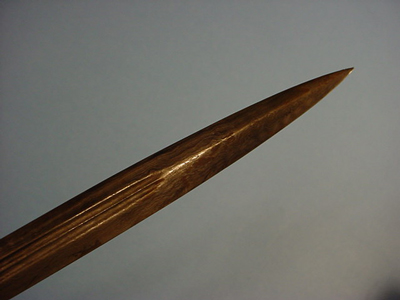
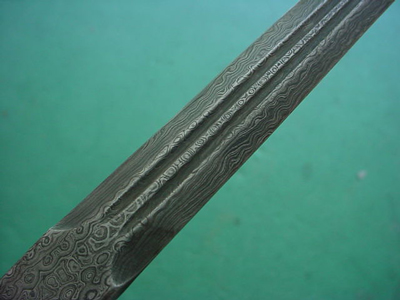
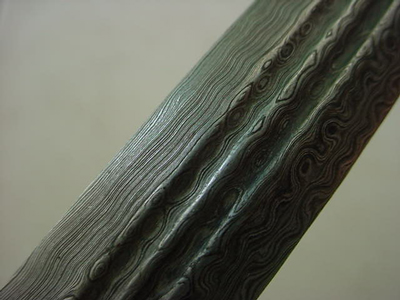
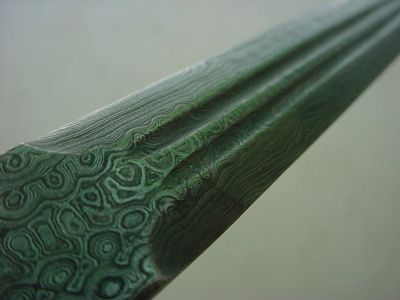
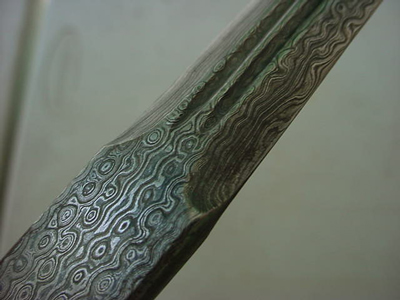
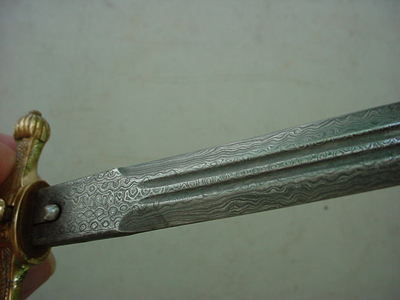
DESCRIPTION: This is a great find! A Tri- Pattern Damascus bladed naval dagger that is the original, genuine Damascus not the etched style of artificial Damascus. Not to degrade the artificial ones, this was also a fine art form of the period. But this is “The state of the art genuine Damascus blade.” There is no maker's name affixed to the blade but it is one of the finer patterns that we have ever seen. The pattern is closest to the one shown along with others in the brilliant work by Thomas T. Wittman in his great book “Exploring the Dress Daggers of the German Navy.” On page 378, there is a chart from the firm of Eickhorn (Solingen) showing 5 different patterns of Damascus steel blades as used in 1938. This beautiful blade that we offer is quite similar to the one shown as Echt Damast No. 421on the chart. Wittman says that the five Damascus pattern designs the Eickhorn firm offered in that 1938 catalog were the same designs the firm offered during the Imperial and Weimar periods. The sample designs were based on actual patterns hand forged during the Imperial Period; however, during the Weimar and Third Reich period new Damascus Smiths emerged as their fathers and uncles retired and passed on as evidenced by the classic works of Third Reich Smiths, such as Paul Dinger and Carl Wester. New variations of basic Damascus themes were soon developed. These Smiths often blended and combined two and three design patterns within a single piece of steel. It is not uncommon to see a hard forged, Damascus blade by one of these craftsman displaying a pronounced peacock-like pattern within the center blade segment and a graceful “Maiden Hair” design flowing on the outer segments. As a result many of the Third Reich period Damascus blades we see today do not reflect the standard patterns illustrated in the early catalogs. Also, the hand forging process usually negates two Damascus patterns from ever being totally identical. Thus, fellow collector, you can see a difference in the pattern that is seen in the dagger we offer and the ones in Tom’s book. However, both can be classified as small rose pattern Damast -- at least in the area above the blades ricasso. The hand forging of Damascus steel blades was an art developed in Germany over the centuries. By the middle of the 19th century, there was no question that Solingen employed the finest Damascus Smiths in the world and many of the most important American Civil War presentation sabers, ordered through New York edged weapon retailers were assembled with a Solingen forged Damascus blade. The process was passed through father to son, often taking decades to develop the proper skills. Since weld patterns are formed before, during and after the actual forging process, each smith spent years cultivating his own techniques and favorite designs. The more common Damast-stahl pattern that collectors refer to as the Maiden Hair pattern tends to look very uniform and consistent between the generations. There will be, however, vast differences as well as some completely new design combinations reflected during the Third Reich era. The most sought after and certainly most intricate pattern in the N.S. era was the small roses pattern Damascus blades. Wittman goes on to say that there is, in fact, a new generation of producers of this art form and for the most part their works are recognizable as being quite different from those produced a half century ago and in general the modern blade lacks the skill level inherent in the production of earlier blades. The collector should exercise caution when purchasing Damascus bladed edged weapons. That is not to say though that an effort should not be made to acquire a genuine example of this wonderful art form. For there is no greater satisfaction in this hobby. The temporary pain of the high price will soon diminish and be replaced by a feeling of pride along with the “triumph of ownership.” We might add the fact that one should realize that his is not a mere standard naval dagger but somewhat of a “National Treasure” and the feeling should be akin to the pride that the Japanese take in ownership of a special Samurai sword. Again, the words “National Treasure” emerge. This dagger has the standard fittings many Naval daggers that had Damast fittings were given . The style of the eagle and cross guard fittings suggest Einkorn manufacture or possibly F.W. Holler. The grip is the standard celluloid type. The pattern overall is the 2nd model Naval 1938 pattern dirk with the grip has brass wire wrapping on the pure white grip. The Damast blade measures 10" from its tip to the bottom of the cross guard where the brown felt washer is placed. The blade has double blood grooves or furrows. Now, here is the most “spectacular thing” attending this particular blade. We have already identified the small rose pattern on an inch and a half of the blade surface near the riccaso but when you look closely you see that this is truly a masterpiece of the art of Damascus art. The rose pattern continues up between the grooves right along to the end of the furrows. But to each side there are two different patterns running along right to the tip of the blade. One is the running water pattern and the other could be termed the maiden hair design. Anyone having a working knowledge of the making of the Damascus blade will know that only a master smith would be capable of this combination of three distinct weld patterns on a single blade. This is indeed a “Treasure personified!” The dagger is equipped with a set of lion mask hanger straps. The lions are stamped out of gilded aluminum. They consist of one longer and one shorter example; each fitted with snap clips at the lower end. The shorter strap is also equipped with a chain and hook assembly. (Nice condition.) All in all, the entire dagger is in great shape. No nicks, no cracks, clean, and crisp. But it is the blade that is the ultra important thing here. They might come better as to outer fittings but you won’t easily find a finer example of Damascus blade. Here is one of the best! PRICE: SOLD |
||||
 |
 |
 |
 |
 |
 |
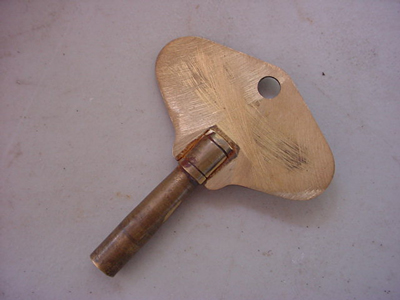 The repaired key |
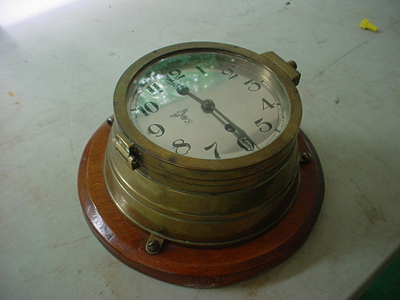
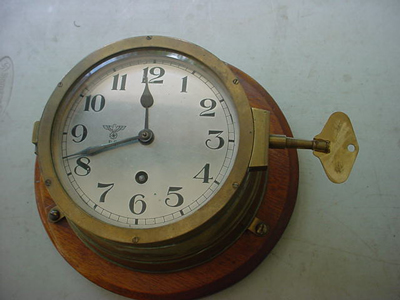
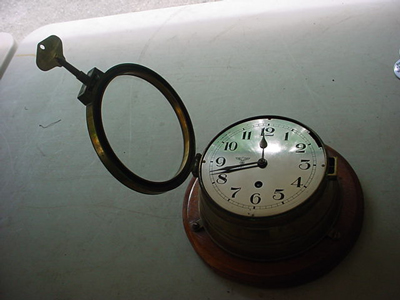
Naval Clock of the Kriegsmarine (Item KRIEG 9-5) |
||||
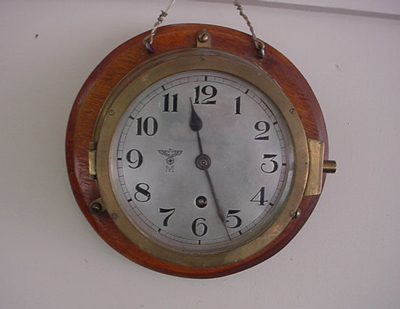
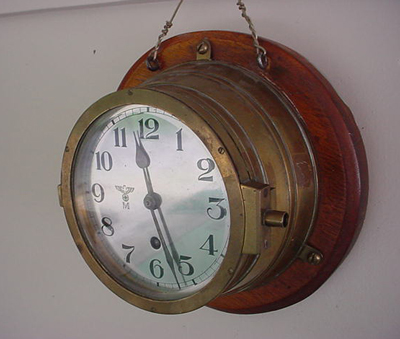
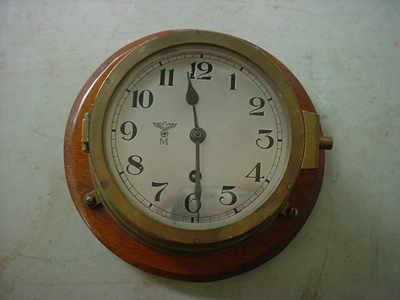
DESCRIPTION: Here is another of the nicest and most sought after clocks of the German Navy (Kriegsmarine). It is an 8-day clock. As usual, it was bought from an Eglish veteran who says he removed it from a scuttled U-boat. It is mounted very neatly on a heavy piece of oak wood with loops for mounting on the wall (easily removed). The clock has the eagle and swastika, but no serial numbers or the usual "M." This is one of the best ones we have encountered. They are extremely rare in the U.S. Most of them are found in England because of their being much more involved in the high seas war than America was. The opening and setting face measures 8" in diameter including the key opening projection tube. The key is half original. It seems that the top portion broke off somehow in the past and the British sailor had his ship's machine shop do a rather crude replacement; but it works fine. These clocks make great decorations and are historical treasures when rarely found. Keeps perfect time! PRICE: SOLD |
||||
 |
 |
 |
 |
 |
 |
 |
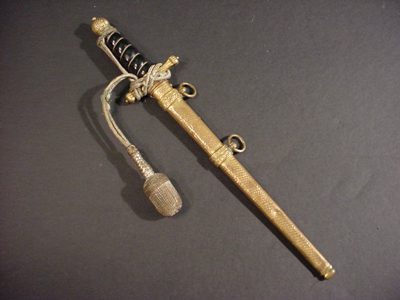
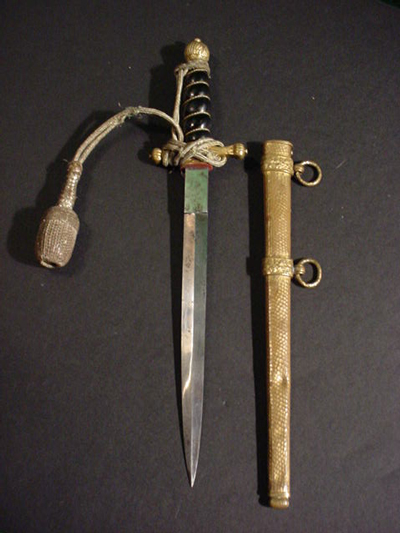
A 1921 Pattern Navel Dirk (Weimar) (Item KRIEG 9-6) |
|
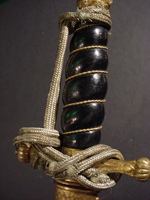
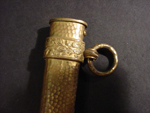
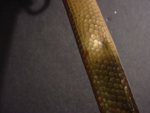
DESCRIPTION: Here is a fine example of a very rare dagger in pretty good condition except for a couple of door dents in the hammered scabbard. Thomas Wittman, in his great book Exploring the Dress Daggers of the German Navy, on page 197 says that this hammered scabbard model may have been purchased after 1921. It is practically identical to the one Wittman shows on page 197 of the aforementioned book with the wide carrying bands decorated with oak leaf and acorn motifs. The blade is of a plain type. The grip consists of black celluloid over wood base -- on page 198 there is a very good picture of just such a dirk worn by an NCO of the Reichsmarine. The book says the portepee is the silver bullion type adopted after 1923 and very much like the one we offer here; it is tied in the double clove hitch style used after the mid-twenties. He even points out in this picture a small dent in the scabbard (just like ours). Another picture of promoted midshipmen at the naval college in Flensburg shows the men wearing the 1921 pattern with black grip. The silver bullion portepees are tied in the new double clove hitch method and, like ours, the scabbards shown are the hammered variety. The 1921 pattern dirk represented a change of scabbard only. Basically the 1919 model dirk was retained and former imperial officers continued to wear their original dirks. The ball pommel décor of reeds and cattails over cresting waves is the pattern on the early and the later 1920’s model. The length of dagger in scabbard is 15" in the scabbard. The blade is 9" long, the guard is perfect as is the pommel.and cross guard. The blade has surface pitting but when we say surface, we mean just a light stain. The portepee is there but shows much use with bare thread showing here and there, but again it is after all there! And, it is honest wear that must be expected. What do we mean when we refer to ‘door dents’? The daggers were always worn suspended low on the hangers and often when the dagger wearer would go through a door, especially bulkhead doors, the dagger might trail behind for a fraction of a second, just enough time to get slammed in the door -- you see this on about half of the naval daggers from early times to the end of WWII. It is a common injury. PRICE: SOLD |
|
 |
 |
 |
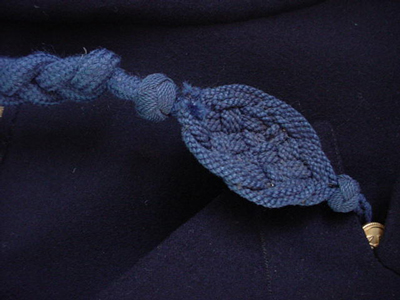 Marksmanship lanyard |
 Rank & specialist patches |
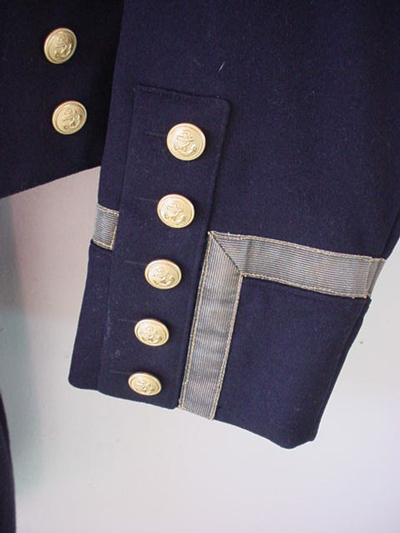 Sleeves & cuffs |
 |
 |
 |
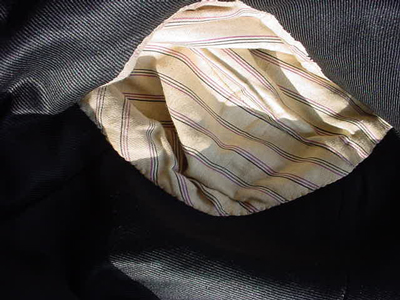 Inner lining of sleeves |
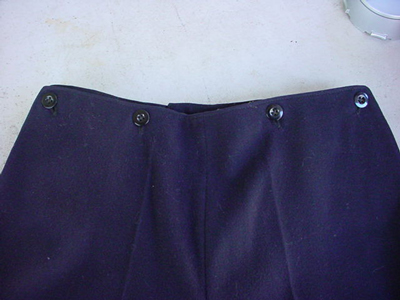 Trousers |
 |
 |
 |
 |
 |
 The service cap |
 |
 |
 |
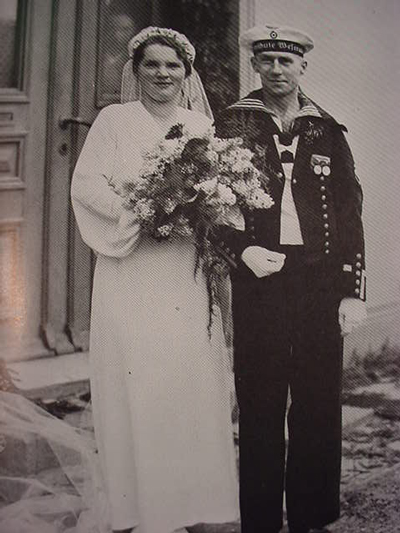
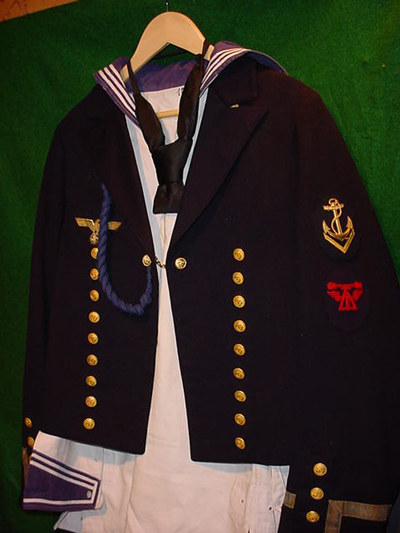
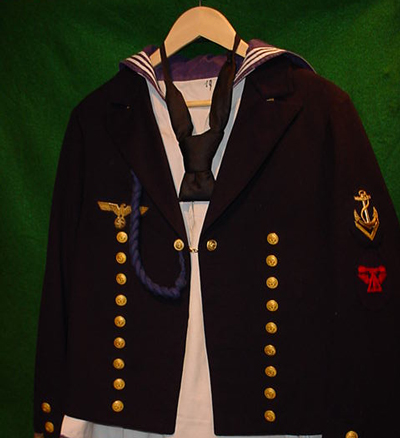
A Beautiful Kriegsmarine Full Dress Outfit for a Junior NCO Rank (Item KRIEG 9-7) |
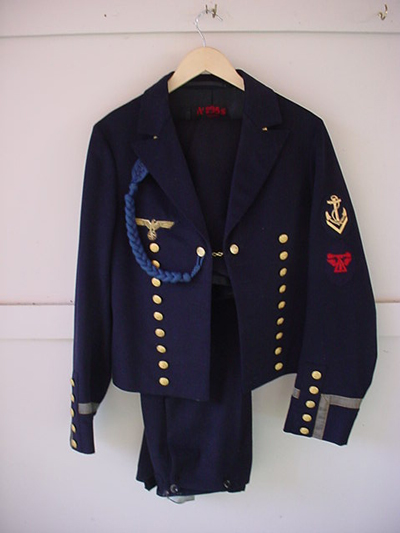
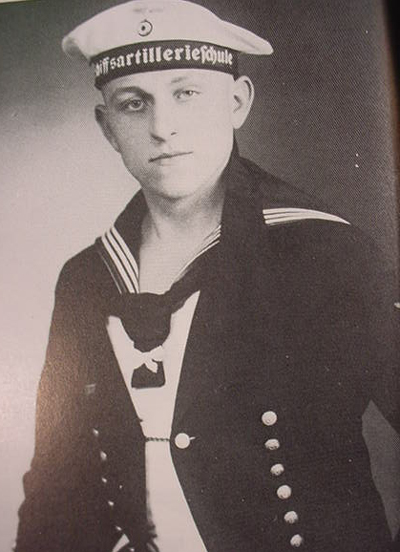
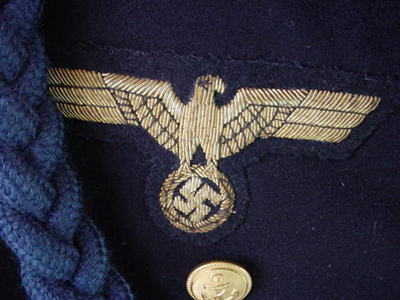
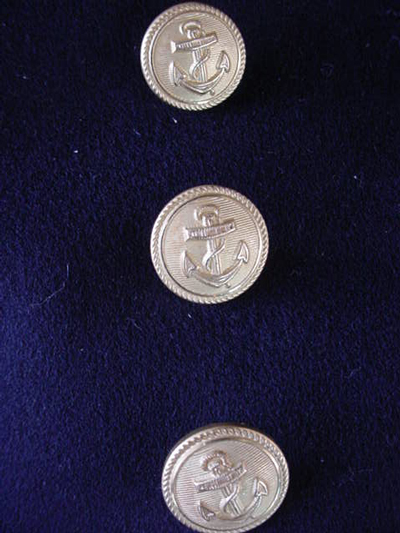
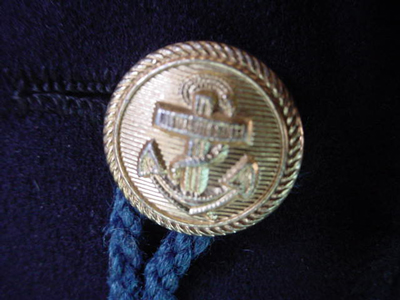
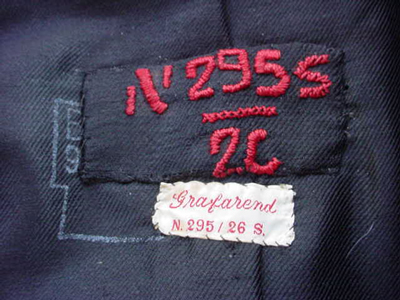
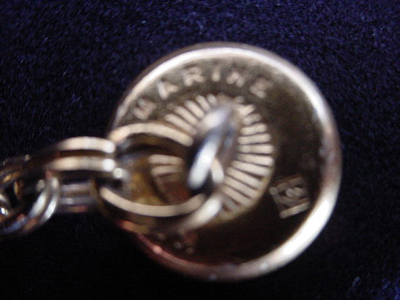
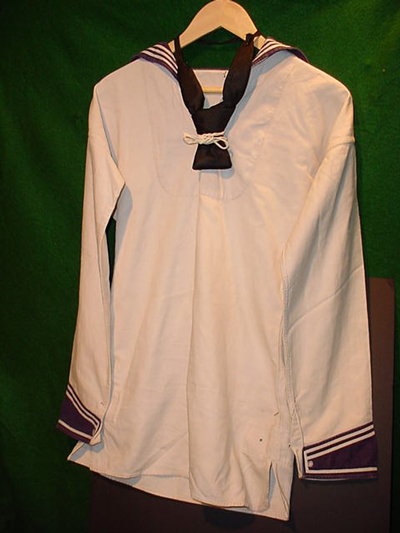
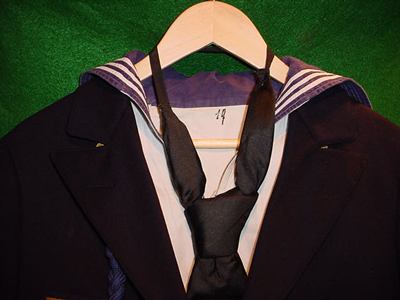
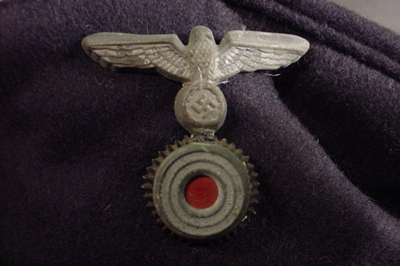
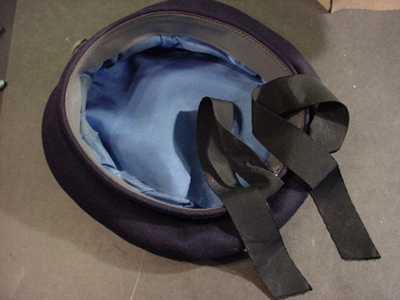
DESCRIPTION: Here is the seldom found dress uniform of the Kriegsmarine (German Navy). It is in immaculate condition and is comprised of the beautiful mess dress tunic with its 28 buttons and two more used for fastening the collar, 30 in all. It has the straight bottom trousers with the sailor flap. Also, there is the Donald Duck cap with Kriegsmarine band. The specialty badge in red is unknown to us and any help with that will be greatly appreciated. The golden bouillon eagle is wonderfully woven and sharp the tunic has a blue marksmanship cord or lanyard suspended from the fastening button on the left right down and attached to the buttons in the front where the two fasten. The tunic in closed position. The cap came separate but is the proper type for this outfit. We have black lighted it and it passes all tests. In this near mint condition this uniform is not only rare but gorgeous. The blue cap was worn on some occasions usually in winter with the dress uniform while the white was used at other times especially in the summer. We also have the shirt with blue striped back flap and the silk collar dickie. All we are missing are the shoes but they would be standard dress shoes in black. The condition is almost mint and we must tell you that the trousers though very nice, have some slight mothing but only trackings that never became holes -- everything is sharp, crisp and ultra neat. The breast eagle is sharply defined as is the insignia on the sleeve. But regarding this insignia we have searched the pages of John Angolia and Adolf Schlichts books (three volumes of Kriegsmarine Uniforms and Traditions) and we could not find references to the specialty insignia on the sleeve. As I have said we need help with that! The buttons are all marked marine on their backsides. There is a blue marksmanship lanyard attached. The tunic is numbered (see image) and has the name of the junior NCO inside. The sailors name was Graforend and his ID No. this was 295/365. The trousers are the wide bell bottom style with the flap button front familiar to most Naval uniforms throughout the world. The inner sleeve linings are of the traditional silk like material. The Donald Duck cap has the two piece national eagle and roundel or feld abzeichen. It has the Kriegsmarine cap band with tails and blue silk lining. A really great and beautiful outfit that will look fantastic on a mannequin in your collection. They really don’t come better than this. Special thanks to author Brian Leigh Davis for the color depiction of the Naval Drum Major from his marvelous book "German Uniforms of the Third Reich 1933- 1945." PRICE: SOLD |
 |
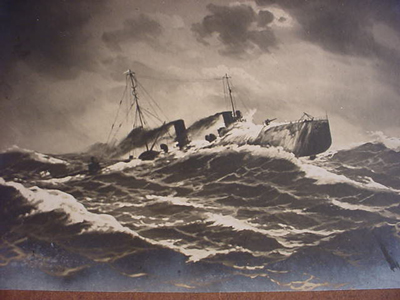 |
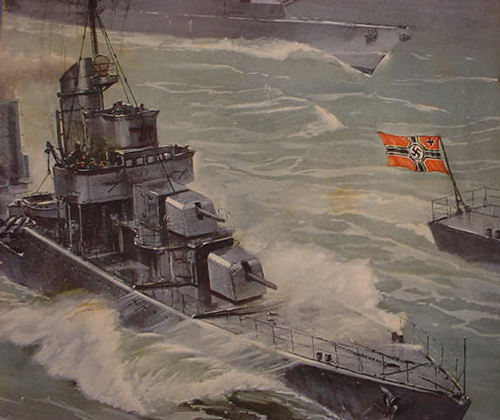
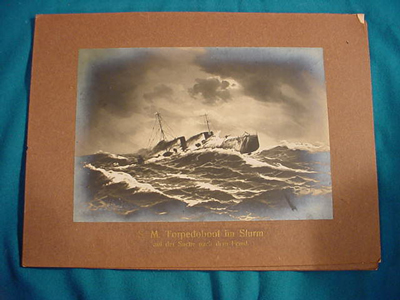
Picture: Torpedo Boat in Storm (Item KRIEG 9-8) |
DESCRIPTION: This framable picture mounted on heavy card stock was form the personal collection of Pastor Arthur Dinter who was the originator and father of the Deutschen Volks Kirche E.V. This was the church that was founded within the 3rd Reich that was to honor and glorify the New Testament of the Christian Bible while giving National recognition and adherence to the New testament of Jesus Christ, The Old Testament was identified as a Jewish work and only a Jewish work and not worthy of Aryan veneration or worship. Dinter believed and taught that Christ was not a Jew but came to challenge the Jews and lead his people (Christian Aryans) on a different path. All of this was “HIS WORDS.” Later, we will have a complete story about Dinter and the German peoples church when we do a narrative concerning a painting of him and several of his personal hand written bound Journals and publications that we have received out of Germany. We are however, offering 3 great photo prints that were his separately. The first is a great picture mounted on board of a German WWI torpedo boat under the words S.M. Torpedoboot in Sturm. It says Auf der suche nach dem feind and this means his majesty's Torpedo boat in a storm while searching for the enemy. The picture and board measures 15 ½ x 11 and the picture itself is 11 x 7 ½. A great thing to frame. The words are in gold print. Very nice and none of the price is based upon the former ownership of this German Pastor. PRICE: $185.00 |
 |
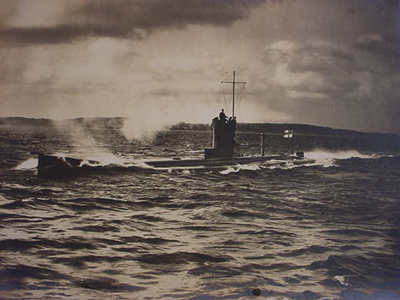 |
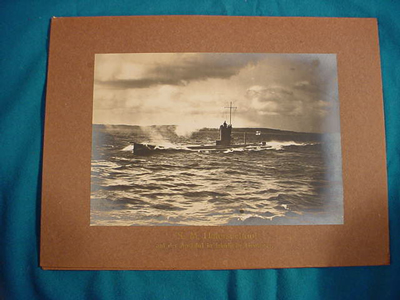
U-Boat Picture (Item KRIEG 9-9) |
DESCRIPTION: This is another picture from the collection of Arthur Dinter the Deutsches Volkskirche Pastor mentioned in the article above. The measurements are the same as the one featuring the Torpedo Boat. Under the picture are the words S.M. Unterseeboot in journey into enemy waters. In German – S.M. Unterseeboot auf der Ausfahrt in Feindliche Gewasser. A nice dramatic period picture that would look great framed. PRICE: $185.00 |
 |
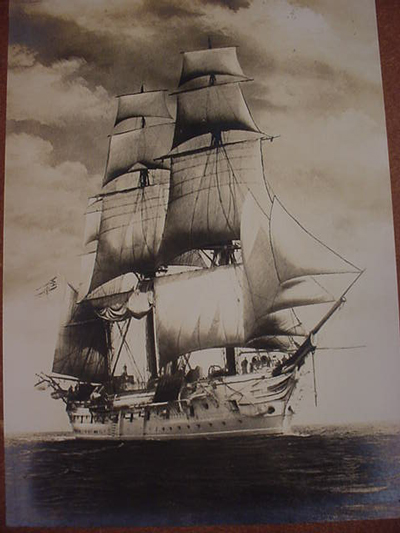 |
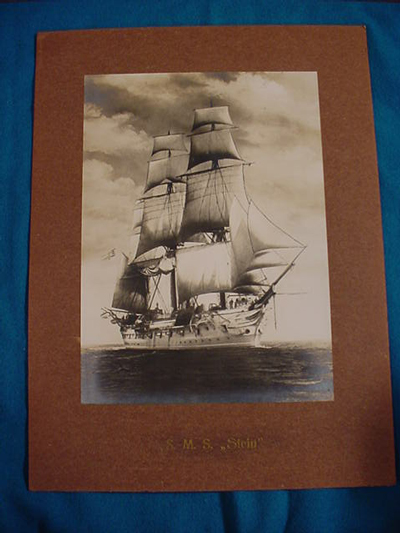
SMS Stein Imperial Training Ship (Item KRIEG 9-10) |
DESCRIPTION: This is another fine photo print from Pastor Dinters collection (see the ones above) mounted the same with the same dimensions. This was his Majesty’s ship “Stein" and it was a training ship of the Kaisers Imperial Navy. Many shipmates who later became famous officers in WWII took their training on this beautiful vessel. It was a stately clipper ship. Interestingly, enough one of them was a spy and a traitor of the lowest order (Admiral Canaris) in 1906. Canaris was promoted to Fanrich zur See, (Midshipman) while assigned to the Stein. The ship was commissioned in 1877 and was a 3 masted full rigged frigate of the Kaiserliche Marine. A beautiful queen of the Seas. PRICE: $185.00 |
 |
 |
 |
 |
 |
 |
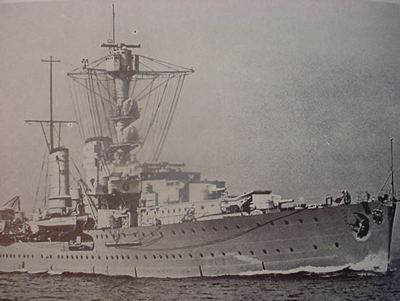 Emden sets sail in Norway |
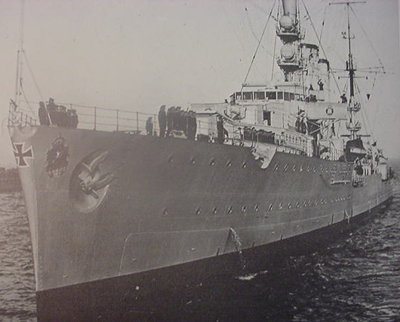 Emden in port |
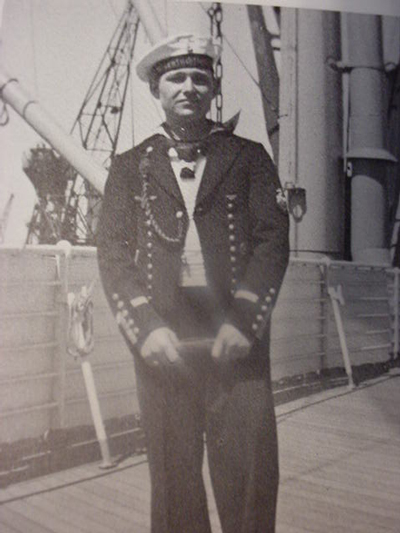 Crewman |
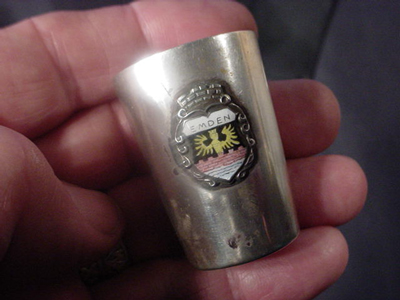
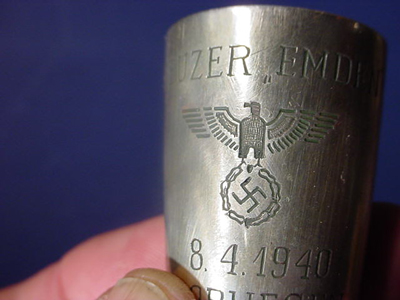
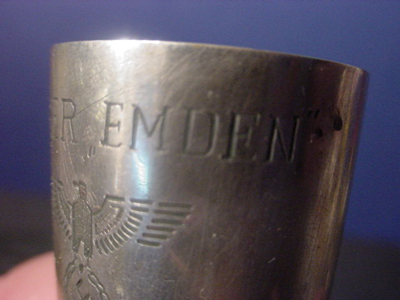
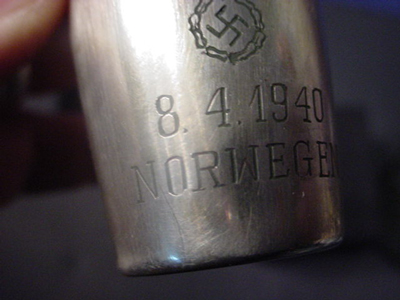
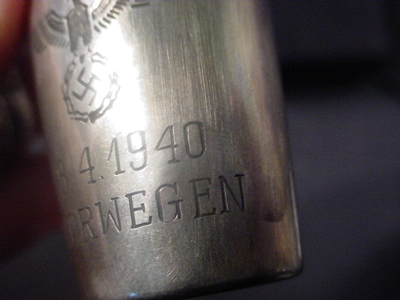
A Shot Glass from the Battle Cruiser Emden (Item KRIEG 9-12) |
DESCRIPTION: Here is a silver shot glass that belonged to a sailor who was stationed on the German battle cruiser Emden in 1940. It is a little over an inch and a half high with a mouth opening of a little over an inch. It has the engraved words Kreuzer Emden over a beautifully hand-engraved Reichs eagle and swastika. (Rather difficult to photograph however with the silver flashback.) Under this is the date 8.4.1940 Norwegen. This was obviously ordered to be made to commemorate Emden's initial part in the invasion of Norway in Operation Weserubung, along with Lutzow, PRICE: SOLD |
 |
 |
 |
 |
 |
 Lanyard cut off |
 The maker |
 Size in German |
 Kreigsmarine marking (M for marine) |
 Marked both sides |
Kriegsmarine Reichskriegs Flagge (Battle Flag) (Item KRIEG 9-14 & FLAG 2-13a) |
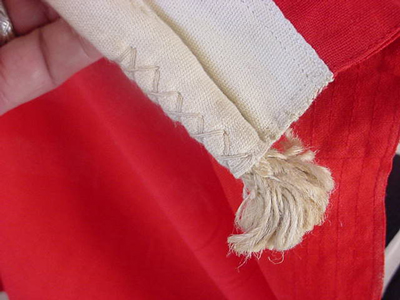
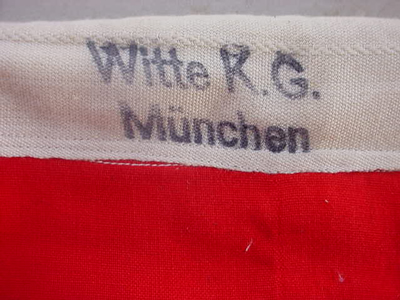
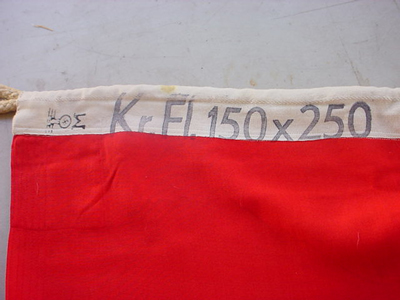
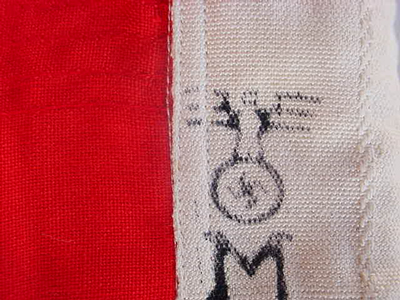
DESCRIPTION: This is a large Kriegsmarine-marked Reichskriegsflagge in great condition except for some minor stains (very minor), but they might likely come out with a washing, but they are from good honest wear in wartime. This is the size for a submarine (U-boat); it measures 8' 3" x 56". It has its top lanyard loop but he extension rope was removed. It is, of course, a very dramatic looking flag. It is nicely marked on each side with its German dimensions and a stick eagle sits on the "M" for marine (navy). This is one of the better ones that we have unearthed in Germany last year. Just as nice as they come. PRICE: SOLD |
 |
 |
 |
 Wir Fahren |
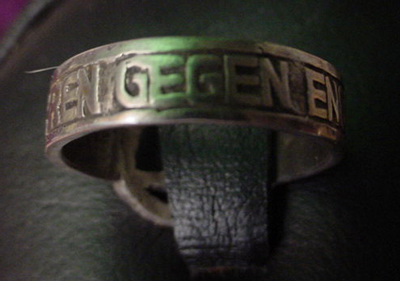 Gegen |
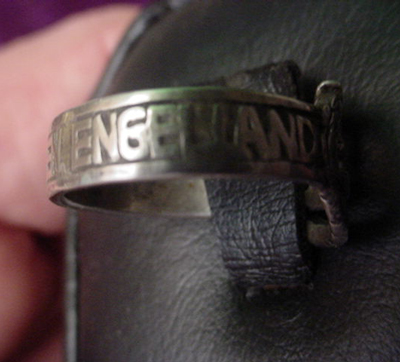 Engeland |
 |
 |
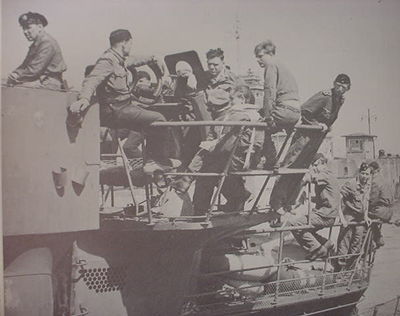 |
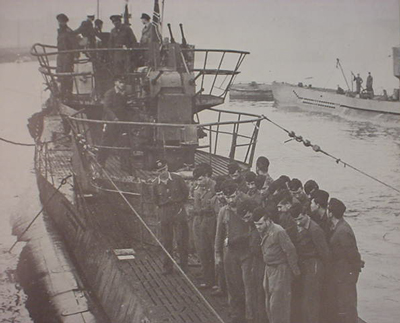 |
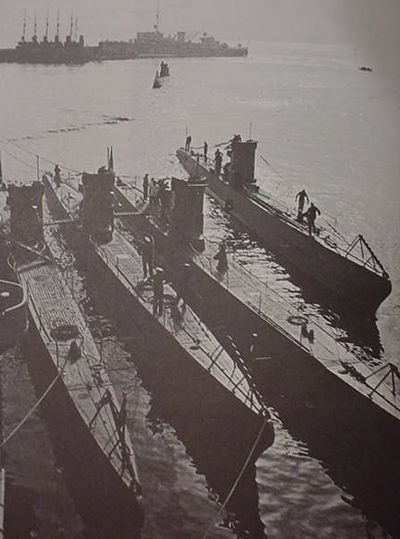 |
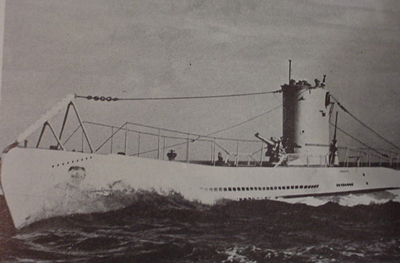 |
 |
 |
 |
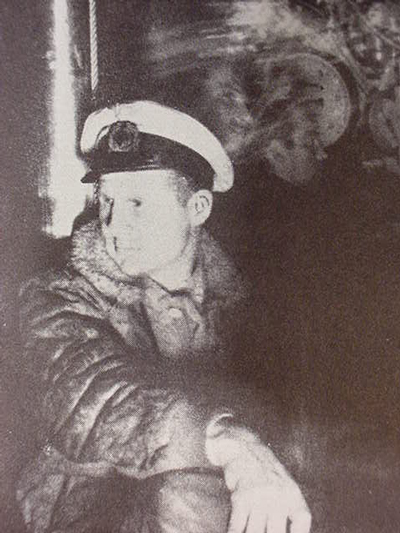 The skipper! |
 |
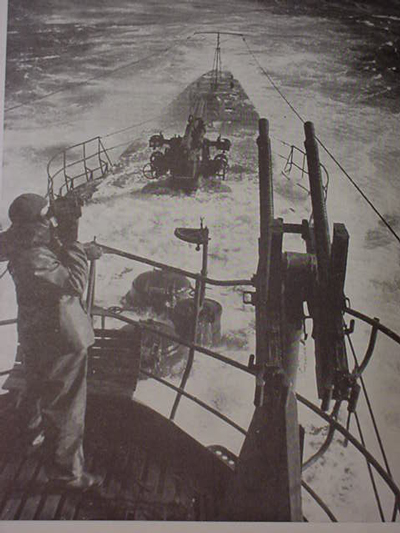
Ring of the Wolf Packs Submarine (U-Boats) (Item KRIEG 9-15) |
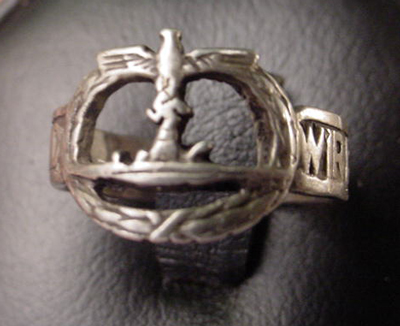
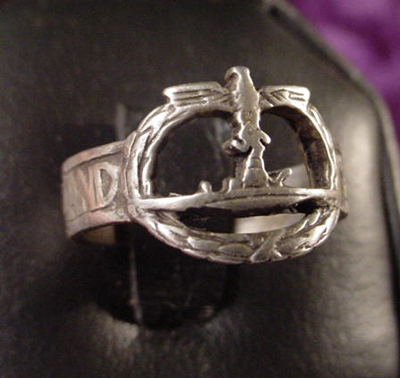
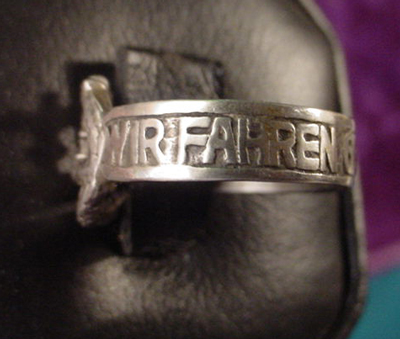
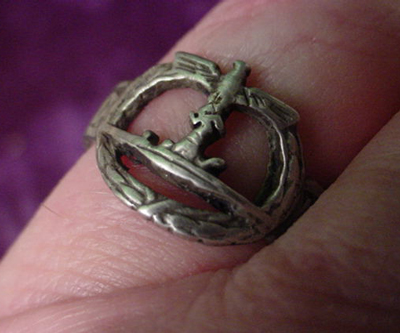
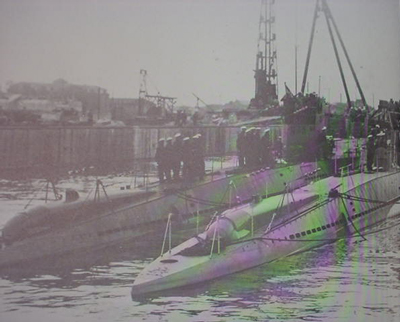
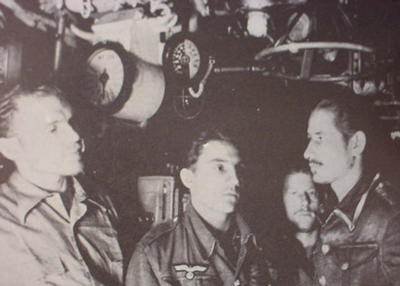
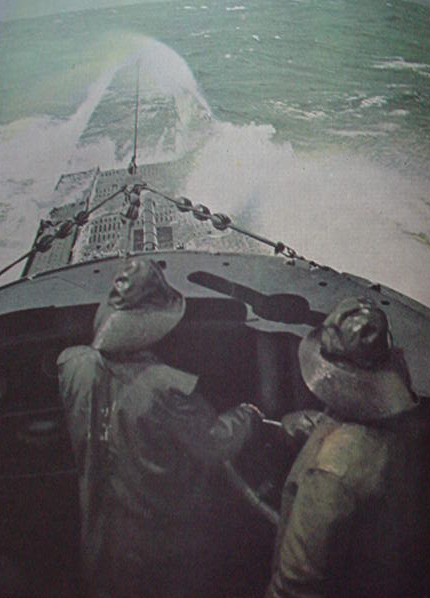
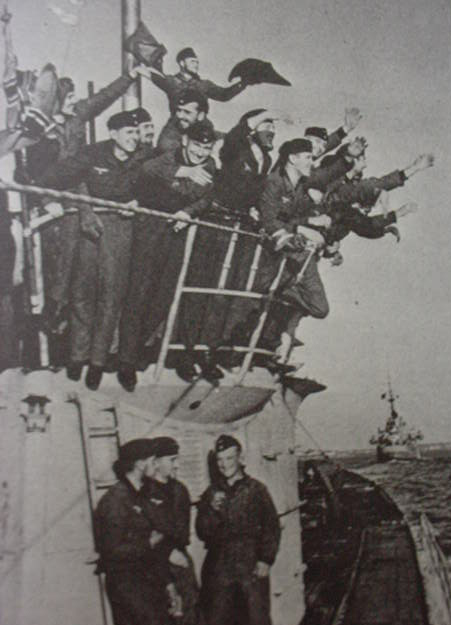
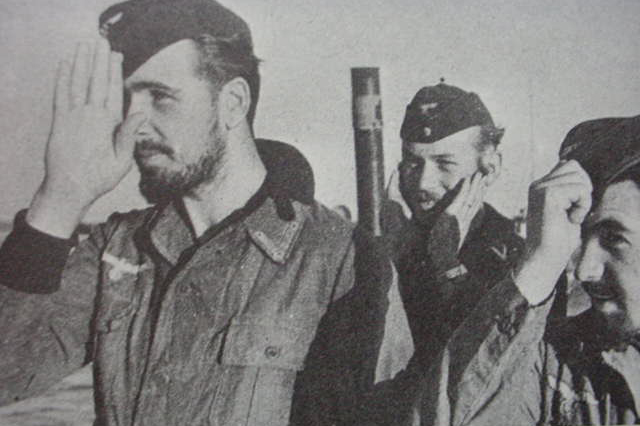
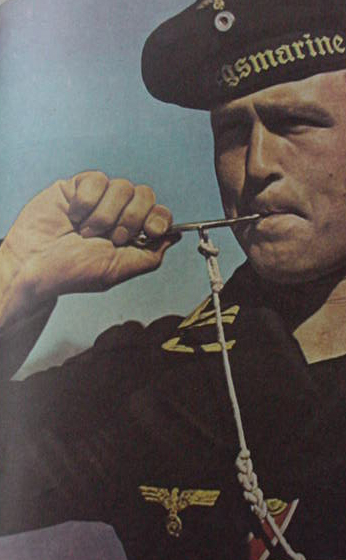
DESCRIPTION: This is the ring commonly worn by the proud German submariners in World War Two. It depicts on its face the image of one of these U-Boats with the National eagle seen above its conning tower. Around the band is the first word of the song that was popular with the Luftwaffe and of course the German Naval services. The name of that song was “Wir Fahren Gegen Engeland” -- "We are sailing against England” commonly called the “Engelandlied. (I have known this songs words and melody from my time as a youth when I attended German picnics near my home town. There were always ex-members of the German American Bund and after a few cold beers there would invariably be a rousing cheer from the Bundists and they would beat the mugs and steins on the table and sing the strong and proud England Lied. Some of the best moments of my life were spent with these wonderful Germanic elders. I loved to sing along with them this ENGELAND LIED and other wonderful songs of the German Wehrmacht.) “Heute Wollen wir ein Liedlein singen, You can go into Google and type in Engelandlied and see and hear the words of this bold yet melodic song at least for now until the traditional enemy manages to have “such terrible racist material” removed. Actually the best presentation of it is the one that has the Japanese characters on the notice look for it- - its spectacular! The sound of it not only stirs the souls of Germanophiles of the West but all over the world even in “England”. The ring should be a memorial of sorts to those proud and brave men who for their Fatherland and the west “Went down to the sea in ships”. The U-Boat losses in personal was 75%. The highest rate of losses of any service of any country in WWII about 27.000 lost their lives and yet there was never a scarcity of young recruits right to the end. When you think of loyalty and devotion think first of these young heroes. The gruesome fact is that had Germany had 25 to 50% more U-Boats the result of the war would have more than likely been much different. Also if the Panzers would have had enough fuel the invaders would have been pushed back into the sea. This is a handsome ring and a historically important relic of the war for Europe and the West. PRICE: $650.00 |
 |
 |
 |
 |
 |
 |
 |
 |
 |
 |
 |
 |
 |
 |
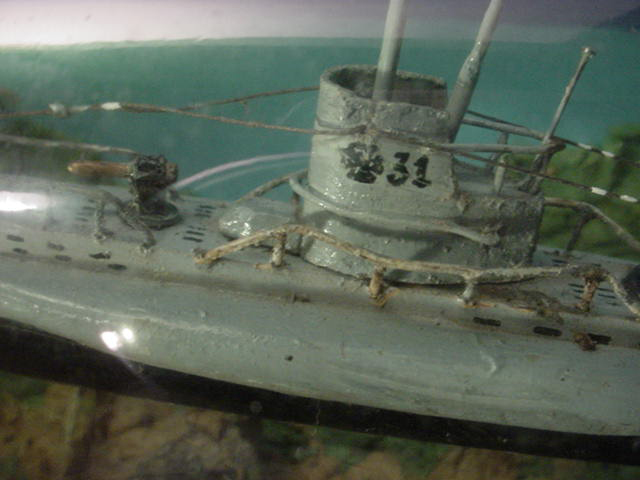
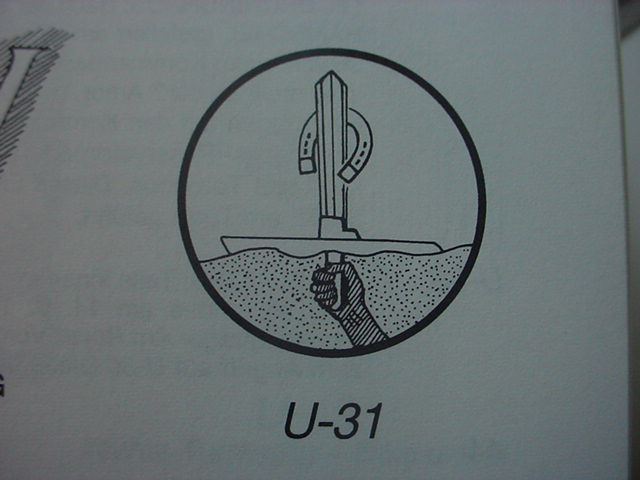 The emblem of the U-31 |
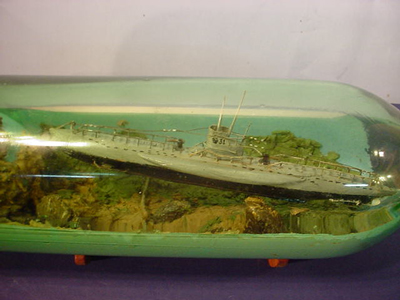
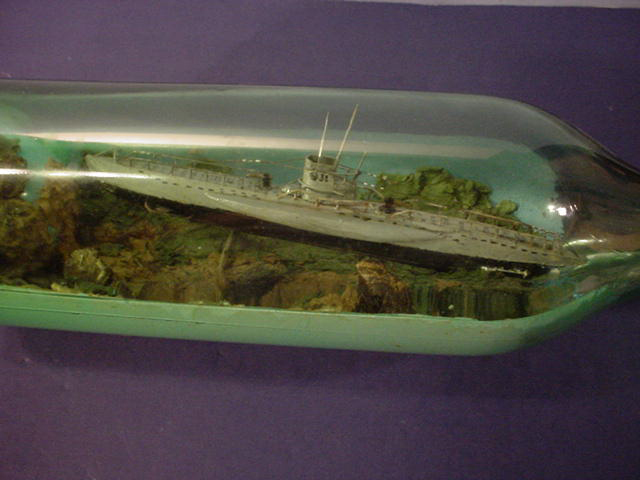
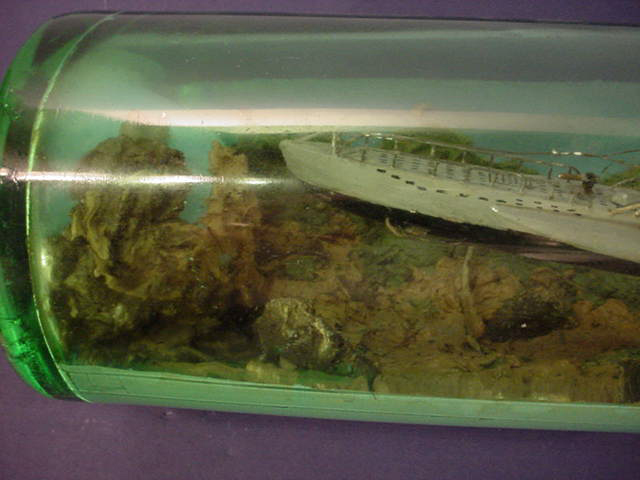
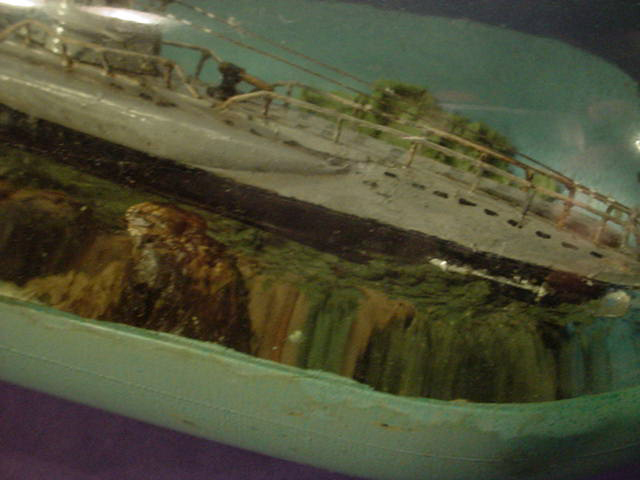
Memorial U-Boat Miniature in a Bottle (Item KRIEG 9-16) |
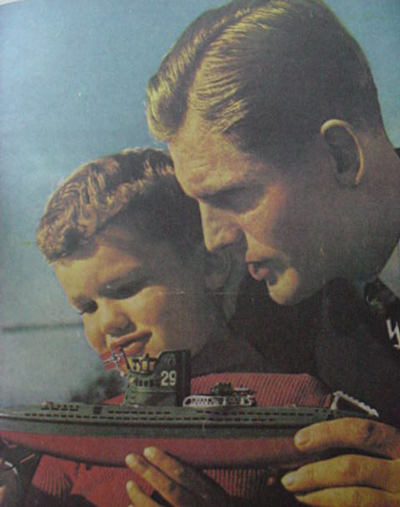
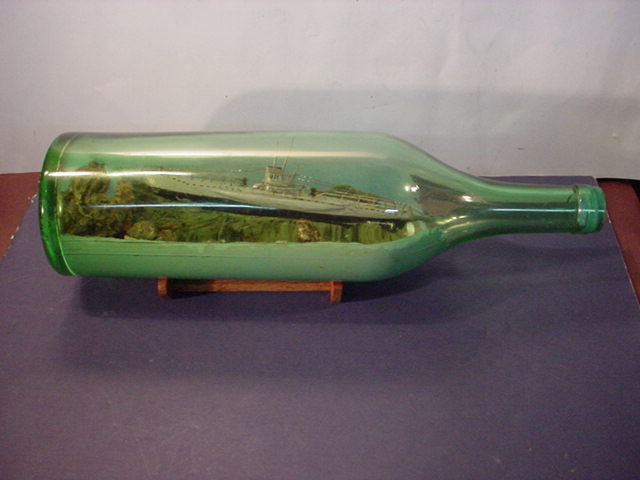
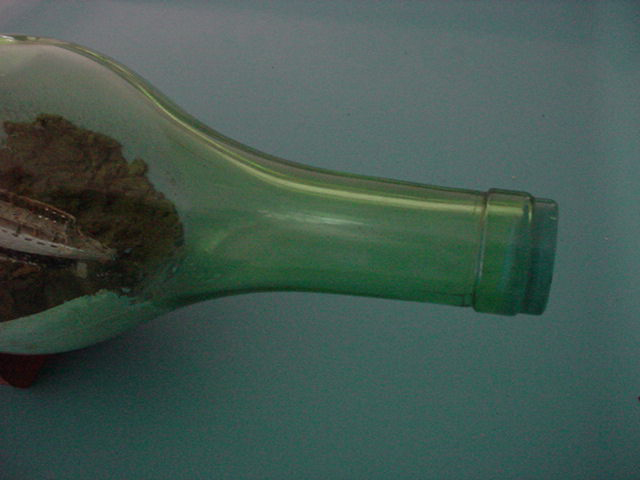
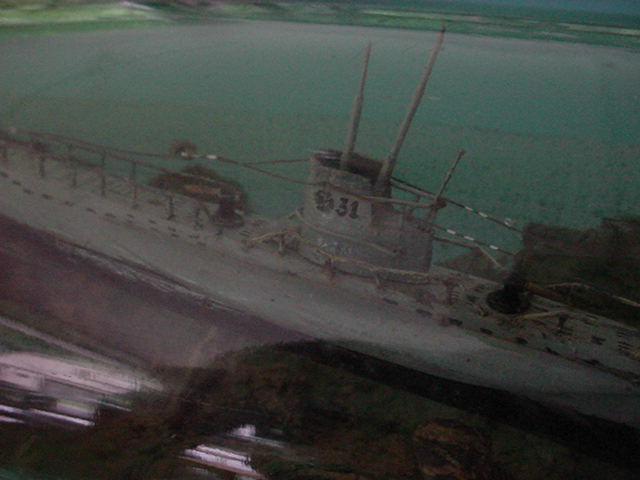
DESCRIPTION: This was an international tradition of the men who go down to the sea in ships. The art of constructing a ship inside a bottle has been a manifestation of the sailor art from centuries ago. Mostly it was a folk art form that was carried on by English and German sailors, although we have seen American efforts as well in museums and collections. It is an exacting art performed by specialists who had no room for error once the project is begun. This example we offer here may be unique for it is no Spanish Galleon or Clipper ship; it is a German WW II German U-Boat believe it or not! But it is more than that, it is a sailor's memorial that was constructed by a member of the German Kriegsmarine who built it to commemorate and honor the crew of the U-31 that was sunk by a British aircraft on 11/31/1940 with two bombs. The U-31 was destroyed with the lives of 58 sailors. Before this tragic ending this crew under Kapitan Prellberg managed to sink the British destroyer Antelope on the northwest Irish coast in 2/11/1940. The sad fact is that due to the loss of radar superiority, the toll of sunken U-boats and hundreds of thousands of brave young sailors lost their lives yet, there never at any time was there a shortage of volunteers so much did they love their nation and people. This great U-boat in a bottle is actually great looking and definitely not a child’s toy although miniature U-boats were a favored plaything and collected in the Third Reich. See our picture of a Knights Cross winner showing a miniature to a handsome Aryan child who we hope survived the horrible fratricidal war (both of them). The bottle is quite heavy and as you can see it has a greenish cast to it. It is 18” long and the bottom is 5” in diameter; it weighs 6 pounds 4 oz. The work is exceptionally good and very realistic looking with the flora and fauna of the deep evidently surrounding the boat. If you look closely you can see the tiny swastika flag on the conning tower although it doesn’t show up in our pictures. If you are a true Germanophile and a lover of the unique this is for you and sentimentally it should be preserved. PRICE: SOLD |
 |
 |
 |
 |
 |
 |
 |
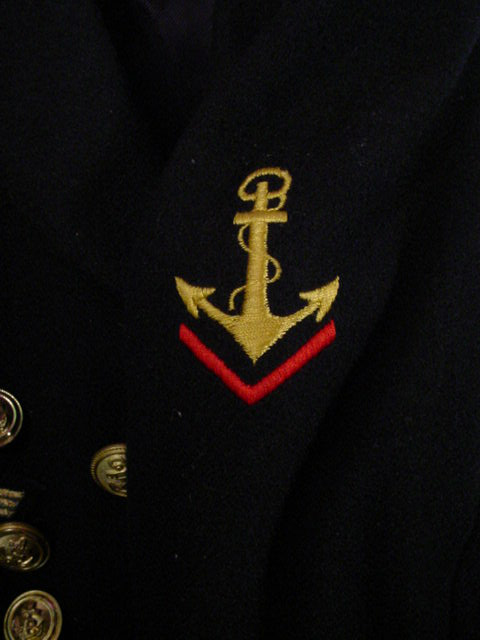 Sleeve insignia |
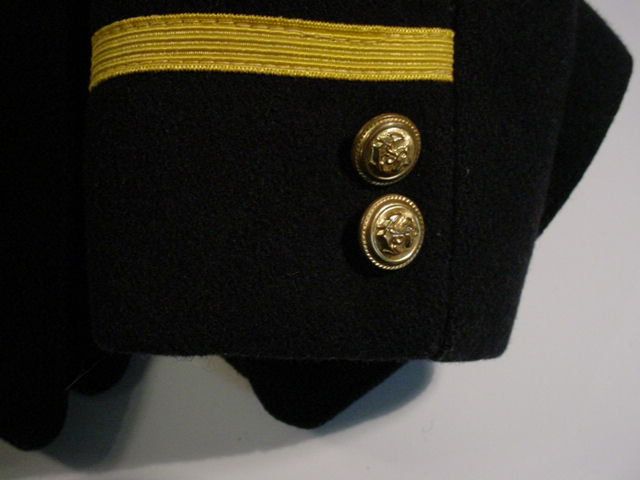 Cuffs |
 |
 |
 |
 |
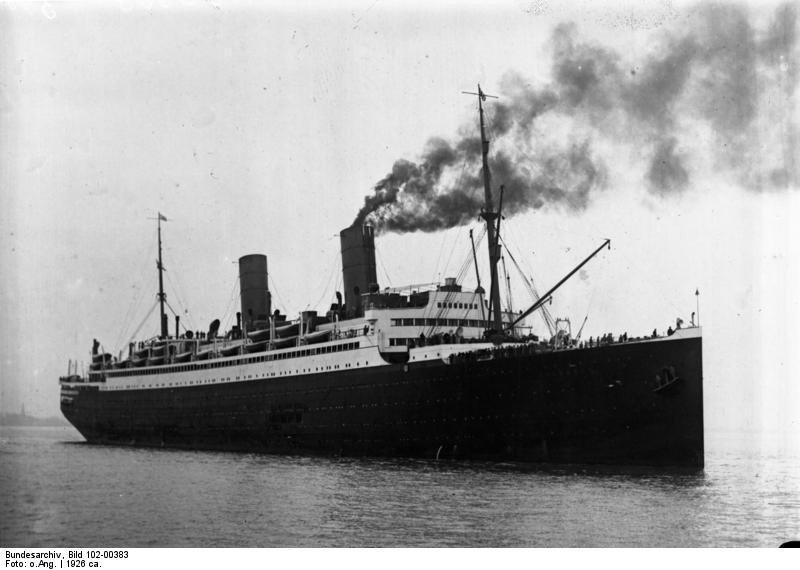 |
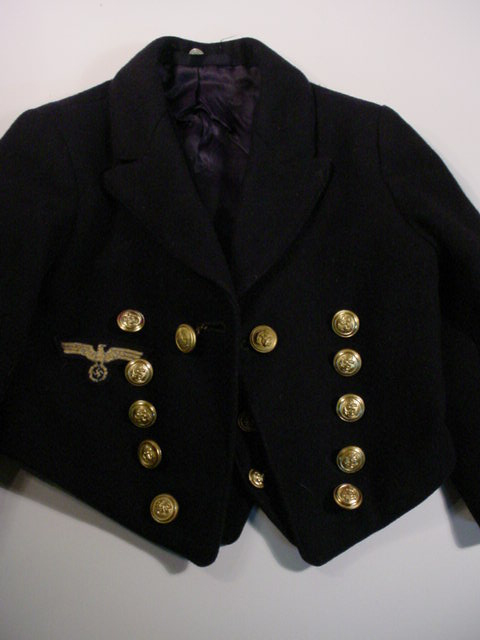
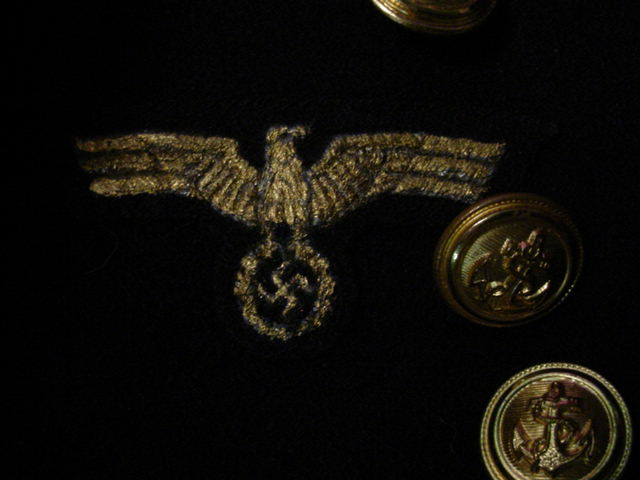
Tiny Tots Uniform from the German Ocean Liner Columbus (Item KRIEG 9-17) |
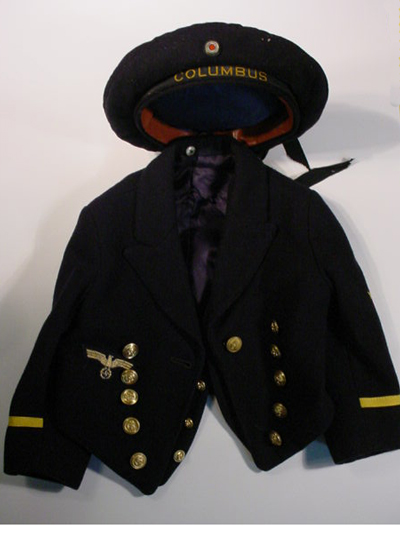
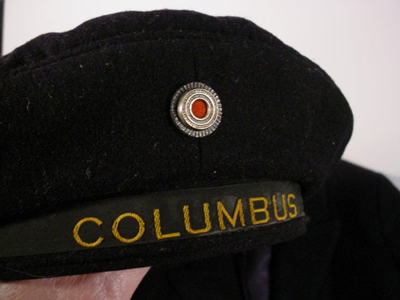
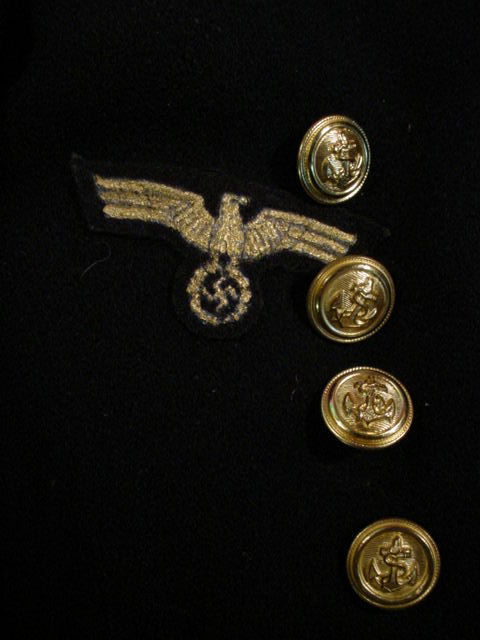
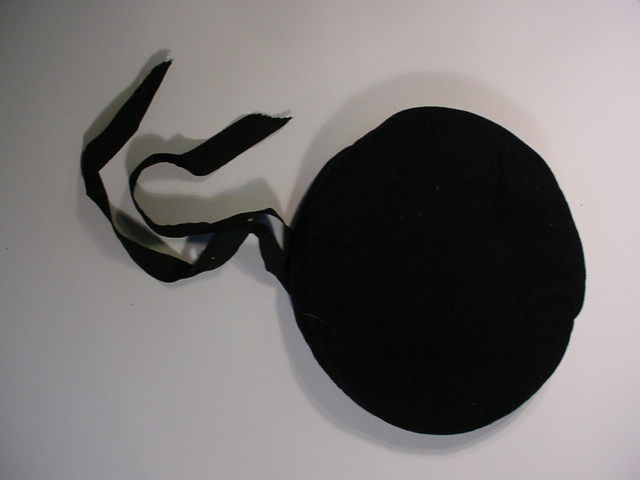
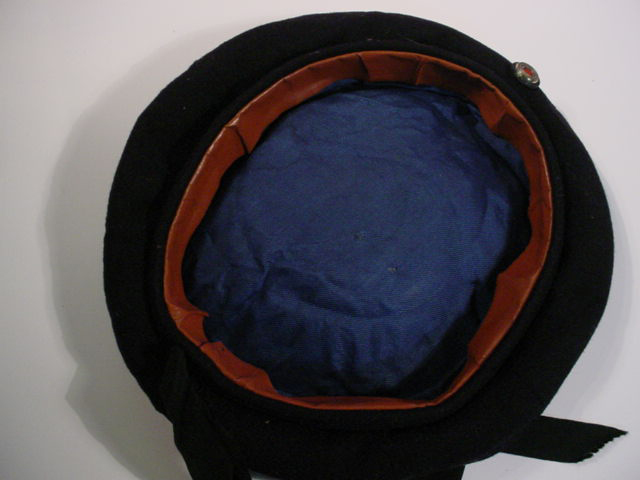
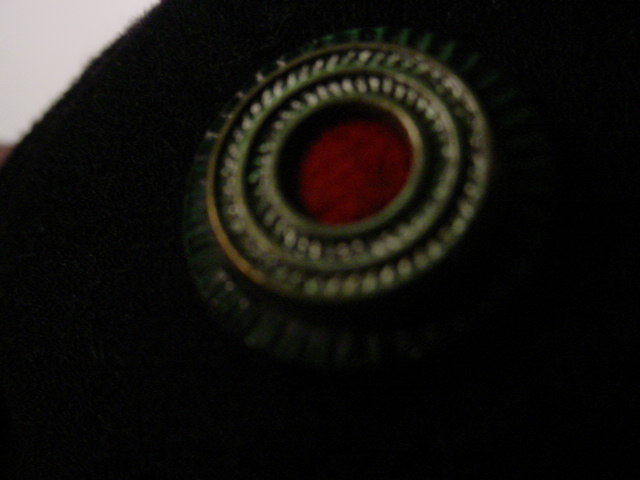
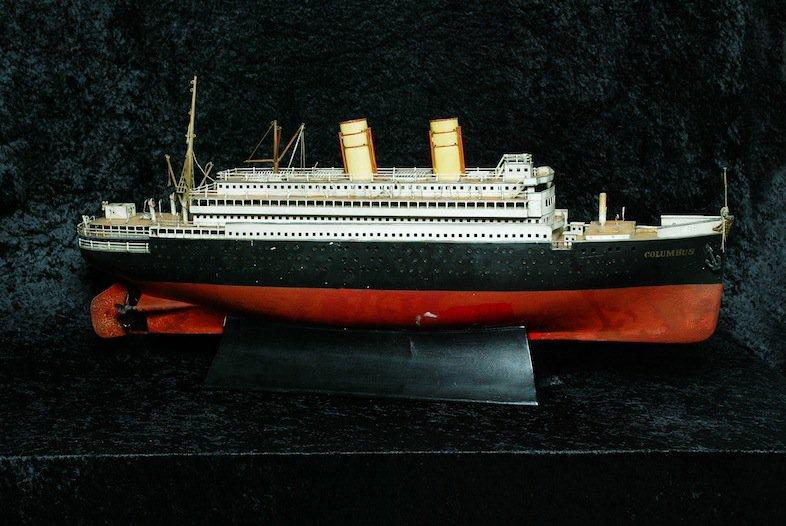
DESCRIPTION: This is a great little set of jumper and cap that was undoubtedly tailored for the son of one of the officers or crewmen of the SS Columbus. The tiny tunic and bib shirt are very authentic looking as per a sailor's suit in the adult version. German seamen were very proud of their service and it is typical that one of the officers or “swabies” would commission this outfit for his little boy. This is a really neat item for a naval collection. The outfit consists of the jacket with sailor bib. The story of the SS Columbus is available on the net under SS Columbus on Wikipedia 1924. The ship was commissioned before the start of WWI and was to be named Hindenburg originally but ended up being named “Columbus”. She was not completed until 1924 and her maiden voyage was in April for that year. She was the fastest and largest of the German merchant marine fleet as an ocean liner extraordinaire! 32,354 tons, she was 774.3 feet in length and could carry 1,250 passengers. The Columbus was one of the first liners to have a swimming pool on deck. Nightime dancing was performed on a special platform, a beautiful pleasure palace and pride of the fleet. Then came World War II and in September 1939 she was on a cruise when she was summoned back to Germany immediately. The merciless British Navy was hunting enemy ships and to them an unarmed passenger ship loaded with innocent civilians was perfectly fair game -- after all those innocent civilians were Germans, right? She steamed off to Havana and the Captian and crew dodged the Brits by hiding in several South American ports. But in mid-December she was spotted by a British destroyer, Hyerion, near the U.S. Coast. There was an American heavy cruiser the “Tuscaloosa’ nearby and its captain and crew watched as the British ship started toward the Columbus. Instead of firing on her the Brits wanted to board and capture her. Rather than let the Brits take her the crew sadly scuttled her and she burned and sank. The crew probably would have been strafed by machine gun fire as was the British traditional custom, but the Tuscaloosa was a witness and the crew of 567 men and 9 women were rescued by the American ship as rescued seamen, were not prisoners of war as they would have been classified had the British picked them up instead of strafing them; the Tuscaloosa took all the sailors to New York and when the war ended many returned to Germany and others decided to stay in the U.S. So this was the unfortunate saga of the beautiful SS Columbus. Is it any wonder that the little tyke who wore this outfit was proud as a peacock or maybe a whale or shark? PRICE: SOLD |
 |
 |
 |
 |
 |
 |
 |
 |
 |
 |
 |
 |
 |
 |
 |
 |
 |
 |
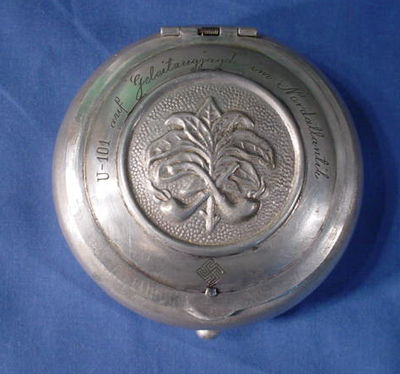
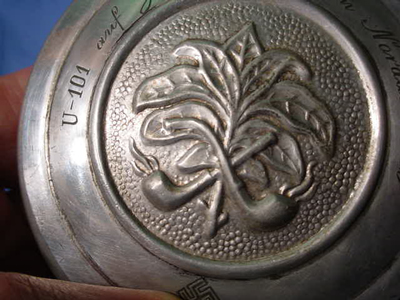
What-Not Box from the Submarine U-101 (Item KRIEG 9-18) |
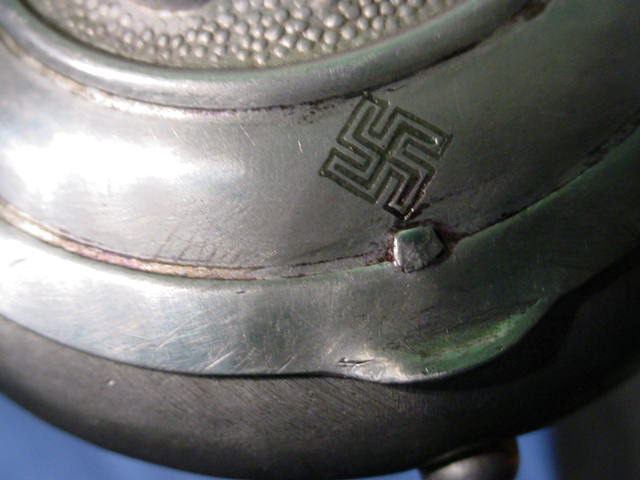
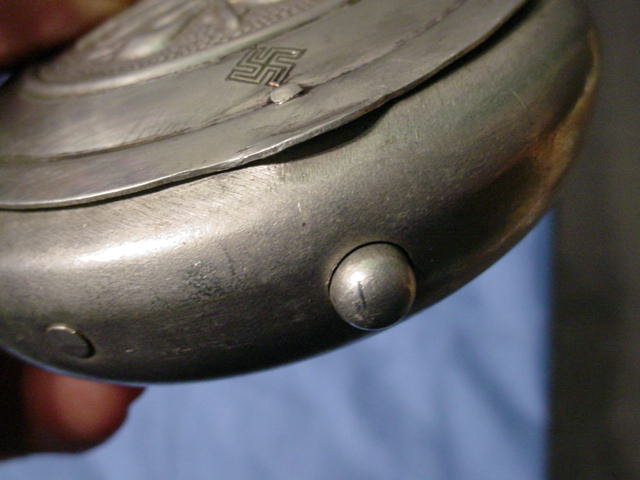
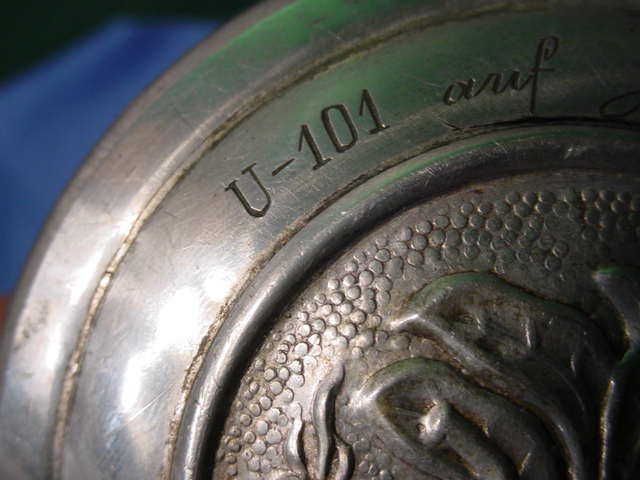
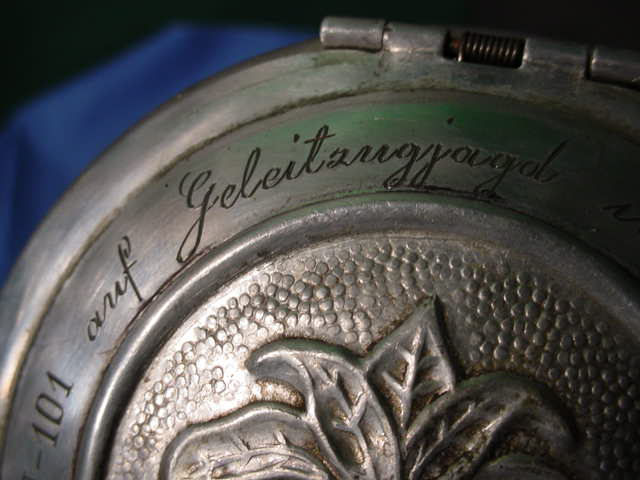
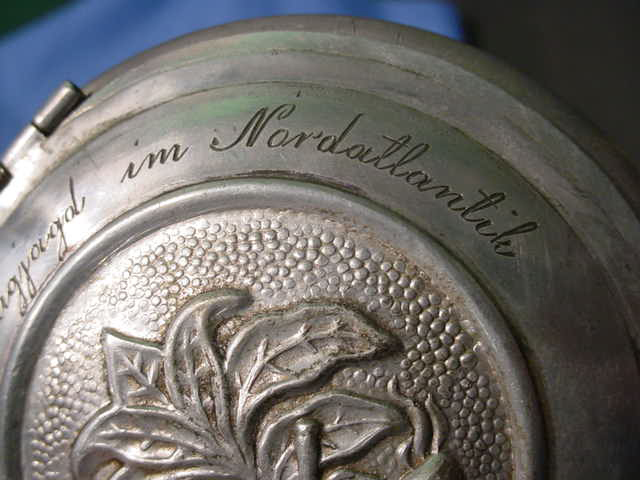
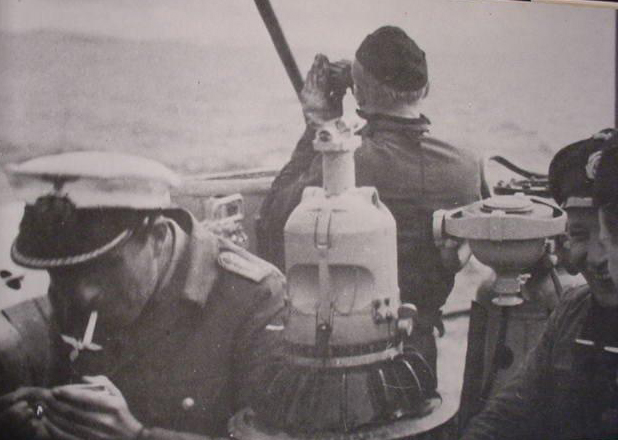
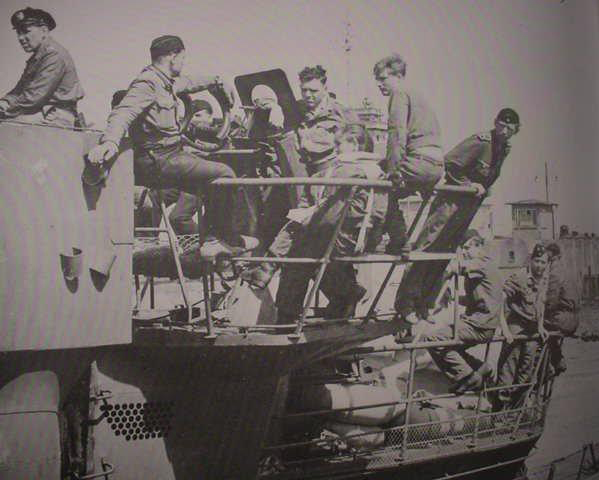
DESCRIPTION: This interesting little aluminum box was crafted by a matrosen (sailor) who served on the famed Wolf Pack Sub U-101. The sub that was a far out leader of the Sea Wolves bringing destruction to Germany’s enemy’s in WWII. The engraving on the box says in German "U-101 Auf Geleitzugjadgd" in the North Atlantic Ocean. Under a raised design of a floral plant of some kind there is a swastika engraved. The box measures about 3 ½ inches in diameter and is about an inch and a quarter deep. It has a catch that opens and closes tightly with the depressing of a button. The top actually pops up smartly when the button is pushed. There is much to know about this 101 that was a type VIIB Sub. There is a Wikipedia encyclopedic history of this ship that can be gotten on Google by putting in (German Submarine U-101 1940). She certainly had a highly successful career and survived with her brave crewmen. “Wir fahren Gegen England.” PRICE: SOLD |
Page Nine |
Please refer to item designator in parentheses in all correspondence.
Please E-mail for any additional information you may need.If you prefer, contact 'Germania' at PO Box 68, Lakemont, GA 30552
or call at 706.782.1668.
Please! do not call during the wee hours of the morning. The best time for calling us is between 10 and 11 am and between 9 and 11 pm eastern time.