|
|
|
|


Medals
Page 4
|
|
|
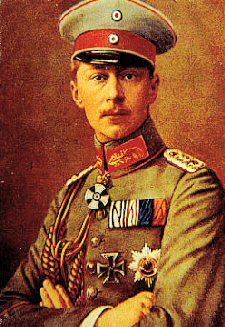
Please be sure to visit our Kaiser Wilhelm II collection.
Also, take a look at our Frederick the Great gallery.
|
|||||
|
Prussian/Austrian/Hungarian Medal Group (Item KMEDAL 4-1; HUNG 1-3) |
|||||
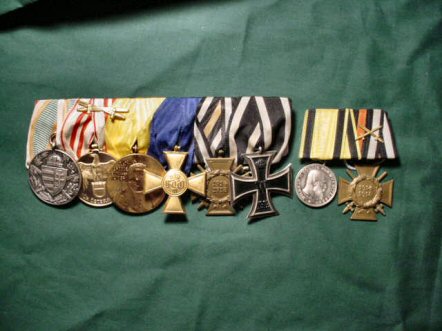
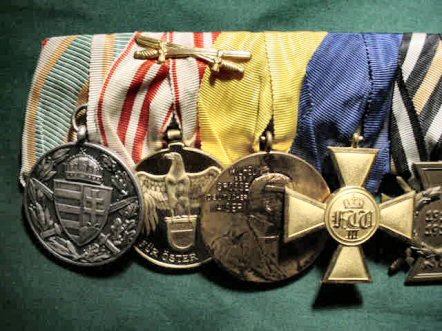
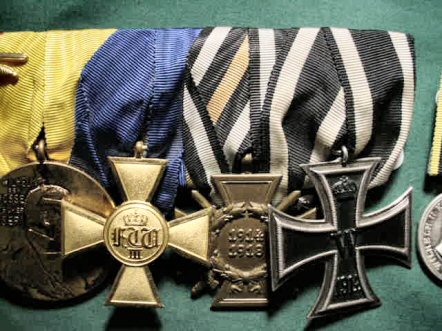
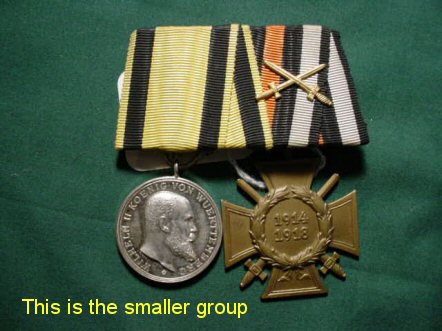
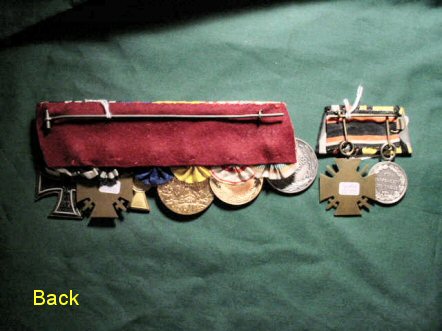
| DESCRIPTION: Here is an excellent group of medals that is in two parts--a six-medal group and a two-medal bar, in addition. This is a very handsome group, indeed. The family that sold it found later the two-medal set and was kind enough to send it along later, and this was much appreciated. The medals are as follows:
From right to left they are listed as: 1. The Iron Cross 1914, Second Class. 2. The War Service Cross awarded to all participants in the Great War, 1914-1918. 3. The 25-Year Faithful Service Medal for officers. 4. The Centennial Medal for Wilhelm, the first German Kaiser and Prussian King. This medal was said to be struck from captured French cannon from the Franco-Prussian War. 5. The War Remembrance Medal for Austria-Hungary with Spange of Swords for Combatants, 1914-1918. 6. The Silver Military Faithful Service Medal of Hungary, 1892-1918. In addition to the above we have, as we stated, another short bar that contains another of the man's 1914-1918 war service medal and a medal for true service and loyalty from the German state of Wurtemberg that is with bust depiction of Wilhelm II of Wurtemberg. PRICE: SOLD |
|
||||
|
Six-medal Grouping of Imperial and Third Reich Medals (Item KMEDAL 4-2) |
||||
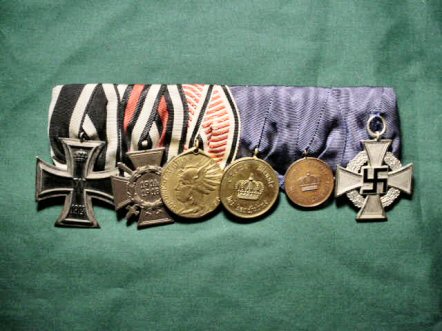
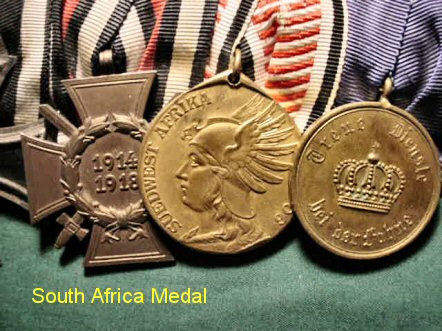
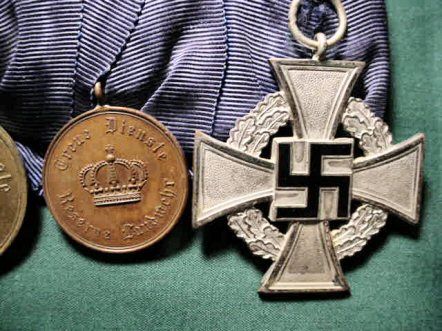
| DESCRIPTION: Here is a very nice six-medal grouping of Imperial and Third Reich medals with some rather rare medals that are listed as follows: 1. Iron Cross Second Class, 1914 2. War Service Cross given to all participants in WWI. This class is with sword for combatants. 3. German Southwest Africa Medal (gilded) for combatants, 1904-06 4. Medal for 12 Years’ Prussian Service in gold 5. The Landwehr Medal Second Class 6. True Service Medal issued in silver by the NSDAP for 25 years of faithful service PRICE: $495.00 |

|
||
|
Hindenburg Medallion, 1928 (Item KMEDAL 4-6) |
||
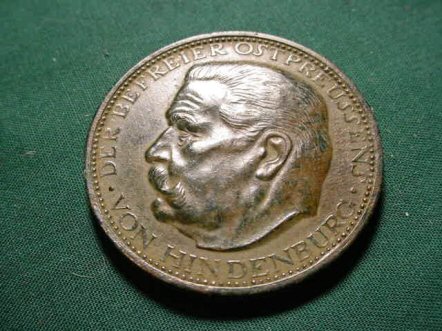
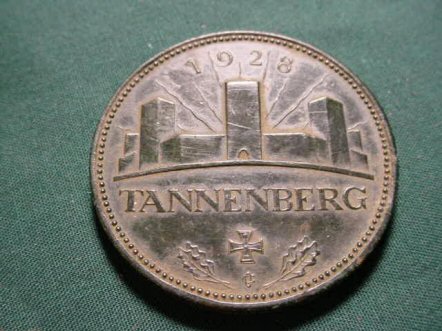
| DESCRIPTION: Here is a very fine numismatic-quality medallion depicting the bust portrait of Paul von Hindenburg, German hero of the First World War. His greatest victory was over the Russians at the battle of Tannenberg. The reverse of the medallion shows the great monument at Tannenberg, where he was later buried. The legend around his portrait reads: “Der Befreier Ost Preusens,” “The man who gave freedom to East Prussia.” Around the rim edge it says: “Prussian State Coinage.” It measures 1 1/2 inch in diameter and is very fine in detailing.
PRICE: $95.00 |
|
|||||||||||
|
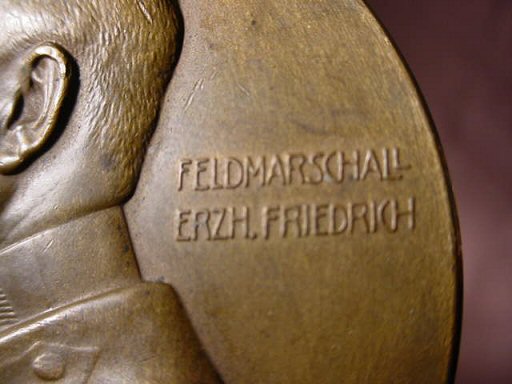
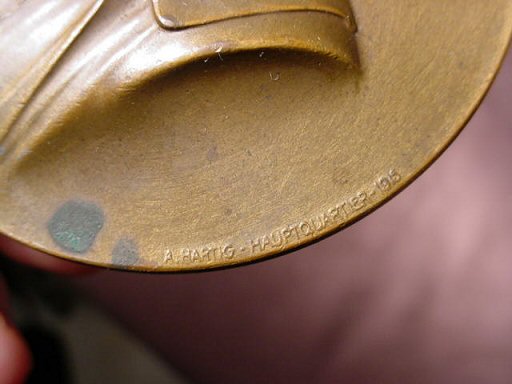
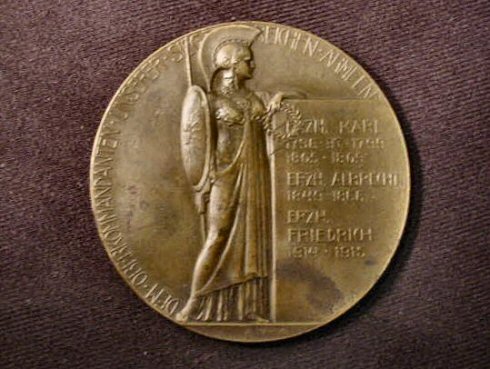
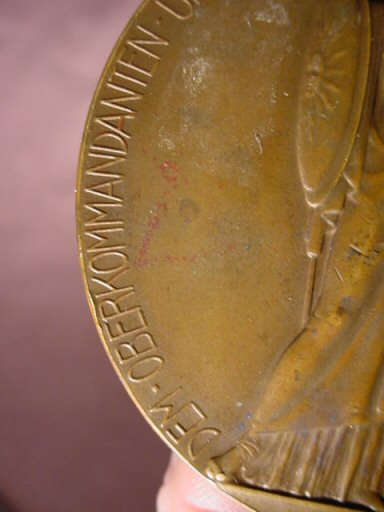
Bronze Award to Commemorate Austrian Field Marshal Erzh. Friedrich, et al. (Erzh. [Erzherzog] stands for “Archduke”) (Item KMEDAL 4-7) |
|||||||||||
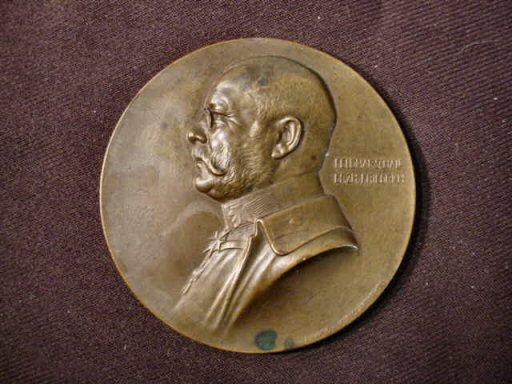
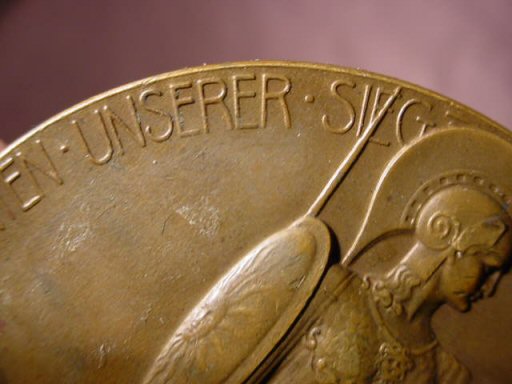
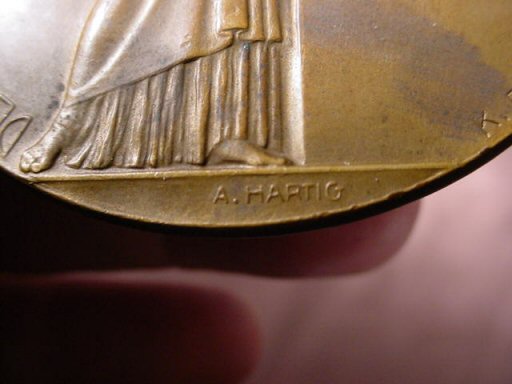
| DESCRIPTION: This is a nonportable plaque or commemorative medallion struck to honor Archduke Friedrich, 1914-1915; Archduke Karl, 1736-1797; and Archduke Albrecht, 1849-1866. The center features the Athena figure with lance and shield, while the legend says ‘The Supreme Commands of our Victorious Army.’ It measures 2 1/2 inches in diameter. It is nicely detailed and, of course, important historically.
SOLD |




|
||
|
Kaiser Wilhelm I and Germania Medal (Item KMEDAL 4-8) |
||
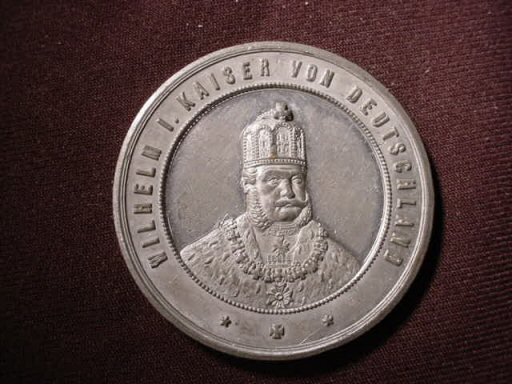
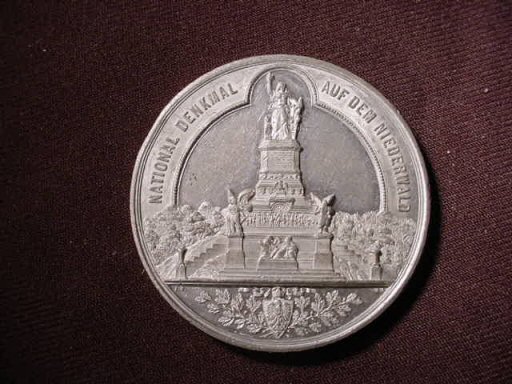
| DESCRIPTION: Here is a very fine medal or nonportable award struck in fine white metal material commemorating the reign of Kaiser Wilhelm I, the Prussian warrior king. It was he who caused the statue of Germania (Spirit of Germany) to be erected in the Niederwald. It was built between 1877 and 1883 to commemorate Germany’s resounding defeat of the French in the Franco-Prussian War of 1870-1871. The monument is above the Rhineland town of Rüdesheim. The statue is important to German history and also commemorates the founding of the then-unified German Empire. The beautiful and fine detailed medallion is 2 inches in diameter. The front has the likeness of Wilhelm I wearing the Prussian Royal Crown, with the legend: “Wilhelm I. Kaiser of Germany.” On the back is Germania in all her Teutonic glory with the legend” “National Denkmall auf dem Niederwald” (National Monument in the Niederwald). It is in practically mint condition. The medal is an important historical item.
PRICE: $125.00 |
|
|||||||
|
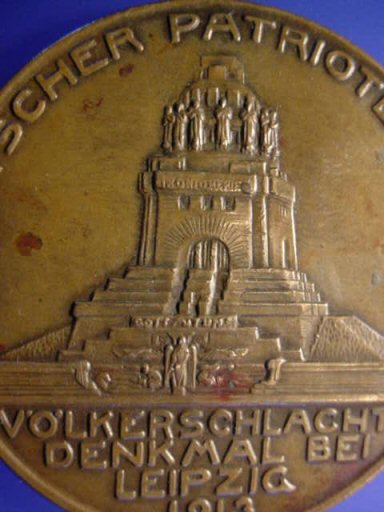
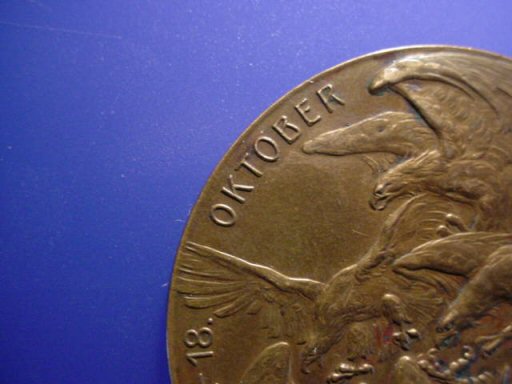
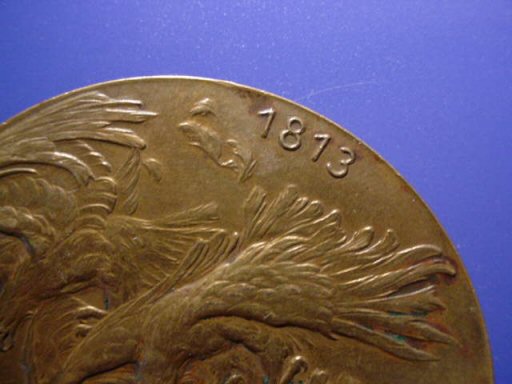
Commemorative Medal for the Battle of Nations at Leipzig (Item KMEDAL 4-10) |
|||||||
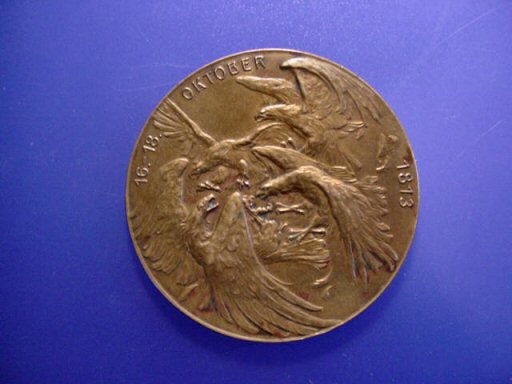
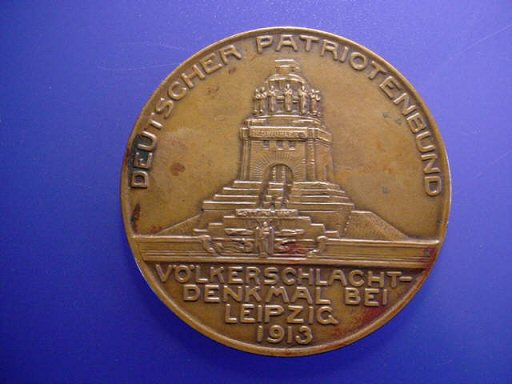
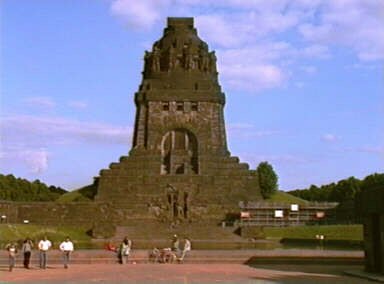
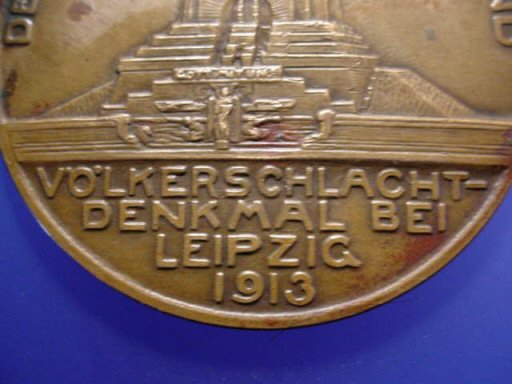
| DESCRIPTION: This is a beautiful art medal struck by R.N. Meyer at Pforzheim. It commemorates the forces of the combined nations of Prussia, Britain, Spain, Austria, Sweden, and Russian and certain small, German states. This was the largest conflict in the Napoleonic Wars and the most decisive defeat suffered by Napoleon before the Battle of Waterloo. In total the combined anti-French forces put into the field were well over a million men. By contrast, Napoleon’s forces had dwindled to a few hundred thousand. Total casualties are uncertain. Estimates range from 80,000 to 110,000 killed or wounded from both sides. The great battle ended the first French Empire’s presence east of the Rhine and brought a number of German states over to the victors. The Völkerschlachtdenkmal, which is a memorial to the heroes of the battle, stands in Leipzig and, without a doubt, is one of the most beautiful war monuments in the world with stone warriors in medieval armor, who stand stoic leaning on their great swords inside and outside of the monument. In the center it features St. Michael as winged guardian of the great edifice of honor. This is Europe’s largest war memorial and was erected in 1913 to commemorate the 100th anniversary of the battle. The medal measures 2 1/2 inches in diameter and is signed on its edge by the foundry. The front has a remarkable depiction of the sacred memorial with the words that translate to: “German Patriot Organization” and the words Völkerschlachtdenkmal bei Leipzig which translate to “People’s Battle Memorial near Leipzig.” On the back are the dates of the battle and a great depiction of fighting eagles (Kampf des Adler). This is a beautiful art medal and an important relic of the battle that changed what would have been the destiny of Europe under Napoleon.
PRICE: $385.00 |
|
|||||||
|
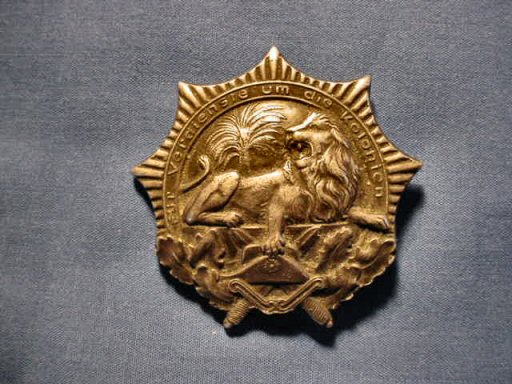
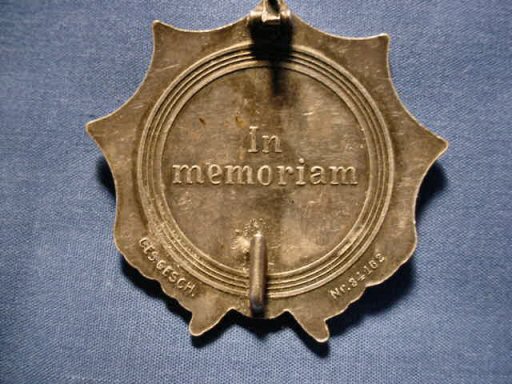
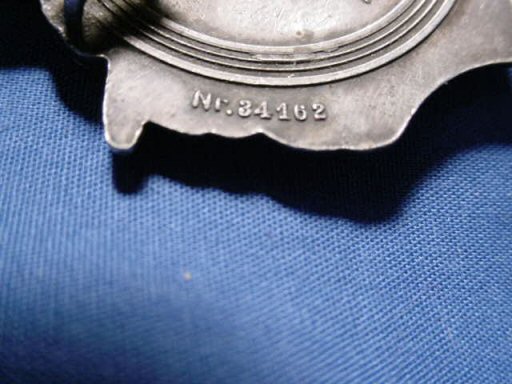
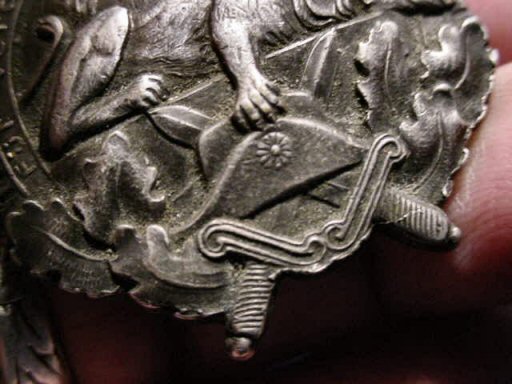
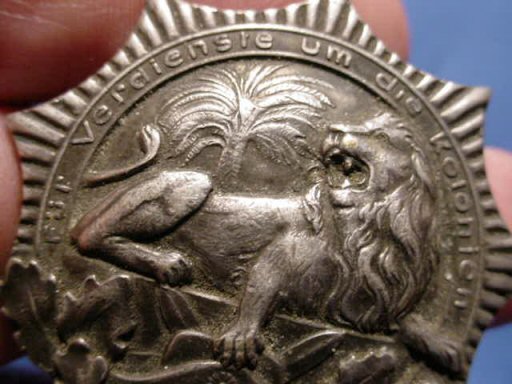
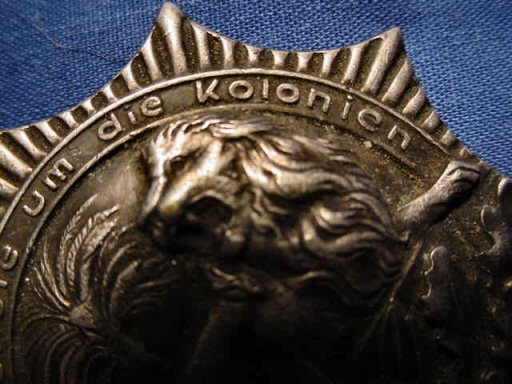
German Badge for West Africa Colonies (Item KMEDAL 4-11) |
|||||||
DESCRIPTION: This in our opinion is one of the neatest badges of Imperial Germany. It says at its edges just under the star: “For exemplary service in the colonies.” It beautifully depicts an African lion with palm tree roaring defiance, while underneath is the hat peculiar to the German East Africa troops, such as who served under General Paul von Lettow-Vorbeck in German East Africa. On the back it says: “In memoriam.” It’s quite rare and important to the Germanic collector. PRICE: SOLD |

|
||
|
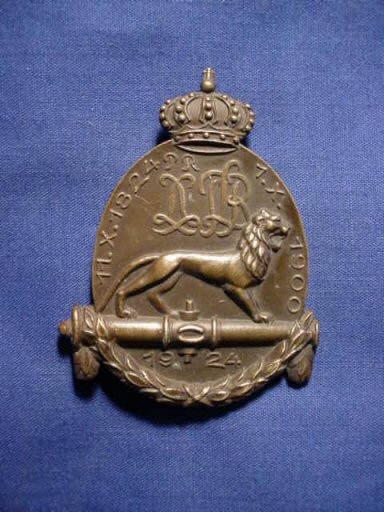
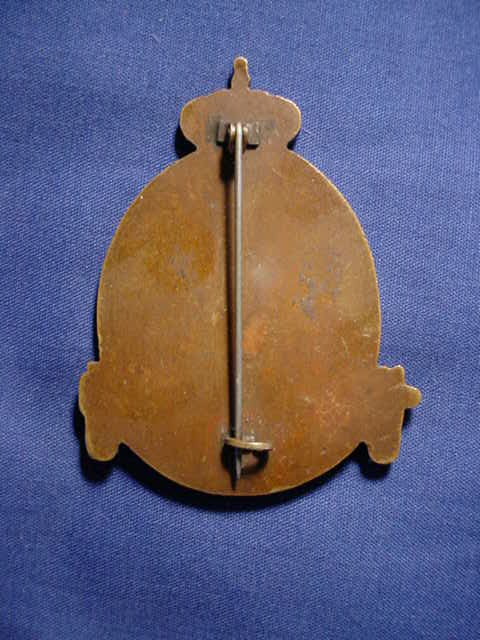
Bavarian Badge for Artillery Regiment (Item KMEDAL 4-12) |
||
| DESCRIPTION: This badge is quite striking in heavy bronze. It commemorates a period of 100 years for whatever regiment it belonged to (a jubilee?) 1824-1924. What happened on the date 1. X. 1900 (1 October 1900)??? Help! In any case, this is a very detailed and beautiful imperial badge.
PRICE: $275.00 |
|
||||||
|
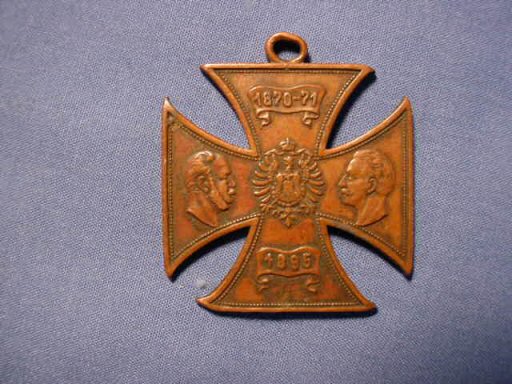
Hohenzollern Cross, USA (Item KMEDAL 4-13) |
||||||
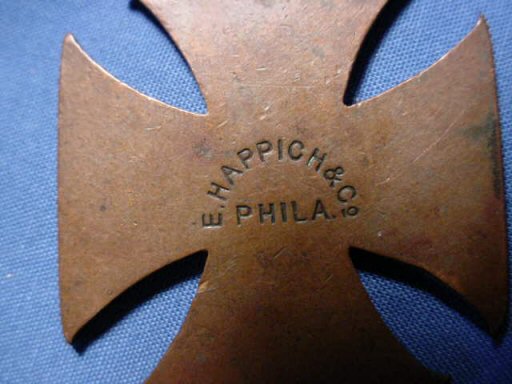
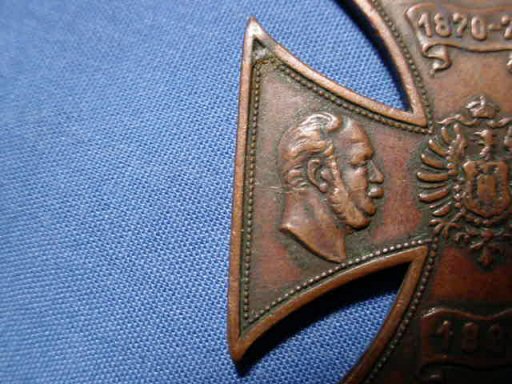
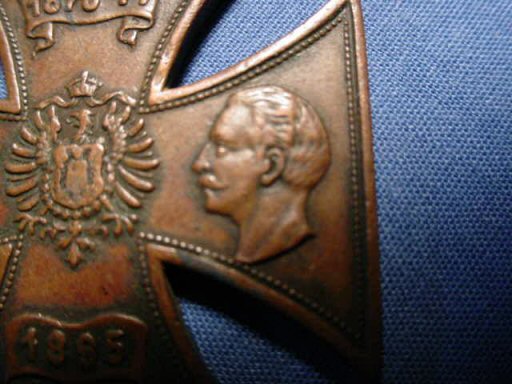
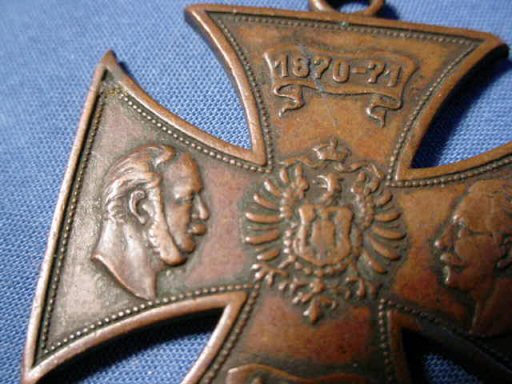
| DESCRIPTION: This is not the expensive order, itself. It is a German-American patriotic medal commemorating Kaiser Wilhelm I and his grandson, Wilhelm II. The dates commemorate the old Kaiser’s victories over the French in 1870 and 1871, and below, 1895. The medal is in the shape of the German Iron Cross with the Prussian Eagle in the center flanked by the bust portraits of the two famous Prussian emperors. The end of each arm measures 1 inch and the entire medal measures 1 1/2 inches wide. On the back is the company name ‘E. Happich & Co.’ in Philadelphia. This was back in the days when the Germans, who gave so much to the American nation, were still allowed to show pride in their ethnic fatherland and admiration for their heroes. This perception and emotion are quite rare, today.
PRICE: SOLD |

|
Number 1
Number 2
Number 3
Number 4
|
||||||||
|
Napoleon II Vampire de la France (Item KMEDAL 4-14; FRAN 2-5) |
||||||||
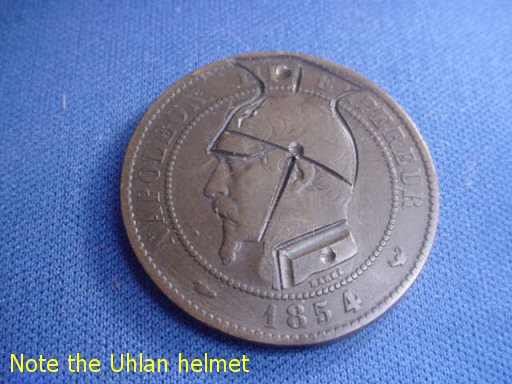
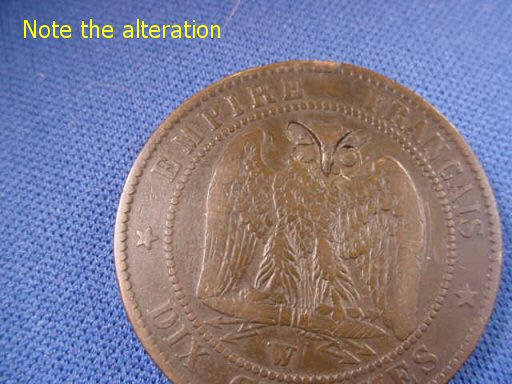
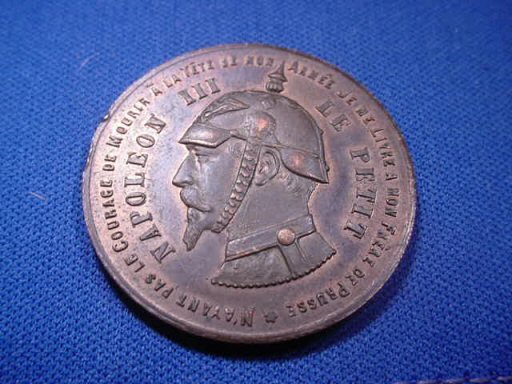
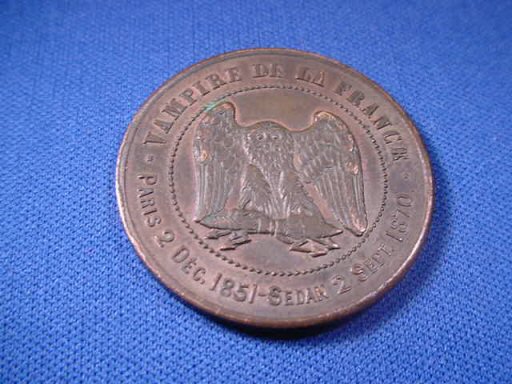
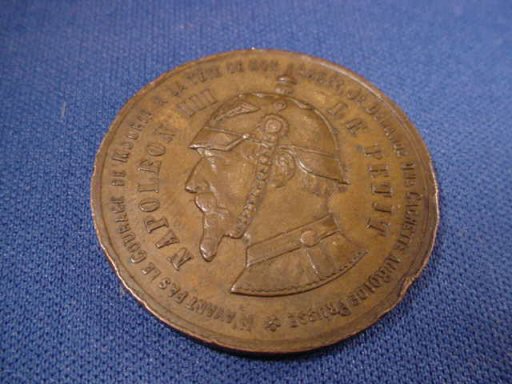
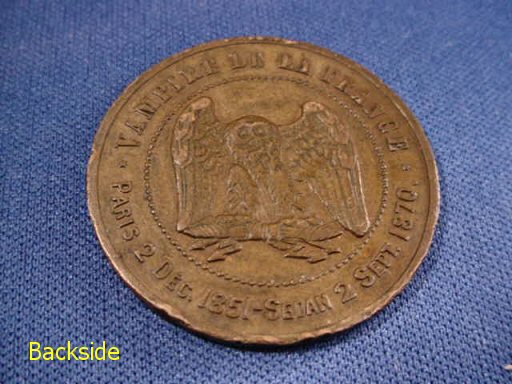
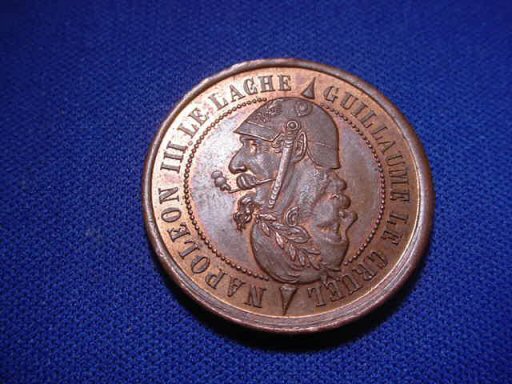
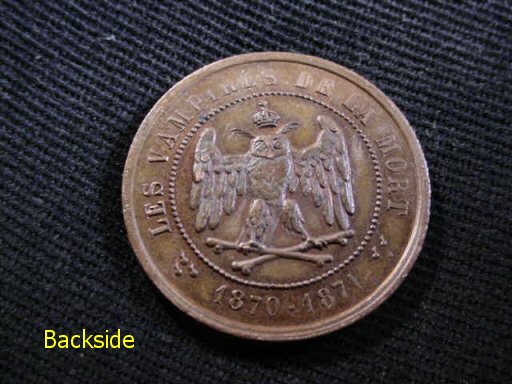
| DESCRIPTION: Here are four coins that are either actual production, or defacements, which portray the French Emperor Napoleon III as a vampire, even though the vampire looks more like an eerie-looking owl. A few of these coins show up over the years and our consigner managed to put together four of them over a period of several (20) years. The Emperor Napoleon III, 20 April 1808-9 January 1873, was president of France from 1849 to 1852 and then Emperor of France from 1852 to 1870. He had a satisfactory reign until 1870, when he declared war on Bismarck’s Prussia and the Franco-Prussian War ensued. This was proved disastrous for France and was instrumental in giving birth to the German Empire, which took France’s place as the major land power on the European continent. In battle against Prussia which started in July 1870, the emperor was captured at the Battle of Sedan on September 2 and was deposed by the forces of the Third Republic in Paris. Two years later he died in exile in England on January 9, 1873. He was so hated by the French people for his defeat and surrender that pictures of him were publicly burned. After all, not only was the emperor captured, but his entire army of 120,000 soldiers was made the prisoner of Moltke and the Prussian King, Wilhelm I. After the defeat, coins were struck at first by working over existing pieces with the bust portrait of the emperor by skilled engravers who would etch a German spike helmet on his head or other Germanic headgear. On the back the empire eagle was transformed into this aforementioned owl that they identified as a vampire. This was generally done on the ‘Dix Centimes’ coin. Later, medalists of renown joined the fray by striking medaled pieces that were a direct takeoff from the over-engraved coins. These pieces were very professionally done and are extremely rare, today. Some of them depicted the emperor as mentioned in various Germanic military headgear, but always the vampire, which now had taken on the owl appearance in professional depiction. The four offered are as follows: Number 1: The ‘Dix Centimes’ coin that was altered by engraving a Prussian Uhlan helmet on Napoleon’s head and changing the empire eagle’s head to the owl-vampire. This is an 1854 coin in fine condition. Number 2: A professional medal art piece depicting the emperor wearing a Prussian spike helmet with the words translated: “Napoleon II, The “little” (petit)! Then around the edge it seems to quote the emperor as saying: “Not having the courage to die at the head of my army, I deliver myself to my friends, the Prussians.” On the back the now-familiar owl-vampire with the words ‘Vampire de la France’ and underneath it says: ‘Paris 2 Dec. 1851-Sedan 2nd Sept 1870. The coin is in extra-fine condition. Number 3: This one also has the spike-helmeted emperor of France with practically the same words and phrases, but instead of the part about ‘friends’ it says: ‘I request a hiding place from the King of Prussia.’ The back is the same as number 2. This one could not be called uncirculated, but except for a little edge wear, it is very good. Number 4: This is the really rare one, we are told. It depicts the French emperor and Wilhelm I, Emperor (Kaiser) of Germany in a playing-card style pose (reversed bust portraits). Wilhelm has a spike growing out of his laurel-wreathed head, and Napoleon smokes a cigarette. Around the head of the emperor are the words: ‘Napoleon III Le Lache - Guillaume le Cruel.’ On the back is the inscription around the bird: ‘Les vampires de la mort,’ (‘Vampires of Death’) 1870-1871. The condition of this one is fine, but for some reason the end of the word vampires seem to fade out at the end or the word. Otherwise, it looks great! So here are three fine and eminently historically important satirical medallions and a coin. Seldom does anyone see one of these numismatic treasures, let along a set of four. We will sell this grouping as a set only. PRICE: $795.00; for the set |
|
||
|
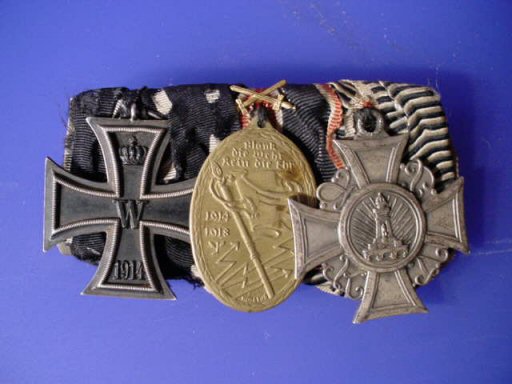
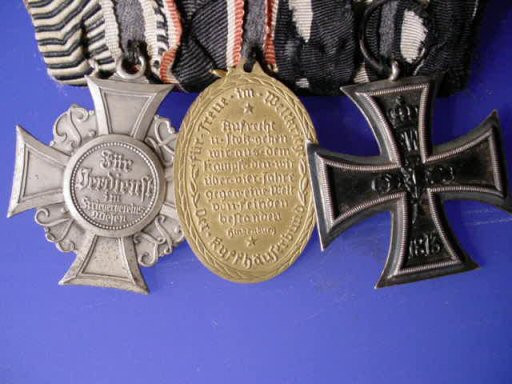
Medal Group (Item KMEDAL 4-15) |
||
| DESCRIPTION: This is a three-piece group with the WWI Iron Cross Second Class, the Kyffhauserbund Loyalty Medal from WWI, 1914-1918, and the Veteran’s Service medal from the Kriegerbund from Wessen. This is a nice grouping for little money.
PRICE: $195.00 |
| ||
|
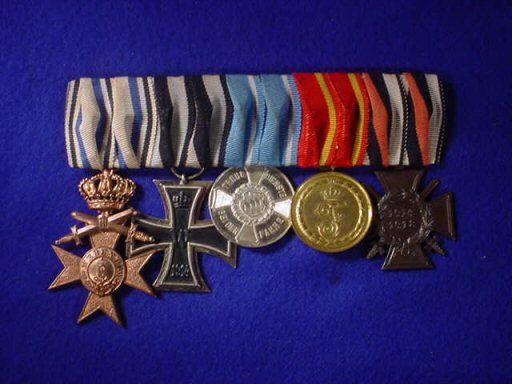
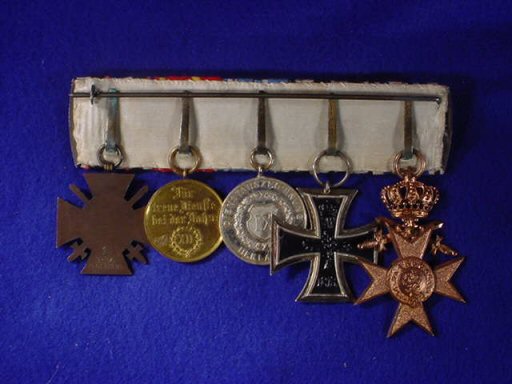
Five-medal Bar (Item KMEDAL 4-16; WWI 8-14) |
||
| DESCRIPTION: Here is a nice 5-medal bar with the: Third Class Bavarian Military Service Order with crown and swords in bronze Iron Cross Second Class Third Class Bavarian Army 9-Year Service Medal (Treue Dienste bei der Fahne!) Treue Dienste Medal known as the Theresian Order for 12 years’ service WWI Honor Cross This is an excellent bar with great medals. PRICE: $495.00 |
| ||
|
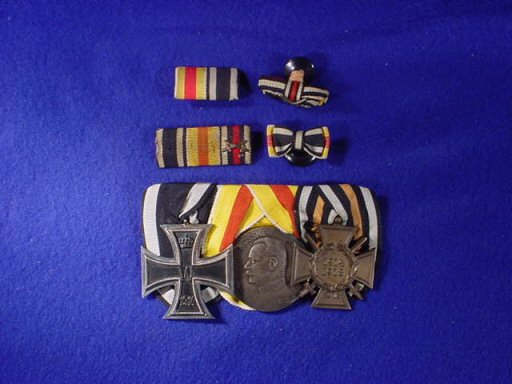
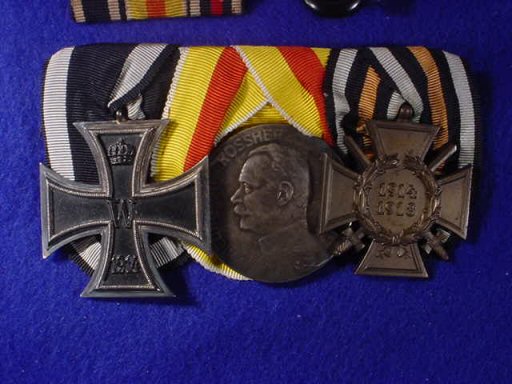
Three-medal Grouping on Bar with Great Appurtenance Ribbons (Item KMEDAL 4-17; WWI 8-15) |
||
| DESCRIPTION: This beautiful bar has the: Iron Cross WWI Second Class Rare Saxon Duchy Cross (unfortunately this one is missing the enameled back panel) (wonderful detail on face) WWI Honor Cross This is a great bar regardless of the missing part. The Saxon Duchy Medal is particularly beautiful. PRICE: $480.00 |
| ||
|
Very Nice WWI Saxon 3-Medal Bar (Item KMEDAL 4-18; WWI 8-16) |
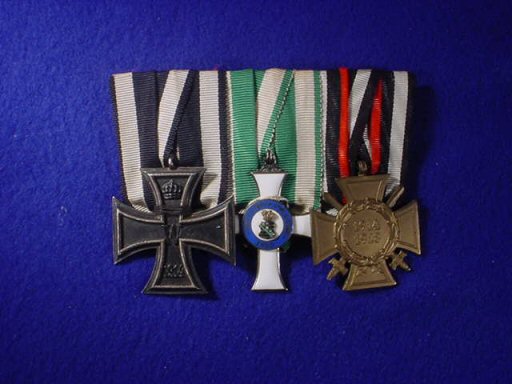
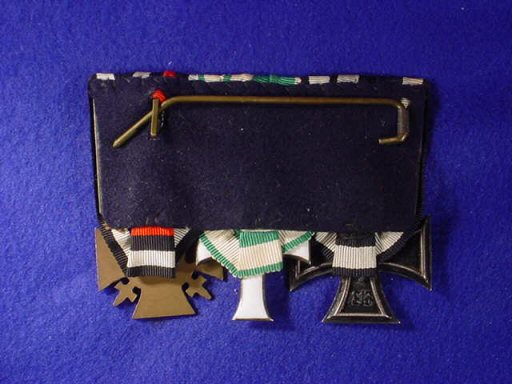
||
| DESCRIPTION: Here s an excellent bar with three medals: Iron Cross Second Class Frederick II Gross-Herzog Service Medal in silver WWI Honor Cross Amazingly there are four ribbon appurtenances; ribbons with the appropriate colors to match the awards on the bar (worn on civilian clothing). PRICE: SOLD |
| |||
|
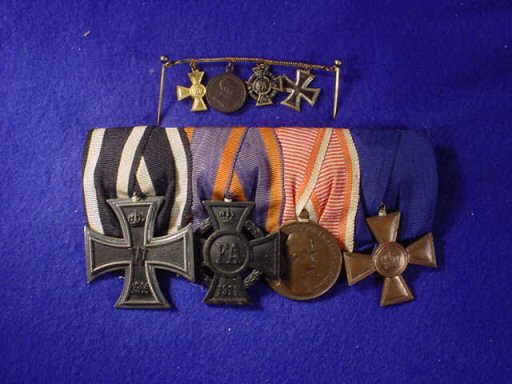
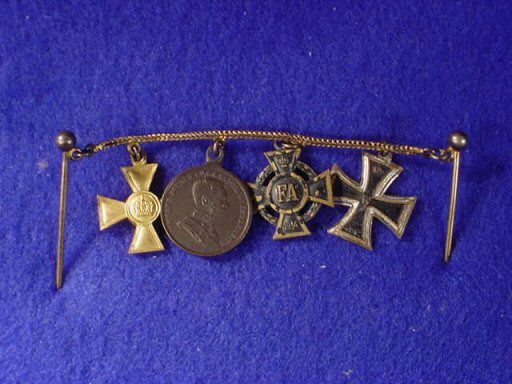
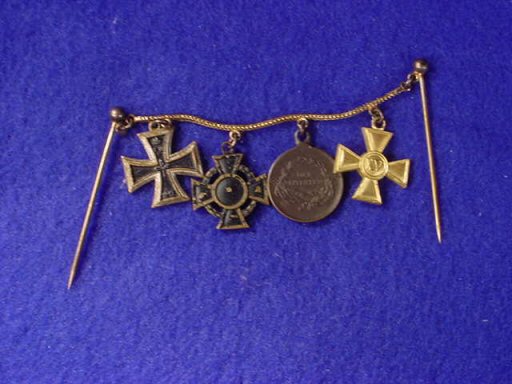
Great Bar with Four Medals and High-Dress Uniform Chain with all the Medal Duplicated in Miniature (Item KMEDAL 4-19; WWI 8-17) |
|||
| DESCRIPTION: WWI Iron Cross Second Class The Frederick August Cross of Saxony Unidentified; possible regimental (help!) 25-Year Service Cross of Prussia. To find a grouping with the correct and original award chain is very rare. We are quite proud to offer this unusual grouping. PRICE: $595.00 |
| |||||||||||||||||
|
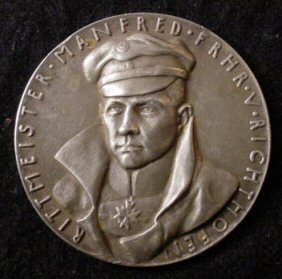
Richthoffen Commemorative Medal (Item KMEDAL 4-20; LUFT 7-4a) |
|||||||||||||||||
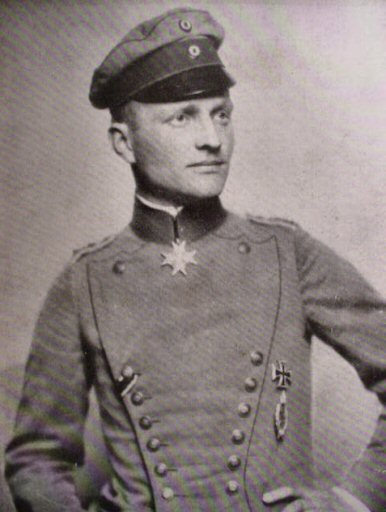
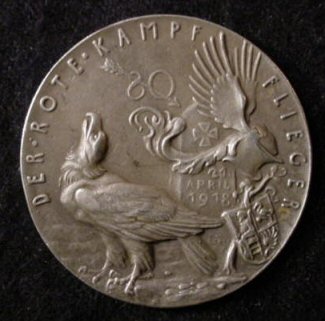
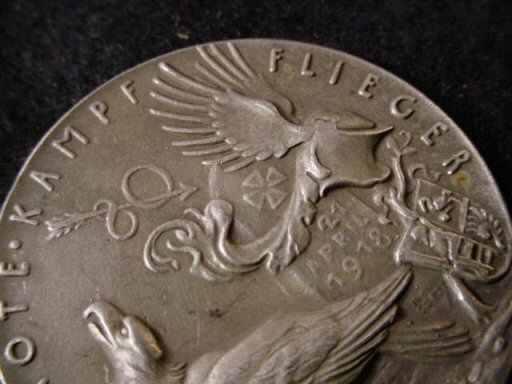
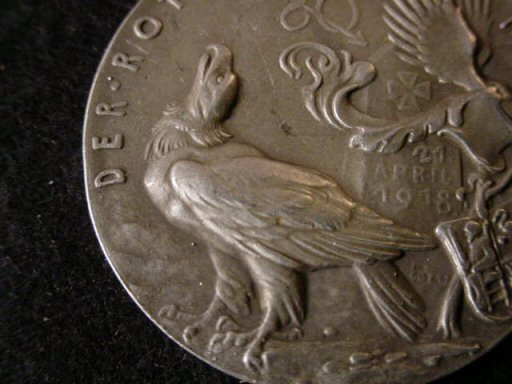
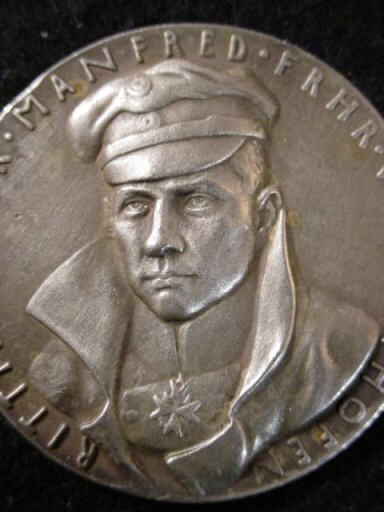
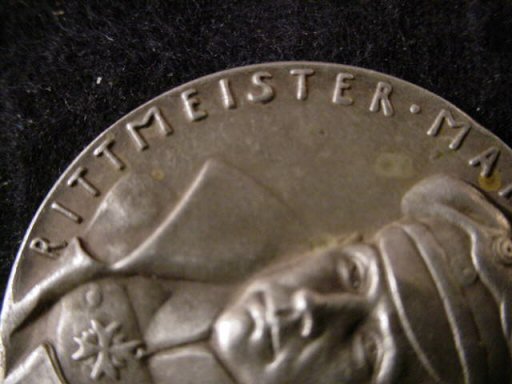
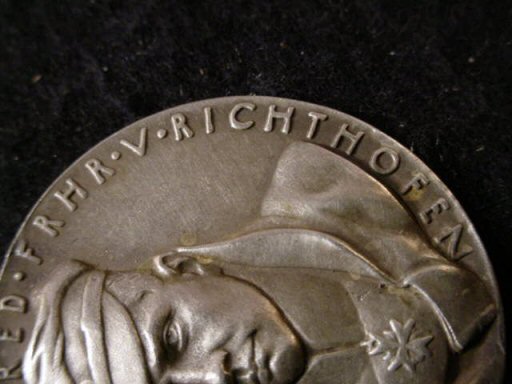
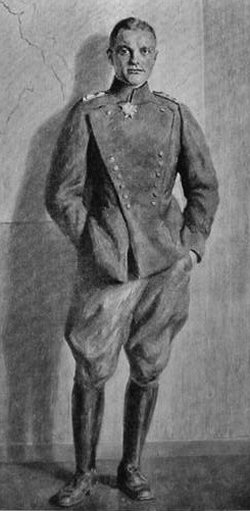
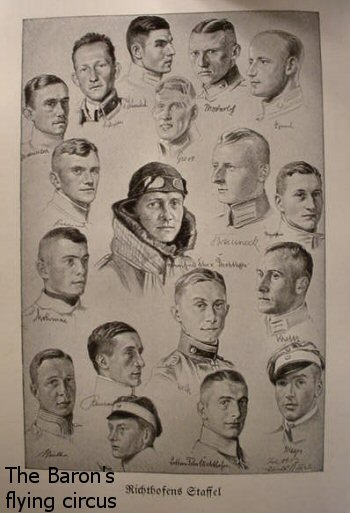
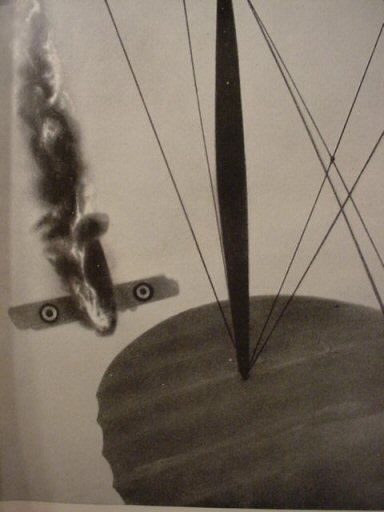
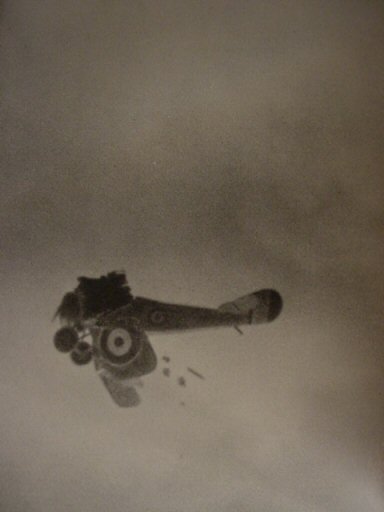
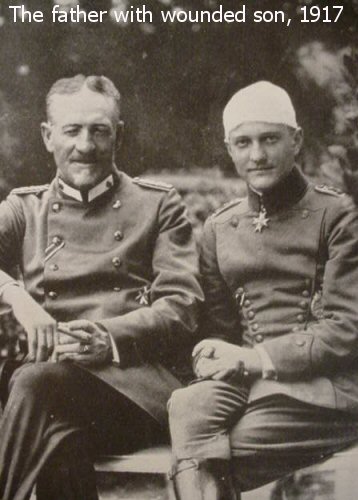
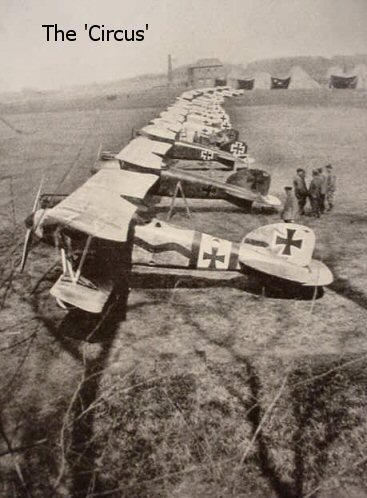
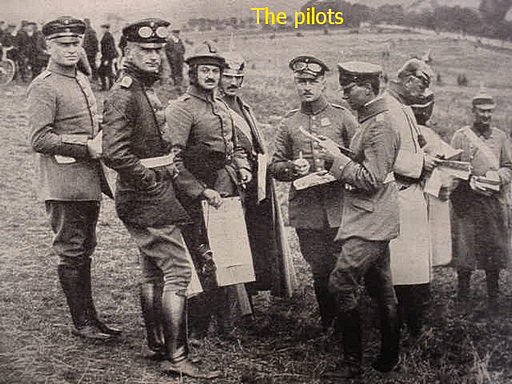
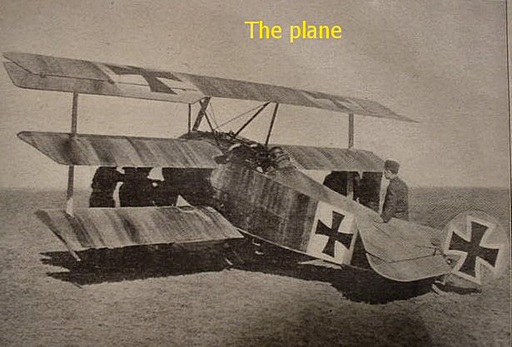
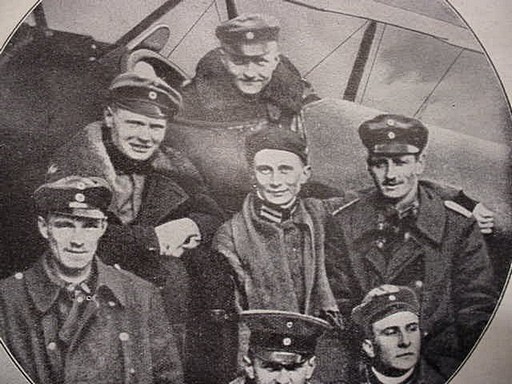
| DESCRIPTION: This is a beautiful medal struck in ‘800’ silver commemorating the heroic life and death of Baron Manfred von Richthoffen (the Red Baron) of World War One flying fame. The original strike of the medal was by the famed medalist Karl Goetz, but the medal was so popular that several companies specializing in silver art objects purchased the rights to strike editions of this beautiful medal. The medal bears wonderful detail and is marked on the edges “Bayer Hauptmunzampt (Bavarian head coinage office). The medal is so fine that the artist was able to register it with the official office of coin distribution of the Reich (government sanctioned). Richthoffen, next to Rommel, was and is considered among the foremost heroes of the German fatherland regardless of the relentless anti-Teutonic propaganda spewed out of the mouths of “inferior mench.” The medal has a great depiction of the Baron dressed in his jaunty German field cap. He wears the greatcoat that he was so often seen in. He also wears the high-collared tunic and suspended from this collar is the highly coveted Pour le Mérite or Blue Max. Around the edges of this obverse view are the words “RITTMEISTER MANFRED FRHR V RICHTHOFFEN.” On the reverse side it says around the edge “DER ROTE KAMPFFLIEGER,” “The Red War Flyer,” and the pictures are first an arrow that pierces a figure ‘80’ that sums up the kills of this fantastic sky warrior. The eagle is shown looking to the sky and seems to mourn the death of the young champion. To the right is the coat of arms of the noble Richthoffen family with the date of his death—April 21, 1918. Richthoffen was the finest airman the world has ever seen. He was not only a good and super-effective fighter, but also the noblest of all airmen on any of the sides. He had the reputation of never killing an enemy after he had him “cold.” After forcing an opponent down he often landed beside him, helped him from his machine, and saw that he was honorably treated. The men of Richthoffen’s famed Flying Circus to a man acted with the same humanitarian and chivalrous nobility. When Manfred was killed he was given full honors accorded to a hero by the Australians with the final rifle salute by former foes. Yet recently, the “History Channel” found an old, decrepit Australian veteran and produced an interview with the crusty old bastard to spew out various indignities about his being overjoyed at the news of the Baron’s death. Also, a recent film called “Flyboys” produced in Hollywood depicted a vicious, nasty ace German flyer who obviously you were to relate to Richthoffen doing all the opposite that Manfred did in the annals of true, unbiased history. Such is the direction of the controlled media today. Orwell was right! In any case here is a lasting and beautiful memorial to the “bravest of the brave,” the eternal Red Baron. His true reputation and legend truly transcends all the rotgut garbage that the Culture Distorters can invent. Horrido! To the skies!
PRICE: $450.00 |



| |||||||
|
Another Karl Goetz Medallion (Item KMEDAL 4-20b) |
|||||||
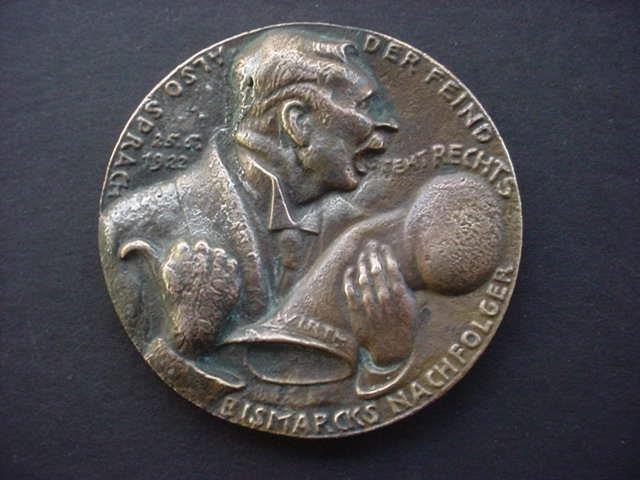
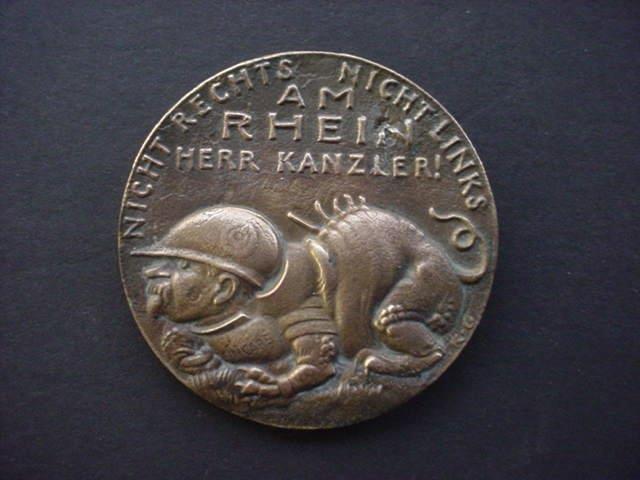
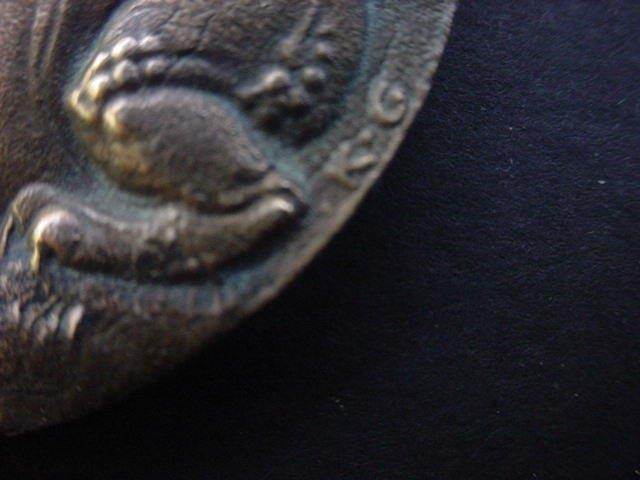
| DESCRIPTION: In 1922, master medalist Karl Goetz struck a bronze medal that was an insulting and opinionated satire against the Socialist Party of Germany. In the tumultuous first decades of the 20th century, the SPD—which was actually Germany’s oldest political party—acted as an umbrella organization for a number of leftists movements, trade unionists, and Communists. History is a continuum and now we have the Democrats here who expose all the same crap and indulge in the same criminality. The SPD thugs were totally eradicated with the advent of the Freikorps and then the Machtergreifung (30 January 1933). The Medal The obverse shows the German Chancellor Dr. Joseph Wirth clutching an SPD balloon cap with his name on it as he shouts “The enemy is on the right” with a rim inscription “Thus spoke Bismarck’s Successor” meaning the real enemy of Germany were the right-wing political groups. Dated June 25, 1922. (Sound familiar? What do the antifa criminals say in America today? Is history a continuum?) On the reverse, President Poincaré of France is presented as an ugly armadillo-like creature wearing a French assault helmet and he replies “Not to the Left! Not to the Right, Mr. Chancellor!” “KG” (Karl Goetz) is on lowerright rim. What Poincaré seems to be imperiously saying is “not right; not left, the enemy is on the Rhine, Mr. Chancellor!” In other words, the French! The medal is cast in bronze and measures around 2½ inches in diameter. This is an important historical memento and quite rare and certainly meaningfully important. PRICE: $350.00 |


|
|||||||||||||||||
|
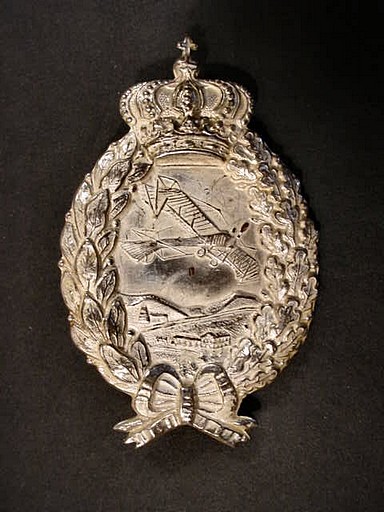
WWI Bavarian Pilot’s Badge (Bayern Flyer Flugzeugführerabzeichen) (Item KMEDAL 4-21; WWI 9-17; LUFT 15-8) |
|||||||||||||||||
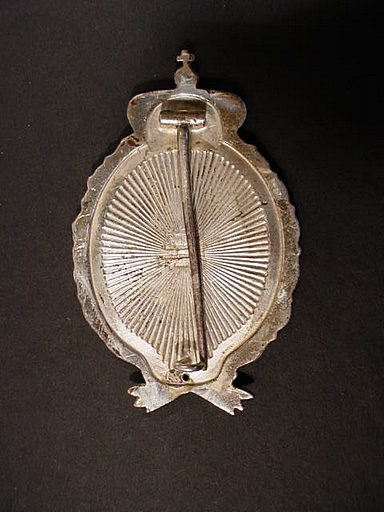
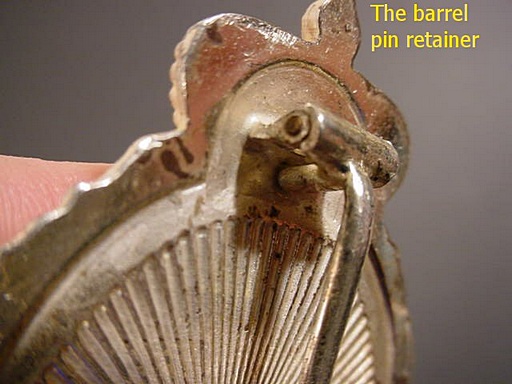
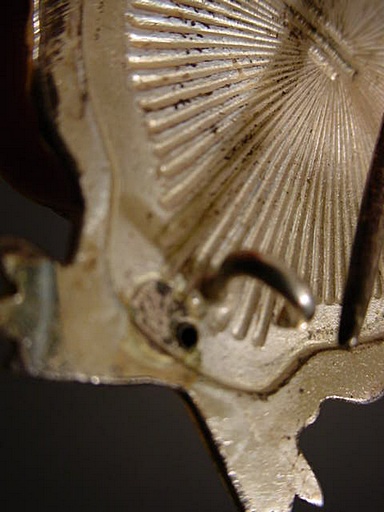
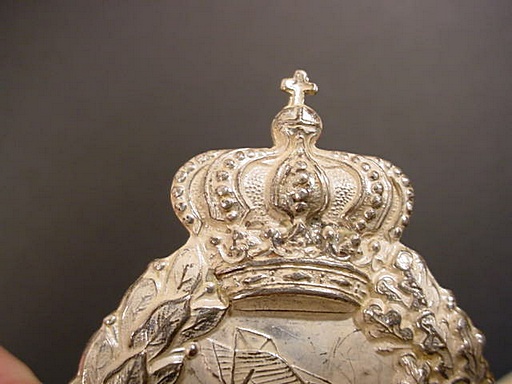
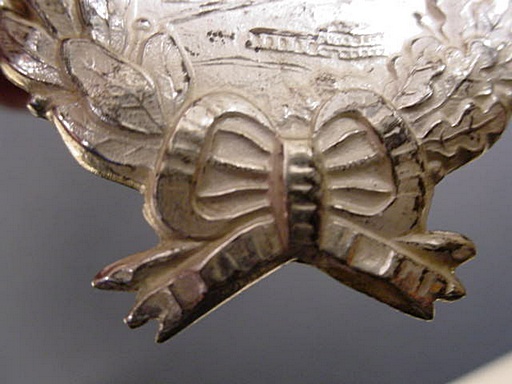
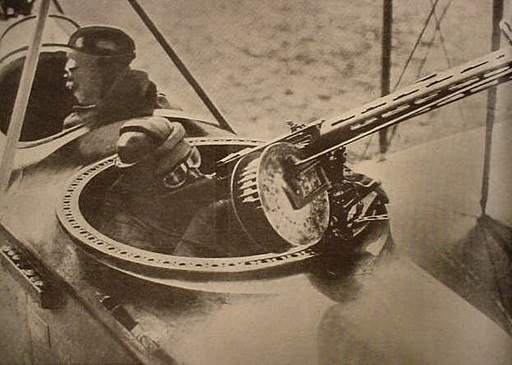
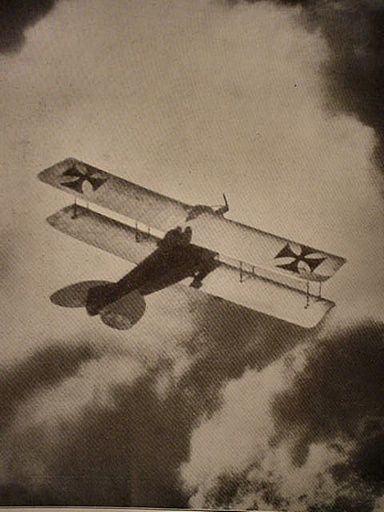
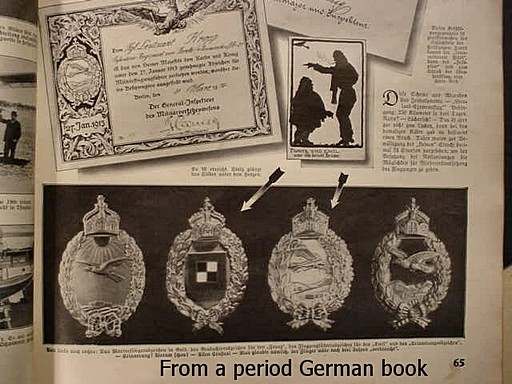
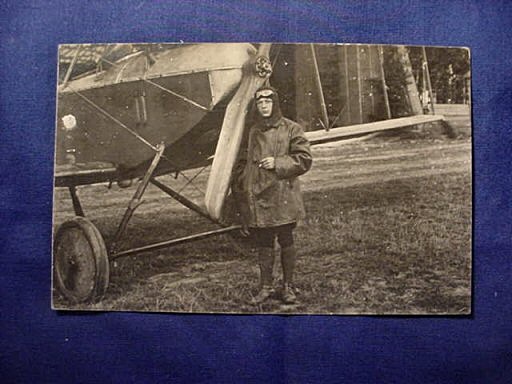
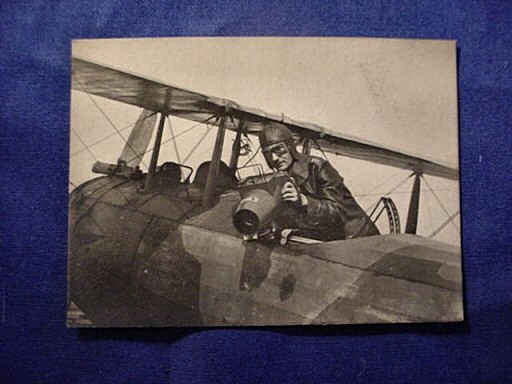
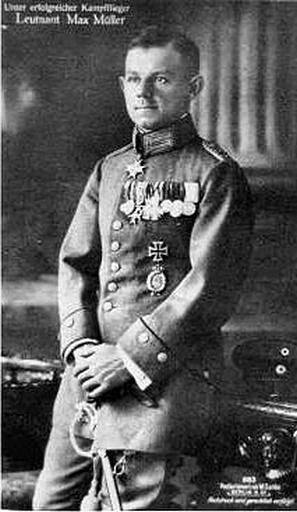
| DESCRIPTION: This beautiful example was made by Karl Pöllath of Schrobenhausen, the only known maker of Bavarian pilot’s badges. The badge is beautifully constructed of two pieces soldered together with a rayed back. The workmanship is superb with no visible seam between the two halves. The pin is semiflat and tapers to a point. The securing hook is slightly rounded and has one weep hole below the bottom clasp (this is important to originality). The hinge for the pin of the barrel pattern and is correctly recessed into a hollow at the back of the crown, which follows the crown shape, unlike Prussian badges. The center is on the back has the inscription “Karlpöllath Schrobenhausen Silber” in three lines. Note that the maker’s name has no space as if it’s one word. The badge measures 74 mm high and 45 mm wide. The beautiful badge is in perfect, near-mint condition and has exquisite detail with all the silver frosting intact. This would become easily the pride of your collection.
PRICE: SOLD |

|
|||||||
Prussian Pilot’s Badge by C.E. Juncker, Berlin (Item KMEDAL 4-22; WWI 9-18; LUFT 15-9) |
|||||||
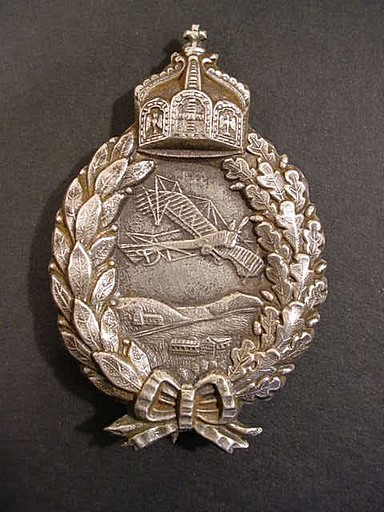
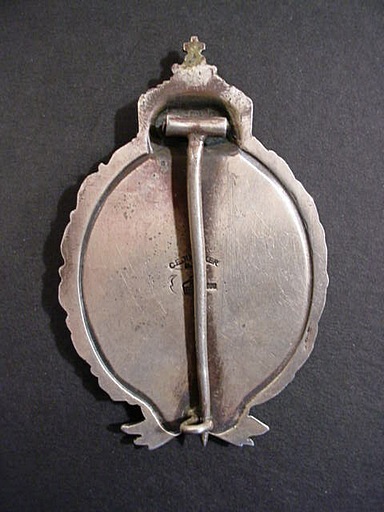
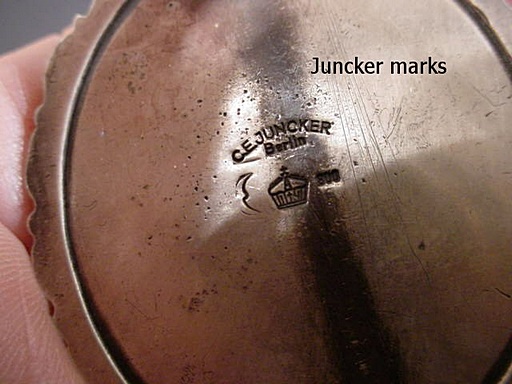
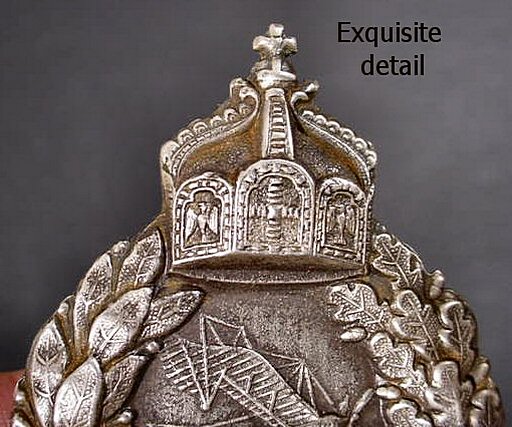
| DESCRIPTION: This is a very nice example of the Prussian badge for pilots of WWI. It’s of early light-weight construction with C.E. Juncker marking on a plain back without rays. It has deeply struck stamping with half moon and crown plus ‘800’ for silver content. It has the barrel-pin holder device, proper weight, correct pin, and size. It’s 100-percent original and ultra-fine! This badge was more of a skills insignia and not strictly an award. It was not automatic that a new pilot would be issued his badge upon completion of flight training. During the war a man was expected to have completed some actual combat flying before his pilot’s badge would be presented to him. Many pilots flew active combat missions without having been “awarded” their pilot’s badge. These are very scarce and always desirable in the collecting field. This one is a prime example.
PRICE: SOLD |

|
|||||||||||
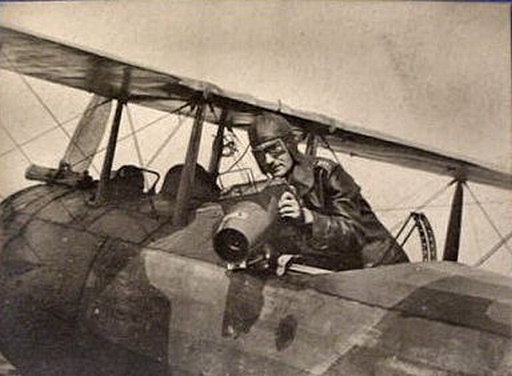
Prussian (German) Flight Observer’s Badge (Item KMEDAL 4-23; WWI 10-1; LUFT 15-10) |
|||||||||||
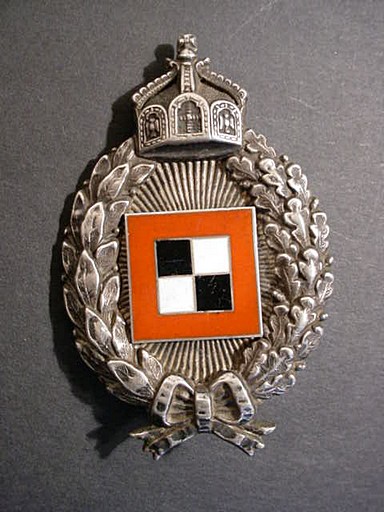
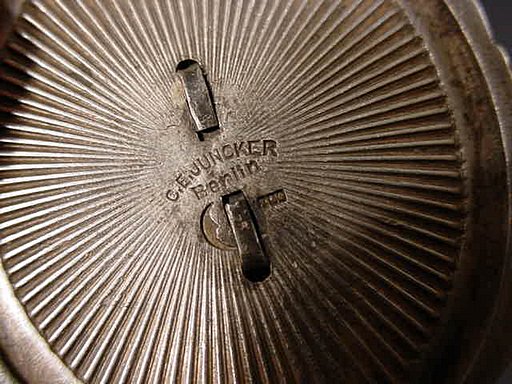
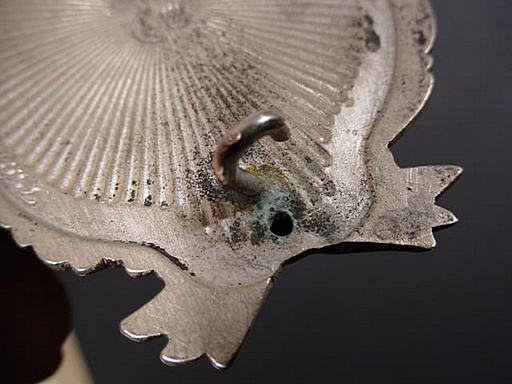
| DESCRIPTION: One of the most prolific makers of Prussian flight badges was C. E. Juncker of Berlin. This is one of the highest-quality badges offered by this firm as all of these badges were private purchases. The quality of the badge was dependent on what the purchaser could afford. The backing plate on Juncker badges is marked “C.E. Juncker Berlin” with a half moon and ‘800’ indicating silver content. Even under high magnification the stamps are clear and sharp. Note that the crescent moon is solid; not merely an outline. The detail and quality of this rayed-back example are exceptional. The badge is constructed of two pieces soldered together with a rayed back, which is visible from the front. Even with a jeweler’s glass at high magnification, no seam is visible. The obverse of the badge is highly detailed and retains much of the original silver frosting. The army corps flag device is silver plated and brass filled with an orange-red enamel, which is typical for Juncker badges. The hinge on the reverse is of the “barrel” pattern and is correctly recessed into the back of the crown. The pin is slightly rounded and blunted at the end. The securing hook is rounded with one weep hole to the right of the bottom clasp. The smooth areas of the reverse are flawless with no casting marks or pitting (a feature of an original badge). Of note is the shape of the bottom bow as seen from the reverse. Original Juncker badges have a distinct “duck feet” appearance. This example measures 72 mm high and 46 mm wide. The badge is in incredibly good shape throughout; almost mint. You’ll never see a fine example. We are most proud to offer it.
PRICE: SOLD |



|
||
|
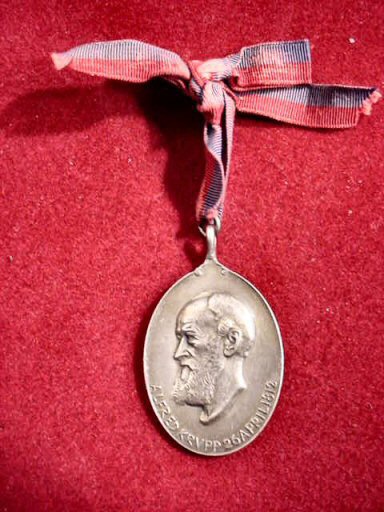
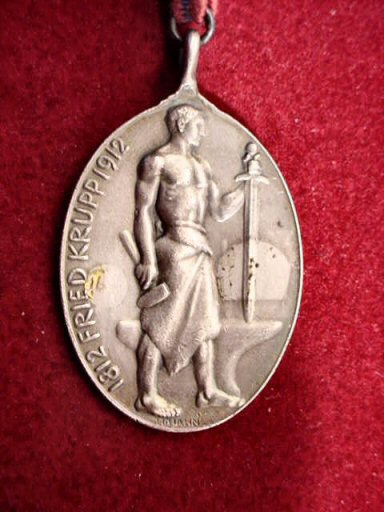
Krupp Centenary Medal in Silver (Item KMEDAL 4-26; ART 14-14) |
||
| DESCRIPTION: This is a rare medal that celebrates 100 years of the Krupp dynasty from Alfred Krupp who was born in 1812 and died in 1887. He was known as the cannon king, or as “Alfred the Great,” from the time of Fredrich Krupp, 1787-1876. The family launched a small steel factory in Essen in 1811 to go on to become the greatest producer of weapons and ammunition the world has ever known. The medal struck in fine silver is oval in shape and is marked on the edge ‘990,’ the closest to ‘1000’ in pure silver that a medal could be. It has a good depiction of Alfred Krupp on the obverse, while on the reverse is the depiction of a muscular blacksmith with hammer, anvil, and a sword that he has forged. At the edges it says “1812 Alfred Krupp 1912. The ribbon is in the colors of the city of Essen. This large medal was presented during the centenary celebrations to Krupp’s leading customers plus important military and civil leaders. They are rare today as very few were struck and those that survive are in museum collections today. The medal measures 2 1/2 inches high.
PRICE: $450.00 |
|
|||||||
|
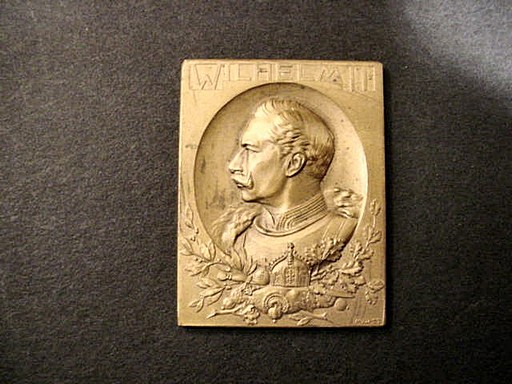
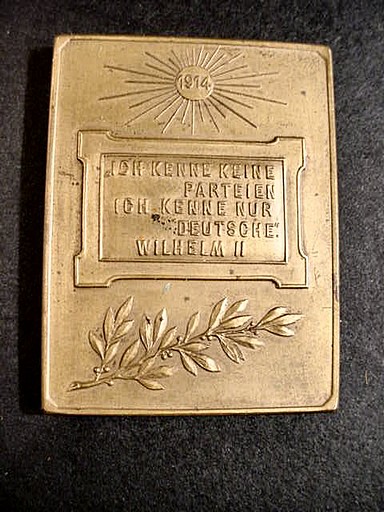
Kaiser Wilhelm Commemorative Medallion (Item KMEDAL 4-27) |
|||||||
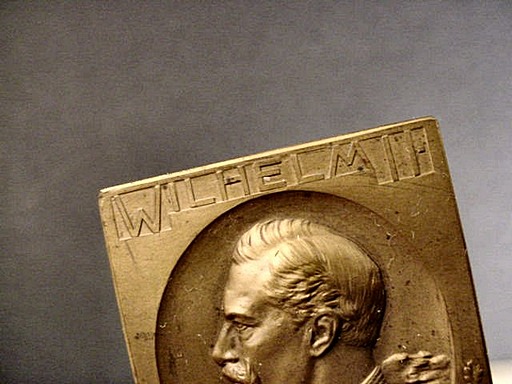
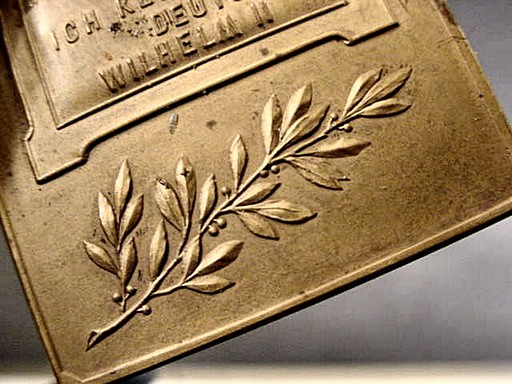
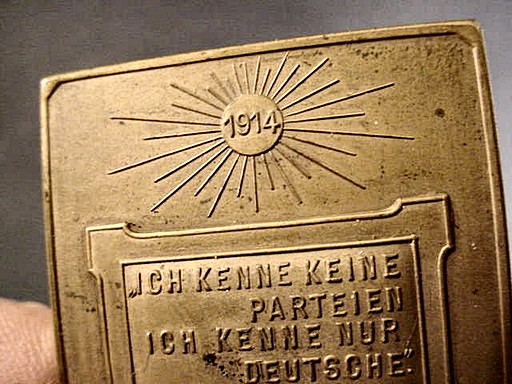
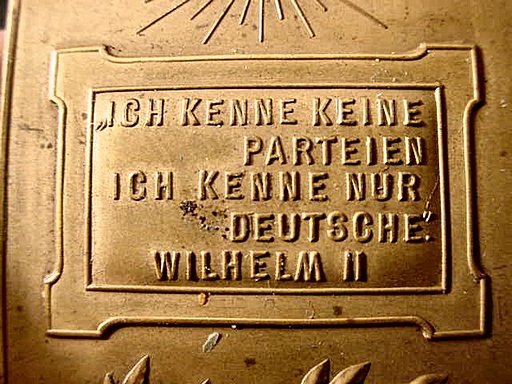
| DESCRIPTION: This is an small, extra-fine art medal in the finest tradition of the medalist’s art. It measures 1 1/2 x 2 inches and the detail is phenomenal. The bust portrait of the young Kaiser is lifelike and is set deeply in a recessed oval with the crown, scepter, sword, and orb of the Prussian dynasty surrounded by oak leaves (beautifully executed). On the reverse is date of 1914 “The first year of the war.” This is set in a sphere with sun rays. Under this is the most famous saying of Wilhelm II: “I know no parties (political parties); I know only Germans.” Under this are the laurel leaves of victory! This is a beautiful nonportable award probably given guests at the Hohenzollern Palace during the gala dinners.
$175.00 |

|
||||||||
Prussian State Official’s Badge (Item KMEDAL 4-28) |
||||||||
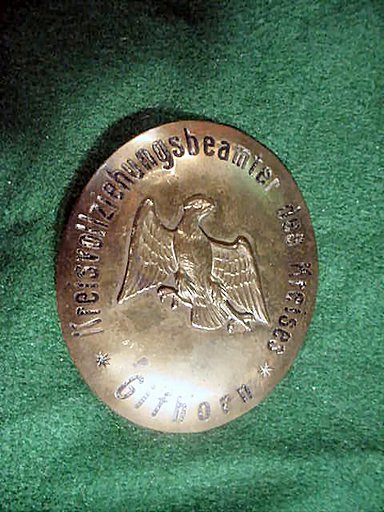
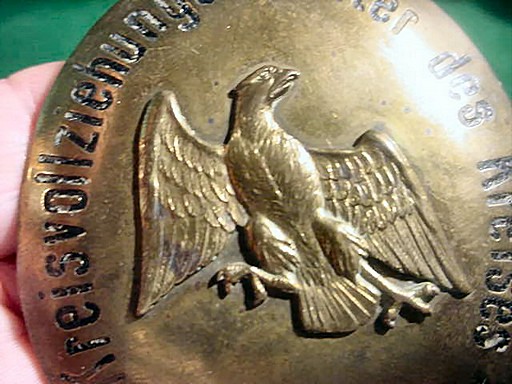
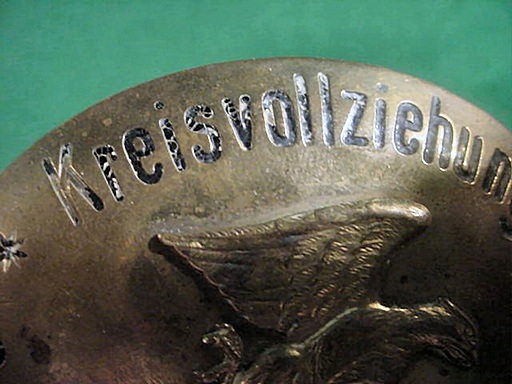
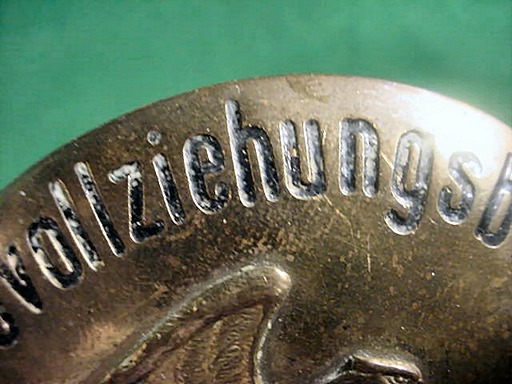
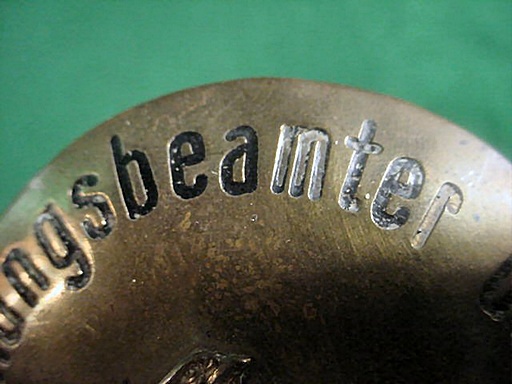
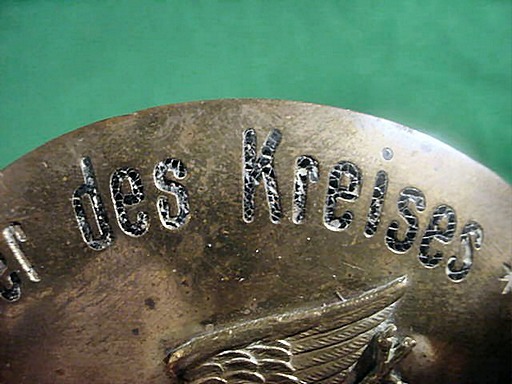
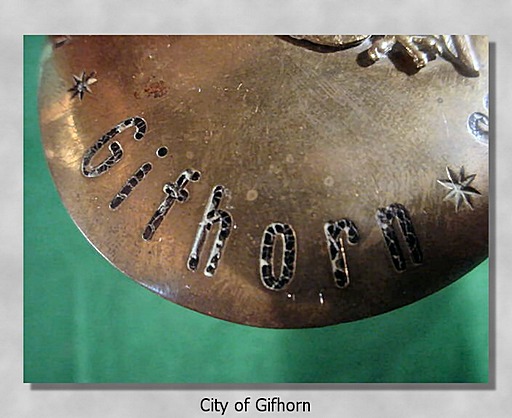
| DESCRIPTION: This was a badge of Imperial power and importance in an age where public officials could still be respected. The badge has the Prussian eagle in the style of what was used by law enforcement. It says along its edges: “Kreisvollzeihungbeamter.” This is an office of bailiff in the court system. If you were fined or lost a judgment this is the man who will track you down and accept payment, or take you to the “crossbar hotel.” This is a large, brass badge. It measures 3 1/2 x 3 inches and is very impressive looking. An old soldered repair can be seen on the back.
PRICE: $250.00 |

 |
 |
 |
 |
 |
 |
 |
 |
 The case |
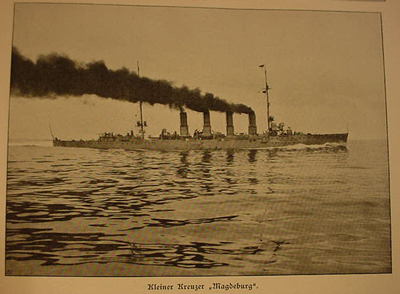 |
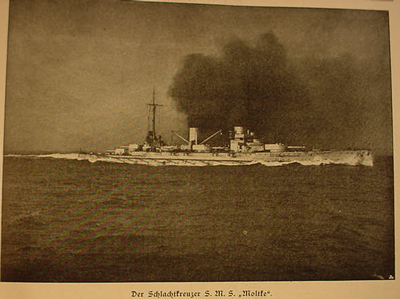 |
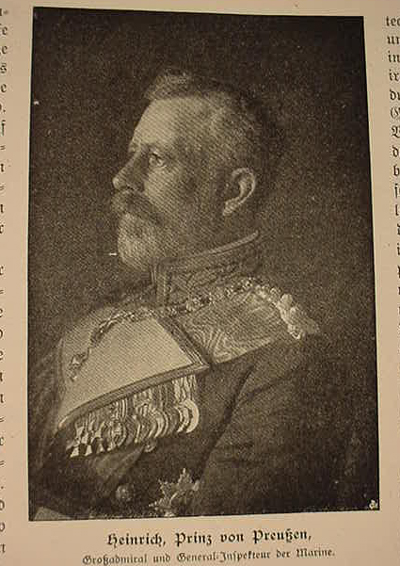 Brother of the Kaiser |
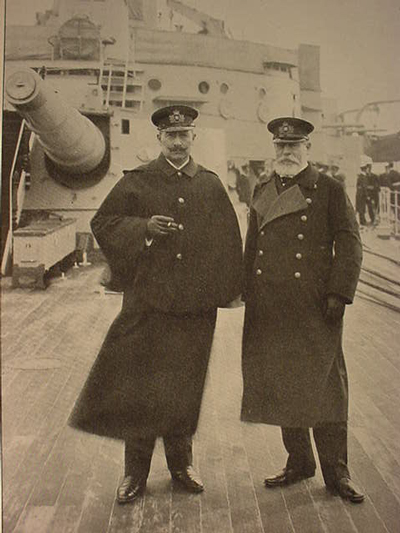 Der Kaiser |
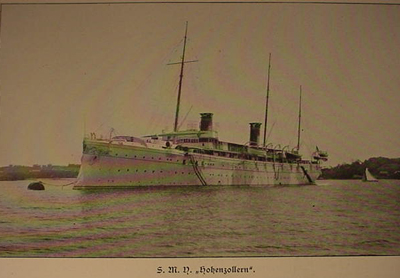 The Kaiser's ship |
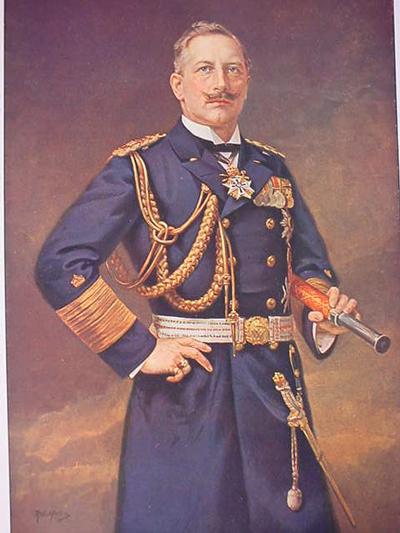 Wilhelm II in Admiral's Uniform |
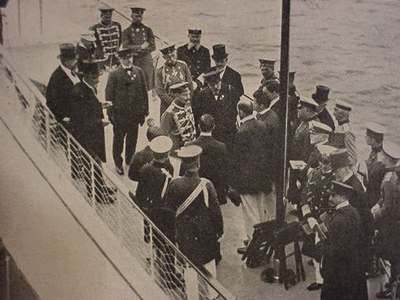 |
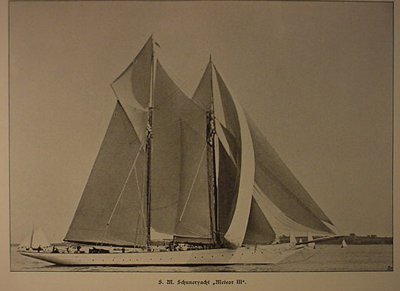 The Kaiser's yacht |
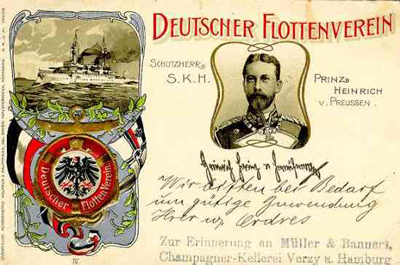 DFV postcard with Prince Henry pictured |
Deutscher Flotten Verein Medal |
|||
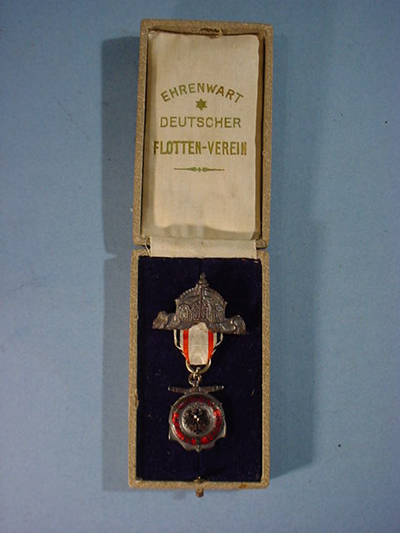
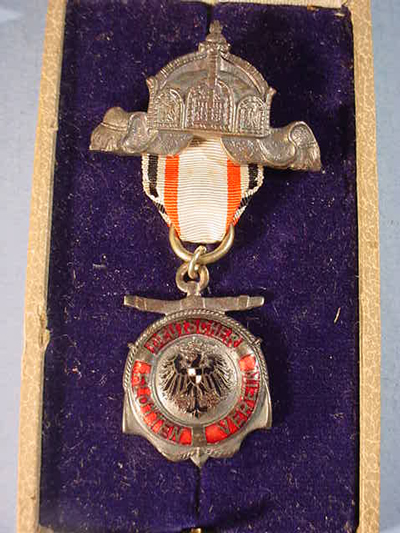
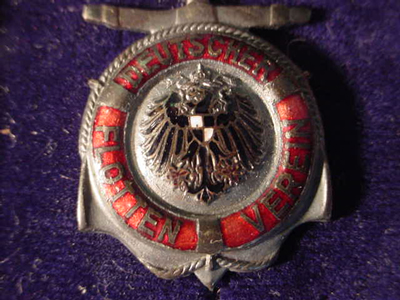
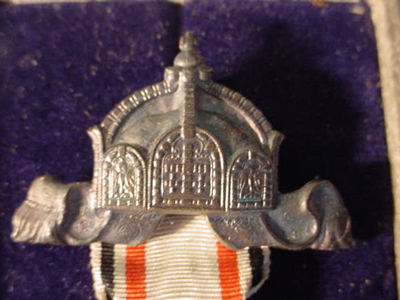
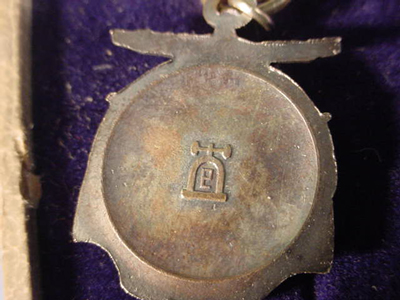
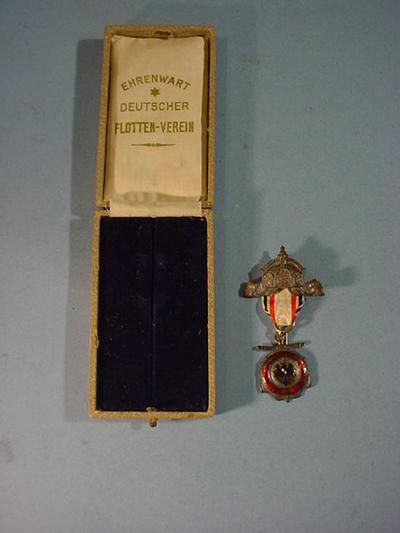
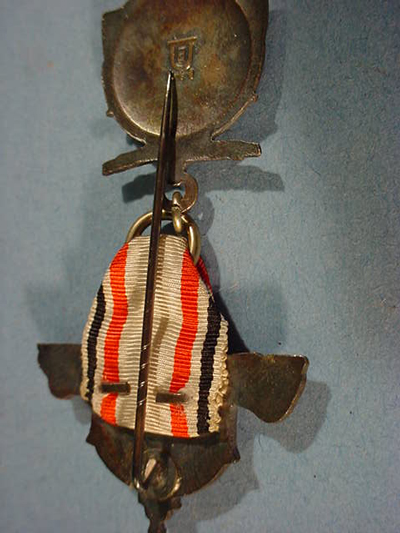
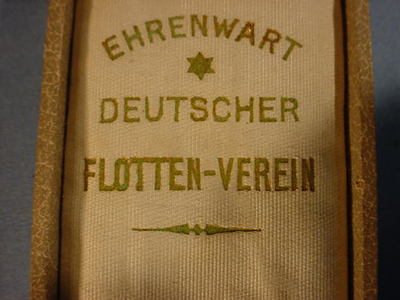
DESCRIPTION: The association responsible for the issue of this petite medal was an interest group formed on April 30th 1898 on the initiative of Admiral Alfred Von Tirpitz through the Imperial Naval Office (Reichsmarineampt) which he headed (1897-1916) with intention of supporting the Kaiserliche Marine. Specifically it was intended to develop proper pressure on the German parliament (Reichstag) to approve the fleet acts of 1898 and 1900 and the attendant expenses. The unification of Germany under Prussian leadership in 1871 was the defining point for the desire of German Nationalists to have a great world class navy. The newly created emperor, Wilhelm I as King of Prussia, was Head of State of the strongest State (Prussia) forming the new Empire. His Prussian Navy and what became the Navy of the North German Confederation in 1817 and now it became the German Imperial Navy. Read the fascinating history of the Kaiserliche Marine on search engines on the World Wide Web. The Flottenverein was one of the largest government sponsored Imperial organizations in German history up to the ‘30’s. The members financially supported the efforts in behalf of that dream of a Navy for the Fatherland greater than Britain’s super fleet. This medal is one presented to persons who have given great support and services to this organization. It really is a little gem of a medal with the Prussian eagle at its center in enamel and a beautiful enameled life saver wreath with the words Deutscher Flotten Verein. All this mounted on a silver anchor that suspends from a ribbon with the German National colors. This ribbon is surmounted with the metal Prussian crown; the medal is made to be worn with a stickpin type fastener. The medal is with the original case of presentation with a black velvet pad on which the medal lies. The case has the words as follows printed in the case top portion: Ehrenwart Deutscher Flotten-Verein. A beautiful little medal with a great history. And saga of the high seas. PRICE: $275.00 |
|||
Page Four |
|
|
|
Please refer to item designator in parentheses in all correspondence.
Please E-mail for any additional information you may need.If you prefer, contact 'Germania' at PO Box 68, Lakemont, GA 30552
or call at 706.782.1668.
Please! do not call during the wee hours of the morning. The best time for calling us is between 10 and 11 am and between 9 and 11 pm eastern time.