
|
|
|
|
|
|
Japan
Page 3
 |
 |
 |
|
|
|
|
 |
|
|
 |
|
 |
 |
|
|
|
|
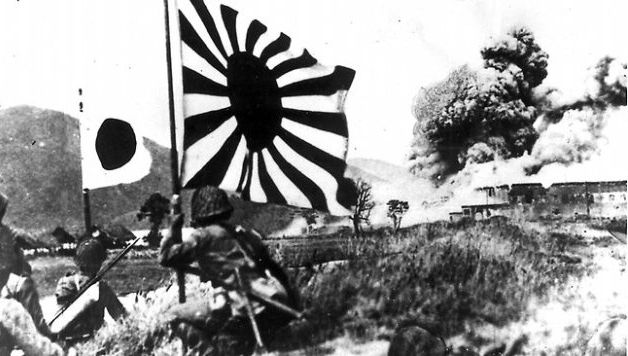
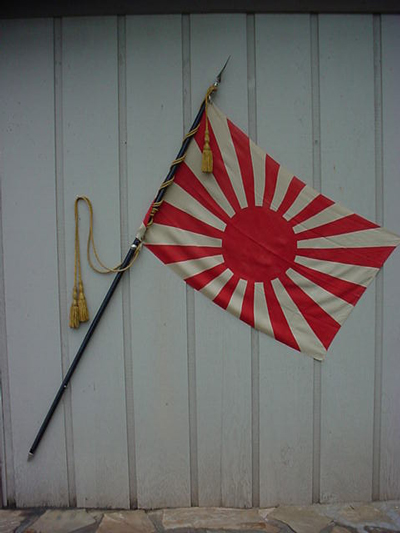
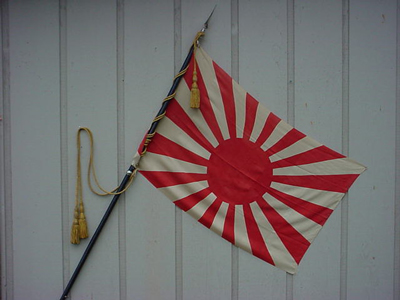
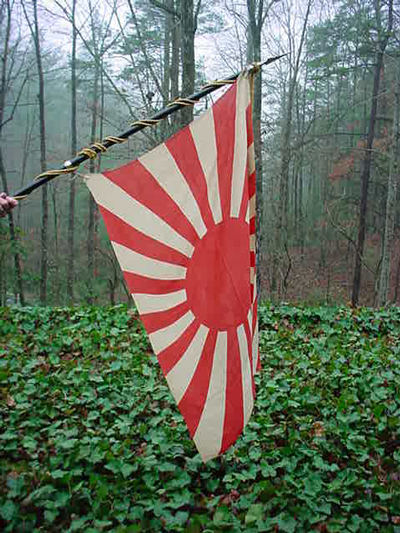
Japanese Imperial Flag with Flag Pole (JAP 3-1) |
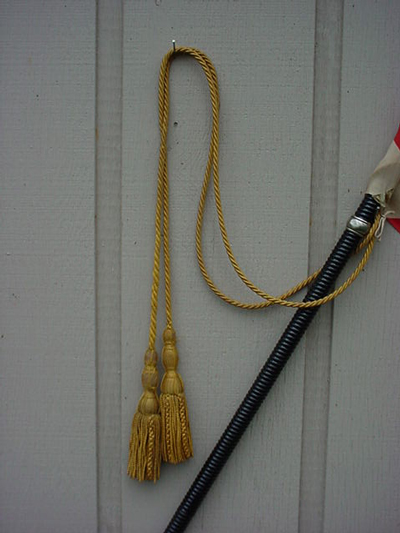
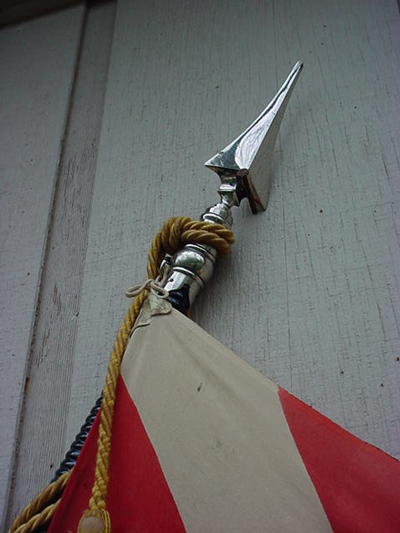
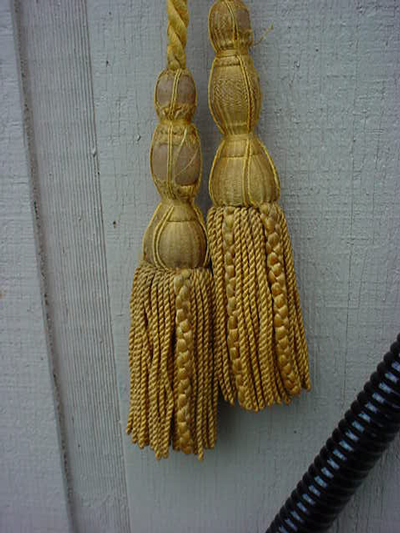
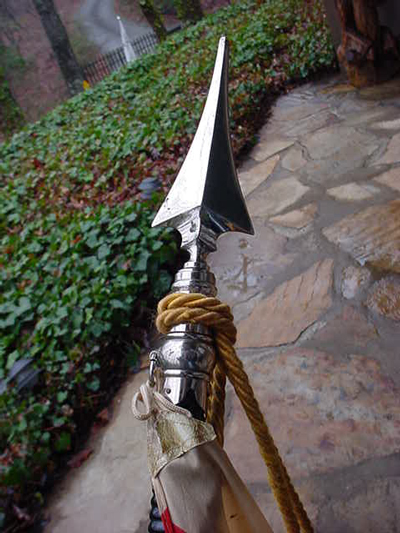
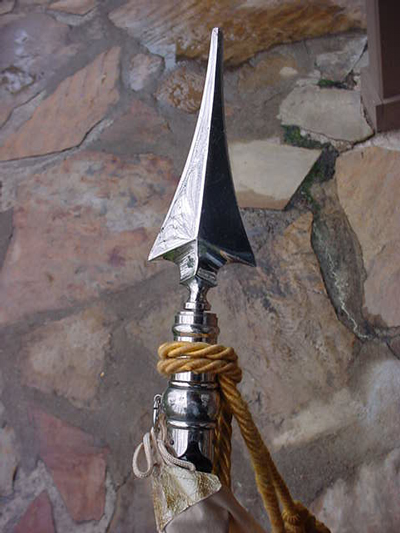
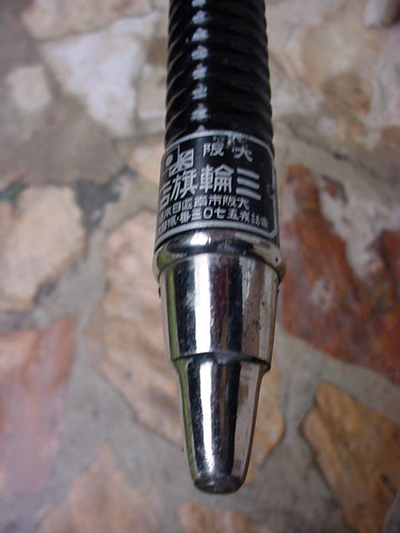
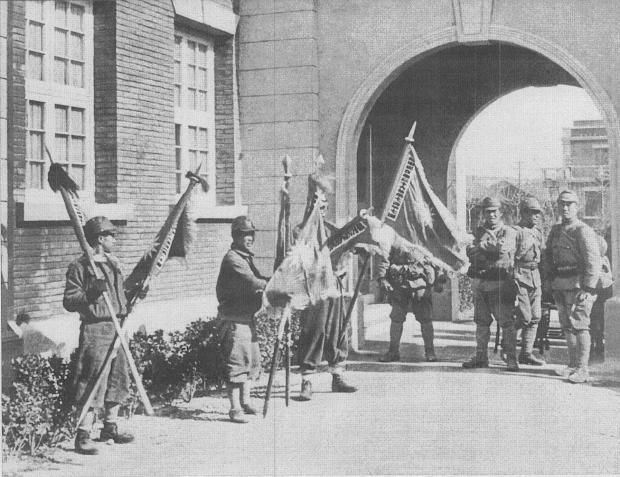
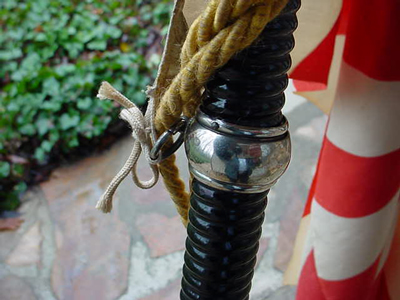
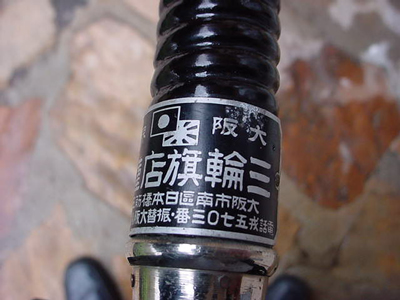
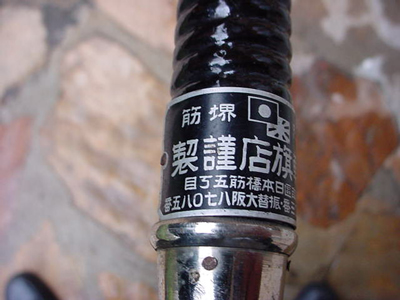
| DESCRIPTION: This has to be the great Japanese World War Two article ever offered on a web site. It is extremely dramatic and downright beautiful looking. It is the Imperial flag of War mounted on a fantastic pole that is a treasure unto itself. The pole is built like a fine Samurai sword scabbard with the circular ringed design throughout and with very special fittings center bottom and top. The plate at the bottom-most portion is quite interesting. It seems to be included as an identification of the flag maker who manufactured this flag. It has pictures of this particular style rising sun and the round sun symbol as well. The finial or flag pole top is made to look like the spear point of the ancient Samurai pole arms. The finial evidently was at one time separated from the pole, but was soldered back. There is a beautiful golden colored rope mount with tassels that would be wrapped in such a way as to grace the whole Nipponese sacred presentation.
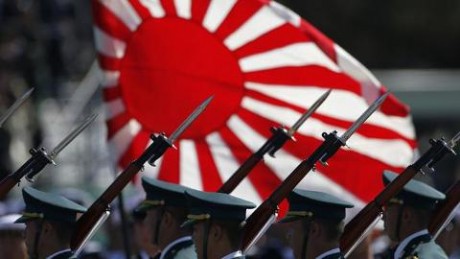
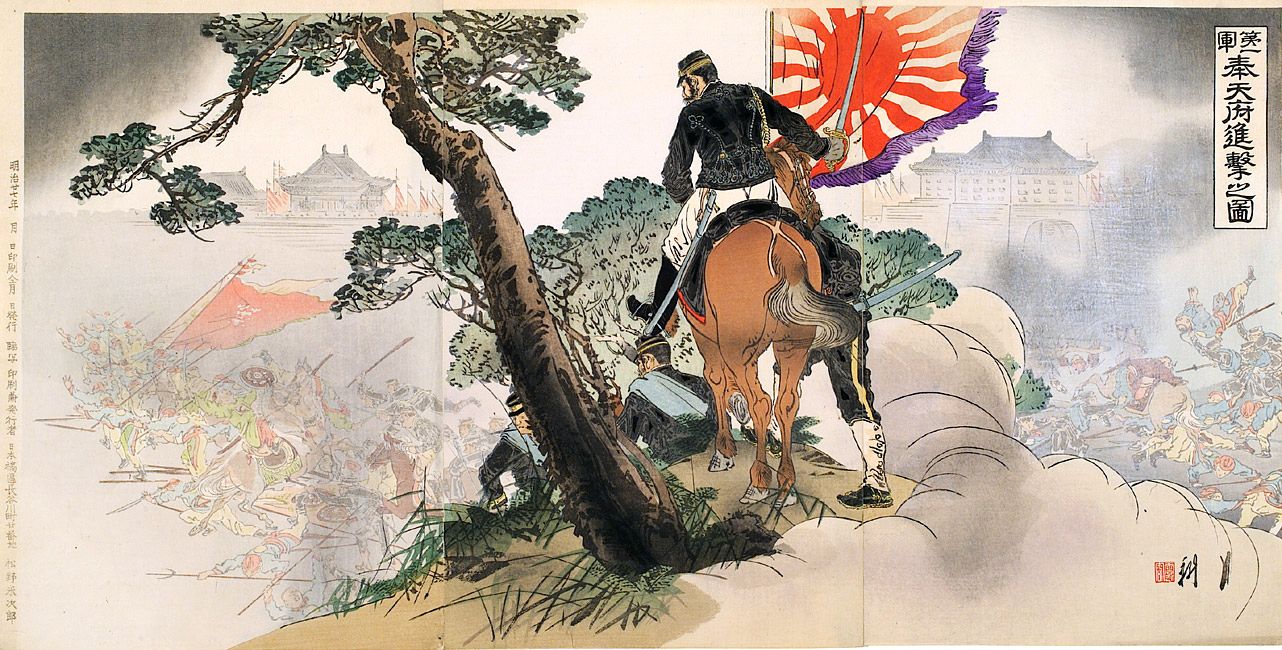
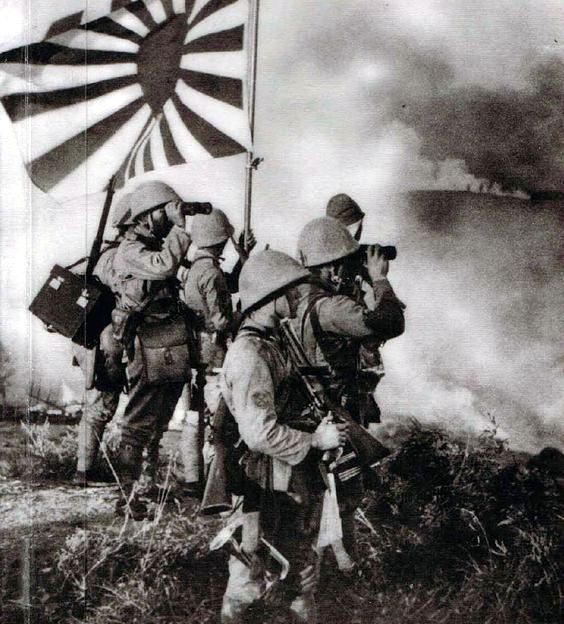
This type flag was not carried into battle, but it was carried to the front and would be used in Bushido ceremonies and borne by the guardsman who would be usually be a war hero picked because of his past special engagements in the field of battle. Flags were of very special importance to the Japanese military. Oaths were sworn on them and men would die willingly for them and the idea of chivalry and bravery that they convey. This is obviously a very important flag and extremely rare -- probably the greatest Japanese article of militaria that you could imagine in your collection or the collection of a museum. PRICE: SOLD |
|
|||||||||
Boys’ Day Figures (Item JAP 3-2) |
|||||||||
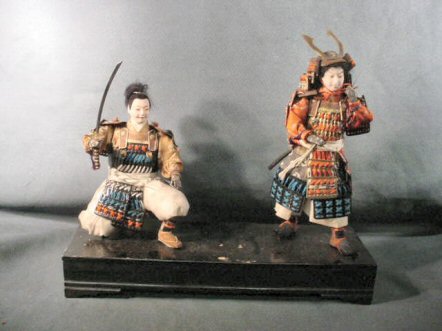
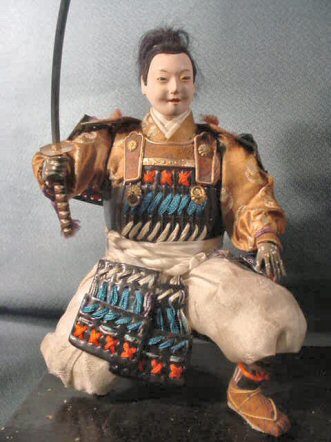
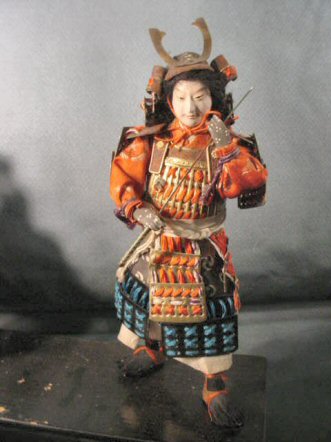
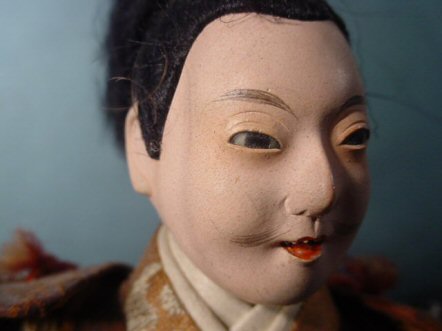
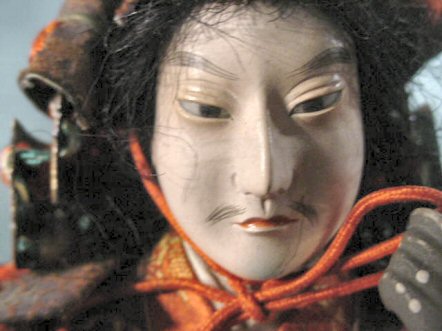
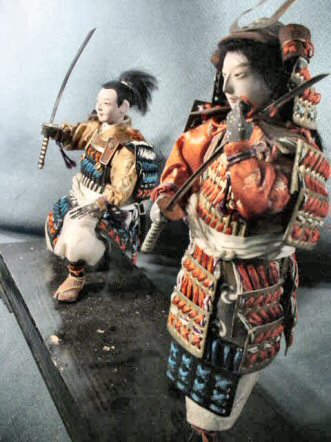
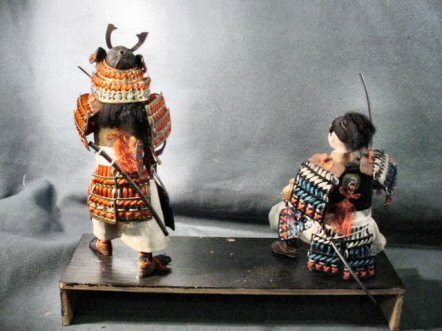
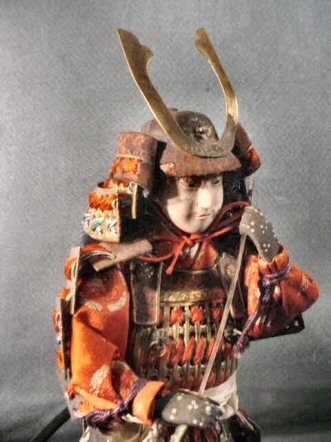
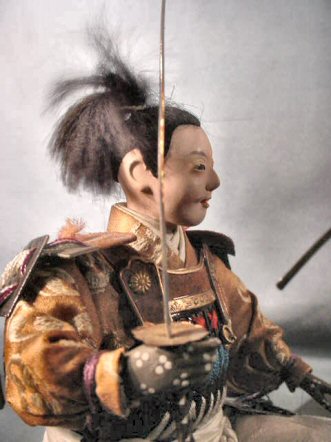
| DESCRIPTION: Here are a pair of Samurai warriors handmade for the celebration of “Boy’s Day” held on May 5th. It was know as Tango-no-sekku, The Boys’ Festival. It has for centuries been Japan’s way of celebrating the healthy growth and development of her young boys. It is a very special day and is vastly important because it commemorates a boy’s life together with family and friends. It is a day when parents show their sons that they are strong and important to the family. No one knows for sure how Boy’s Day originated, however, it is believed that it started in ancient rural China. Guards wore special helmets and were woodsmen and archers. Another legend traces the origin to Tokimune Hojo’s victory over the invading Mongols on May 5, 1282. As a result Samurai families erected flags and flew kites in celebration of the victory. In the latter-day observance of Tango-no-sekku a display is arranged in the tokonoma or alcove, in the guest rooms of Japanese houses. Among the decorations are miniature Samurai warriors handcrafted by the young men and their fathers. Often the warrior dolls will represent Kintaro, the Herculean boy who grew up to be a general. Also often depicted was Skoki, an ancient Chinese general believed to protect people from devils and Momotaro, the Japanese David, the killer of giants. The earliest samples of the Samurai dolls trace back to the 18th century. These pieces were in those early times commissioned by the Samurai class thus making them quite rare today. During the time preceding the Second World War the dolls saw a real renaissance since all of Japan was under the influence of Bushido, the Way of the Warrior. This was not unlike the chivalry codes of European knighthood of old. The actual warriors were men who lived by the code of Bushido. The Samurai’s loyalty to his emperor and his overlord or Daimyo was unsurpassed. They were trustworthy and honest. The Samurai had no fear of death. They would enter into battle no matter what the odds. To die in battle would only bring honor to one’s family and one’s lord. The Samurai and their way of life was officially abolished in the early 1870’s, but it was not forgotten. However, Bushido was reborn in a big way in the 1930’s and 1940’s when the Black Dragon Society helped to bring it back in Imperial Japan. The signal for war in the Pacific was given on August 16, 1941, at a session of the Black Dragon Society in Tokyo. So Boys’ Day in these years took on very special significance in those prewar and wartime years considering that young men are the main tools of war and that militaristic fervor must be instilled in them so you can be sure that Black Dragon representatives were present at every one of the more important celebrations and the displays became more Samurai indoctrinated than any time before. The set of Boys’ Day dolls we offer here re typical of the ones used in wartime Japan. The great figures we offer here are typical, but a bit unusual in that they are a set of two mounted as a grouping. In the center of the plinth are two holes that make us assume that something else was at one time there, but what? We do not think it was another Samurai warrior, but it could have been a chest or a sword stand??? The figures are in wonderful condition. The standing figure is about 9 inches high, while the kneeling one is about 6 ½ inches high. The armor and fabric is all handmade as was the ancient tradition to accomplish. There were valuable prizes to be won by participants in the doll making and clearly from examples we have seen these figures would have no doubt been in the running for top prize. Even the eyes are so realistic as to marvel you.
PRICE: $350.00 for the set |
|
||||||||
Wooden Hand-Carved Netsukes (Item JAP 3-3) |
||||||||
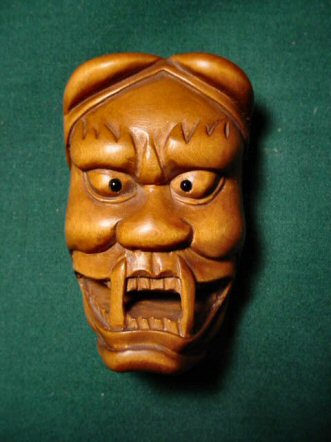
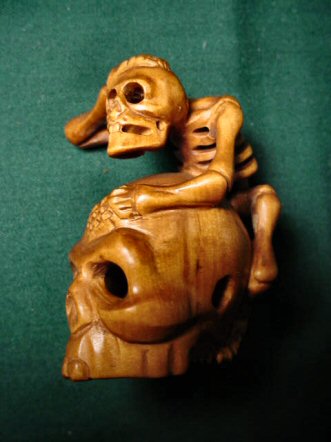
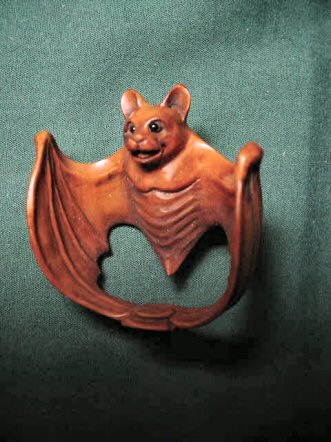
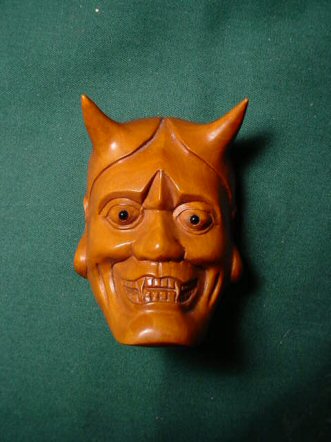
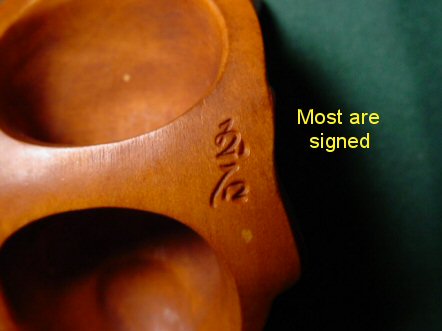
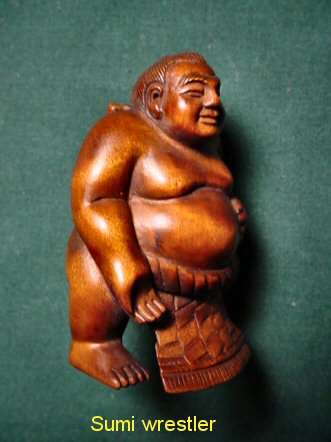
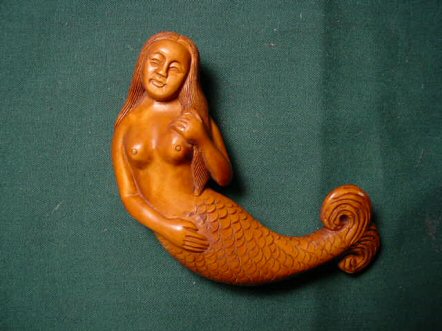
| DESCRIPTION: Netsuke date back to the 17th century and became extremely popular in Europe as collectibles toward the end of the 19th century. They served both functional and aesthetical purposes. The traditional Japanese dress, the kimono, had no pockets. The robes were hung together by a broad sash (obi) so items were needed to be carried were held on a cord tucked under the sash. The hanging objects (sagemono) were secured with carved toggles (netsuke). Netsuke were also used to secure purses, and were widely used to hold the tobacco pouches that became almost universal with the introduction of smoking in Japan. The quality of netsuke was variable. As everyday objects many were carved quickly with left over materials. Netsuke could be made using a variety of materials mainly wood, and ivory (also shell, bone, horn, even metal and precious stones). Wealthier people would have finer netsuke, and it could be possible to tell the status of an individual by the quality of their netsuke. The workmanship is some is outstanding and despite their small size 1 to 2 inches, there can be considerable detail. Captured or killed Japanese soldiers often had netsuke on their person or in their gear. When questioned about this the answer was always—‘for luck.’ We managed to obtain a few of these from a man who collected them for many years. We were completely thrown by the apparent beauty and craftsmanship (they are completely hand carved) in a wood-like substance that we are given to understand these were carved from a type of nut that is found growing in the orient. We have several styles and shapes. Some are absolutely great! They do fit well into a Japanese WW II collection.
PRICE: $39.00 each; $32.00 each if you let us choose |
 |
 |
 |
 |
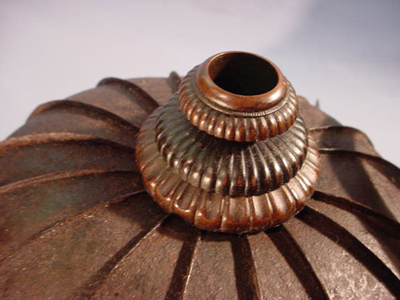 Top knot porthole |
 |
 |
 |
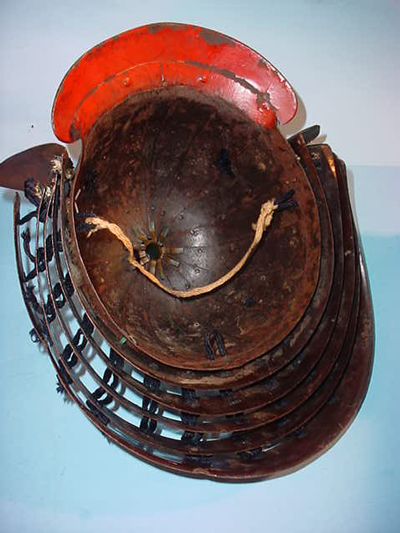 Interior of helmet |
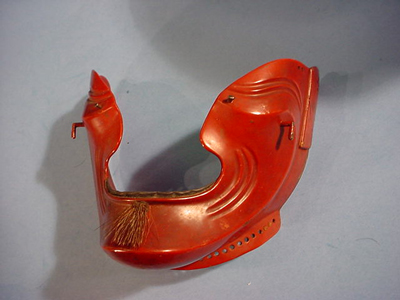
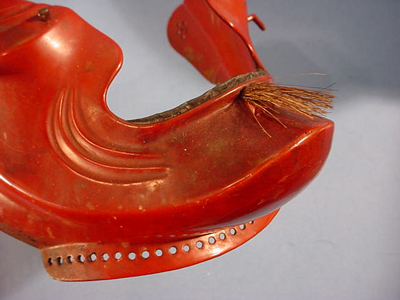
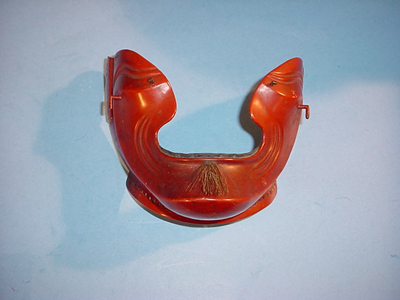 Face mask |
 |
 |
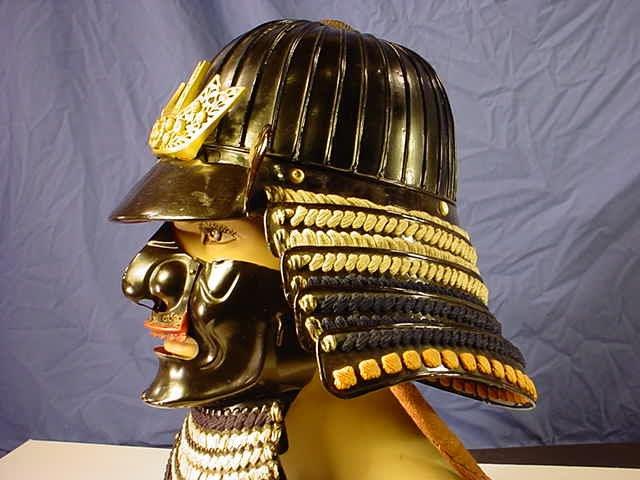
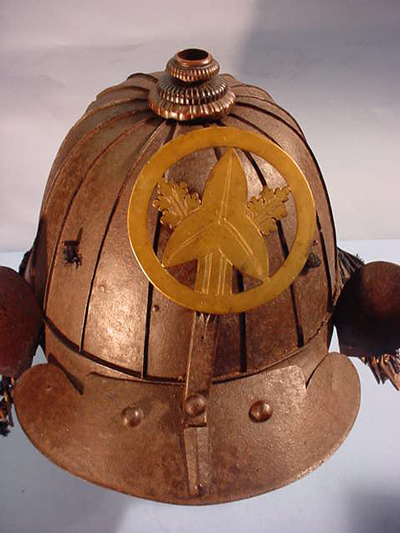
Japanese Samurai Helmet “Kabuto” (Item JAP 3-4) |
||||
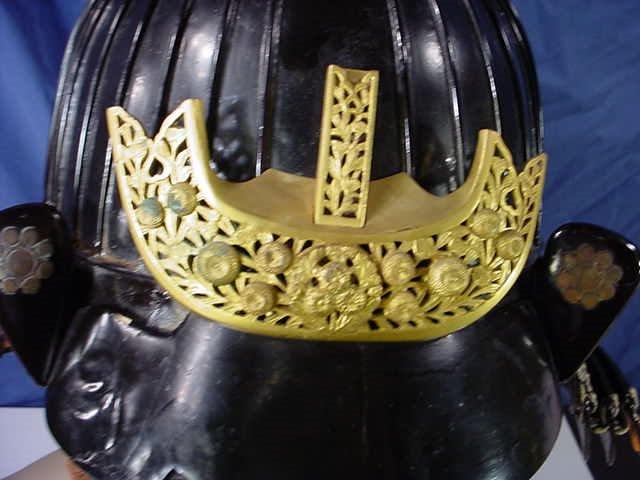
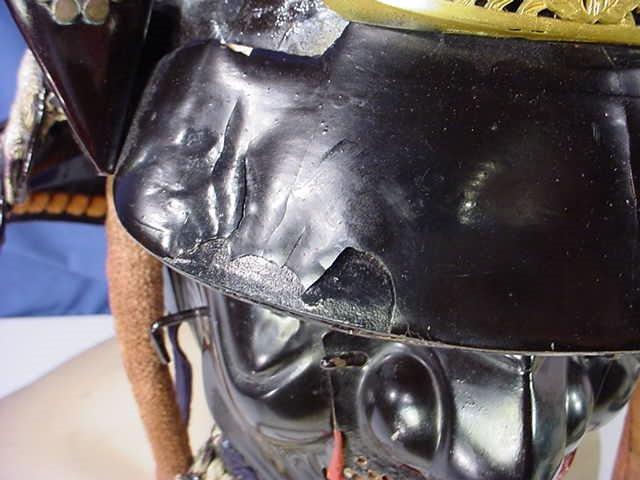
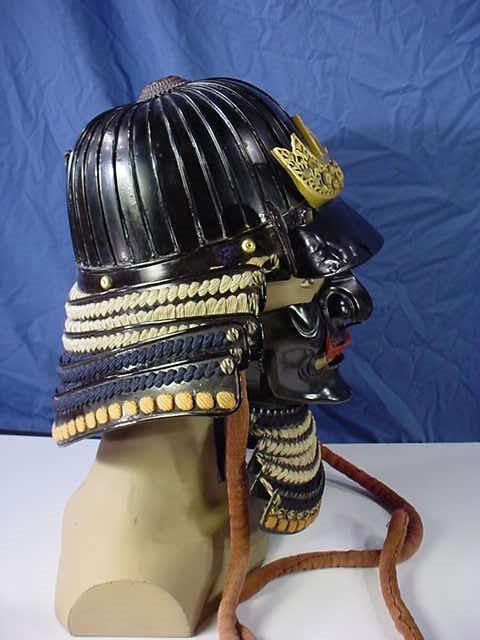
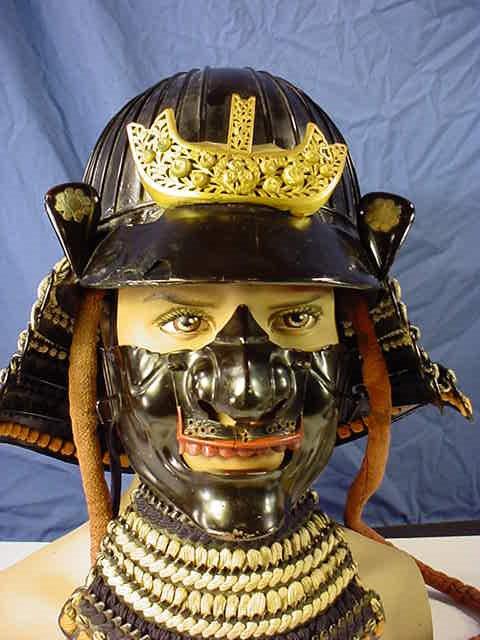
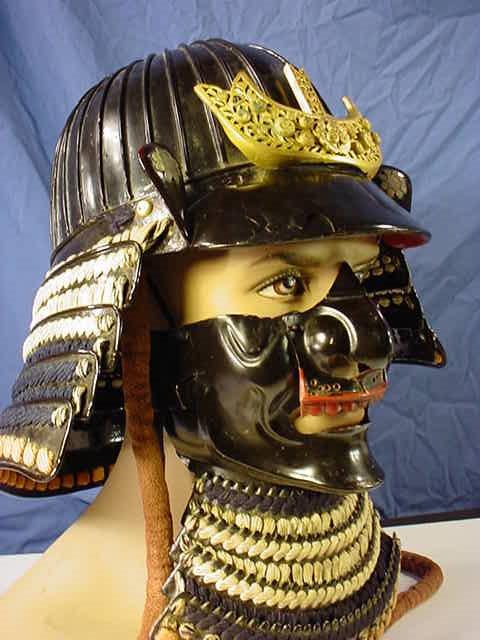
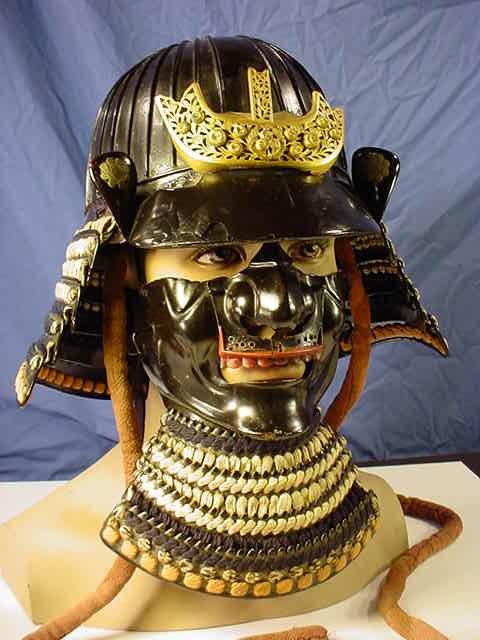
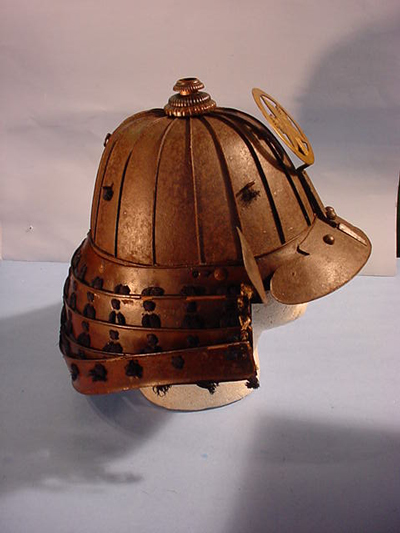
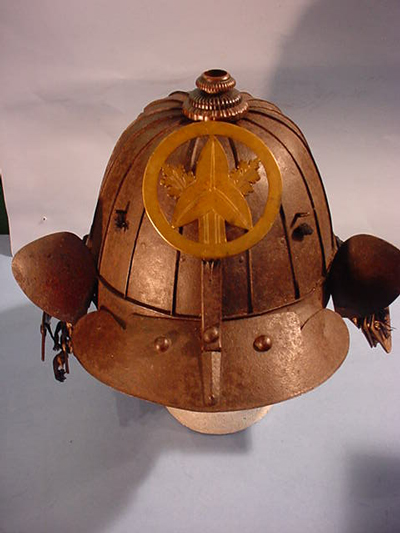
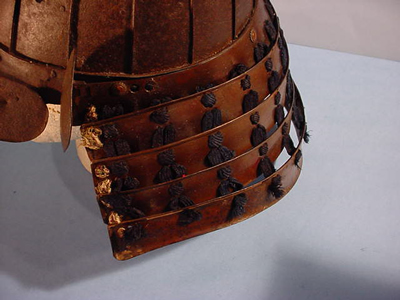
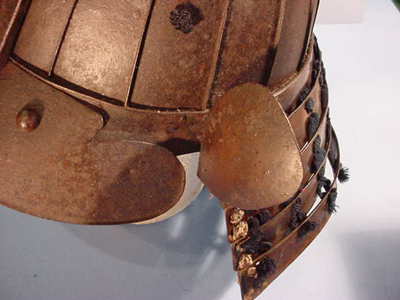
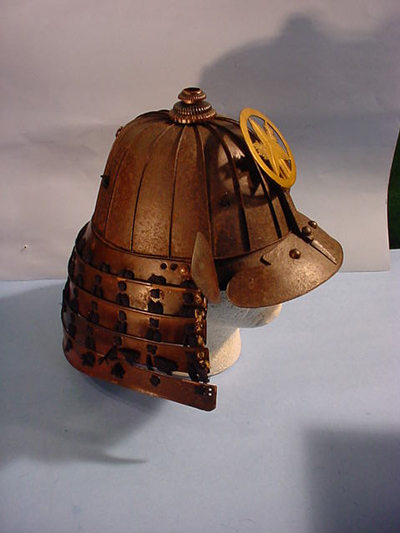
| DESCRIPTION: This is a classic Kabuto helmet used with traditional Japanese armor as worn by the legendary Samurai. It features a strong bowl (Hachi) which protects the crown of the head. A suspended series of articulated plates (the Shikoro) to protect the crown of the head. This Kabuto was constructed with many metal plates riveted together. At the top of the helmet is an opening called a "Tehen” or hachiman-za (seat of the war God Hachiman). The original purpose of this Tehen was for the warrior to pass his top knot through.
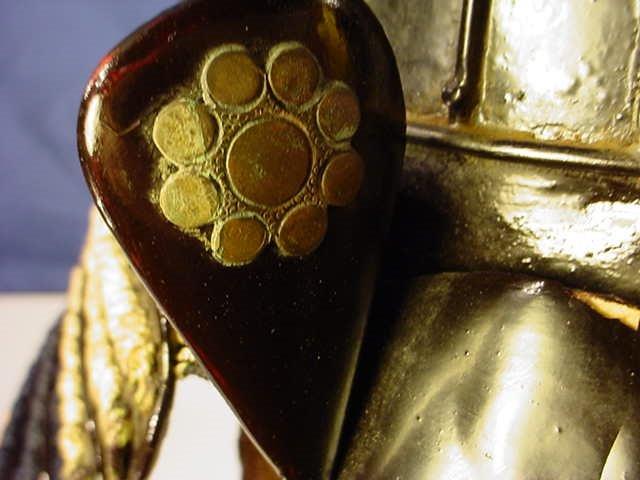
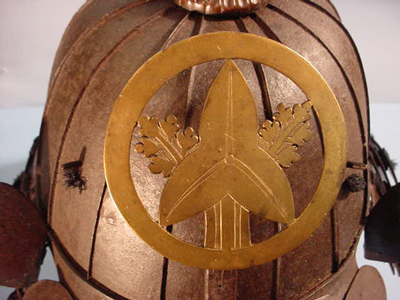
This Kabuto is adorned with Maedate or Mon, a frontal crest. These Mons can be family crests or objects representing animals, mythical entities, prayers or other symbols. This one has the revered sacred Japanese symbol of the Imperial Chrysanthemum. This helmet has the suspended neck guard called a Shokoro. This is composed of semi-circular lacquered metal lamos attached and articulated by this system of lamos and is somewhat standard technology of defense along with chain mail for the body protection in Japanese armor (Kikou). We believe this helmet to be of the Momoyama period and is of the Myochin style. We have a very fine samurai face mask that was worn with a Kabuto. This was known as Mempo and came often with attached mail throat guards, etc. This one is rather plain and came with the Kabuto that is shown when we bought them both; it surely is a different period but since we bought them together, we show them together even though they are separately priced. PRICE: Kabuto (Helmet) SOLD Mempo face mask SOLD |
||||
 |
 |
 |
 |
 |
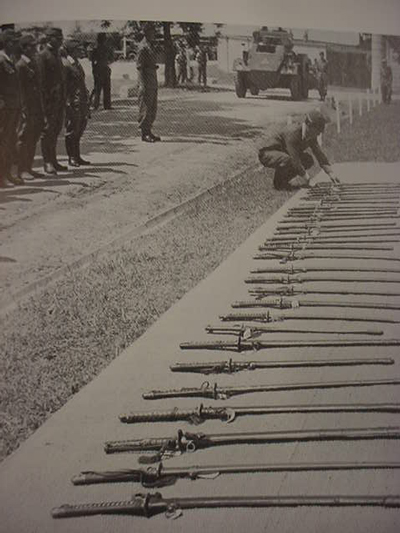 The surrender of Japanese swords in 1945 |
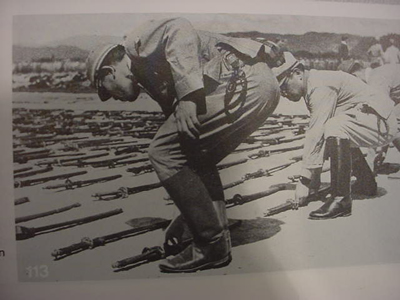 Surrender |
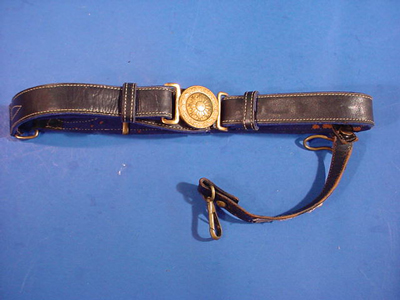
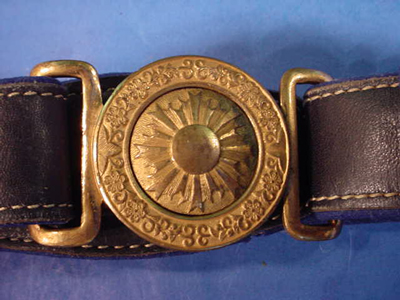
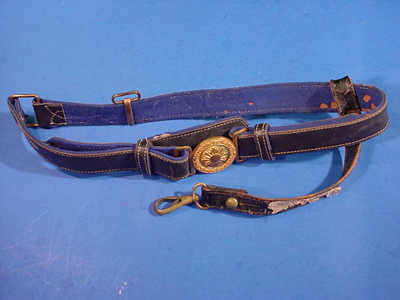
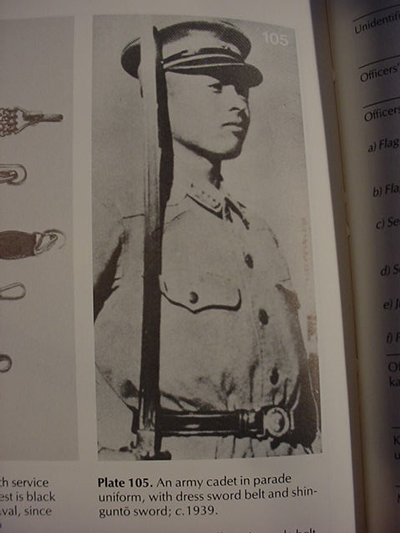
Japanese Sword Belt (WWII) for Naval Officer (Item JAP 3-5) |
|||||
DESCRIPTION: Here is something seldom encountered...a belt with hanger for a military sword. It is crafted in front quarter horsehide and is in good sound condition. Its buckle is the two part interlocking variety for naval officers. The buckle has the rising sun motif of the Japanese empire. Quite rare PRICE: $285.00 |
|||||
 |
 |
 |
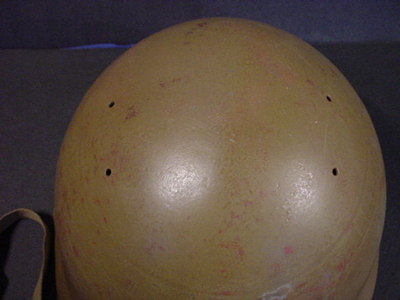 Vent holes |
 |
 |
 |
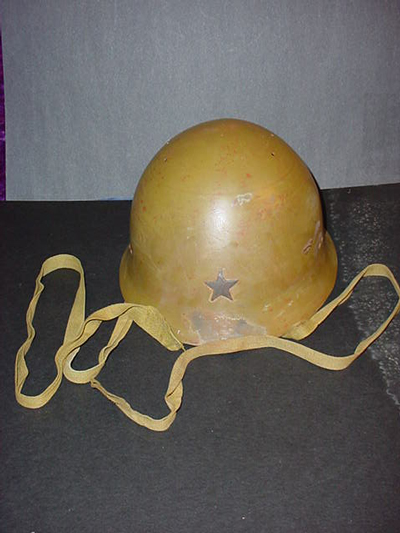
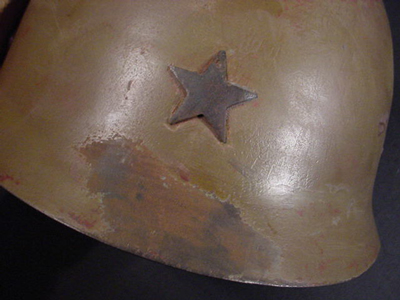 Star and blemish |
 |
 |
 |
 |
 |
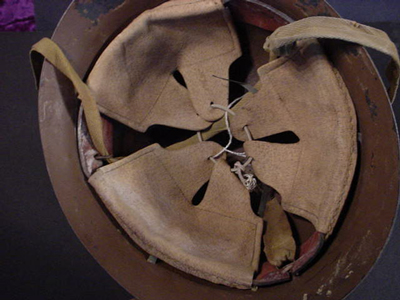
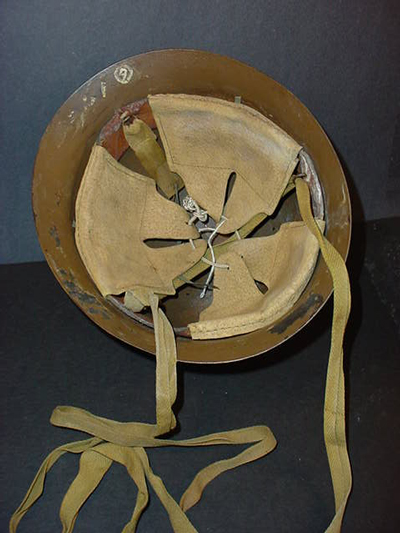
Original WWII Japanese Helmet (Item JAP 3-7) |
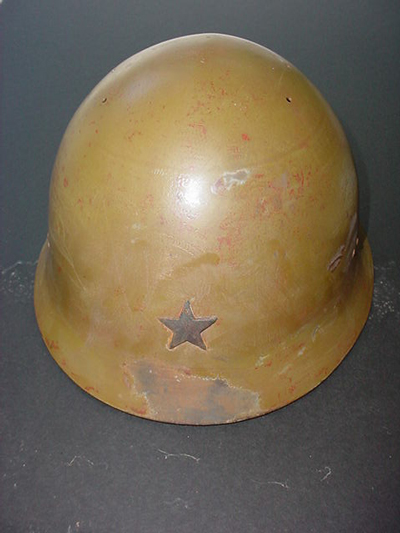
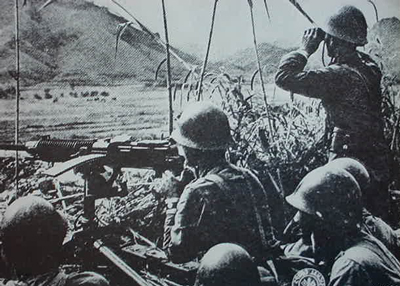
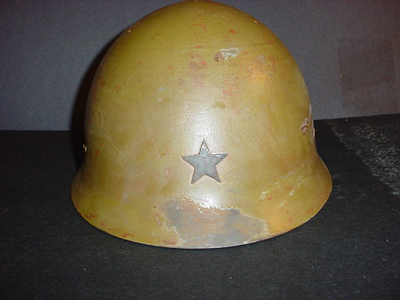
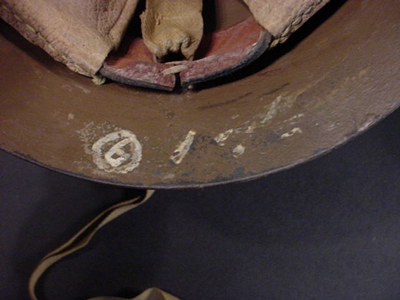
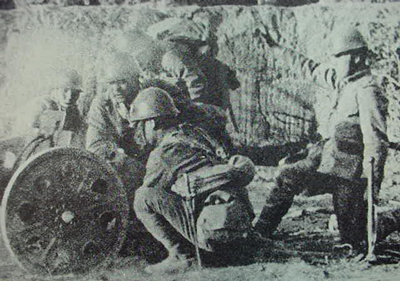
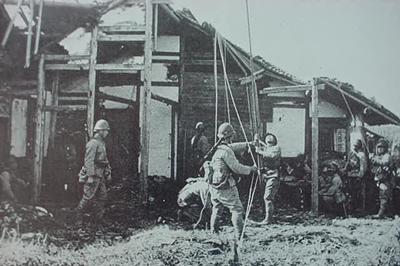
DESCRIPTION: Here is a rare piece of headgear that is much less encountered than the German WWII helmets and when one of these rare helmets is occasionally found it is usually missing the liner and the ties or straps. These helmets are shaped like an upside down pot of conical form. (Rather pointed.) It could be held firmly on the head by wearing straps which tied under the chin or at the back of the neck. In front was displayed the five pointed star significant to the Japanese army. This was in metal and held on with split clips. The steel from which the helmet was made was of a lighter gauge and gave less protection than that from which British and German helmets were made. This helmet is 100% original and the condition is fine “plus” with original straps and liner. It has some painted marks at the back of the shell in possible Japanese characters. There is a slight blemish at the front under the star otherwise the original paint is intact. There are four ventilation holes in the top (usual). A very rare WW II helmet in great condition. PRICE: SOLD |
 |
 |
 "The Liberators" |
 |
 |
 |
 |
 |
 |
 |
 |
 |
 |
 |
 |
 |
 |
 |
 |
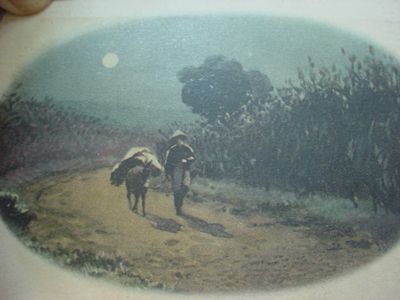
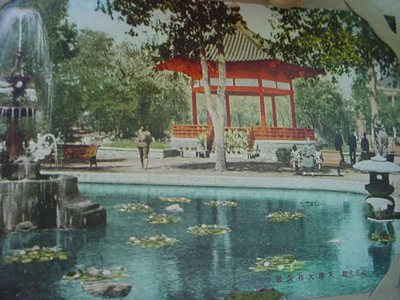
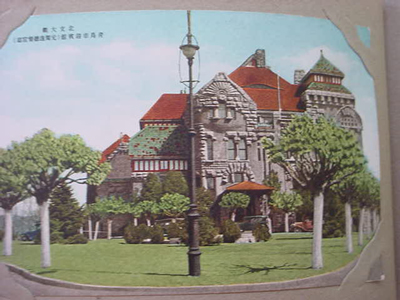
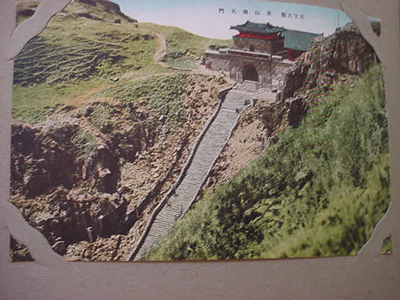
A Soldier's Album of Postcards WWII (Item JAP 3-8) |
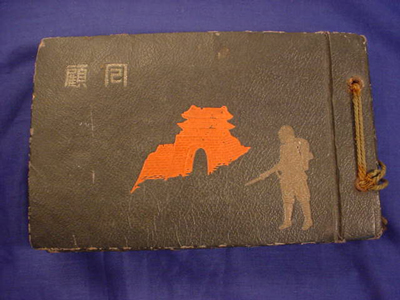
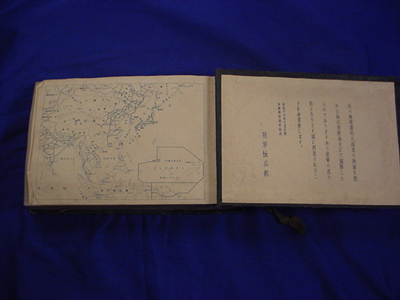
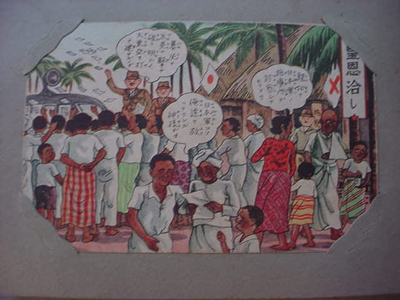
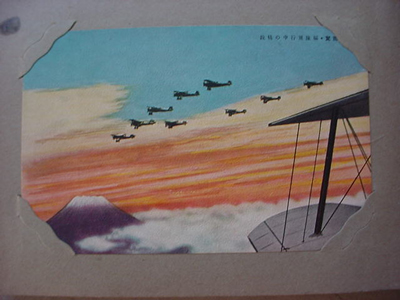
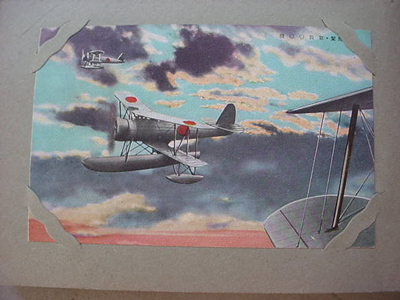
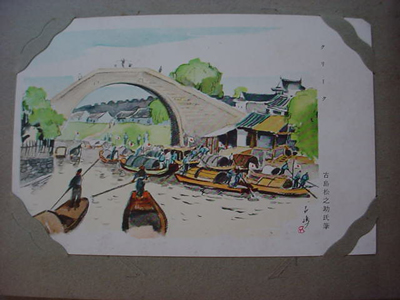
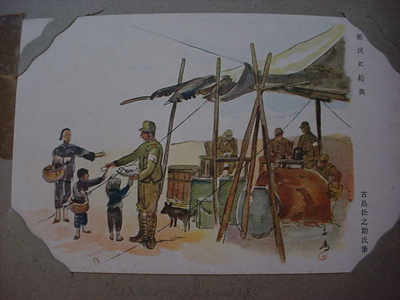
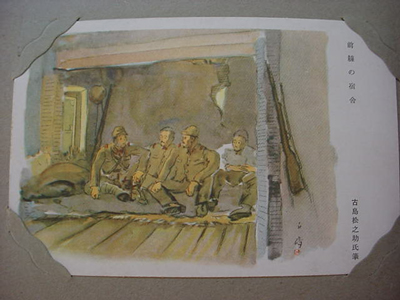
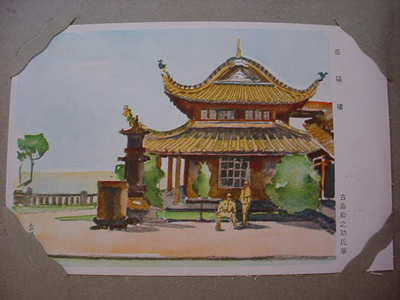
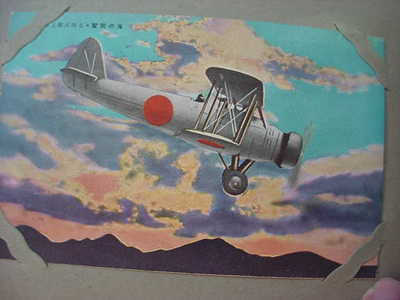
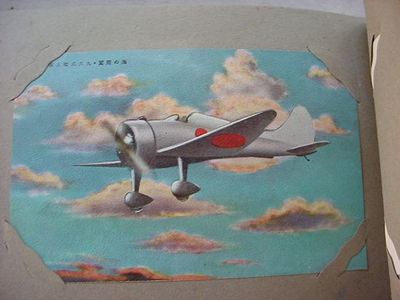
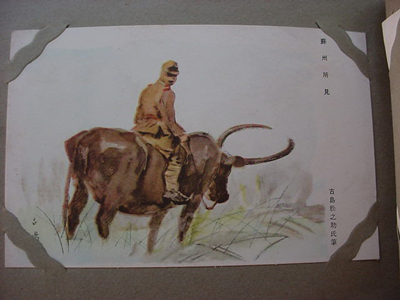
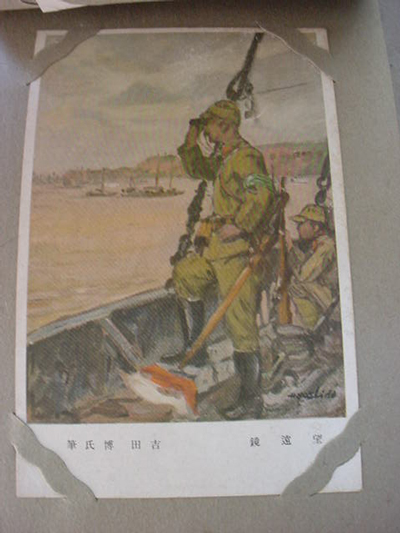
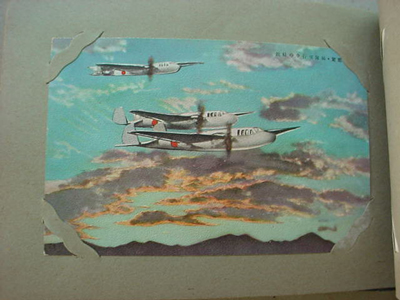
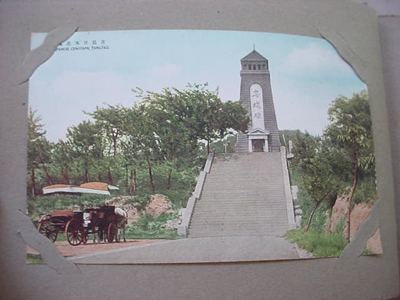
DESCRIPTION: This is a great little album full of postcards that was reportedly taken from a Japanese officer’s desk on Guam during WWII. At least half of the cards are about military scenes including cartoon types and also cards that are included that appear to have been copies of art work from original Japanese water colored paintings -- some of them depicting Japanese soldiers in all types of military exercises, there are also pictures of Japanese combat aircraft and interesting pictures, take for instance, a Japanese soldier riding a water buffalo and scenes of the sons of Nippon being “very kind and benevolent” to the people of occupied lands. There are also some very good pictures of Shinto shrines, Buddhist temples, monuments, mountains and other scenic stuff. The album measures 8 ½ x 5 ½ and is 1 ½ inches thick. There is a map inside the front cover and lots of Japanese writing in the front and back inside covers. Inside the back cover the corporal who ‘liberated’ it signed his name CPC.M J. Stosic and his unit ID 353/6312. This is one great memento of the fierce fighting in Guam in WWII. 54 cards within. Great cover with soldier and Imperial Palace. PRICE: SOLD |
 |
 |
 The presentation |
 Note ruby and rising sun |
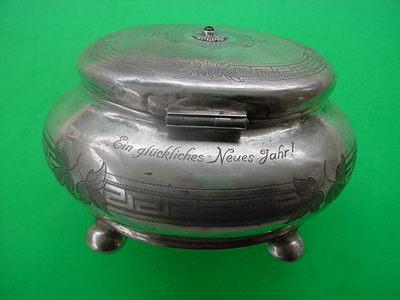 Backside - "Happy New Year" |
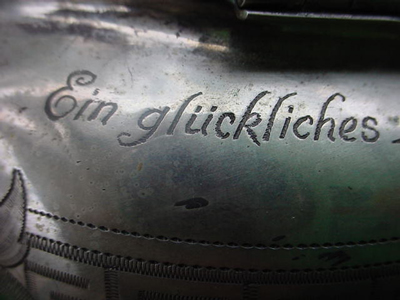 "A Happy.." |
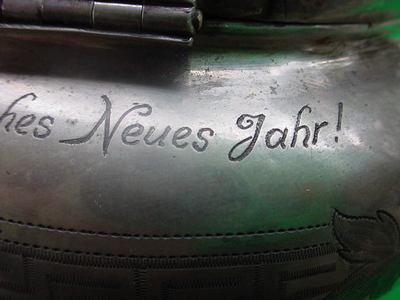 "New Year" |
 "To Mrs. Lauterbach" |
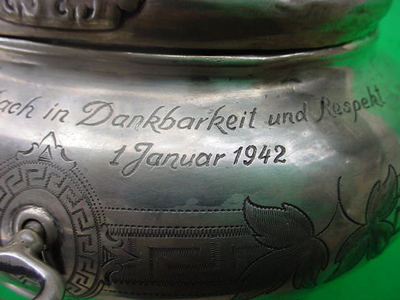 "In Gratitue and Respect" |
 |
 |
 |
 |
 The key |
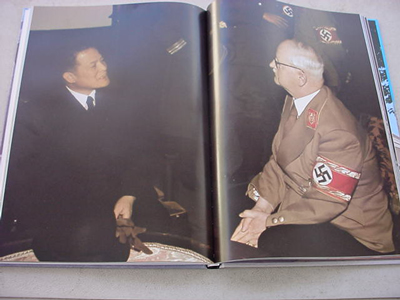 Oshima with Franz Xavier Schwarz |
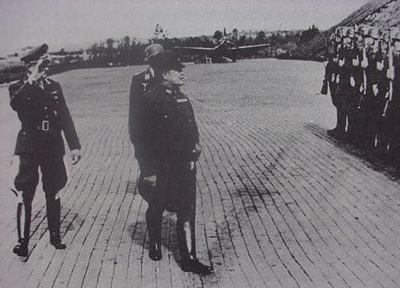 General Oshima |
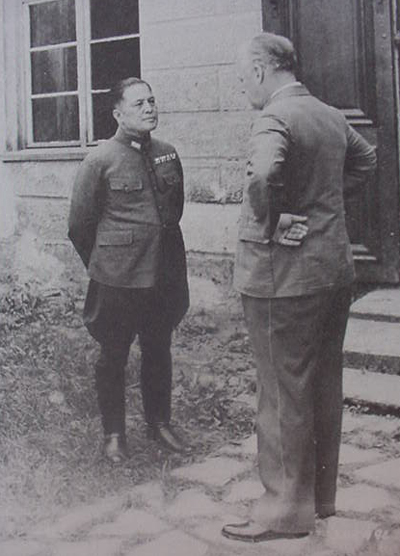 With Ribbontrop |
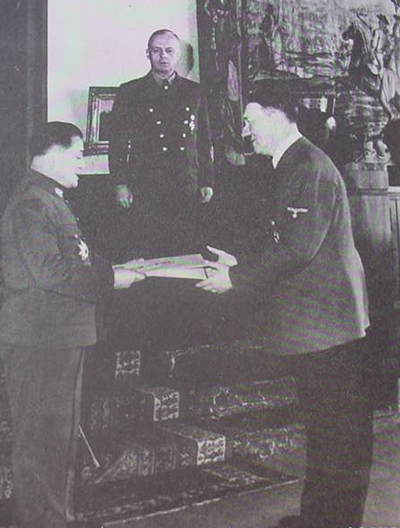 With the Chief |
 |
 |
 |
 Book on Oshima |
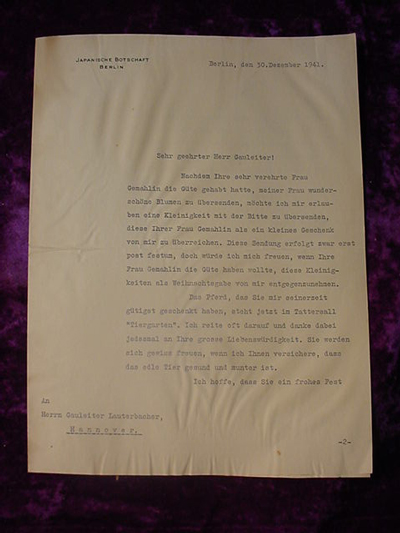 The letter |
 Japanese Embassy |
 |
 To the Hannover Gauleiter |
 |
 The handwritten signature |
 General Oshima at Nuremburg |
Japanese Ambassador Oshima’s Gift to the Wife of N.S. Gauleiter Lauterbacher (Item JAP 3-9 & PERS 4-17) |
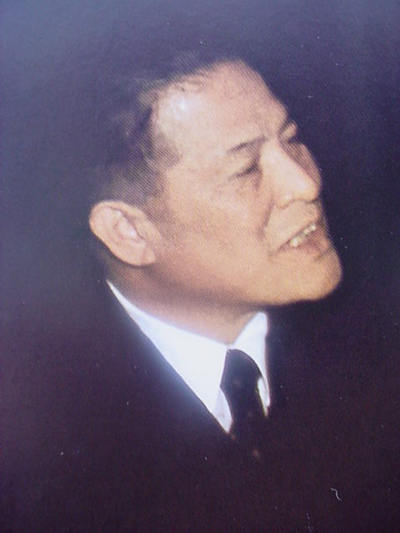
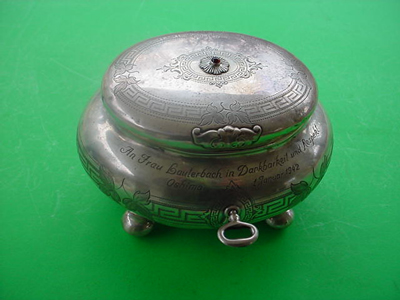
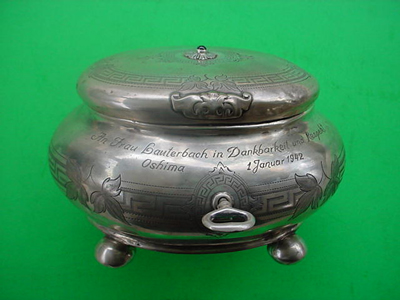
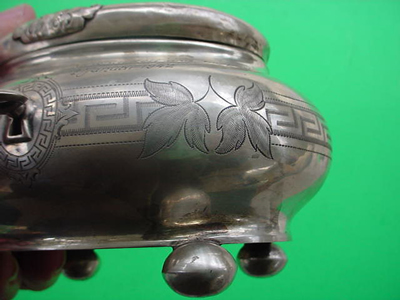
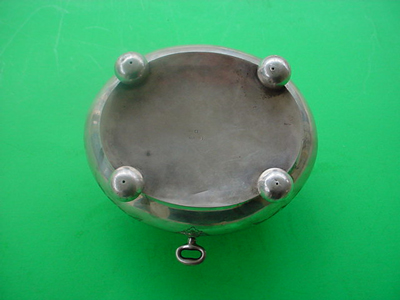
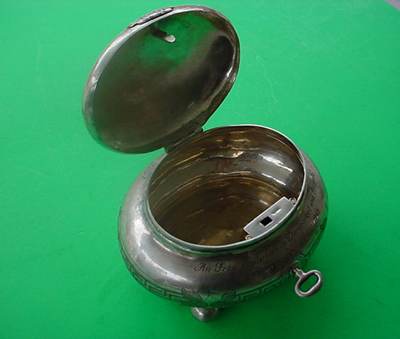
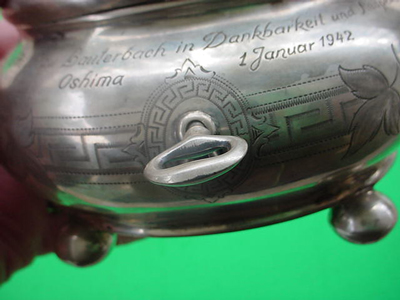
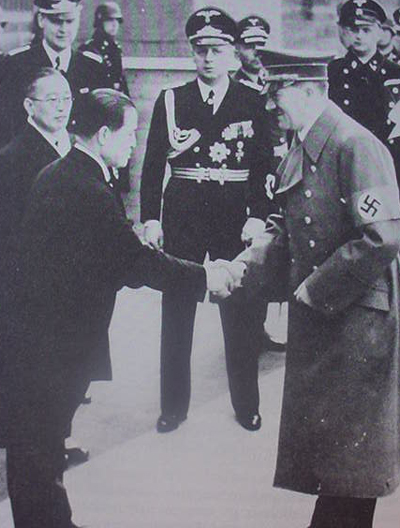
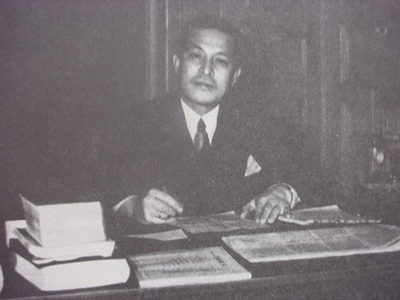
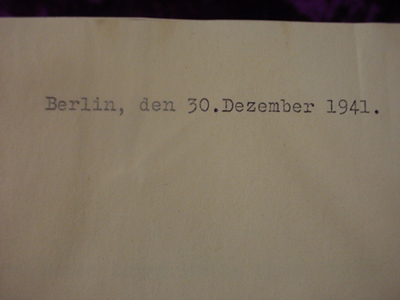
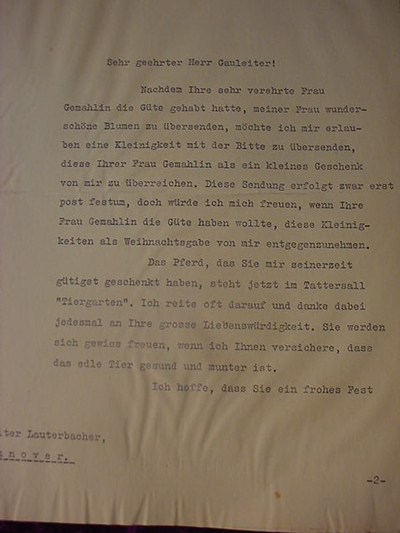
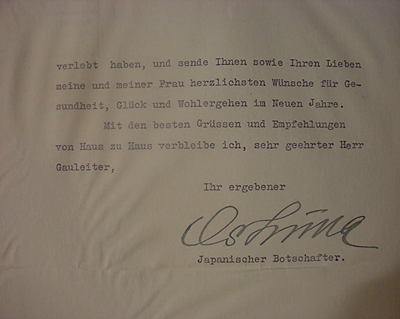
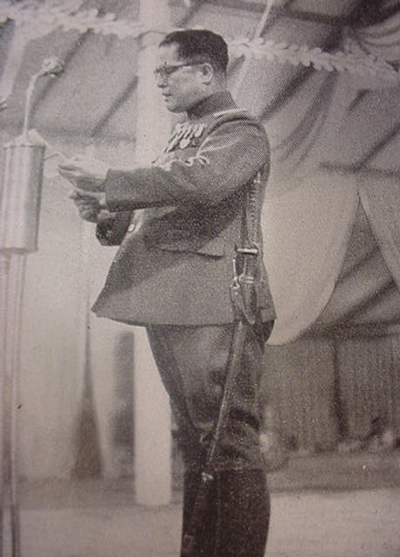
DESCRIPTION: Baron Hiroshi Oshima was a General of the Imperial Japanese Army and later ambassador to Berlin in National Socialist Germany during WWII. He was the son of a prominent Japanese family; his father, Oshima Kenichi, was the Minister of War from 1916-1918. Oshima graduated from the 18th class of the Imperial Japanese Academy in 1906 and from the 27th Class of the Army War College in 1915. He served as a military attaché to Budapest and Vienna from 1923-24. After his return to Japan he was made Commander of the 10th Field Artillery Regiment form 1930-31. In 1934 Oshima became Japanese military attaché in Berlin with the rank of Colonel; he spoke perfect German and soon was befriended by Joachim Von Ribbontrop, Hitler’s Foreign Policy advisor. Oshima’s importance for the Fuhrer during his service can be seen in the fact that following the conclusion of the anti-Comintern pact, the US Ambassador in Japan Joseph Crew estimated that the agreement was pretty much the result of Oshima’s doing without the participation of the Japanese Ministry of Foreign Affairs. Under Ribbentrop’s guidance, Oshima met privately with Hitler in the fall of 1935. With the full support of the N.S. leadership and the Imperial Japanese Army General Staff. He progressed rapidly while in Berlin obtaining the rank of Lieutenant General and being officially appointed Ambassador to Berlin in October 1938 according to official sources and presented at the Nuremberg Star Chamber “trials” in 1945. During his early months as Ambassador he was plotting the assassination of Stalin through Russian agents that were sympathetic to the N.S. cause. In a conversation he had with Heinrich Himmler on January 31, 1939 he expressed the hope that a German-Japanese cooperation in the field of intelligence would lead eventually to the disintegration of the Soviet Union. His ideas were sound and had they played out the present world would have been quite different. Oshima’s close relationship with Hitler and Von Ribbontrop gave him unparalleled access for a foreigner to German war plans and national policy. The left leaning author and yellow rag journalist William L. Shirer in referring to Oshima’s so-called anti-Communist fanaticism said that Oshima was “more Nazi then the Nazis.” It is true that he was very much admired by the officials of the National Socialist scene -- he was honest, forthright, outgoing and considered brilliant. He was a constant guest at the Ribbontrop estate and visited with Reichsmarshal Herman Goring at Karinhalle many times. He often was invited to the homes of the other Party and military officials and they considered him to be the personification of the ‘Valiant Samurai” of old. His honor code seemed to harken back to the saga of the warrior class of old Japan. N.S. Gaulieter Hartmann Lauterbacher of Sud Hanover who had been a highly placed Hitler Youth Leader and member of the Allgemeine and Waffen SS was particularly fond of Oshima and they attended many diplomatic corps events together; the Gauleiter and his wife often entertained the ambassador and some of his entourage in their home. The Gauleiter knew that Oshima had a penchant for fine blooded horses and in December, 1941 while the war was in its second year going on its third, Gauleiter Lauterbacher presented to Ambassador Oshima a fine thoroughbred riding horse. Oshima was highly appreciative of this and sent him a letter from the Japanese embassy in Berlin thanking him for the horse and a notice of appreciation for flowers sent by Lauterbacher's wife. The original letter that is dated 36 December 1941 is offered here. This was the same month of the Japanese attack on Pearl Harbor. The letter reads translated - - - ‘My dearest Gauleiter, The horse you so kindly presented me with has now found a home at the Tattersall “Tiergarten.” I do ride it often and think of your generosity always. I am sure you will like to hear that the horse is in the best of health. I hope you had a pleasant and I send you and your wife my heartfelt congratulations and happiness for the New Year. My best wishes from my home to your home. Dear Gauleiter. Oshima *The reference to the Tattersall Tiergarten refers to a Park in Berlin similar to Central park in N.Y. where they had a bridle path used for equestrian riders Oshima jests a bit when he refers to the Tattersall “Tiergarten” This would be a zoo. The Gift - This is a very charming what-not box in 800 silver. It is a very beautiful little box that has a distinctly oriental look over all, with a Japanese version of the Greek key pattern running all around it in a band that surrounds its middle section and around that between the various sections of the Greek keys. A floral leaf design also in Oriental style can be observed. In the center of the top is a badge or escutcheon that looks like the Japanese Order of the Rising Sun surrounded by once again the Greek key design. On the front section there are the engraved words: An Frau Lauterbacher in Dankbarkeit und Respekt’- Oshima I Januar 1942. Translated –“To Frau Lauterbacher in gratitude and respect. Oshima 1st January 1942.” Obviously he wrote on Dec. 30th but made the gift in the first of January 1942. On the back of the box are the words: Ein Gluckliches Neues Jahr ( A Happy New Year!). This is a great historical relic very important yet beautiful in its simplicity and artistic style. PRICE: $5,800.00 For the gift and the original letter signed by Oshima |
 |
 |
 Signature in Japanese |
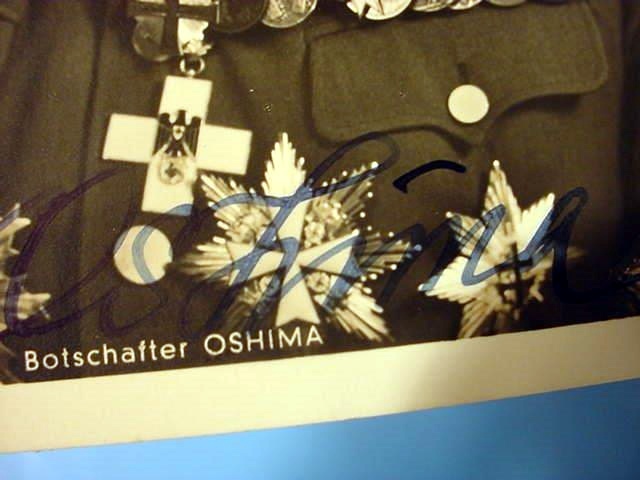 Signature in German |
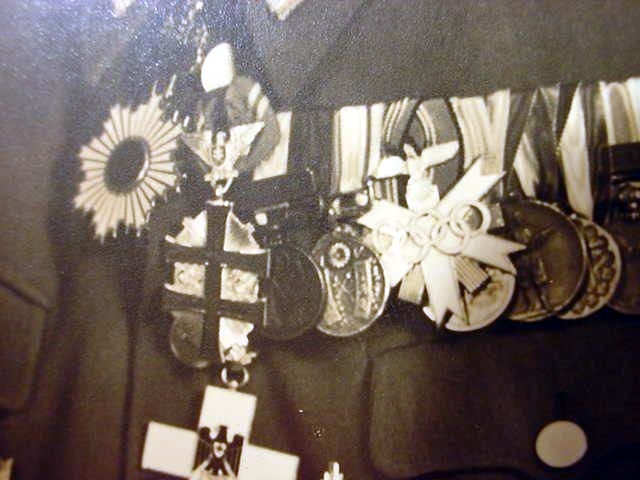 German and Japanese medals |
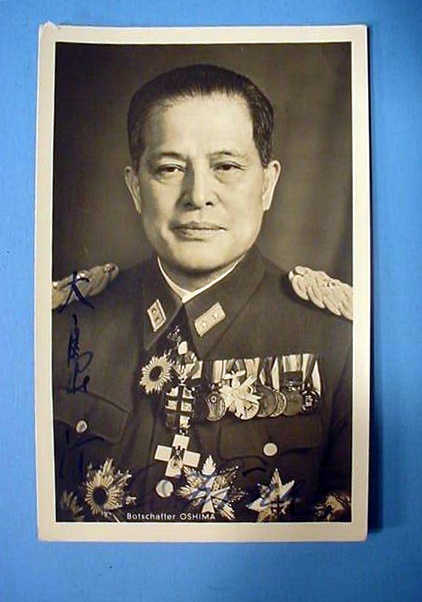
Signed Postcard with Hiroshi Oshima's Signature (Item JAP 3-9a; PERS 4-17a) |
DESCRIPTION: This is a German-produced postcard picturing the Japanese Ambassador to National Socialist Germany during WWII. General Hioroshi Oshima signed in both English and in Japanese characters (signature contrast fair to good) on the signatures (postcard must be held at certain angle to be seen but guaranteed to be there) against heavily bemedaled uniform. Further information about this Samurai-like general can be found in the narrative above. “He was indeed more Nazi than most Nazis” and from me, that’s a compliment. PRICE: $350.00 |
|
|
Signed Photograph of Hiroshi Oshima, Japanese Ambassador to Germany (Item JAP 3-9b; PERS 4-17b) |
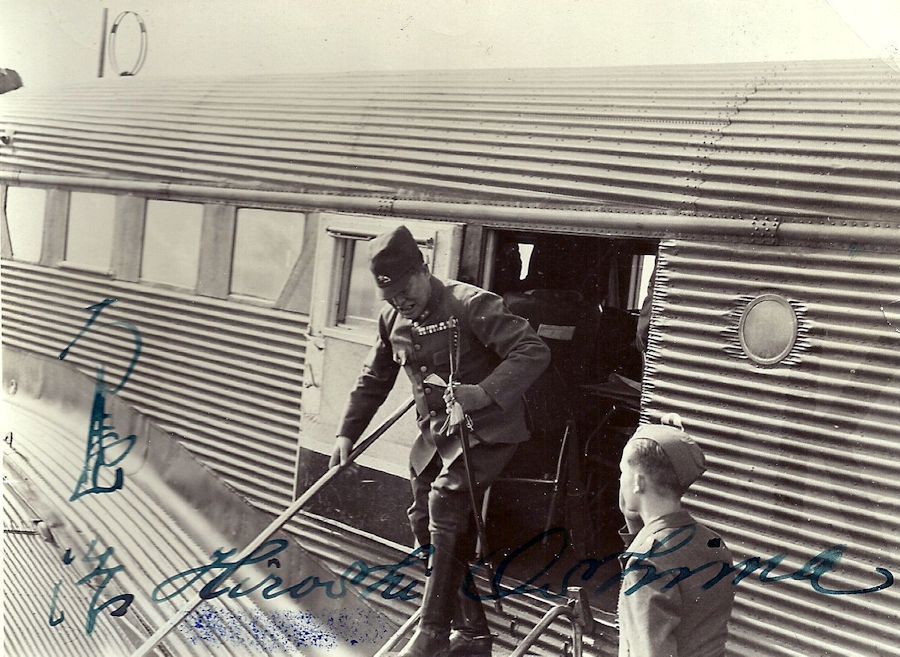
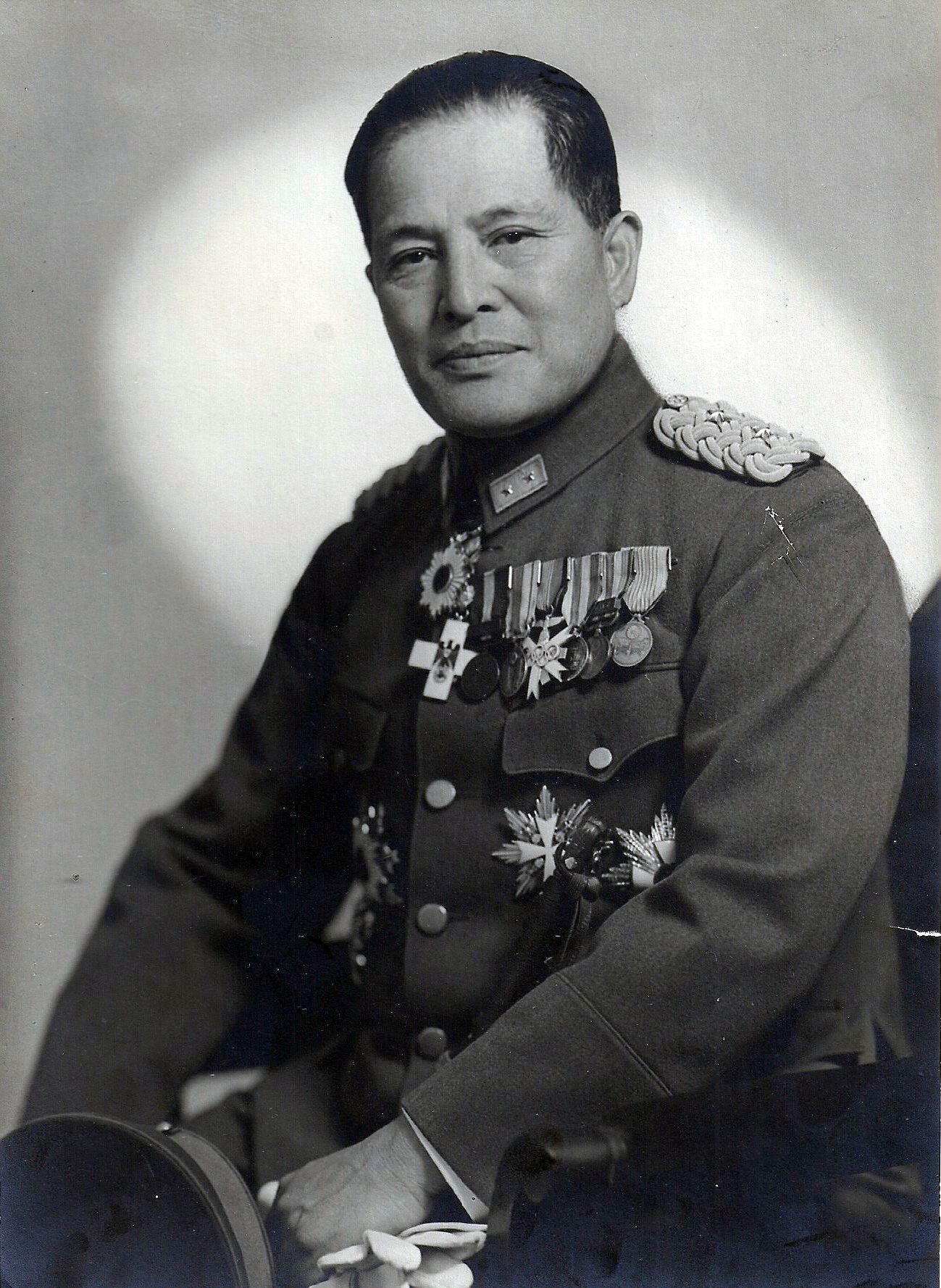
DESCRIPTION: This is a 7 x 5-inch glossy black-and-white photograph signed by hand in English/German and Japanese by Japan’s WWII Ambassador to Germany. The image shows Hiroshi Oshima exiting a Junkers Ju 52 transport plane probably in Berlin. A slight bleed-through of ink on verso appears beneath the signature, else fine. Please do read our background information on Oshima above with the gift item to the wife of Gauleiter Lauterbacher. This offering includes a great 6½ x 9-inch photo of Oshima that is an original-period German portrait photo of him in full uniform bedecked with medals. The back of this picture has the stamp of Ernst Schneider, the German photographer. This is a great and historically important find. PRICE: $650.00 |
|
|
Signed Photograph of Japanese Ambassador Hiroshi Oshima (Item JAP 3-9c; PERS 4-17c) |
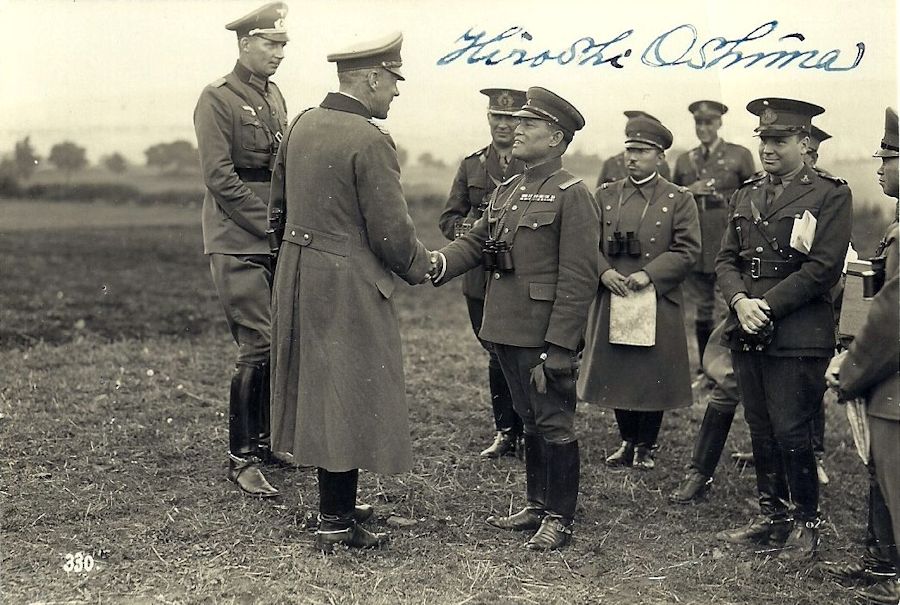
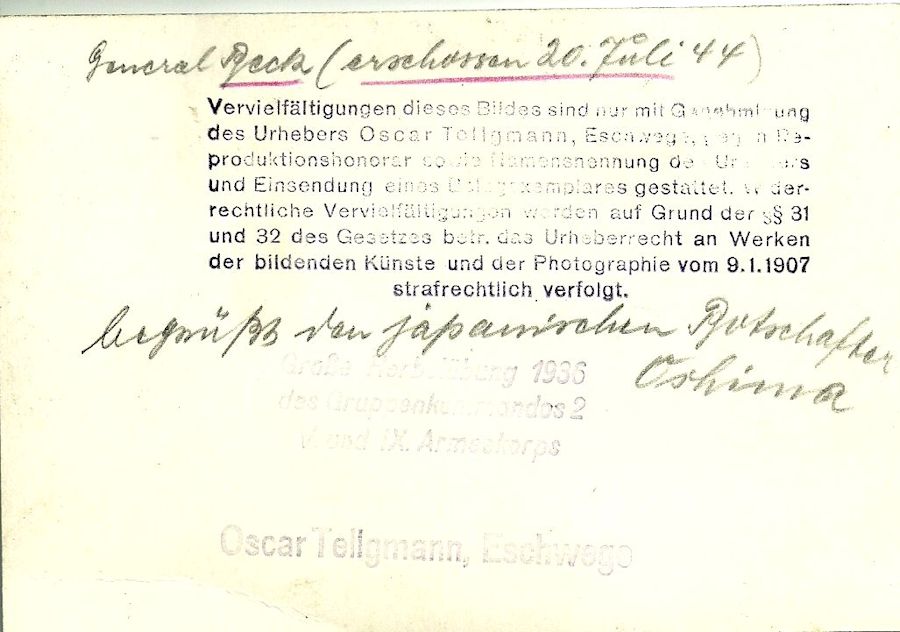
DESCRIPTION: Here is a very nice photo on cardstock of General Hiroshi Oshima. In the entries seen above you can see much more information on the man about whom it was said was “more Nazi than the Nazis.” He signed this card in full across the top. The scene portrays his greeting German General Ludwig Beck during field exercises in 1936. I personally liked this man (Oshima) and the proud, heroic traditions of the ancient Samurai were in his entire persona. A man’s Man!!! Unfortunately, General Ludwig Beck, seen in the photograph, was implicated in the July 20, 1944, assassination plot to murder Adolf Hitler and was summarily executed after a failed attempt at committing suicide. The plot was foiled by a young German officer named Otto-Ernst Remer of the Grossdeutschland Division. There is a stamp of the photo studio on the back as are some notes penciled in in German about Oshima and Beck (“erschossen 20. Juli ‘44”-“shot dead 20 July ’44”). Photo measures 5 x 3 ¾ inches. PRICE: $375.00 |
 |
 |
 |
 |
 |
 Release button |
 |
 |
 |
 |
 |
 |
 Dirks in book |
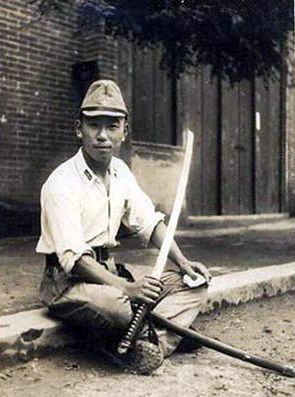
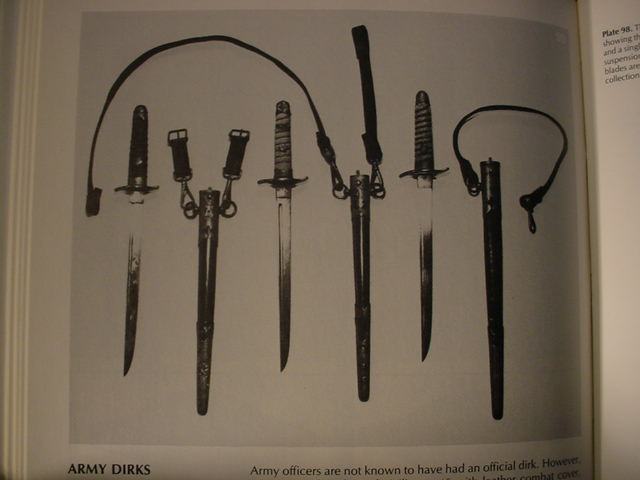 Picture from sword book |
| Japanese 1883 Pattern Naval Dirk (Item JAP 3-10) |
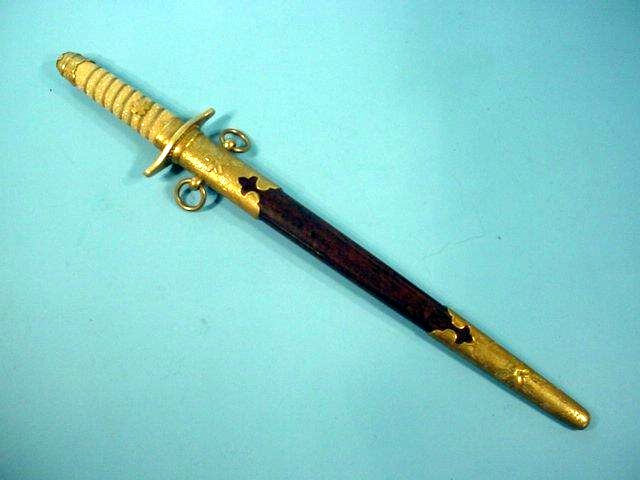
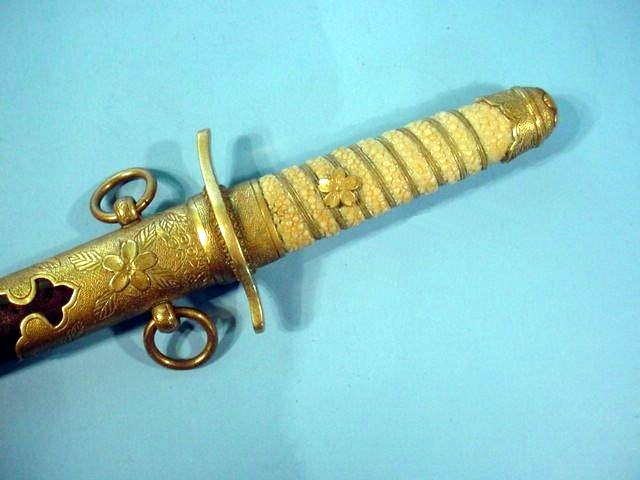
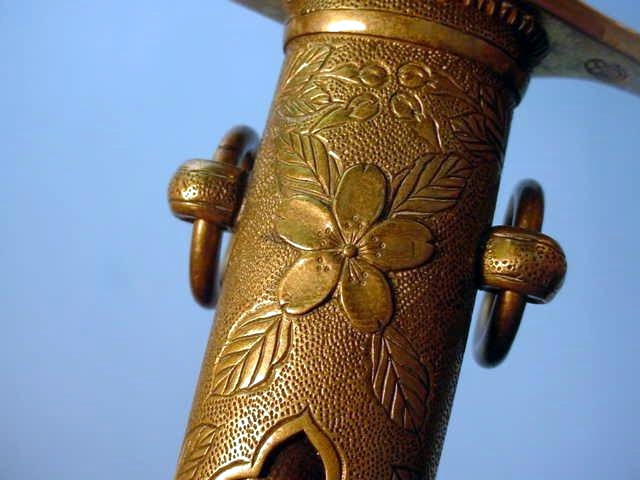
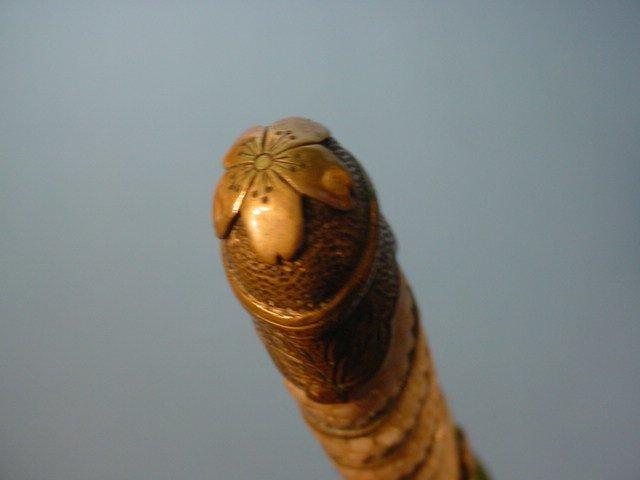
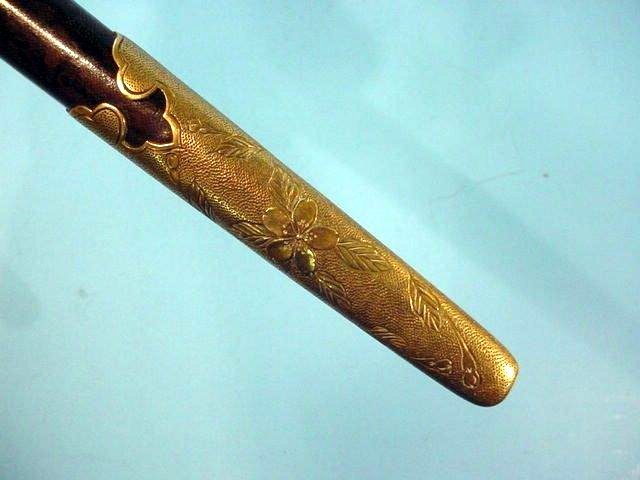
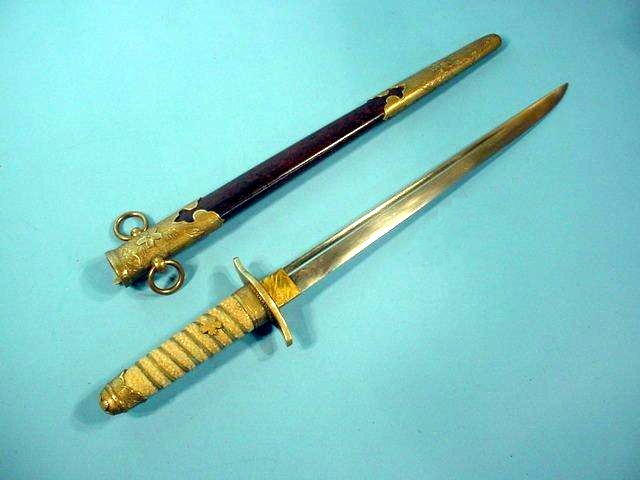
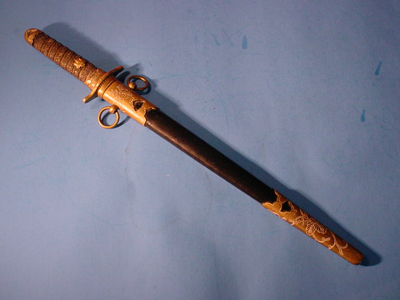
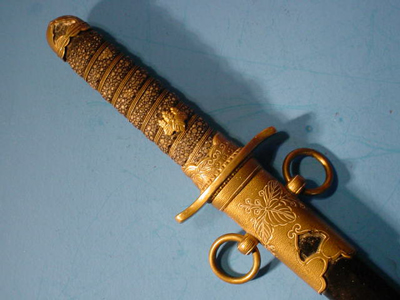
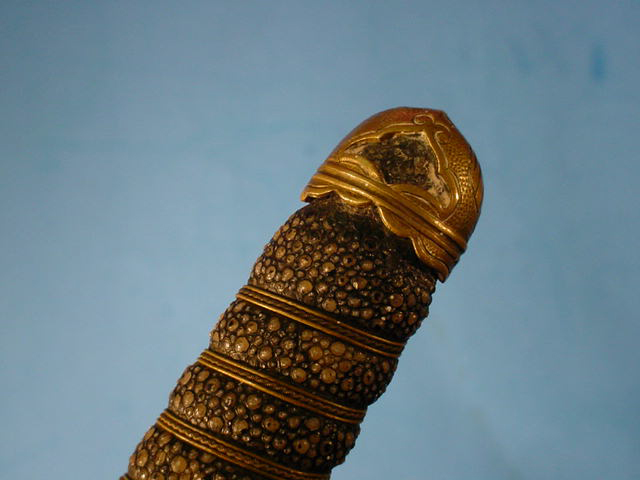
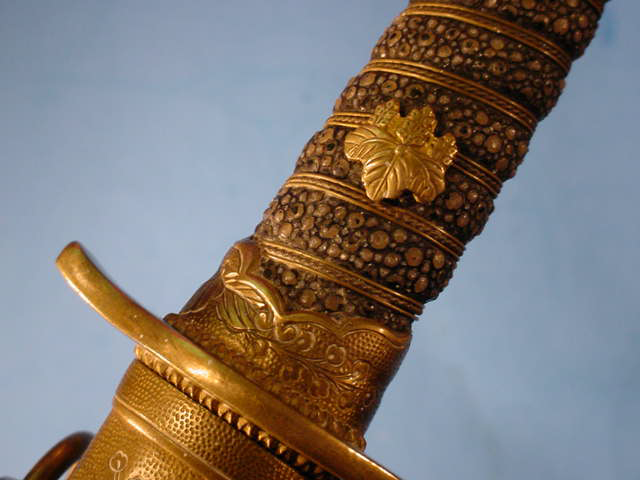
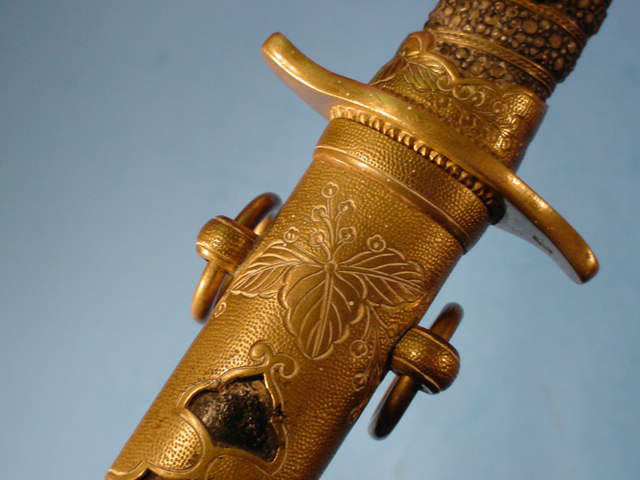
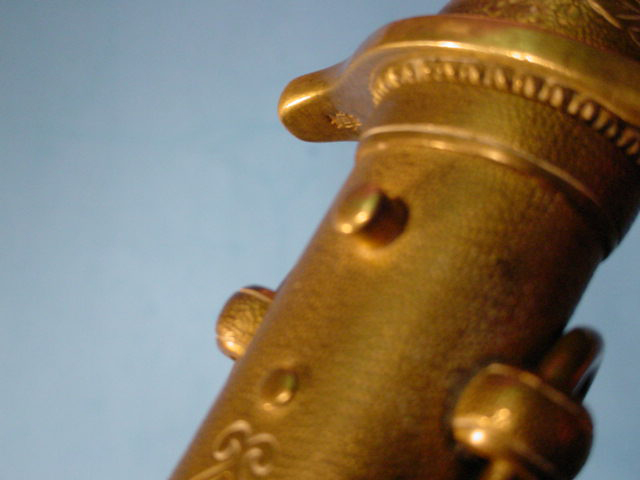
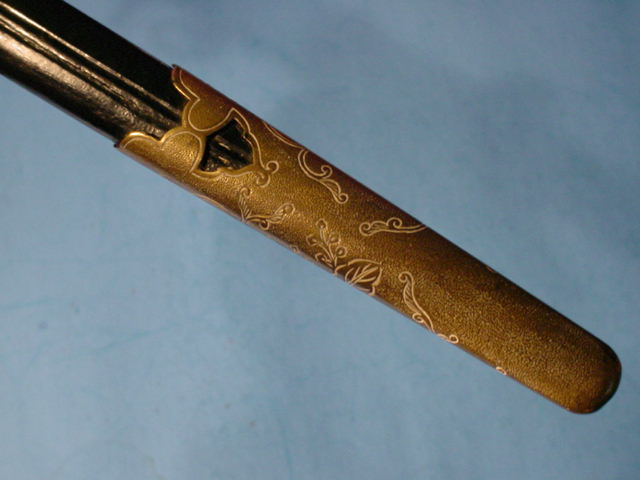
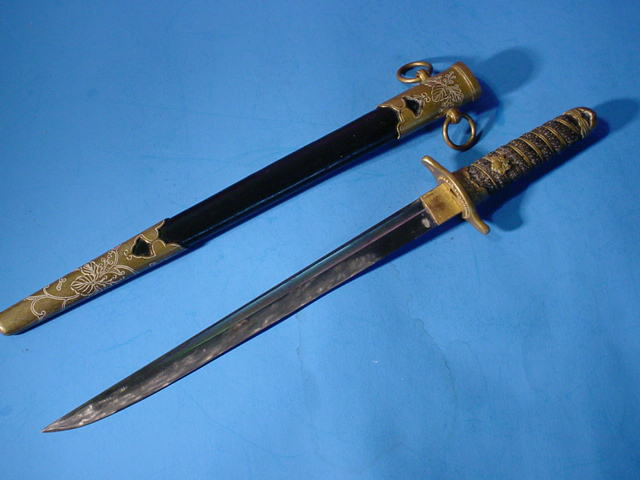
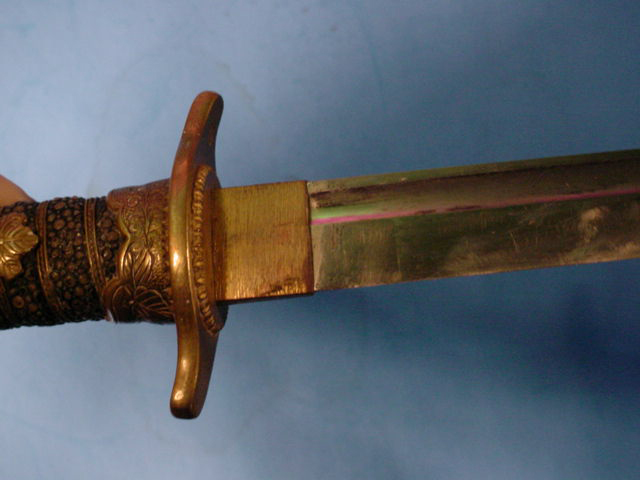
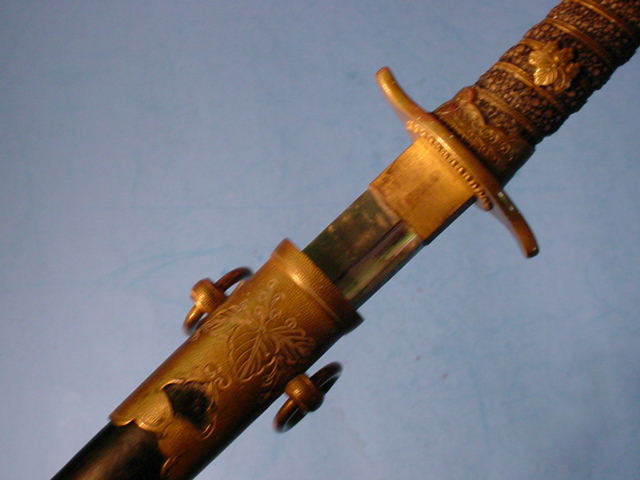
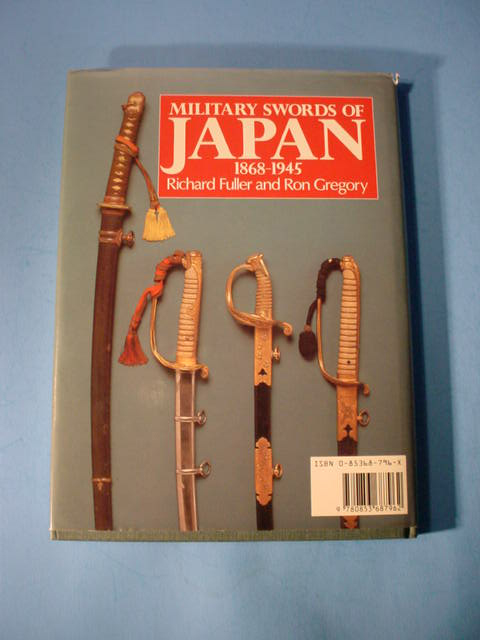
DESCRIPTION: In the best study of Japanese weapons of 1868-1945 Richard Fuller and Ron Gregory call this 1883 pattern naval dirk of this type quite rare. The dirk is described on page 71 of their book Military Swords of Japan. This dagger was introduced 26 October 1883 for all senior commissioned officers. This officer’s designed piece was particularly traditional in that it resembled a tonto in its appearance. They were carried throughout the 2nd World War. Some are factory produced and some like this one have a hand forged blade. A single edged fullered blade is mounted in a tapering white same covered grip with spirally wrapped gilded wire binding. All fittings are gilt finished brass, consisting of a domed pommel, a fuchi and a short inverted cross guard. The Fuchi has a raised Sakura as has the pommel also. The scabbard is of blue-black leather with gilt-finished fittings decorated with sakora and leaves the scabbard has a release button that when depressed allows the blade to be withdrawn. The blade is of the Samurai style with deep blood fuller. There is a copper habaki that acts as a wedge in the scabbard just as in the case of the Samurai swords. Actually this dirk is much like the one pictured in the referenced book on page 72 plate 95 item (V) where it is noted that it is a post 1883 commissioned officers pattern with an unusual black same grip. Yes, this is highly unusual and quite rare! Someone has made a stupid attempt to sharpen the blade but there are no nicks and the blade could be handily restored to a gleaming brilliance with a bit of careful polishing. This dirk in its scabbard is 19 inches long. The blade is measured at 16 inches to include the part under the habaki. The condition outside (the furniture) is in perfect condition. A rare and beautiful Japanese weapon. PRICE: SOLD |
|
|
|
|
|
|
|
|
|
|
Japanese 1883-Pattern Naval Dirk (Item JAP 3-10a) |
|
DESCRIPTION: Here is another Japanese naval dirk; it’s practically the same as the one pictured above at JAP 3-10, and the description is practically the same except this one has a white grip and it has the cherry blossom in the grip’s middle section. The blade on this one is unsharpened, with one minute nick. The cherry blossom is seen in the pommel as well. The hard-leather scabbard probably covered in treated ray skin is right and sound and has a beautiful brown hue (quite spectacular). This a very fine and highly collectible piece of WW-II history. Rare to find in this beautiful condition throughout.
PRICE: SOLD |
 |
 |
 |
 |
 |
 |
 |
 |
 |
 |
 |
 |
 |
 |
 |
 |
 |
 |
 |
 |
 |
 |
 |
 |
 |
 |
 |
 |
 |
 |
 |
 |
 |
 |
 |
 |
 |
 |
 |
 |
 |
 |
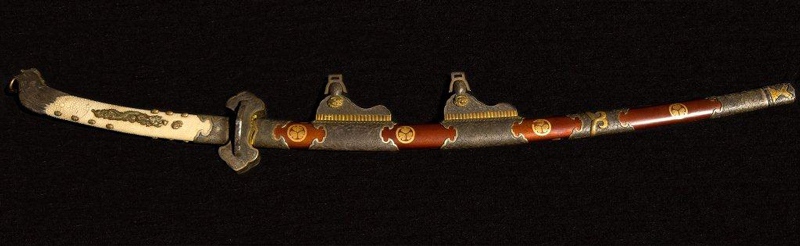
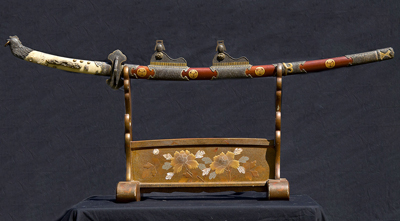
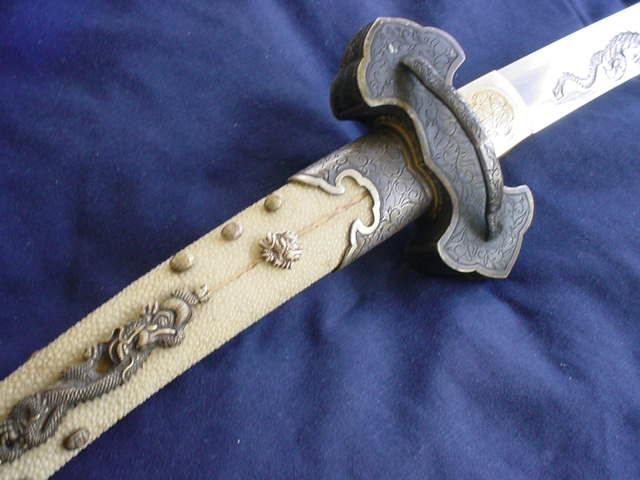
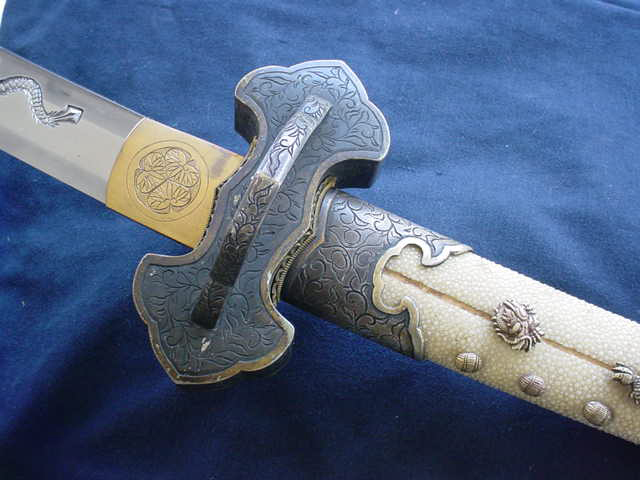
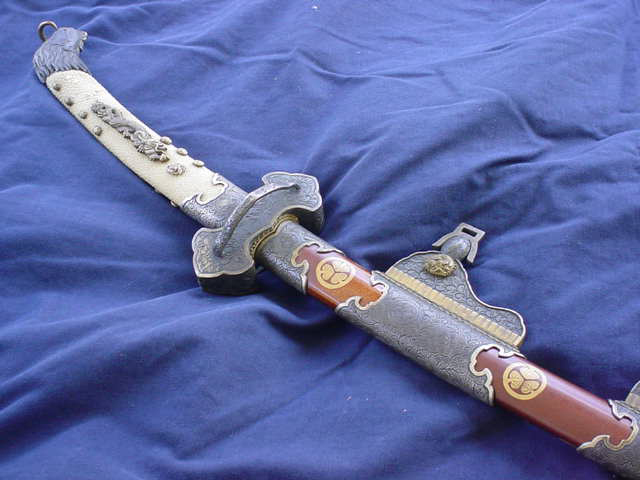
Wonderful Japanese Imperial Tachi Sword (Item JAP 3-11) |
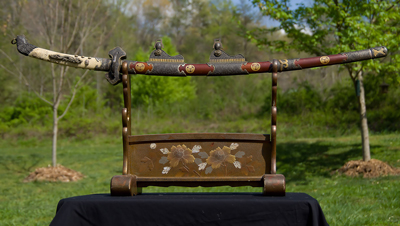
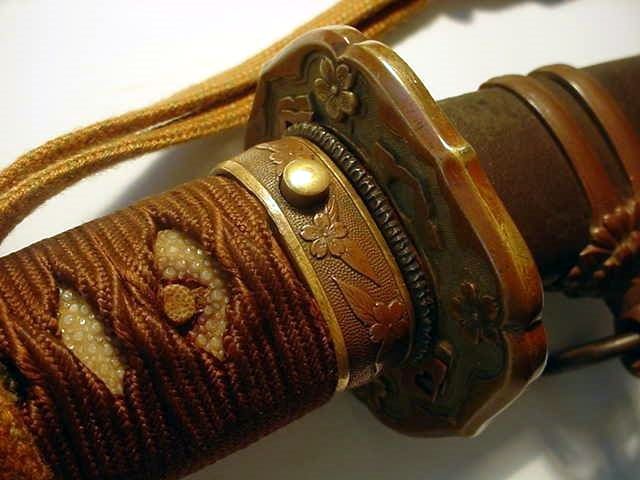
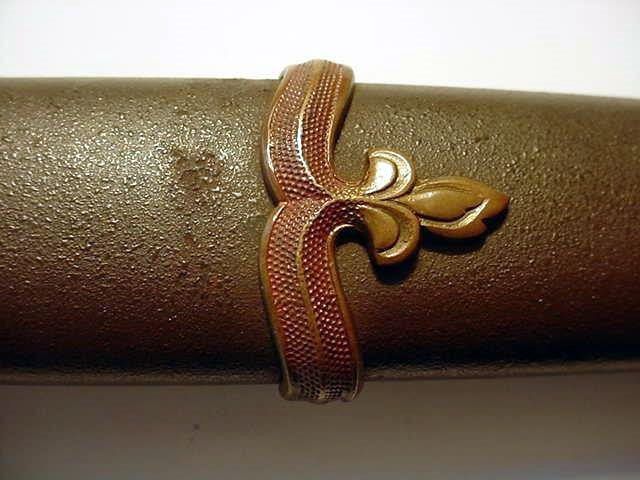
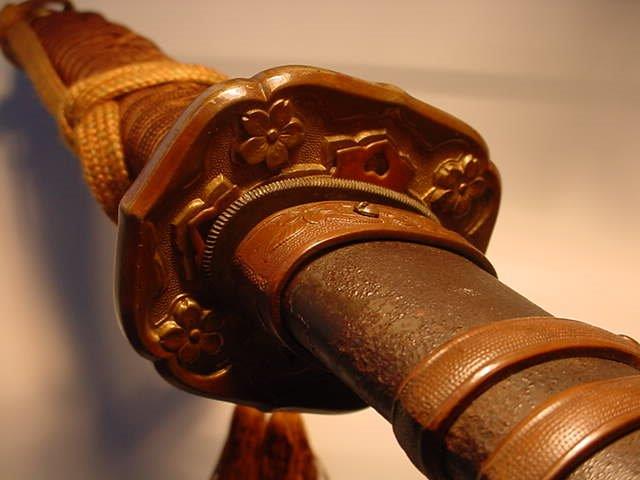
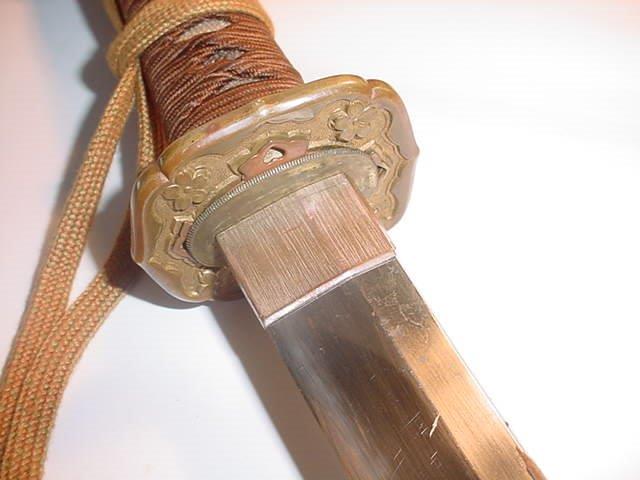
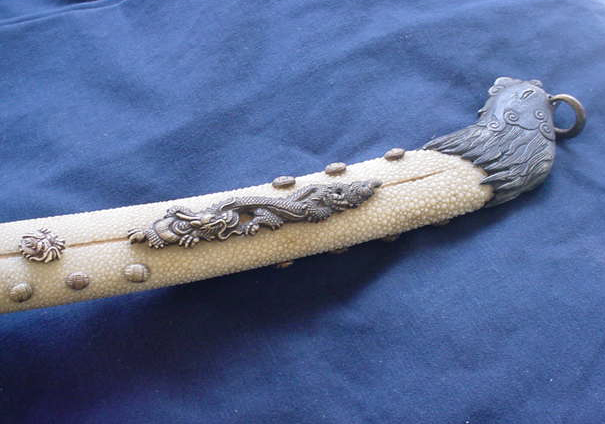
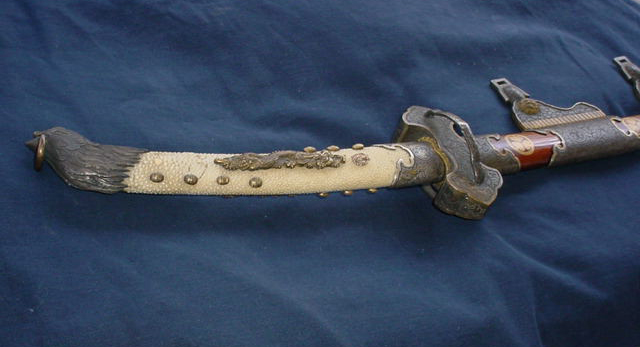
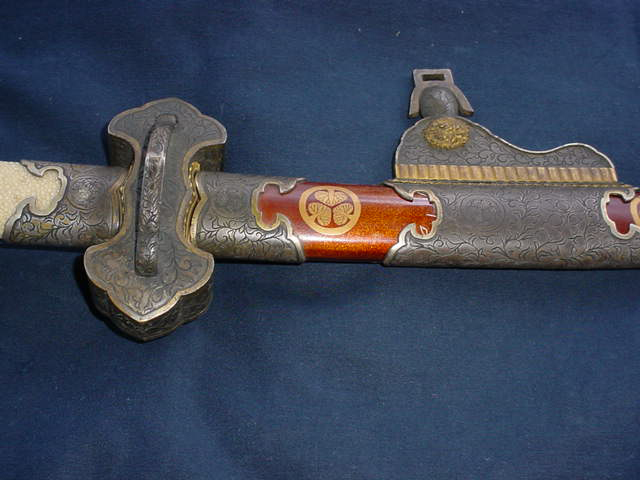
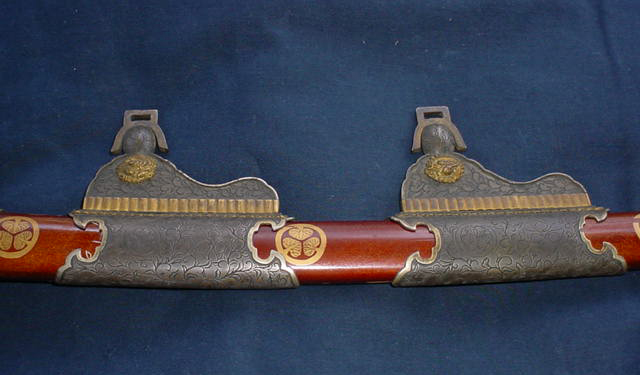
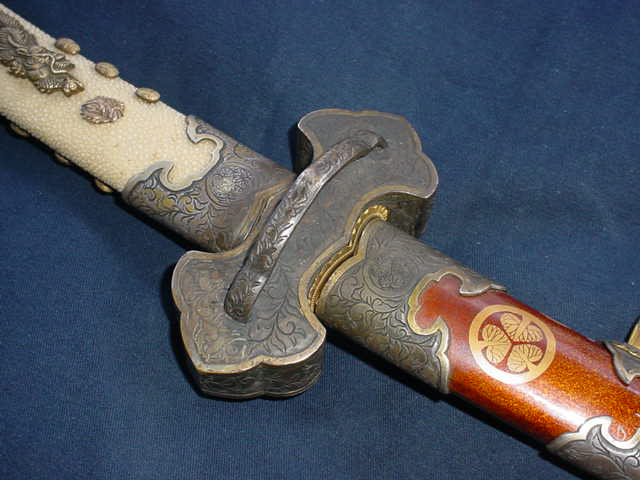
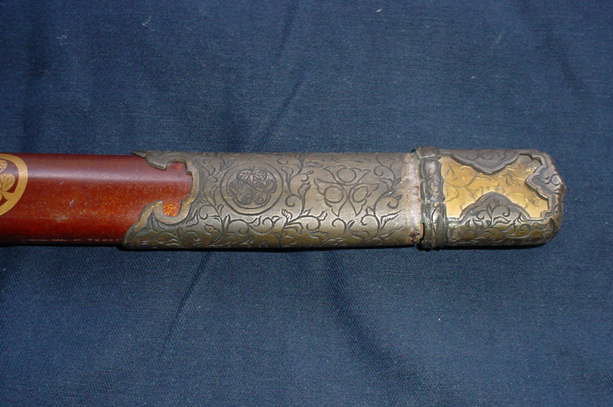
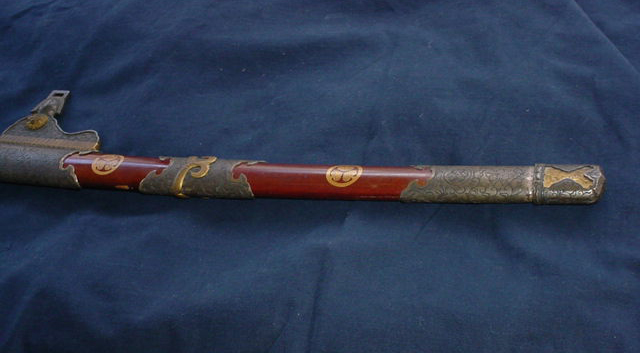
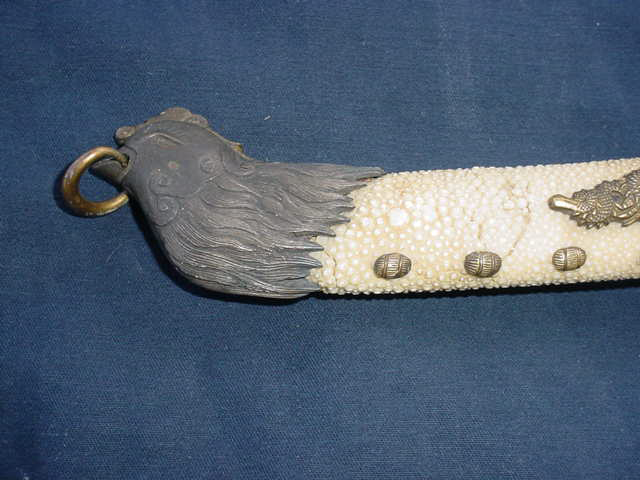
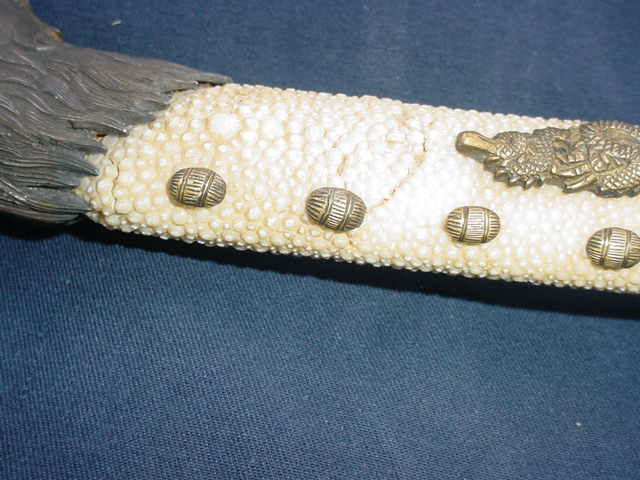
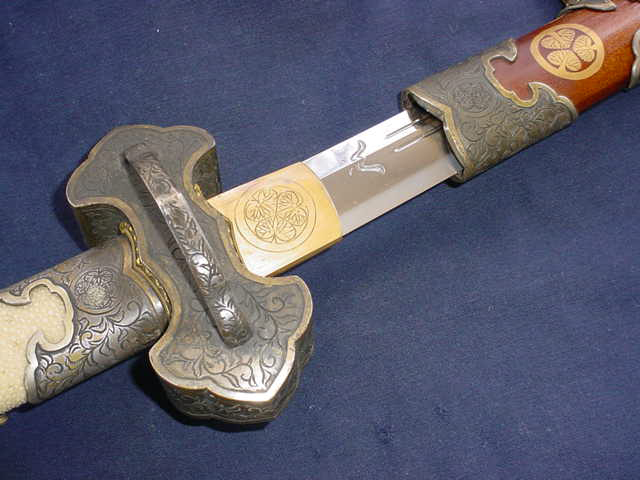
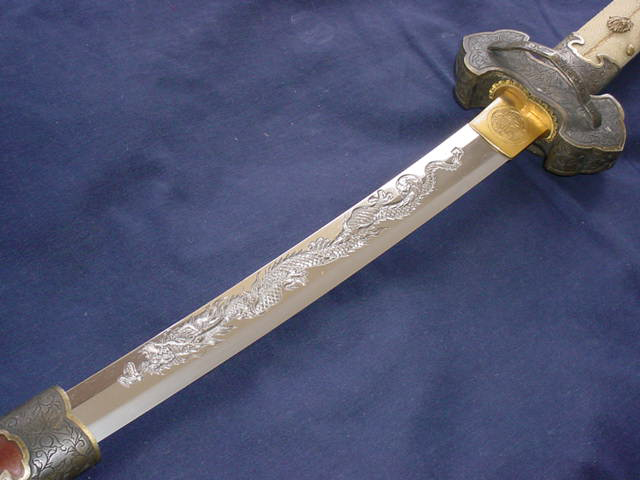
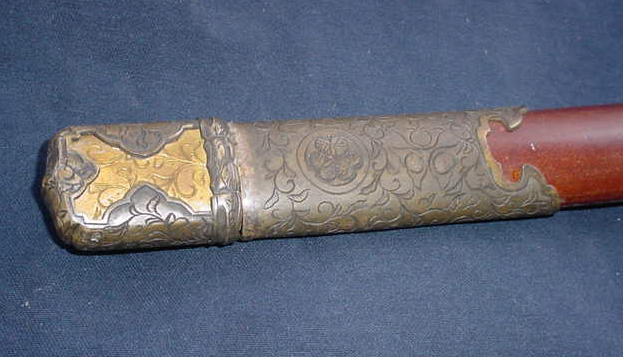
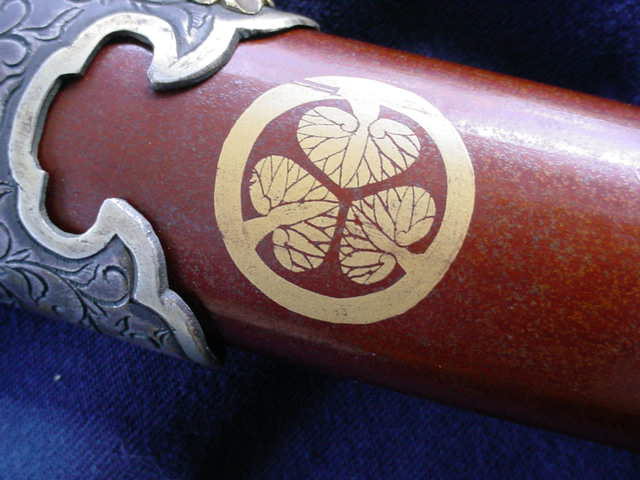
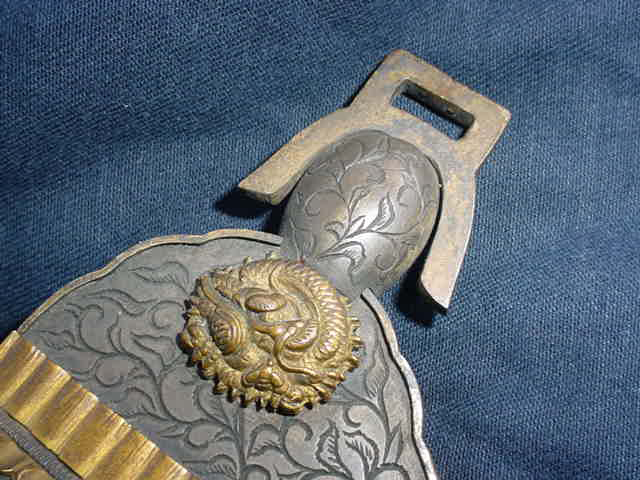
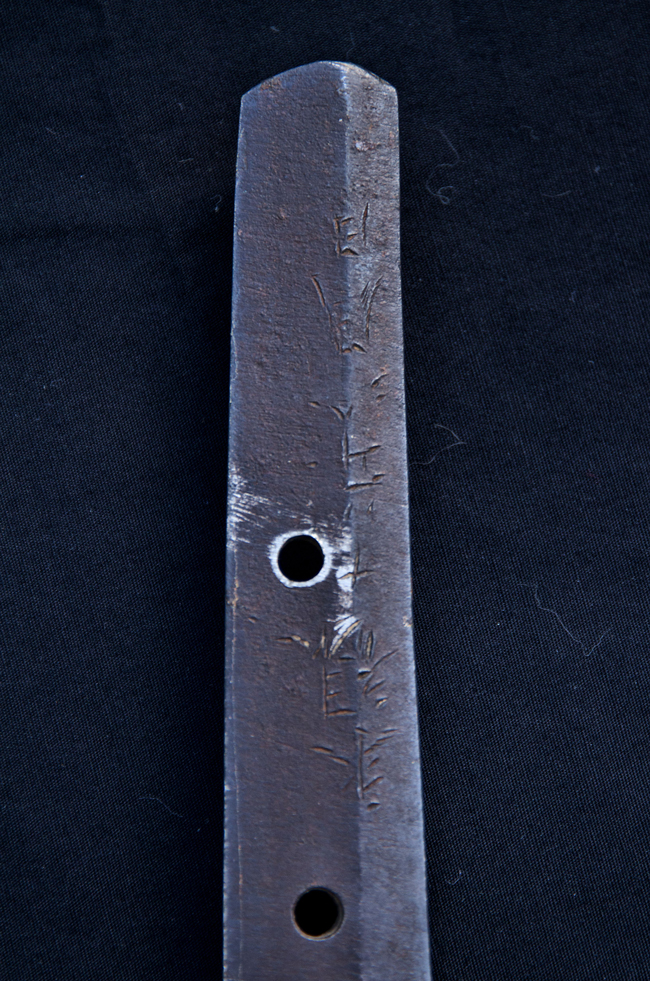
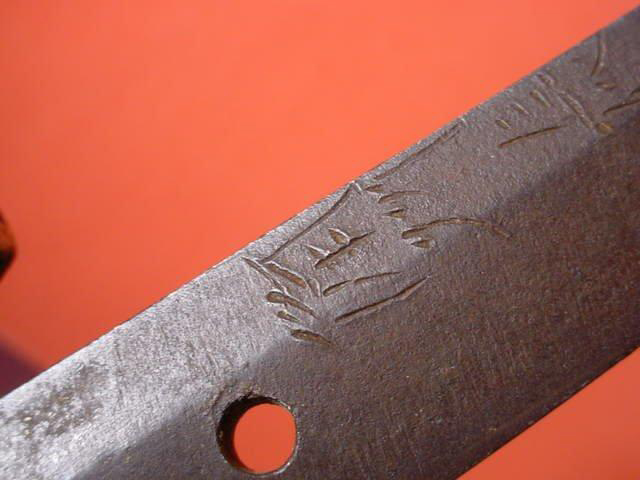
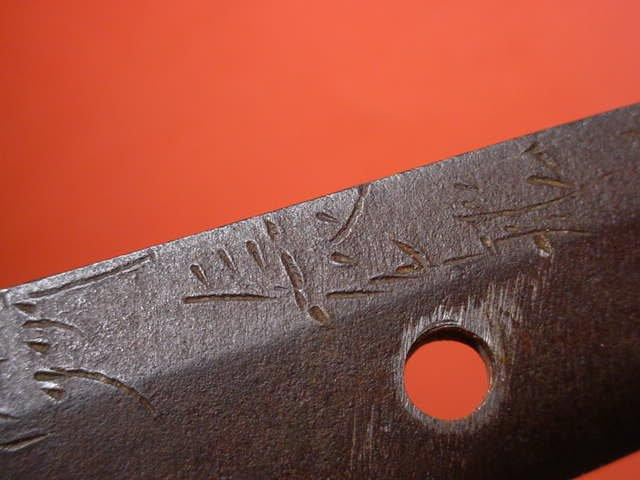
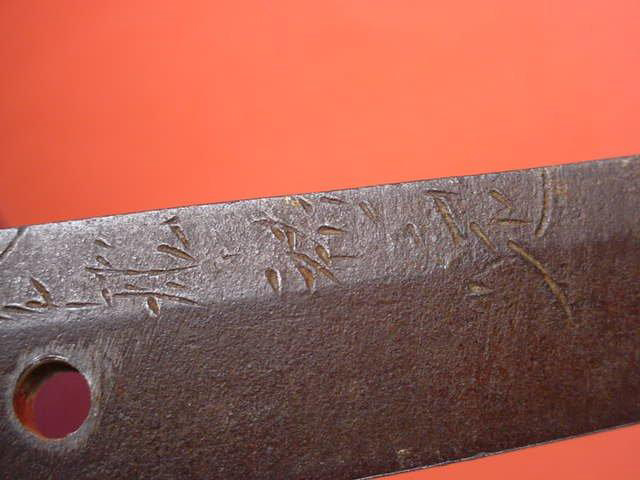
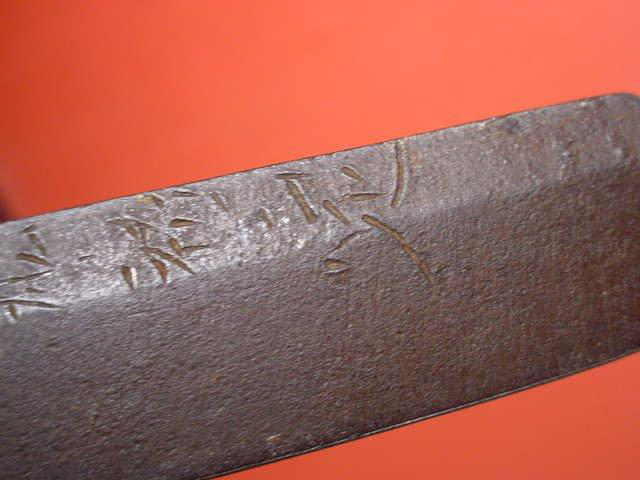
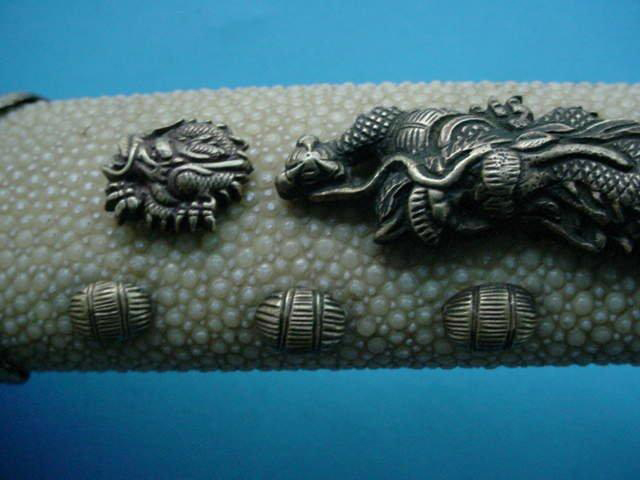
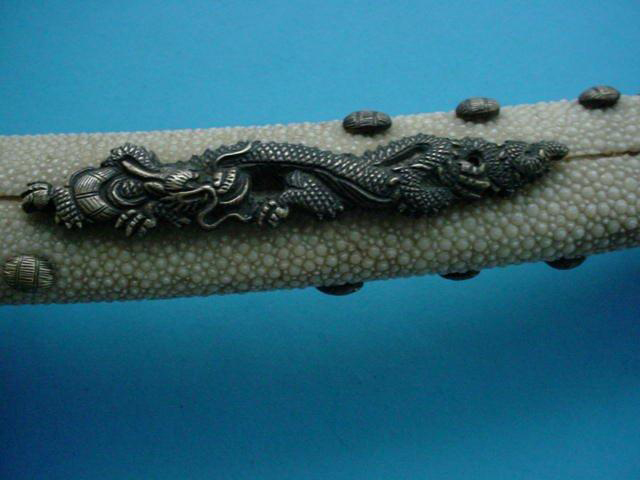
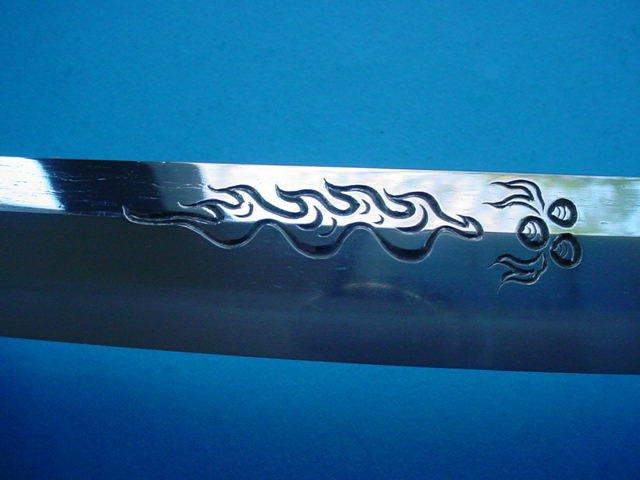
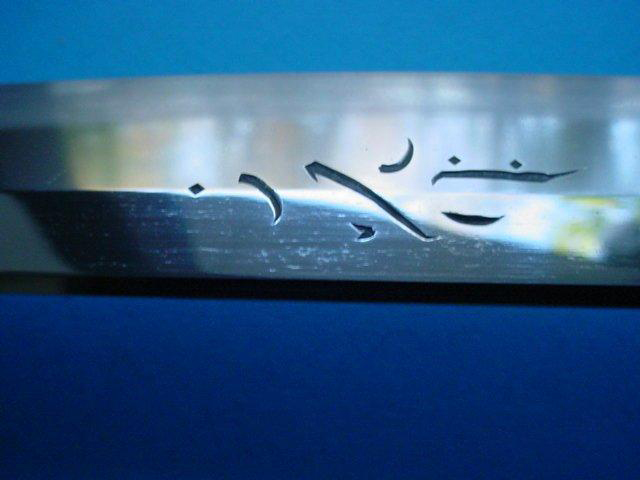
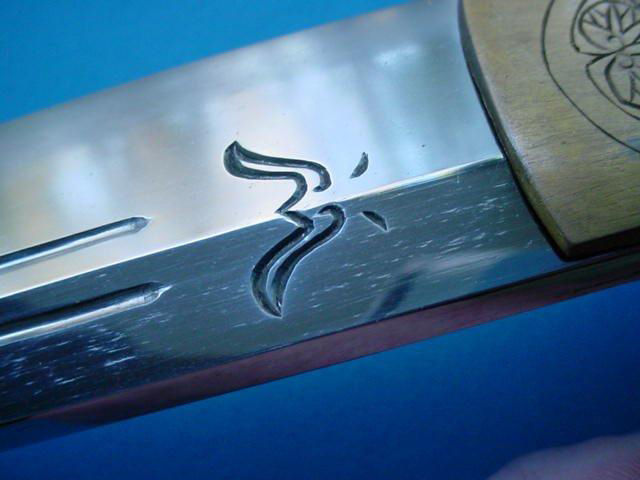
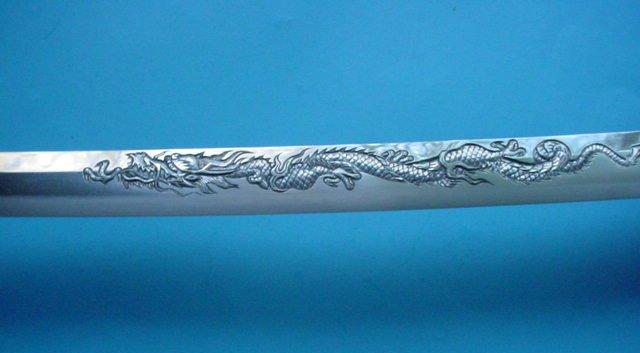
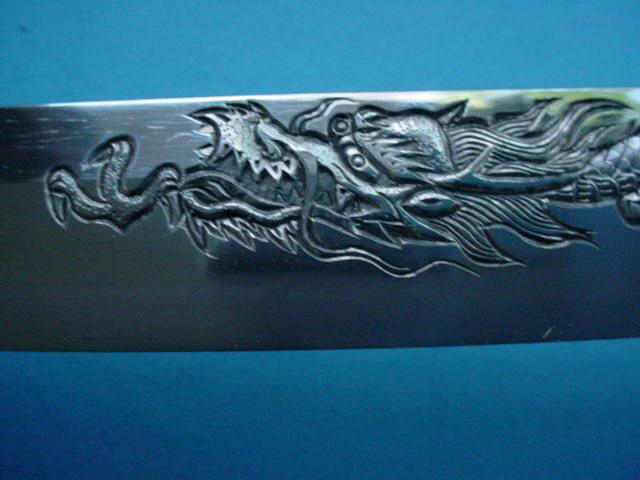
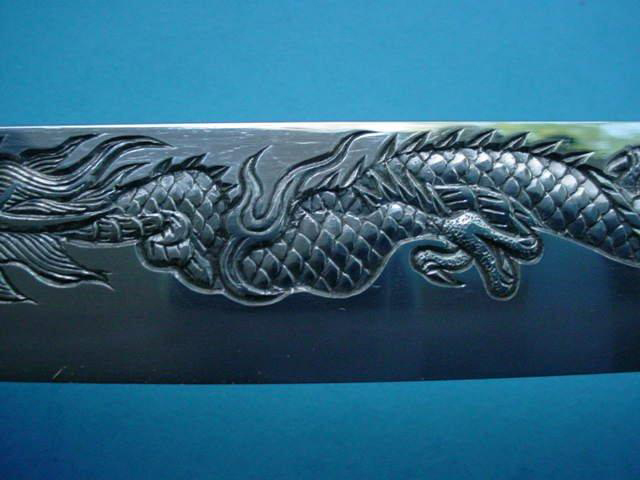
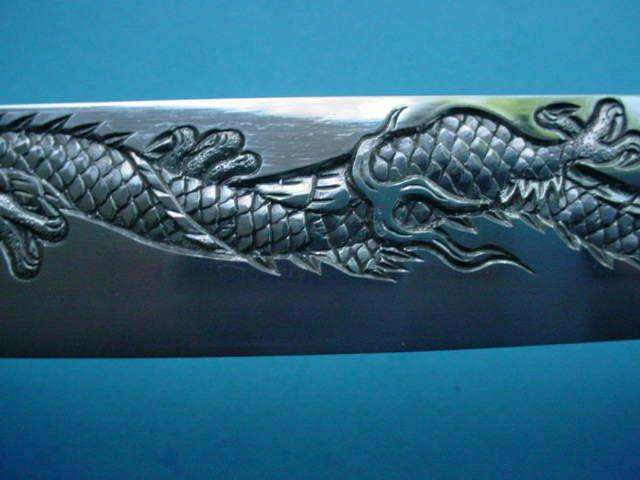
DESCRIPTION: Here is, without a doubt, the finest Imperial Tachi that we have seen in many years. It is in practically immaculate condition. A Tachi is a long sword more curved and longer than a Katana worn with the edge down as opposed to the Katana. The Saya (cabbard) is amazingly beautiful almost to the extreme. The Tsuka (grip) is surmounted with the traditional bird head -a ho-o that is akin to a Phoenix in the Buddhist beliefs of reincarnation. The grip is covered in white ray skin with several Menuki applied. These weapons were carried as court swords and as a symbol of Imperial authority. The Ashi (hangers) are quite unusual being beautifully crafted in art bronze rather than the usual leather. The Tsuba (cross guard) is a work of art in its own right employing just about the finest work ever to be encountered in this renowned art form. This Tachi could be called a Dragon Sword since the Menuki, (ornaments), the Mekugi (decorative metal peg) and the blade all feature ferocious dragons. The only non-dragon on the sword is the bird's head on the Kabuto-gane (Tachi style pommel). Even the little buttons on the Ashi are coiled up dragons. The Nagasa (blade) is bright and in mint condition practically untouched with an absolutely beautiful Hamon (temper line). On one side is a magnificent heavily engraved Horimono...a beautiful dragon. This blade can be said to be a spectacular work of art. The Nakagu (tang) of the blade is signed Mei Bishu Osafune Sukesada and dates 1550-1570 and is from the Muromachi period that was 1460-1600. There were many Sukesada group of swordsmiths working at this time and this is no doubt a wonderful example of one of the best! Possibly it could be by Yososaemonjo Sukesada who made swords of superior workmanship on special order. The sword is 42 inches overall. The blade is 28 ¼ inches including the portion at the mune-machi (back notch). The scabbard is 30 inches long. The grip with guard or Tsuba is 13 inches long. The Tsuba is 5 inches across. There are Buddhist symbols on the blade. This sword is fit for an Emperor or at least his court staff for certain. With the sword is the stand fitted for a Daisho; whatever happened to the wakasashi we will never know! This Kake (rack) is a bit of a treasure on its own with traditional Japanese paulownia motif. One would not easily find a Tachi that is this fine and important.
PRICE: Withdrawn and sold by consigner |
|
|
|
|
|
|
|
|
|
|
|
|
|
|
|
|
WW II Japanese Trench Periscope (Item JAP 3-12) |
|
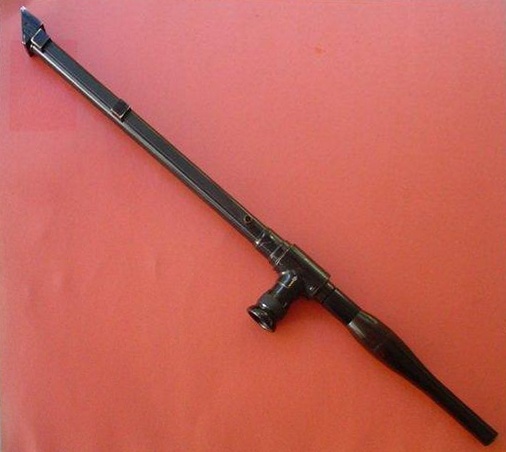
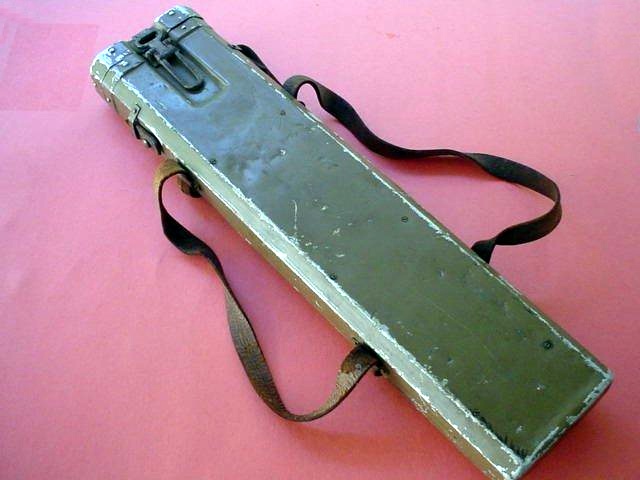
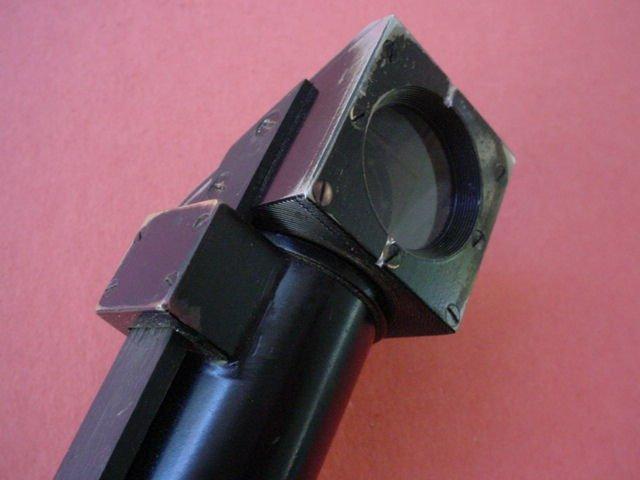
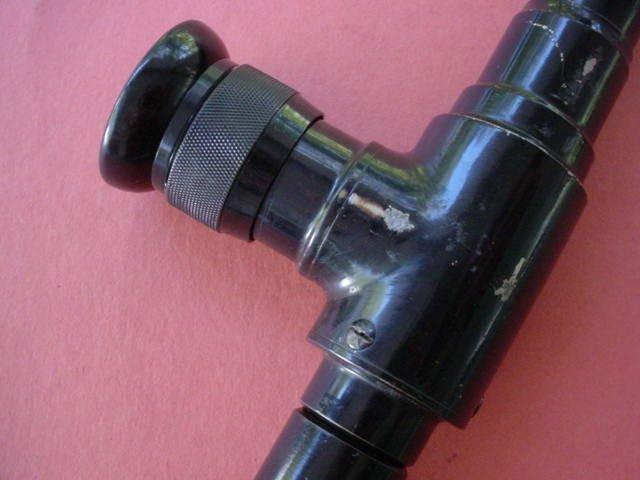
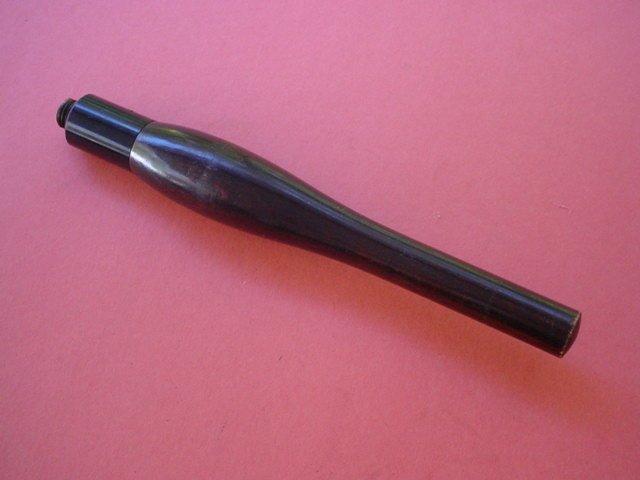
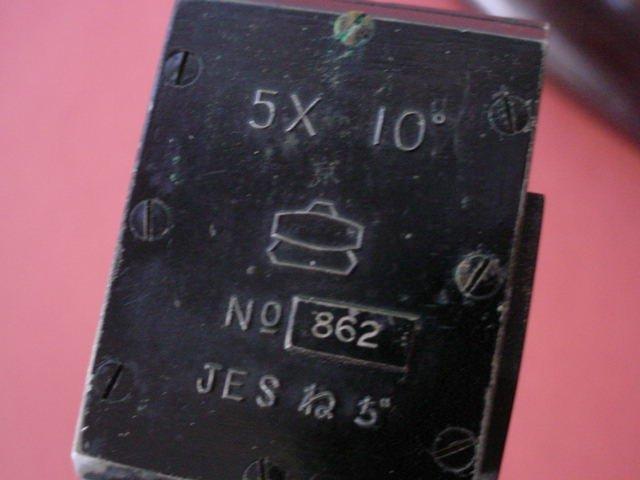
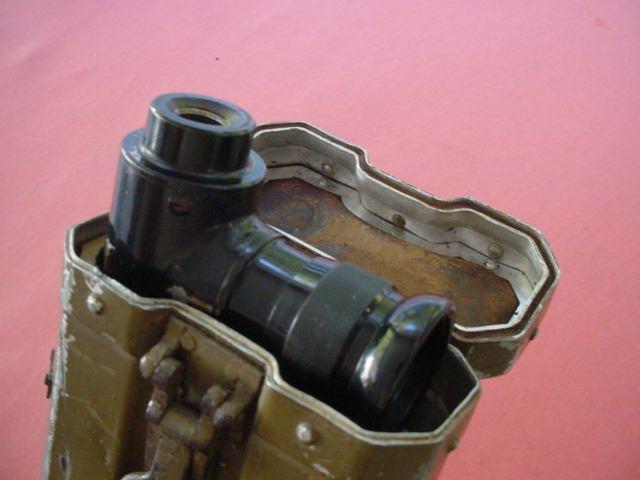
DESCRIPTION: Here is a really neat WW II Japanese war relic, a trench periscope with carrying case. This was for the purpose of not only seeing over the edge of a foxhole, but could be used in urban-warfare situations where a head sticking around a corner could be ultradisastrous We believe it was produced by the Asahi Optical Company probably about 1937. The item is packed neatly into a steel olive-green-colored case and that in itself is a surefire indication of its military purpose. On the end cap, where the cap is, there is a plaque that gives mirror-observation scale. Unit of measurement, type, year, etc. and the assigned serial no. That is 862. Unfortunately, I am unable to translate Japanese, but I found out that much through research. When opened the case exposes a great custom-made wooden interior that is entirely hand finished. The lid is leather padded to ensure that the scope is securely held in place when packed inside. A periscope is a device for conducting observations from a concealed or protected position. As we have indicated the advantage of this model over the larger rabbit ear trench binoculars is that this one can be used to look around corners. The eye piece is adjustable from +5 to -5 and is the only way to focus the image. When looking through it a scale similar to a sniper rifle can be seen. This scale which consists of vertical lines has a zero mark in the middle and stretches out to a value of 50 on both ends. This scale is probably used to determine the size of the subjects being observed. The pipe including the triangular-shaped item, which is in fact the upper mirror in a metal casing, is 44 cm long. There is a wooden handle that screws into the device enabling better positioning of the scope. On the back of the mirror prism there is a stamping that shows the numbers 5x10 that indicates that the periscope has a 5x magnification factor with a field of 10 degrees at 1000 yards. Below this is the company logo and the serial number that matches the serial number on the case.
The scope is in practically pristine condition with some minor scratches. The equipment and optics are perfect. The case shows wear, but is sound. However, the straps are separated through wear by the soldiers of Nippon in their war for the emperor and Bushido!
Here is a very scarce relic in great condition.
PRICE: SOLD |
|
|
|
|
|
|
|
|
|
|
|
|
|
|
|
|
|
Samurai Sword (Item JAP 3-13) |
|
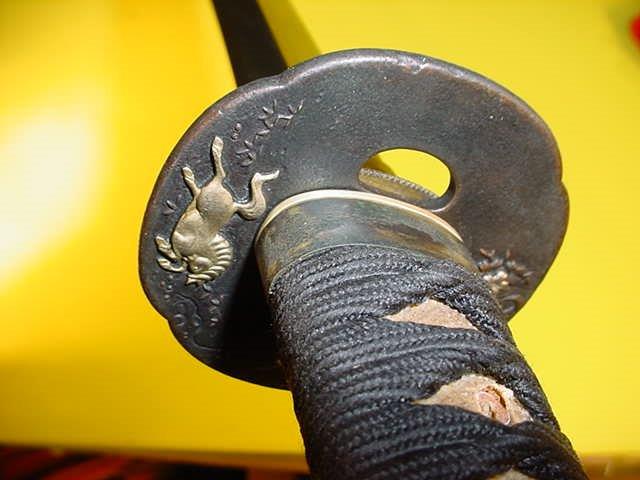
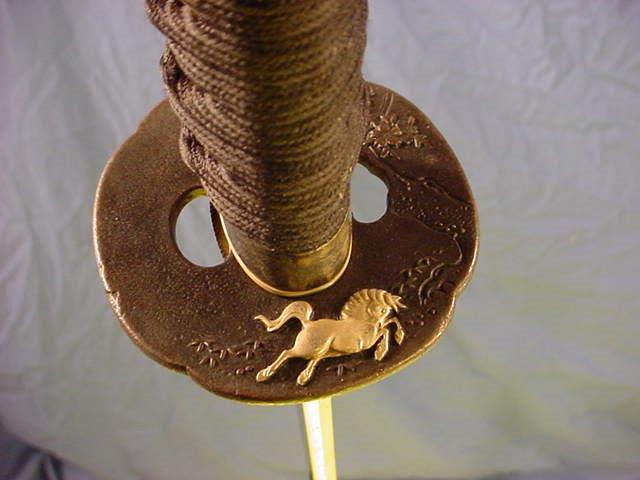
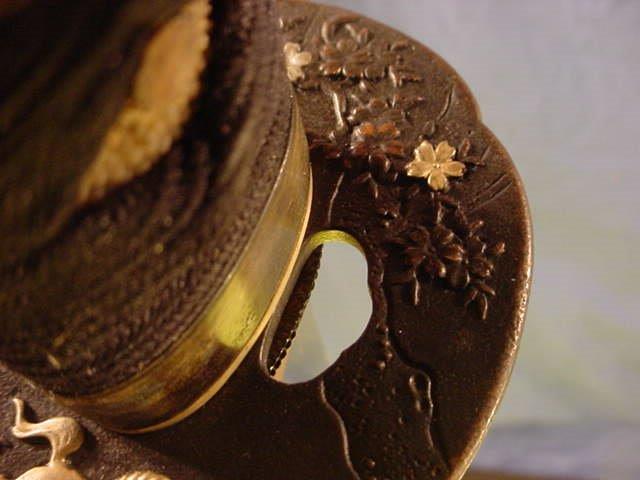
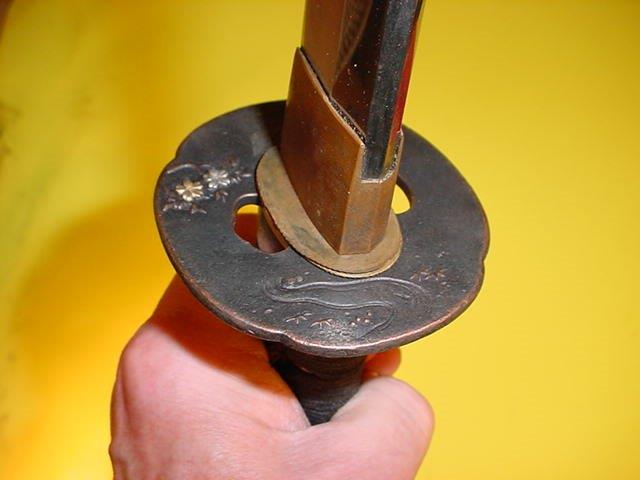
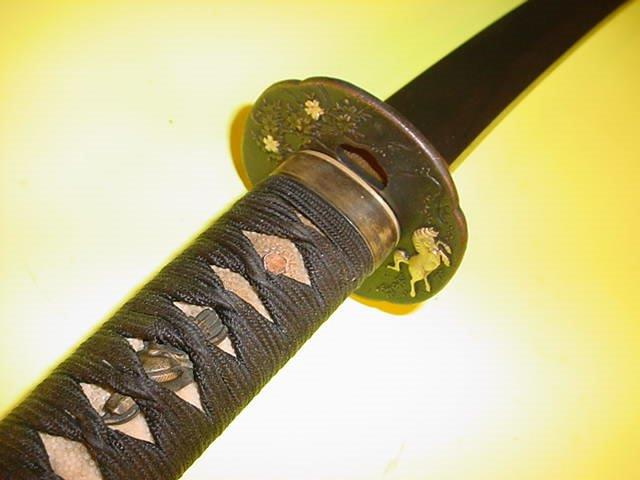
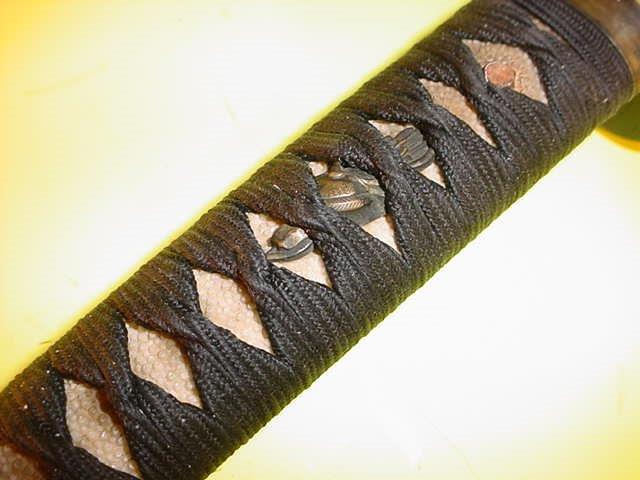
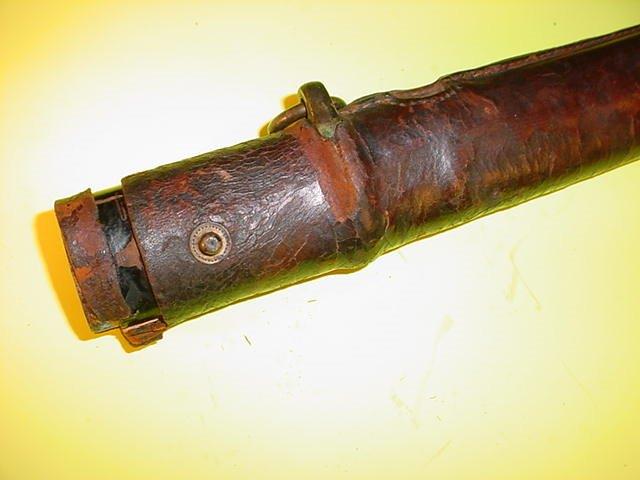
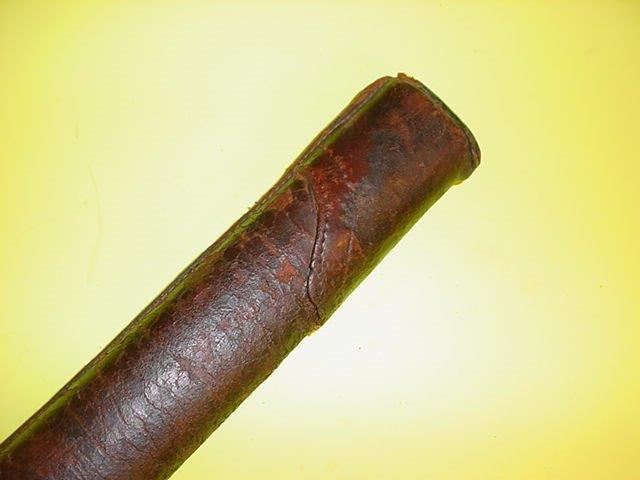
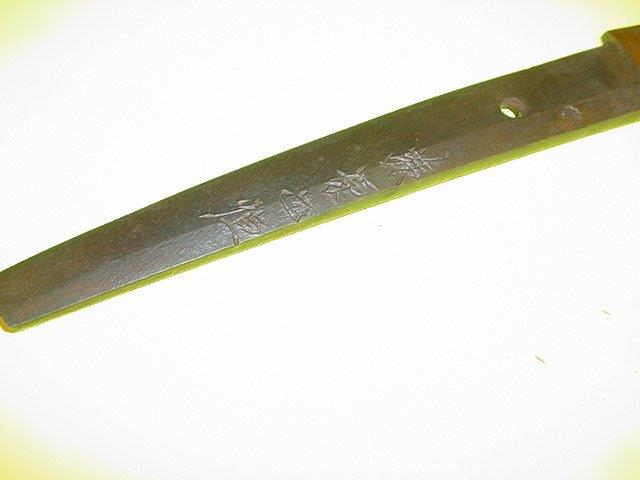
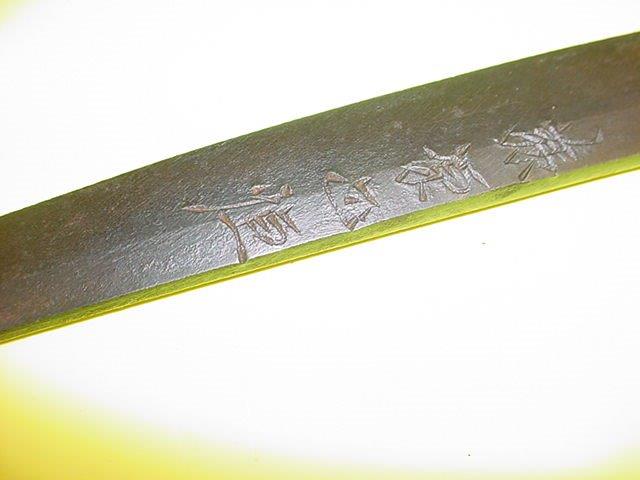
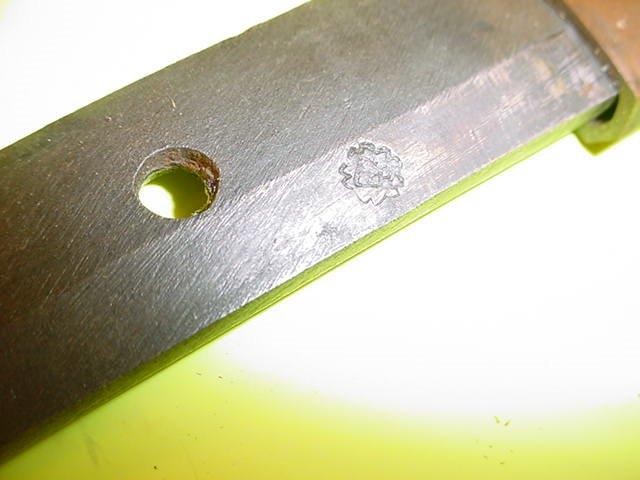
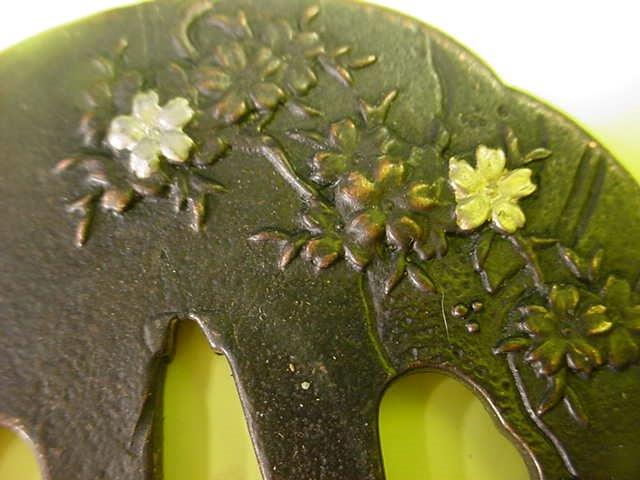
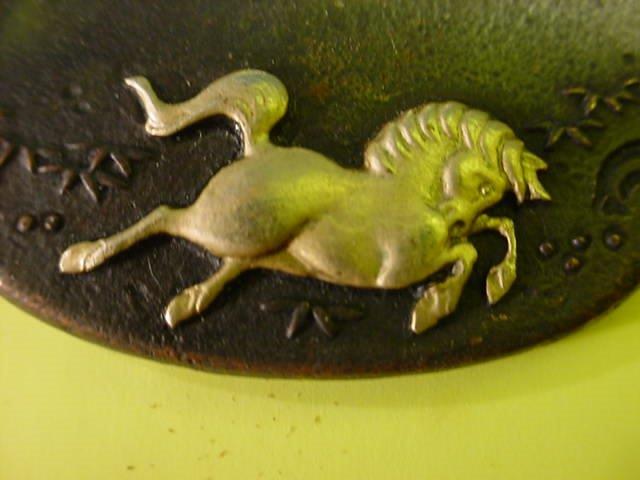
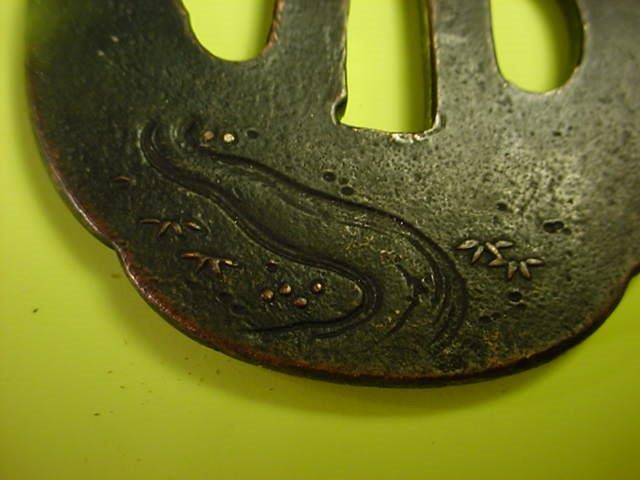
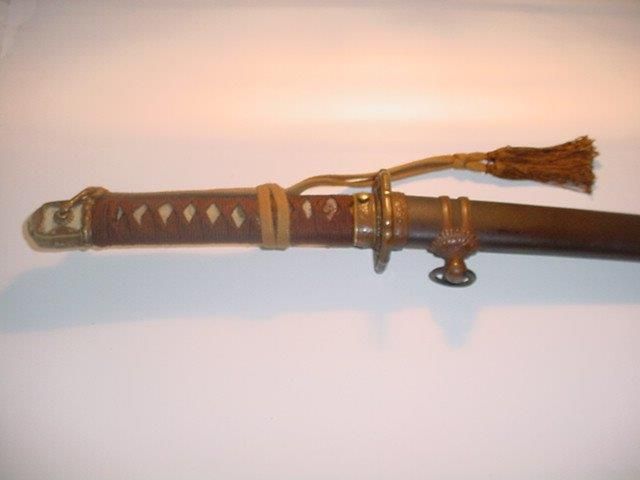
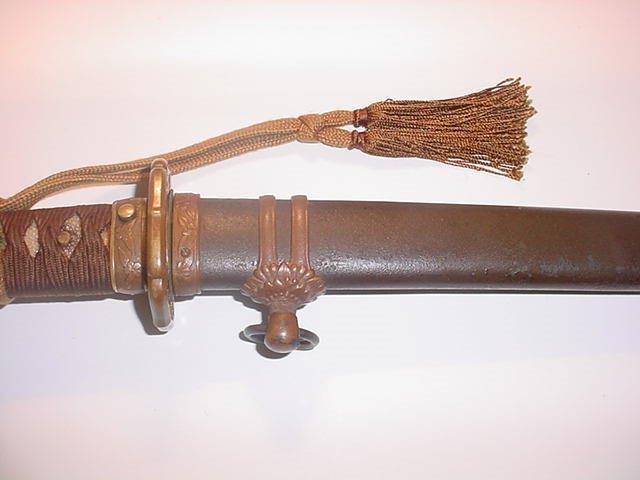
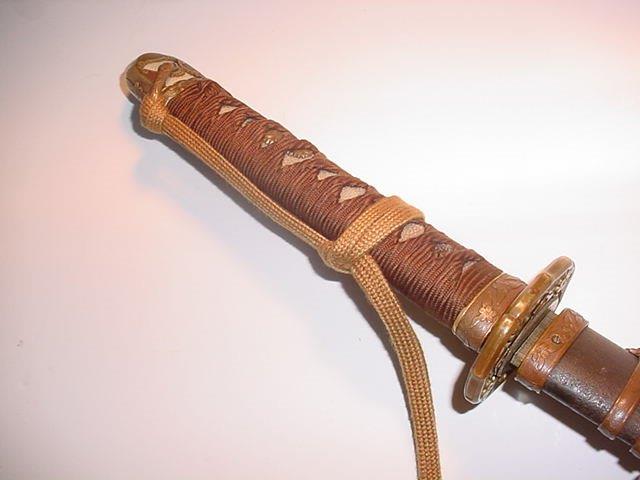
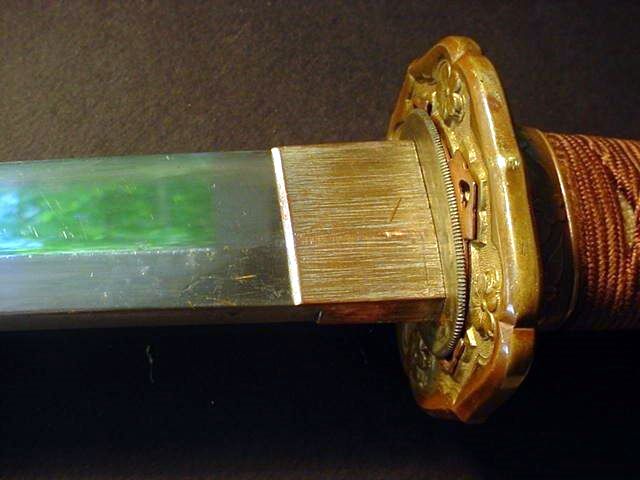
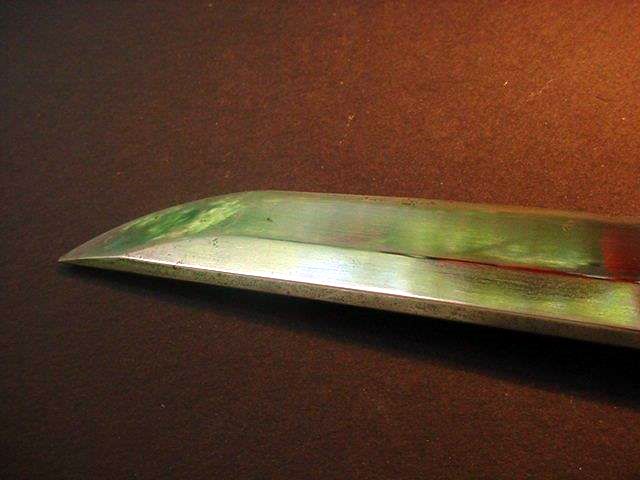
DESCRIPTION: Here is a very nice traditional sword of the Samurai style even if for a late sword: WWII. Description: 37 ½ inches overall with a 26 ¼-inch blade showing a well-defined Hamon (patterned blade) set into a copper Habaki* (spacer) iron Tsuba (sword guard) with wild-horse theme and chrysanthemums. This flower gave its name to the Japanese chrysanthemum throne and it was the imperial seal of Japan. It has a black, cord-wrapped Tuska* (grip or handle) with bird-shaped copper Menuki (figurative décor under the wrapping) The tang is stamped with a Showa-era* stamp on the left side above a four-symbol, untranslated signature. It includes a brown leather covered Saya (scabbard). Condition is good. Some light spotting and dings are present on the blade along with a few edge chips and scratches concentrated on the left side. An attractive Hamon the Tuska and fittings are good and the gaya is fair but battle worn. This one was sold to the collector/consigner by a marine who captured it on Guam in WWII. Despite its little bit of rough-and-tumble nicks and minor scars it is a typical Japanese sword that was used by the Japanese soldier prior to his capture. A nice used example, we suspect that the tsuba is a family heirloom going back into another era and it is quite exceptional.
PRICE: $1,450.00 *The Showa Era is from1925 to 1989; it ended with the death of Emperor Hirohito. This was the era during which Japan turned to militant nationalism even though it was termed “The Period of Enlightened Peace and Harmony.” The sword was probably crafted in the 1930s. |
|
|
|
|
|
|
|
|
|
|
|
|
|
|
|
|
|
|
Fine and Elegant Set of Men-Gu and Kabuto (Armor Helmet and Face Mask) (Item JAP 3-14) |
|
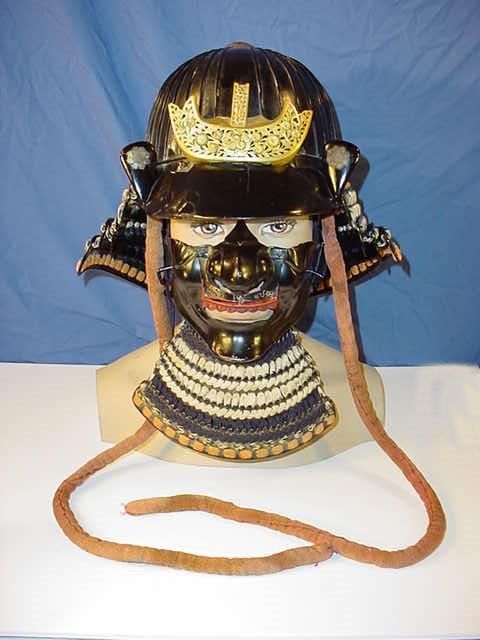
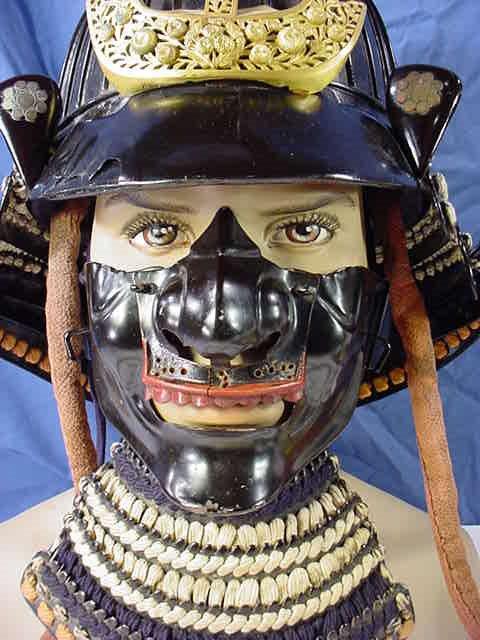
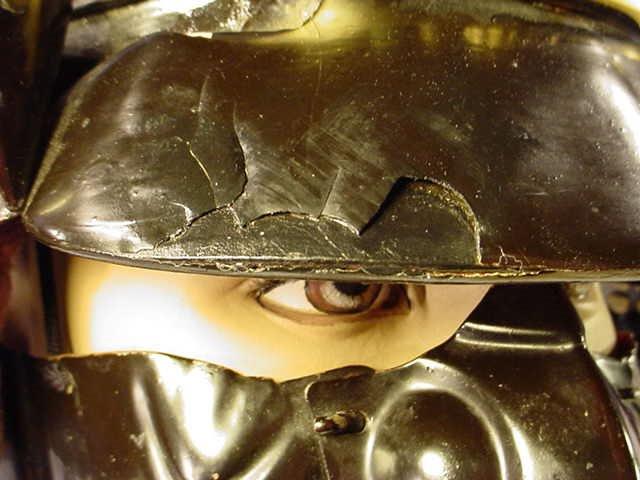
DESCRIPTION: This is the best set we have ever been so proud to present and very reasonably priced. The Japanese facial armor shown here as a mask is known as men-gu or (men) and the actual helmet is known as kabuto. The helmet had a family or empire crest called maedate that in this case is missing. This was a vertical upright item that would spring from the brim of the kabuto. This piece is in brass and was a designed addition (see our images of a typical kabuto); sometimes they are in the shape of horns or crescents. The designs are absolutely legion! These designs changed over the centuries of warfare. The word “samurai” became almost synonymous with “bushido.” They were the military nobility of medieval and early modern Japan. Of this particular set we are fairly sure is from the Edo period or Tokugawa period. The Edo period spans 1603 to 1868 and we believe this set is from the 1820s, or possibly earlier. The kabuto is in very fine condition except for the missing mon (an identifying emblem) and it has some old museum repair on the brim at the left side as you view the images. The shikoro or neck guard is intact and perfect. The bib or guruwa is a throat protector and is also in good shape. The faceplate or mask (known as menpo) is all there and in great shape. The kabuto top has the traditional crest with a hole that is decorated all around. The forward plate that would hold the crest is highly decorative and rather special. The entire kabuto and men-go are exceptional! I believe an investment in this set would be wise as the authentic ones are almost impossible to find today. We are interested in buying a kabuto magdate to complete this ensemble.
PRICE: $3,800.00 for the pair as it stands |
|
|
|
|
|
|
|
|
|
|
|
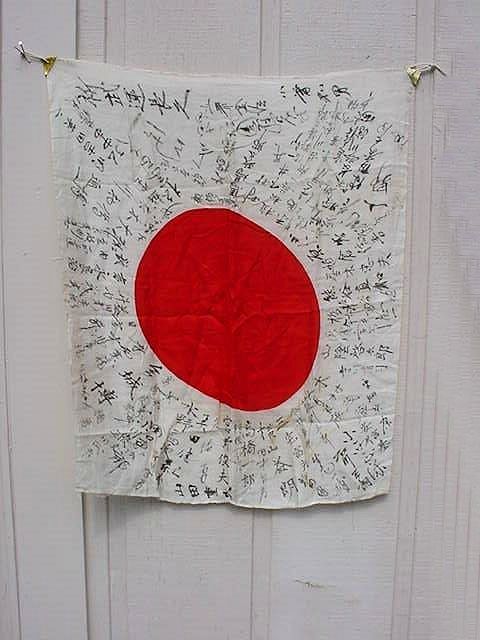
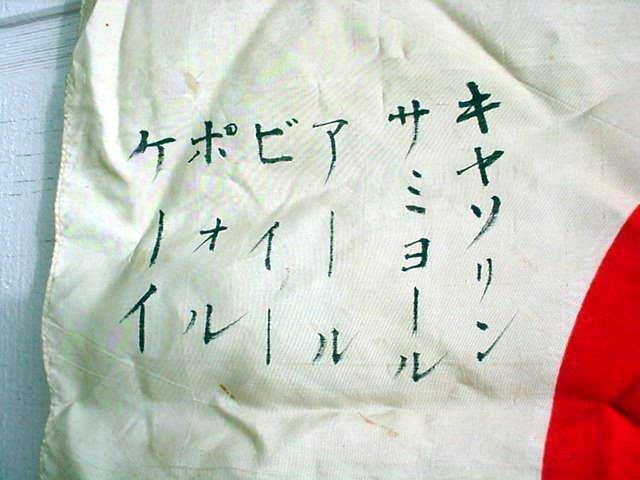
Japanese Soldier’s Good Luck Flag (Item JAP 3-15) |
|
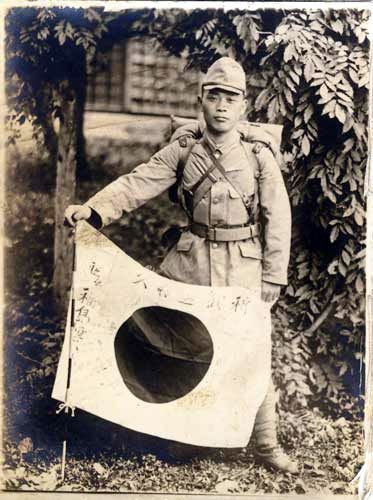
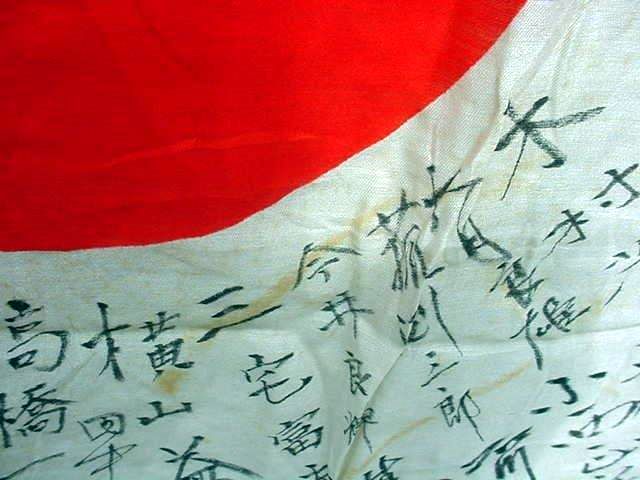
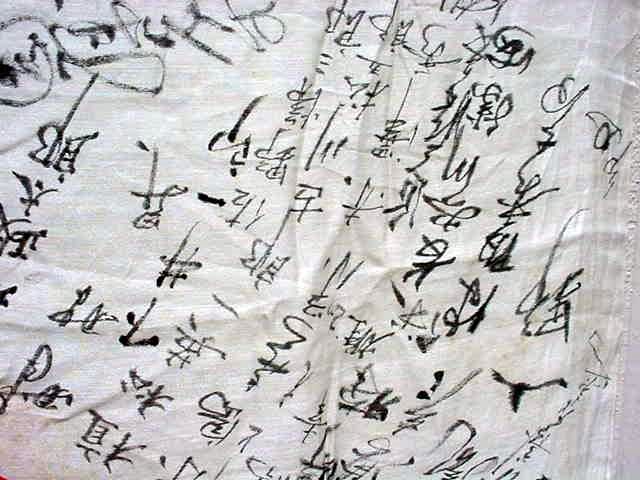
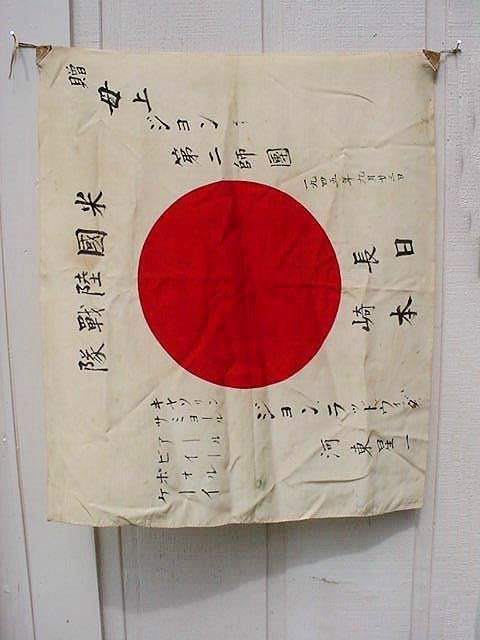
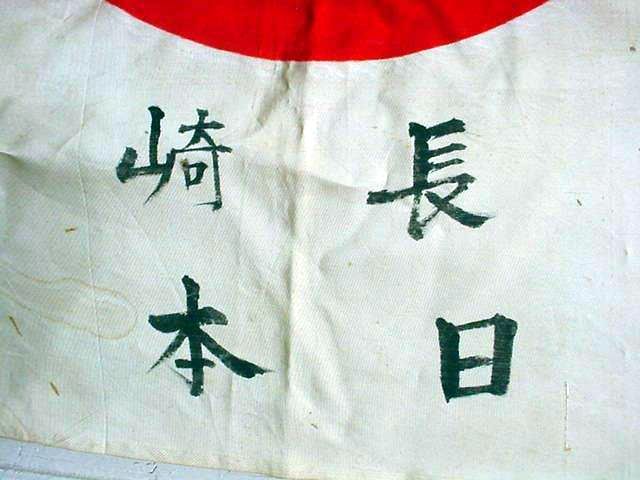
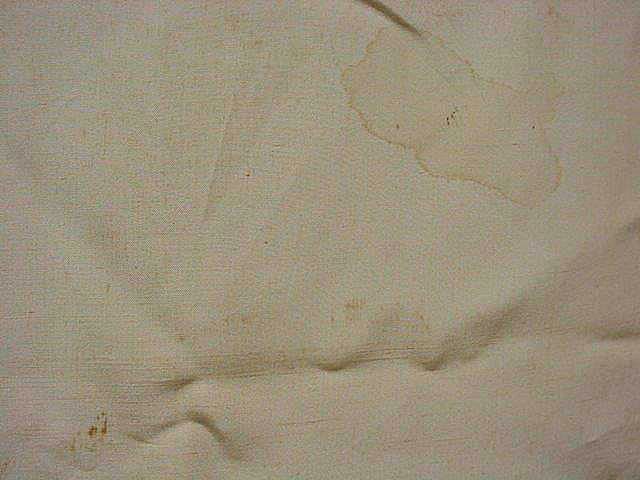
DESCRIPTION: Here is a rarity that we were fortunate enough to purchase. It is a genuine good luck flag that would be given to a Japanese soldier and it was traditional for friends and family to sign it with wishes of good fortune. The flag was also known as hinomaru yosegaki. In the Japanese language, “hi” means “sun,” “no” means “is,” and “maru” means “round,” so translated literally this means: “The Sun is Round.” This describes the commonly seen solid white flag with large, round, red center disc. When the hinomaru has been signed with Japanese characters or ideograms on and around the red center, this is called “hinomaru yosegaki.” Broken into its component parts, “yose” means “sideways,” and “gaki” means “to write.” In other words, this phrase means “To write sideways around the red sun.” History The hinomaru yosegaki was traditionally presented to a man prior to his induction into the Japanese armed forces or before being sent off to fight. Generally, relatives, neighbors and/or coworkers of the person receiving the flag would write their names, good luck messages, exultations, etc., upon the field of the flag to remind the soldier, sailor, or airman to do well in battle. The writing usually flowed out sideways in a ray pattern away from the red sun. Characters may be seen going in many directions. However, some flags have so many signatures and slogans added to them that the characters were placed wherever the well-wisher could find the room. When studying good luck flags the observer may commonly see larger dark characters placed horizontally across the top of the flag and vertically down the right or left hand side. Normally, some kind of exultation such as “Buun Chokyu” is written across the top within the white filed. Loosely translated into English it means: “May your military fortunes be long lasting.” Medium-sized characters may normally be seen that run vertically down the right- and left-hand margins of the flag. These usually occur in one, two, or three columns and are generally the names of the man receiving the flag and the name of the individual or organization presenting the flag to him. While it may be said that the ideograms are written, they are in fact placed upon the material using a fudepen or brush and ink. In addition, while it was normally the custom to only sign around the red center of the flag, some examples may be found with characters written upon the red center as well. The one we offer here is rather the “busiest” one we have ever seen with absolutely the most Japanese exhortations and hopes for success we have ever seen. It has a few trivial stains, but is otherwise in very good condition; the best you probably will ever find! PRICE: $650.00 |
|
|
|
|
|
Another Japanese Soldier’s “Good Luck” Flag (Item JAP 3-16) |
|
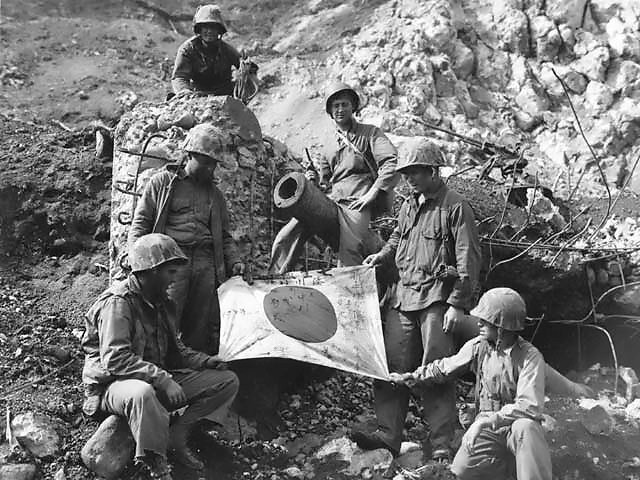
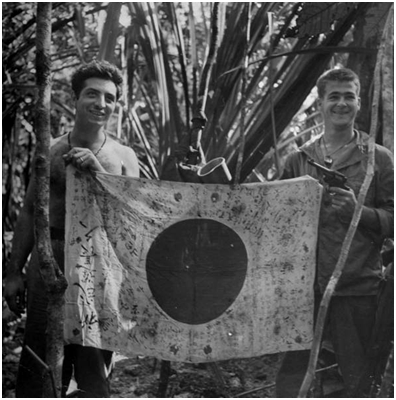
DESCRIPTION: Here is yet another Japanese good luck flag, but it has fewer exhortations and success wishes. Obviously this Japanese warrior had somewhat fewer relatives or friends, but it still is a prime example of the traditional “Hinomaru Yosegaki.” This one, like the other, was captured in tough and murderous island combat in WW II by American soldiers, this is the ONLY way that one of these would ever come to be gotten. No Japanese would ever willingly relinquish one. See our description of the flag just above for excellent details about such rare Nipponese flags. The story is the same and the flag is basically the same size and all, but I think the material is a little heavier. Like the other one, it has string ties in two corners. It is in very good condition with a few trivial stains. I assure you that these don’t come along very often.
PRICE: $475.00 |
|
|
|
|
|
|
|
|
|
|
|
|
|
|
|
|
|
|
|
|
|
|
Magnificent Handmade WWII Samurai Sword by a Major Japanese Artist (Item JAP 3-17) |
|
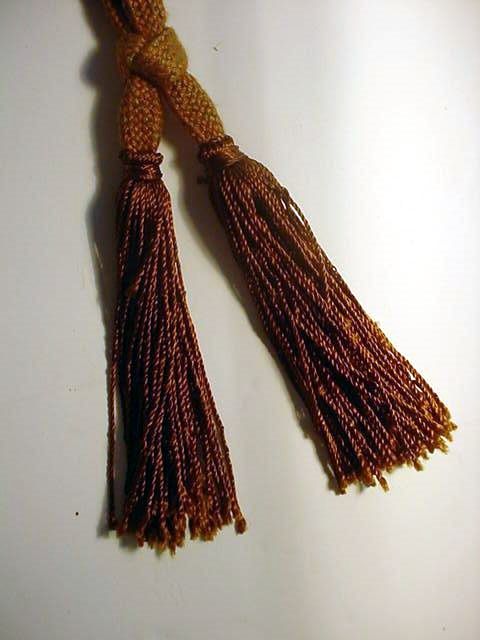
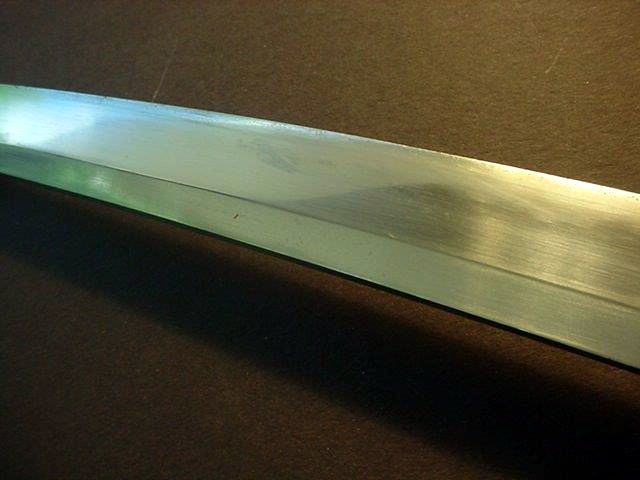
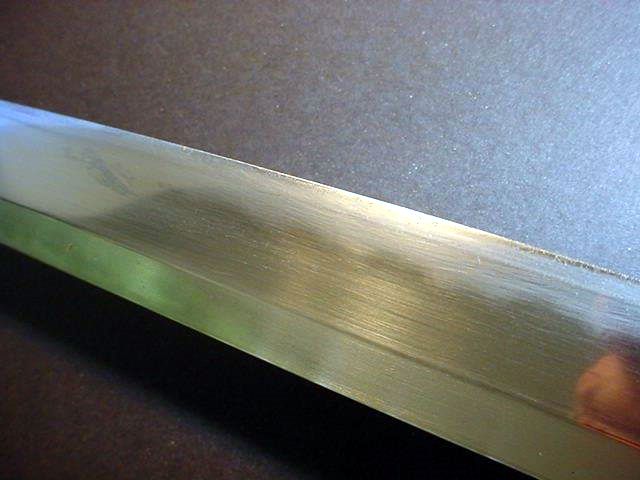
DESCRIPTION: This is without a doubt the cleanest WWII Japanese sword we have ever encountered. It was made by Hagane Amachi Masatsune, who worked in the Province of Saku. He is a listed artist that worked in the WWII era. He was considered one of the top swordsmiths of the time and you can find him in several internet listings for WWII Japanese swordsmiths. The Sword The name given to this style of WWII sword is “Shin Gunto,” which translates to “new military sword.” The official designation was “Type 94.” The year of introduction was 1934 by Imperial Decree No. 26 for commissioned officers, warrant officers, and officer candidates. The sword has the standard fittings like other WWII mounted Shin Gunto, but the fact that it is signed by a famous maker sets it apart from the usual ones encountered. Relatively few arsenal blades were signed; most show simply a government stamp; the best known being the Showa Stamp. On this sword, though, the full name of the artist is significantly engraved into the tang. Also usually the hamon or temper line on the arsenal swords is usually seen to be perfectly straight. On this one however the hamon has a beautiful wavy edging that is plainly seen. This hamon is considered to be the badge of the blade and is the line defining the hardened edge and the crystalline structures within it similar to that of earlier masterpiece swords. This can be considered an honored trademark of the best of the WWII swordsmiths such as Hagane Amachi Masatsune, who produced this great sword. The length of the blade is 25 1/2 inches from the tip known as kissaki to the portion known as the habaki (blade collar). The same (ray skin) under the grip wrap is in perfect condition. The tassels that are invariably missing from the bring-back WWII swords are not only there, but are in mint condition, as well. The saya or scabbard is also perfect. Few things in life are more impressive than the strength and beauty of fine Japanese sword steel, and this one has the finest hamon that we have ever seen on a Shin Gunto example. The steel used in this sword is known as yasuki and this is shown on the blade tang along with the artist’s signature. The sword is in as near-mint condition as we have ever encountered. Very exceptional! PRICE: SOLD |
|
|
|
|
|
|
|
|
|
|
|
|
|
|
|
|
|
|
|
|
|
|
|
|
|
|
|
|
|
|
|
|
|
|
|
|
Fantastic Cloisonné Samurai Sword (Item JAP 3-18) |
|
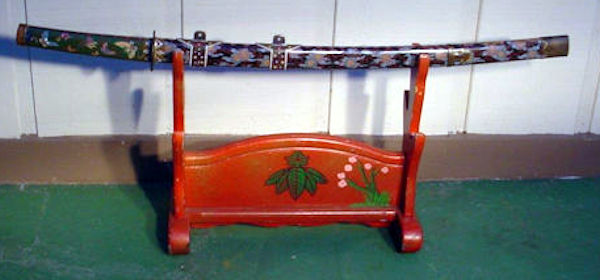
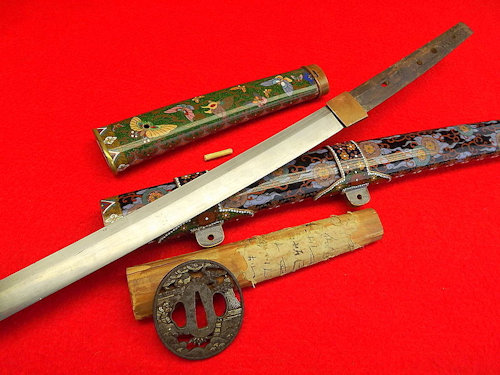
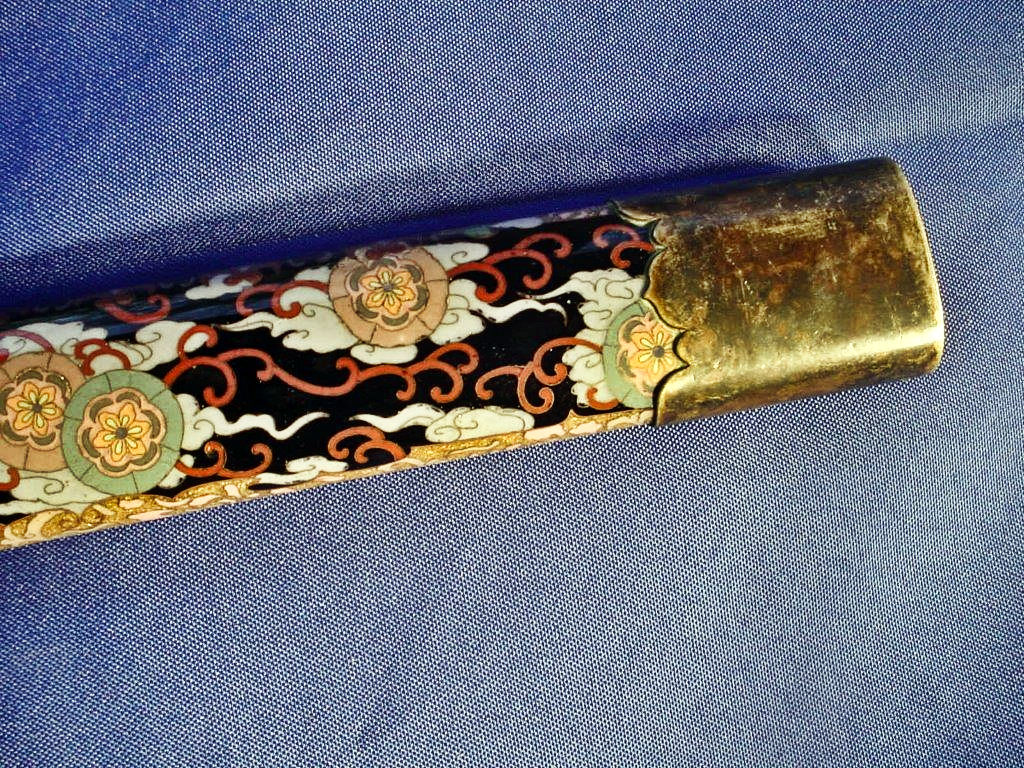
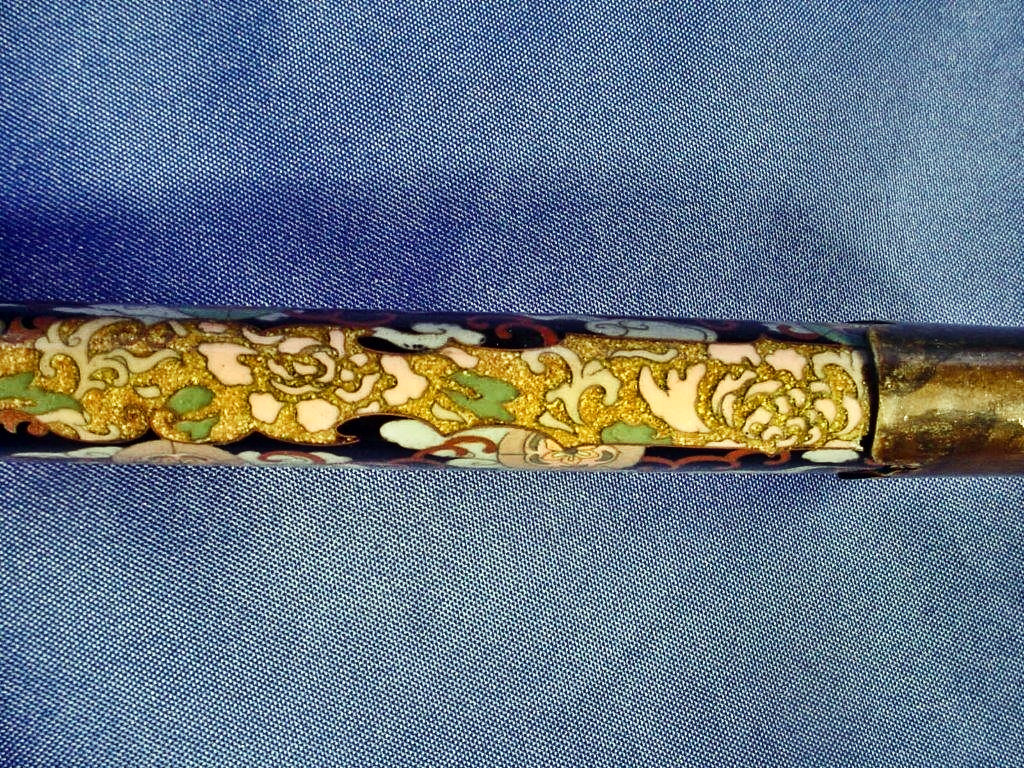
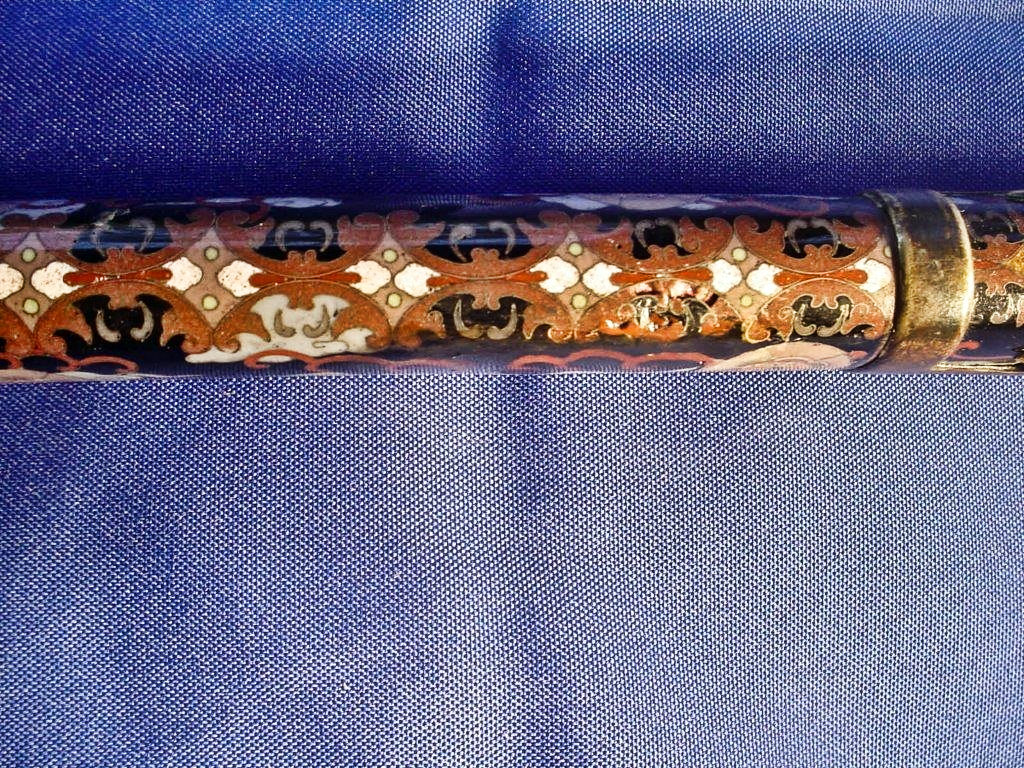
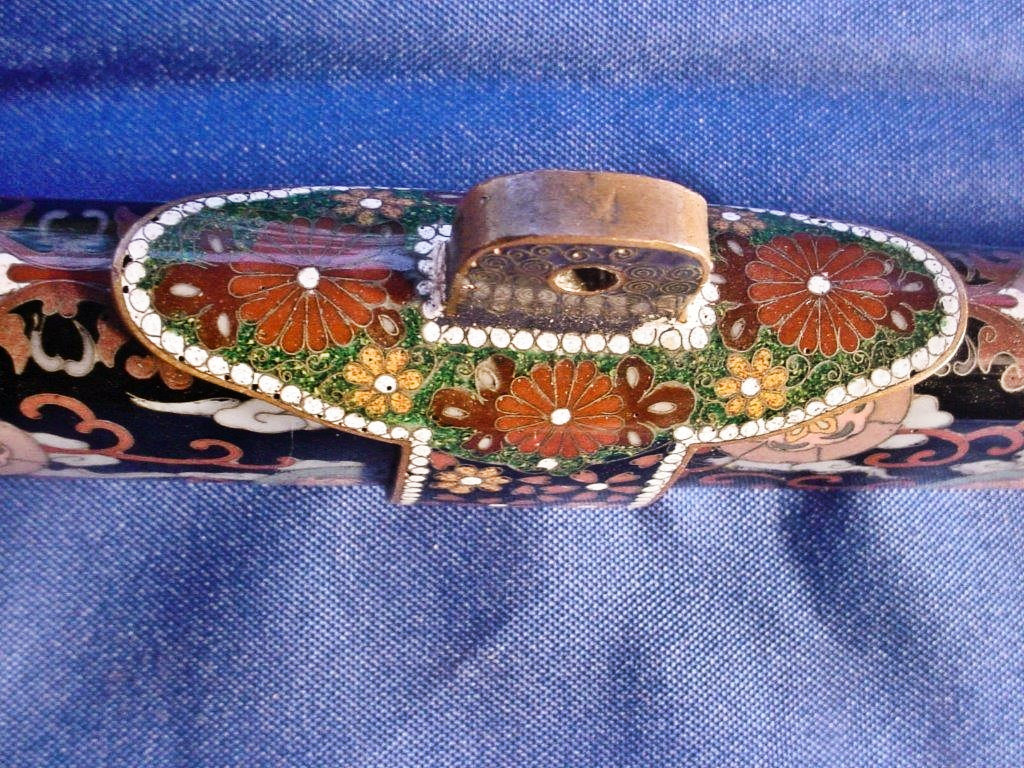
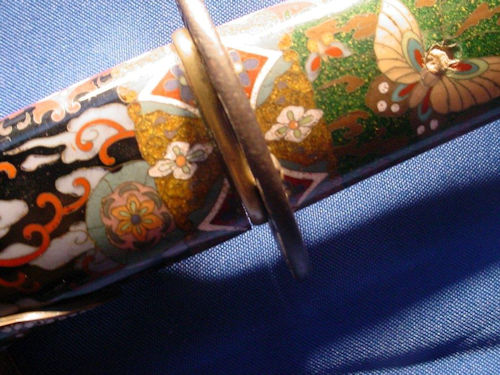
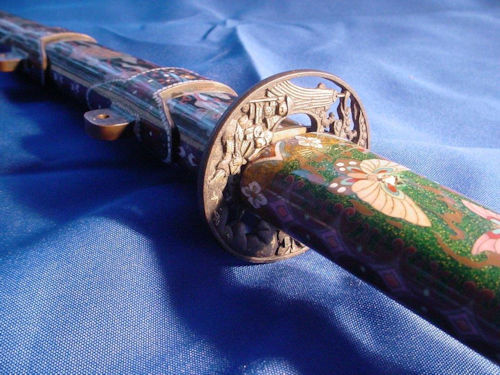
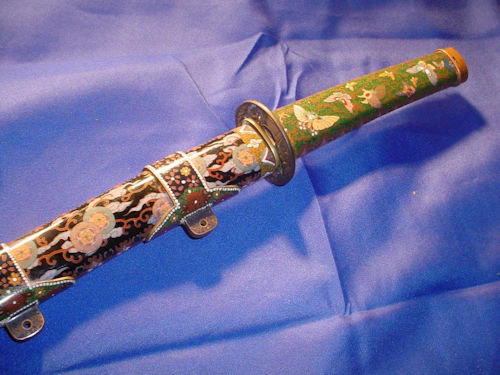
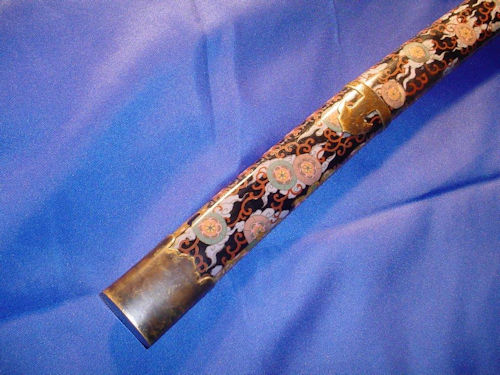
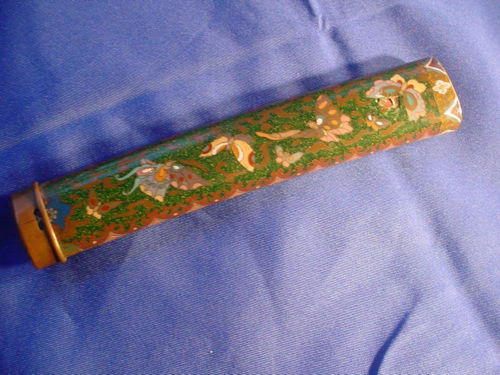
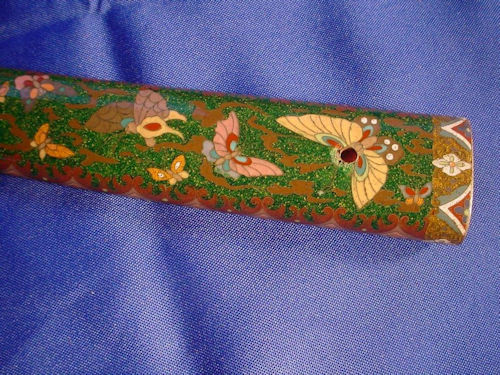
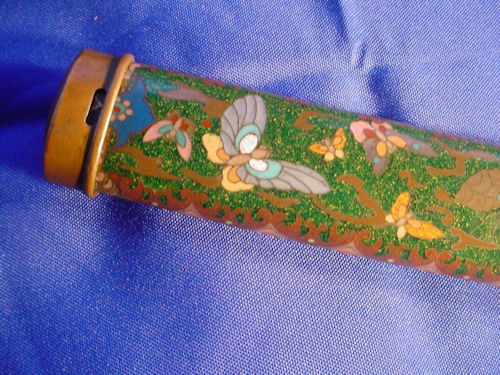
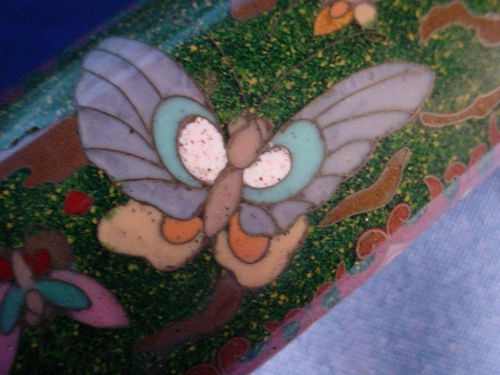
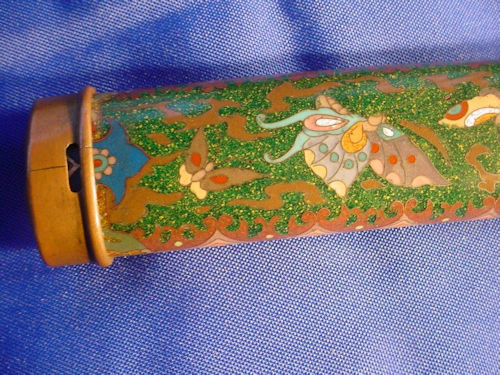
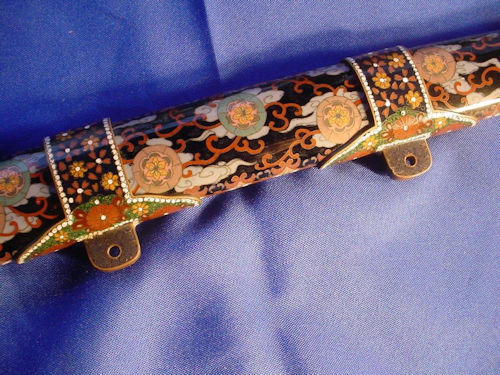
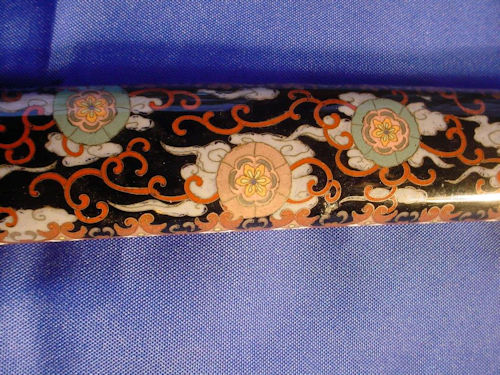
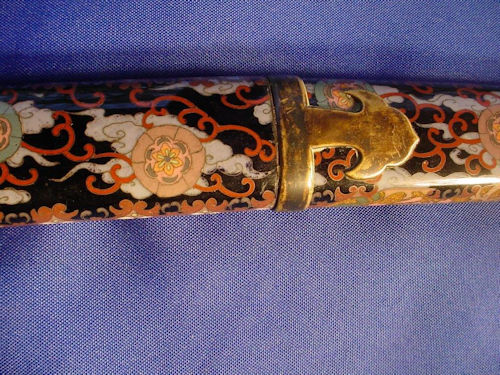
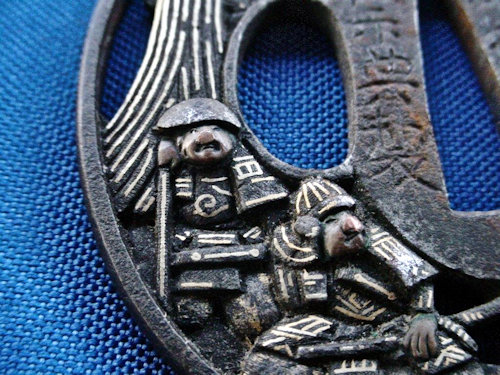
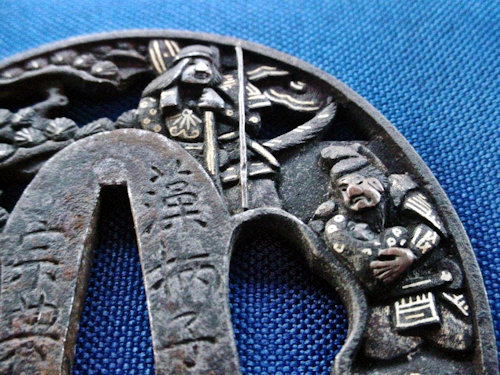
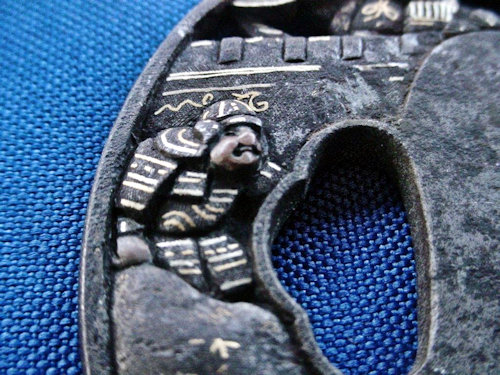
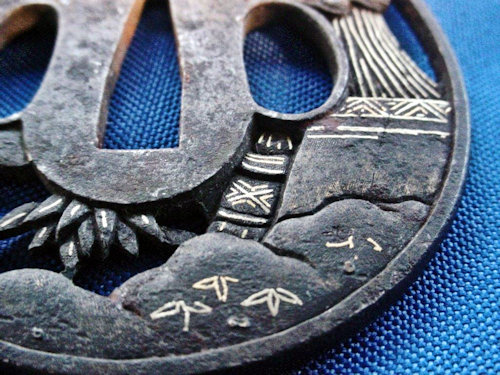
DESCRIPTION: This is rare Meiji-era Japanese ceremonial samurai tachi sword in enamel-cloisonné mounts with the very old Koto-or Shinto-era blade, having five holes in the tang (This usually indicates long history of remounting and possible warfare history.) The wooden part of the tsuka (hilt under the enamel cover) is covered with Japanese writings. The tsuba (guard) is signed “SOTEN HIKONE JU GOSHU.” This is later, early nineteenth-century Aizu work, iron marubori (carved in the round) depicting samurai in armor inlaid in gold and copper. The saya (scabbard) and tsuka (hilt) are Meiji circa 1900 done in cloisonné. The saya has in its background multicolor floral roundels; the kojiri (drag) and lower band are in plain, dark brass. The tsuka (hilt or handle) is with green background with beautiful multicolor butterflies. The length of the sword is 38 inches in its sheath and the blade is 28 inches long. They just aren’t found as good as this one these days. Astoundingly beautiful!
PROVENANCE:--- H.H. Thomas Collection.
Cloisonné is an ancient technique for decorating metalwork objects. In recent centuries, vitreous enamel has been used, and inlays of cut gemstones, glass and other materials were also used during older periods. The resulting objects can also be called cloisonné. The decoration is formed by first adding compartments (cloisons in French) to the metal object by soldering or affixing silver or gold wires or thin strips placed on their edges. These remain visible in the finished piece, separating the different compartments of the enamel or inlays, which are often of several colors. Cloisonné enamel objects are worked on with enamel powder made into a paste, which then needs to be fired in a kiln. The technique is exceedingly tedious and arduous and perfection is achieved only by the absolute masters of the art. In antiquity, the cloisonné technique was mostly used for jewelry and small fittings for clothes, weapons, or similar small objects decorated with geometric, floral, or schematic designs, with thick cloisonné walls. In the Byzantine Empire, techniques using thinner wires were developed to allow more pictorial images to be produced, mostly used for religious images and jewelry, and by then always using enamel. By the 14th century this enamel technique had spread to China, where it was soon used for much larger vessels such as bowls and vases; the technique remains common in China to the present day, and cloisonné-enamel objects using Chinese-derived styles were produced in the West from the 18th century. In Japan, the art reached excellence never really effectively duplicated in the world. The cloisonné-mounted Tachi offered here is an example of the epitome of the enameller’s art. PRICE: $6,950.00 |
|
|
|
|
|
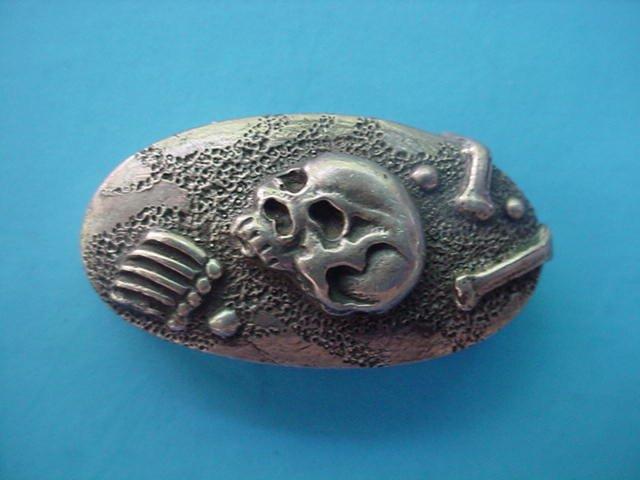
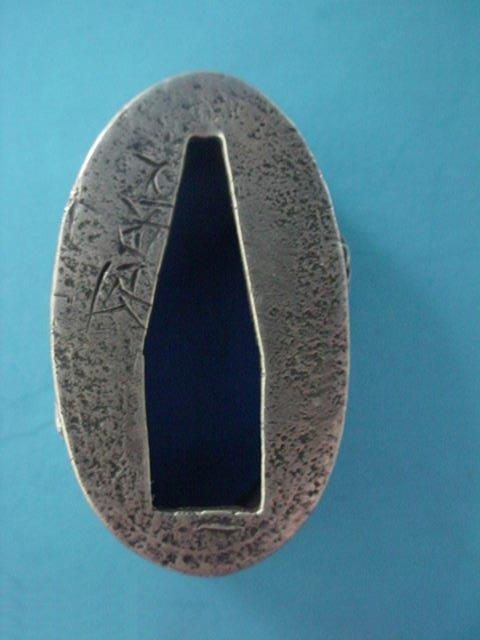
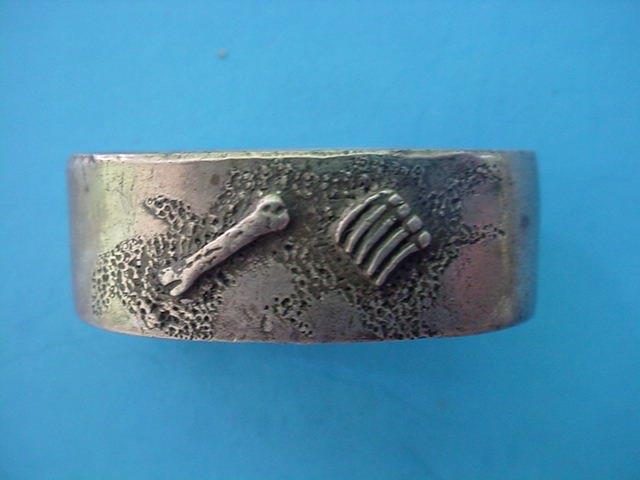
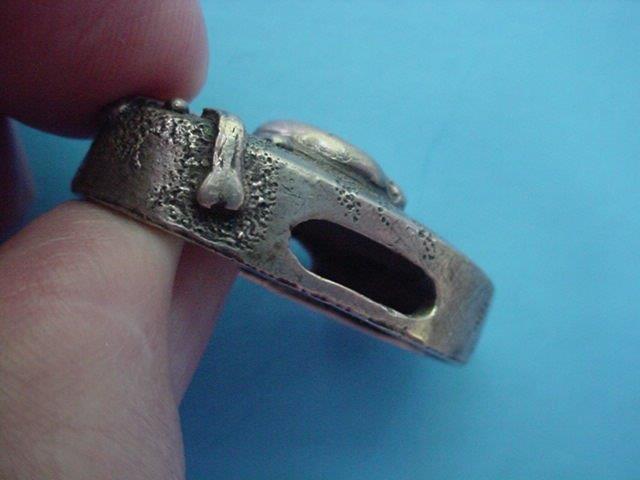
Set of Japanese Fuchi Kashira with Skull & Bones Motif in Genuine Silver (Item JAP 3-19) |
|
DESCRIPTION: Here is a great set of Japanese tanto fittings. The motif is of cadaver parts: skull, bones, rib cage, etc. The pieces are in silver and there is some sort of signature under the Fuchi. Yes, it is a baneful and rather loathsome offering—true, but interesting nonetheless and an example of a culture that embraces death as possibly the most sacred part of life itself!
PRICE: SOLD |
|
|
|
|
|
|
|
|
|
|
|
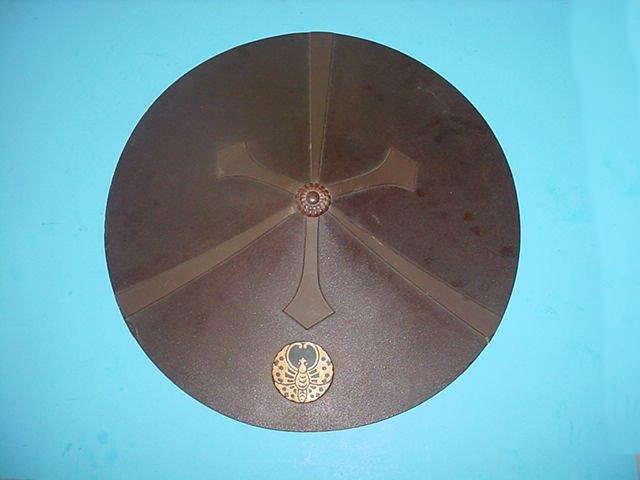
Japanese Jingasa with Samurai “mon” Possibly Late Edo Period (Item JAP 3-20) |
|
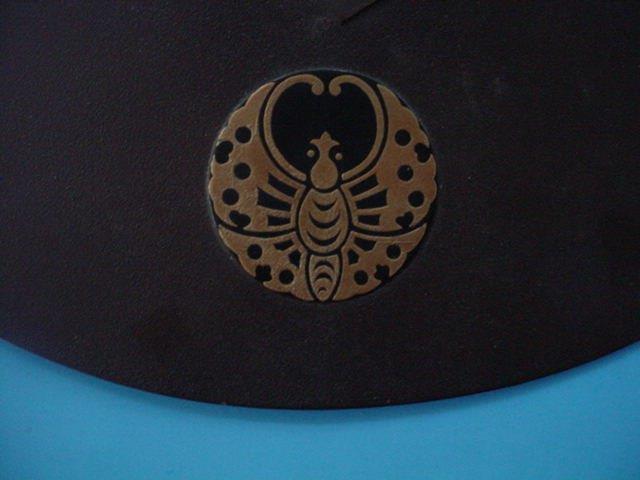
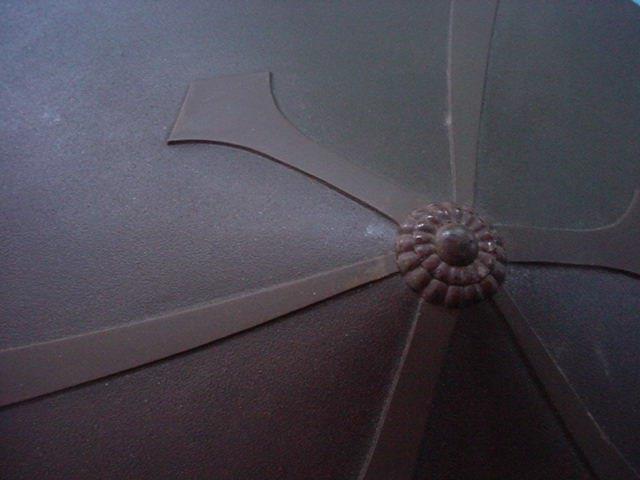
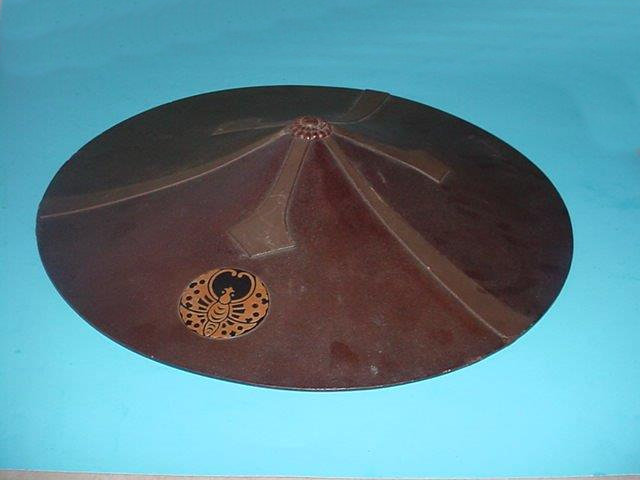
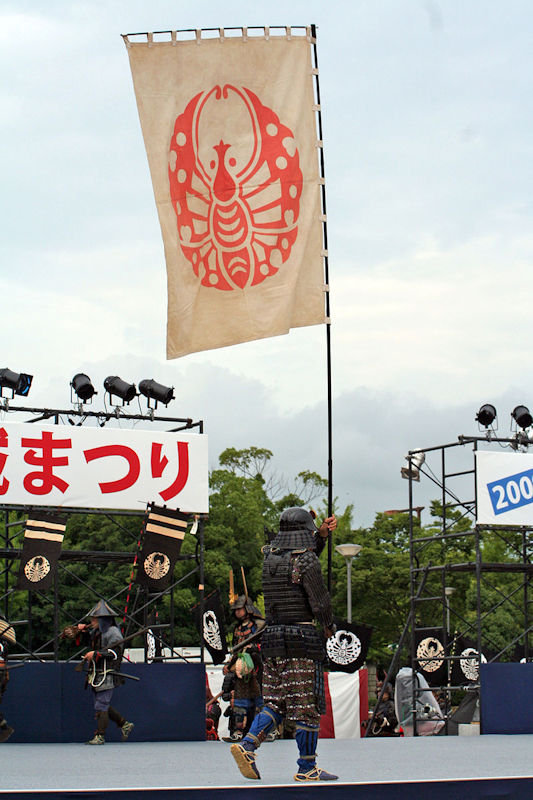
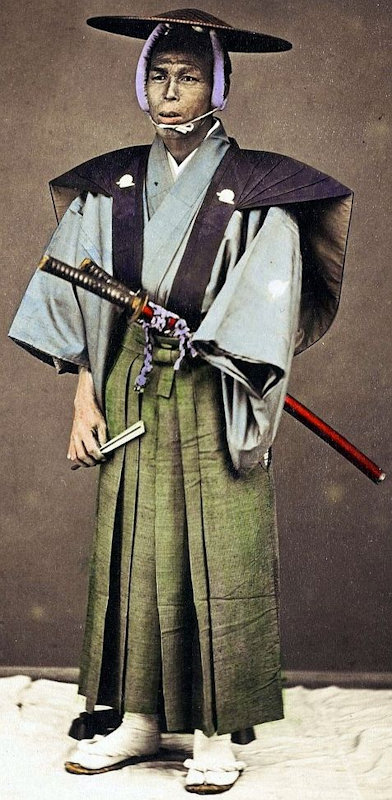
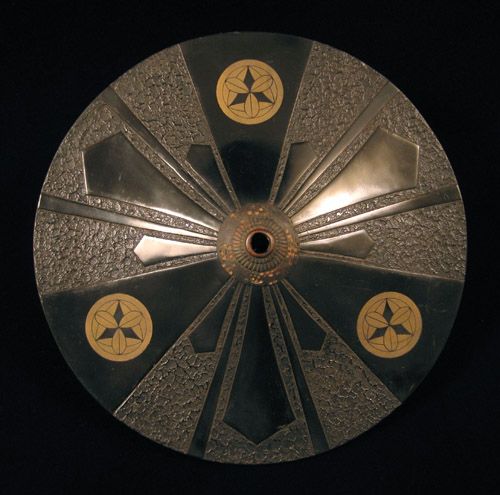
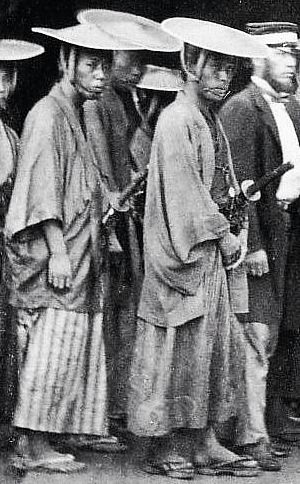
DESCRIPTION: Here is an antique, circular Samurai-style Jingasa (a type of military headgear) with gradual domed top with textured décor that at first appearance looks like iron. However, it is of light, wooden construction. The emblem or mon is shown as “Cho Mon,” the Japanese butterfly crest “Bizenn-chou” of the Ikeda clan. See our image of a recent celebration of this notable clan at the Himeji castle. We feel this Jingasa is from the late Edo period, maybe 1865, or from the middle Meiji restoration period. In any case, it is certainly a superior, antique Japanese item showing great design and fine workmanship. It measures about 16 1/2 inches in diameter. At present we will accept serious offers on this remarkable piece. Please make an offer or even provide further information.
PRICE: Make a serious offer. |
|
|
|
|
|
|
|
|
|
|
|
|
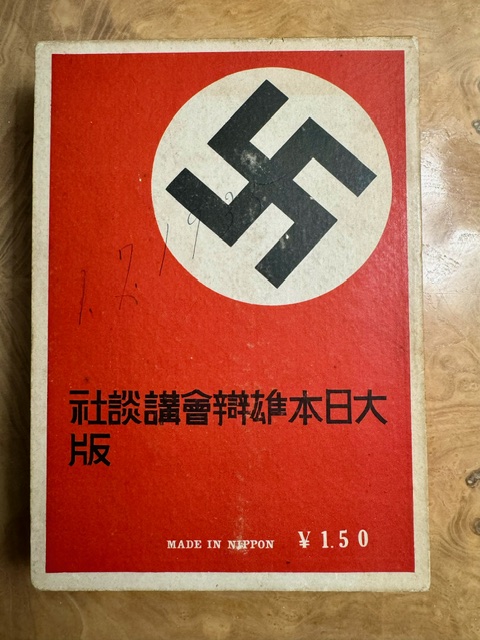
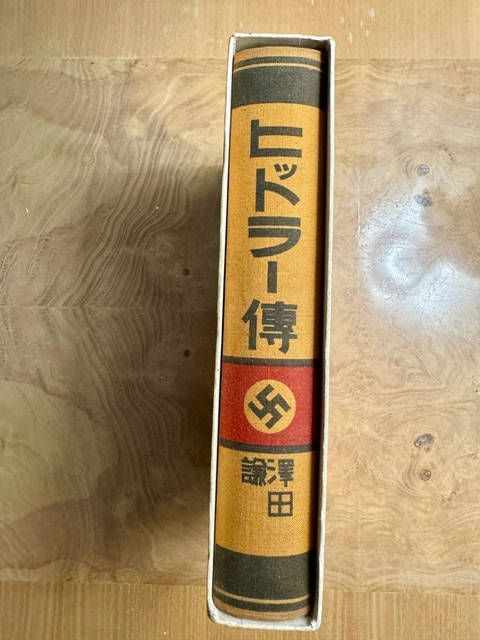
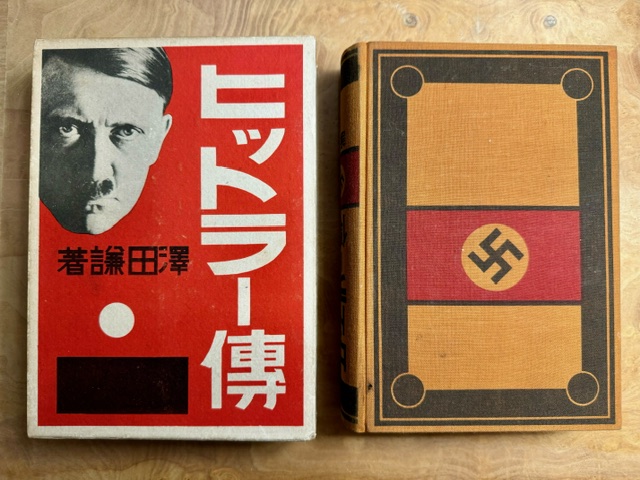
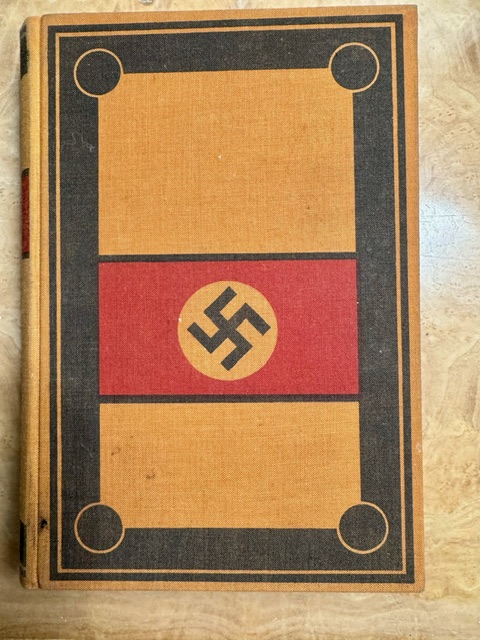
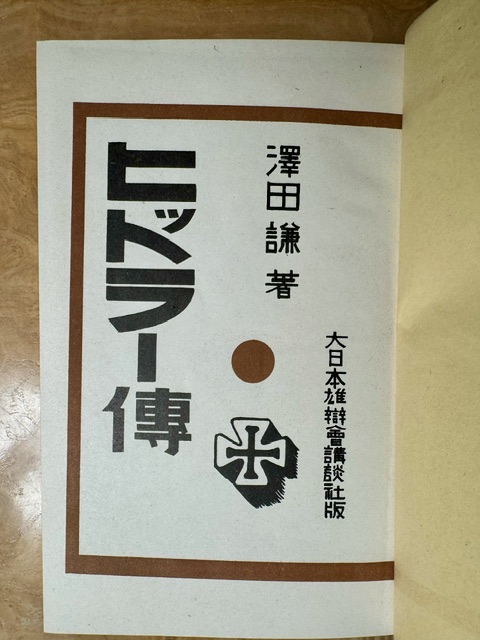
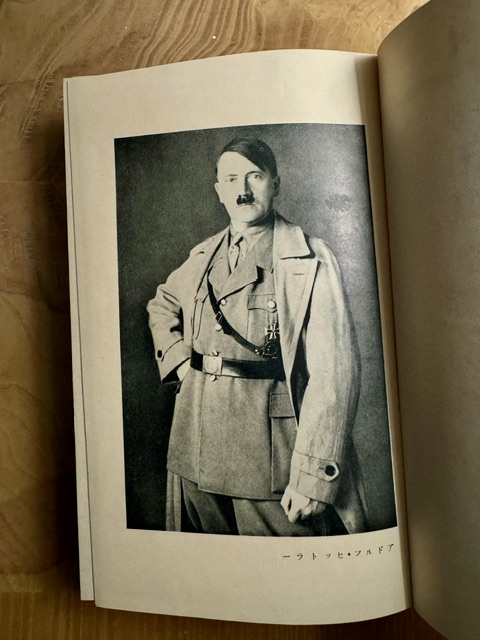
Japanese Edition of Mein Kampf (Item JAP 3-21; RAREBOOK 2-29; AH 31-25) |
|
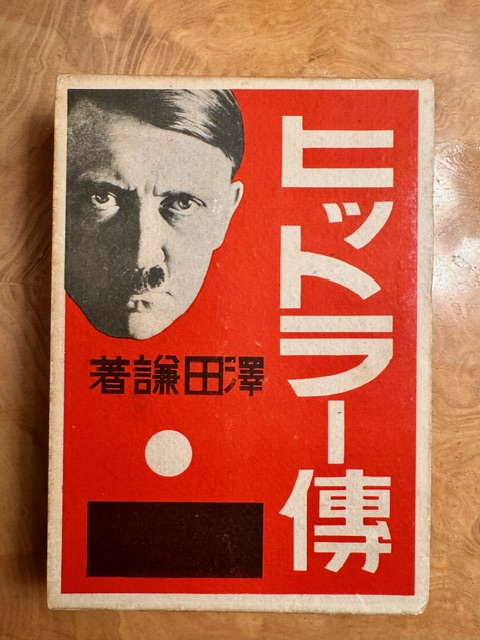
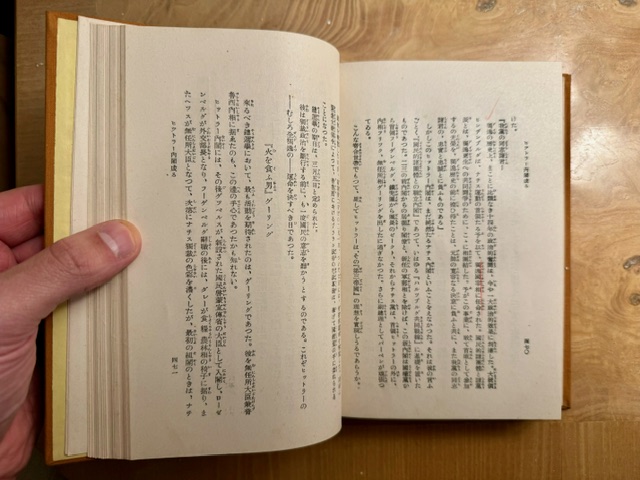
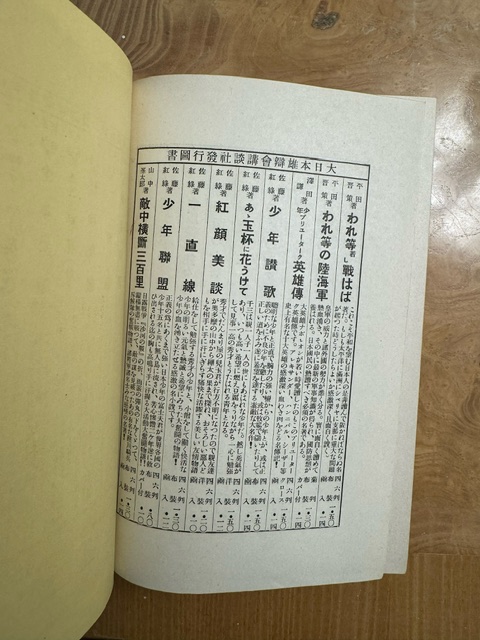
DESCRIPTION: This rare find is not a word-by-word translation of Hitler’s Mein Kampf, but rather a combination of his book and a biography of Adolf Hitler; therefore, unlike regular copies of Mein Kampf, this edition contains pictures and comes with its rare slipcase. This is a seldom-seen publication and an unusual addition for every Mein Kampf collection. It was written by the Japanese author Kenswawada, and published in Japan in 1940.
PRICE: $1,850.00* |
Page One -- Page Two -- Page Three
Please refer to item designator in parentheses in all correspondence.
Please E-mail for any additional information you may need.