
[ Home Page ] [ Third Reich ] [ Old Reich ] [ Kaiser Reich ] [ Imperial Russia ] [ Axis Powers ] [ Italian Fascist ] [ WW I ] [ Landsknecht ] [ Kaiser Wilhelm ] [ Frederick the Great ]

Kaiser Reich

Kaiser Reich

Kaiser Reich

Adolf Hitler

Page 14


Hitler

Hitler

Hitler

Hitler

Hitler

Hitler

Hitler

Hitler

Hitler

Hitler

Hitler

Hitler

Hitler

Hitler

Hitler

Hitler

Hitler

Hitler

Hitler

Hitler

Hitler

Hitler

Hitler

Presentation Mein Kampf owned by the Führer (Item AH 14-1)

DESCRIPTION: This utterly fantastic object d'art from the German Third Reich might be considered one of the finest and historically important articles found in the past dozen years. First, it was definitely a personal possession of Adolf Hitler and was in all probability a much-treasured one at that. Hitler was always cognizant of the importance of archiving and preserving the arts and crafts of the German people. This was ultimately germane and necessary to the ideology and agenda of the National Socialist mythos. This particular edition of Mein Kampf is specially decorated and adorned by artisans at the zenith of their craft. Why else would anyone present this Mein Kampfto the very author of the work? The immediate importance of this presentation was indeed the custom workmanship. The overall intricate, handmade, and very meaningful motif seems to personify the feelings, the expression, the stark realism of the proposed agendas of the "Thousand Year Reich." The publication, otherwise, is a quite normal volume of Hitler's book and that is where any recognizable identity ends, because the binding and the outer decor are a "presentment of high art in the craft of the silversmith" at the epitome. The company that produced the piece was Brunckhorst in the village of Buxtehude, and is signed this way. This art form was practiced quite uniquely by artisans there for over 1,000 years. They were noted for elegant armor and weapon appurtenances that they produced for the knights and nobility of many from a bygone age. Rare and exquisitely decorated Bibles and other religious regalia were by tradition and preference decorated by firms plying their trade in Buxtehude. It all began from very early times when this area was recognized as Der Stadt der Silberkunst—the city of silver art—and many a museum throughout the world will boast of treasured articles to include reliquary treasures encased in Buxtehude silver. Therefore it is only fitting and appropriate that a gift to the Führer of his own book would be bound with this town's memorable art form. The real specialty in silverwork that these artists had produced was the intricate filigree work that was part of almost every piece produced there. The lacy spider web of decoration has never quite been duplicated anywhere in the world and to this day remains the mark of the silversmiths of that tiny village. Buxtehude is found in the section of Germany that was designated as East Hannover. This was due to the Nazi zoning system known as the Gau, each administered by political leaders, overseers, and governed by a Gauleiter--a rank similar to a governor. The man who presented this magnificent gift to Adolf Hitler was Gauleiter Otto Telschow, who had one of the <:I>Alte Kampfer or “Old Fighters,” faithful to the ideals and agenda of the N.S. movement as early as 1925, but earlier he had been deeply involved in nationalistic and anti-Semitic movements. He also had been very instrumental in virulent anticommunist activity. He came from an old aristocratic family of farmers which had served Frederick the Great, the illustrious King of Prussia. A cavalryman in World War I, he served until 1924 and then led Freikorps troops against the Spartacists (communists). Telschow was one of the earliest workers with the fledgling N.S.D.A.P. (Nazi Party), thus cementing an early personal and lifelong friendship with Hitler, who personally appointed him to the Gauleitership of East Hannover. Later he was further elevated in rank to the Prussian Council. He was the Gauleiter who enjoyed the closest friendship to all the German leaders. So then it occurs that on April 20, 1938 (Hitler's birthday), Otto Gauleiter Telschow presented this wonderful gift to his leader and Chancelor of the Third Reich. The entire volume is covered in red leather and then encased in silver, which is hand engraved and filigree decorated. Many configurations of ancient Germanic mythological and runic designs adorn its front, back, and spine. Each important symbol had deep meaning to Nordic and Teutonic saga, and had connotations to the overall historic mission of the "empire" that history has designated as the German Third Reich. Of all the Hitler possessions that have been found and ultimately archived, none seem to be quite as important as this particular item for all the reasons stated herein. As to archival value, the importance of the gift was immediately recognized upon its initial presentation. Inside the front cover there is a 3 x 5-inch file card which announces that this book was a gift from Gauleiter Otto Telschow of Gau East Hannover. This of course is in German and is then signed by hand across the typewritten statement by Obersturmführer B. Woltz, who was known to have been the official caretaker and archivist for the German Reich's chancellor. Woltz signs in red pencil as having received this gift in good order to be added to the personal library of Hitler. Also to be perceived on this card is the handwriting of the American G.I. who had looted this book, then later trading it off for cigarettes to another looter (a Russian). He (the G.I.) does a rough translation of the above information by Woltz as he writes on the face of the card itself. The runic symbols that heavily adorn the outer cover include the Ty rune, the Hagel rune, the Seig rune, the Odel rune, the Lebensrune, and the Sinnzehn.The book measures 5 x 7 1/2 inches, the standard size of a normal Mein Kampf with a little added for the silver protrusion at the spine about 1 3/4 inches thick with a bit added for the silver. The book is very heavy with all that precious metal on it. This Hitler piece practically makes all others pale in significance. It must have surely been one of his favorite possessions in that it was his own book, but given by so close a friend and decorated in the high-art accomplishment of a company that lived up to every tradition of this the Imperium of German art and culture.

PRICE: POR; only telephone inquiries on this piece, but please observe the times to call as shown on our opening pages. No wee-hour calls!


Hitler

Hitler

Hitler

Hitler

Hitler

Hitler

Hitler

Hitler

Hitler

Hitler

Hitler

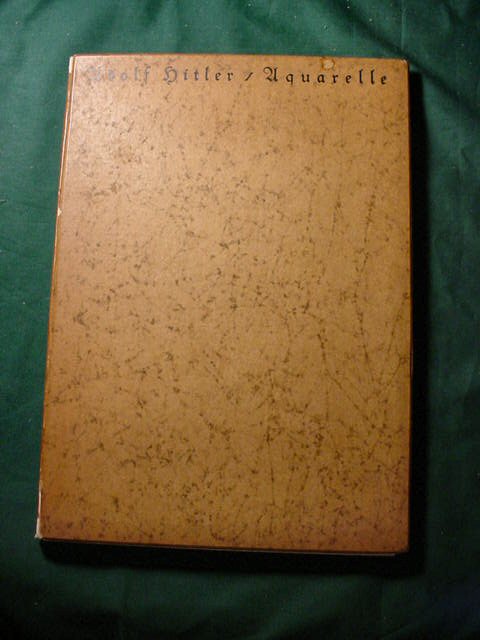
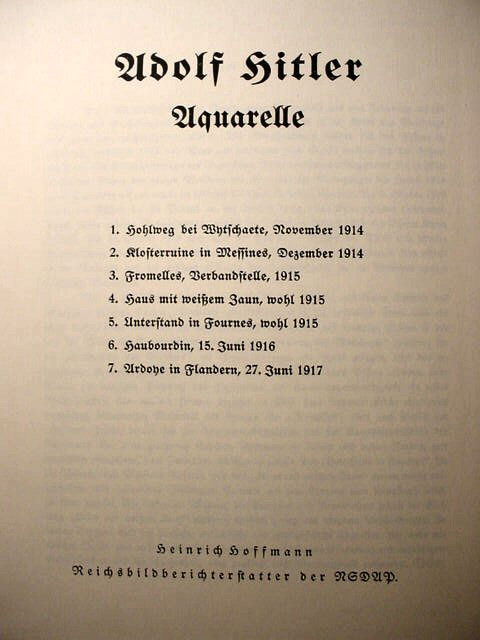
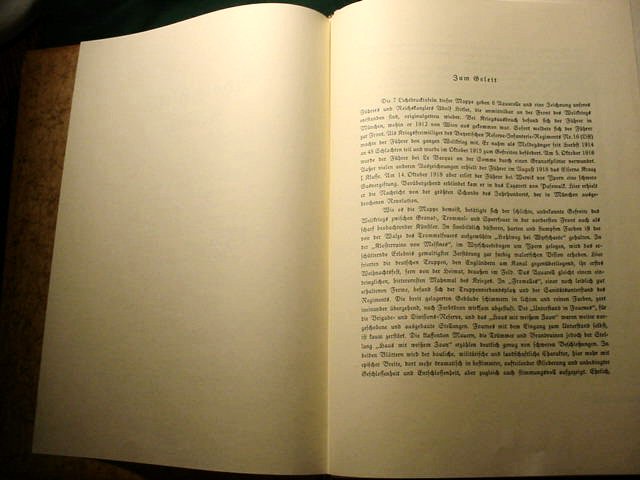
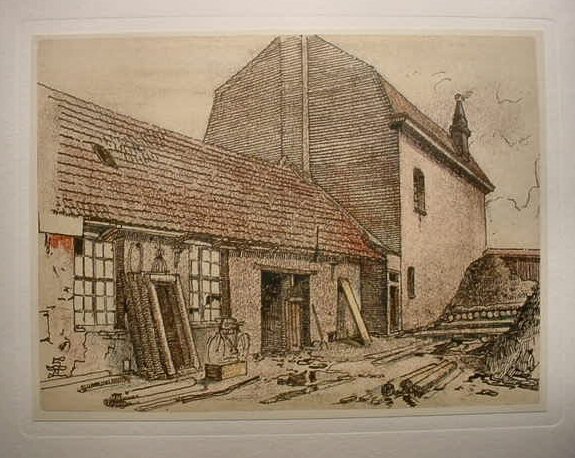
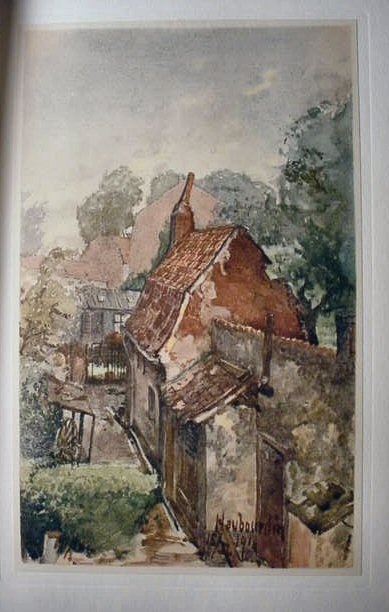
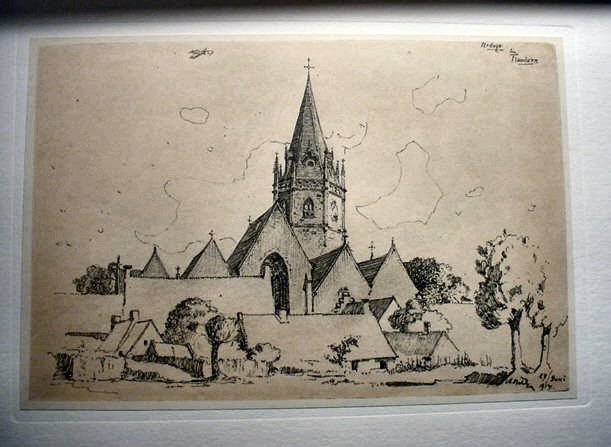
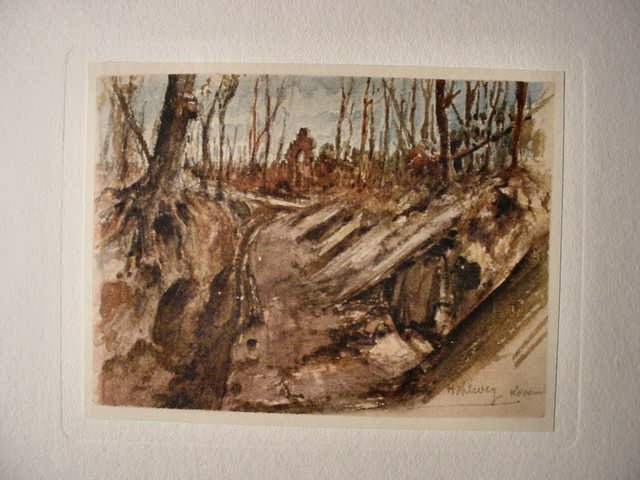
Adolf Hitler Aquarelle (Watercolors) (Item AH 14-2)

DESCRIPTION: This is an original Mappe, or folder, of seven of the most famous paintings of Adolf Hitler from 1914 to 1917. This was officially published by Heinrich Hoffman’s studios. Hoffman was one of Hitler’s closest friends and his official photographer. The paintings are wonderfully reproduced in full color and range in size from 8 x 6 inches to 6 x 5 1/2 inches. The album is in good condition. The cover shows some separation at the spine, but it’s not really going anywhere. The inner contents (the prints) are in practically mint condition with no damage or stain. The dimensions of the folder itself are 9 x 12 inches. This was a very limited edition and some say that they were printed to present as gifts to those important people who visited the Reichs chancery. They seldom show up today. This is a very historically important relic of the Reich.

PRICE:  SOLD


Third Reich Art

Third Reich Art

Third Reich Art

Third Reich Art

Third Reich Art

Third Reich Art

Third Reich Art

Third Reich Art

Third Reich Art

Third Reich Art

Third Reich Art

Third Reich Art

Third Reich Art

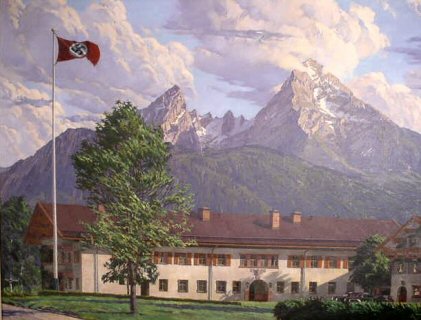
Berchtesgaden; Reich’s Chancellery (Item AH 14-3; ART 5-6)

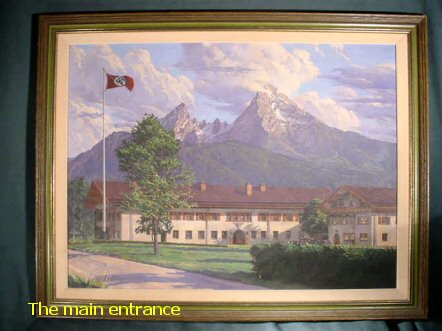
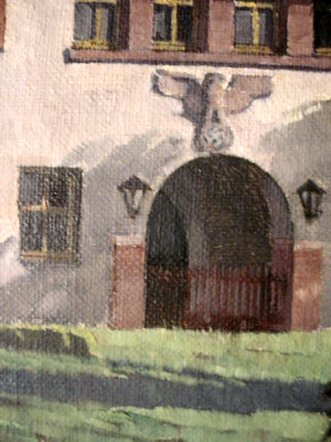
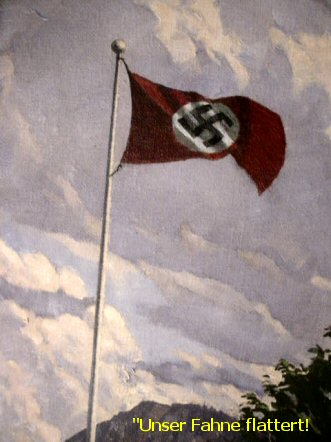
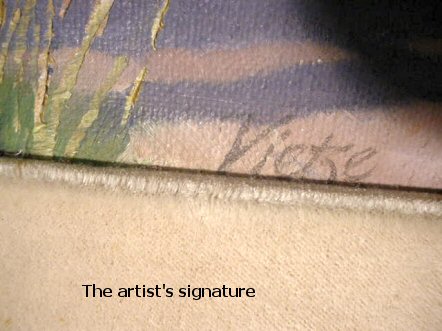
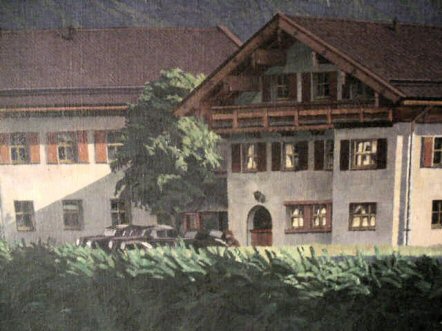
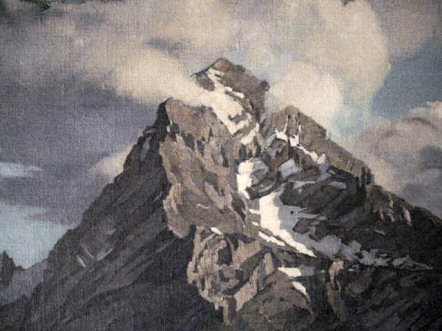
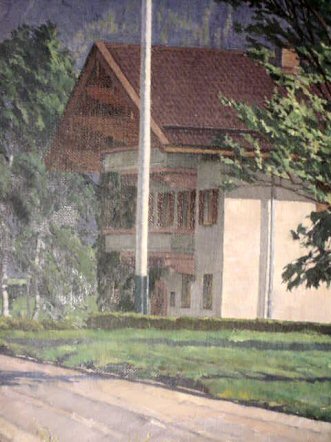
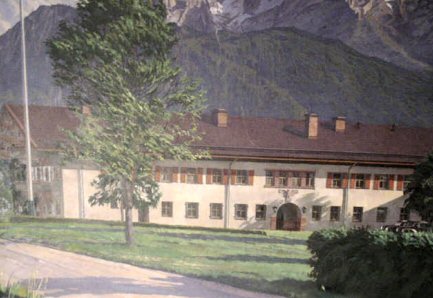
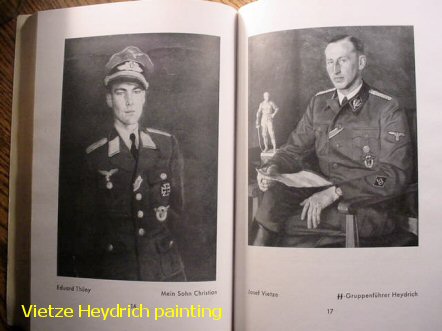
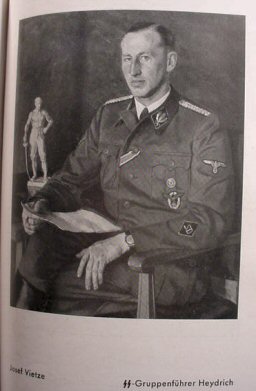
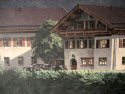
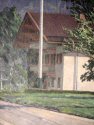
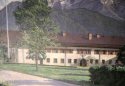
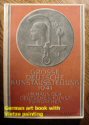
DESCRIPTION: Here is an original rendering of the chancellery of the Führer, Adolf Hitler, and is called the Bischofweisen Reichskanzlei. This fantastic rendering is by a major Third Reich artist who had some of his works featured in the Haus der Deutschen Kunst in Munich. The artist, Joseph Vietze, and one of his most famous painting was the rendering of SS-Gruppenführer Reinhard Heydrich, that was shown in the Grosse Deutsche Kunstausstellung catalog of 1941. This was the official exhibition catalog of the finest of German art and Vietze’s “Heydrich” was number 17 in the listings. It was an excellent portrayal of the Gruppenführer seated beside a porcelain fencer by the SS Allach firm. Heydrich was an ardent active fencing master right up to the time of his murder by British-controlled Czechs. This fully equipped branch of the Reich Chancellery in Berlin was built as a remote government center and as Ray Cowdery said in his book on the Chancellery, “…this was sort of a western White House and allowed Hitler to receive diplomats and to conduct government business without leaving one of the most beautiful places on earth.” Bischofwiesen is just outside the tiny town of Berchtesgaden not far from the Obersalzberg where the Führer had his mountain home, the Berghof. It was Hitler’s regular practice to retreat to his Berghof for extended periods several times each year and he took much of the Reich chancellery infrastructure with him. The compound was completed in 1937. It was absolutely a beautiful Bavarian-motif building with verandas at each end. Several other buildings that make up the compound are scattered here and there: SS guard Kasserne, diplomat lodging, caretaker buildings, etc. The inside is breathtakingly beautiful with red marble columns and staircases. Until recently the entire building was occupied by U.S. Army command. It was then turned over to the Bavarian Government and now, thank goodness, it was sold to a private group, which has no doubt saved it from the wrecking crews of the present government of culture vandals, which would take great delight in pulling it down and eradicating it from history (so they think) just as these barbarian criminals have done with the Platterhof, the remains of the Berghof, and all the other historic sites on the Obersalzberg. Only the tea house survives and these modern Mongol hordes would love to destroy it, also. They are, for the most part, ravenous wolves in 1000-euro suits.

PRICE: $3,850.00; a true bargain


Third Reich Art

Third Reich Art

Adolf Hitler

Adolf Hitler

Adolf Hitler

Adolf Hitler

Adolf Hitler

Adolf Hitler

Adolf Hitler

Adolf Hitler

Adolf Hitler

Adolf Hitler

Adolf Hitler

Adolf Hitler

Adolf Hitler

Adolf Hitler

Adolf Hitler

Adolf Hitler

Watercolor by Adolf Hitler (Item AH 14-4; ART 9-3)

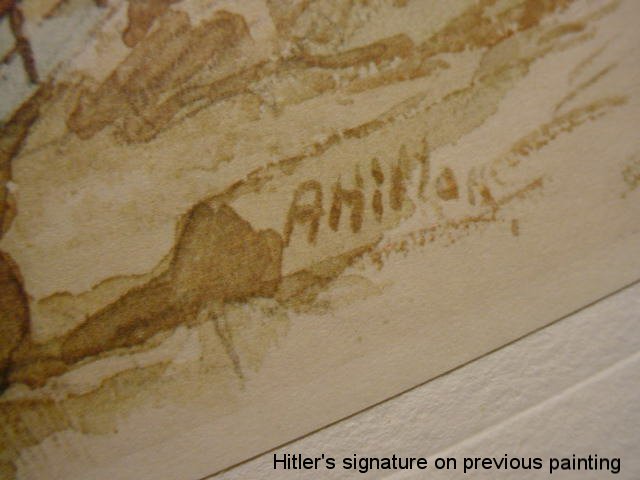
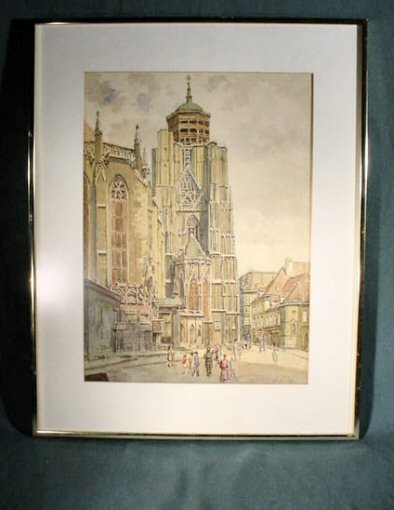
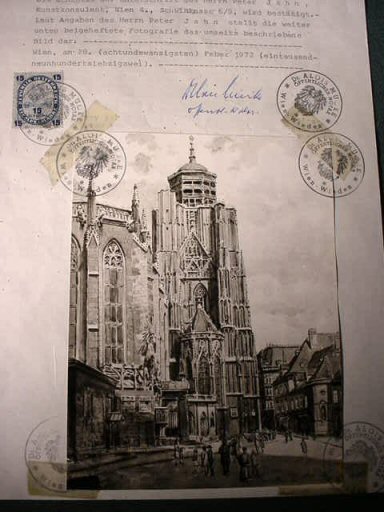
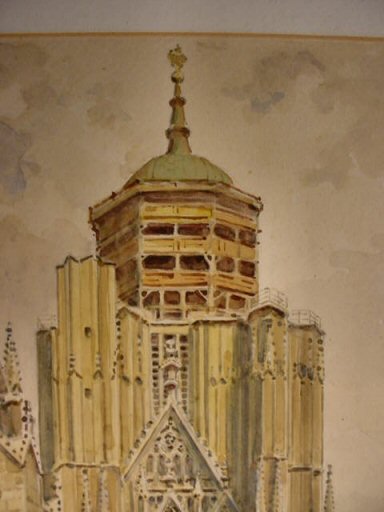
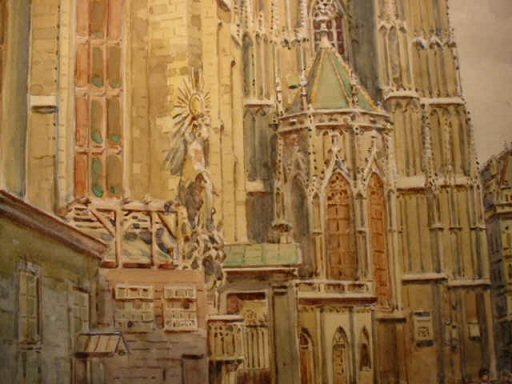
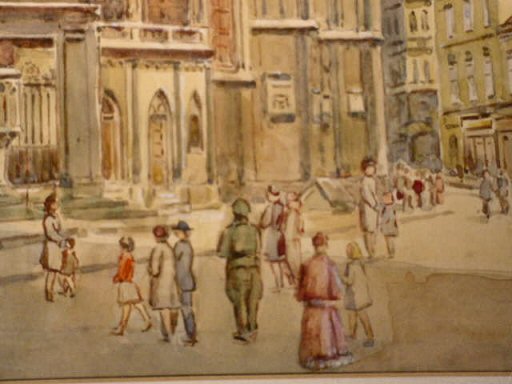
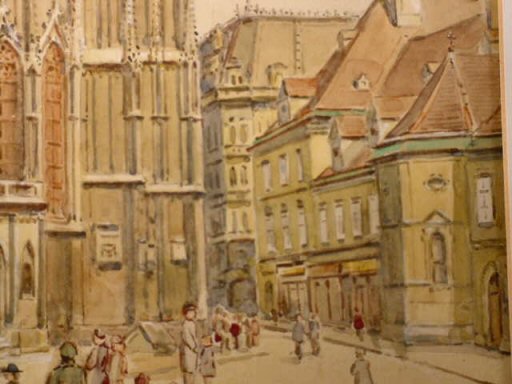
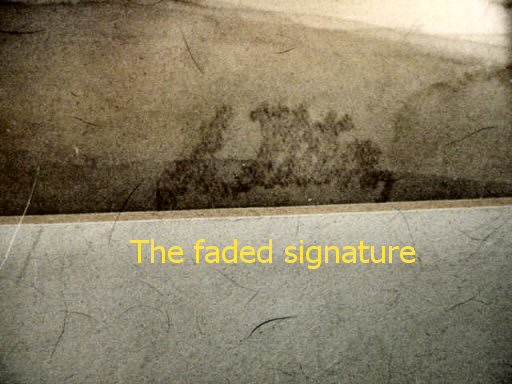
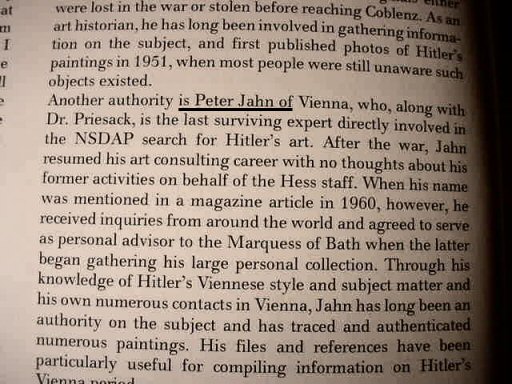
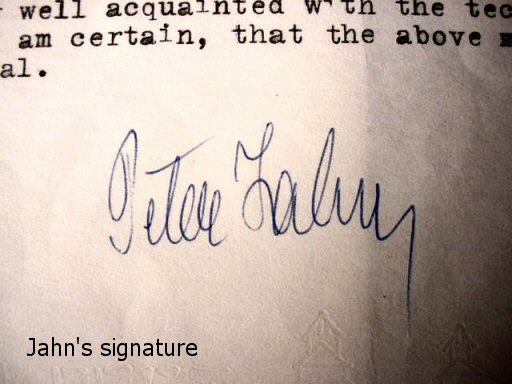
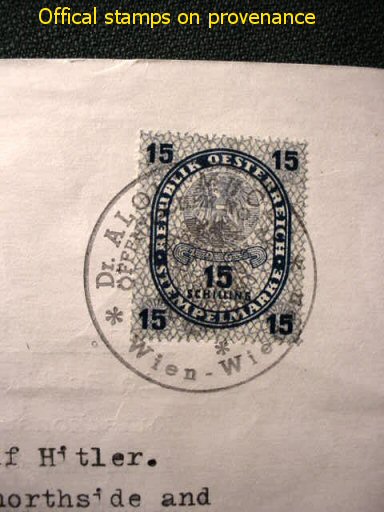
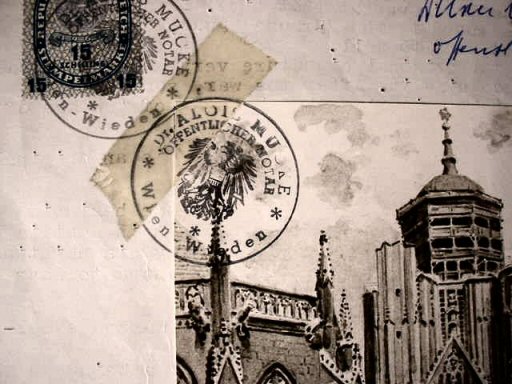
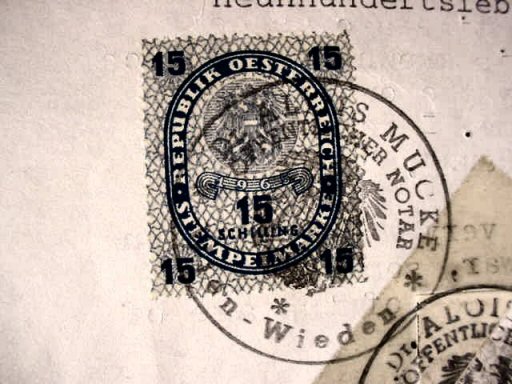
DESCRIPTION: This original watercolor, done by Adolf Hitler before he came into power, depicts the north side and the unfinished tower of St. Steven's Church in Vienna, and a small part of the Stefansplatz. The watercolor is accompanied by an interesting letter of authentication executed on February 26, 1972. This authentication is done by a Herr Peter Jahn. Mr. Jahn was an expert on Hitler paintings and his specific function during the years of 1937-1944 was to search out and repurchase any of Hitler's works of art that had been executed before his coming into power. (In part because of this, very few of Hitler's watercolors exist.) Hitler apparently felt that because the watercolors were of little commercial value and because of his new position of prominence, he would prefer not to have these works out amongst the public. It was Jahn's specific purpose to seek out and repurchase these watercolors. In his letter, he is specifically familiar with this painting. In 1939, he indicates an owner of a bank was in possession of it at that time and he attempted to repurchase it. The signature in the lower right hand corner is muted and an attempt was made to remove Hitler's signature, possibly by the owner after the end of the war? Jahn also indicates that over the many years that he examined Hitler's paintings and watercolors, this one was the largest personally known to him. It measures approximately 13 x 18 inches. Other than the stain in the signature area, it is generally in good condition. It is matted and framed in a contemporary frame. Many Hitler paintings have been offered by various dealers over the years, but many were bogus, dubious, or at least questionable. Possibly, some of them were genuine, but without provenance. The only absolute 100-percent accepted provenance would be a painting with letter of authenticity from one of only two men. The first would be the late Dr. August Priesack of Munich, and the aforementioned Peter Jahn, who with his above-mentioned credentials was the number-one expert in the world on AH art. With this painting is the signed expertise by none other than Peter Jahn, who looked at it in 1972. Mr. Jahn in his certificate of authenticity states as follows:
CERTIFICATE OF AUTHENTICITY for an original water colour by the hand of Adolf Hitler. This picture is signed A. Hitler and shows the northside (sic) and the unfinished tower of the St. Stephen’s Church in Vienna and a small part of the “Stefansplatz”. The size is 46 x 34.5 cm which being exceptionally large, is quite unusual. It is the largest of his paintings known to me. The owner of this picture consulted me some time ago as he wanted to have it expertised. The painting is known to me since the year of 1939, when it was shown to me by the owner of a bank, in whose possession it was at that time. I reported the same picture as being found to [from] the “Braune Haus”, but at that time the owner did not want to sell. I still can remember the original signature very well and even now one can easily recognize it. After the war, somebody must have tried to wash out the signature but because of the age of the colour, this was not completely accomplished. To my best knowledge I certify that this picture is an original. To my person: I’m an expert for Hitler’s paintings as from the beginning of 1939 until 1944 I searched for Hitler paintings in Austria by order of the “Braune Haus”. Hitler wanted to rebuy his paintings, as they were of little commercial value and he wanted to have them out of circulation. After the war I was consulted by many people who wanted expertises. Most of the pictures are not for sale. I was mentioned in a German illustrated newspaper a (sic) being an expert for these kind of pictures. I think that now I am the last living expert as my former co-workers have died or their whereabouts are unknown. My collection of photographs of Hitler’s pictures is probably the largest known. I am very well acquainted with the technique of his way of painting and I am certain, that the above mentioned aquarelle is truly an original.”Vienna, 16th February 1972 /s/ Peter Jahn>
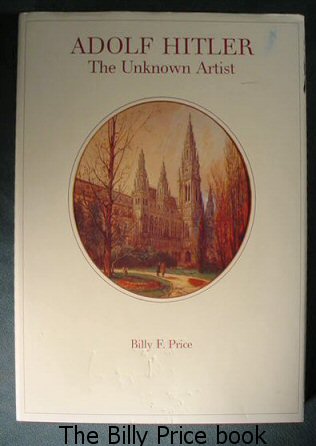
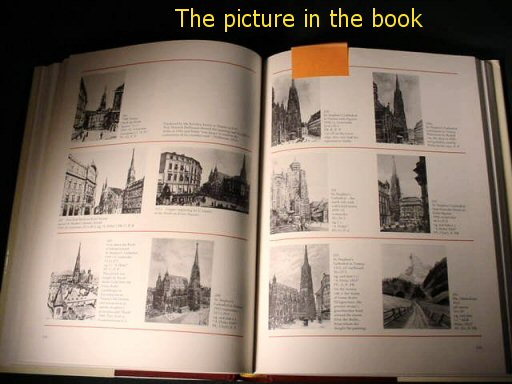
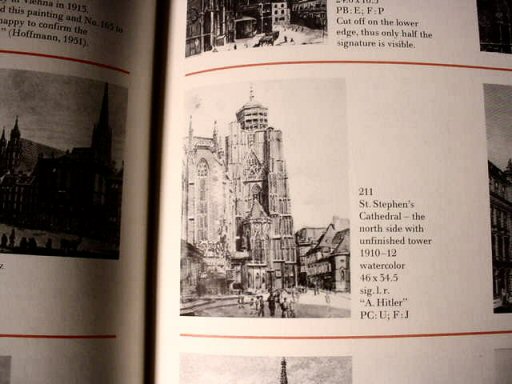
At Germania we strive always to bring you, the collector and historic connoisseur, the finest of relics of Teutonic importance. We could hardly match this one even if we tried as Herr Jahn has indicated this particular Adolf Hitler watercolor is exceptionally large and Jahn says it is the largest one known to him and that is saying something since probably 90 percent of these paintings were viewed by him at one time or another. Small paintings half that size, even without proper provenance, have brought very high prices, while Jahn- or Priesack-provenanced paintings in much smaller sizes have brought astounding prices at auctions. In 1985, the author Billy F. Price wrote a book called Adolf Hitler, The Unknown Artist. In this book Price, along with many prestigious researchers worked diligently to gather as much information about Hitler’s art as could be amassed. Mr. Price is a multimillionaire and he left no stone unturned regardless of expenditure to bring this wonderful informative book to print. Price made many contacts among Hitler’s surviving friends and persons who worked in the many governmental facets of the NSDAP and Wehrmacht witnesses of the Reich and its art forms. The 260-page coffee-table book is vastly replete with paintings, drawings, and other forms of art that have connections or were actually created by the German Führer. The artist was always inspired by the towering edifice of St. Stephen’s Cathedral (Dom) and on pages 138 and 139 there are 11 views of this magnificent House of God to include the very one we offer here. Price has given it the number ‘211’ and states that this is “St. Stephen’s Cathedral—the north side with unfinished tower, 1910-12 watercolor 46 x 34.5 (18 x 13.5 inches) sig. l.r. “A. Hitler.” Only one other of the cathedral is almost as large as this and it is the one pictured next to it described as “St. Stephen’s from the Stock-im Eisen Square 46.8 x 31.6.” For investment we could not even think of an item as prestigious or as historically important as this painting and with this totally unassailable provenance this has to be one of the greatest items we have ever had the great privilege and honor to present on Germania pages.

PRICE:  NO LONGER AVAILABLE


Adolf Hitler

Adolf Hitler

Adolf Hitler

Adolf Hitler

Adolf Hitler

Adolf Hitler

Adolf Hitler

Adolf Hitler

Adolf Hitler

Adolf Hitler

Hitler-owned 1939 Edition of Mein Kampf (Item AH 14-5)

DESCRIPTION: This is a truly rare edition of the Führer’s work. This very edition was the actual property of the German author and leader and was looted from the Berghof (Hitler’s mountain home) high above the sleepy town of Bertesgaden by a member of the American 101st. airborne Div. This “Stalwart” found it there and shipped it home to the U.S. with quite a few other books from the library that was practically the only room that was partially left standing after the SS blew the house up purposely to prevent its contents or structure from falling intact into the hands of the approaching Americans. The personal bookplate of Adolf Hitler is found inside the front cover. Not only is this a rarity because of its former ownership by (at just before that time) the worlds most powerful leader, but it is a rare edition on its own--published in English. Have you ever read this book and wondered if you are reading Hitler’s actual words or have certain important words been ‘treated?’ The change of a word can throw off the whole meaning of a paragraph or even an entire passage. In any case here in this rare book translated by James Murphy for the British public, every word is brought forward without the changes or annotations by anti-NSDAP writers. Mr. Murphy takes a completely unbiased position in his translator’s introduction as he structures briefly the reason Adolf Hitler wrote My Struggle. Murphy feels that it was a necessary book at that stage of the power struggles that were proceeding at that time between the left and the right. He very briefly covers the Putsch in Munich that led to the Führer’s incarceration and his feeling the need to compose the testimony that would pave the way to political power in Germany. Mr. Murphy was a realist of the times in 1939. The die was cast and Murphy’s nation, England, would soon be in war with Germany, yet this courageous researcher dared to publish this remarkable work where he (Murphy) said very positive things about the author and his movement. One of the remarkable things about this edition of Mein Kampf is that not only the exact words are translated exactly, but the whole physical look and structure of volume is a perfect likeness of the German edition. The cover is exactly the same with the gold-tinted eagle and swastika emblazoned upon it. The title page is laid out in the very same manner as the German copies with the exception that it is in English with the eagle bearing the ‘HB’ logo in the wreath standing for Hurst and Blackett, Ltd., which was the publisher in London. Within the second page there is the list that was made and published with black borders and here are the names of the martyrs who were killed on the November 9, 1923, with a facsimile of the signature of Adolf Hitler. The translator’s notes say it all to set the mood and explanation of the writings of this the world’s most beloved and hated man. The book is also of the standard size similar to the German edition—8 3/4 x 5 1/2 inches, and is 1 1/2 inches thick. The cover is in good shape with a very tiny bit of tattering at the edges of the spine. This is today considered the rarest editions by collectors. This is the only one we have ever seen in many years in this field and the fact that it was actually the property of the Führer himself make this an item of profound importance.

PRICE:  TRADED. NO LONGER AVAILABLE.


Adolf Hitler

Adolf Hitler

Adolf Hitler

Adolf Hitler

Adolf Hitler

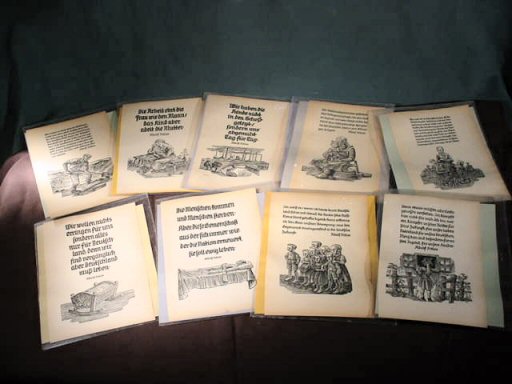
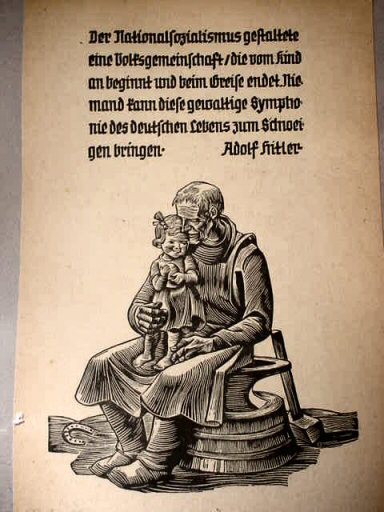
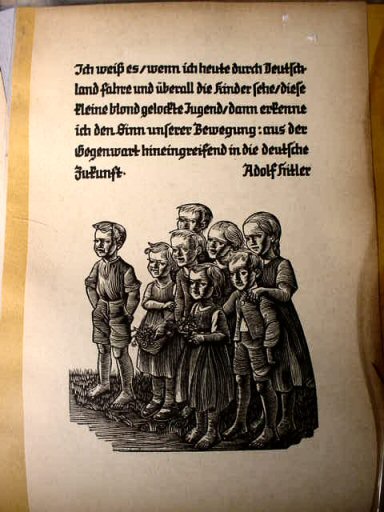
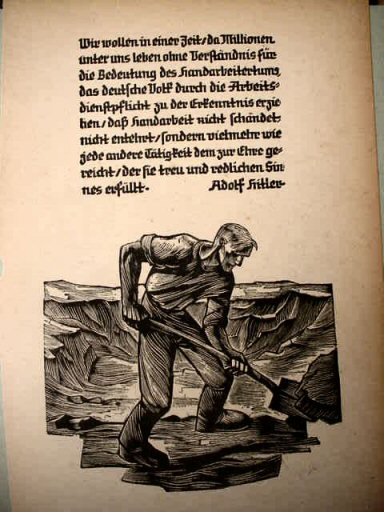
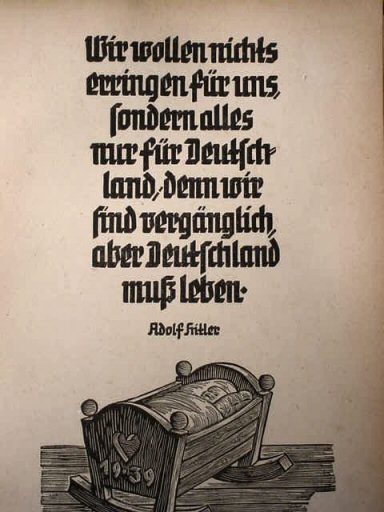
Group of Original Quotes of Adolf Hitler (Item AH 14-6)

DESCRIPTION: This is a grouping of original quotes from speeches of Adolf Hitler. These are absolutely original paper handouts from the actual era of the Third Reich. They were placed in plastic holders years ago by an early collector. They measure 5 1/2 x 8 inches. The plastic on some are a bit warped, but I’m sure will straighten right out when a heavy book or other flat object is placed on them.

PRICE:  SOLD


Adolf Hitler

Adolf Hitler

Adolf Hitler

Adolf Hitler

Adolf Hitler

Adolf Hitler

Adolf Hitler

Adolf Hitler

Adolf Hitler

Adolf Hitler

Adolf Hitler

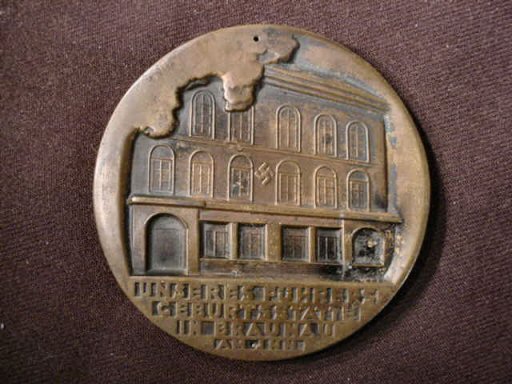
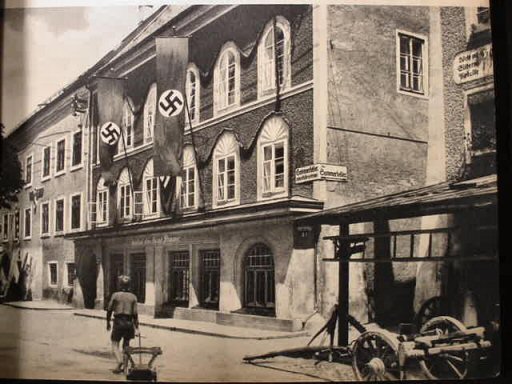
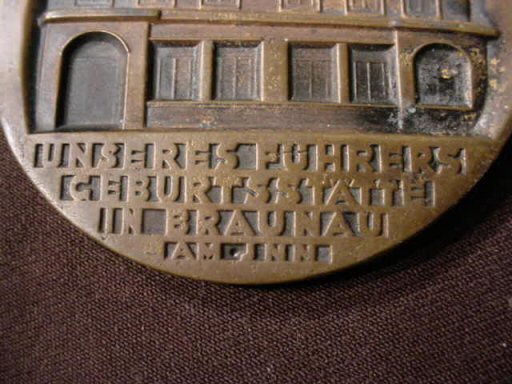
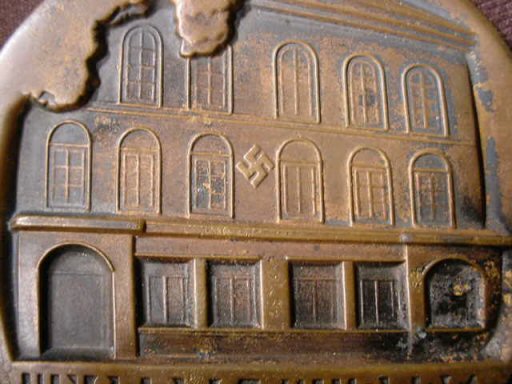
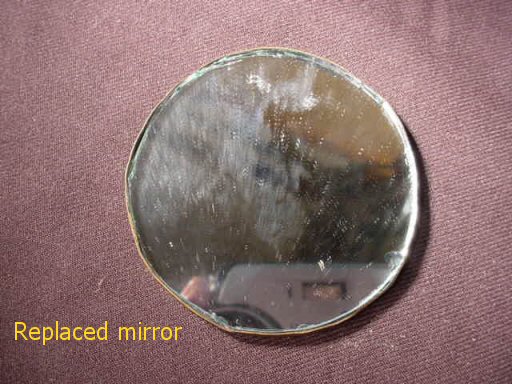
Hitler’s Birthplace in Braunau (mirror) (Item AH 14-7)

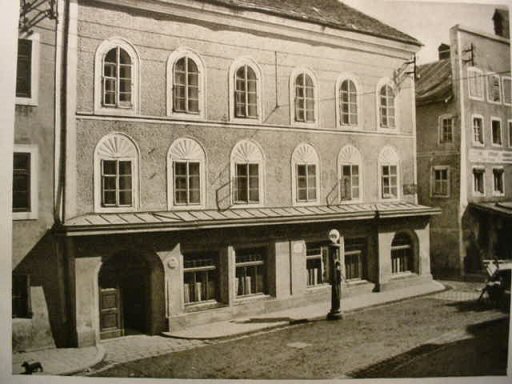
DESCRIPTION: This is a souvenir that used to be sold in Austria in the 1930s. It depicts the building where Adolf Hitler was born in Braunau am Inn on April 20, 1889. The swastika depicted there on the front of the house is in the middle two windows that were of the apartment where the birth occurred. The legend below is translated to mean: ‘Our Leader’s Birthplace in Braunau am Inn.’ The reverse side is a mirror, but it evidently was once broken and replaced. This is quite a rare little piece of 1938 Kitch. It measures 2 3/4 inches in diameter. It is of bronze material and is now considered very historically important.

PRICE: $275.00


Adolf Hitler

Adolf Hitler

Adolf Hitler

Adolf Hitler

Adolf Hitler

Adolf Hitler

Adolf Hitler

Adolf Hitler

Adolf Hitler

Adolf Hitler

Adolf Hitler

Adolf Hitler

Book from Adolf Hitler’s Library (Item AH 14-8)

DESCRIPTION: This book is entitled Mit Dem XIII. Armeekorps in Polen, With the 13th Army Corps in Poland. It was taken (looted) from the Obersalzberg Berghof, Adolf Hitler’s home in lower Bavaria, by soldiers of the 101st Airborne Division. Several books were taken and some of them were bought from a Detroit Michigan veteran of this unit. This one printed in 1940 traces the history of the 13th Army Group and is an Erinnerungsbuch, memory book, of their actions in the campaign against the Poles. It includes 80 pictures and maps to include depictions of the action, the soldiers, the commanders, the Führer, and the victory parade in Berlin after the successful campaign. It comprises 64 pages in all. The book measures 9 x 12 inches and is in remarkably good shape. It is an authentic Hitler relic probably given to him by the commander of the 13th. It has archival importance as well as being a treasured addition to a WWII collection.

PRICE: $785.00


Hitler


Page One

Page Two

Page Three

Page Four

Page Five


Page Six

Page Seven

Page Eight

Page Nine

Page Ten


Page Eleven

Page Twelve

Page Thirteen

Page Fourteen

Page Fifteen


Page Sixteen

Page Seventeen

Page Eighteen

Page Nineteen

Page Twenty


Page Twenty-one

Page Twenty-two


Contact Us

Please refer to item designator in parentheses in all correspondence.

Please E-mail for any additional information you may need.

If you prefer, contact 'Germania' at PO Box 68, Lakemont, GA 30552
or call at 706.782.1668.


Please! do not call during the wee hours of the morning. The best time for calling us is between 9 and 11 am and between 9 and 11 pm eastern time.