
|
|
|
|
France
Page 4
|
|
|
|
|
|
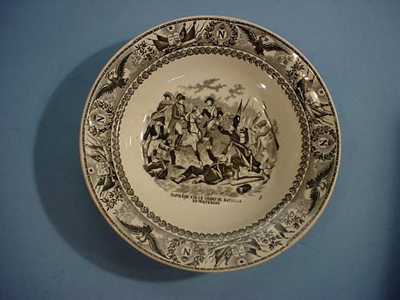
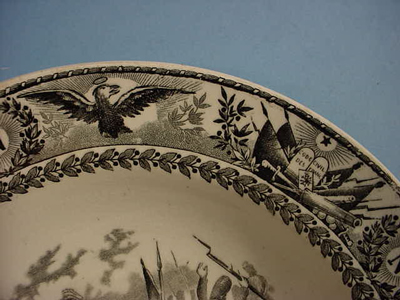
Napoleon Plate (Vive La Emperor) (Item FRAN 4-2)
|
|||
|
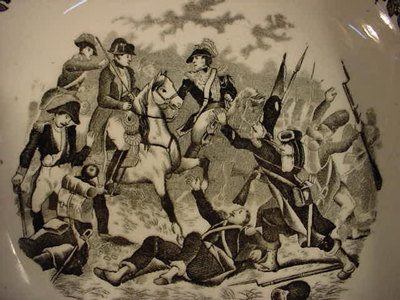
DESCRIPTION: This is a nice 8 ½" diameter plate depicting Napoleon and his soldiers in battle pose. Around the edges we
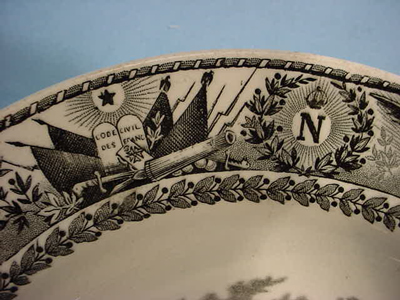
encounter flags, bayonets, cannon, and the crowned (N) representing Napoleon with the laurel wreath of Victory. We believe this is a decorative
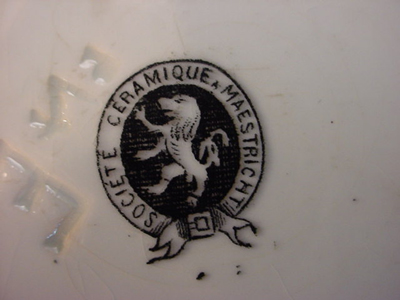
collector’s plate from the turn of the century. The mark on the back is a rampant lion and the words in French or Dutch that translate to
Germanic society in Maestricht. This would indicate a specially made piece of porcelain with limited issue or perhaps unique?? PRICE: $125.00 |
|||
|
|
|
|
|
|
|
|
 Artist's signature |
|
|
|
|
|
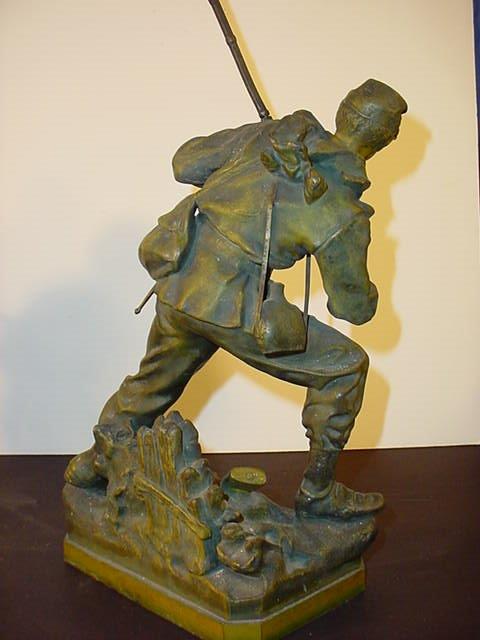
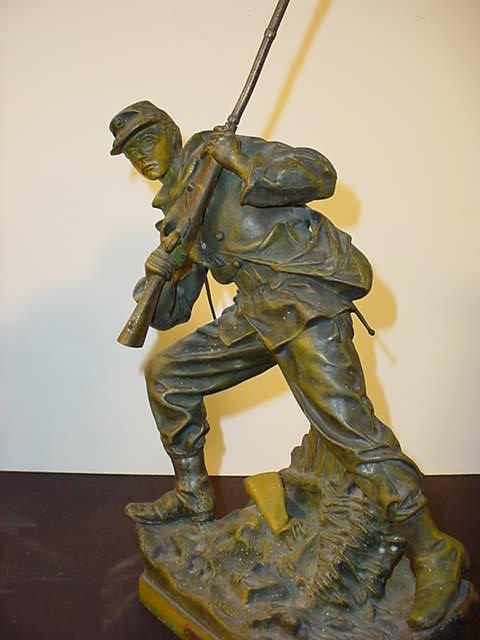
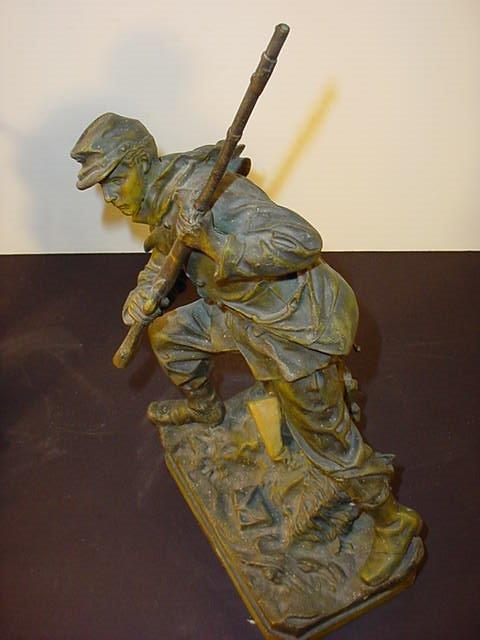
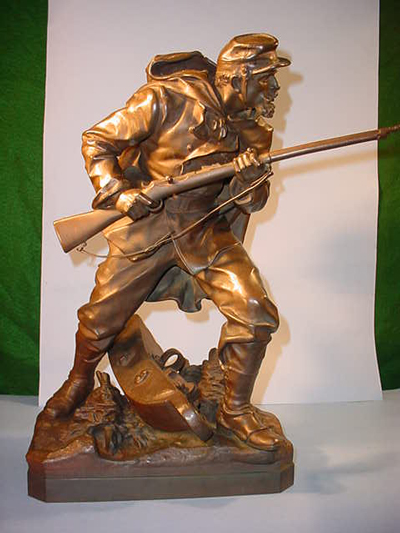
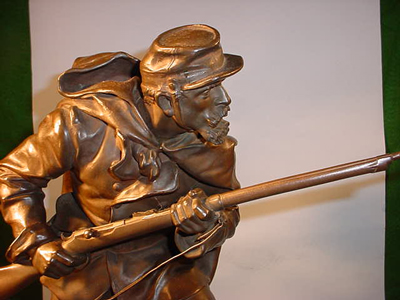
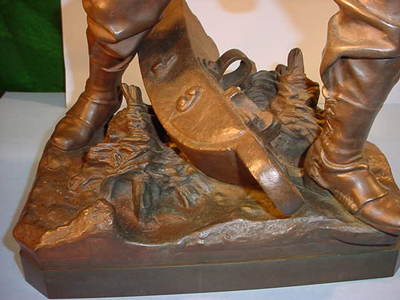
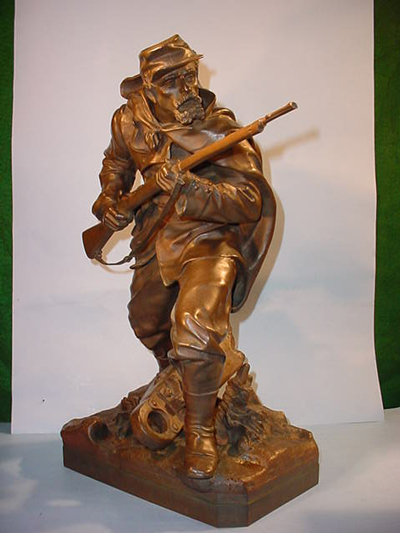
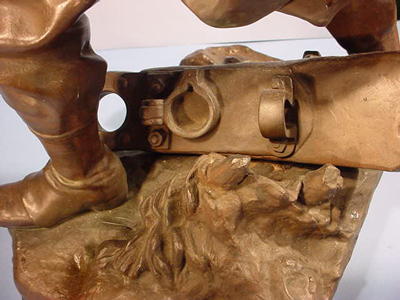
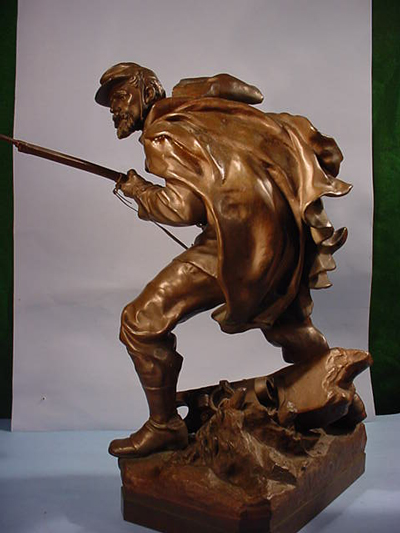
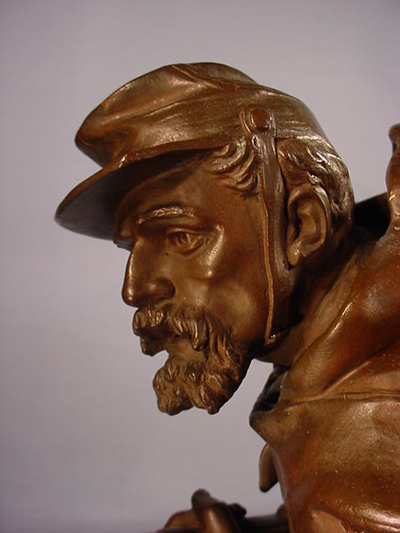
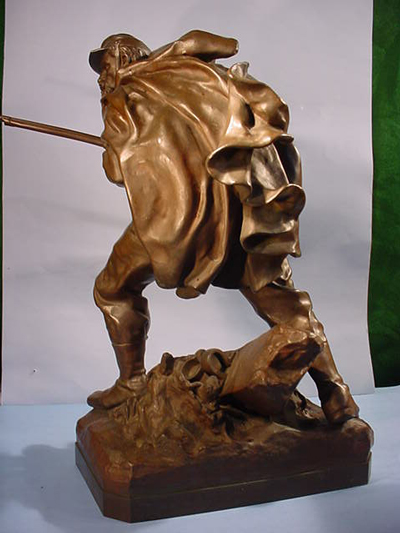
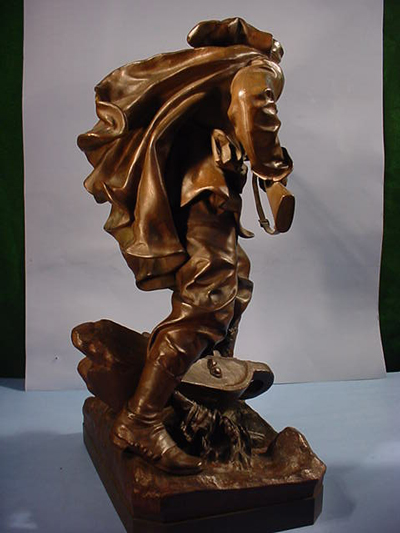
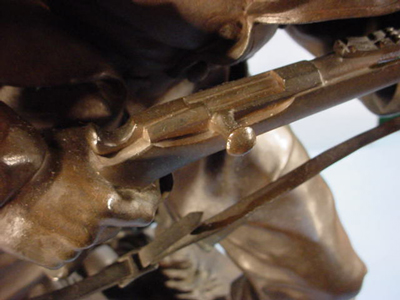
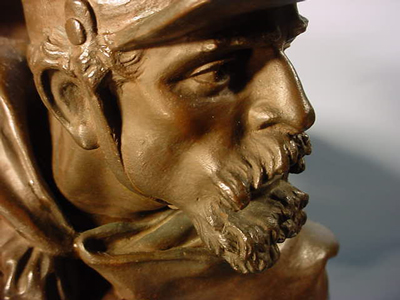
Huge Bronze Sculpture of 1870 French Soldier by Aristide Croisy (Item FRAN 4-3)
|
||||
|
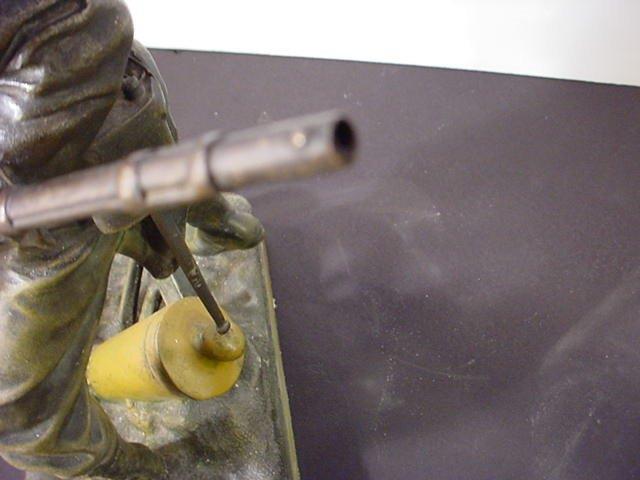
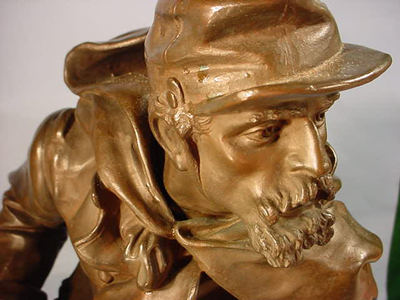
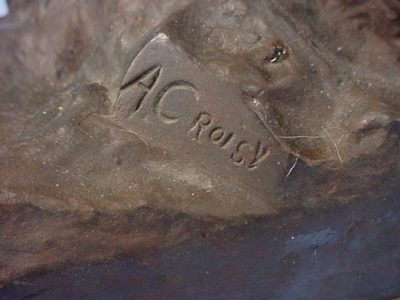
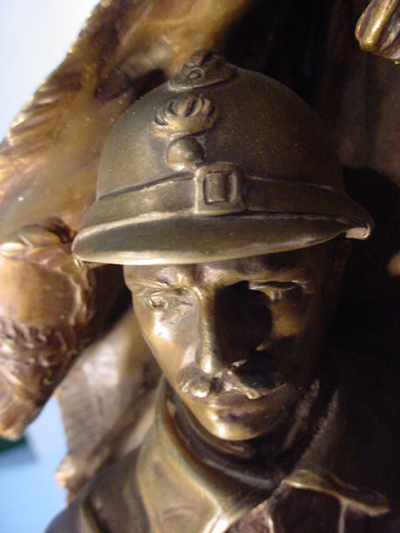
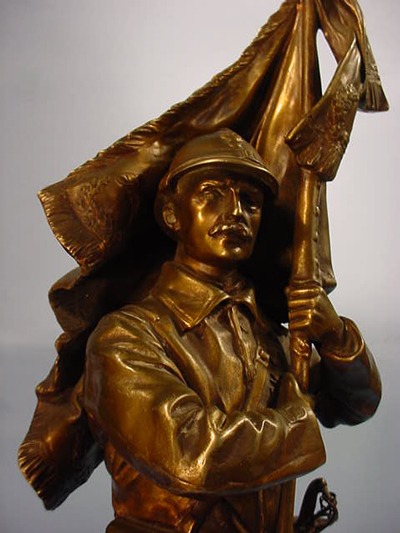
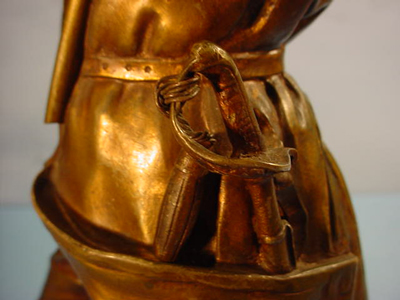
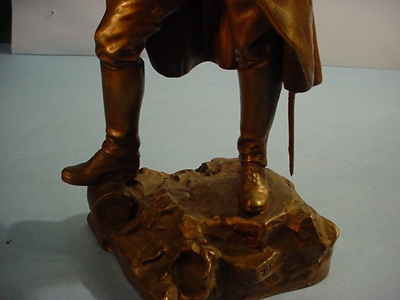
DESCRIPTION: This is a monumental bronze statue by the famed sculptor Aristide Croisy born in Fagnon Ardennes. He was a pupil of the great sculptor Toussaint. He received prestigious medals of the Salon 1873, 1882, and 1885. He was honored with the Legion d’ Honor in 1885. He was a prolific artist turning out many hundred of bronze statues in his career. Some for official government sources. He was most famous for military subjects. His l’Invasion group was world famous. This was a two part set depicting a French soldier and the other part was a French sailor both at the ready with rifles. This one we offer is one of his most famous sculptures. It depicts a French 1870-period soldier foraging with rifle in hand. It is most accurate and the fine detail is wonderful. We said it is large!! Measures 20” high including the base. The rifle he holds is 16" long and the base is 8" x 12" in size. The soldier is 15 ½" high. It is signed by the artist and is very heavy! This is a true museum piece extraordinaire! PRICE: SOLD |
||||
|
|
|
|
|
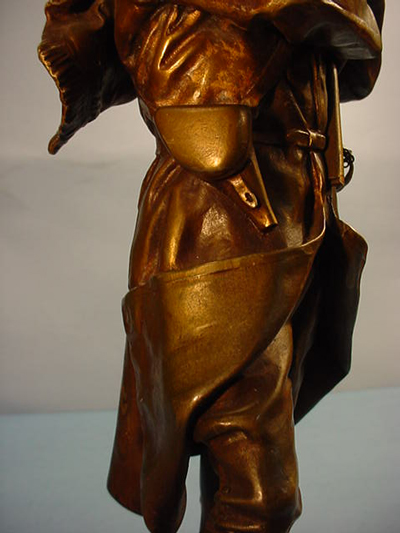
|
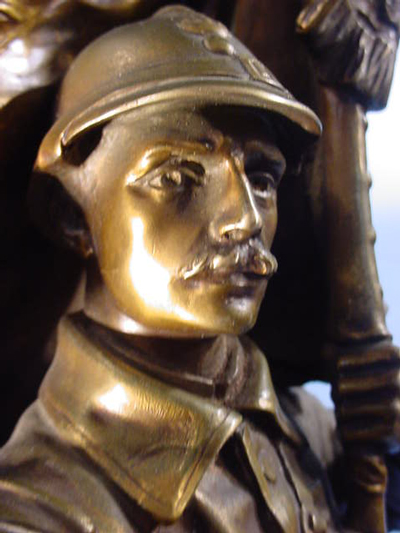
|
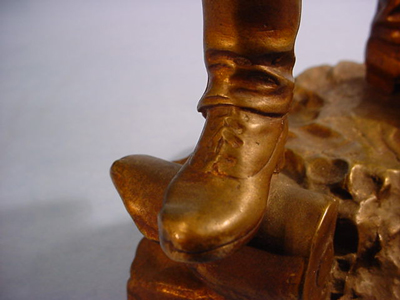
|
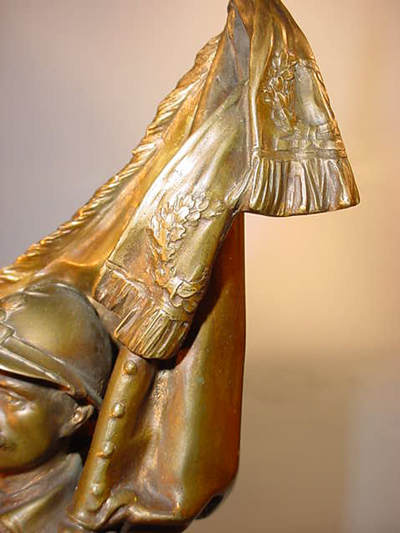
|
 Artist's signature |
|
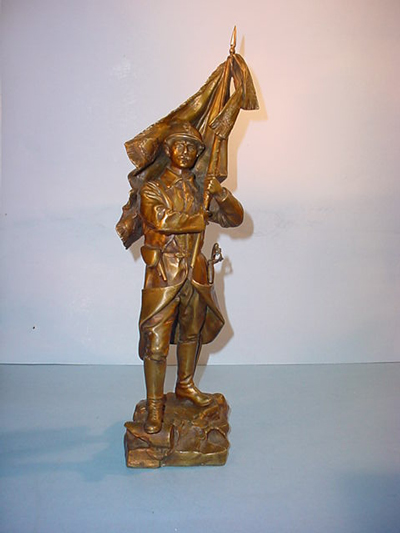
A Bronze Figure of a French Soldier with Standard (World War I) (Item FRAN 4-4)
|
||
|
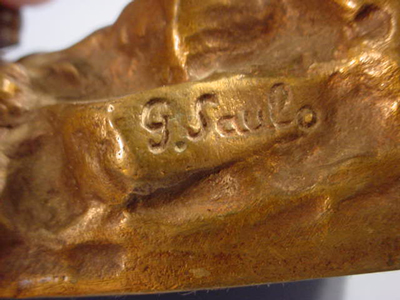
DESCRIPTION: This bronze sculpture is magnificent in its patriotic depiction of a “Poliu” officer. The detail is wonderful and prodigiously accurate. The statue stands about a foot high and is signed G. Saulo. This was George Ernest Saulo, one of the greatest sculptors of military art in the 19th century. He also sculpted many feminine figures depicted in the nude. This statue we offer here is nothing short of great. It depicts a hope of Glory that was won in WWI and dashed to the ground in WWII by Hitler’s Wehrmacht 1940. The soldiers of WWI France were, with a few exceptions, not Napoleon's Old Guard. The Grande Armee was past tense, but don’t tell this guy that we offer here anything like that. His love for l’Belle France is obvious. At the end of the day this is truly a really fine art piece. Absolutely museum quality! It should be featured all by itself in a lighted glass showcase prominently displayed, it is actually that good. PRICE: SOLD |
||
|
 Captain Cole, Royal Navy |
|
|

|
|
 Note missing silver |
 Old replacements |
|
 Note slight patching |
 Slight patching |
|
|
|
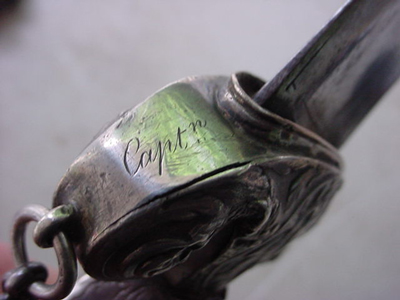 "Captain" |
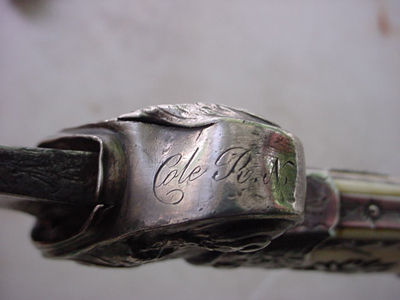 "Cole, RN" |

|

|

|
|

|
|
|
|

|
|
A Beautiful French Hunting Cutlass Captured in Battle |
||||
|
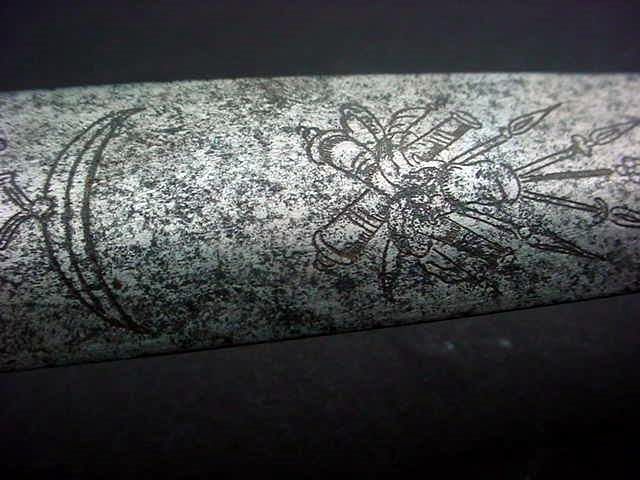
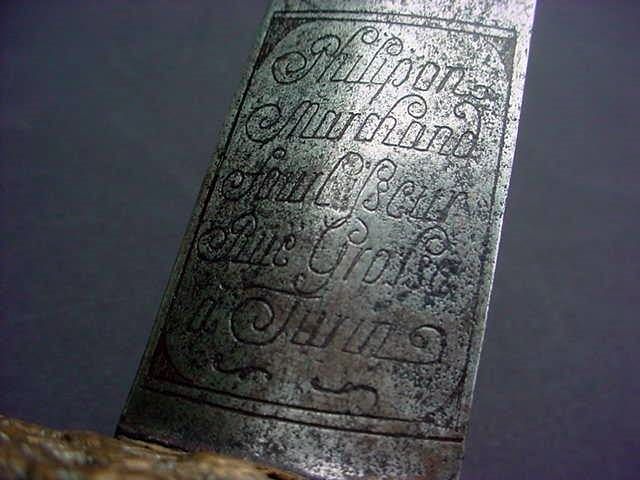
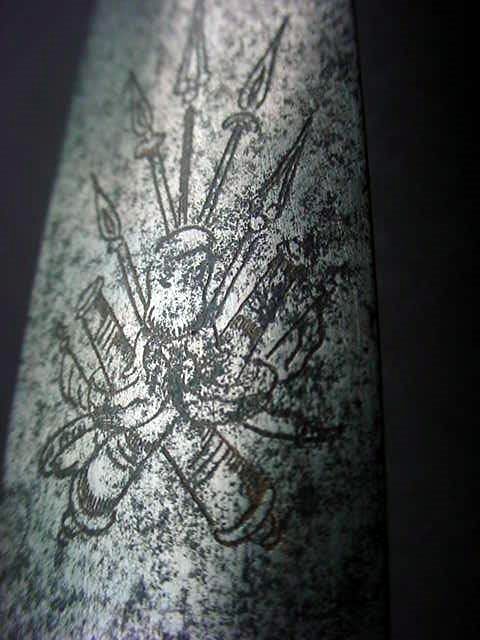
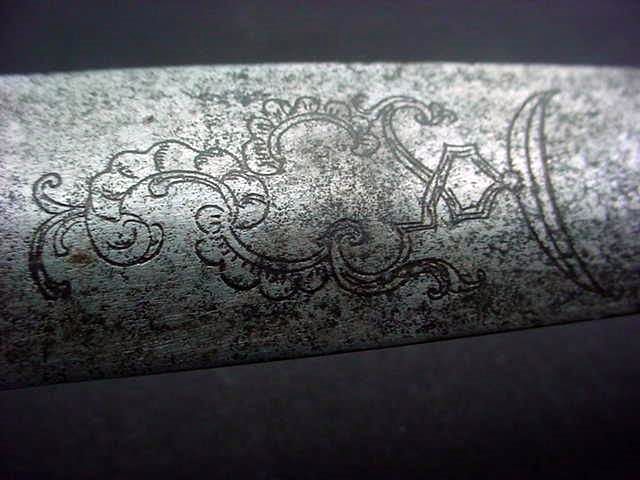
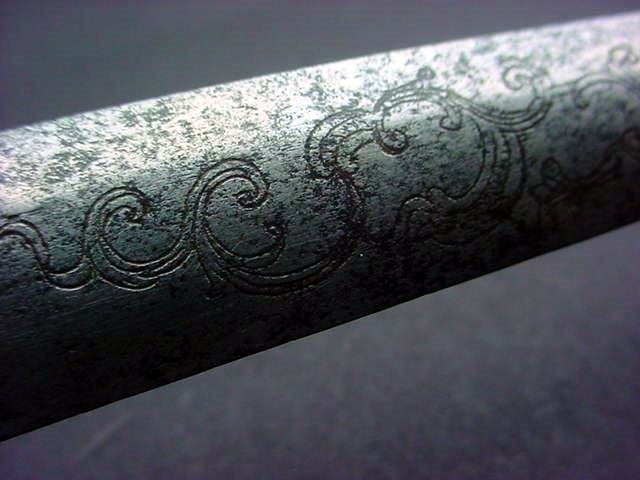
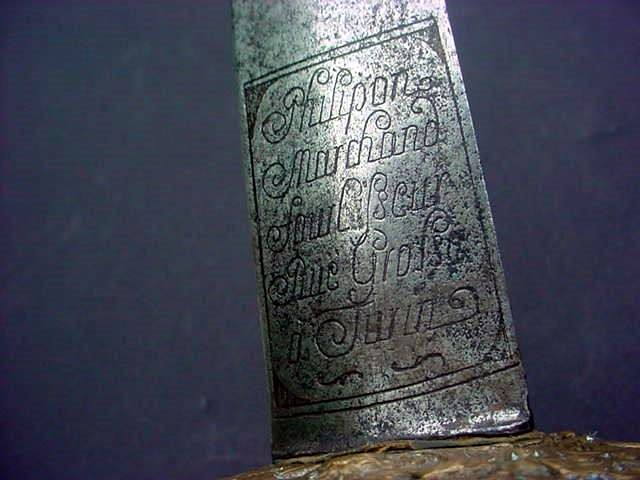
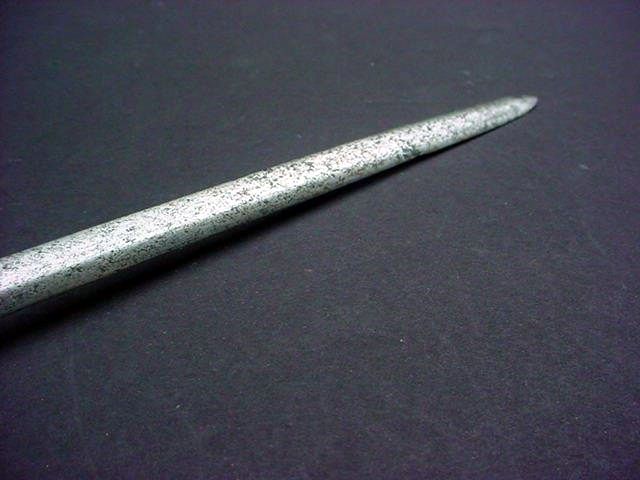
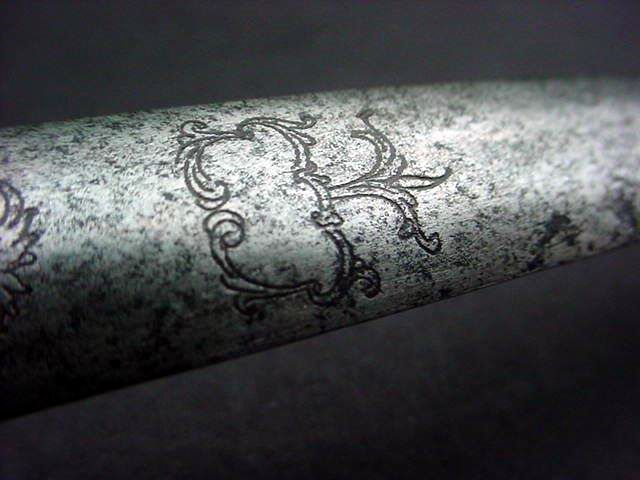
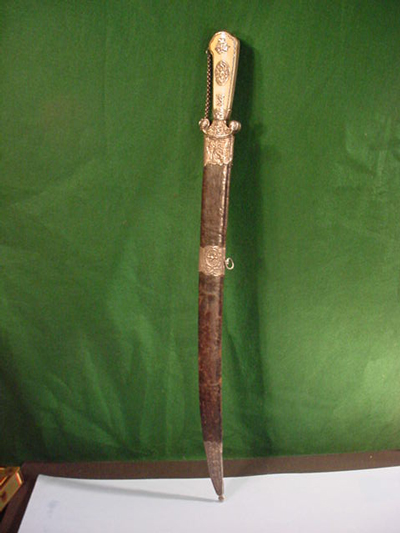
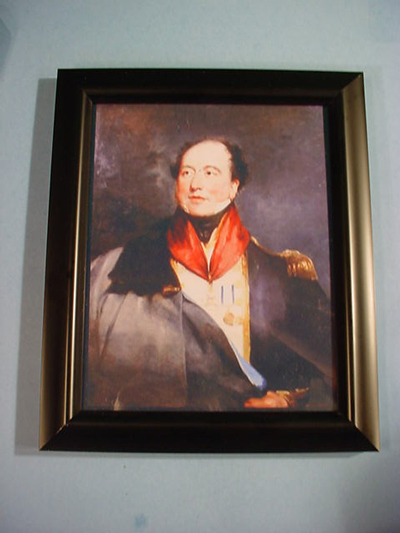
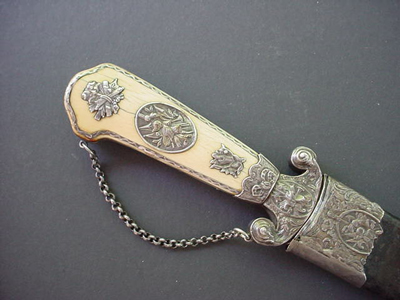
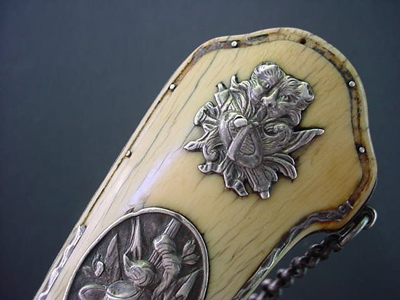
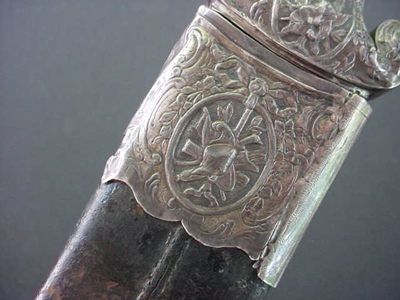
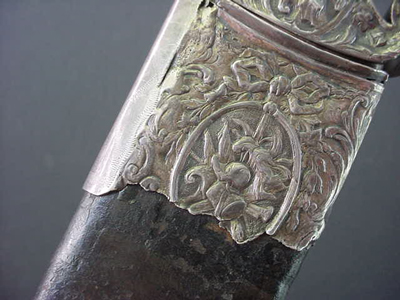
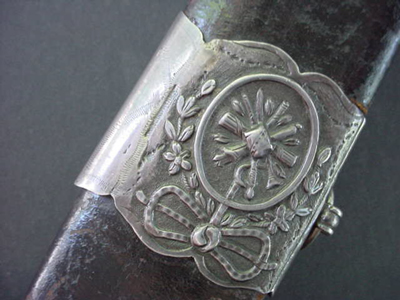
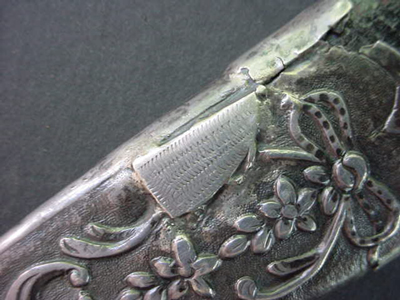
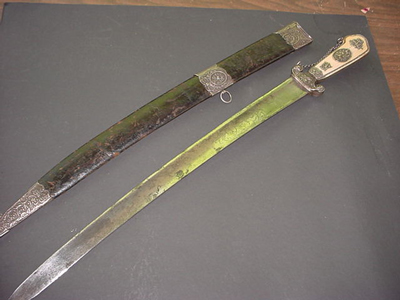
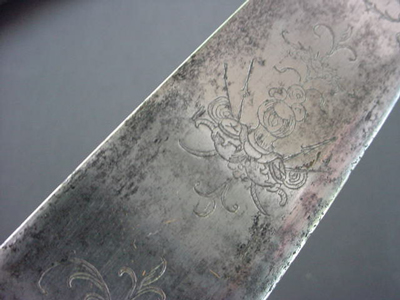
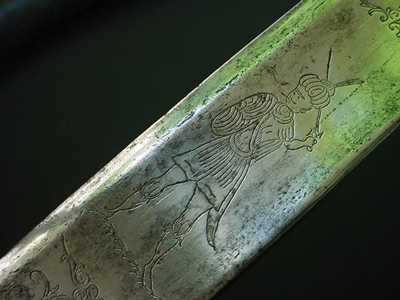
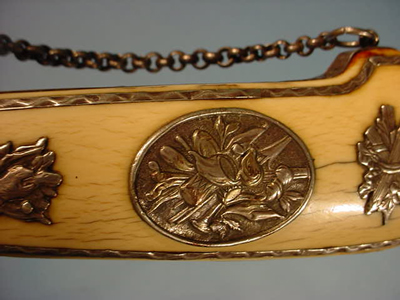
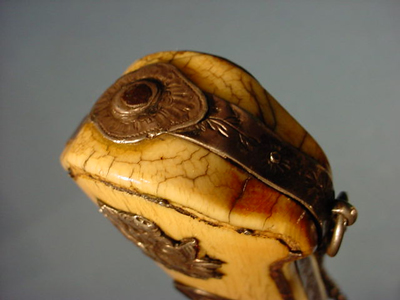
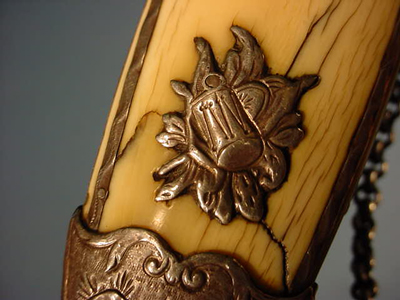
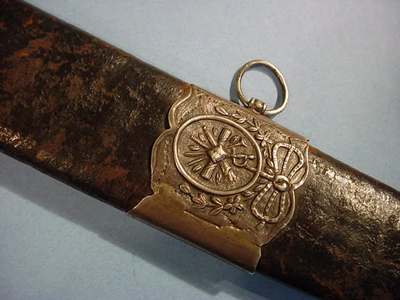
DESCRIPTION: This is a wonderful museum piece (personified!). It is a French hunting sword that is bone and silver mounted, possibly dating back to the 17th century but could be as late as 1750. This weapon was captured by Captain Sir Christopher Cole of the British Royal Navy. Captain Cole was the skipper of the famed HMS Caroline and the Rippon, a 36 gun frigate in service against the French and earlier against the Dutch. The internet is replete with the adventures of Captain Sir Christopher Cole so we will not explore his illustrious career here at this time. He served as a Member of Parliament after his life of high adventures on the sea had ended. He had also served in the rank of Colonel in the Royal Marines. He was invested as a Knight Commander (Order of the Bath) (KCB) in 1814. The sword or hunting weapon that we offer was captured from a French Captain during Captain Cole's many daring sea engagements. The style of hunting sword is longer than the usual and quite fancy indeed. Why would a French Captain be armed with a hunting sword instead of a naval sword? This is a speculative question but it can be supposed that it was a family heirloom and probably from a family of aristocracy as this weapon was obviously made by a swordsmith of the ‘master craft.’ The beauty of it is obvious. And please pay attention to the standing Turk on the blade that is commenserate with the memory of Prince Eugene of Savoy who defeated the Turks at the Battle of Vienna. Prince Eugene was born in Paris and was a hereditary Prince of the Royal House of Savoy. The French had a love/hate relationship with the Turks and Muslims, using them as allies from time to time but also fighting them in other eras. But many of the weapons of Austrians, Hungarians and the French often depict a fierce Turk in the blades of especially these styles of hunting weapons. The shape and style of the sword is very Islamic looking and this was favored by the French noble classes. We earnestly believe the French Captain who surrendered to Captain Cole was of French gentry at least, and Capt Cole treasured the sword enough that he had his name and R.N. (Royal Navy) engraved under the cross guard. (Shown in our pictures). We also believe this to be more than likely a mid-17th century sword (maybe 1650 or so.) It is of sword length -- 31" long in its scabbard. The beautiful silver decorative plaques that lie upon the gorgeous bone grips stand out boldly. The silver fittings on the scabbard are at some places repaired with silver overlay -- the scars of battle? Probably! The blade is about 21 ½" long and except for some old antiqued rust spots, it is quite excellent for its age and past usage. It would be rated as (museum grade excellent) and for a weapon of this age to have its leather and wood scabbard still there and fine is the incredible bone grip, but it has the minute age cracks to be expected on a weapon as old as this one. Back to the blade... it has about 8 engraved pictographs including the Turk. Some of the engraved parts at the base of the blade where it meets the cross guard are quite worn indicating that it was drawn often and used possibly through the many years. This was not the weapon of any peasant or even a lower class noble; it was surely the property of a highly placed Royal personage or at least fabulously wealthy landed gentry. It’s a superlative weapon worthy of display in the finest museum or very advanced collection. We have handled many fine pieces at Germania but this one is worthy of bragging about. A sword of elegant beauty but also it has the distinction of having belonged to a French officer and an illustrious British sea-going Knight of the Bath and M.P. Fantastic! PRICE: SOLD |
||||
|
|
|
|
|
 35 caliber? |
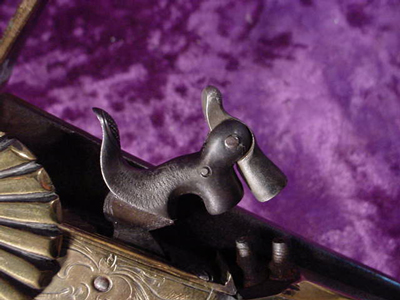
|
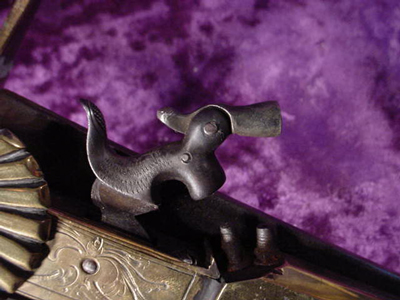
|
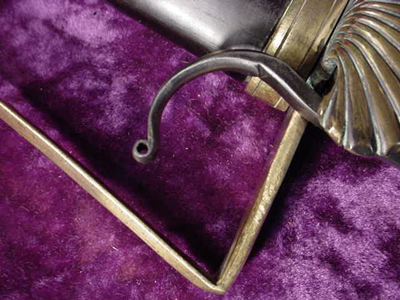 Trigger |
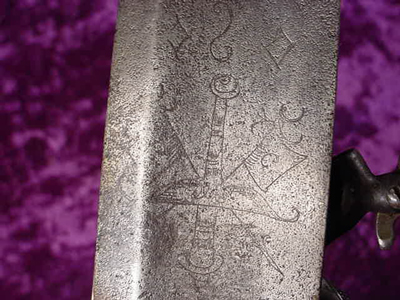
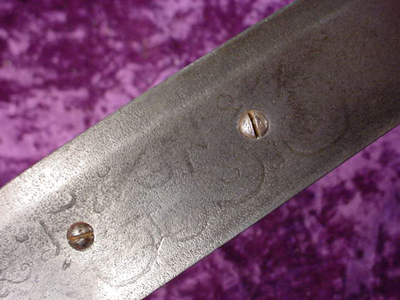
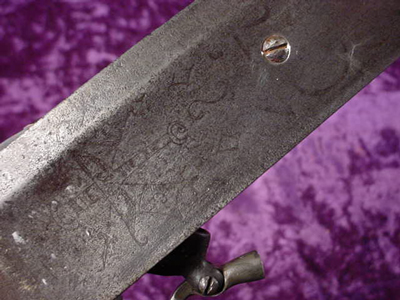 Blade engraving |
|
|
 Back side |
|
|

|
|
|
|
|

|
 Signature |
|
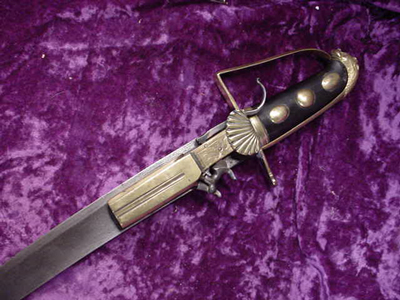
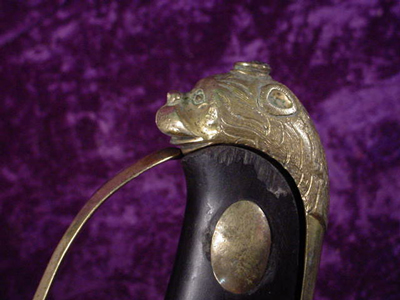
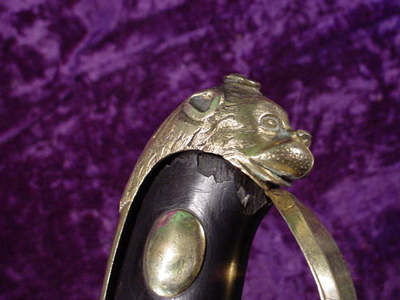
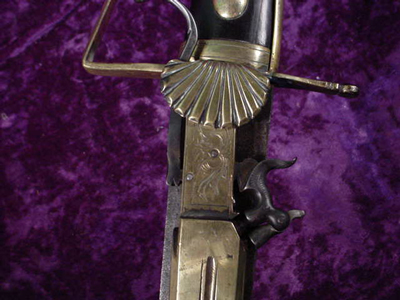
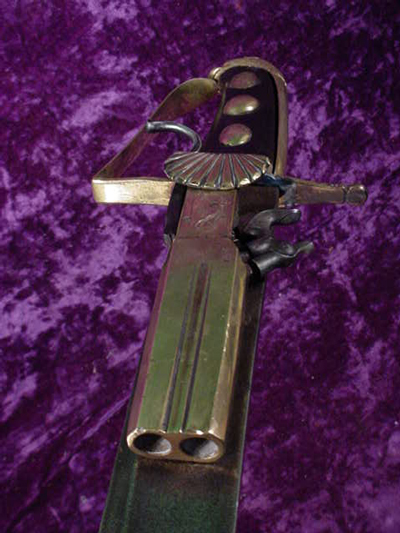
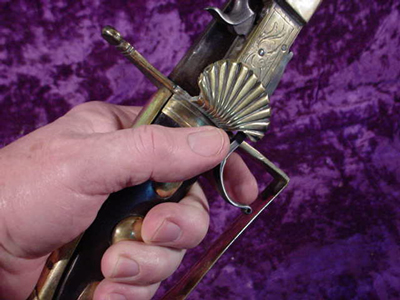
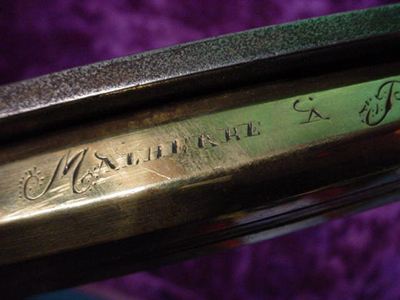
French Double Barrel Combination Weapon (Pistol & Sword) (Item FRAN 4-6 & KWEP 4-10 & HUNT 8-2)
|
|
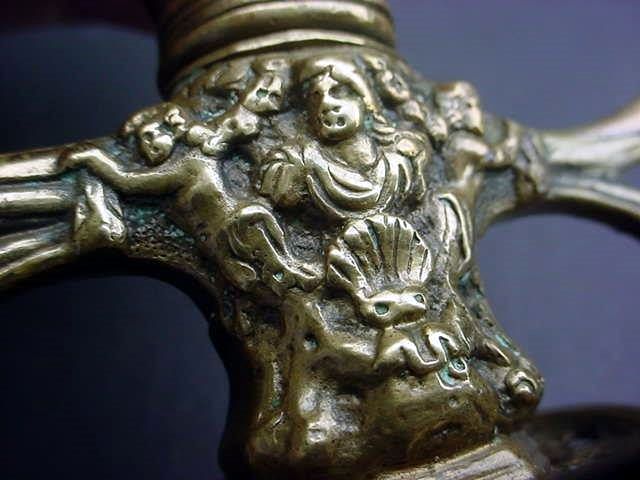
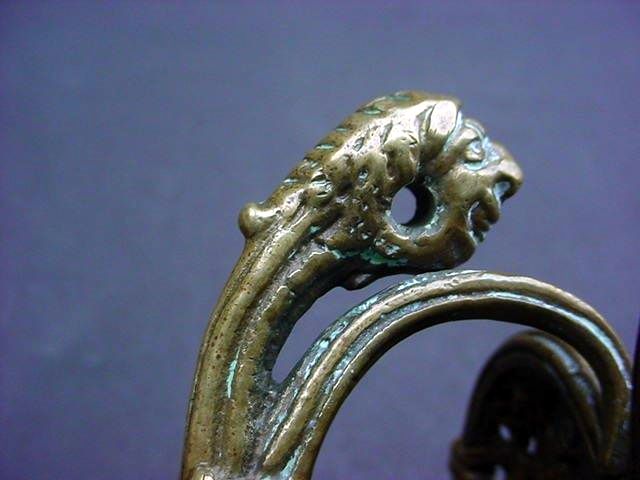
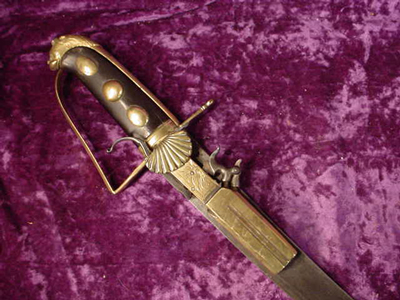
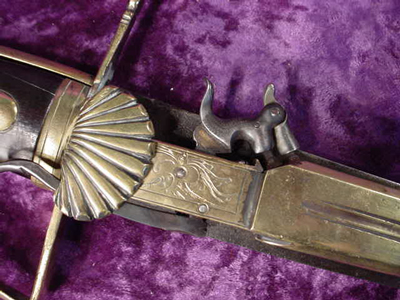
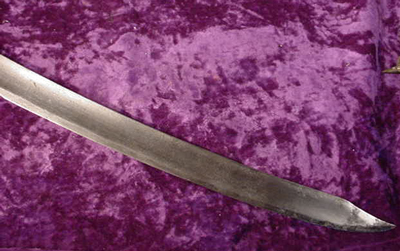
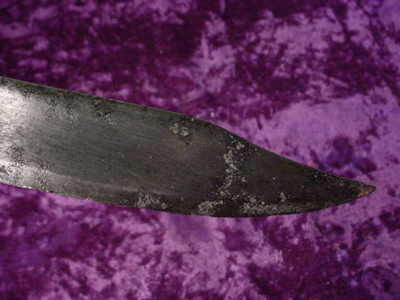
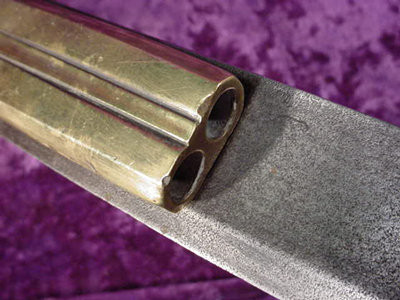
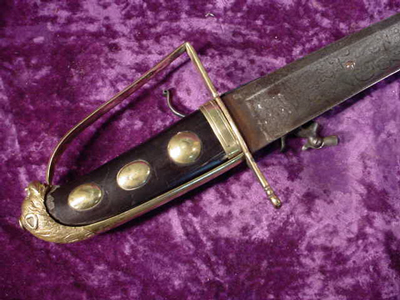
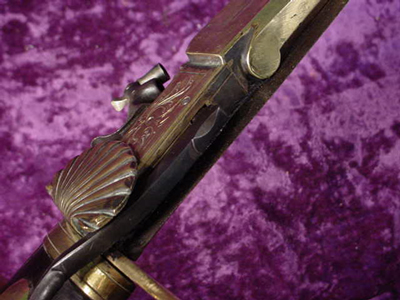
DESCRIPTION: This is a true rarity deserving of the cover of a prestigious gun magazine perhaps? A combination sword or dagger & gun. These combination weapons are scarce enough but to find one with an over and under pistol as the accoutrement is “super rare.” It constructed with all brass fittings and the grip looks like a Napoleonic Sword of the cavalry regiments with horn grip or perhaps it is ebony? The brass guard supports a lion or panther head at the top. The brass clamshell hand guard covers part of the flint lock action. It has a very unusual trigger device as well. The piece was made probably by a professional weaponry blacksmith shop. It is signed by the maker in Paris. The action is inventive and very different. In one of our pictures supplied herein you can see the percussion hammer and if you look closely you can see that it has two strikers -- one top and one on the bottom. You can also see two nipple posts where the percussion caps are placed. When the first barrel is fired, the shooter can then in turn swing the hammer seen at the top downward thus enabling the hammer to strike the 2nd nipple post thus firing the 2nd barrel. Now and then these combination sword and gun ensembles are to be encountered in famous collections but never have we seen one like this. This example is prodigiously rare in the extreme! It probably dates in the 1860’s or earlier. Weapons such as these were used by hunters but also in warfare and also by police detachments. The piece may have had a scabbard but that is history. Another usage for something like this would be utilized in sea service either the kings navy or possibly by pirates? Perhaps that is why the fittings are brass that is less likely to be affected by the damp sea atmosphere. In that case it would not have a scabbard -- rather it would be stowed in the Captain’s cabin as a ready weapon to be used in the case of a possible mutiny. The possibilities are numerous but surely romantic saga has attended this magnificent double purpose sword. Of this we can only speculate but we can be assured that is a worthy museum piece that should be in a great collection. Details: 30 inches long overall, blade 24 inches, the double barreled pistol is 6 inches long, the grip with the clamshell guard is 7 inches long. PRICE: SOLD |
|
|
|
|
|
|
|

|

|
|
|
|

|
|
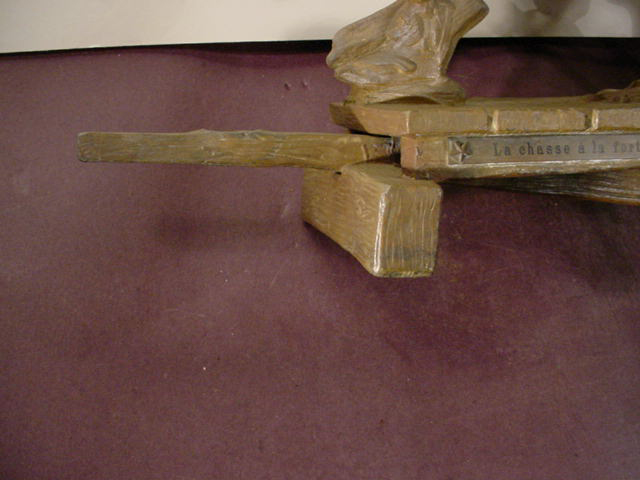
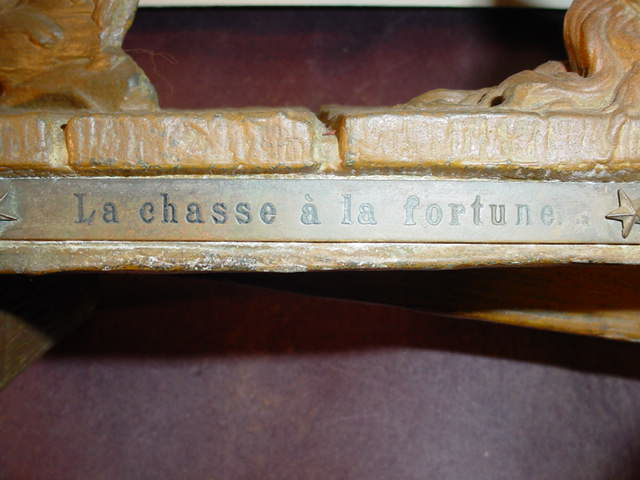 The title plate |
|
|
|
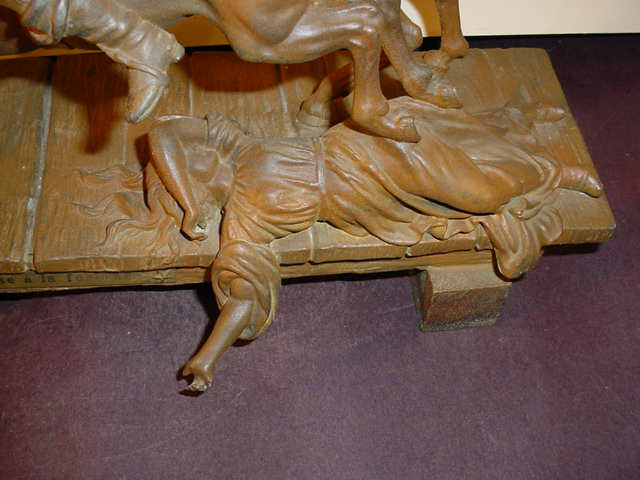
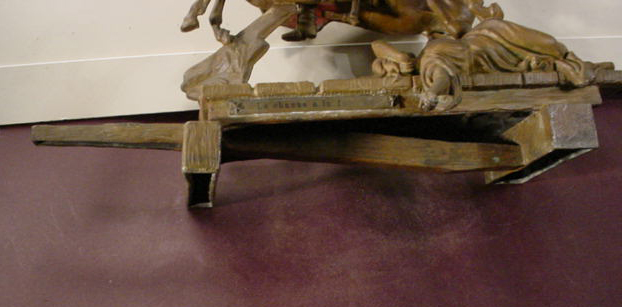
 Note the bridge base |
|

|
|
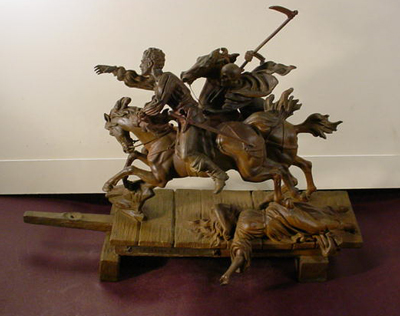
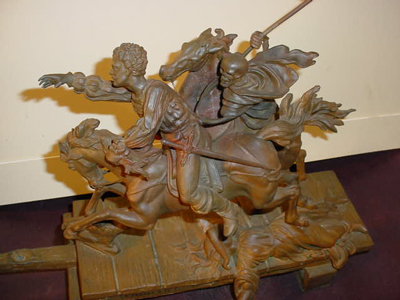
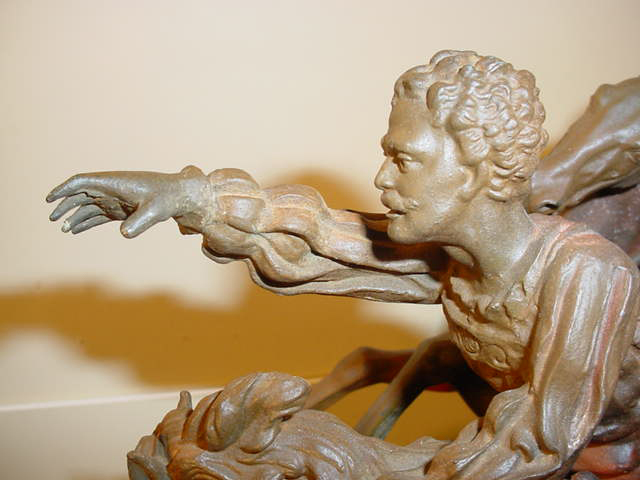
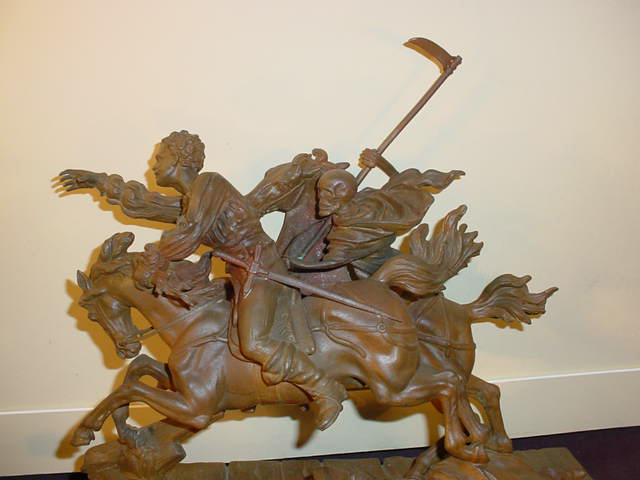
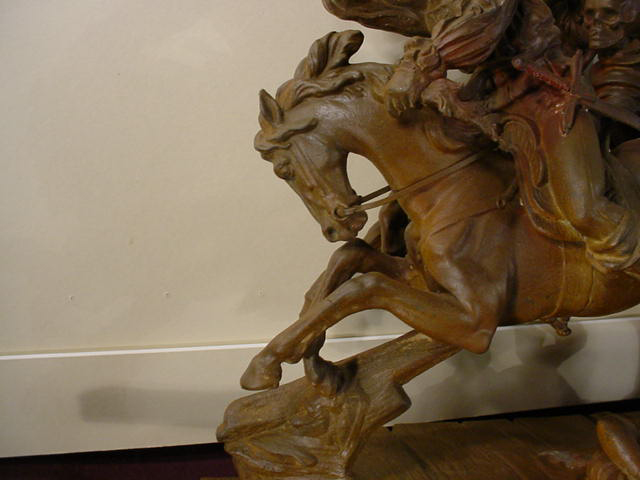
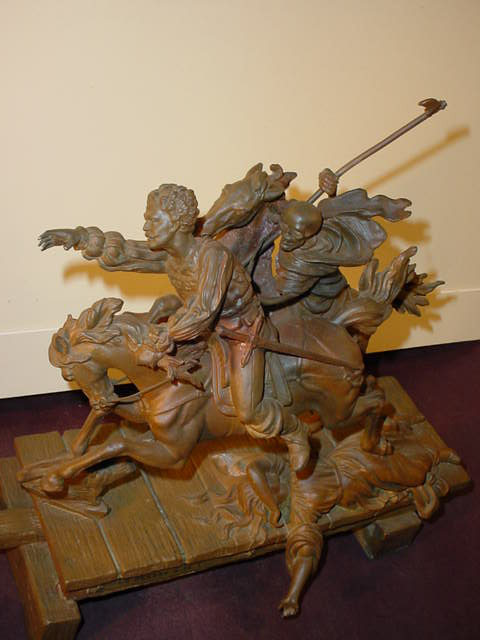
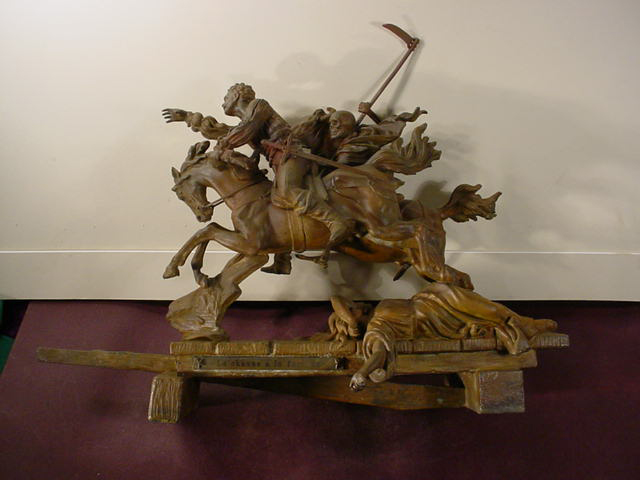
Incredible Statuary Grouping Taken from a French Army HQ in 1940 (Item FRAN 4-7 & WEHR 32-1) |
|
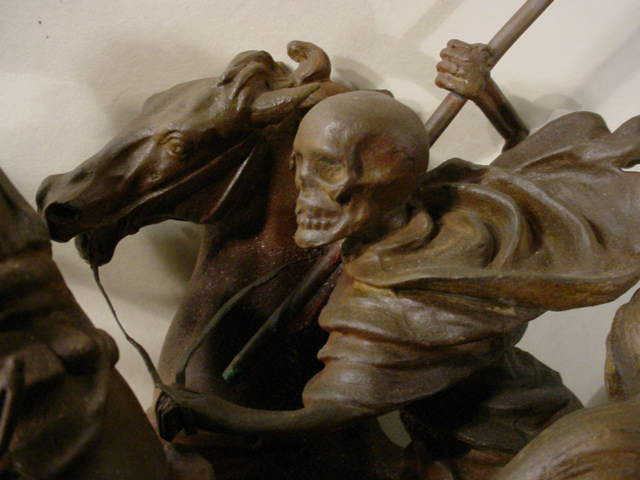
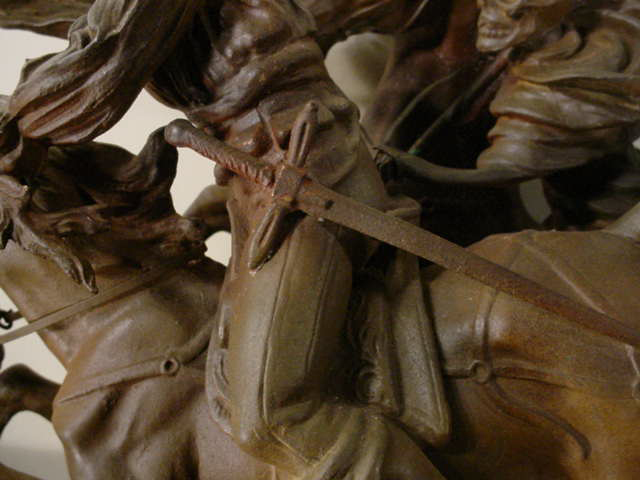
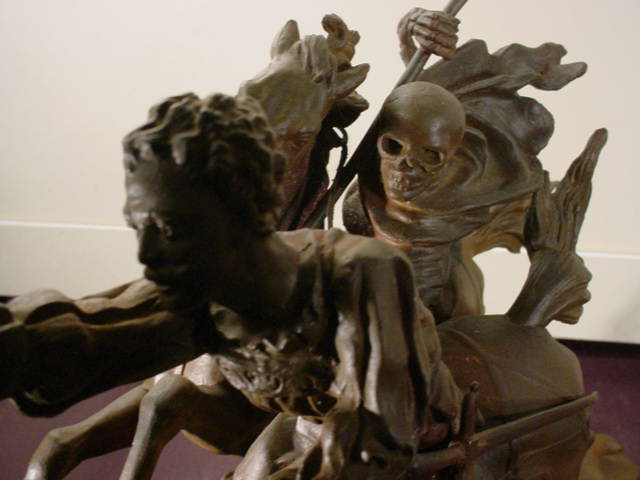
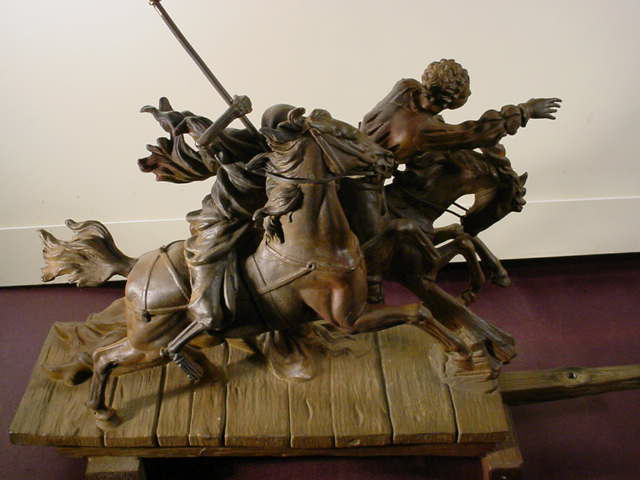
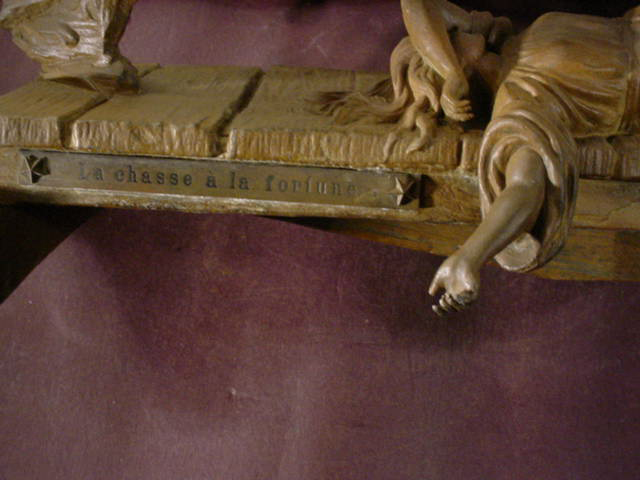
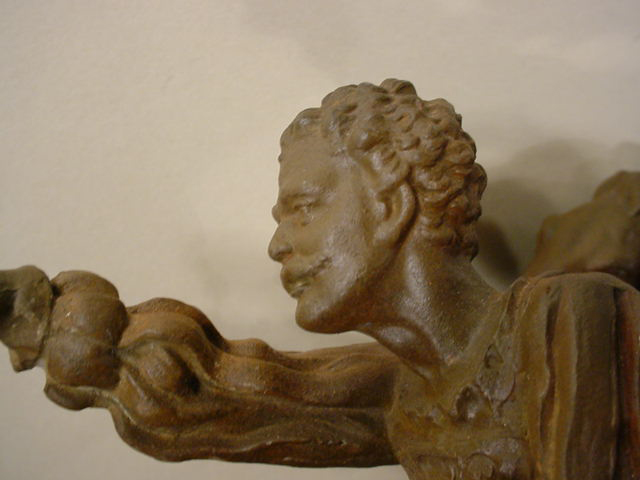
DESCRIPTION: This is a wonderful sculpture executed in iron that was a German officer’s trophy in WWII. We met the widow of this officer at an antique show in Stuttgart Germany last year and found out that she had this sculpture group. After the conversation with her we arranged to go to her apartment in Berlin a week later where we managed to negotiate and purchase it. It is a fantastic artistic sculpture that depicts a scene of morbid but romantically exciting sequence with three central figures and two horses. The piece was taken from a Field Headquarters connected to the Maginot line, Frances seemingly impenetrable defensive fortification. The sculpture was on a desk that was used by a Commanding officer in what was referred to as a ‘Petits Ouvrages’, a small adjacent fortress compound that reinforced the line of infantry bunkers that served for barracks, electric generator centrals, mess halls and officers’ quarters. After the German onslaught that ran over all French defenses in a matter of days in May of 1940, it is presumed that the unexpected happened so quickly that the French officer fled with practically none of his personal possessions other that the clothing on his back. Our German officer felt this was a fine trophy of war and he obviously did not sling it into a field pack (note: condition!) He carefully hauled it off to Paris and after packaging it very carefully he sent it intact to his wife in Berlin. The subject is noted on a plaque at the bottom of the base: La Chasse a La Fortune – this translates to roughly – ‘Hunting for Fortune’. To try to make sense of this statement can only be extrapolated by viewing the subject. (Suggestion) We have what looks to be a military man on horseback fleeing for his very life from the also mounted Grim Reaper who bears a great scythe and seeks to cut our hero down with it. Lying on the base is the figure of an obviously deceased maiden whose lifeless arm extends over the planks or base. (Artistic excellence!) (Theory) Could this in its depiction demonstrate the fortunes of greed? Could this cavalier have lost his lover through his quest for fame and fortune and now flees from the just retribution that is now at hand? Would you have a better theory? In any case, it is a most unusual subject and very possibly it is entirely unique. We have studied and merchandized bronze and iron sculptures for many years in America and in Europe but never seen anything like this. Cast iron figures are just as popular as bronze and often better detailed. This is certainly an example of the finest in this art form. The base is 13 inches long. The base is made to depict a plank bridge with realistic looking boards joined together. The measurement of the figure is for instance 12 inches from the bottom of the bridge to the top of the cavalier's head. There is an extension of the base that extends out the front that has a hole in it. Why??? This stumps us completely. Was it a place for something additional? Or, was it part of the legend? Only the artist would know and he probably belongs to the ages. So dear collector, here is our chance to own something not only historically important but presumably unique and ascetically stimulating. PRICE: SOLD |
|
|
|

|
|

|
|
|
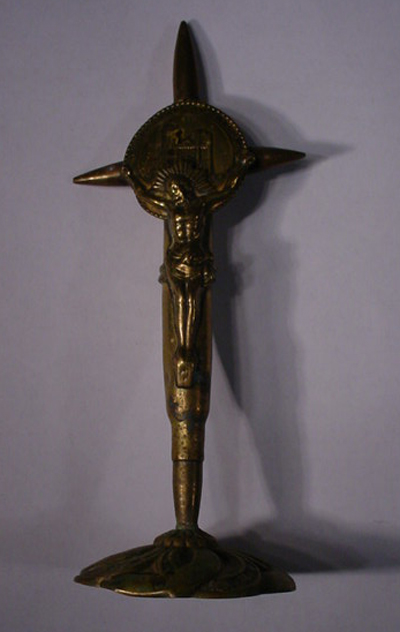
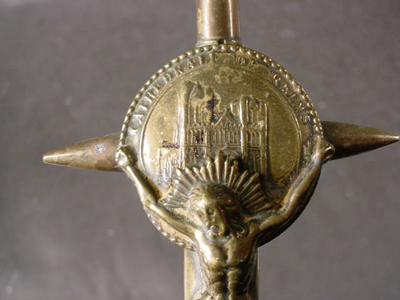
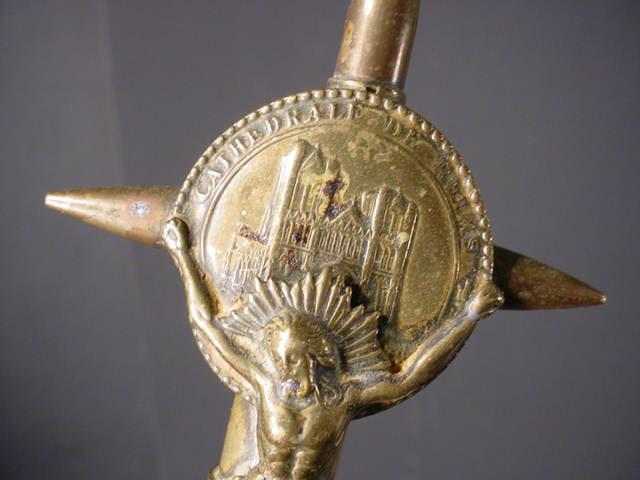
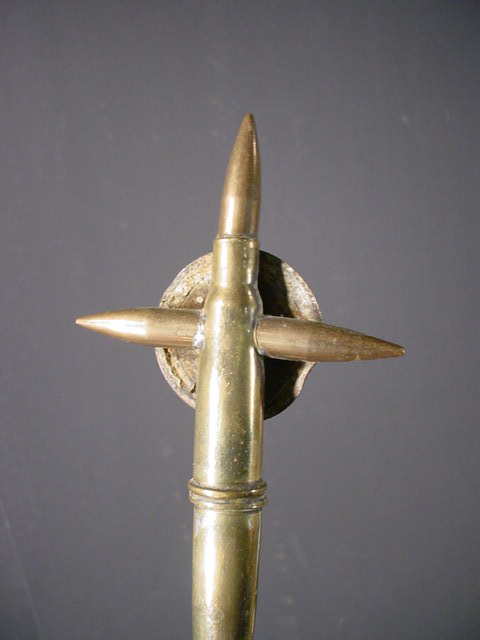
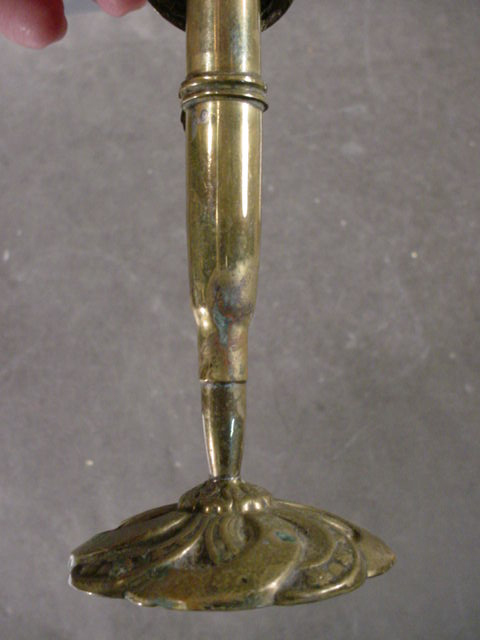
Crucifix Made from Bullets from WW 1 – Trench Art (Item FRAN 4-8 & WWI 12-12)
|
|
DESCRIPTION: From time to time one of these interesting items shows up. They are always unique since they are made in the field by soldiers or produced by jewelers in occupied territories from bullets supplied by these soldiers. This would appear to be the case here due to the professional touch to the base, The Christ figure, and the medallion. There was one on our site at WW1 6-15 and is still there however sold. This was a German one although the French were known to favor them as well as the British. The reason for them being produced by the soldiers is speculative. Some say it is an anti-war message that depicts religious imagery with the idea of the horrors of war (brother against brother) depicted with the debris of war and the same juxtaposition of the paraphernalia of death, with the obvious symbology of Resurrection. The one we offer could be a war souvenir from the war time effects of a German soldier who captured it from a French soldier or possibly it is in fact, the post war souvenir of a French soldier. The answer could be in the caliber and style of the bullets. We are not nomenclature experts when it comes to ammunition. In any case, they are in fact real bullets form the Great War period. Above the Christ figure is a medallion with the Cathedral of Reims Depicted. And the base is decorated with turning rays of the promise of eternity. The relic stands five inches high and the left to right bullet arms measure 2 ½ inches. A genuine piece of history from the war to end all wars. Too bad we didn’t learn from that! PRICE: $475.00 |
|
|
|
|
|
|
|
|
|
|
|
|
|
Signature of Napoleon Bonaparte on a Document from the War Department (Item FRAN 4-9) |
|
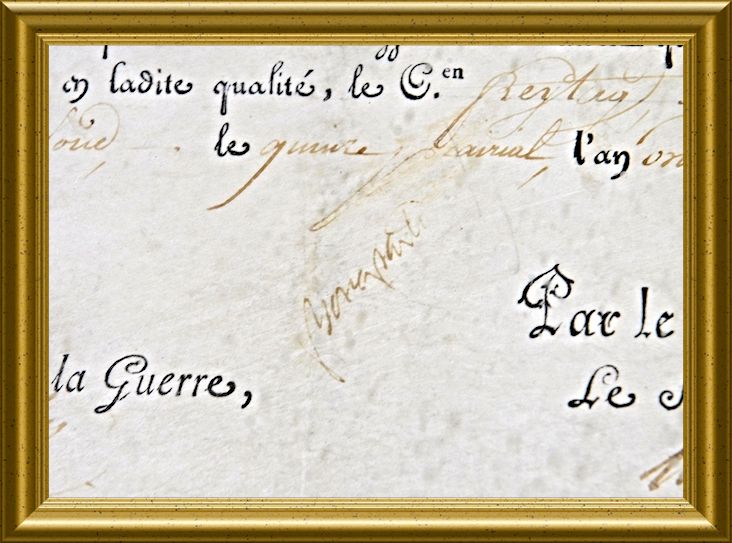
DESCRIPTION: Here is a great document that is from the 1st Empire Department of War. It has as its first wording at the top Au nom du
Peuple Français (“On Behalf of the French People”) and it’s the promotion of a Captain Daniel Freylag to a higher rank. Listed in columns are his
details of service and his campaigns, (actions). It’s signed by the Ministre de la Guerre (Minister of War) and also the Secretary for
the Premier Consul. Then across the middle of these two signatures written boldly is the signature of Napoleon. (He writes Bonaparte).
The signatures have faded to a light-brown texture over the centuries, but are still clear enough to discern. I cannot find a date; perhaps it
is written out as in most English comparable documents as “in the year of our Lord,” but I couldn’t make it out. At the heading of the paper is
the symbol of the Republic of France—the seated La Belle Française. This was used by Napoleon Bonaparte as 1st Consul of the French Republic,
so the document had to be after 1799 and before 18 May 1804, when he was proclaimed Emperor. The document is in excellent shape and is
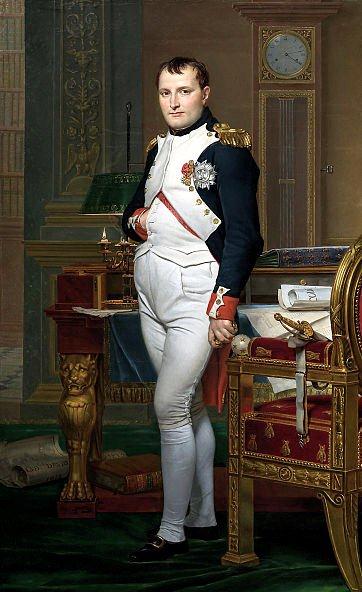
professionally matted. Inside the frame is a nice picture of Napoleon. The frame measures 22 x 20 inches, while the document is 12 ½ x 9
inches. The picture of Napoleon is 8 ½ x 6 inches. All in all, it is one great historical offering of vast historical importance to a museum or
collector; a genuine relic of that age of high adventure and military grandeur. (Unfortunately, also a horrible fratricidal and tragic waste
of the finest men of the Aryan world of the time.)
PRICE: SOLD |
|
|
|
|
|
|
|
|
|
|
|
|
|
|
|
|
|
|
|
|
|
|
|
|
|
|
|
|
|
|
|
|
|
|
|
|
|
|
Napoleonic Sword from Egyptian Campaign (Item FRAN 4-10) |
|
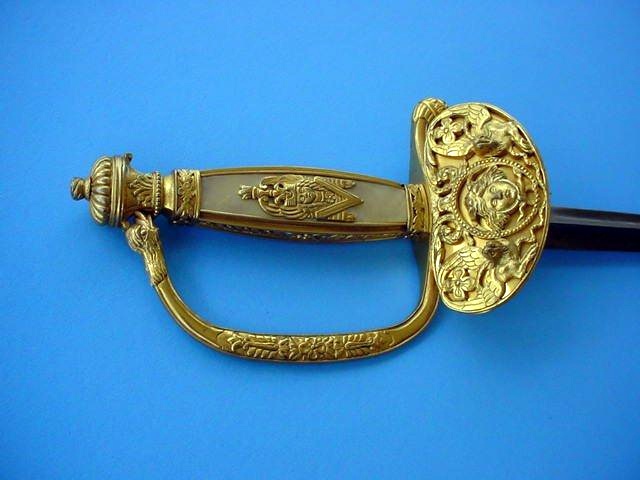
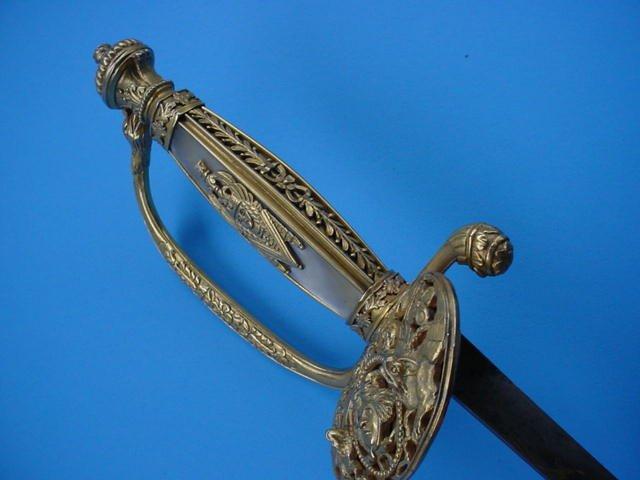
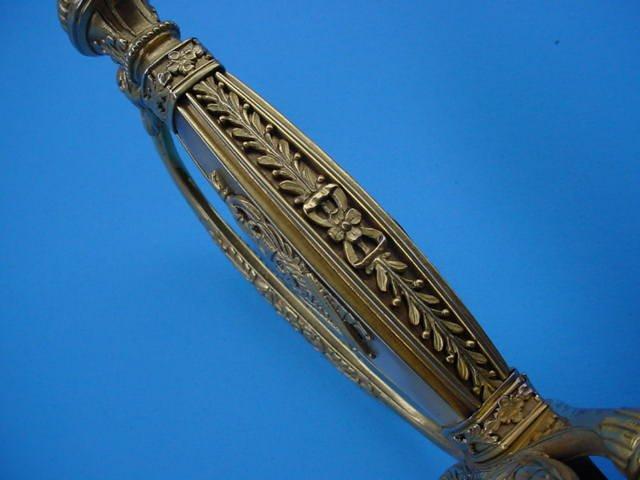
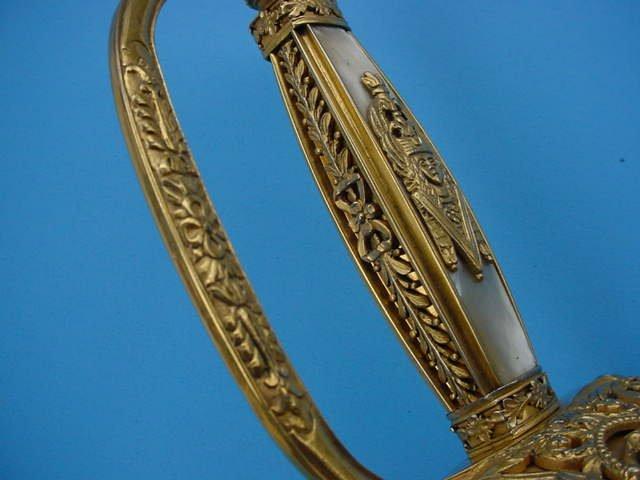
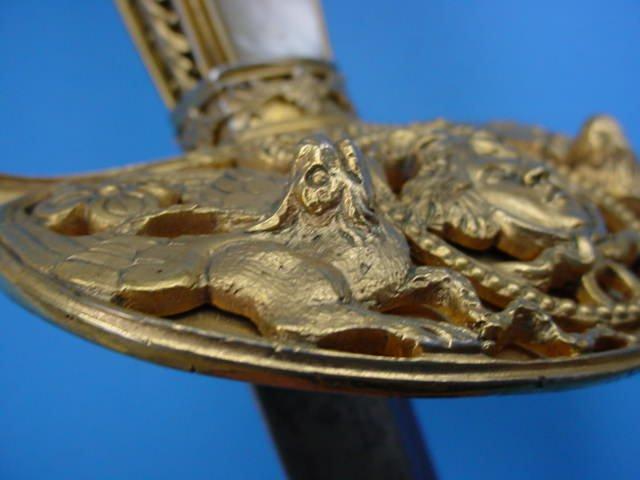
DESCRIPTION: First Empire Napoleonic Sword from Napoleon Bonaparte’s Egyptian Campaign
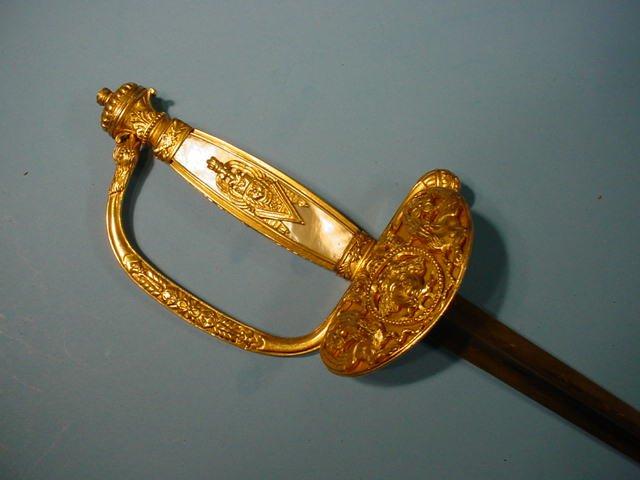
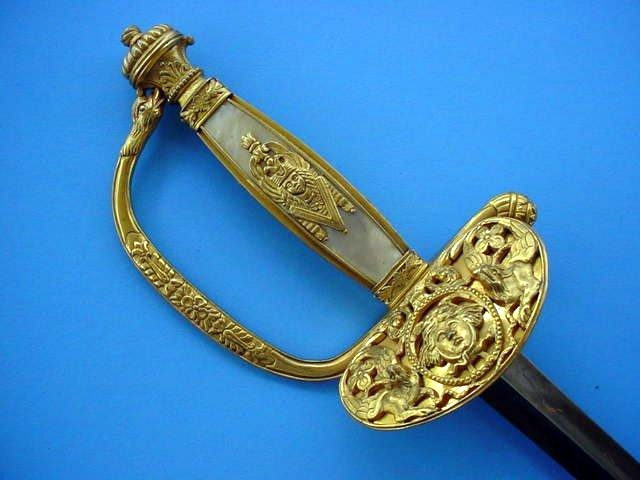
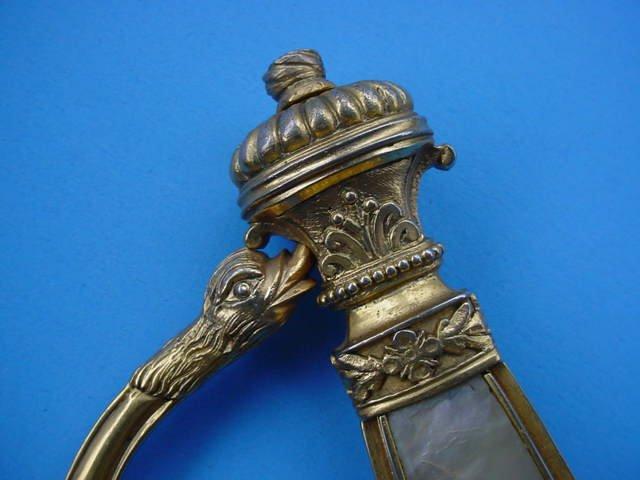
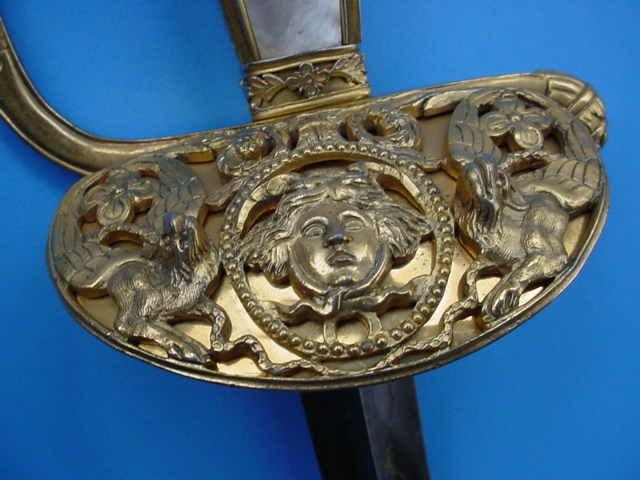
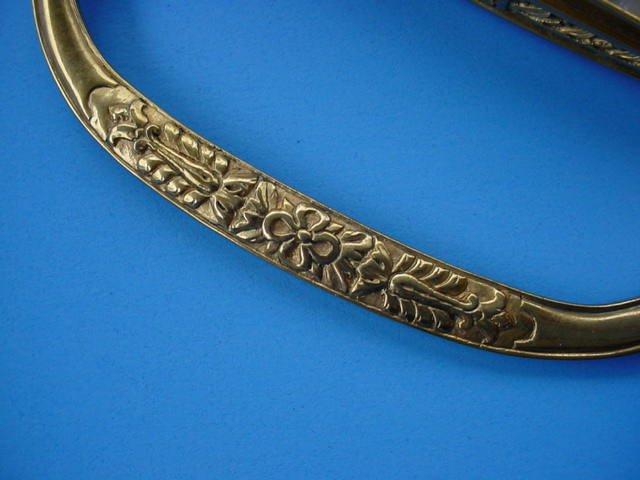
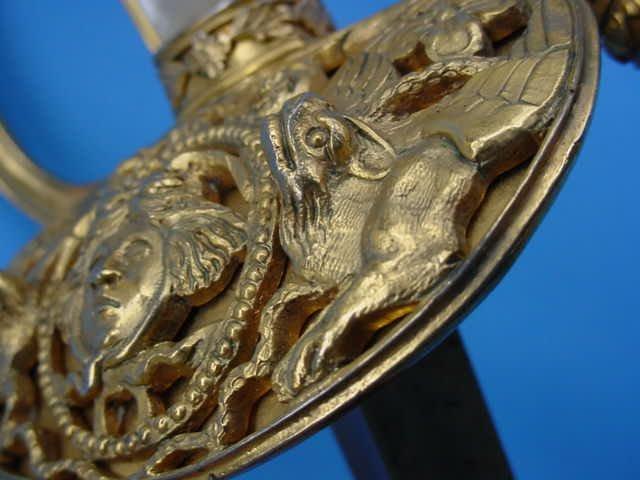
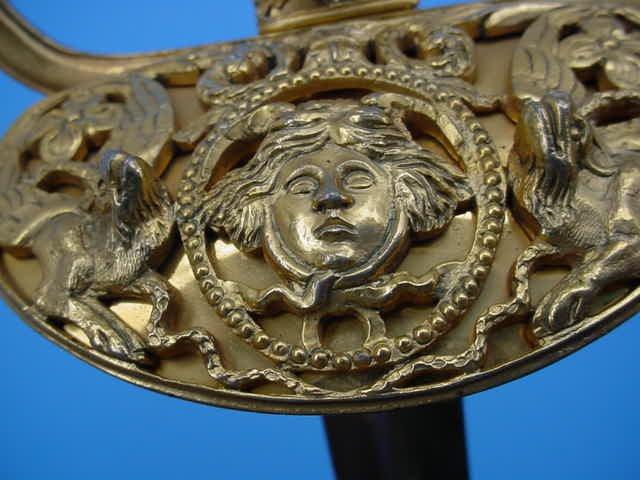
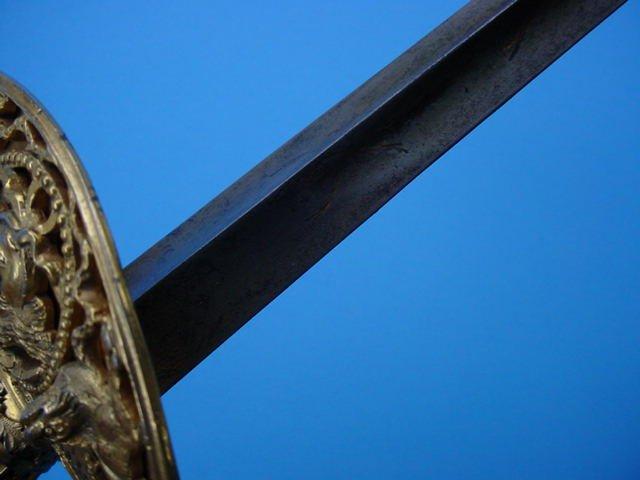
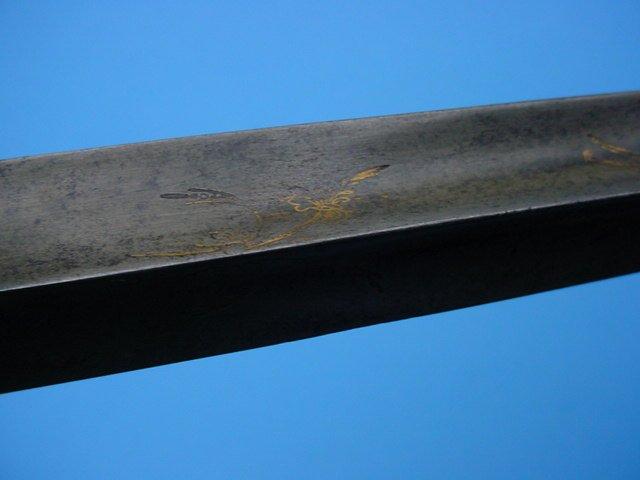
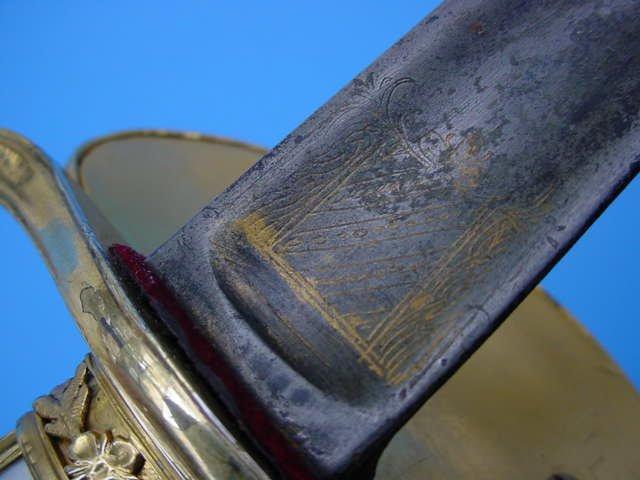
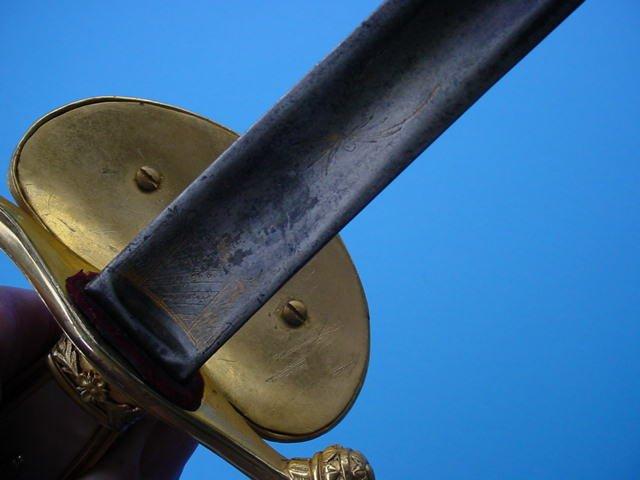
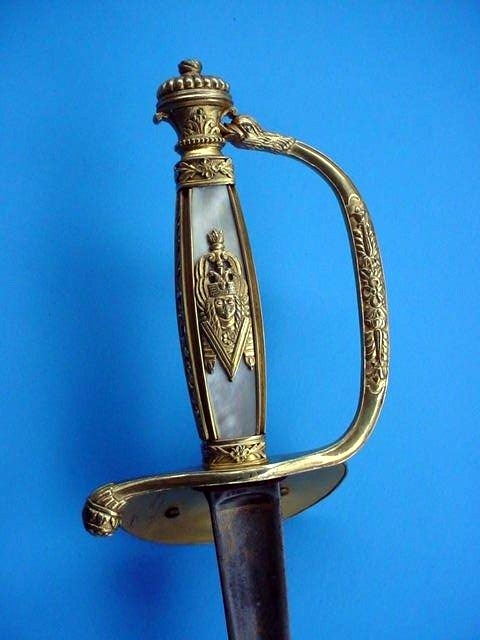
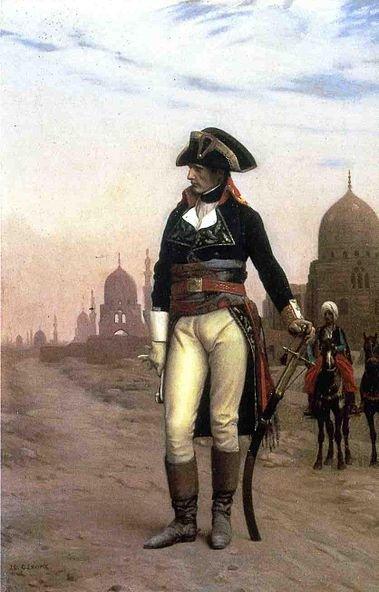
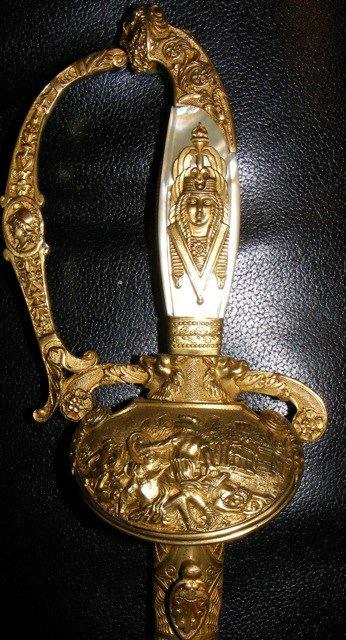
We are very proud to offer this magnificent sword. It is possibly the most beautiful and historically important weapon we have ever offered. It is one of the very special swords that Napoleon presented directly to his generals after the Egyptian Campaign. On May 19, 1798, Napoleon and several senior scientists and military officials arrived in Alexandria, Egypt. On July 1, 1798, when the directive to invade Egypt came down Napoleon saw it as an opportunity to make the founding country of Western culture a province of the greatest country in modern Europe and he wanted to bring a gift–modern science–to help the Egyptians map their country, manage the Nile, raise their agricultural and industrial output, improve their standard of living, and invigorate the intellectual climate. Accordingly, he brought his bevy of soldiers and officers and he decided to take with him a corps of scholars trained in engineering, astronomy, natural history, topography, manufacturing, and linguistics. So, it can be said that the invasion of Egypt was not undertaken to capture Egyptian soil, but Egyptian culture and history and while the military invasion was an ultimate failure the scholarly one was successful beyond anyone’s expectations. Meticulous topographical surveys were made, native animals and plants were studied, minerals were collected and classified, local trades and industry were scrutinized, and most famously, ancient Egypt was discovered: Temples and tombs of Luxor, Philae, Dendra, and the Valley of the Kings. Each of these sties was measured, mapped, and drawn, recording in meticulous detail a Pharaonic Egypt never before glimpsed by the outside world. Over the years concluding in 1828 the first volumes with all the research (a total of 23 volumes) would appear. Three of these were the largest books that had ever been printed standing over 43 inches tall and they captured Egyptian culture from every possible vantage point. The most impressive were surly the volumes of antiquities, spilling over with obelisks, colossi, temples, sphinxes, and all manner of artifacts. But, the volumes on natural history were also impressive with their crocodiles, asps, lotuses, and palms. Never before had a single country inspired such a monumental encyclopedia of such depth and splendor. As to the invasion Napoleon landed in Egypt with 400 ships and 54,000 men and he proceeded to invade the country as he had recently invaded Italy, but, as we have illustrated, this invasion was decidedly different in the fact that he brought along the 150 ‘servants’ for social betterment and important research. So, in essence, the man who was called the Monster by other Europeans did in fact do something very positive in this instance. Because of this campaign he became wildly popular with the French people. Little did they know, however, that even at this time he was beginning the preparations for the proposed invasion of England, but that is another story. There was fierce fighting in the Egyptian campaign including the Battle of the Pyramids that ended with a French victory over an enemy force of about 25,000 Mamluks. In all, 300 French and 6,000 Egyptians were killed. The battle gave rise to dozens of stories and drawings. The Sword The magnificent sword is possibly the jewel of Napoleonic weapons as vastly important as the Egyptian campaign was to Napoleon and France. There needed to be a very special prize constructed to award the participants, thus Bonaparte went to one of the finest sword makers in France; a man to whom swords was equal to Boutet, who was Napoleon’s gun maker. This could have been Jean le Pale, who produced the finest in weaponry/guns/swords. He was the Royal gun maker to the French King Louis XVI and after the revolution, to Napoleon. The sword has a grip that features double-sided panels of mother of pearl with separate side panels of brass that are seen as open with palm-leaf design done in the manner of elegant jewelry. In the center of the grip on both sides is an escutcheon depicting an Egyptian pharaoh and this marks it as being a gift to a member of the Institute d’Egypte and all of the artists, scientists, and Napoleonic generals who accompanied him to Egypt were members and it was to them that the special swords were given. There were several designs, but all bore the pharaoh motif. The finest and most luxurious of them were to the generals and this one is surely one of them. The blade is of the style with incurved diamond-shaped triangular cutting edges (a very lethal rapier). This is why we feel this one was presented to a military recipient. It has brilliant beauty, but is also ready to function as a sword, as well. The clamshell languet is highly decorated with a face of an Amazon-like figure mounted upon it surrounded by mythical griffins whose heads emerge stretching outward from their winged bodies. All the decoration is separately adhered in the style associated with the finest of jewelry. The gilding is very bright and one would almost feel that they should put on gloves when handling the sword (It’s that nice!). It measures 38 inches long including the grip. The blade is 32 inches long. Unfortunately, the scabbard is missing. Here is one of the greatest First Empire Napoleonic swords found. We know of only one other that is in a private collection in France and that is in the collection of Y. Guinhut, who owns the Antik-Costume Company in Dinard, France. (contact@antikcostume.com) they handle the finest of Napoleonic reproductions, but Mr. Guinhut has a private collection of original period weapons. This sword should be in a museum or in a notable collection. Germania strives to handle only the finest and most rare of antiquities at all times. PRICE: SOLD |
|
|
|
|
|
|
|
|
|
|
|
|
|
|
|
|
|
|
|
|
Furlough in Paris—Limited Pass for March 27, 1942 (Item FRAN 4-11) |
|
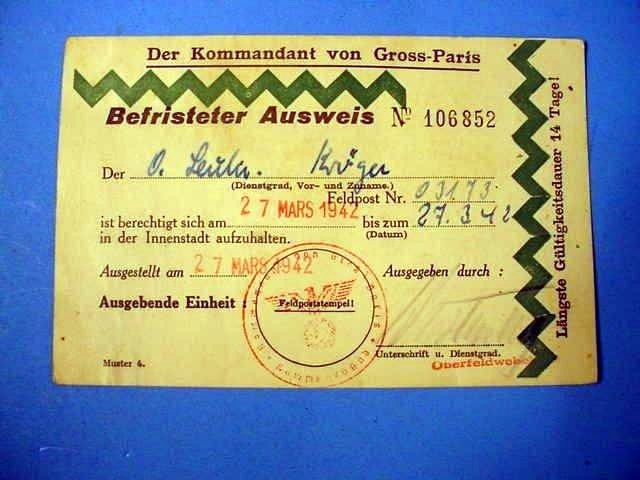
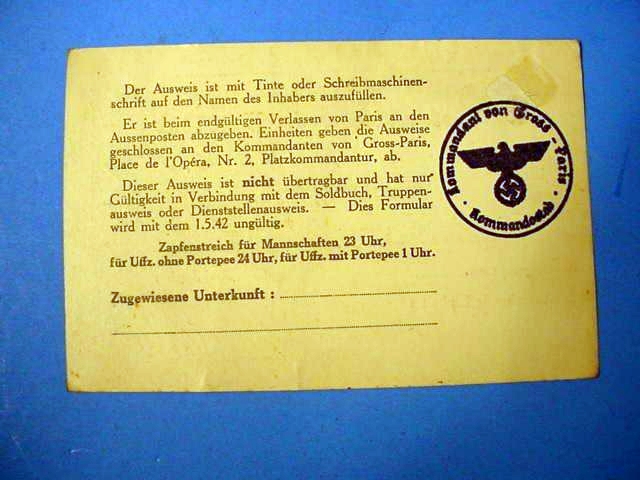
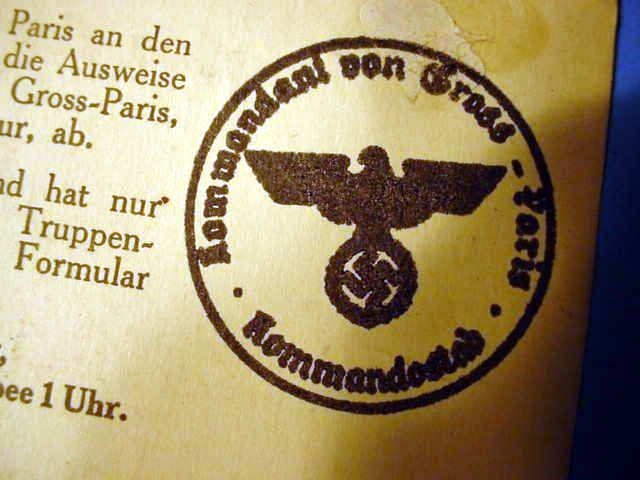
DESCRIPTION: Headed with the words Die Kommandant von Gross- Paris (The Commandant of Greater Paris ). This is the furlough pass for a German soldier to visit inner-city Paris during the German occupation. We know now that German soldiers were on their best behavior while guests of the French. This works out to a 14-day pass and probably was the greatest experience that a German Soldat could have experienced in all his life. The pass is signed by an officer representing the Supreme Command of the Deutsches Heers (army) and has a red stamp on the front and the black one on the back with eagle and swastika and the words Kommandant von Gross-Paris. This may not look like much, but it is a very rare vintage document. We have had but one in 40 years.
PRICE: $175.00; Very rare |
|
|
|
|
|
|
|
|
|
|
|
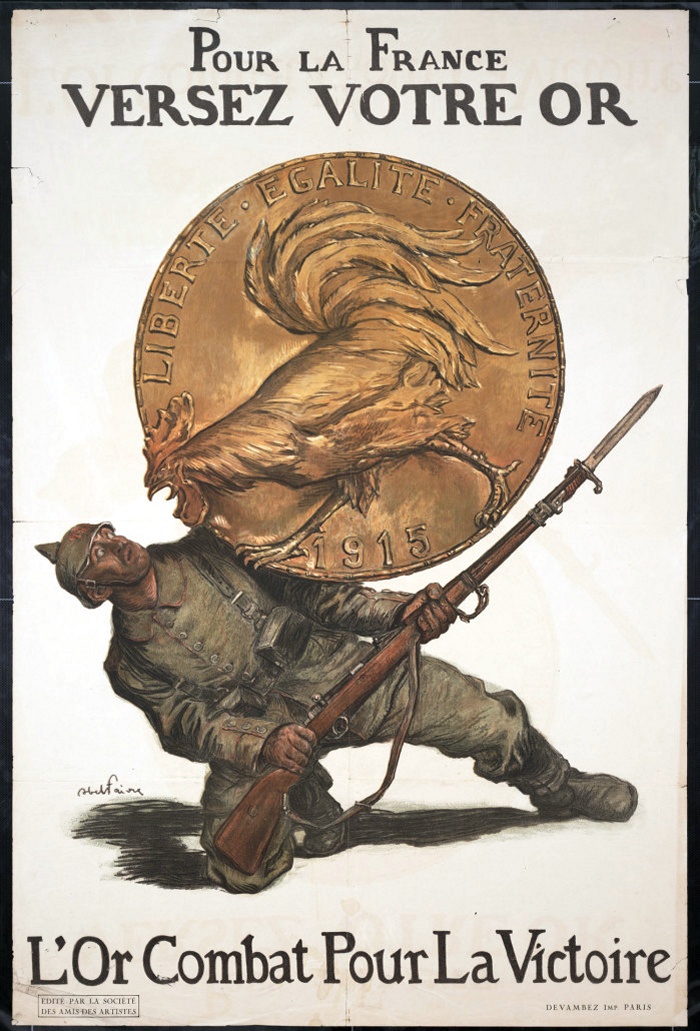
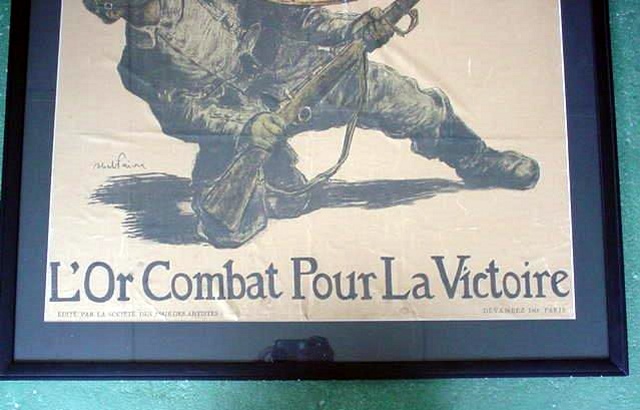
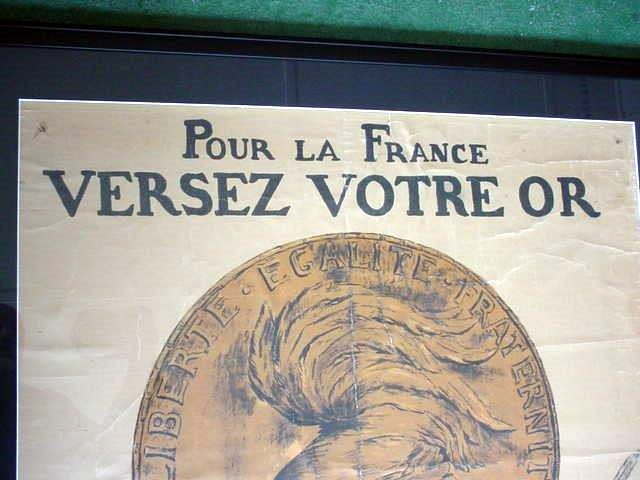
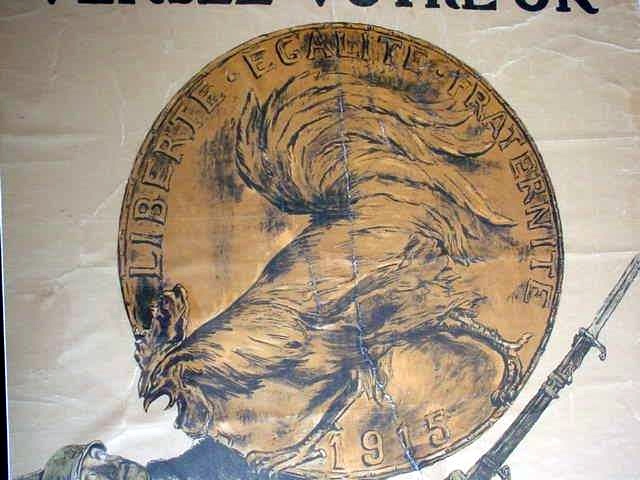
French WWI War Loan Poster (Item FRAN 4-12) |
|
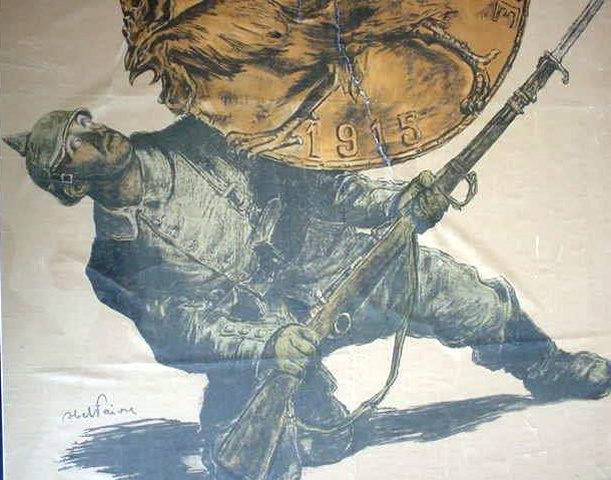
DESCRIPTION: Here is a very-rare French War Loan-appeal poster; it depicts a giant French gold coin with the French rooster as it attacks a German soldier who is forced to his knees. The legends top and bottom read: “For France, pour forth your gold” and “Gold fights for Victory.” This poster is from 1915. The artist is Jules-Abel Faivre. The dimensions are of the poster only at 31.5 x 47.5 cm and in the frame it is 36 by 51 inches. The poster was at one time in its history folded down the center and at the middle. The vertical fold being the worst, but now that it is framed this truly takes away from the damage and it is still a very dramatic presentation and would look great in your den. We have seen original posters like this from WWI bring $2,000 to $2,500. Yes, in better condition but because of the damage and the fact that this is going to be quite expensive to ship we are going to make it a super bargain.
PRICE: $500.00; plus any charges |
|
|
|
|
|
|
|
|
|
|
|
|
|
|
|
|
|
|
|
|
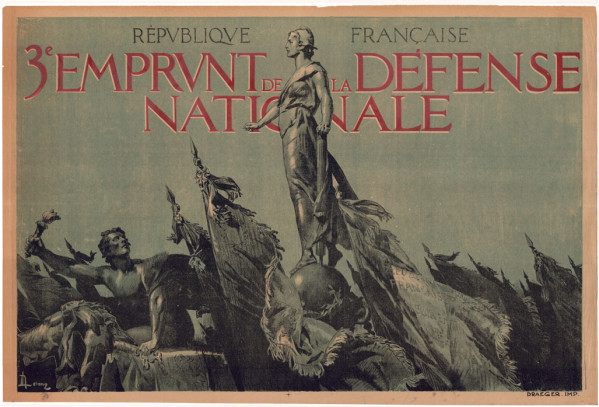
French WWI Poster (Item FRAN 4-13) |
|
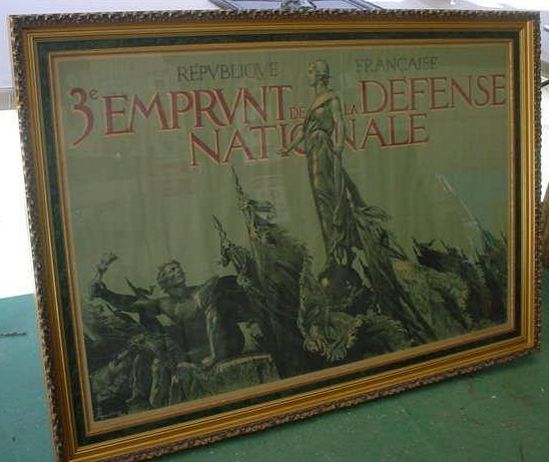
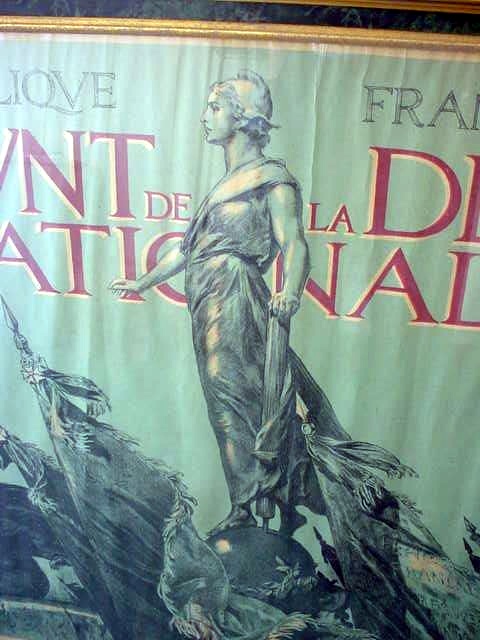
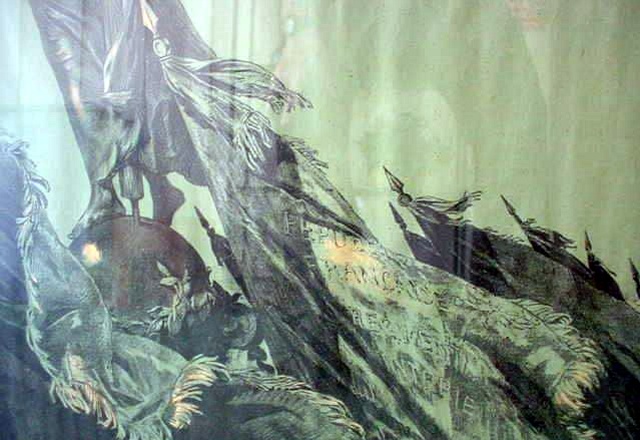
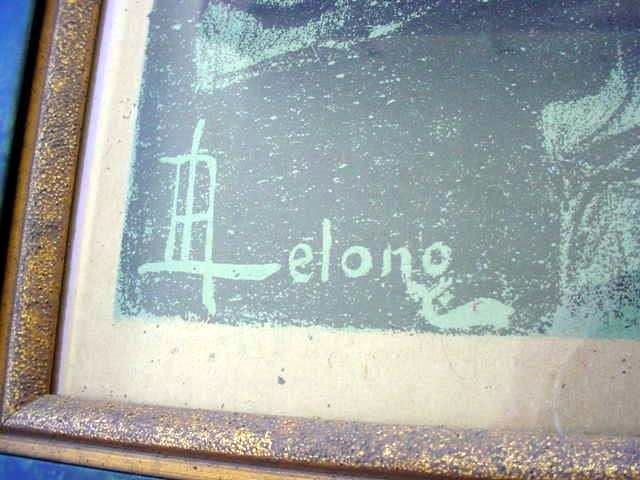
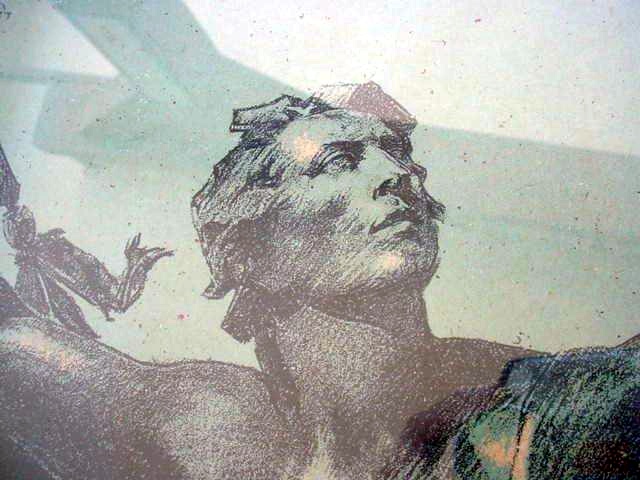
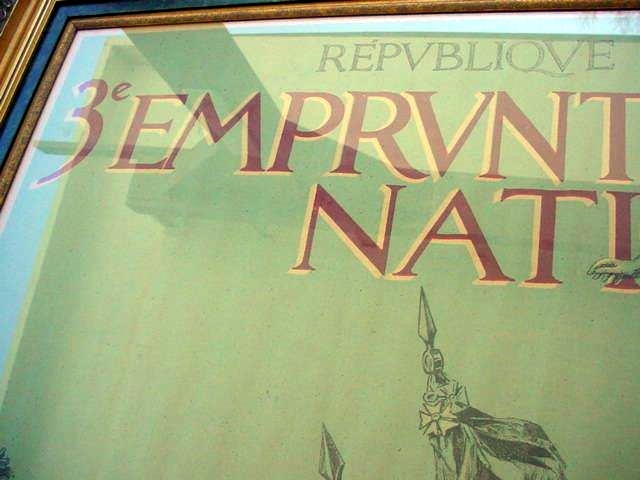
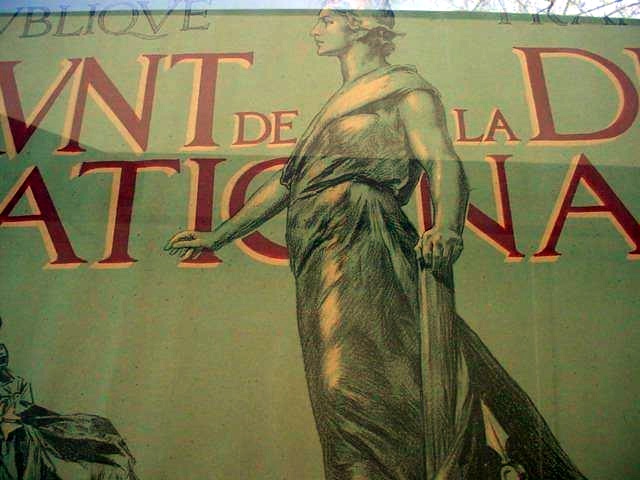
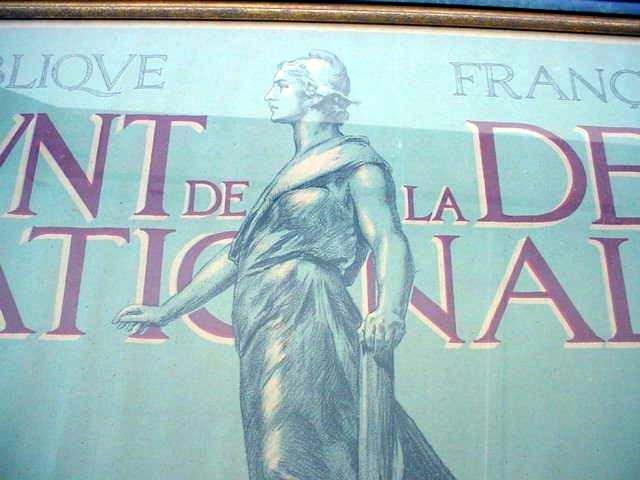
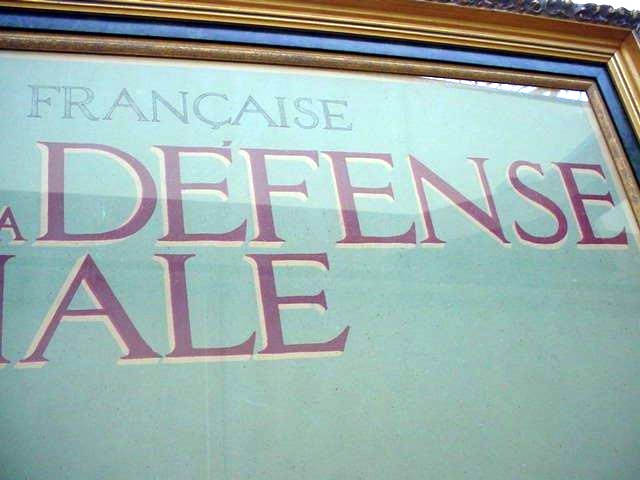
DESCRIPTION: This is a giant-sized framed poster appealing to the French citizens for a wartime defense loan. War-loan posters were produced between 1914 and 1918. They appealed to civilians’ desire to aid the war effort rather than to gain any monetary return. Following the approach of other propaganda campaigns such as enlistments and production drives, war-loan posters appealed to patriotism and historical identity, raised sexual themes, and played on a sense of guilt that might be experienced by those who did not fight, and in the later stages of the war it was claimed that supporting the French army through war bonds would help to speed the end of the war. The one we offer is for the French Republic Third National Defense Loan. It depicts the Spirit of France (A heroic-looking woman) who stands on a globe above a sea of flags with a bold Gaelic warrior leading the way.
The size is 121.7 x 82.6 cm (poster only). In inches with the frame it measures 48 x 36.
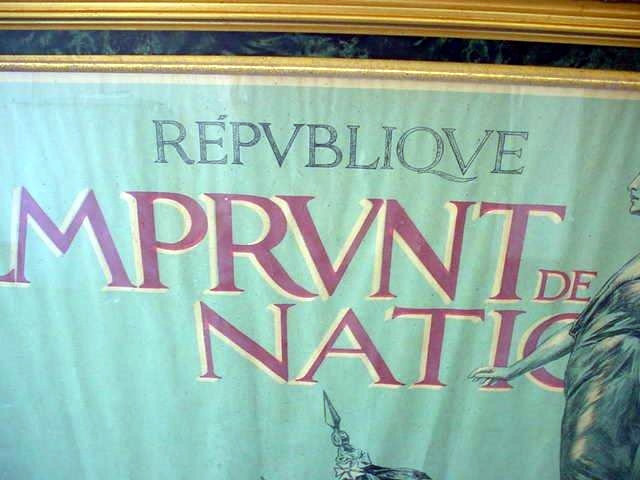
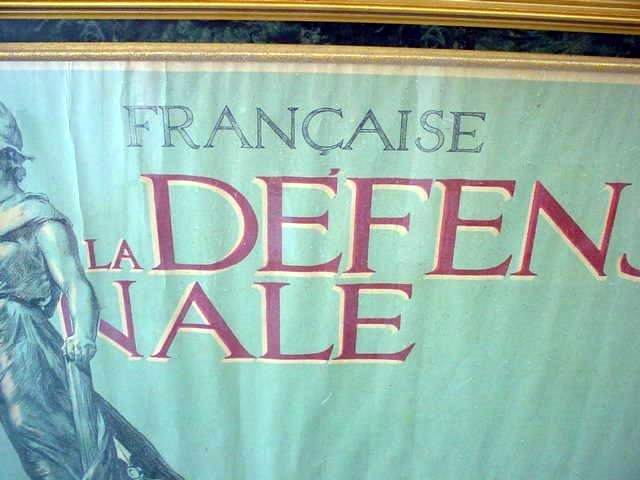
The wording is 3e Emprunt de la Defense Nationale. This is a very-dramatic WWI item with a special frame that was particularly expensive and beautifully executed. This is priced very reasonably. Why? Because we know it will be expensive to ship.
PRICE: $550.00 |
|
|
|
|
|
|
|
|
|
|
Original Painting in Bone of Napoleon as First Consul (Item FRAN 4-14) |
|
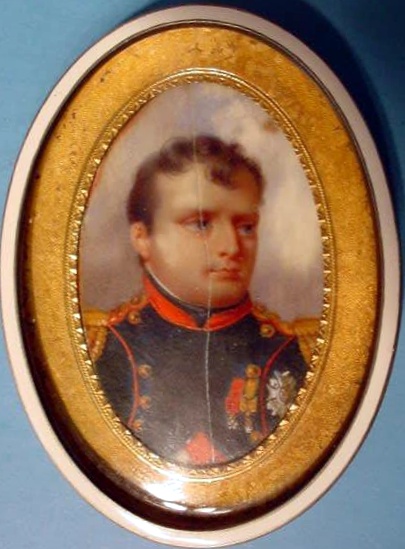
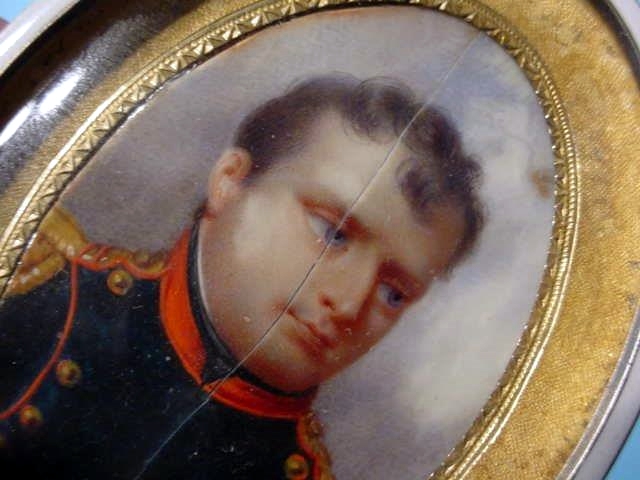
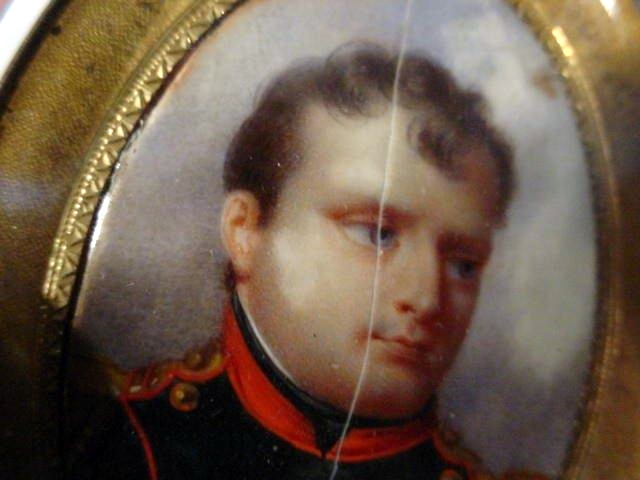
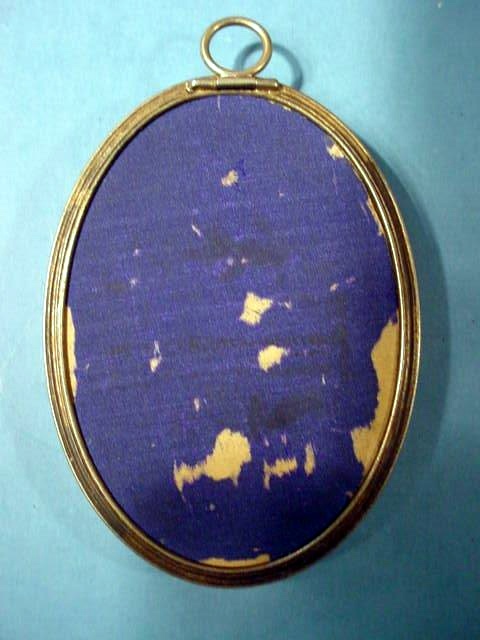
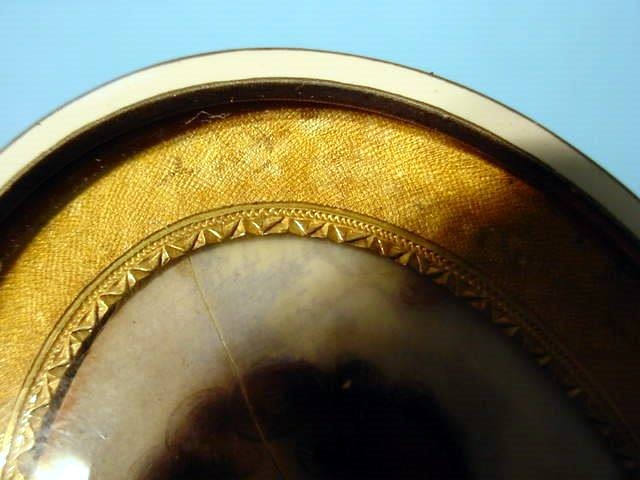
DESCRIPTION: Here is a fine miniature of the young Napoleon Bonaparte in his uniform of First Consul, the mighty office that he had secured for himself in 1804. This clever move on his part secured for him most of the power in government and gave him complete dictatorial powers. Those at this time who supported him and cooperated with him were richly rewarded, but those who thought him to be a threat were ruthlessly eliminated. He was clearly the highest power in the land and an absolutist ruler. His rise to imperial power was “phenomenal” when one realizes that he was not even French—he was born in Corsica. He trained as an artillery officer in mainland France and rose suddenly to prominence under the French First Republic. After that he led myriad successful campaigns, and then it was in 1799 that he started a coup d’état and took the position of First Consul and then five years later the French Senate proclaimed him Emperor of France. We all know that he was about to be personally crowned by the pope and he unexpectedly turned and forestalling the pope, he removed his laurel wreath and crowned himself! So, here was without a doubt one of the most egotistical men in history and one can see that this attitude reflects in the portrait we offer. It measures with frame about 3 x 2 inches. The actual portrait is about 1 ½ by 2 inches. We would estimate that the portrait was painted somewhere in the early 19th century and obviously by a very competent and talented artist. Now we must painfully disclose that the bone that the portrait is painted on is cracked right down the face and tunic of the subject. This is noticeable when one holds the frame up and closely looks at the subject. The piece still remains an important historical objet d’art, nevertheless. The inner framing seems to be in genuine-gold material while the outer framing appears to be fine white enamel application. The back of the frame is a bit tattered as one might expect seeing that it is covered in a felt material so beloved and tasty to moths. Although damaged, the piece is quite grand, and is from a turbulent time in history—the day of imperial glory and the man who most influenced it. This is a really nice little gem of the past now available to you. If it were perfect the miniature would bring at least ten times the amount we offer it for. Remember, it is clearly a museum-quality piece without question.
PRICE: SOLD |
|
|
|
|
|
|
|
|
|
|
|
|
|
|
|
|
|
|
|
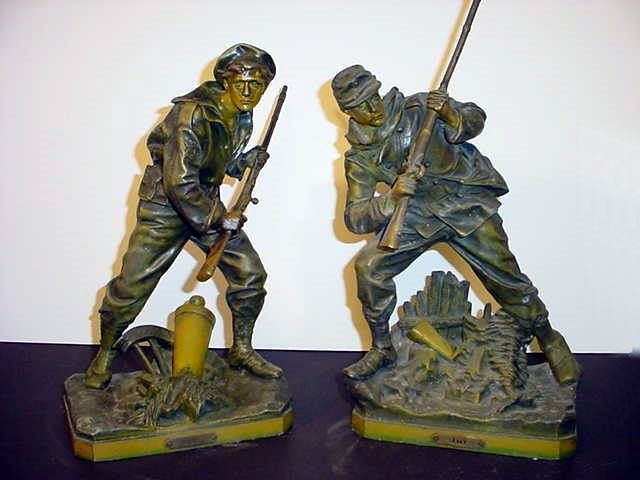
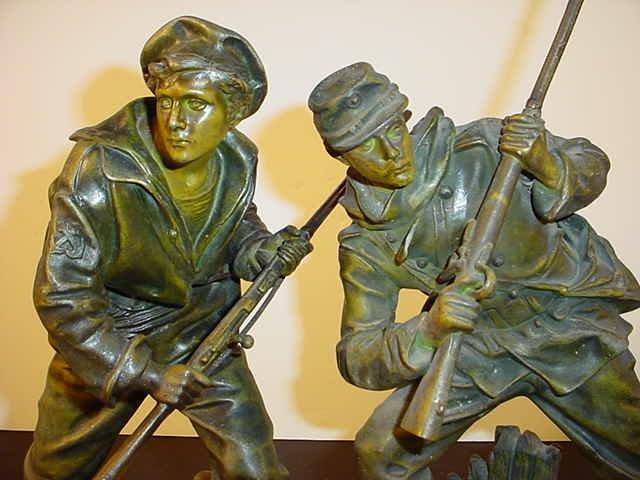
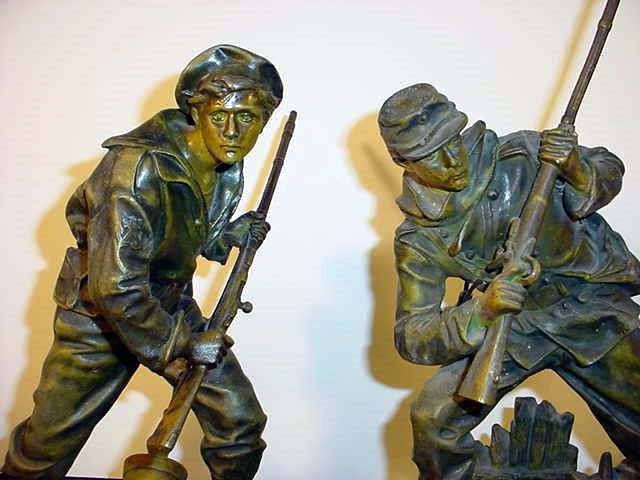
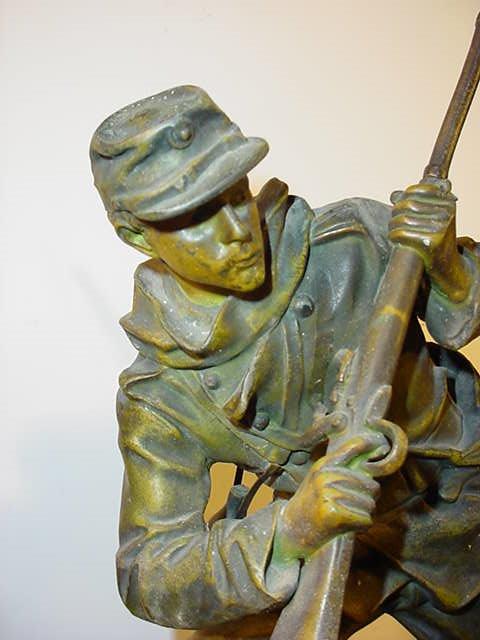
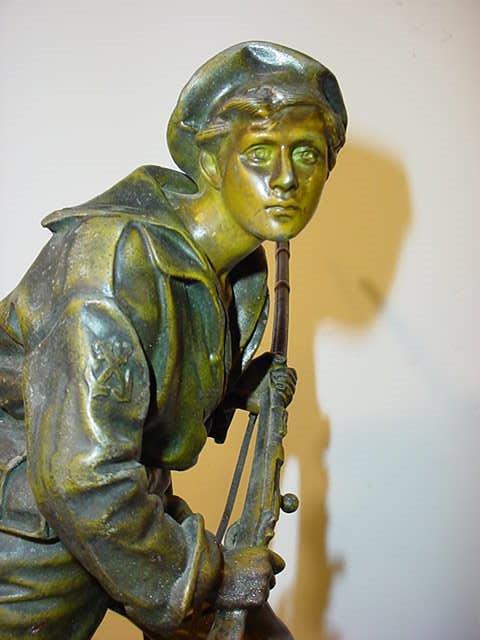
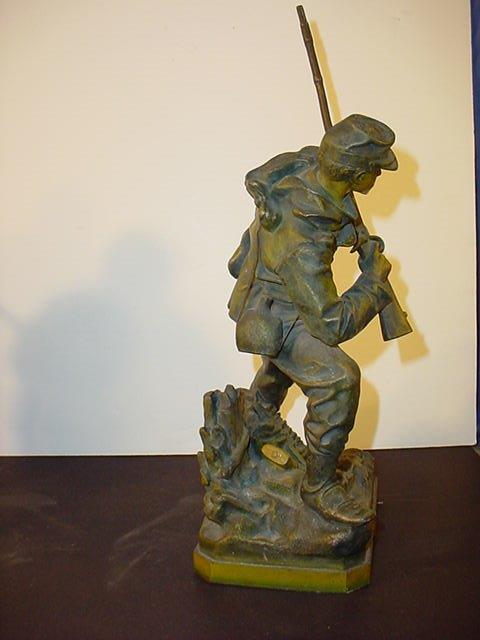
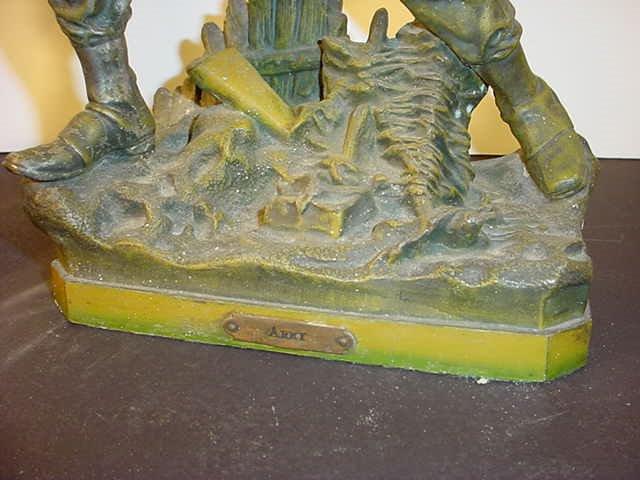
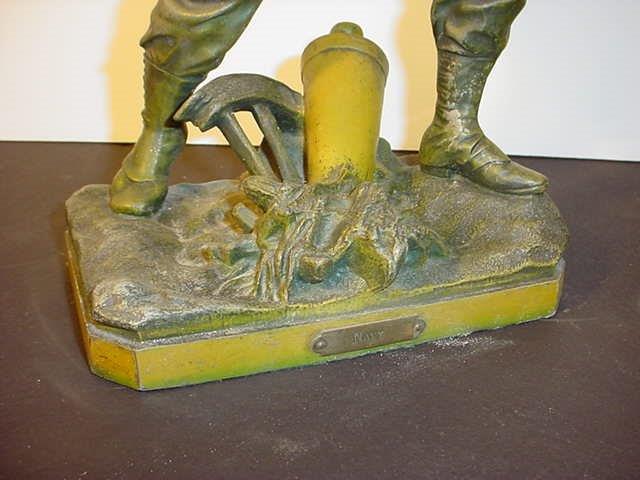
Pair of Soldier and Sailor Figures (French 1870) (Item FRAN 4-17; BRONZEMET 3-20) |
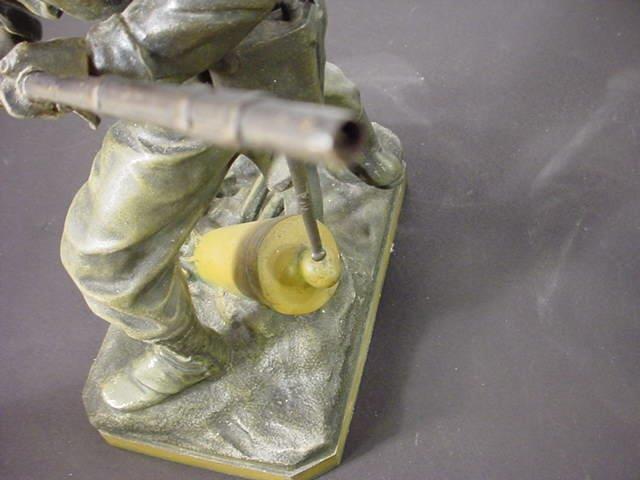
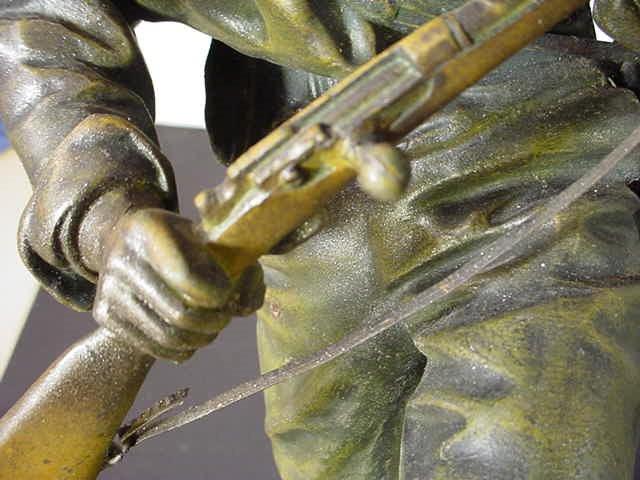
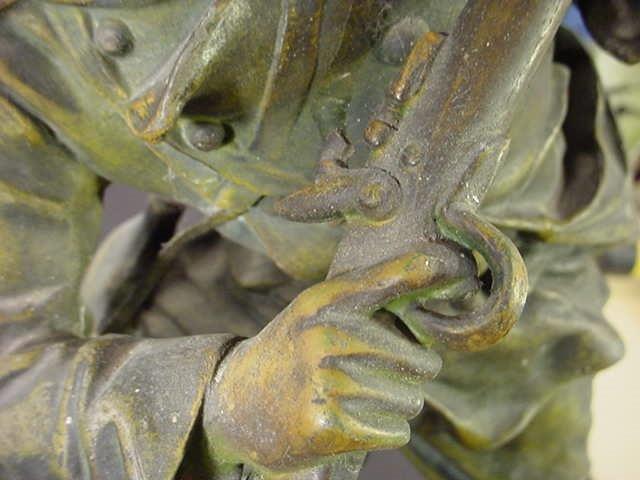
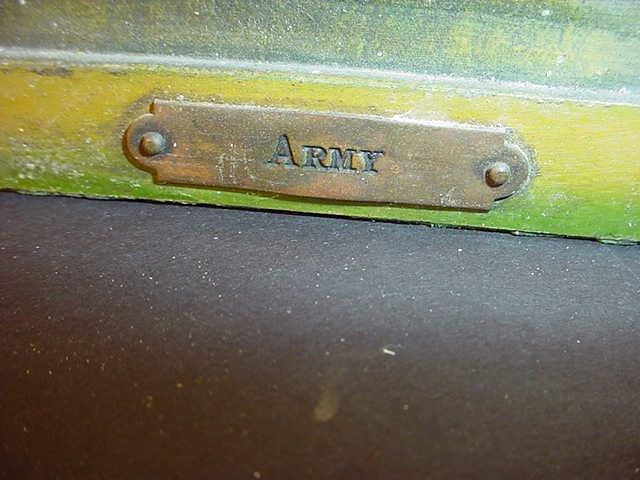
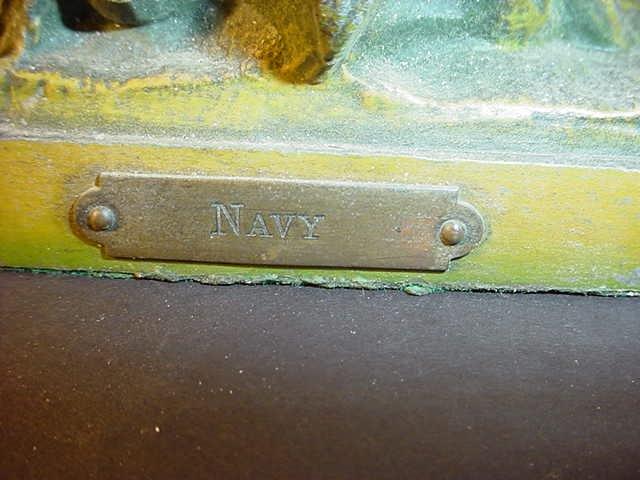
| DESCRIPTION: Here are two action figures probably done in the early 1870s just before the Franco-Prussian War. They were cast in metallic zinc or white metal. Whenever rarely this pair shows up in an antique show or shops invariably one of them is missing or when they are found together the rifle barrels at least will be missing because of the fragile positions they were manufactured in. Ours are practically perfect except for a rifle sling with the soldier. They are, when found, practically always labeled “American Civil War Figures” and priced very dearly missing parts or not. The French uniforms at that time were in fact copied from the American-issued battle dress of the 1860s and France used this sort of military attire until its defeat by the victorious Prussians in the Franco-Prussian war of 1870. We offer these figures for what they really are and that is two magnificent artistic figures of a soldier and sailor of the French armed forces as depicted during that early time of warfare. They are both shown wearing the correct uniforms of the period and their action stance is clearly dramatic; they stand about 13 inches high including their bases. The bases measure 5 x 7½ inches. There are no signatures, but it’s obvious they were the original design by a master sculptor. The bases identify them as “Army” and “Navy” by small plaques (To a greater part, these were made for export and sold in French stores to tourists from England and the U.S.A.). Think of these as added to that bookcase behind your office desk. They are really and truly pure classic art!
PRICE: SOLD |
|
|
|
|
|
|
|
|
|
|
|
|
|
|
|
|
|
|
|
|
|
|
|
|
|
|
Wonderful French Rapier or Dueling Sword (Item FRAN 4-18; ANTWEP 4-6) |
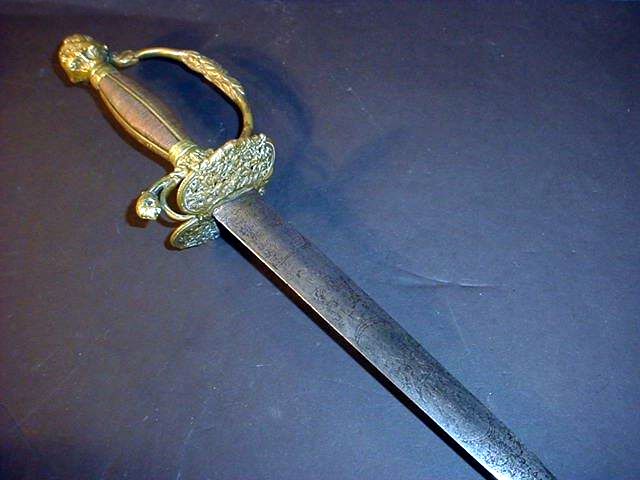
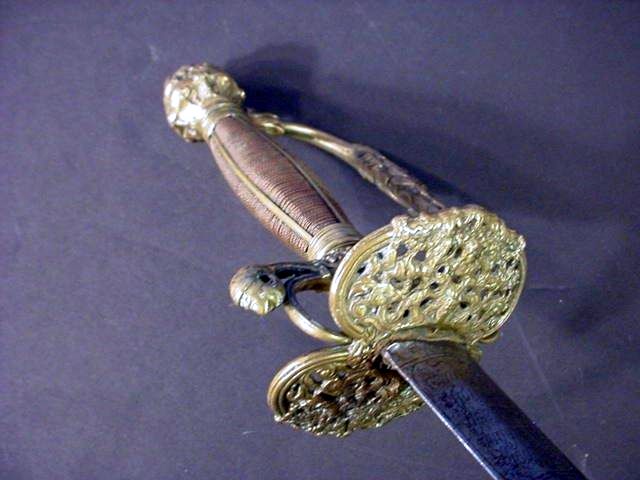
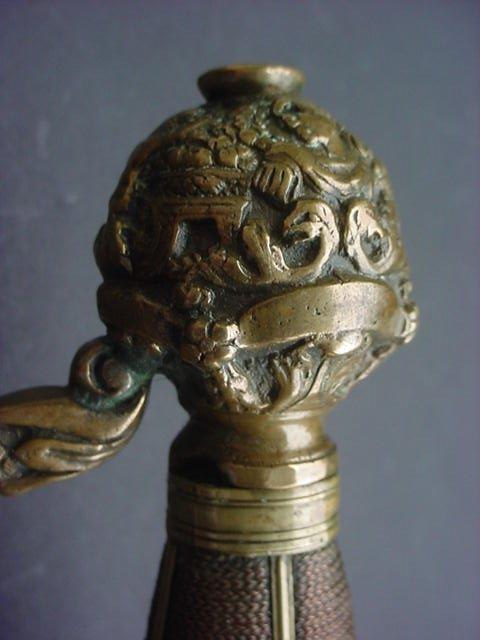
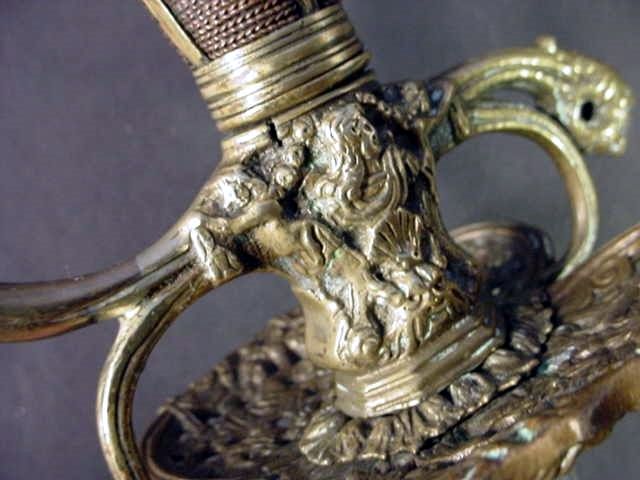
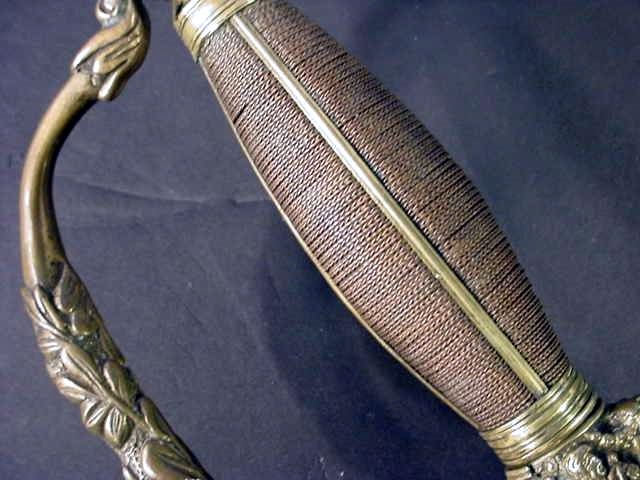
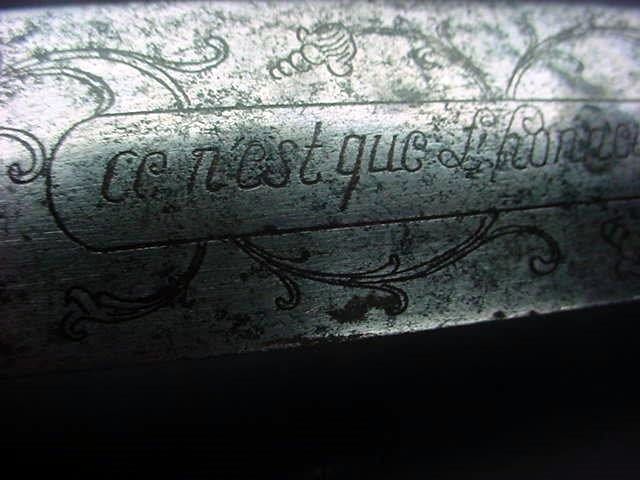
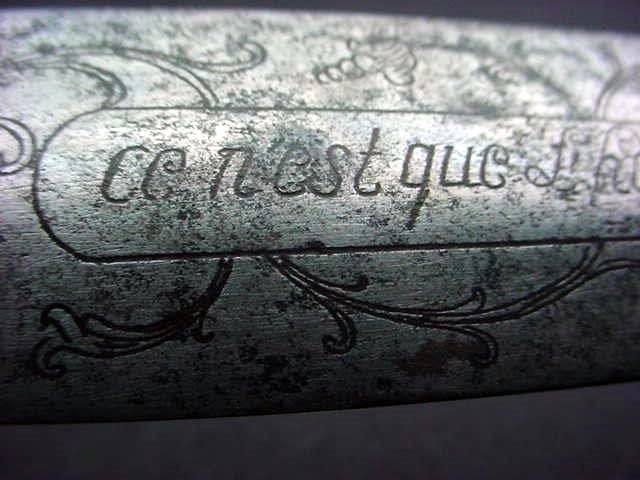
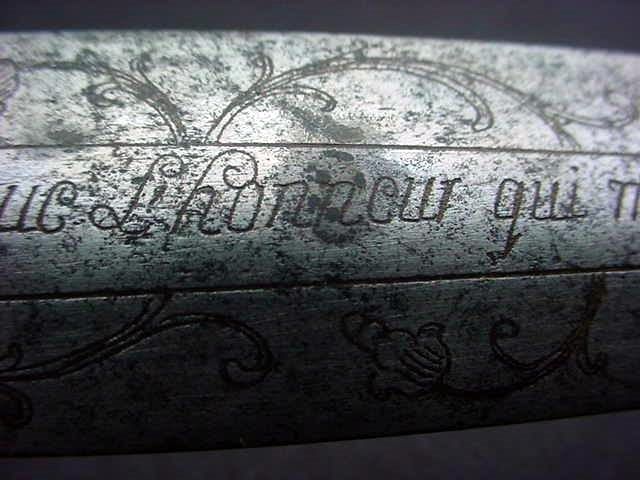
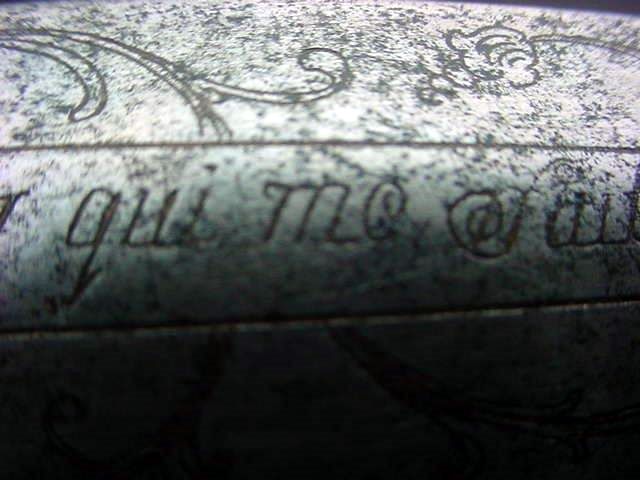
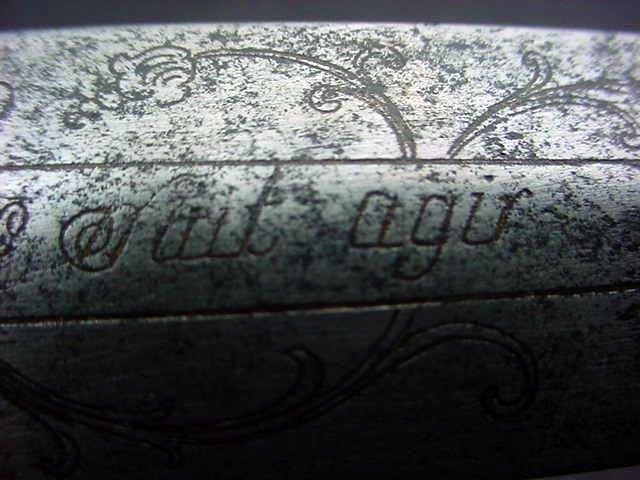
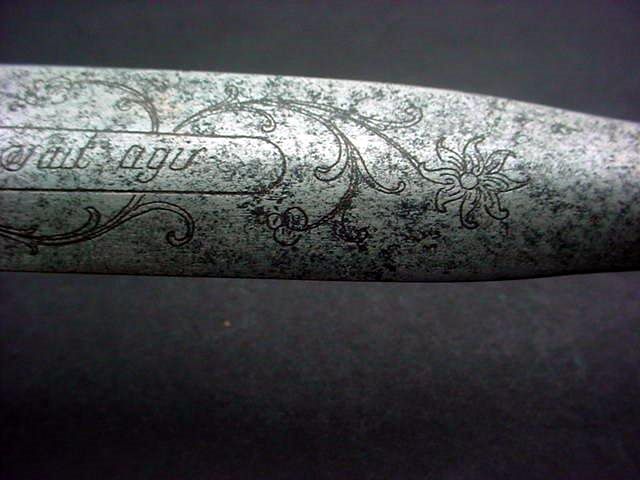
| DESCRIPTION: This is a magnificent sword of the dueling type used in the early-to-late 17th century and is related to the épée or colichemarde, the latter having a blade that features a wide forte which narrowed drastically toward the point after the forte ended. They were very popular and used right up to about 1800. The shape of such a rapier combines good parrying qualities with good thrusting abilities and its light weight also adds to the use of it as an extremely effective and lethal weapon. The sword that we offer here has all the qualities as mentioned, but it also has obvious connections to the nobility of the gentleman who owned it and wielded it. On the blade in the French language is the following as best I can translate: “Only honor would compel my use.” These words that the original owner had engraved upon this blade marks him as a believer in the chivalry of the age, practically nonexistent today. The sword has a special blade in its construction, as well. It starts with the upper eight inches being an inch wide and then there begins a radical narrowing of the blade right to the tip. This was an innovation that gave the weapon a strength for thrusting yet so very lethal with its deadly point. The grip is wire wrapped with brass supports that prevent the wrap from unraveling as seen on many swords with wire wrapping. This sword’s knuckle guard is in the “D” shape while the counterguard in clamshell is in highly decorated baroque floral design. The double-ring ricasso is also quite ornate, as is the pommel. So, in essence, here we have a very beautiful classic rapier, but also a sword that was a very lethal weapon of the romantic past. The saying on the blade evidences that a true gentleman once treasured it and no doubt it was his constant companion. This is a very important historical relic indeed!
PRICE: $4,590.00 |
|
|
|
|
|
|
|
|
|
|
|
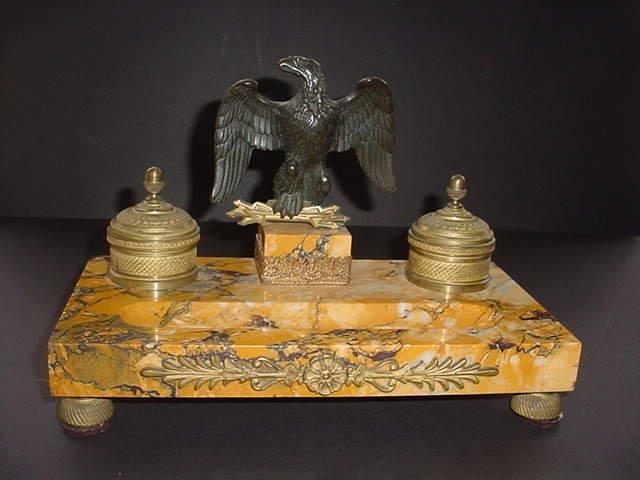
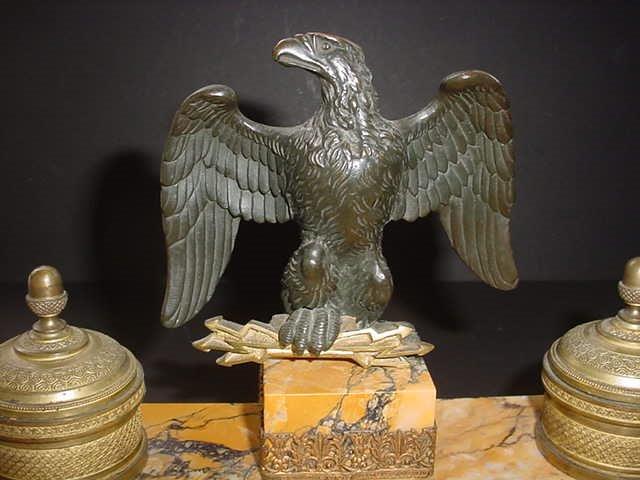
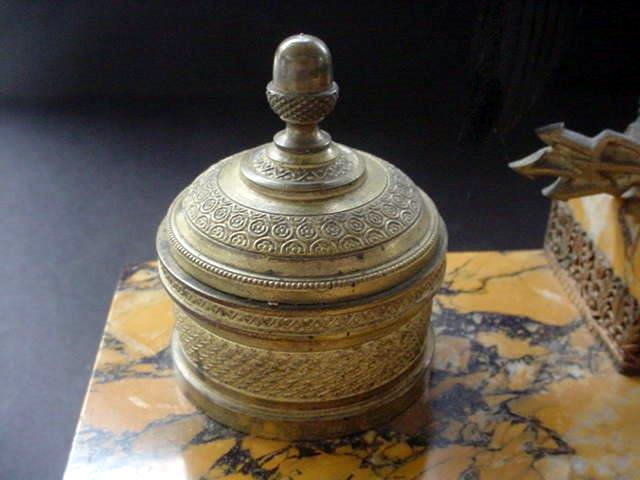
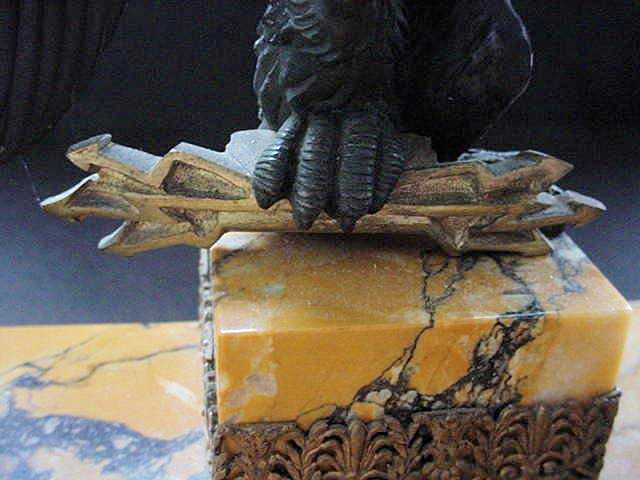
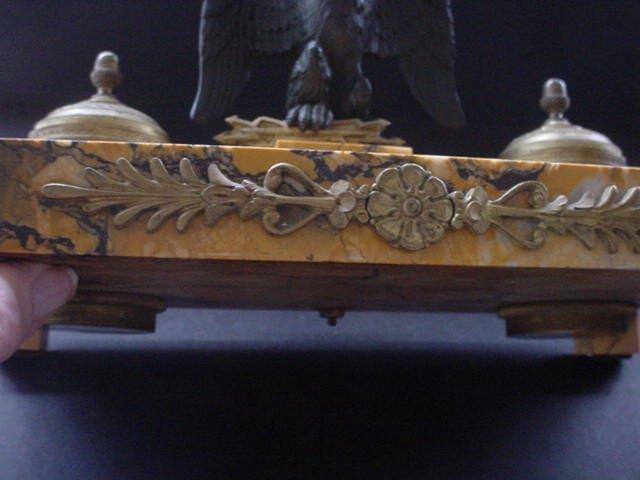
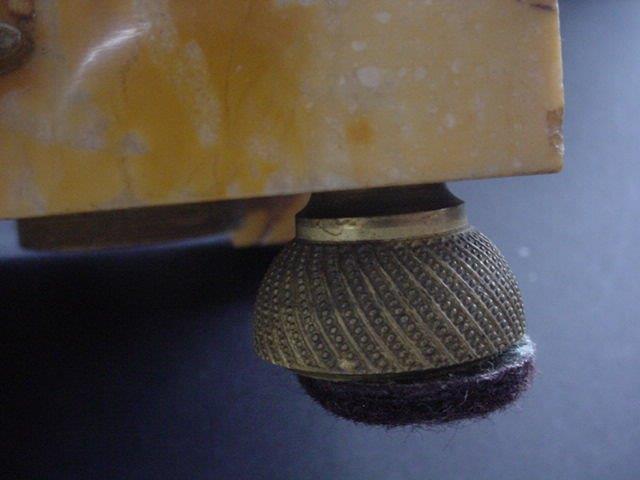
Napoleonic Inkwell Set (Item FRAN 4-19) |
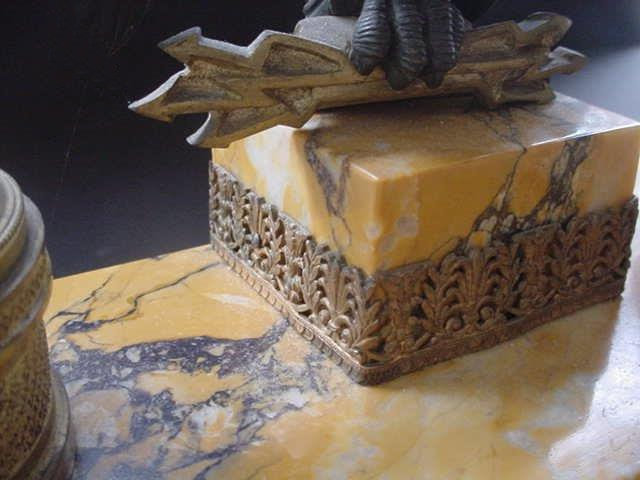
| DESCRIPTION: This beautiful inkwell desk set is probably from one of the offices of the emperor, or possibly, a military attaché. The typical Napoleonic Eagle sits upon the bundle of lightning-bolt arrows. The inkwells are beautifully chased with Florentine design one having been used for black ink and the other for possibly red. The tops of the inkwells are shaped like an acorn. The front of the marble stand is decorated with a beautiful floral design. The marble is indented to carry the pen or pens. The marble coloration is incredible; probably from an Italian rock quarry. The marble stand measures 11½ inches by 6 inches. The eagle stands about 5½ inches tall including its own marble plinth. The marble on the stand is 1½ inches thick. This is definitely a piece associated with Napoleonic Royalty.
PRICE: $1,500.00 |
|
|
|
|
|
|
|
|
|
Charlemagne Medal (Item FRAN 4-20; KJEWELRY 3-12) |
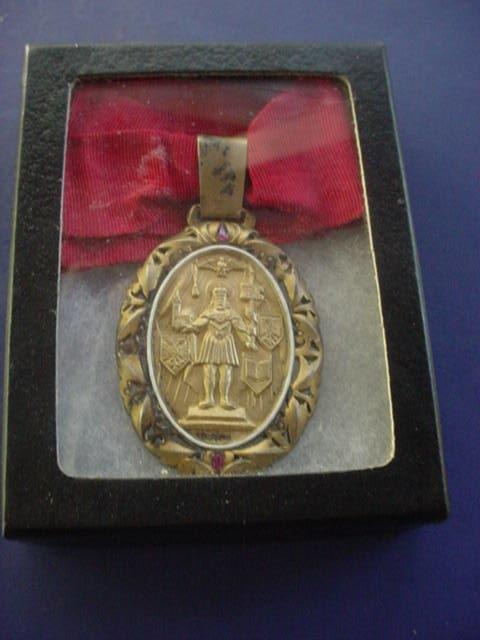
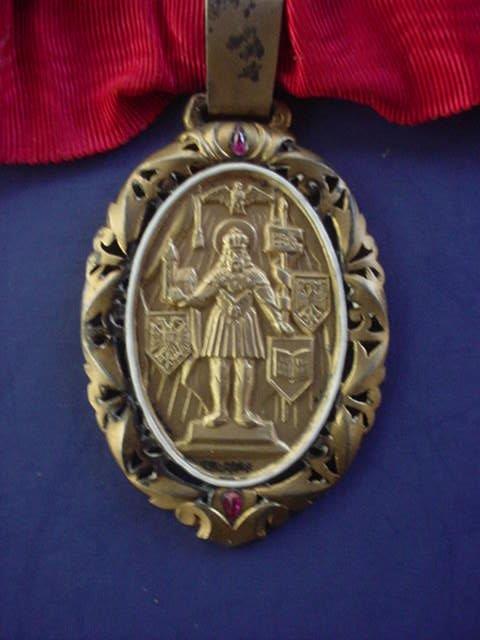
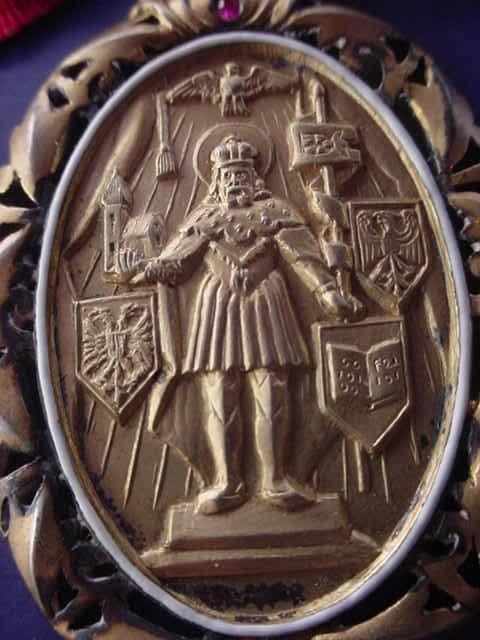
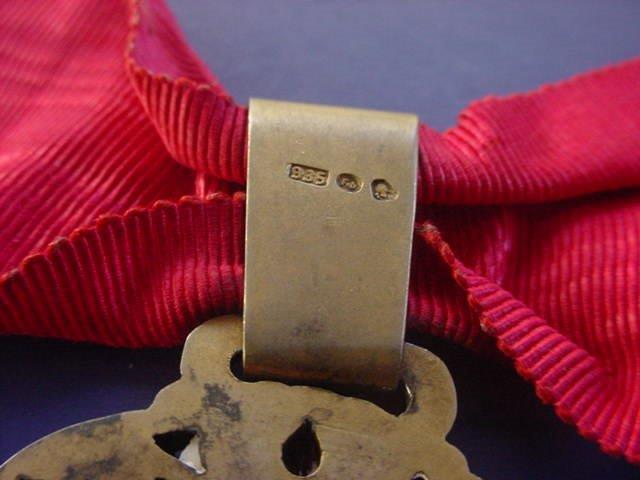
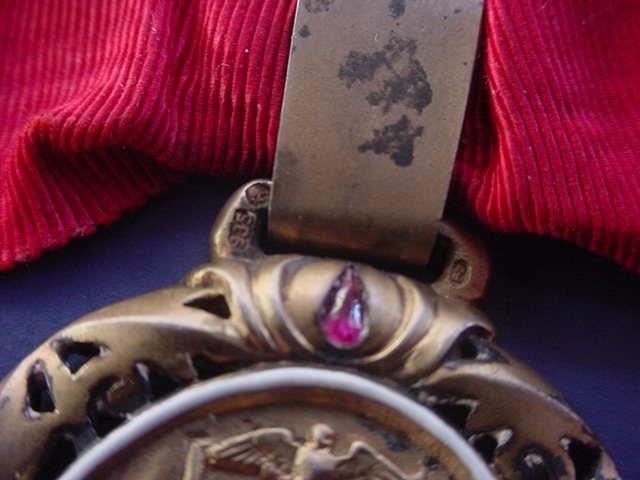
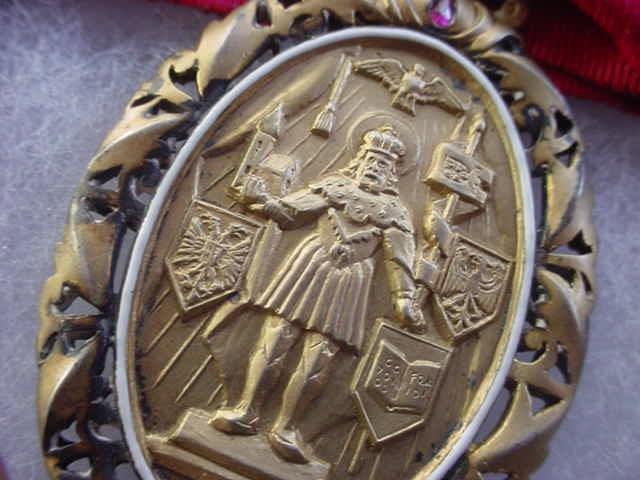
| DESCRIPTION: Here is a medal that celebrates Emperor Charlemagne, who was King of the Franks; he bore the title of “King of the Lombards,” as well, so France and Germany both claimed him as their royal ruler. From 800 during the early Middle Ages, Charlemagne unified the majority of western and central Europe. His name in German is equivalent to “Charles the Great.” He was said to be the founder of the Holy Roman Empire. It has often been said sarcastically that this was neither Roman nor Holy. Charlemagne was crowned Emperor of the Holy Roman Empire on Christmas Day December 25, 800, by Pope Leo II in St. Peter’s Basilica in Rome making him the most powerful ruler of his time. The Medal The piece is oblong in shape and suspends from a reddish-purple neck ribbon of the sort used in high European orders. Taffeta is the word often used to describe this material. Then there is a suspension that supports the medal and all around the main medal are finely-cut edging patterns and at the crest and at the bottom are tiny, inlaid red stones that might be ruby insets The center of it depicts Emperor Charles who stands imperiously holding a model of the Cathedral of the Empire, which is seen above the double-headed eagle shield of the Holy Roman League, while to his other side is the shield of Lombard above the Book of Laws. Over his head is seen the dove of Peace. The measurement of the medal is about 2 inches high by 1½ inches wide. The back is unfinished. The entire piece is finished in an attractive gilded brass. What it was awarded for or to whom is not known at this time, but it looks to be the medallion style of the mid-19th century, and its recipient must have been of some importance in military or social affairs. We seek further information and if you have some, we would like to hear from you. PRICE: $450.00 |
|
Page Four
|
Please refer to item designator in parentheses in all correspondence.
Please E-mail for any additional information you may need.