
|
|
|
|
|
|
World War I
Page 12
 |
 |
 |
 |
 |
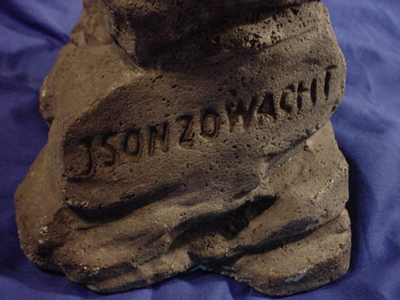 Watch on the Isonzo (River) |
 |
 |
 |
 |
 |
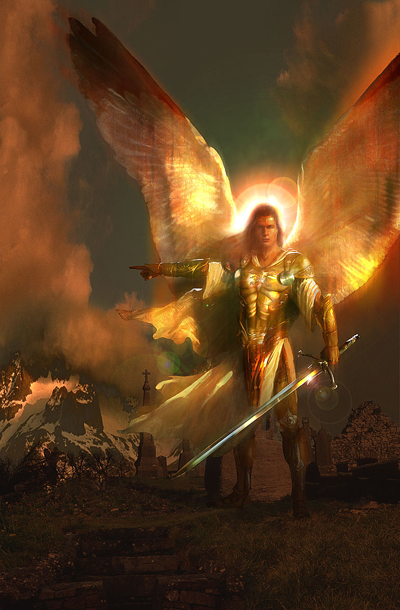 |
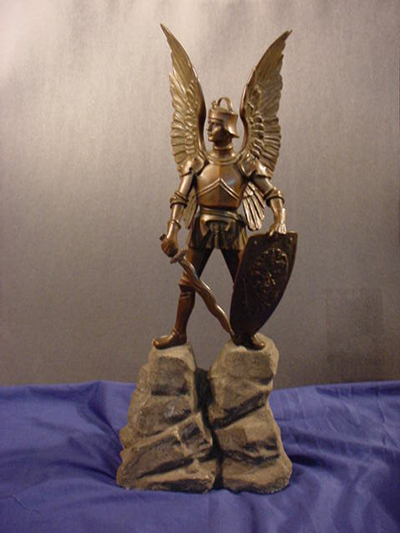
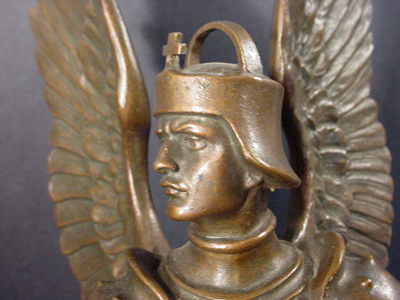
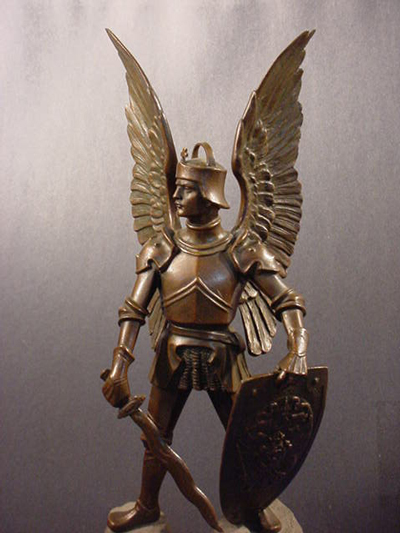
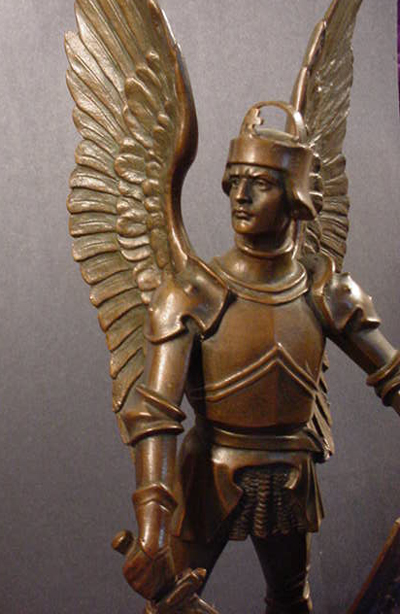
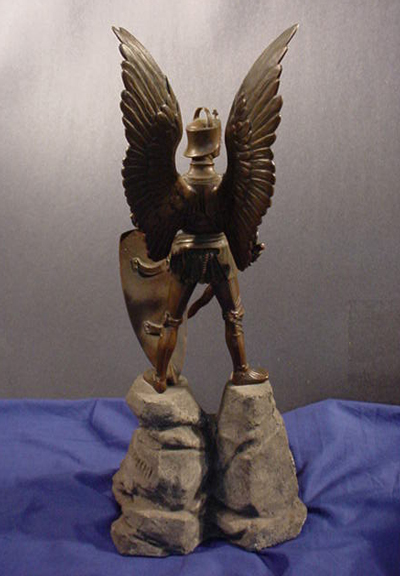
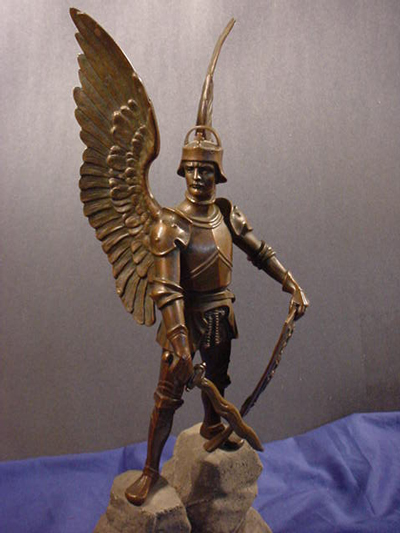
Austrian Bronze Statue of Saint Michael Guarding the Austrian Border (Item WWI 12-1 & KSTATUE 5-5) |
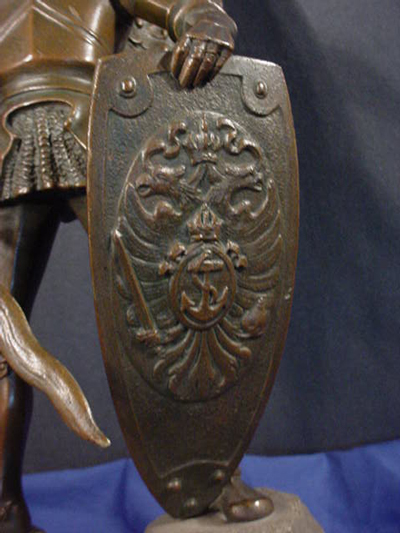
DESCRIPTION: This is a magnificent bronze statue of the Patron Saint of Imperial Austria armed with sword and shield. He stands defiant and steadfast as he guards the area known as the “Isonzo” named for the Isonzo River that runs from the Gulf of Trieste through Italy and Slovenia and joins with the Sola and Idrija Rivers as it ambles toward Austria. The battles of the Isonzo were a series of 12 battles between the Austro-Hungarian and Italian armies in World War One. They were fought along this river on the Eastern sector of the Italian front between June 1915 and November 1917. Most of the battles were fought on the territory of modern Slovenia and the remainder in Italy. During the war the Isonzo valley was part of the Alpine sector of the Italian Front, along which the armies of Italy and Austro-Hungary clashed. During World War One the sixty miles long river ran almost entirely inside Austro–Hungary in parallel to the border with Italy. There is a narrow corridor between northern Italy and central Europe. This corridor is also known as the “Ljubijana Gate.” The Italian army wanted to break through this passage in order to penetrate into central Carniloa and then on to Stynia to the heart of Austria. The area between the northernmost part of the Adriatic Sea and the sources of the river Soca thus became the scene of twelve successive battles with the rest of the mountainous 400 mile long front almost everywhere dominated by Austro-Hungarian troops. The Isonzo was the practical area for Italian military operations during the war. The Austrians had fortified the mountains ahead of the Italian long expected entry into the war on May 23rd, 1915. The details of the battles are available on the internet; we won’t go into further description here. Fratricidal War at its Most Heinous. Despite the huge effort and resources poured into the continuing Isonzo struggle the results were invariably disappointing and without real tactical merit, particularly given the geographical difficulties that were inherent in the campaign. Cumulative casualties of the numerous battles of the Isonzo were enormous. Half of the entire Italian War casualty total some 300,000 - 600,000 were suffered along the Isonzo. Austro-Hungarian losses while by no means as numerous were never the less high at around 200,000 of an overall total of around 1.2 million casualties. The statue stands today as a memorial to the brave Austrian soldiers who died in those twelve battles as defenders of their sacred fatherland the figure of Saint Michael depicted with the wings of an archangel. His sword is the wavy blade type and his shield has the double headed eagle of the Hapsburg Empire. The bronze figure stands at the peak of a simulated mountain. This model mountain is formed from actual Austrian granite from the area of Austria where such stone is quarried. The realistic tone is exemplified by this clever artistic touch. The whole of the sculpture in height including the granite base is 15 inches with the base being 6 inches high and Saint Michael being 12 inches. The sculpture and base are in A-1 perfect condition. Very dramatic looking and noble in its concept. This is one of the most meaningful art statues we have ever presented to serious Germanophiles worldwide. By the way, we might need a St. Michael or St. George at our border in the near future to guard against the Dragons and Devils from south of that besieged border. Let’s support Arizona! In Hoc Signo Vinces!!! PRICE: SOLD |
 |
 |
 |
 |
 |
 |
 |
 |
 |
 |
 |
 |
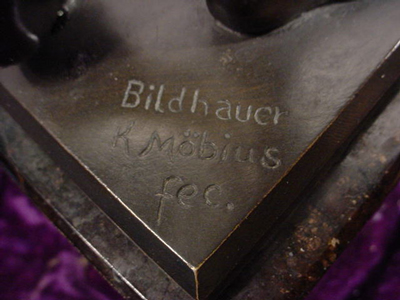 The artist |
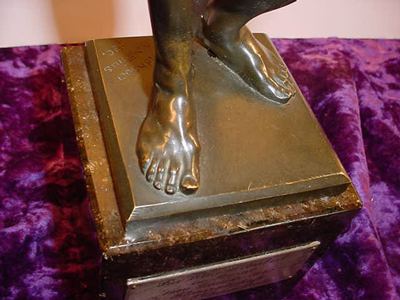
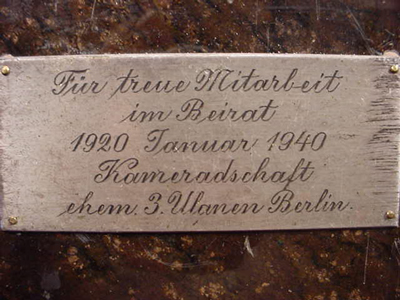 The plaque |
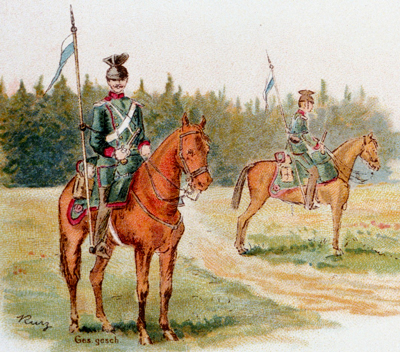 Ulanen on patrol |
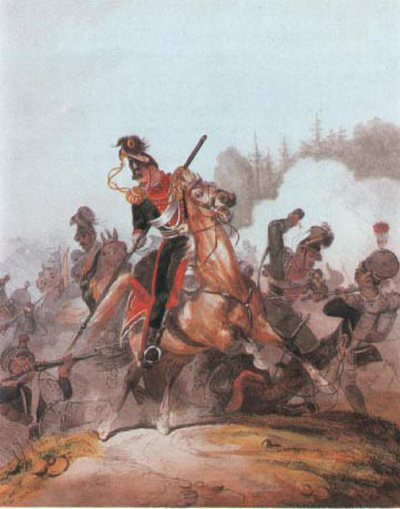 Ulan in early combat |
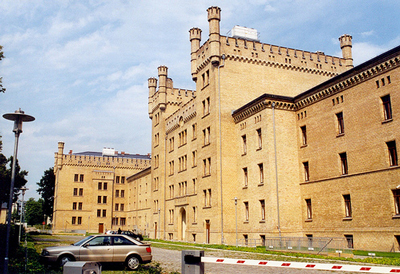 Third Garde Ulanen Kaserne in Berlin |
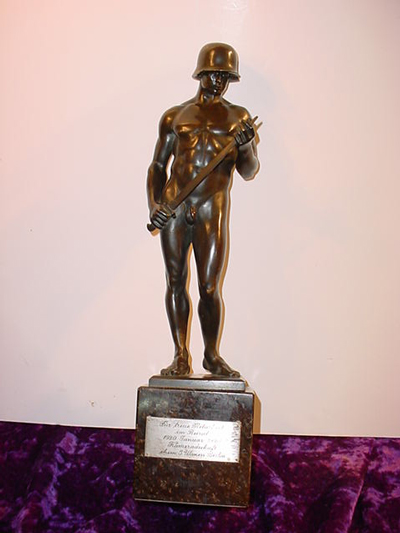
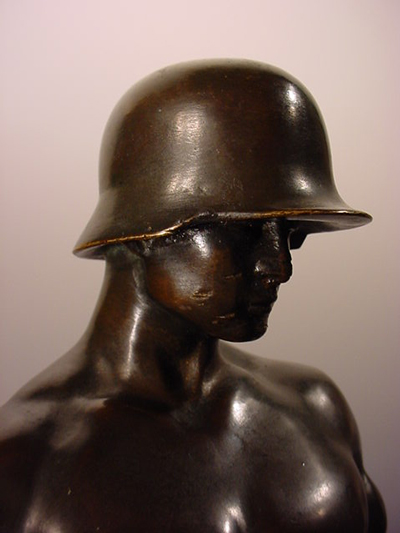
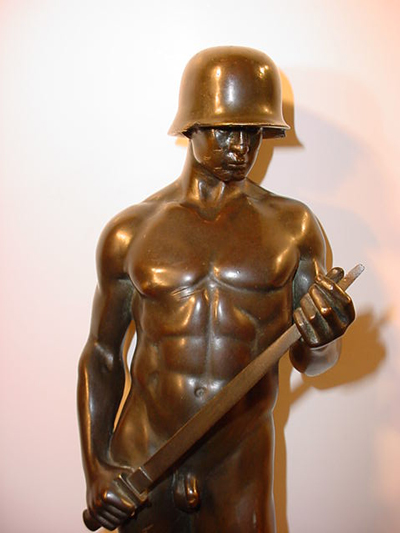
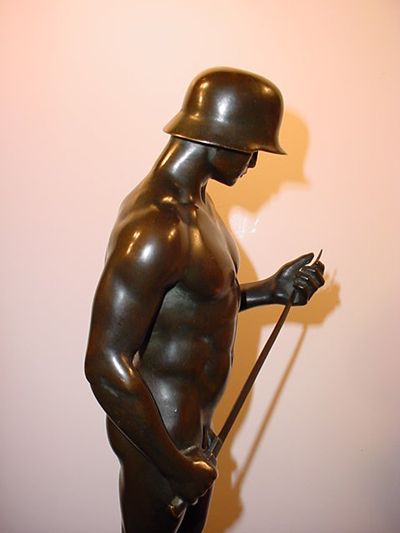
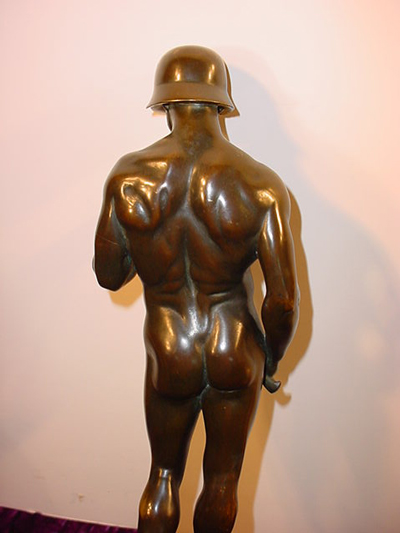
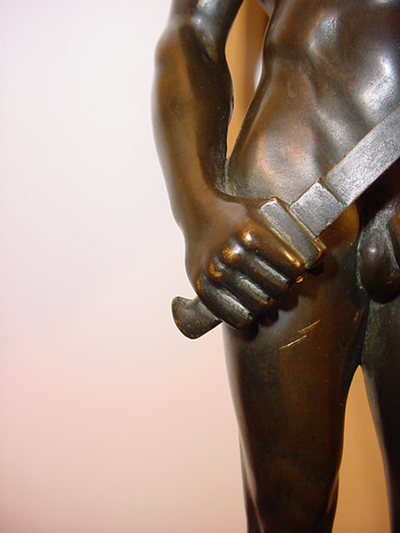
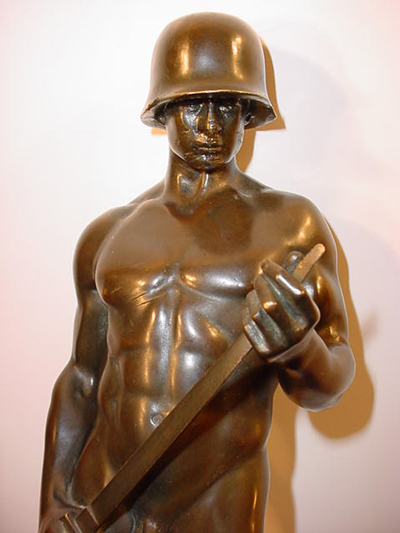
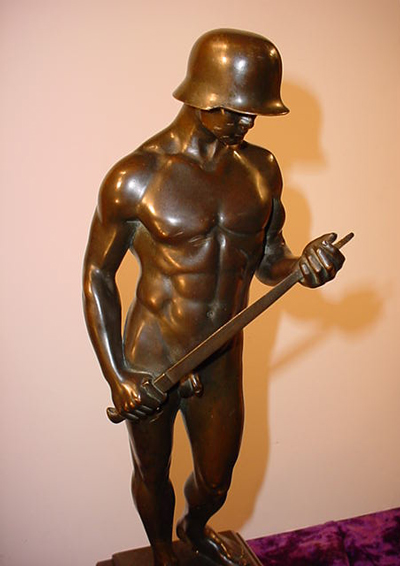
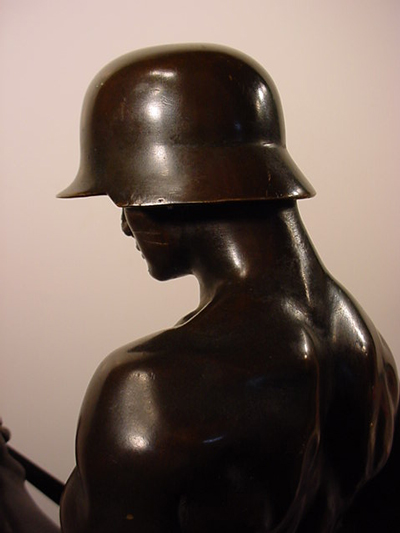
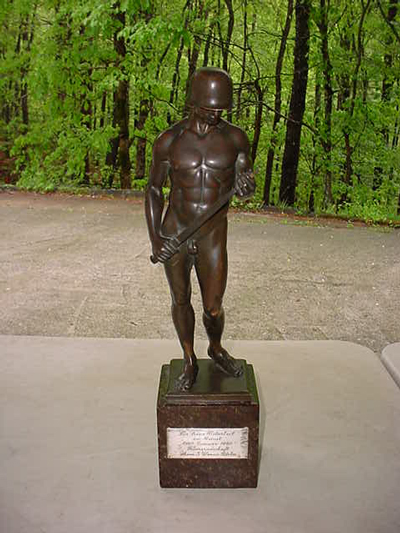
Bronze Soldier of the Reich (Item WWI 12-2, ART 16-10, KSTATUE 5-6, WEHR 31-14) |
DESCRIPTION: This marvelous statue measuring 13 ½ inches high with a base 4 ½ inches square (length and depth) personifies the strength and determination of the “Deutscher Soldat” from the time of the battle of the Teutoberg Forest up through the pages of history and into the 2nd World War. The slogan that might go with this wonderful sculpture could be “Die Ganze Welt Gegen Uns”! The whole world against us! Yes, Germany in the embodiment of the Heilege Vaterland was always to protect Europe against the constant incursions from the east against the Magyars, Huns ,Goths, and Visagoths and even the moribund Roman Empire. The land of Germania and its Teutonic Volk took on all comers. It was no different in the 2nd World War when Germany with a few allies stood against the Maelstrom in what was a German led crusade to destroy the beast of Bolshevism before all of Europe was disseminated by what President Regan later called the Evil Empire. Tthis was truly “evil personified! “ And in this author's perception, all the nations who joined in the fight to preserve communism and crush Germany were the acolytes of Stalin and Tito and obviously Satan*. (*Authors historic opinion.) The statue you see here tells of a saga that we have briefly touched upon in the forgoing narrative. As this Warrior stands naked before the world, the artist who sculpted him conveys in statuary the defeated yet proud and militant German soldier who wears the Stalhelm (steel helmet) and makes ready the sword of Siegfried known as Nothung for the next time the call of the besieged Fatherland is heard. We readily admit that all of this will only be understood and honored by Germanophiles, but we can envision all the deep meaning that this artistic masterpiece conveys. Nothing else that we have ever offered or seen offered comes up to the artistic expression and important significance of this prodigiously important piece. Its historical importance is magnificently conveyed. This statue which may actually be unique; it is a presentation piece to an officer who was “Beirat” (military advisor) to the Third Ulan battalion in Berlin. This wonderful gift was from the Kameradschaft (comrades) and presented to him for his true service to the Batt. From 1920 to 1940 this illustrious unit was the Third Guard Uhlan regiment and in WW 2 the Uhlans became armored divisions and covered themselves with glory in the early campaigns in Poland and the military engagements against France and Russia. The sculpture weighs about 14 pounds with the marble plinth and is in perfect condition with a gorgeous patina throughout. Deutschland Uber Alles ! PRICE: SOLD |
 |
 |
 |
 |
 |
 |
 |
 |
 |
 |
 With cymbal raised |
 |
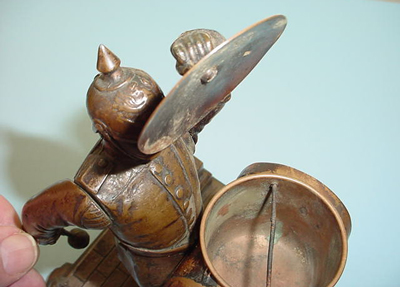 |
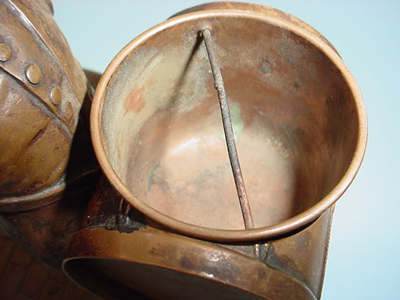 The ash receptacle |
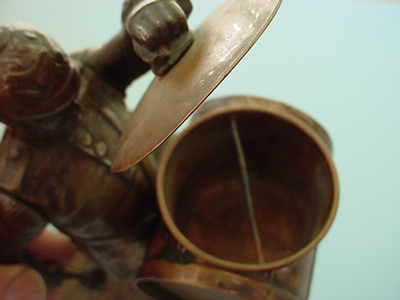 |
 |
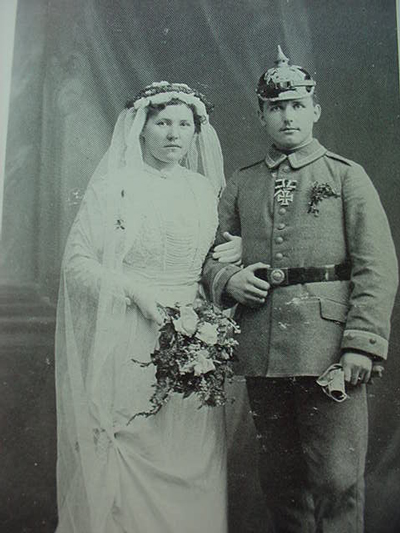 Prussian bandsman (note swallows nest) |
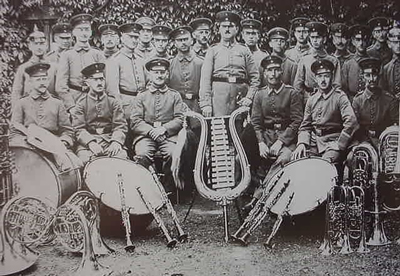
 Prussian band |
 |
|
|
 |
 |
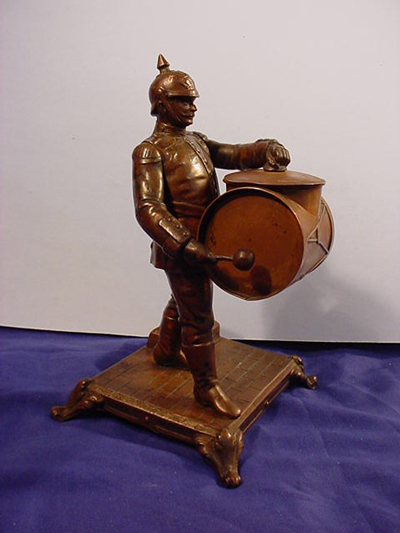
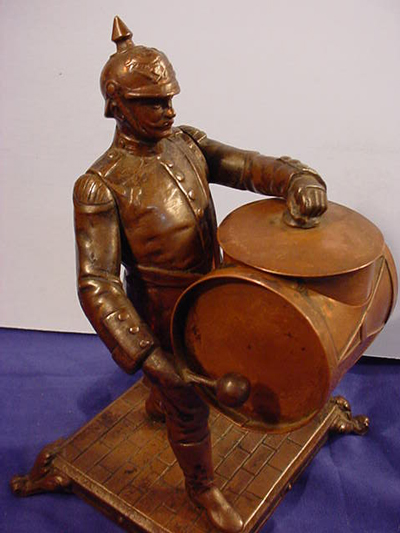
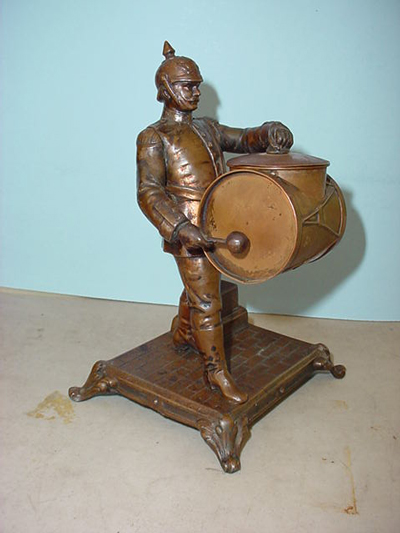
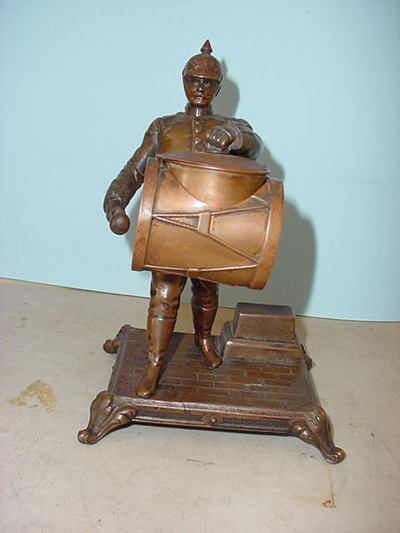
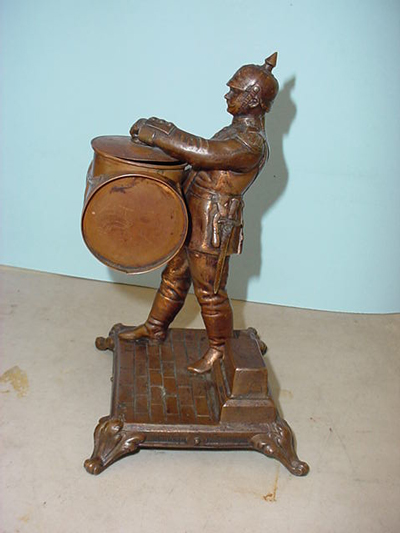
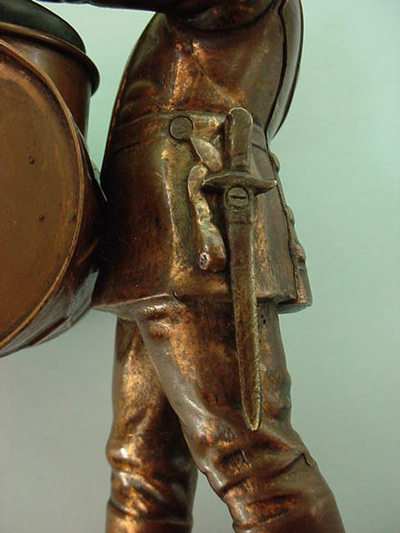
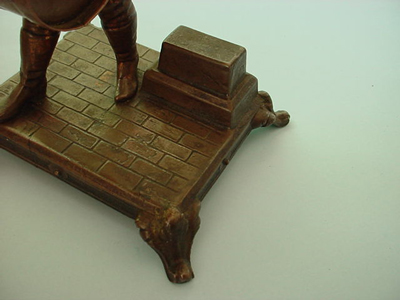
A Soldier Ashtray (Unique) (Item WWI 12-3 & KSTATUE 5-7) |
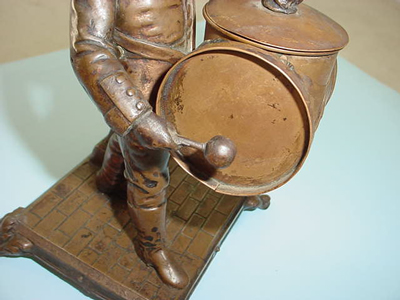
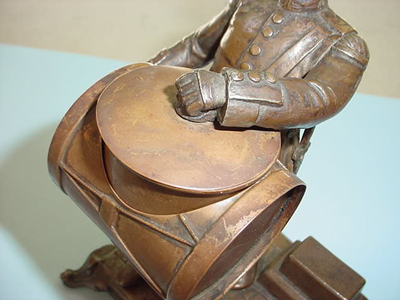
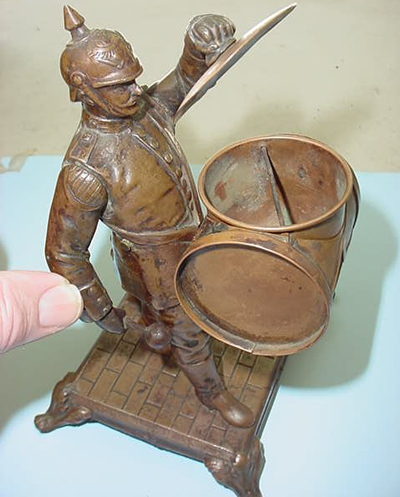
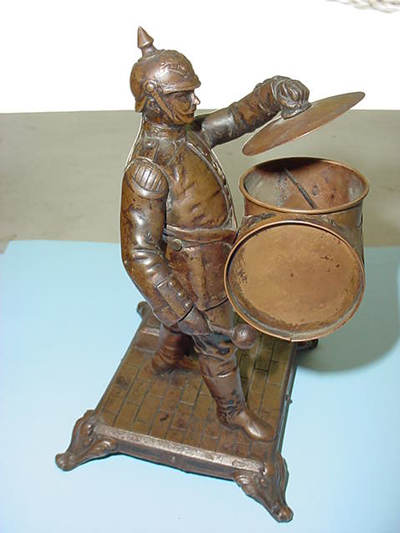
DESCRIPTION: This has to be one of the neatest WWI German novelties of the Imperial Era we have ever seen or heard of. This Pickelhaube wearing Prussian soldier is a ‘Bandsman’ and “what a bandsman.” He is playing the “Grosse Trommel” (Grand Drum) and the large cymbal at the same time. He is in full Prussian Landser uniform with the ‘Birds nest” or swallow tail epaulettes on his shoulders and the special three button style cuffs that are sported on the dress tunic. He wears the Mauser 98 bayonet with portepee. The absolute most unique thing about “Fritz’ is found in his moving parts -- when the arm holding the drum stick is depressed downward, he raises the cymbal and brings it clanging down when the drumstick is returned to its original position. Of course when the cymbal is raised the ashtray is exposed. Behind ‘Fritz’ is a small plinth where a pack of matches would be mounted. The figure is mounted on a base that is made to look like a brick street. Under the base are letters, D.R.G.M. (German registered patent) and another word is found by the base fixtures. It could be Mustersch.? The figure with base stands about 8 inches tall. The drum is about 2 ½ inches long. The cymbal is about 2 inches in diameter. We at Germania are particularly proud to offer this great figure to the collecting pubic and at the same time in hopes he doesn’t go out too soon, he looks great on our desk. In all probability ‘Fritz’ was a table piece in an officer’s Mess Hall. He is certainly not a toy. PRICE: SOLD |
 |
 |
 |
 Austrian Soldier |
 German Soldier |
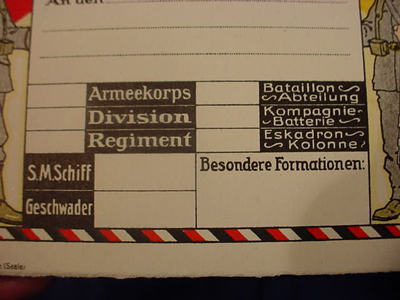 |
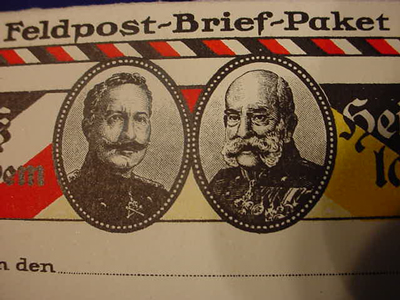
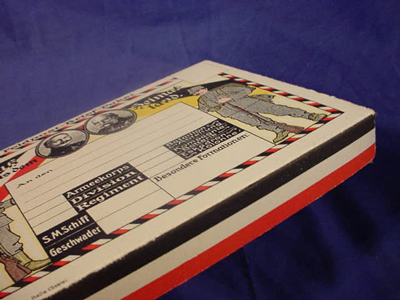
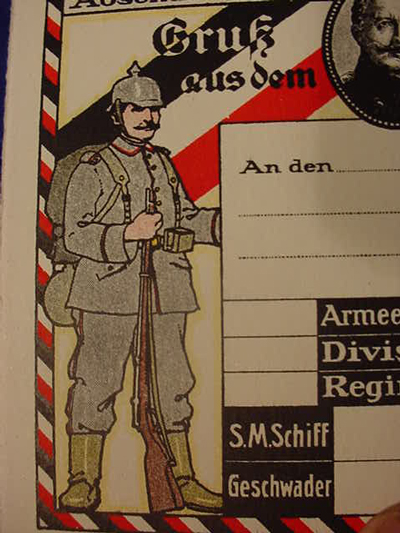
World War One Military Mailing Box (Item WWI 12-4) |
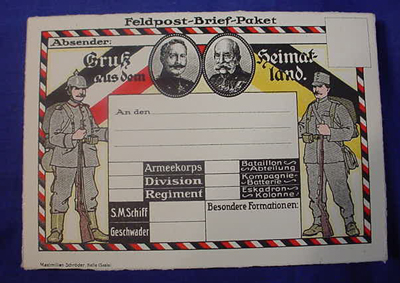
DESCRIPTION: We managed to find four of these beautiful mailing boxes that were issued to soldiers of Germany and Austria. They were for the soldiers in the field to send home letters, notes, souvenirs, etc. They are measured at 7 x 5 inches and are 1 ½ inches deep with the Austrian and German soldiers depicted with their colors behind them. Also seen is a picture of Kaiser Wilhelm II and Franz Joseph of Austrian side by side in portrait style while in the middle you can see the lines to be filled out as to address and destination and other lines for military identification of the sender. Across the top is written Feldpost-Brief Paket. (Field post letter packet). They are in mint condition and truly rare but a package of them was recently found (never issued). A great souvenier of the Great Fratricidal war. PRICE: $60.00 each (a bargain!) |
 |
 |
 |
 |
 |
 |
 Artist signature |
 The plinth |
 The Field Marshal |
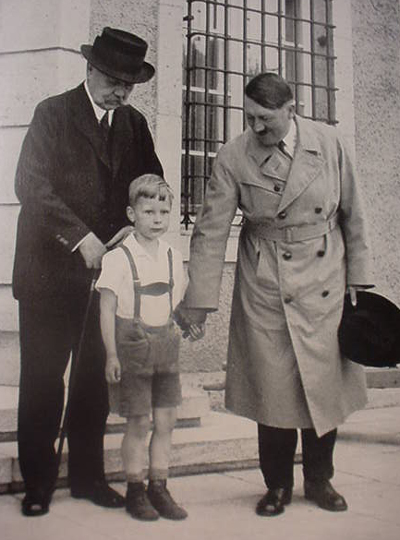 With grandson and future Fuhrer |
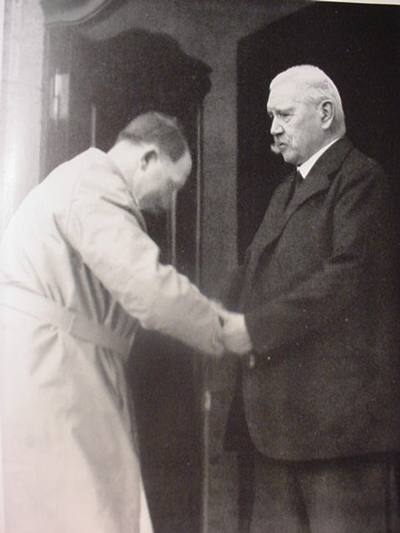 |
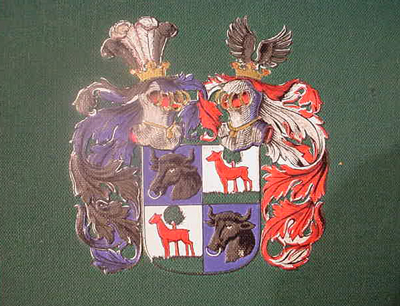 Hindenburg crest |
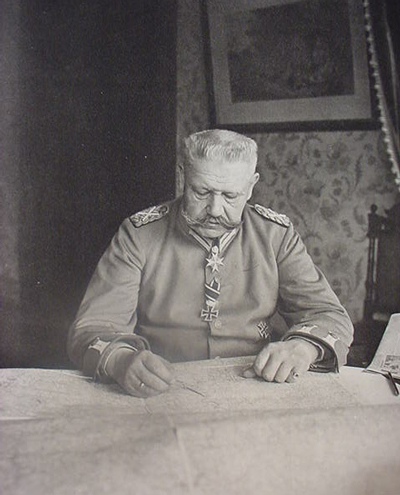 |
 |
 Memorial |
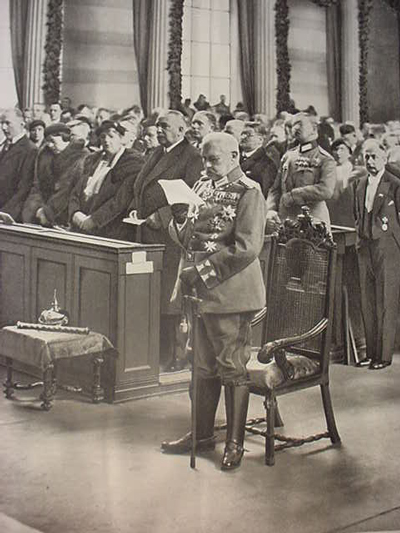 |
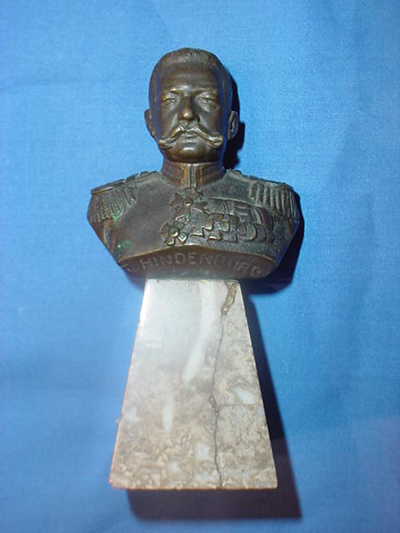
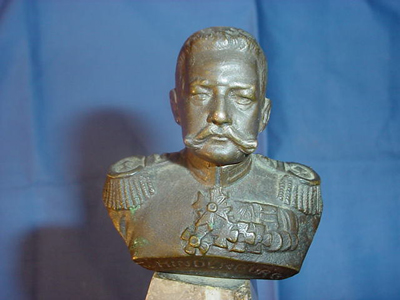
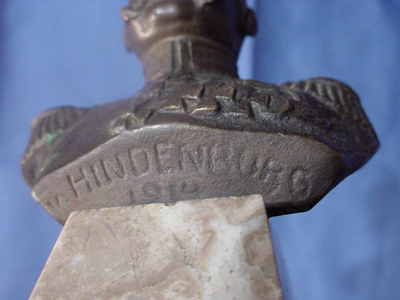
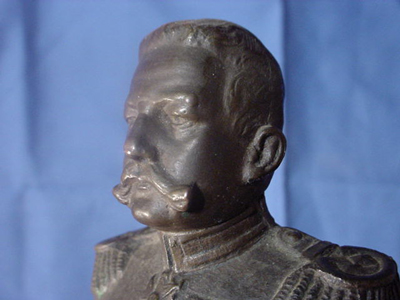
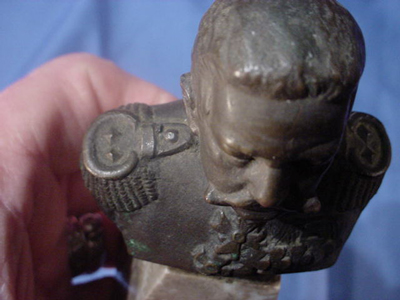
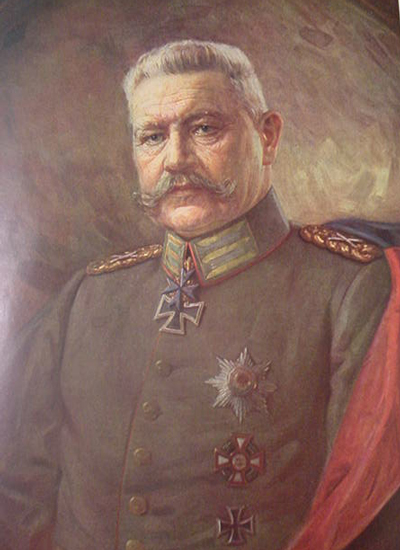
Small Bronze Bust of General Field Marshal Paul von Hindenburg (Item WWI 12-5 & KSTATUE 5-8 & PERS 4-16) |
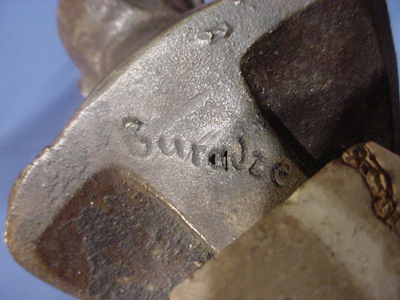
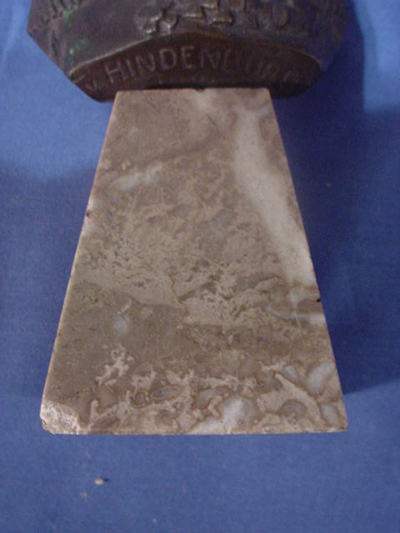
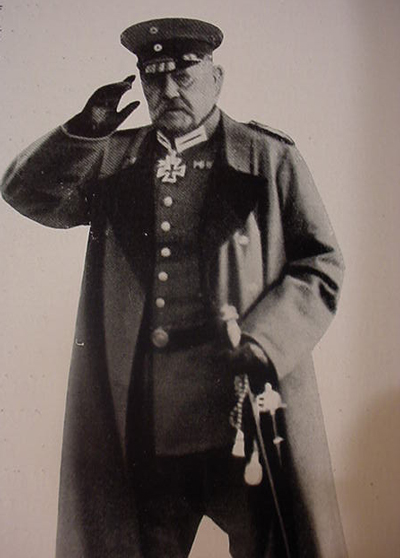
DESCRIPTION: This is a great little sculpture mounted on a marble base. It is highly detailed and an excellent likeness of the Great War leader who later became the first post-war president of Germany. He later appointed Adolf Hitler Reich’s Chancellery. There is a narrative about this much loved and respected leader in several of our pages and the Kaiser Reich section on bronzes and statuary page 4 at KSTATUE 4-2 and also on the Third Reich page 14-1. He was known as the “Father of the Fatherland” and Germany’s greatest war hero. Please do read about him on our pages at the WWI section. This is a fine period bust and a great historically important item. Small but dramatic! The bust with its plinth stands 4 3/4th inches high and the bust alone is 2 1/2 inches high; it is signed Burajze. The medals and birds nest shoulder boards and stand out in amazing detail and the face is remarkably life-like. The artist certainly captured the spirit of the grand old Marshal. PRICE: SOLD |
 |
 |
 |
 |
 |
 |
 |
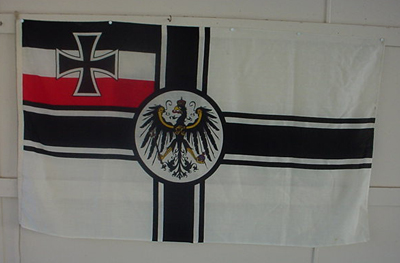
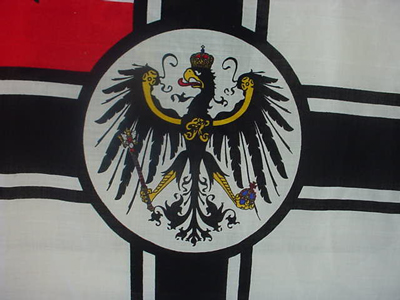
Imperial Battle Flag (Item WWI 12-6 & FLAG 3-1 & KCLOTH 2-7) |
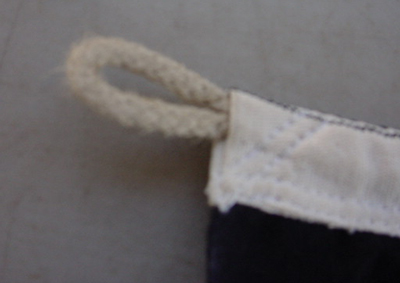
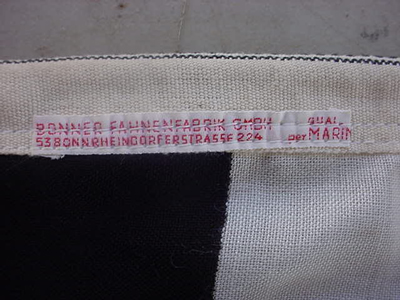
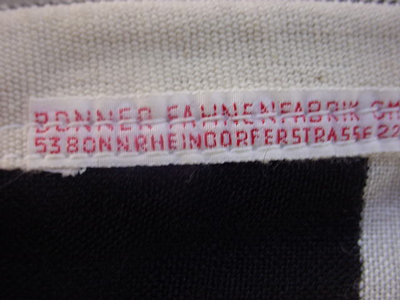
DESCRIPTION: Here is a specimen in nearly mint condition of the Kaiserreich battle flag. We are not sure if it was manufactured in the period leading to or during the First World War. It could have been produced in the 1930's or 1940's. The Veterans Associations used this ensign in all their parades and ceremonies. The condition is great and it has the label of the flag maker on its rope edge. It is a great size for the collector (53" x 31") and is a very dramatic looking flag. It has the rope running through the left side (stitched on) with the loop and tie lanyard all there. The Banner Fahne Fabrik was known to make the finest in flags and standards in the Imperial era and in the Third Reich (they made the best!) PRICE: SOLD |
 |
 |
 |
 |
 |
 |
 |
 |
 |
 |
 |
 |
 |
 |
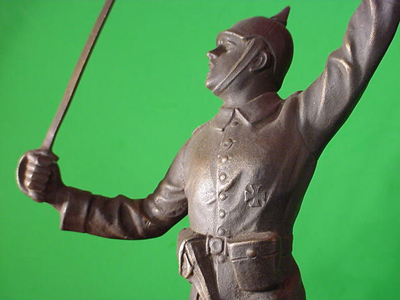 |
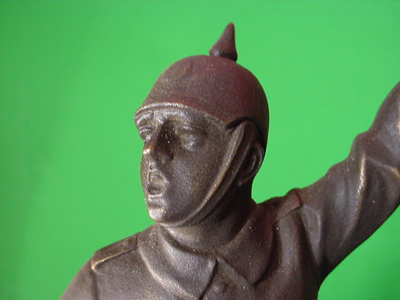
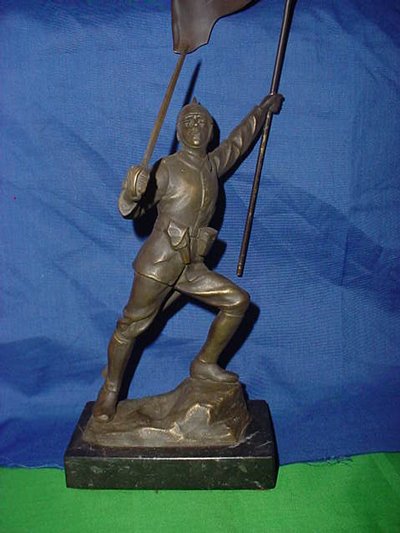
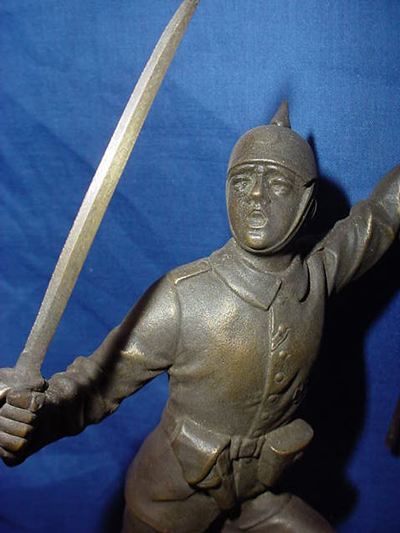
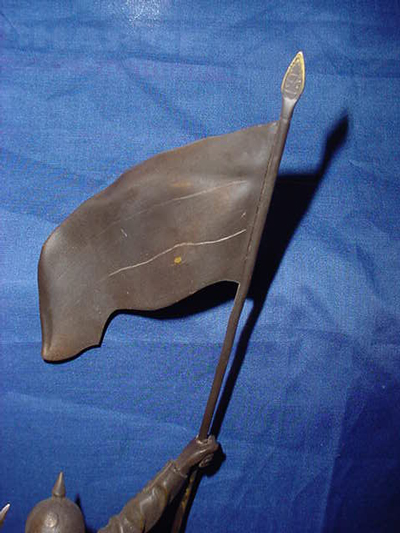
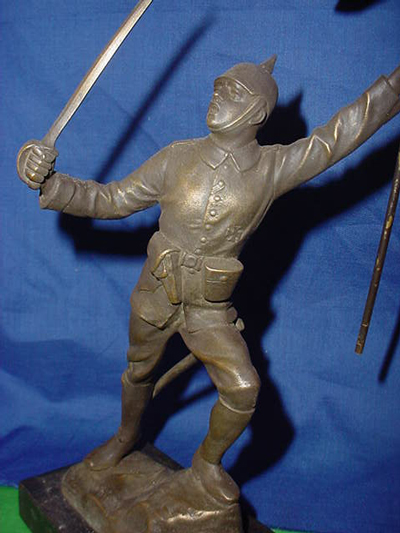
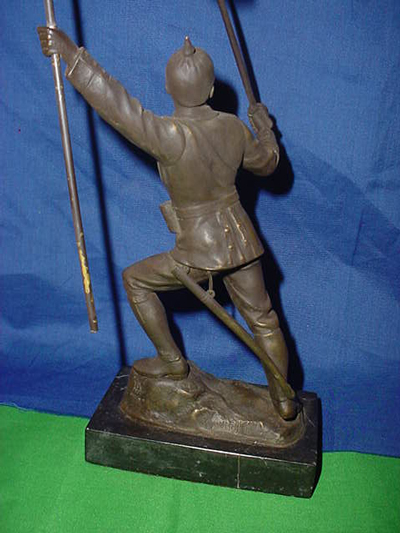
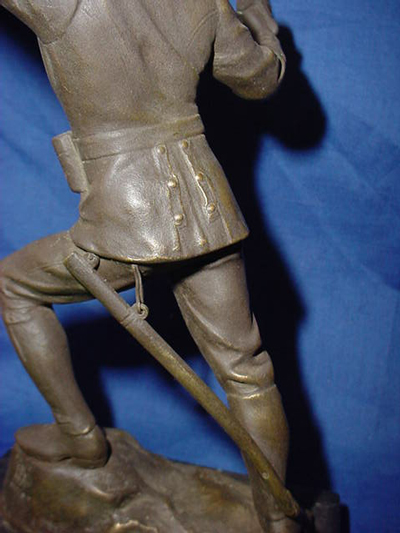
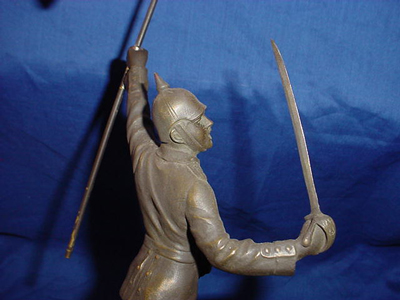
WWI Soldier in Bronze with Banner (Item WWI 12-7 & KSTATUE 5-9) |
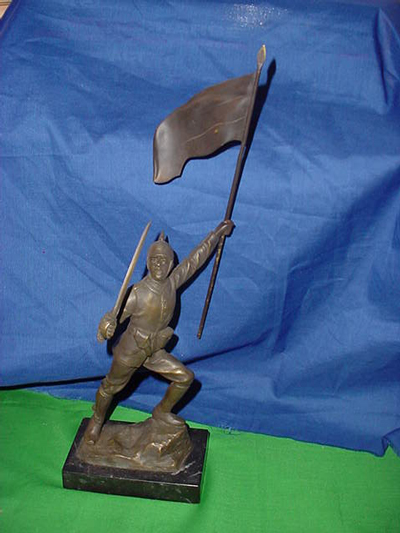
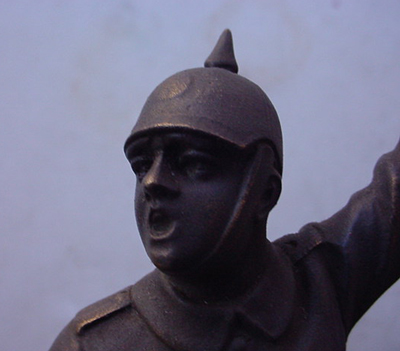
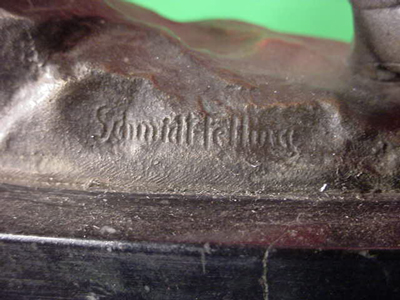
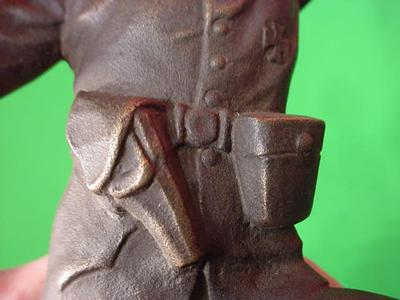
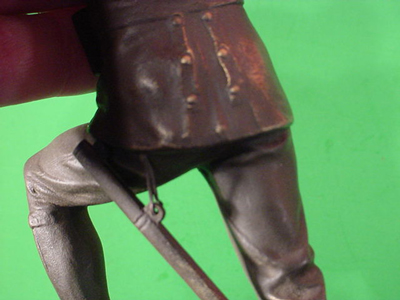
DESCRIPTION: This is a bronze sculpture by famed Paul Schmidt Felling 1835 - 1930. He was one of the most famous artists doing human figures in his time. Farmers, children, workers, soldiers and some animal figures, he was a very prolific artist and was most known for his very dramatic figures but also his Volkskunst(Art of the People). This example is a patriotic theme with a soldier of the Fatherland in the pose of officer holding the schwarz, weiss, rot banner as he advances with drawn sword. The officer seems to be rallying the troops for a charge against the enemy. The banner is seen to be divided into sections that, were they in color, they would be the national colors of black, white and red. We have seen a larger version of this Felling statue in a German art museum and it had the name ‘Vorwarts’ or ‘Forward.’ Certainly an appropriate title for this extremely melodramatic figure that is so striking and full of meaning to the Germanophiles among us. PRICE: SOLD |
 |
 |
 |
 |
 The presentation cigarette case |
 |
 |
 |
 |
 |
 |
 |
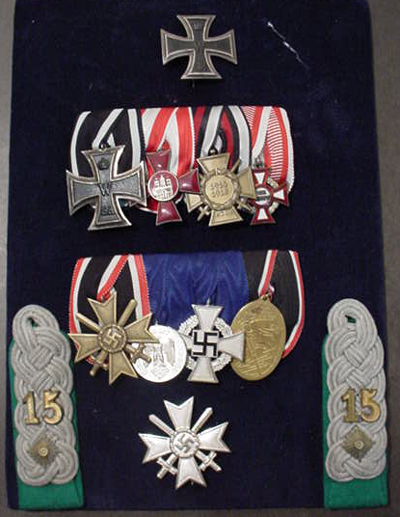 Medal assemblage with shoulder boards |
 |
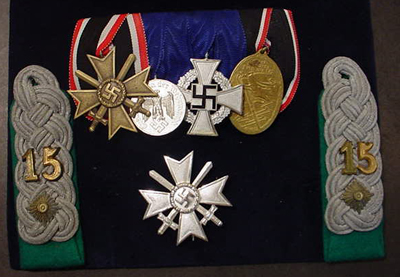 |
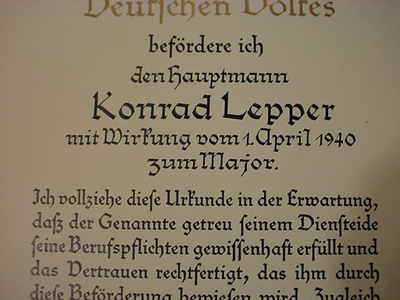
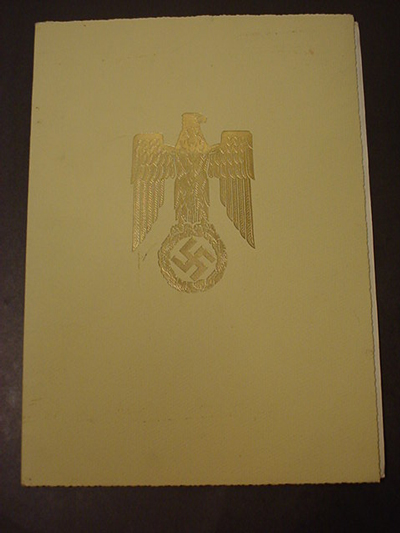 Promotion certificates |
 |
 |
 To Captain |
 |
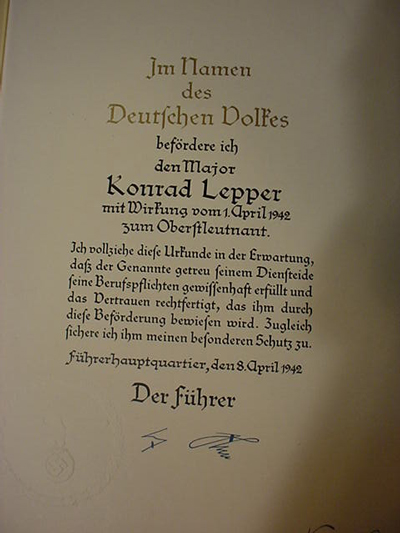 To Major |
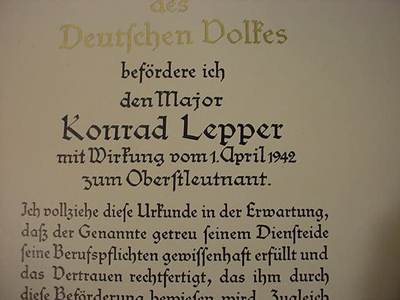 To Oberstleutnant |
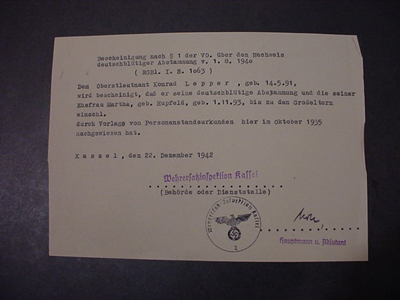 Aryan birth paper |
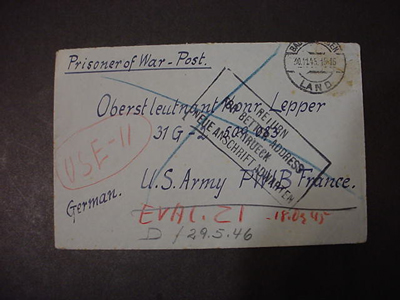 Letter while POW |
 |
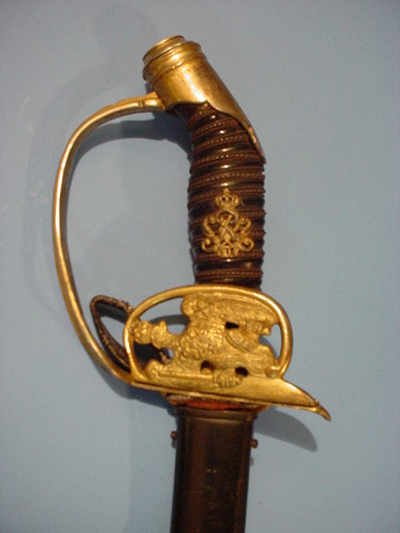
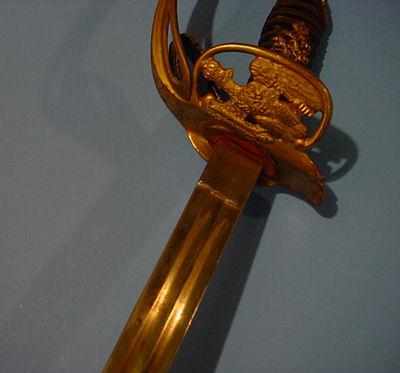
 His sword from WWI seen in this portrait |
 |
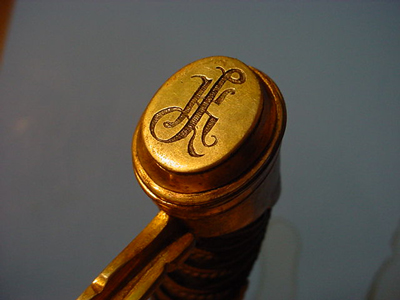 His engraved initials |
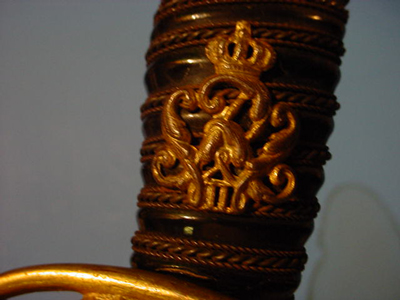 Wilhelm II cypher |
 |
 |
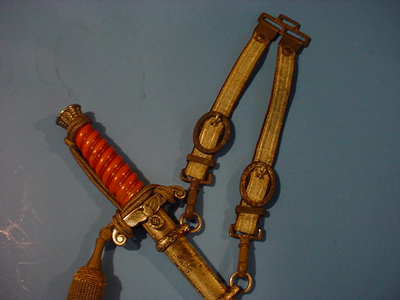
 His WWII officer's dagger |
 |
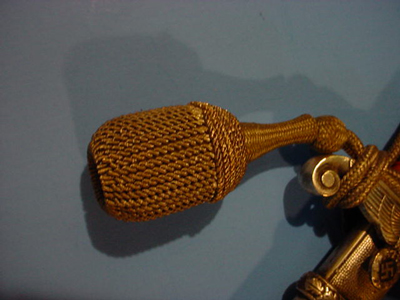 Portepee |
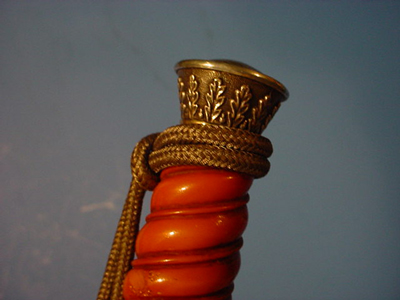 |
 |
 His initials |
 Manufactured by Puma-Solingen |
 |
 |
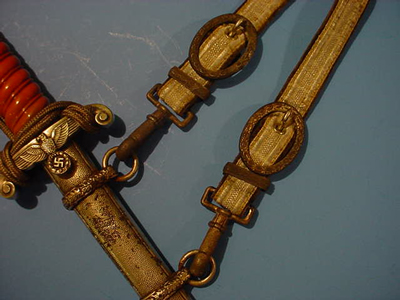 Hangers |
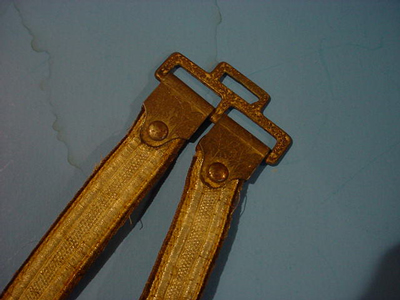 |
 Some misfortunes of war |
 Back side |
 |
Utterly Magnificent WWI & WWII Group Belonging to One Officer of the Deutsches Vaterland (Item WWI 12-8 & WEHR 31-28) |
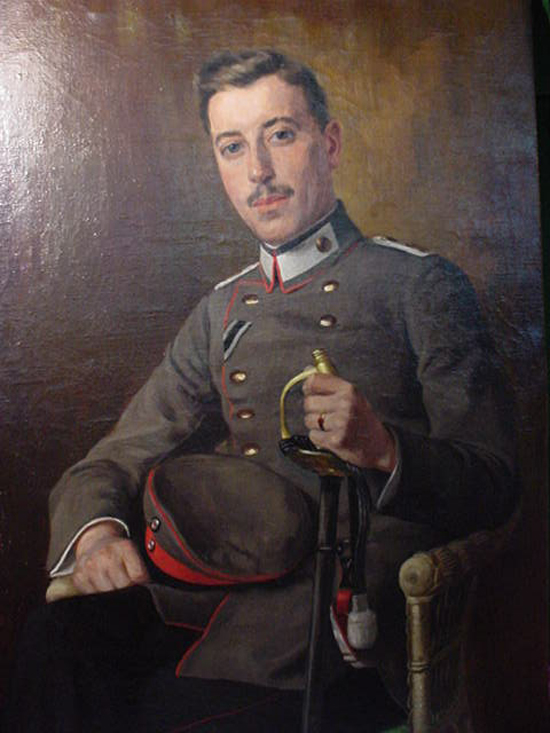
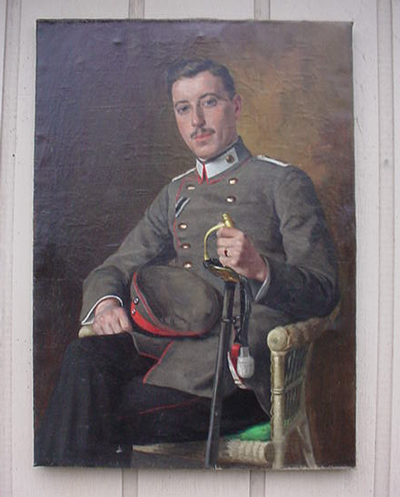
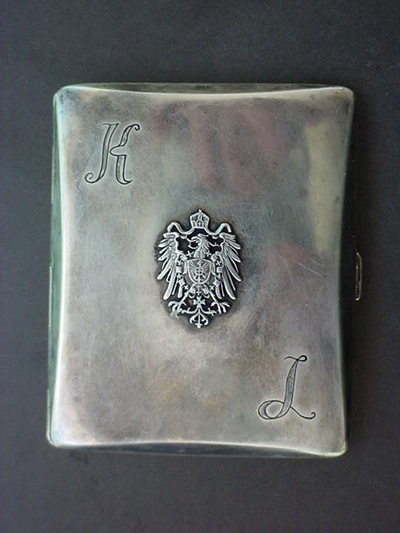
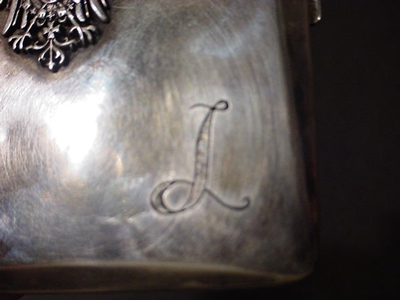
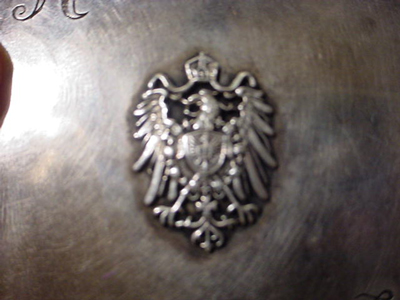
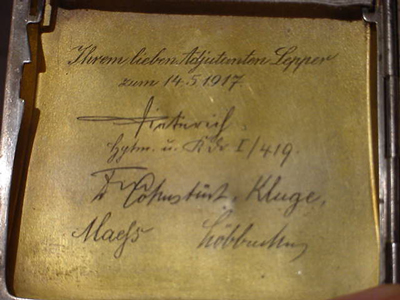
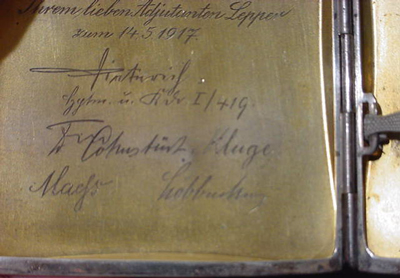
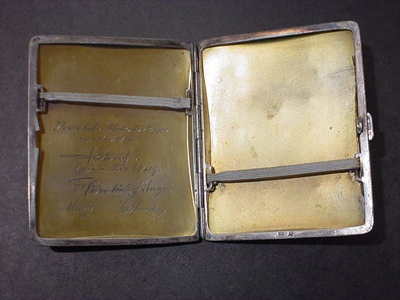
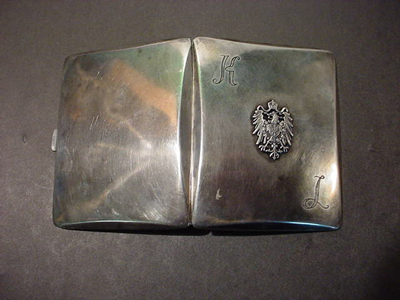
DESCRIPTION: This has to rate as one of the absolute best groups we have ever offered at Germania International. In a word, incredible. The articles were the personal possessions of Herr Konrad Lepper who served in WWI and won the Iron Cross First and Second Class and was an adjutant, so we are told, in the unit I/417 and worked up the ranks to being an Oberstleutnant in 1942. The Second World War, he was in the Gebirgsjager Corps (Mountain Infantry) or at least that is indicated by the color of the underlay on his shoulder boards...light green Waffenfarbe. With the group there is a cigarette case that is crafted in 800 silver. It measures 3 ½" x 3" and about ½ inch thick; it has the Hohenzollern eagle in its center and K.L for Konrad Lepper. The initials are on the left (K) and in the bottom right (L) on the inside of the case. It is presented to Lepper with the words that are hand engraved -- Ihrem Lieben Adjutanten Lepper 2-M 14 5 1917. “To the Dear Adjutant Lepper’. Then there are what looks to be five facsimile signatures of officers that were presenting the case to Lepper. The only one at his point that we can make out clearly is Kluge -- this could be the famed General Von Kluge of WWI and WWII fame. That might have been the officer that Leper was adjutant to. With the group are 10 medals in parade dress mount and his shoulder boards from his WWII rank -Oberstleutant 1st Colonel in the 15th Mountain Troop Battalion. His medals are mounted on a board that is similar to the funeral pillow that is used in display, these would be the awards won in the career of a soldier then deceased and this might well be the case here. We received them mounted like this when we purchased the group. Note the medals in our pictures and they are from the top on down:
On the Next medal grouping parade bar we find:
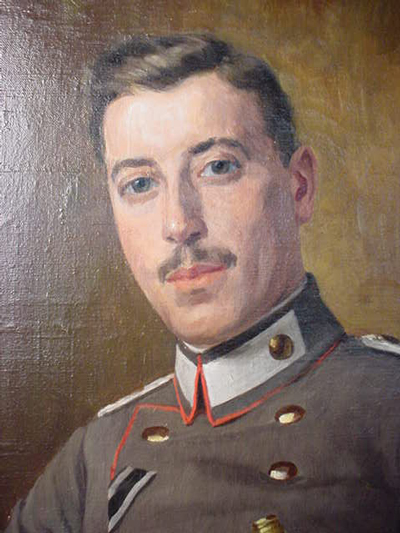
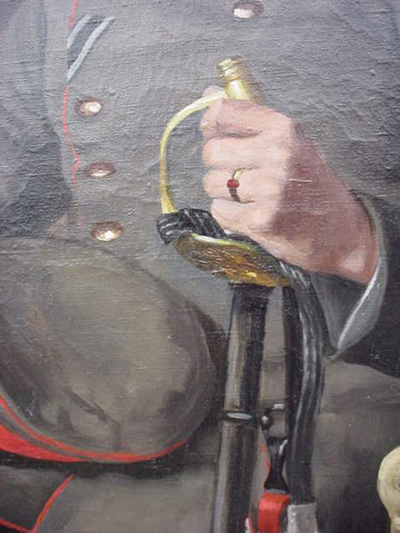
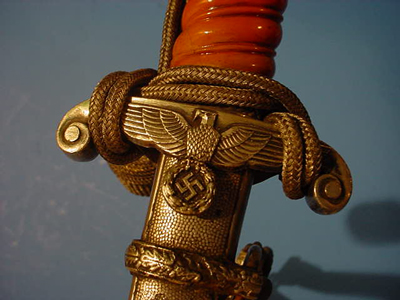
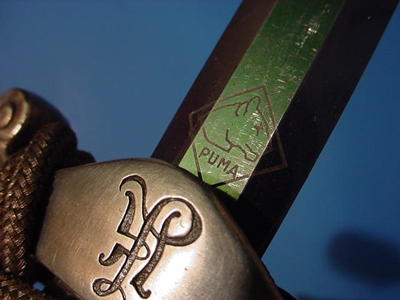
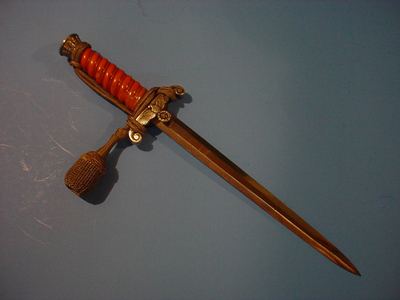
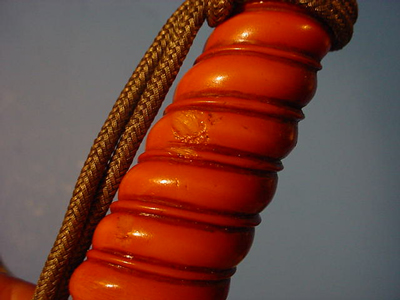
On this board you can also see Lt. Col. Lepper's WW II shoulder boards from the 1st Gebirgsjager Regiment. We would hazard a guess that Lepper may have been retired at the age of 52 in 1943 or 53 in 1944. He was born May 14th, 1871. We say this because of the Weimar Kyfhauser bund medal and the N.S. Faithful Service award; it indicated he may have been in the Civil Service even before the First World War. To continue we come to the most incredible part of the group and that is a beautifully rendered oil portrait of the Soldat Lepper in full uniform in the WWI era with his sword. This is a large painting 42” x 30”. It is actually from the period 1914-1918 and it is in fine condition. We had to remove the frame to send the painting home but believe me the frame was nothing we would treasure. It was a black painted common frame in chipped up condition and this magnificent oil deserves a better framing job in any case. We leave that to the buyer. The painting is unsigned but is obviously the work of a truly professional artist; very life-like portrait of a real career officer, Germany’s finest. Also fantastic is that we have the actual Mod 1889 Infantry officers sword that you see in the picture with Lepper's initials K.L. engraved in the pommel section. The sword is in all around great condition The wire wrapping is tight, the brass is all still with 90% of its original gilted patina. The scabbard shows use but no abuse. The blade is plain steel. Unsigned, with double blood gutters. The royal Prussian crest are perfect as is the eagle on the brass foldable guard The sword in its scabbard is 36 inches long. Herr Lepper was a proud German soldier so it is not so unusual to find their initials or names on the swords. Usually it is the career men who are “button busting proud” of their army, their nation and their family who would have this done. To continue, we have Lepper's Wehrmacht officers model ‘Heersdolch’or (army dress dagger) with original portepee (knot) and hanger. The dagger was manufactured by the famous Solingen Firm of Puma. The cross guard on the back incredibly has his initials once again (K.L.) done in classic Germanic letters that exactly match the personalization on the sword. This dagger is in average to very good condition. The blade is bright but could have at one time broken at the tip. But if so it has been expertly repaired even if shortened by a ¼ inch or so. The grip may have had a chip near the cross guard but that also was excellently repaired. The scabbard shows some plating loss here and there but we think Lepper was no armchair officer; he was probably busy most of the time and wearing the weapon all the time as an adjutant. The supplied hangers show use but are still good and serviceable (and highly collectable); all in all a very nice specimen of the official dress dagger of the German Army. Next, and this is incredible, the original three promotions that Lepper earned through his long military career. This starts with:
Next: When an officer reaches the high rank of Oberstleutenant the official Wehrmacht inspection always came to pass. And this was similar to the Party Rasse und Siedlungshauptamt “Race and Resettlement Office.” They wanted to know if the officer was of pure Germanic descent according to paragraph (1.) The law of Aryan descent. This was under the Reichsgesetzblat-filing system 1063 it says “We hereby certify that Oberleutnant Konrad Lepper who was born 14/5/91 is of German descent as is his wife Martha who was born Hupfeld Nov 1st 1893 and as far back as her grandparents is also Aryan Approved by inspection of official records here in Oct 1935. This was signed in Kasssel the 22nd of December 1942. It has the stamp of the inspection office and is signed by a captain and adjutant. This file paper is 8 x 6 inches in size. Last but not least is an envelope minus the letter -- 5 ½" x 4" addressed to Oberstleutnant Lt. Lepper # 316-2 509 083 U.S. Army POW 1 B France and dated 29 May 1946. It says to the side (German) and at the top Prisoner of War post. On the back it says Lepper Bringhausen UB Wildungen 16 Germany. We believe this was a letter from his father or mother but could be from his brother or sister while he was a prisoner of war in France but at a US prisoner facility. So here we have one of the most complete groupings of the personal articles ever offered -- absolutely stupendous! How and why they were ever released and sold by the family is unknown to us. Perhaps it is because of the slander and debasement of Germany’s soldiers taught in the post-war German schools and in fact even in the media today in the Orwellian world we now seem to have reached. Or perhaps most of the Lepper family is gone leaving behind a few of the ‘new’ Germans who have adopted the “Coca-Cola and gum chewing culture”. These types would sell their history and heritage in a snap! It means nothing to them. If they would be asked if they knew the difference between ignorance and apathy their answer would likely be “I don’t know and I don’t care!” Think about that one. To us this collection is truly a Germanophiles dream and a tribute to a brave soldier of the Reich. May he rest in glory! Alles für Deutschland! PRICE: SOLD List of items with Group:
|
 |
 |
 |
 |
 |
 |
 |
 |
 |
 |
 |
 |
 |
 |
 |
 |
 |
 |
 |
 |
 |
 |
 |
 |
 |
 |
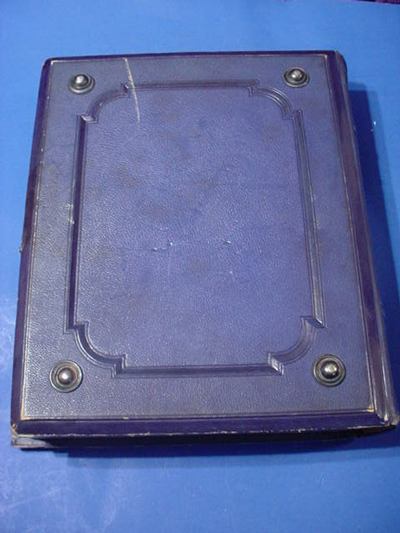 The back |
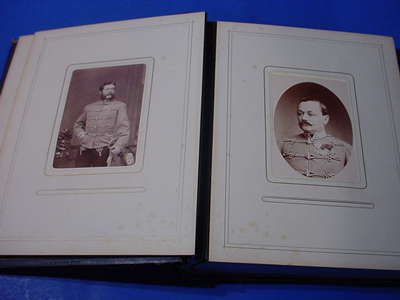
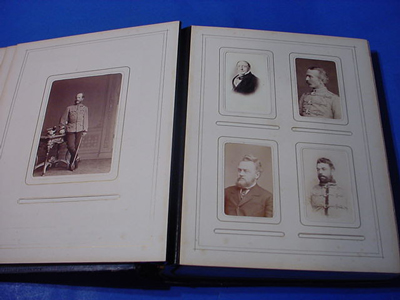
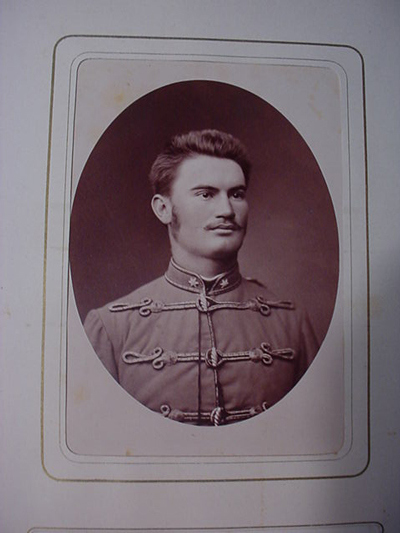
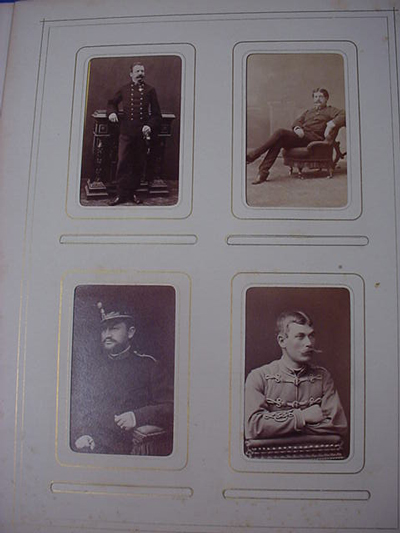
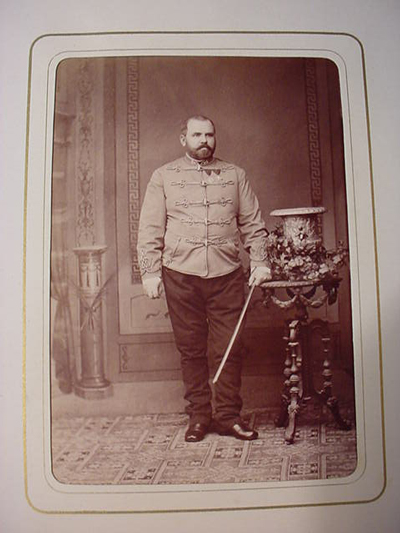
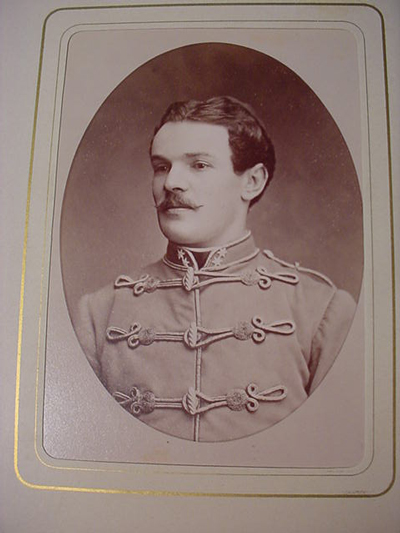
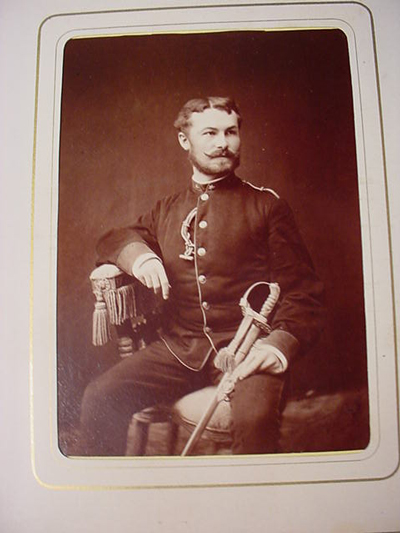
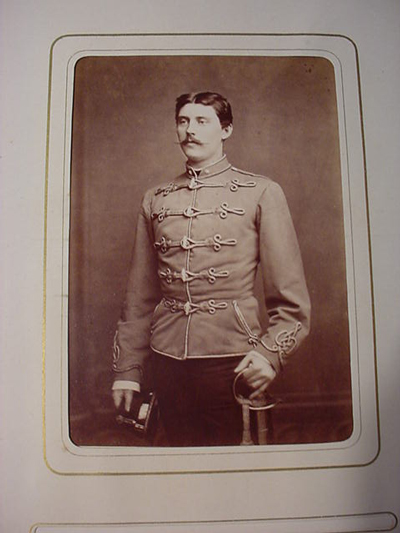
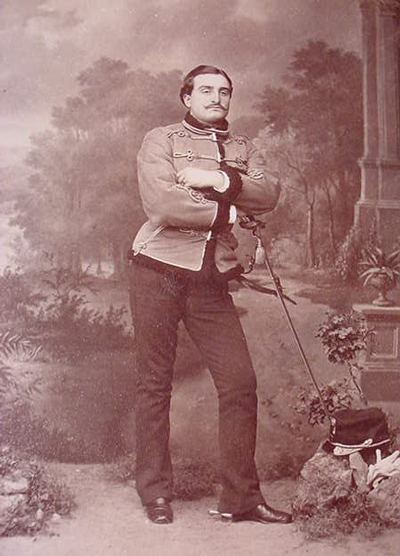
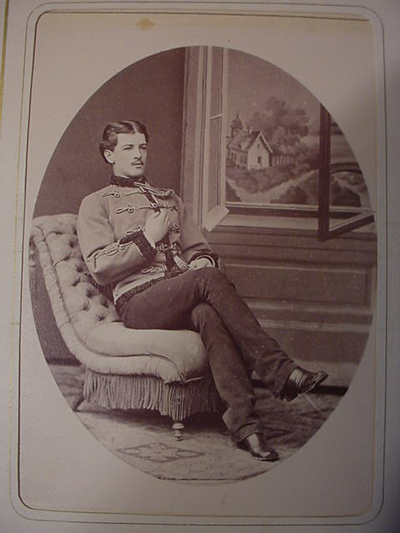
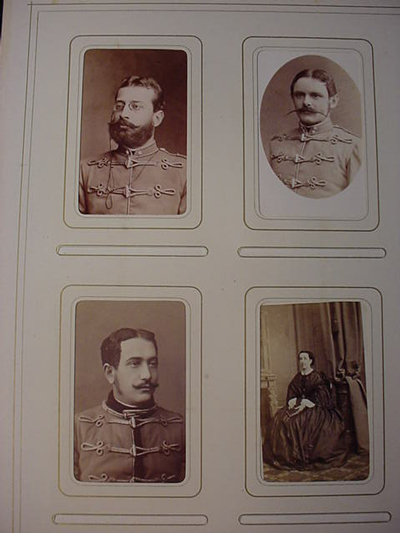
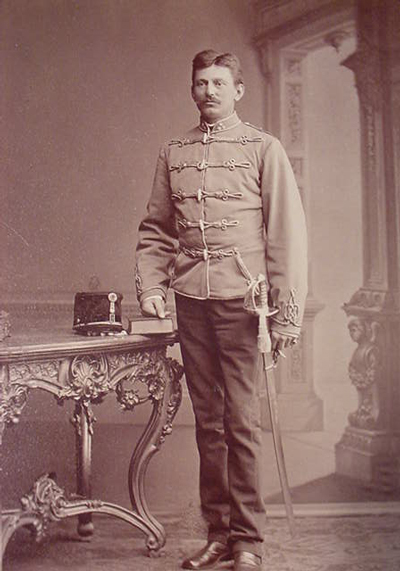
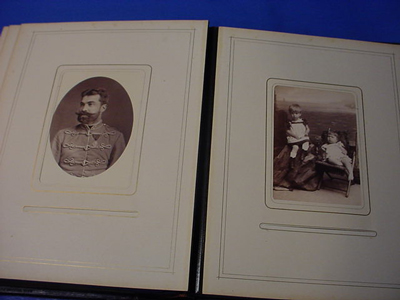
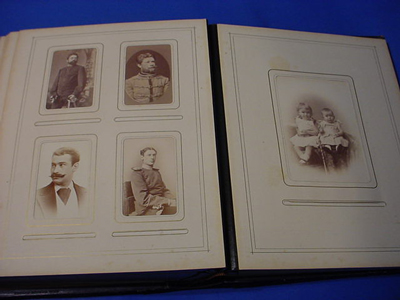
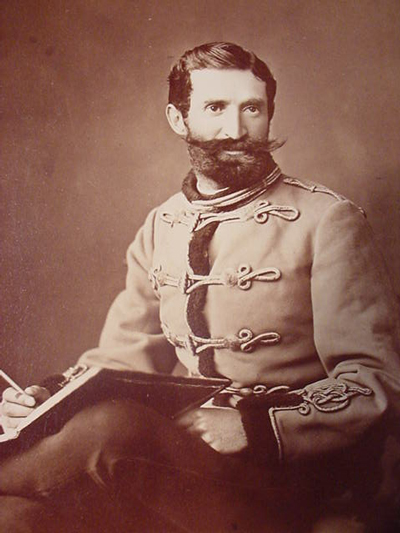
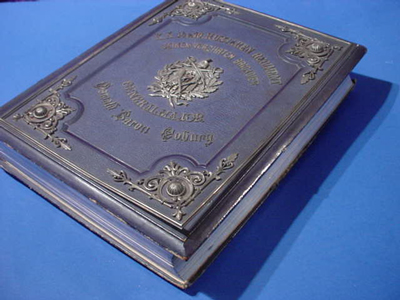
Beautiful Presentation Album of Photos from the 14th and 16th KK Hussar Regiment of Imperial Austria (Item WWI 12-10 & KSPEC 1-3 & IMP 1-1) |
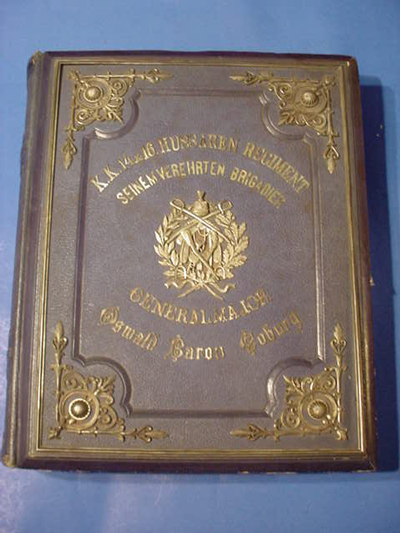
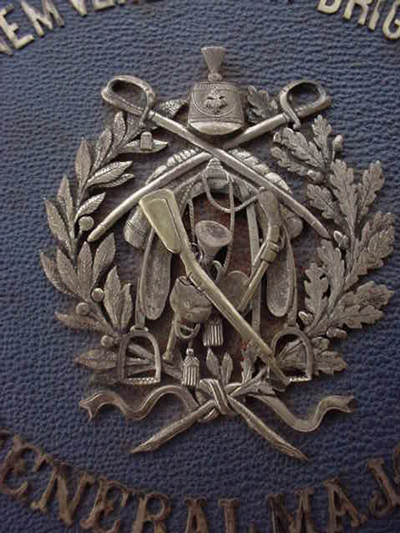
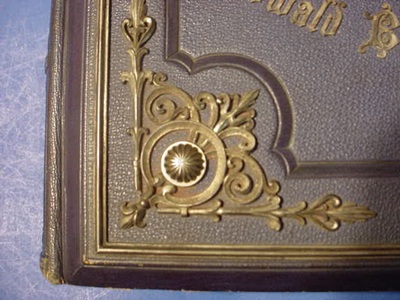
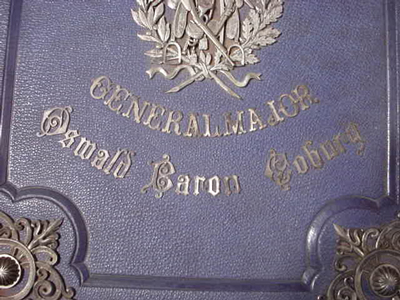
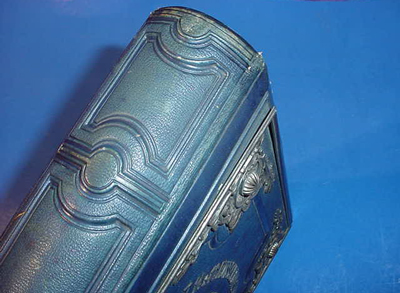
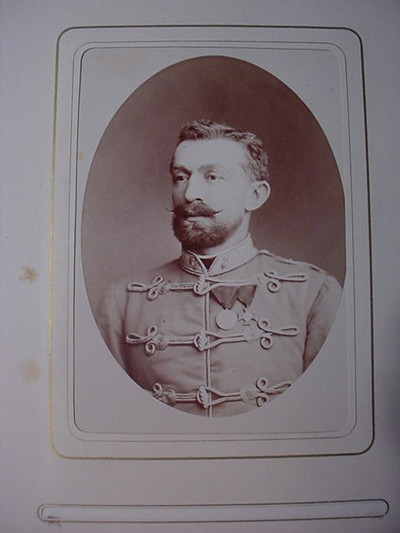
DESCRIPTION: This is a gorgeous photo album presented by the elite 14th and 16th Hussar Regiment to their Brigade Commander, Major General Baron Oswald Coburg (probably a retirement gift). In the center of the front cover is a wonderful badge style escutcheon that employs all the equipment of the horse solders (Hussars) -- carbine, swords, shako, horse stirrups, revolver, bugle, etc. and all of this is surrounded by branches of palms and another of oak leaves. This is all in the finest of 800 silver. At top and bottom are the words of presentation. The corners are highly decorated with beautiful floral designs in high relief. The cover is in lovely blue leather. The album measures 13 x 10 inches and is slightly over 2 inches deep and contains 77 mounted picture all on the studio card stock of the age; there are also two loose pictures but all the photo slots that are made to contain the images are filled. The pictures range in two sizes 2 ½ x 4 1/8th. And the bigger ones are 5 ½ x 4 ½. All are in perfect shape and the pages are clean. The Germanic phrase in the title of the albums cover KK stands for Kaiserlich and Koniglish (Imperial and Royal). This was applied to all units that served Austria and the Hapsburg monarchy. The album is in great shape throughout. The pictures of the uniformed Hussars show the dashing and daring of these soldiers of the horse. The Hussars were of course light cavalry which first originated in Hungary and of all the world's Hussars, the Austro-Hungarian riders were the best! They were very effective against the Prussians and French. The Allies in WWI and even against the Russians in the early days of WW II. This album miraculously turned up and bears silent testimony to a band of equestrian heroes who shall never be forgotten in the annals of military history and glorious renown. PRICE: SOLD |
 |
 |
 |
 |
 |
 |
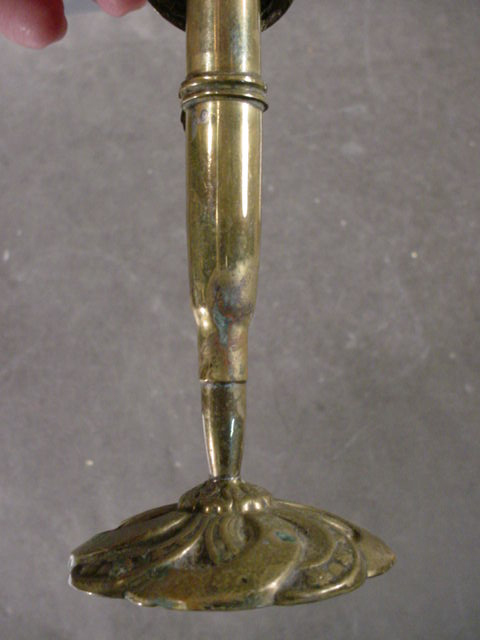 |
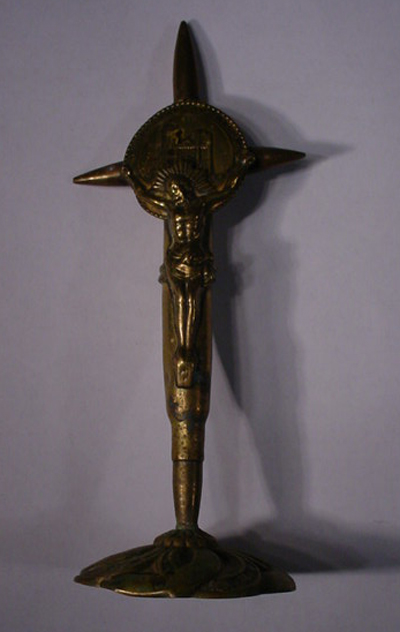
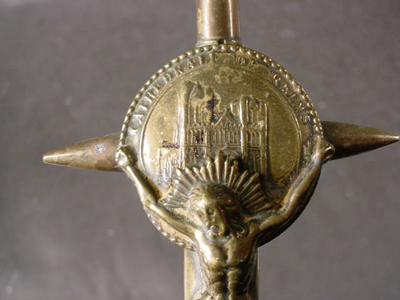
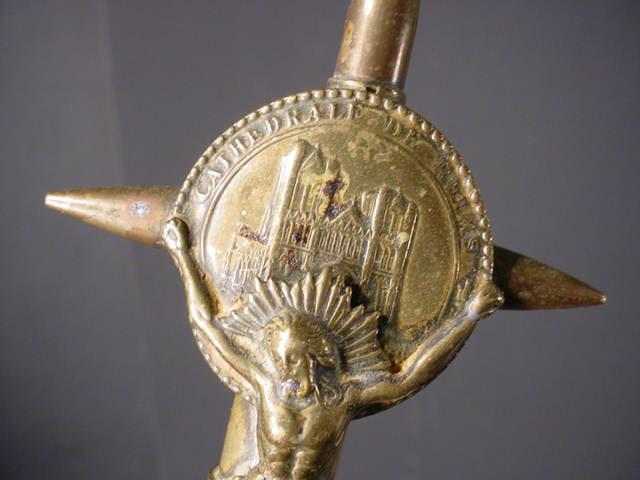
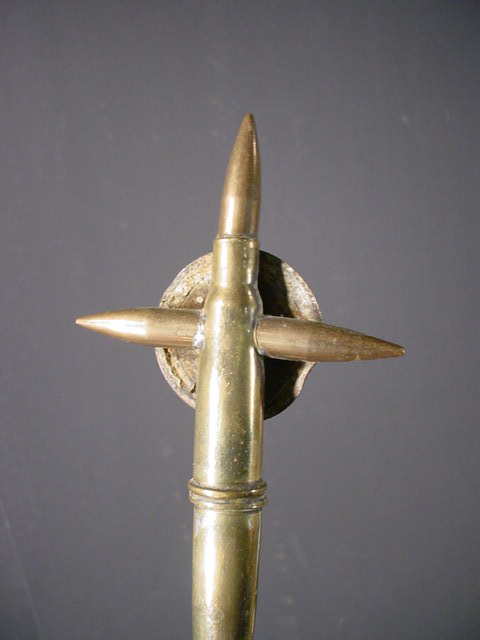
Crucifix Made from Bullets from WW 1 – Trench Art (Item WWI 12-12 & FRAN 4-8) |
DESCRIPTION: From time to time one of these interesting items shows up. They are always unique since they are made in the field by soldiers or produced by jewelers in occupied territories from bullets supplied by these soldiers. This would appear to be the case here due to the professional touch to the base, The Christ figure, and the medallion. There was one on our site at WW1 6-15 and is still there however sold. This was a German one although the French were known to favor them as well as the British. The reason for them being produced by the soldiers is speculative. Some say it is an anti-war message that depicts religious imagery with the idea of the horrors of war (brother against brother) depicted with the debris of war and the same juxtaposition of the paraphernalia of death, with the obvious symbology of Resurrection. The one we offer could be a war souvenir from the war time effects of a German soldier who captured it from a French soldier or possibly it is in fact, the post war souvenir of a French soldier. The answer could be in the caliber and style of the bullets. We are not nomenclature experts when it comes to ammunition. In any case, they are in fact real bullets form the Great War period. Above the Christ figure is a medallion with the Cathedral of Reims Depicted. And the base is decorated with turning rays of the promise of eternity. The relic stands five inches high and the left to right bullet arms measure 2 ½ inches. A genuine piece of history from the war to end all wars. Too bad we didn’t learn from that! PRICE: $475.00 |
|
||||
|
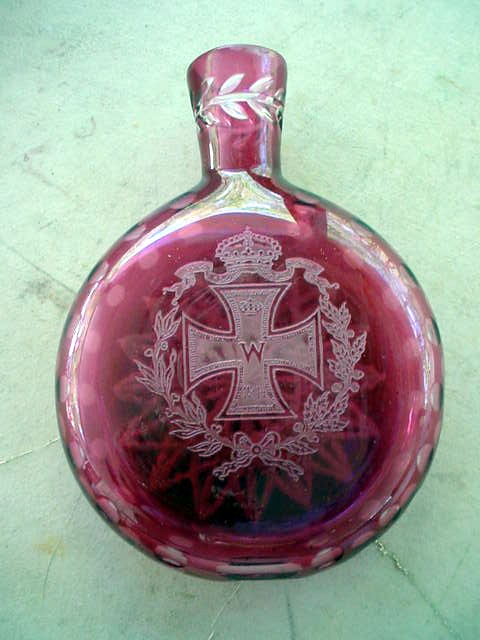
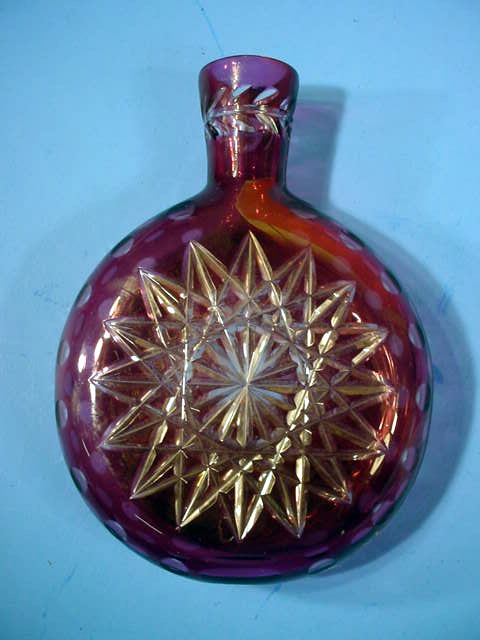
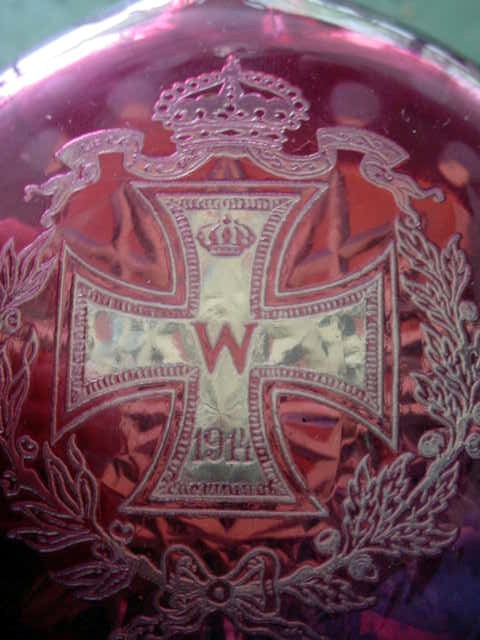
Novel Military Schnapps Flask (Item WWI 12-13; KGLASS 3-14) |
||||
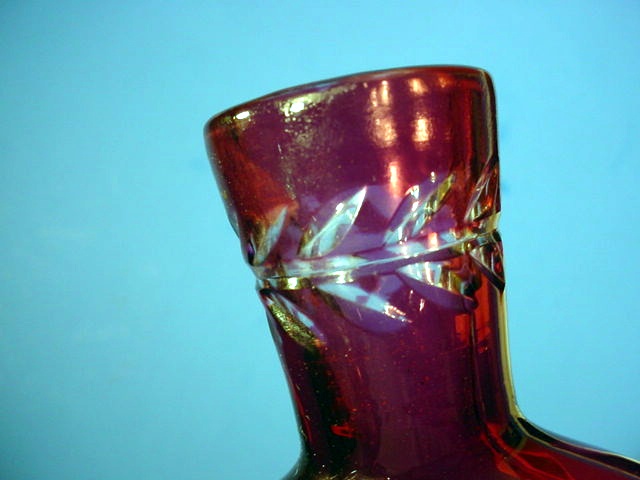
| DESCRIPTION: This is a beautiful piece of pressed or cut glass. It is a Schnapps flask carried by a German officer in WW I. It is beautifully constructed with precise glass engraving showing the Iron Cross 1st Class surrounded by boughs of oak leaves and surmounted with the Royal Prussian Crown. The beautiful translucent wine color is spectacular. On the backside you can see a gorgeous deeply cut, many-pointed-star depiction. The flask has a diameter of about 6 inches. The neck is also decorated with leaf design and would have carried a simple cork stopper. This flask, I am sure, provided some small pleasure for a superior officer of the Kaiser when at rest in regimental quarters.
Zum Wohl! Oder Prost!
PRICE: SOLD |
|
||||||||
|
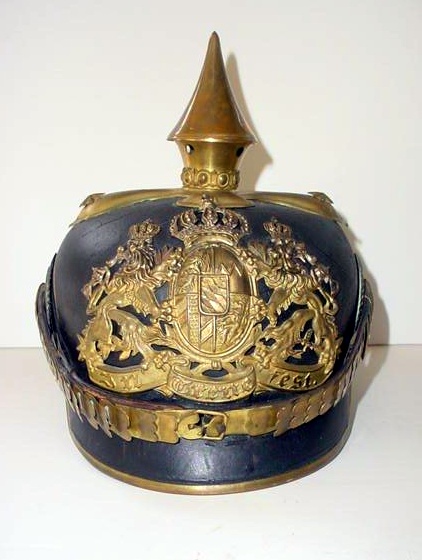
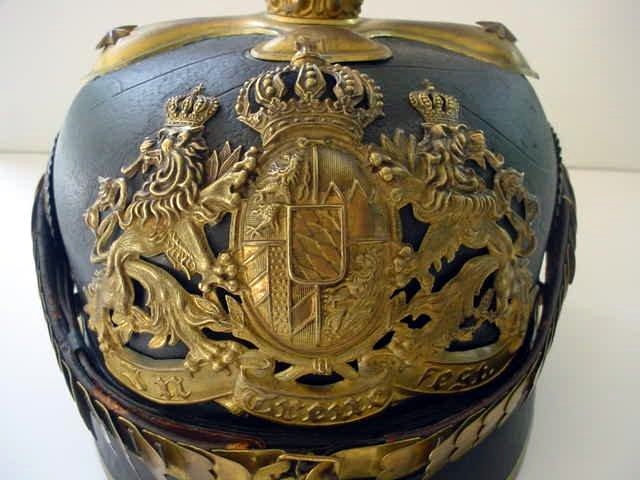
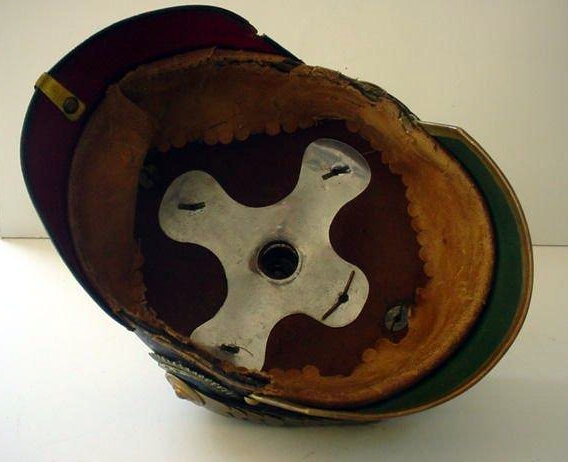
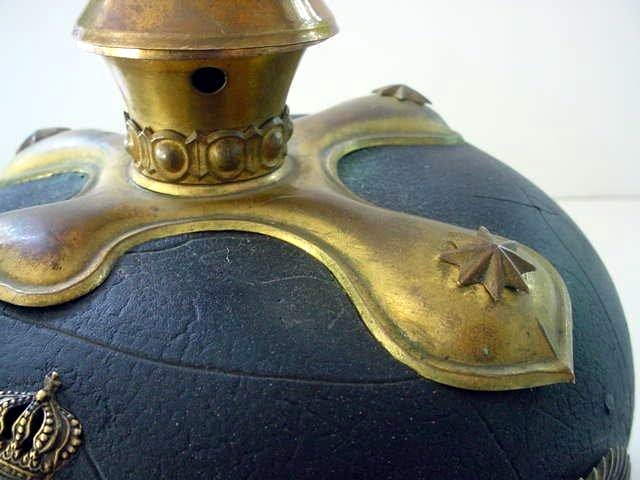
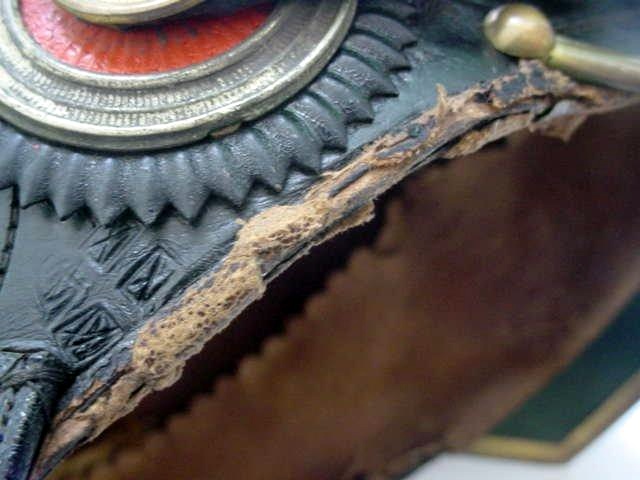
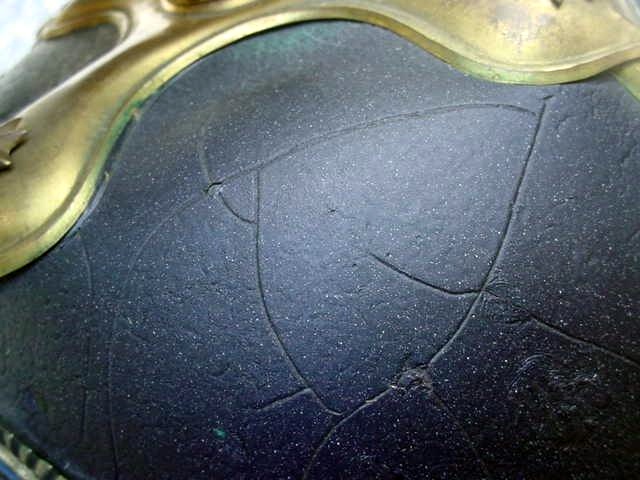
Bavarian Pickelhaube (Spike Helmet) (Item WWI 12-14; KHELMET 2-15) |
||||||||
| DESCRIPTION: Here is a very nice example of a Bavarian officer’s dress helmet as used between 1900 and 1913. It’s in fairly good shape with slight crazing in the leather and some damage at the sides near the rosettes on each side. The overall condition is about 85 percent; the helmet is good looking and with sharp detail to the helmet plate. These are becoming very scarce and soon I am sure hardly any will be available in any condition at all. This one is certainly worthy of display in any museum setting or in a fine collection. The Bavarian officer helmets are much scarcer than the Prussian ones. The inner silk liner is missing and probably was removed by a previous collector. Why? Well, this helmet was most definitely used and used often on the front and home front. It was no “wilting violet”! It saw action! And in daily wear these liners seldom outlast the leather parts and most of them you see that saw front line action are that way, today. But, again look at the spectacular condition of the outside of this great helmet. They really are not found often in this sound a condition. Other ranks’ equipment is generally in much worse condition because of rough wear in rough conditions.
This is a good, honest example of a rare piece of Imperial Bavarian wartime headgear.
PRICE: $1,600.00 |
 |
 |
 |
 |
 |
 |
 The lance |
 |
 The signature |
 |
 |
 |
 |
 |
 |
 |
 |
 |
 Note: 5th Uhlan boards |
 |
 |
 |
 |
 |
 |
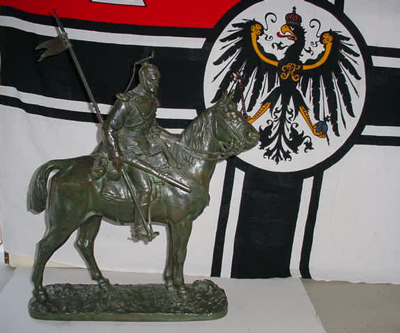
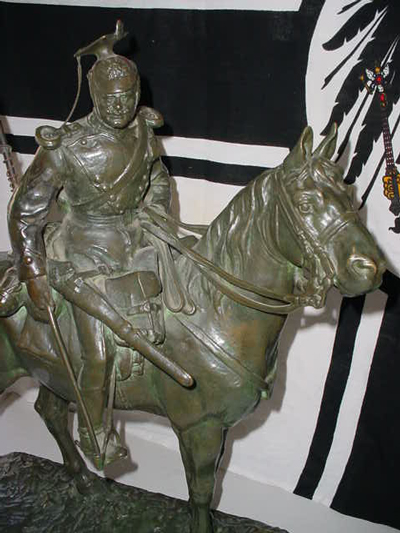
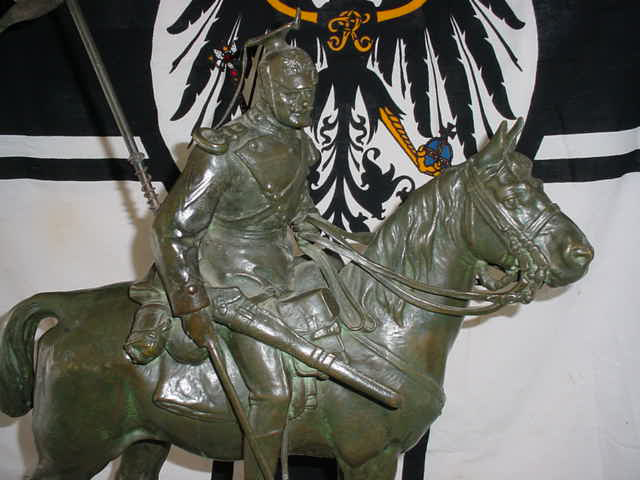
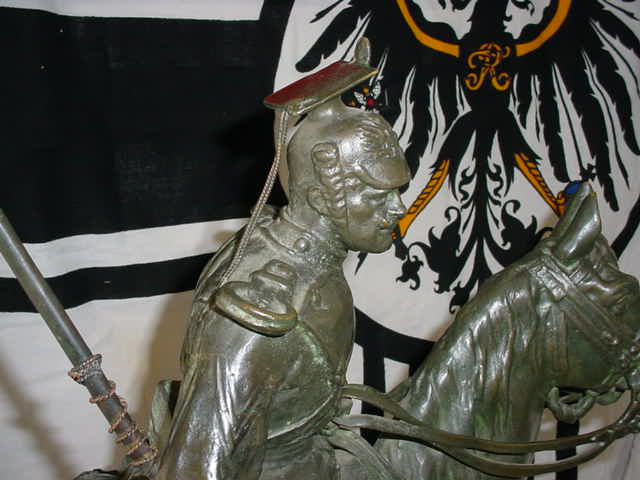
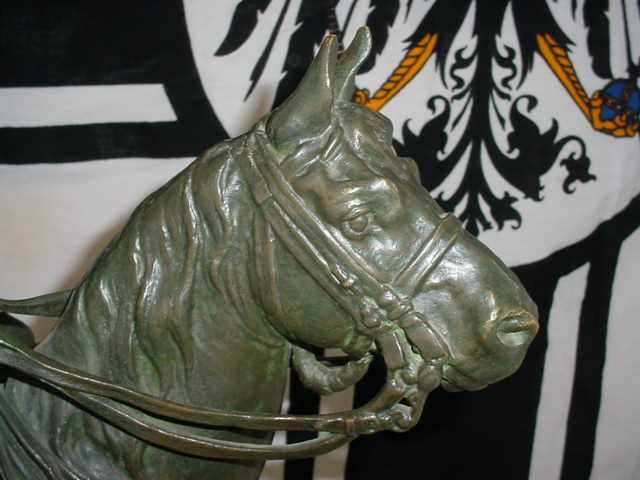
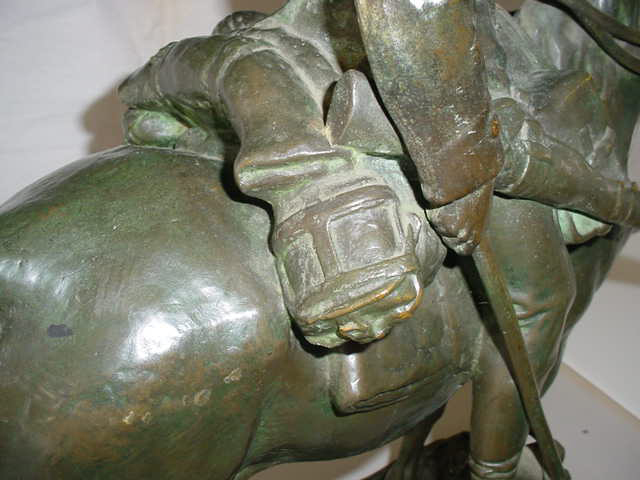
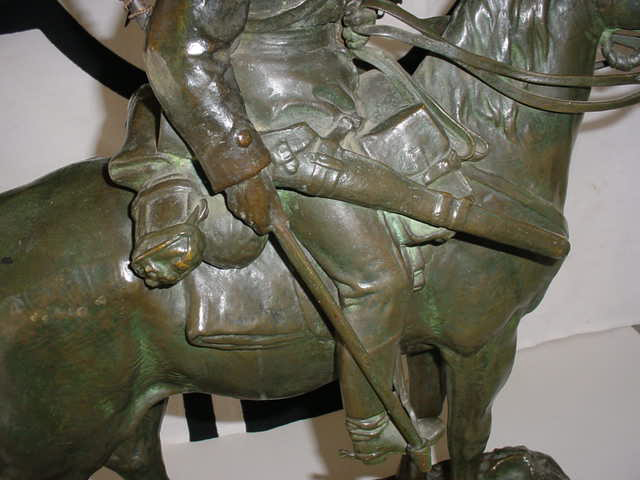
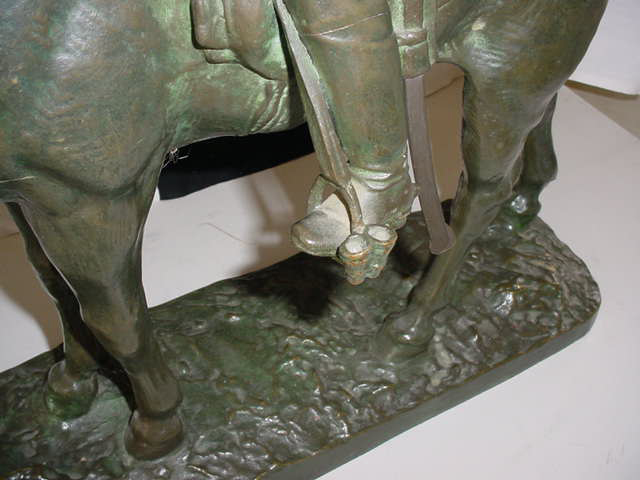
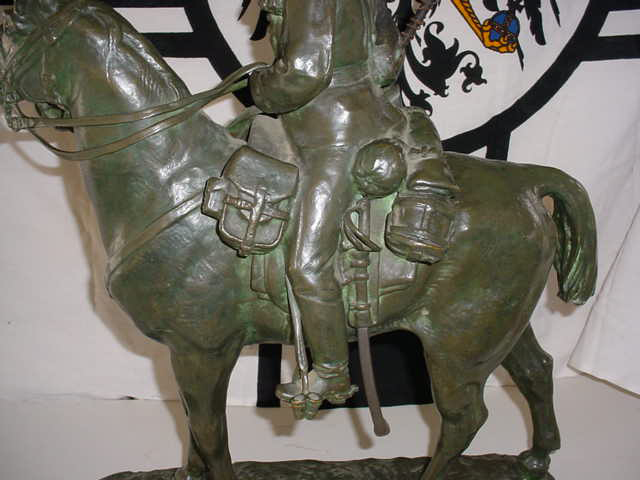
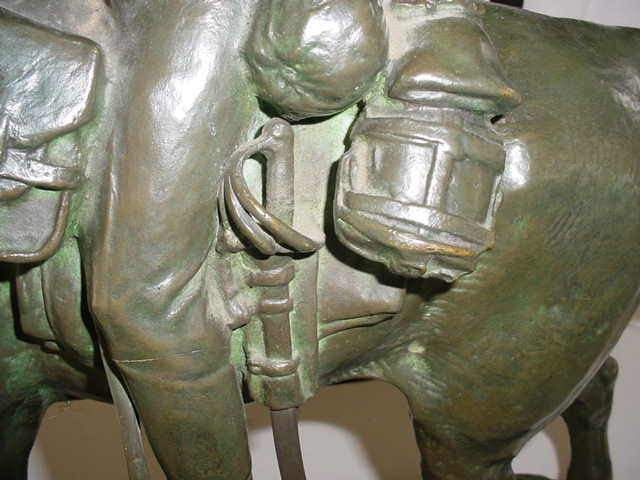
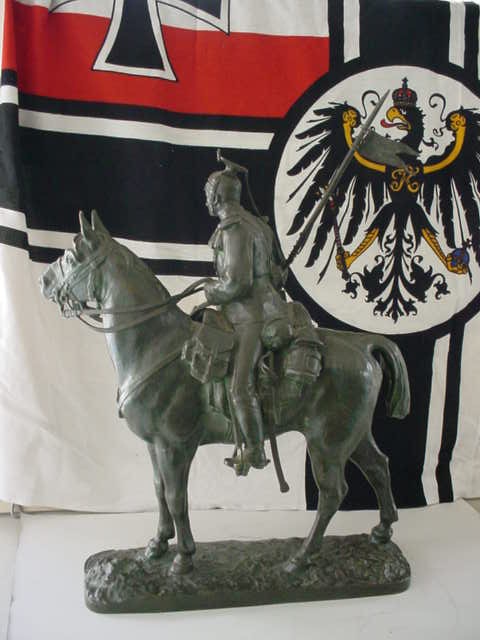
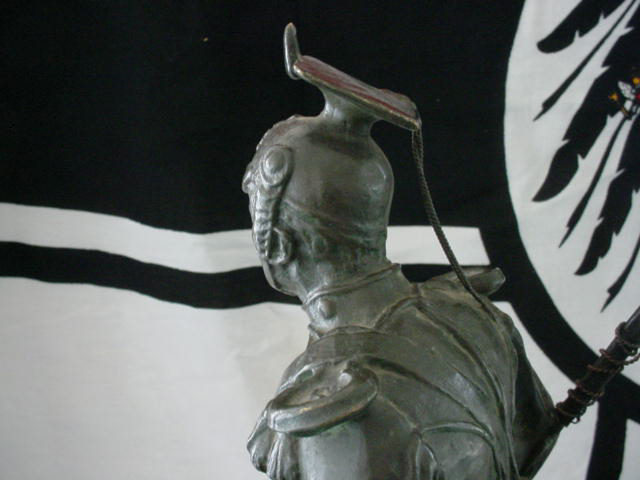
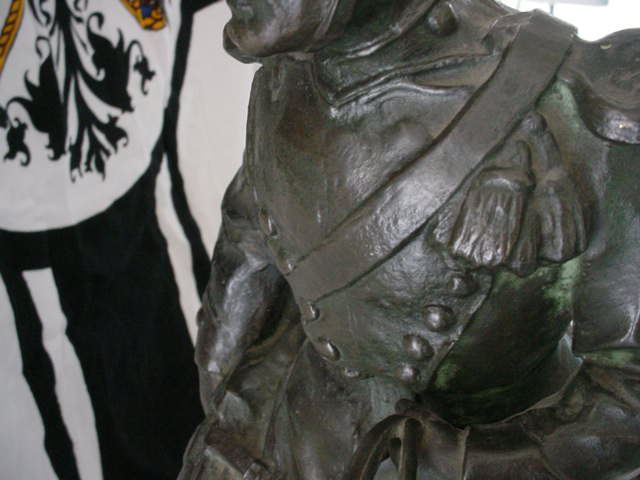
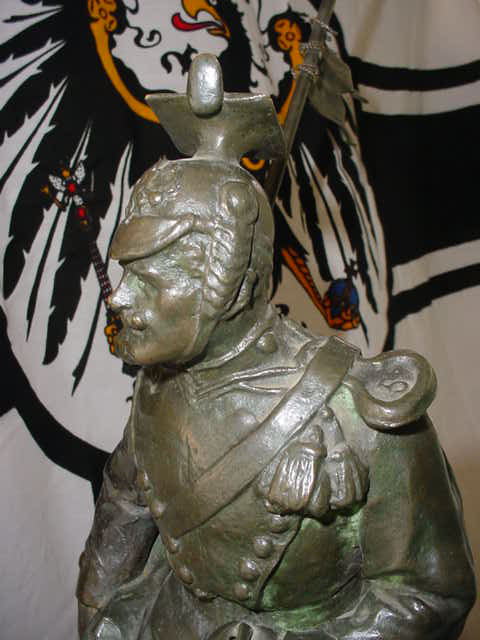
Massive Equestrian Bronze Statue of the 5th Regiment Prussian Uhlans(Item WWI 12-15; BRONZEMET 3-3; KSTATUE 5-16) |
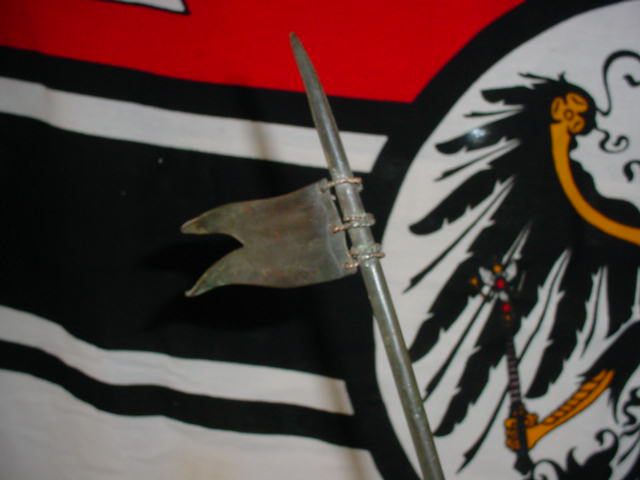
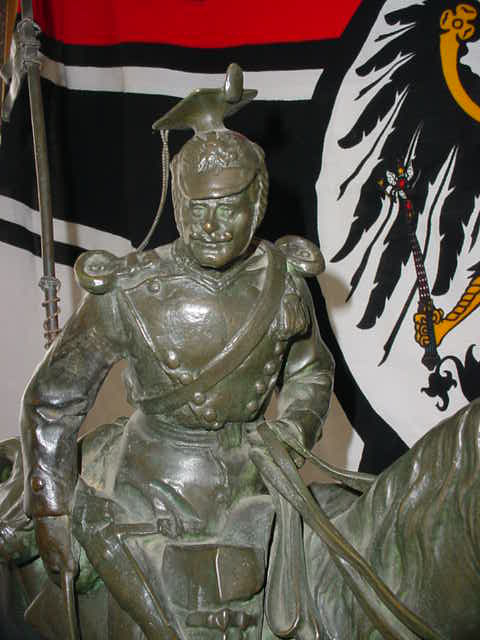
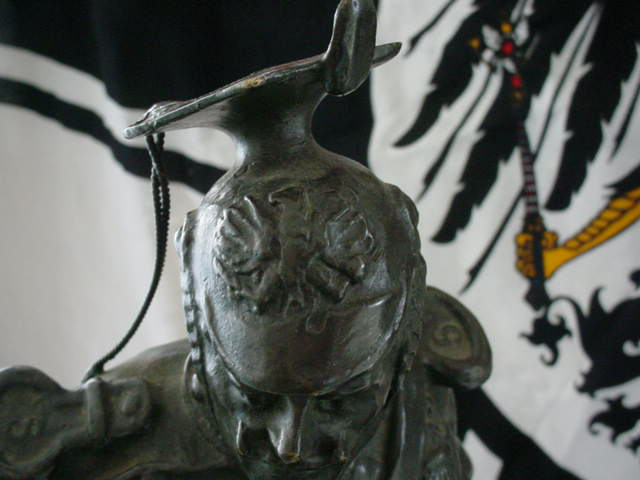
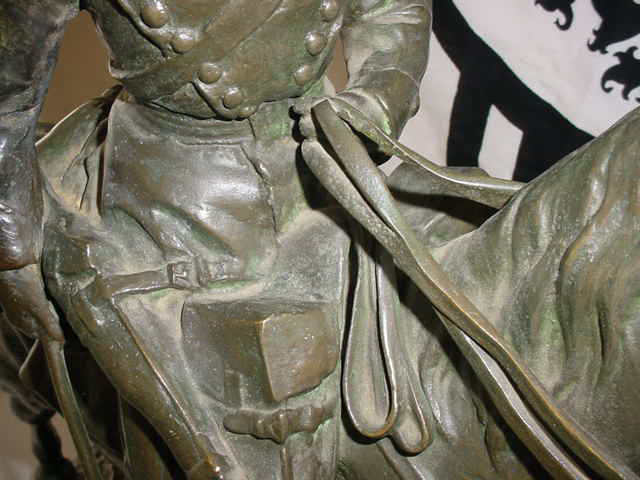
DESCRIPTION: This is a magnificent bronze depiction of a mounted horseman of the Fifth Uhlan Regiment of the Kaisers 3rd Cavalry Division attached to the First German Army Command. They served with particular distinction in the Franco Prussian war and WW1. Uhlans were light cavalry, actually Lancers, who fought with carbines, swords, and lances. The title Uhlan was used by Lancer regiments in the Russian, Austrian and especially the Prussian armies. Uhlans typically wore a double buttoned tunic (Kurta) with a colored panel at the front, a colored sash and a square topped Lancer cap (Czapka), also spelled chapka. This cap was originally derived from a traditional design of the Polish civilian cap made more formal and stylized for military use. Their Lances usually had small swallow tail pennants known as the Lance Pennon that was found just below the spearhead (see our pictures). Prussian Uhlans distinguished themselves and fought bravely in the war against Napoleon. In WW1 the Imperial German Army included 26 Uhlan regiments. They all saw action while on duty at the first part of the war and their charge with lances struck fear in the hearts of the enemy since it has well been known that these were formidable warriors adept at warfare (up front and personal!). Later in the second year of the war the Uhlan regiments were either dismounted to serve as cavalry rifle regiments in the trenches of the western front or transferred to the eastern front where primitive conditions made it still possible for horse cavalry to play an effective role. In WWII a popular myth is that Polish cavalry armed with lances charged and were annihilated by German tanks during the 1939 campaign; this arose from the misreporting (both intentional and unintentional) of the charge at Krojanty on 1 September when two squadrons of Polish 18th Lancers armed with lances and sabers were met in combat by German cavalry led by Harry Von Johnston in what was the last charge of German cavalry with sabre. The Poles were dispersed and defeated by Germans who rode one last time in the spirit of the Old Prussian Uhlans. This is a little known fact of history that for the most part has remained hidden for all these years. The bronze statue is accurate in every detail and prodigiously dramatic in its heroic depiction. It is a huge and heavy sculpture done in the finest mode of German bronze art. It measures 26 inches high from the bottom of the base to the top of the Uhlan Czapka. The horse is 22 inches long from tail to muzzle. The base is measured at 19 ½ x 7 inches. The sculpture is signed by Leon Mignon (1847-1898), a sculptor from Brussels, Belgium. He studied under the sculptor Prosper Drion (1822–1906) at the Académie in Liège from 1857 to 1871. He was a particular admirer of the anecdotal sculpture of Léopold Harzé (1831–1893). His vocation as a sculptor of animal subjects began in Rome, where he studied on a grant from 1872 to 1876. He exhibited in Ghent (1874) and on several occasions in Paris (where he lived from 1876 to 1882) at the Salon des Artistes Français. He achieved prominence at the exposition Universelle of 1878 in Paris with his bulls fighting in the Roman countryside (Brussels, mus. a. mod.). In 1880–81, he shared a studio with the Belgian sculptor Paul DeVigne, whom he had met in Rome. Mignon’s bull tamer (liège, parc avroy) took the gold medal at the Salon of 1880. In 1882 he settled in Brussels and in 1888 produced the labors of Hercules reliefs for the stairway of the palace of Charles de Lorraine (now part of the Bibliothèque Royale Albertier). He sculpted several historical figures for the provincial law courts and was an astute philosopher of his time. In 1892 he sculpted many subjects for the Université de Liège. He excelled as a sculptor of animal subjects. Mignon occupies a leading place in Belgian realist art. He also modeled busts of Belgian personalities as well as a statuette of the Belgian painter Hubert Bellis; figurines of workers, soldiers from the Belgian regiments (c. 1889), and even an equestrian statue of a Prussian Uhlan, France’s enemy in the 1870 war; and a statue of Leopold in 1886 ( Brussels, mus. a. mod.). His works are preserved in the Musée de l’art Wallon, Liège, and the Musée d’Art Moderne, Brussels. He was completing a frieze for the Hôtel Somzée in Brussels when he died unexpectedly. He was an amazing artist and a cultured man of vision. A grand museum grade art piece personified and extraordinaire! It is priced under market value for a sculpture as fine as this one is. It is certain that one could not find any such dramatic artistic accomplishment to rival this one. Here he is! In all his Imperial glory. Listen as you view him and perhaps, just perhaps, you will hear the strains of “Heil Dir im Seigerkranz” (Hail to thee in Victors Crown.) Deutschlands Helden Lebt in ewig leben! PRICE: SOLD |
|
|
|
|
|
|
|
|
|
|
|
|
|
|
|
|
|
|
|
|
|
|
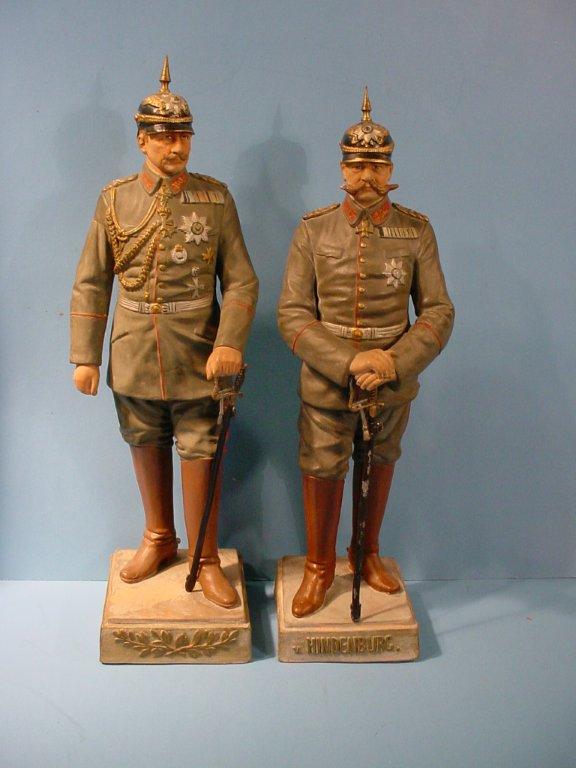
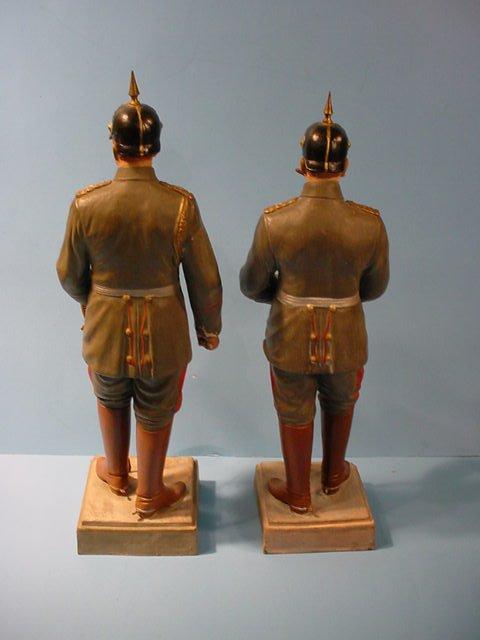
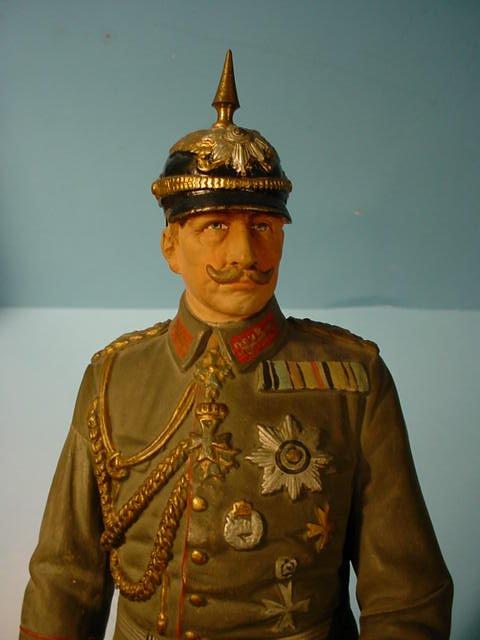
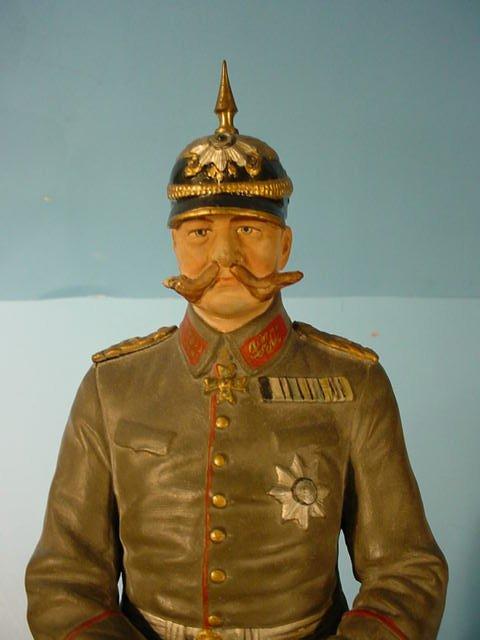
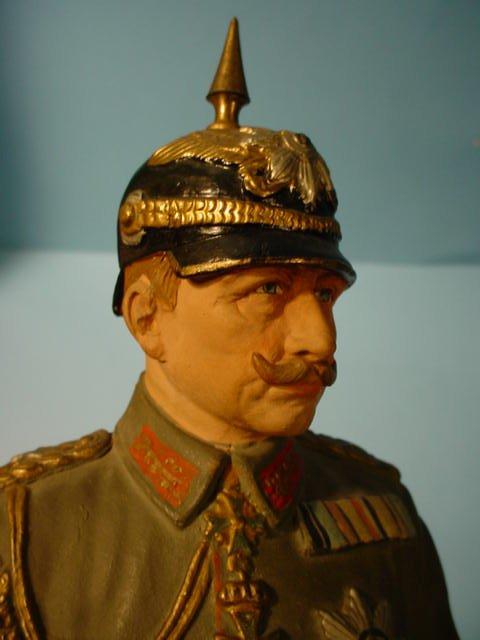
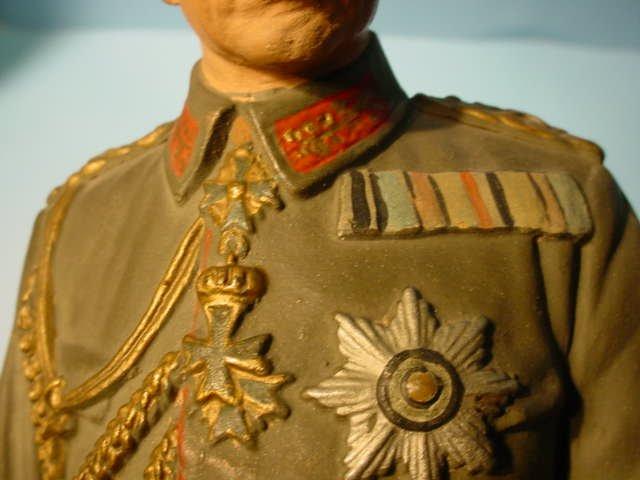
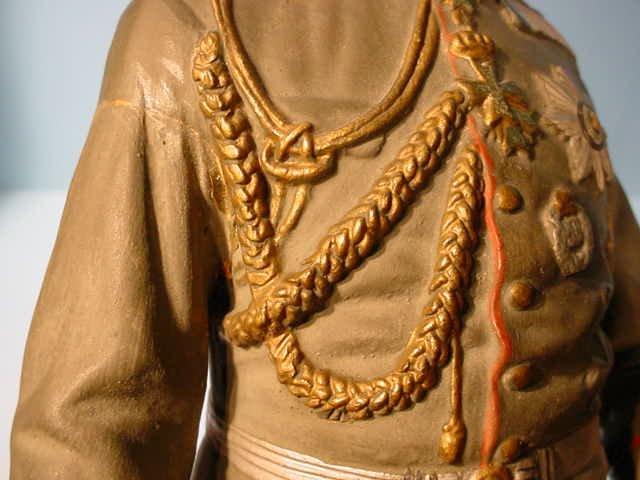
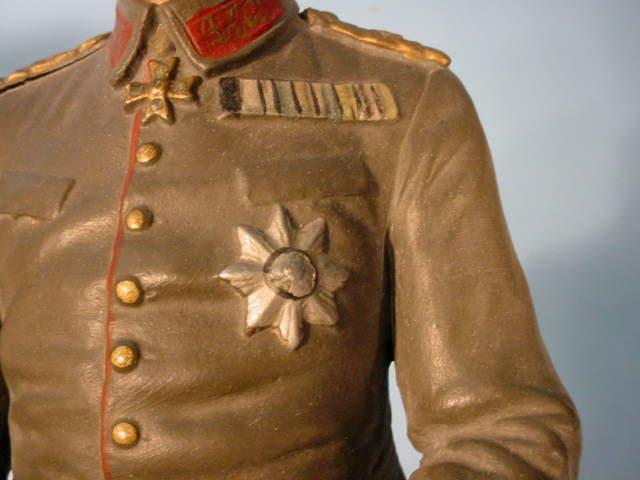
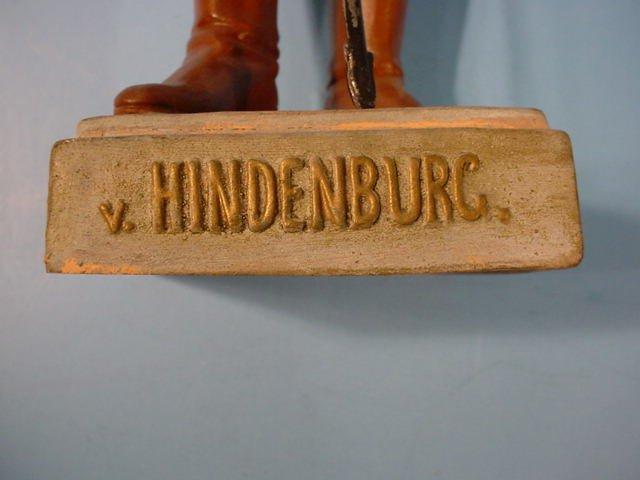
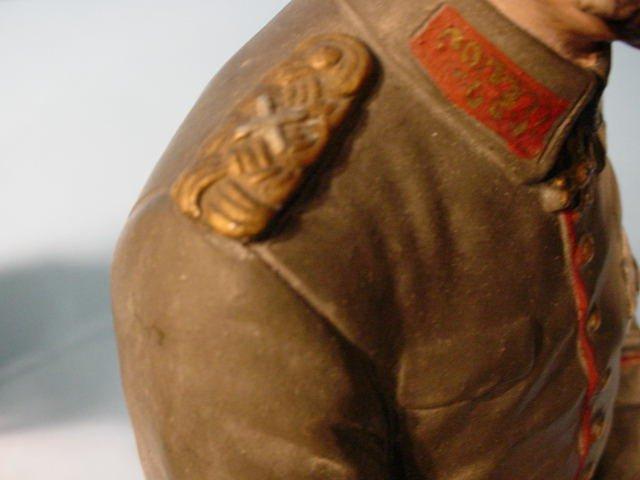
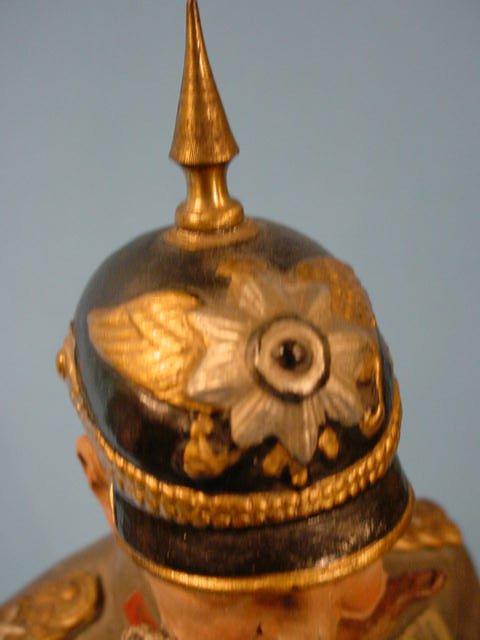
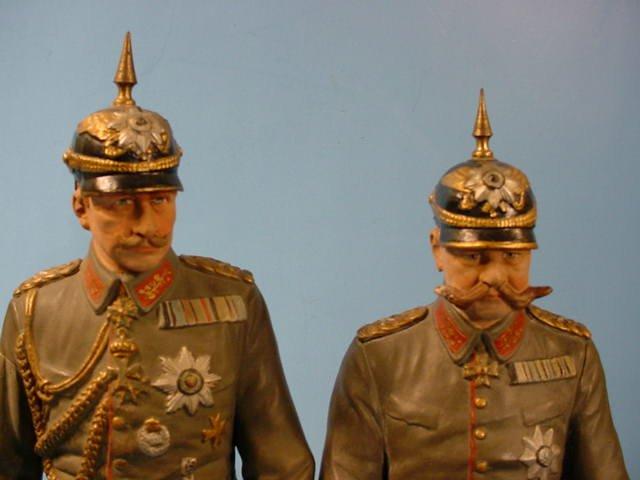
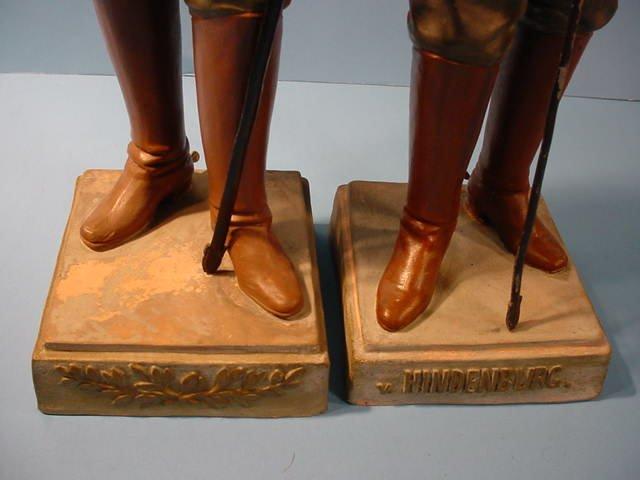
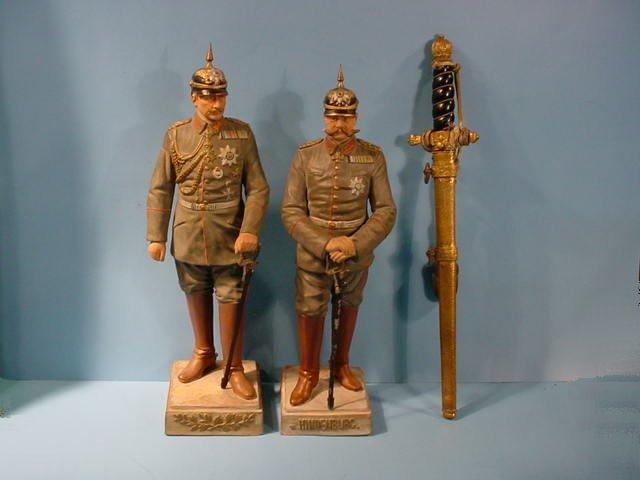
Set of Fantastic Statues of Kaiser Wilhelm 2 and Field Marshal Hindenburg (Item WWI 12-16; KTOY 1-11; KSTATUE 5-17) |
|
DESCRIPTION: Beautiful almost beyond belief! Here is a grouping of the most famous luminaries of the WW-I period. They are constructed in terracotta material and hand painted to true perfection and historic accuracy as to uniforms, medals, etc. These are period pieces from Imperial Germany and NOT Chinese-made toys that flood the market today. These two heroic figures are genuinely 100 years old, at least! They are so realistic looking that they practically breathe. The life-like quality of these figures could never be captured in bronze or metal of any kind. The faces are like fine portraits. The detail is so great that even the spurs on their boots are still there. (See our picture). It is nothing short of incredible that they survived this long in the pristine condition that they are in. (They are perfect!) Just imagine these pieces standing erect in the midst of your helmet collection. We can really say that these two figures are the finest depictions in artistic creativity we have ever seen (worldwide). Probably no bronze, in fact, no painting can be more realistic than these two items for beauty and historical significance. They could NEVER be duplicated today.
PRICE: SOLD |
|
|
|
|
|
|
|
|
|
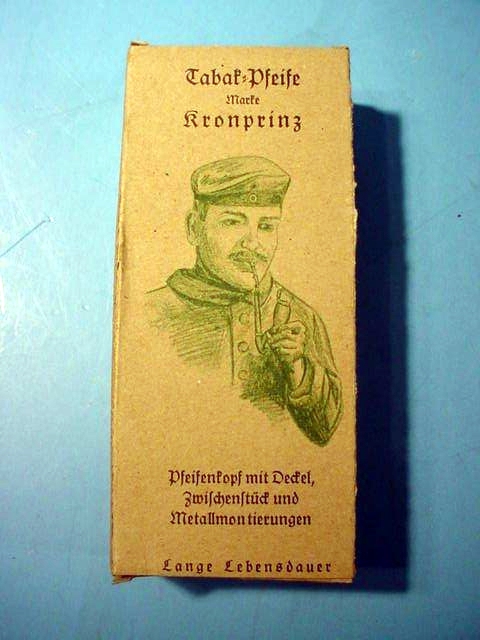
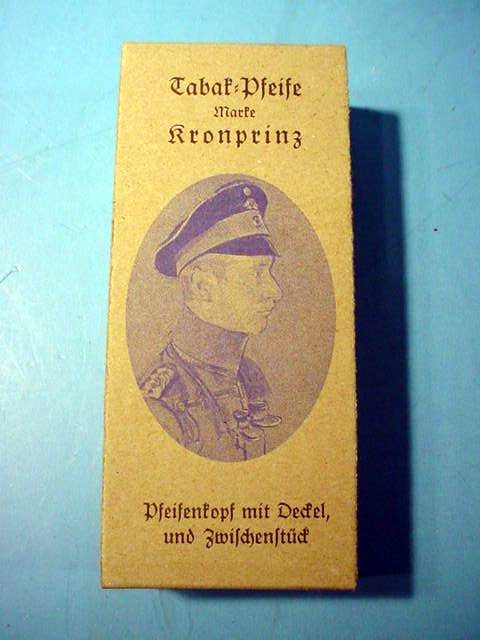
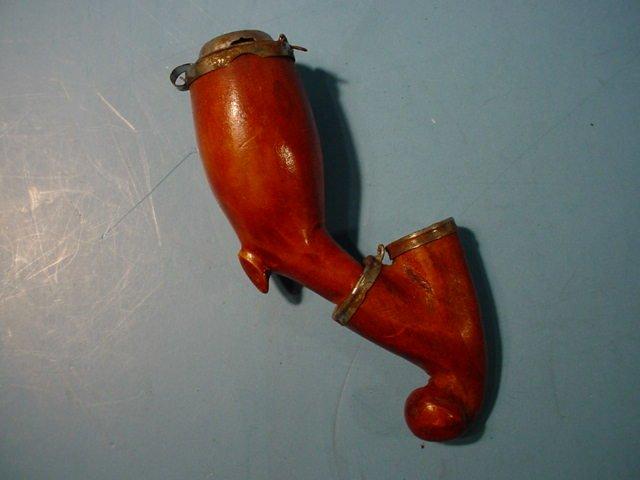
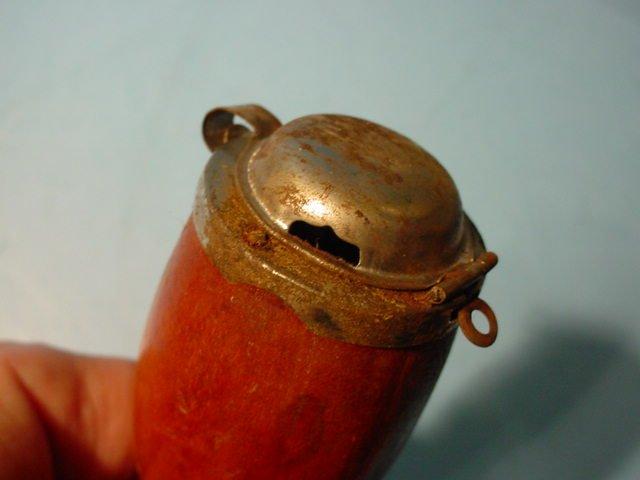
Mint-Condition Pipe that bears the Name of the Prussian Crown Prince, Wilhelm (Item WWI 12-17) |
|
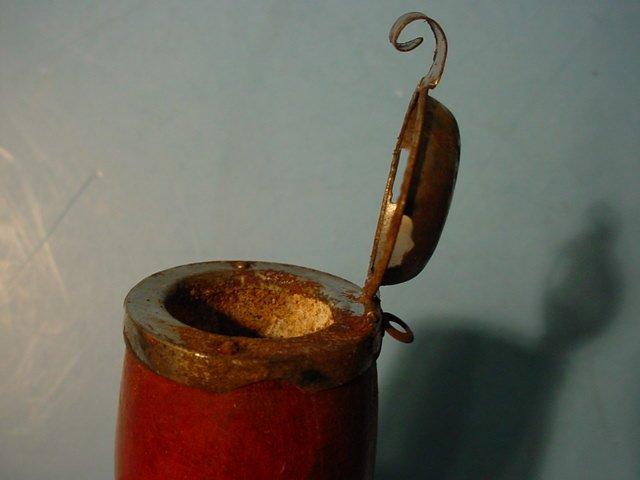
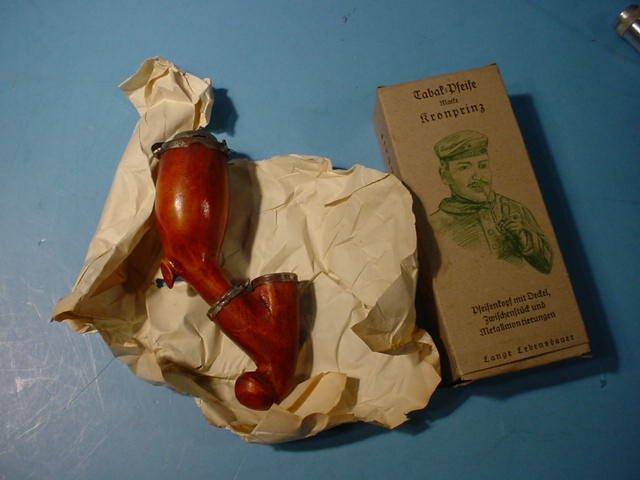
DESCRIPTION: This is a very interesting lot. It’s a typical German pipe as used by generations of German civilians and soldiers. It’s handmade and its box tells us that (Deutsches Handwerk). The company that produced these pipes was founded in 1887. The product has the label Tabak Pfeife Kronprinz, and on one end of the original carton it says (translated) “The favorite soldier’s pipe for army and navy.” The other end has the German national eagle of the Imperial period; it was produced by C.G. Reich Pfeifenfabrik in Thuringen. The pipe in its original carton is comprised of the pipe bowl only, as the soldier receiving it would have his own pipe stem, or so it could be assumed. On one side is an image of the typical German Landser or Soldat, and on the other side, the Prussian Crown Prince.
This is extremely rare in this complete and mint condition after about 100 years--a real museum piece!
PRICE: $140.00 A bargain of the week! |
|
|
|
|
|
|
|
|
|
|
|
|
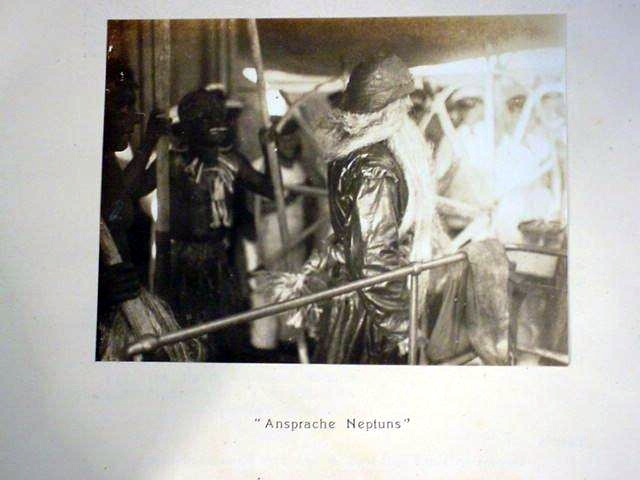
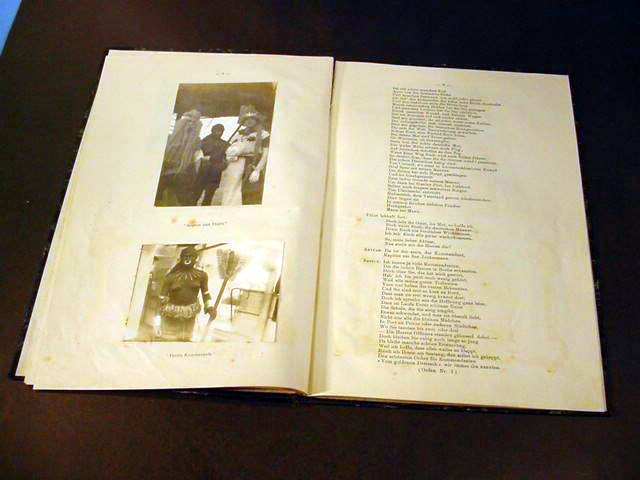
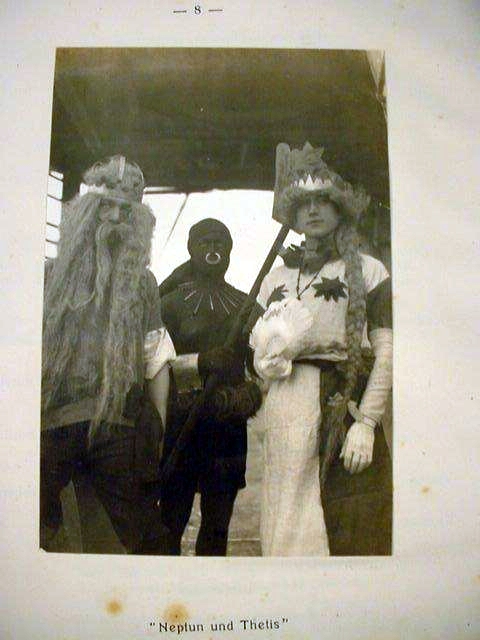
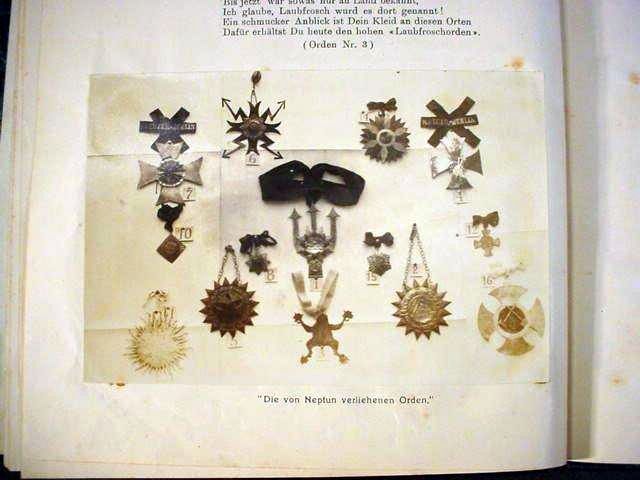
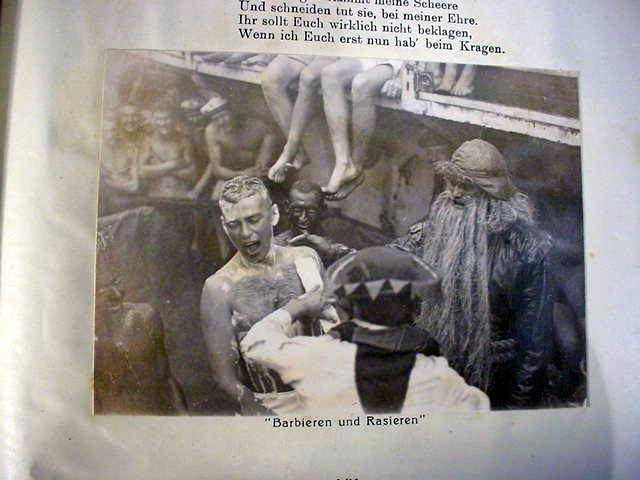
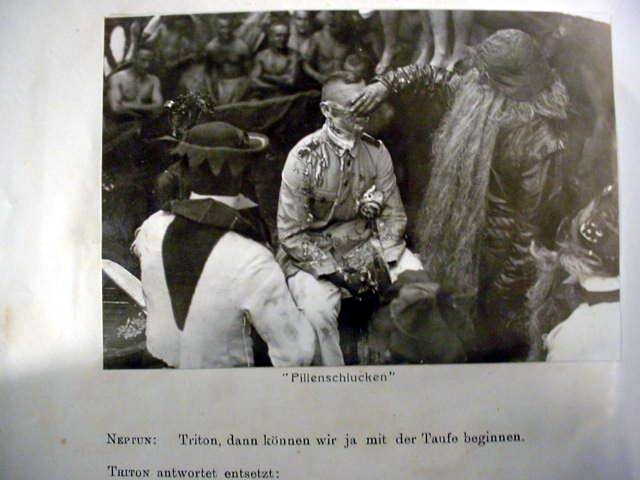
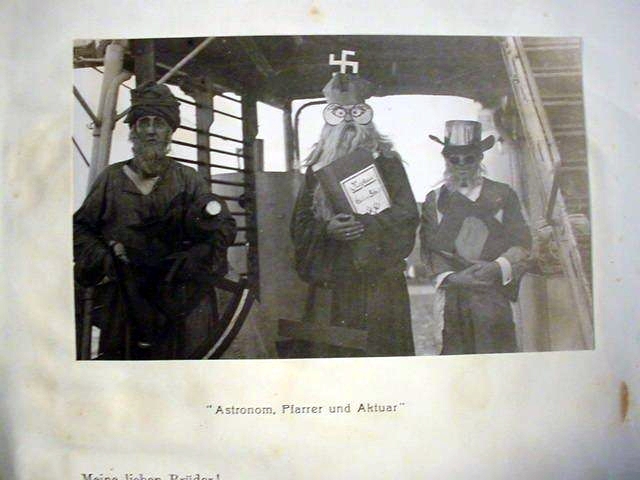
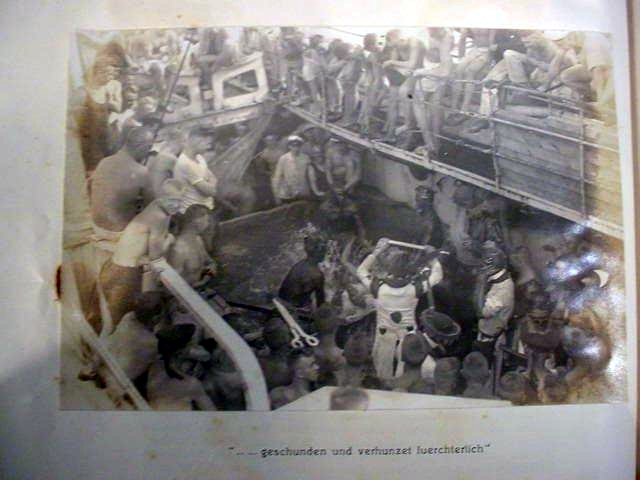
German Cruiser SS Berlin Neptune’s Baptism at Sea (Tauf-Akton) (Item WWI 12-18; KRIEG 10-5; ALBUM 4-16) |
|
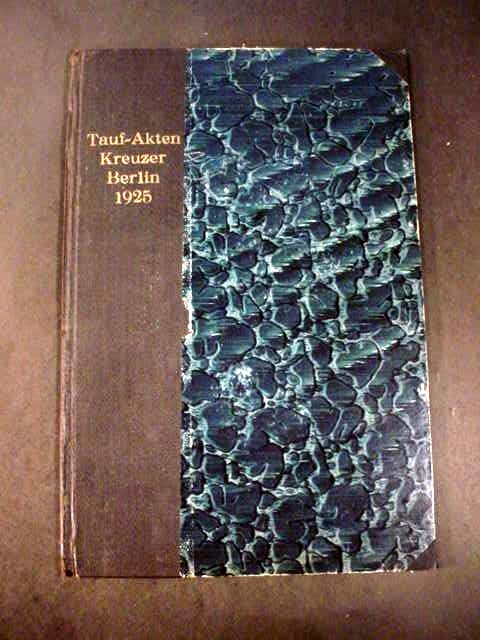
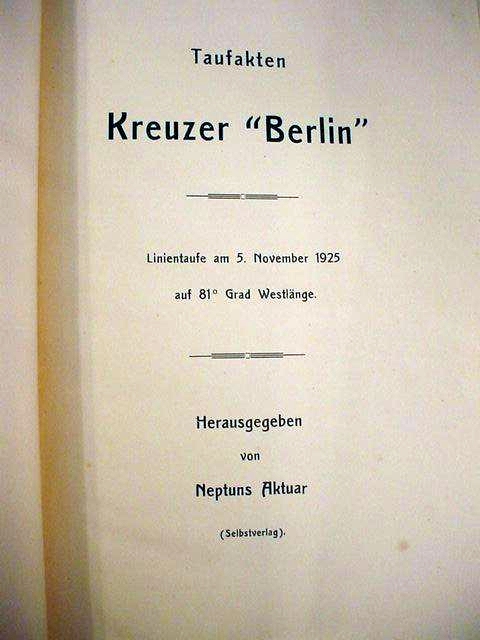
DESCRIPTION: It has long been a custom of many nations’ navies to hold a ceremonial initiation rite to celebrate and commemorate sailors’ first crossing of the equator. These recruits are called ‘Pollywogs.’ The two-day event (evening and day) in which previously indoctrinated crewmembers (Frosty Shellbacks) are organized into the royal court of Neptune to indoctrinate the “slimy pollywogs” into the mysteries of the deep. Physical hardship, in keeping with the spirit of the initiation, is tolerated and each pollywog is expected to endure a standard initiation rite in order to become a Shellback. The event of the equator crossing is called Wog Day, and after crossing the line pollywogs receive subpoenas to appear before Neptune, God of the Sea, and his court and Neptune’s assistant ‘Davy Jones’ and her highness, Amphitrite, who are represented by the highest-ranking seamen who officiate at the ceremony which is often preceded by men dressed up as women afterwards. Some Wogs may be interrogated by King Neptune and his entourage and the use of truth serum (hot sauce and after shave) plus uncooked eggs put in the mouth and numerous other silly indignities and ordeals are experienced by the Wogs. They are even in some cases forced to crawl through shoots of rotting garbage, hair chopping being coated with axel grease, being locked in stocks and pilloried. They might be pelted with mushy fruit, etc. All this for the entertainment of the Shellbacks. Once the ceremony is complete a pollywog receives a certificate declaring his new status. This has been for the most part an almost identical ceremony on ships of all nations (an old naval tradition) and the maritime Germans were no exception. In fact with typical Teutonic tradition they of course had to bring it almost to a science exceeding any other navy in the furthering of the custom. What we have here is a rare book that could be considered a ships log of sorts but it chronicles the Tauf Akten (the baptism of the sea at Neptune’s Court) aboard the famed Kreuzer Berlin (cruiser Berlin). The SS Berlin was a passenger liner of the early twentieth century, which later saw service as an auxiliary cruiser of the Imperial German Navy during the First World War. She was built in 1908 by A.G. Wesen of Bremen for the North German Lloyd Shipping Line and saw service on the Genoa-to-N.Y. route prior to the outbreak of the war. In August 1914, she was taken over by the Kaiser’s navy for service as an auxiliary cruiser. Berlin was one of the more successful of Germany’s raiders accounting for the single most grievous losses to the British Royal Navy’s strength in the early “Klein-Krieg”campaign. After many engagements Berlin sought to return to Germany, but put in to Trondheim with storm damage and really was unfit to leave port and she was interned by the Norwegians on November 18, 1918. She remained in Norway for the duration of the war. There is some confusing information about her eventual destination; some say she was turned over to the British for war reparation. This book proves different because in 1925 the ceremony here took place and all the printed ceremony is chronicled in the German language. The log book is comprised of 20 pages and 10 great pictures of the initiation ceremony that are actually hilarious. This is actually an archival treasure important to the annals of the German Sea Service.
PRICE: $350.00 |
|
|
|
|
|
|
|
|
|
|
|
|
|
|
|
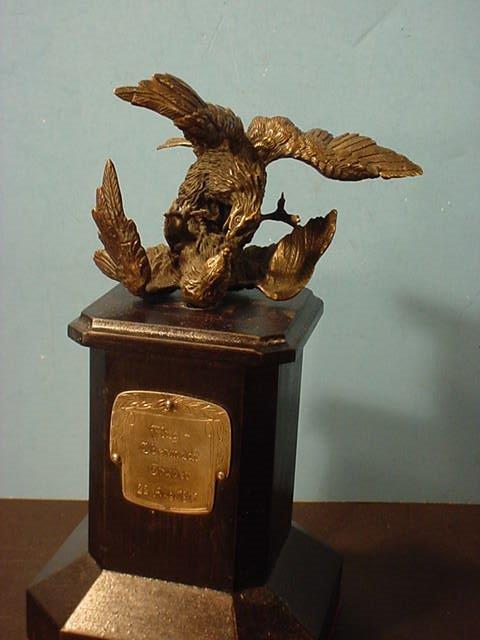
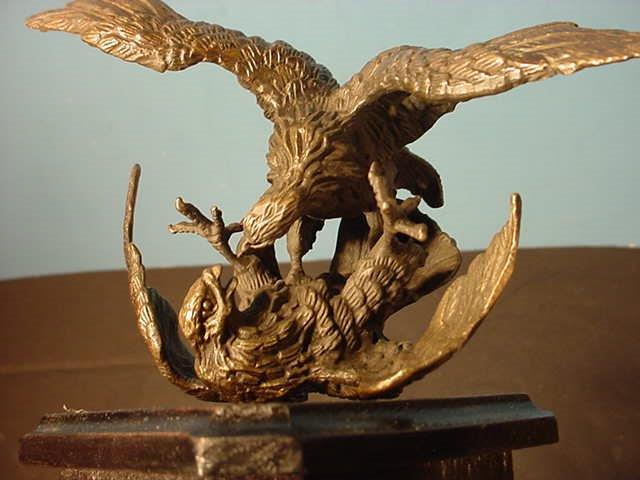
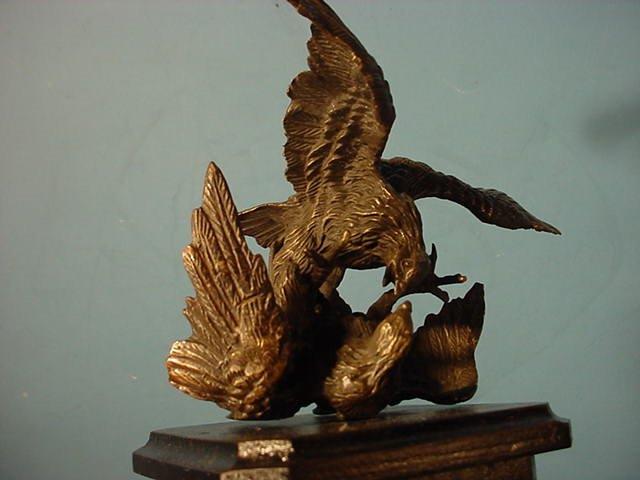
Prize of Honor for Victory in Aerial Combat in the German Imperial Naval Air Service (Item WWI 12-19; LUFT 20-19; KMEDAL 5-9) |
|
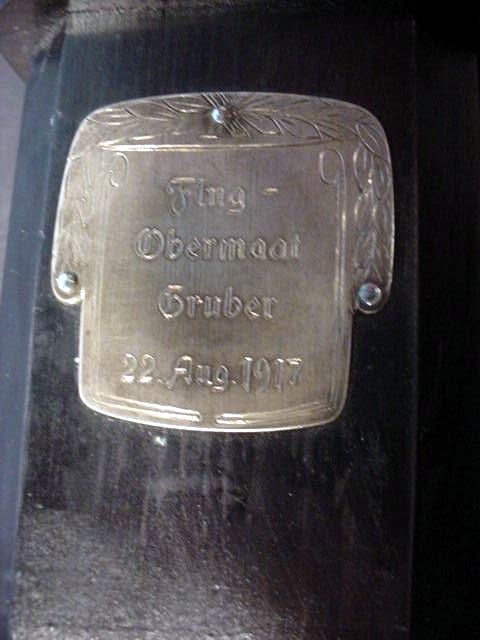
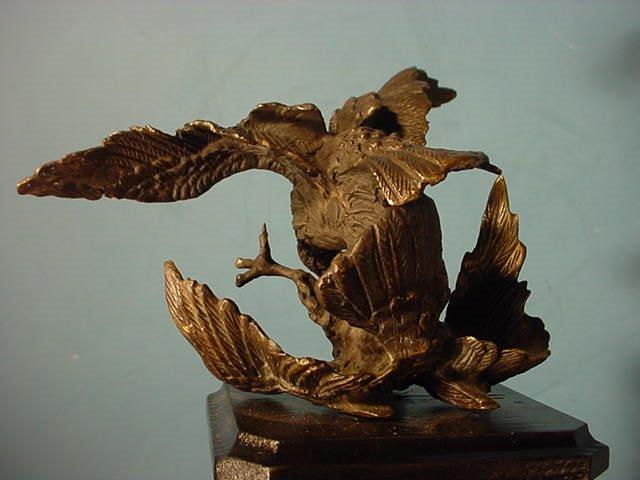
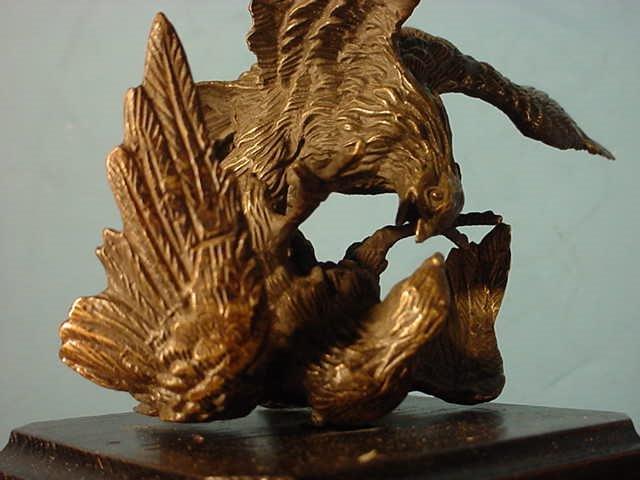
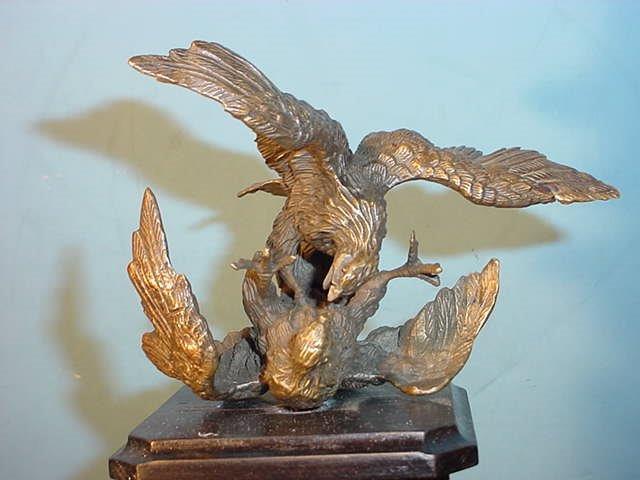
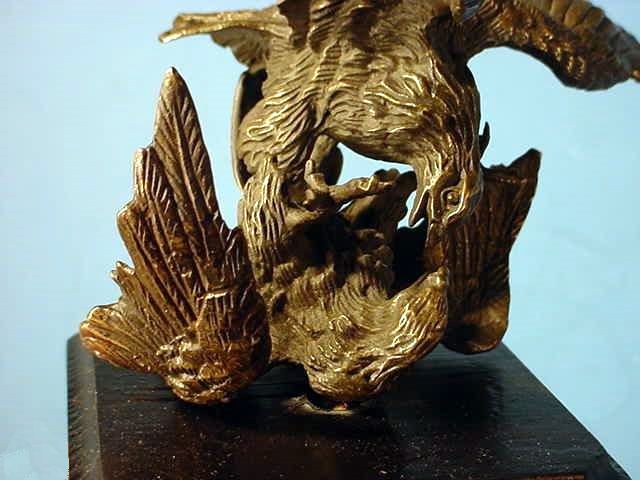
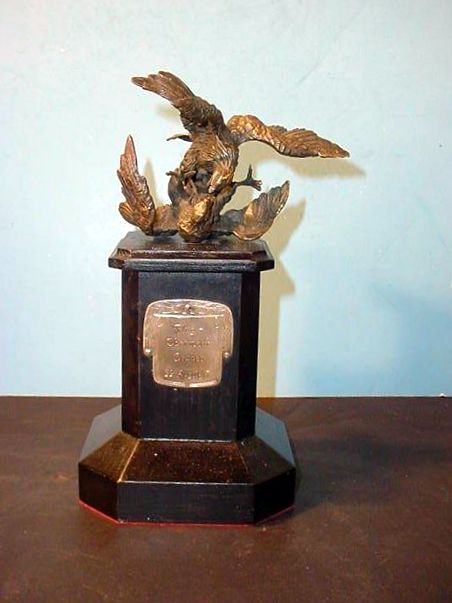
DESCRIPTION: Here is an award that is much rarer than even the famed Ehrenpokal of the Luftkampf (The Honor Goblet). This is the “Ehrenpreis für Vernichtung eines feindlichen Flugzeugs” translated: “Honor Prize for the Destruction of an Enemy Aircraft.” This is not a goblet, but a highly detailed sculpture of two bronze eagles locked in mortal combat representing the Adler-Kampf (Battle of the Eagles) and this was, of course, the suitable design to represent the engagement of WWI fighter planes in the proverbial “dog fight.” The Ehrenpokal, commonly known as the Honor Goblet, had the same Adler-Kampf as its central design in both the WWI version, and the WWII version, which was personally designed by marshal Hermann Göring. The Imperial German Navy had only a small contingent of naval pilots compared to that of the army, therefore far fewer of these Ehrenpreise were ever awarded. At first, the prizes were awarded to naval pilots for their first “kill” although later in the war more kills were required to earn the award. Usually, high-ranking officers in the army air service were the pilots, but often other naval air personnel could be the winners of various honors and were often an ordinary seaman, who was not necessarily a pilot, but could be a rear gunner or even a crack artillery ace who destroyed a great number of enemy aircraft. In this case, the award we offer was won by a Flugobermaat (flying petty officer first class) by the name of Gruber, who won it for action on August 22, 1917. Petty Officer Gruber had a flying talent that earned him this prestigious award bestowed in the name of the Kaiser’s Kriegsmarine. Obviously, he did not win this award because of any air-to-air combat while piloting a Friedrichshafen FF.41A (a reconnaissance/bomber/minelayer floatplane), as the meaning of the award would suggest, but rather he earned this during an incident in his role in the bombing of the Russian destroyer Stroinyi on the date indicated on the trophy (“22.Aug.1917”). Stroinyi, among other ships, was anchored at the Estonian island of Osel, in the Baltic Sea. During a reconnaissance mission, Gruber and his observer sighted the anchorage scene, and flew to their home base to load up on bombs, then returned to the site to make their successful bombing run: one of the bombs struck Stroinyi’s superstructure, which thwarted any attempts by the Russian crew to effect repairs from a previous incident. Besides being a beautiful sculpture, this item is prodigiously important and extremely rare today. It is a symbol of bravery and military excellence in combat on the high seas and is a worthy prize for its original recipient, and the fortunate collector who will procure it. “Hebt hoch Deutschlands Fahne” PRICE: SOLD |
|
|
|
|
|
|
|
|
|
|
|
|
|
|
|
|
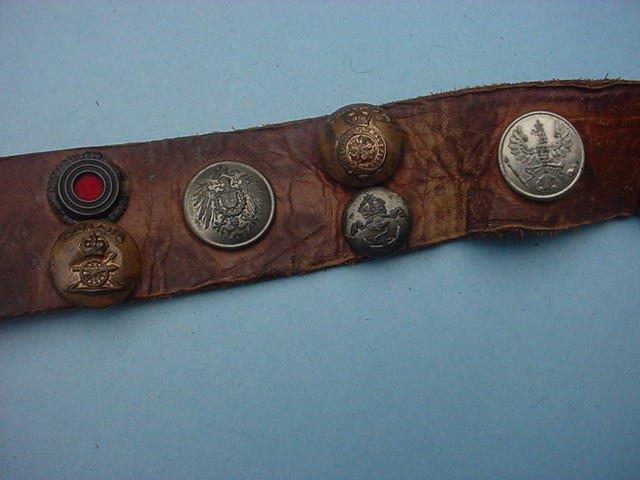
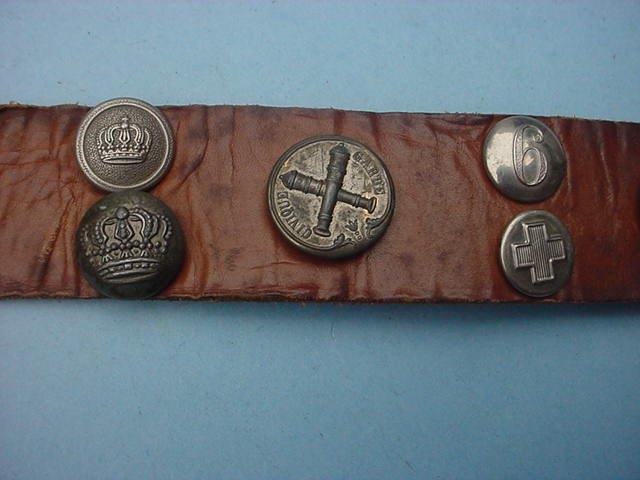
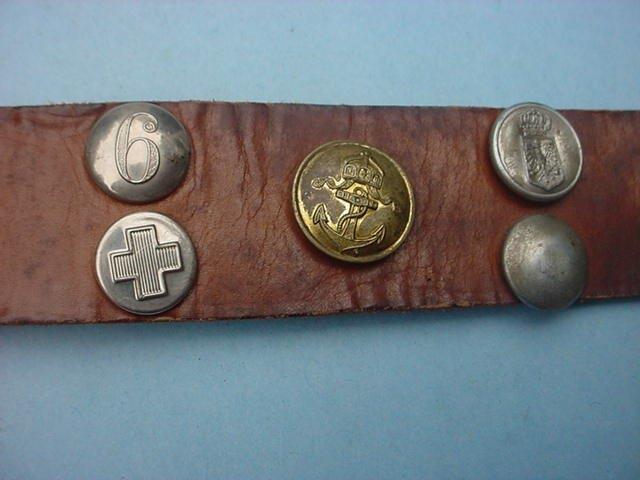
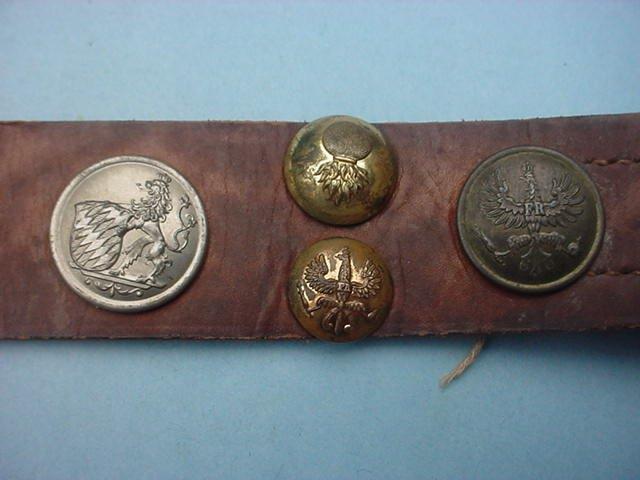
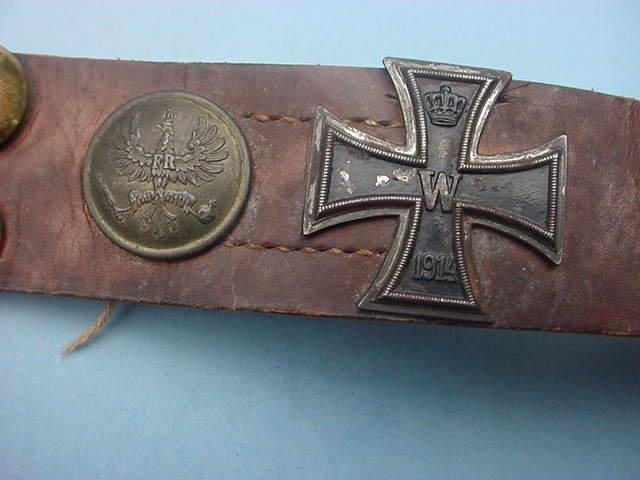
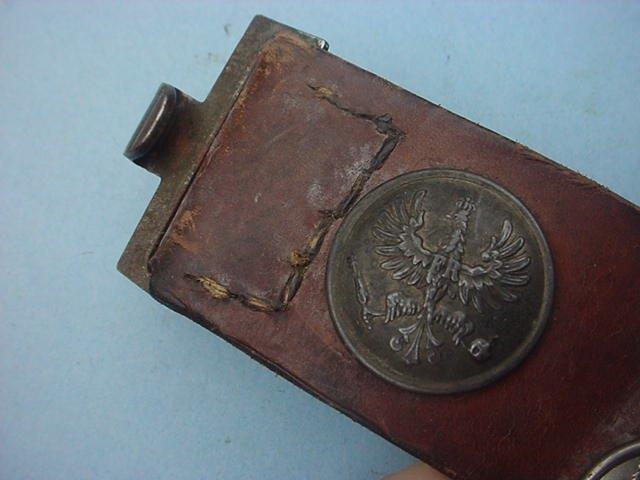
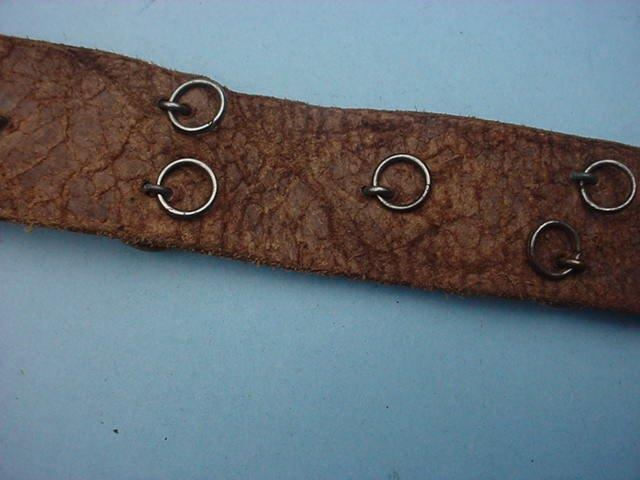
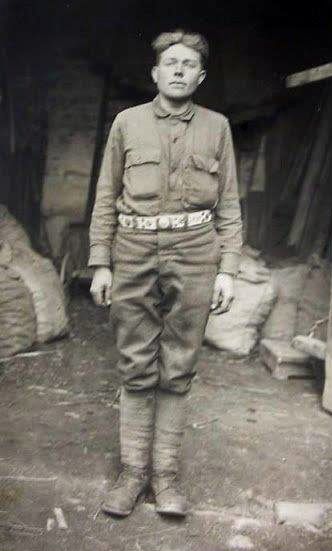
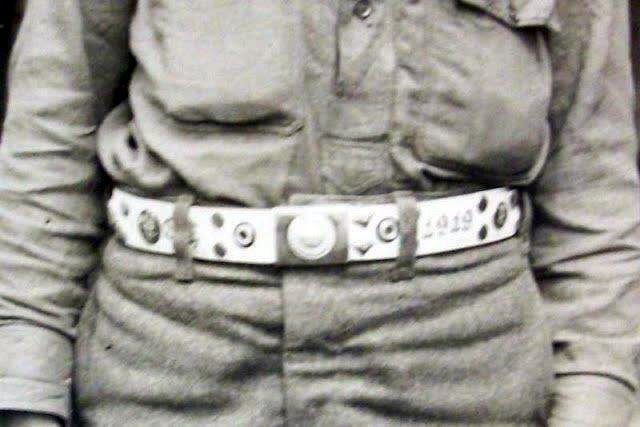
WWI “Hate Belt” (Item WWI 12-20) |
|
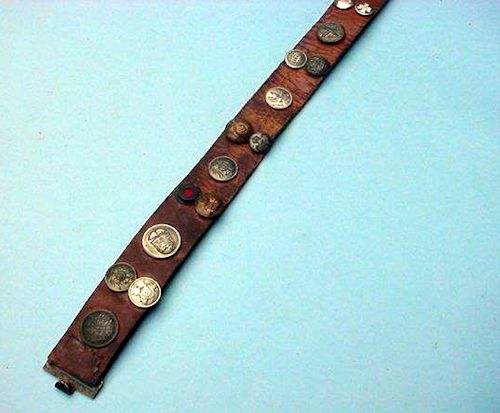
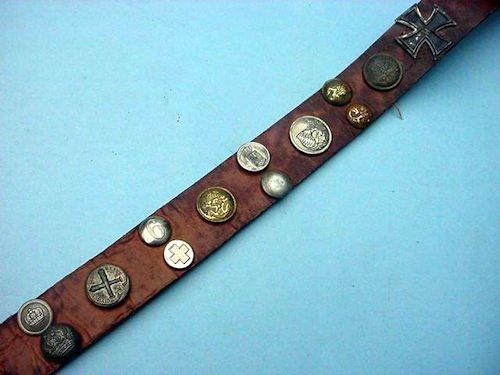
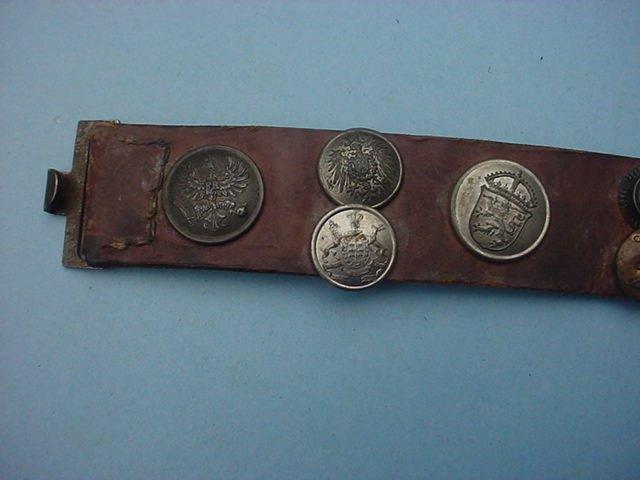
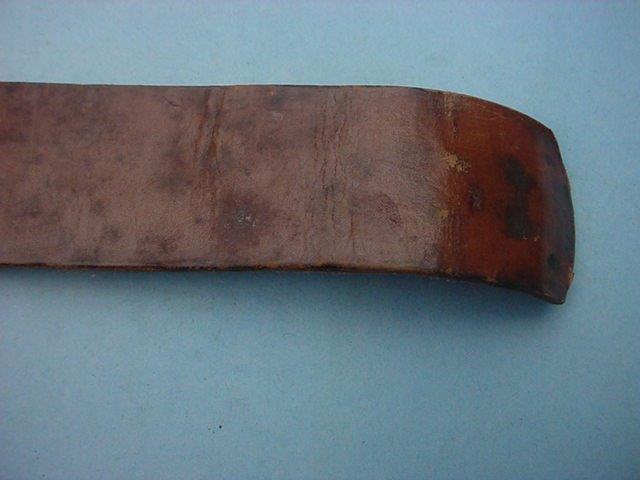
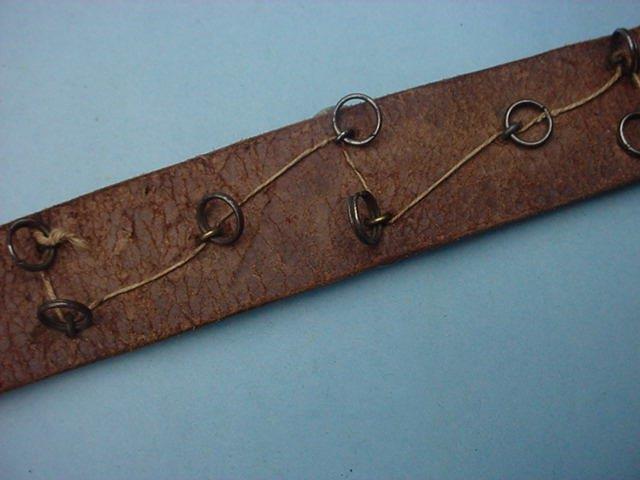
DESCRIPTION: These belts could be falsely named as they have the bad rap of being identified as belts containing buttons and badges collected in combat from dead or captured soldiers from the ranks of the enemy, but further study of the subject leads us to believe they were often simply a soldier’s collection of mostly uniform buttons that were swapped between soldiers (mostly German) who made it a hobby or pastime to put them together. This one, however, has 23 items to include 14 obviously German buttons and actually an Iron Cross, four British regimental buttons, and a single button from a Belgian Garde Civique. The leather belt itself is a German standard-issue type fitted for the German Gott Mit Uns belt buckle. Was this the collection of a German soldier or of a British “Tommy,” or could it actually be one of the rare ones with buttons from prisoners or battlefield dead? The Iron Cross leads us to the latter conclusion. WHY? Because a German soldier would hardly add this sacrosanct medal to a belt. Another answer that has been handed down from the past was that these button collections would be collected by soldiers on graves detail and that they would take a button from the body as a memorial token. In any case, these belts very seldom ever show up anymore, anywhere. They are truly historical treasures and this one world rank as one of the best examples ever turned up from the aftermath of the greatest war and greatest tragedy that the world has ever seen up until the horrible madness unleashed in WWII.
PRICE: $585.00 |
|
|
|
|
|
|
|
|
|
|
|
|
|
|
|
|
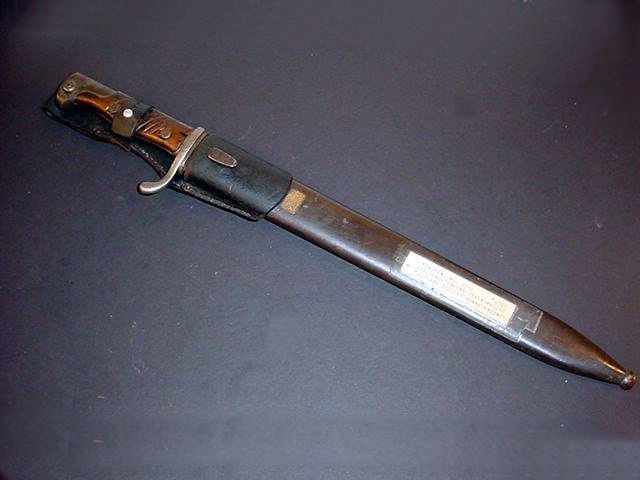
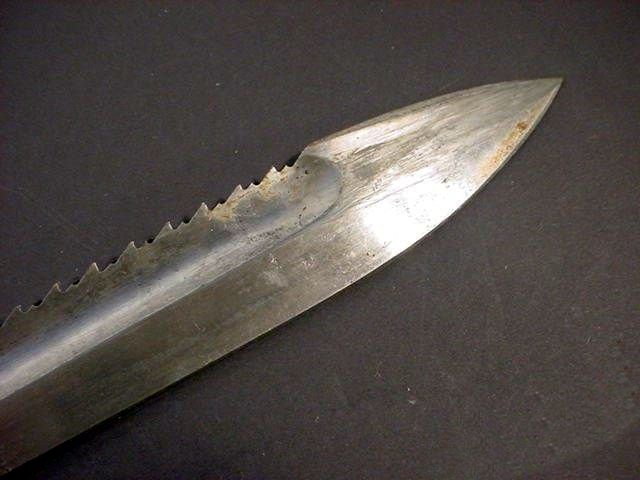
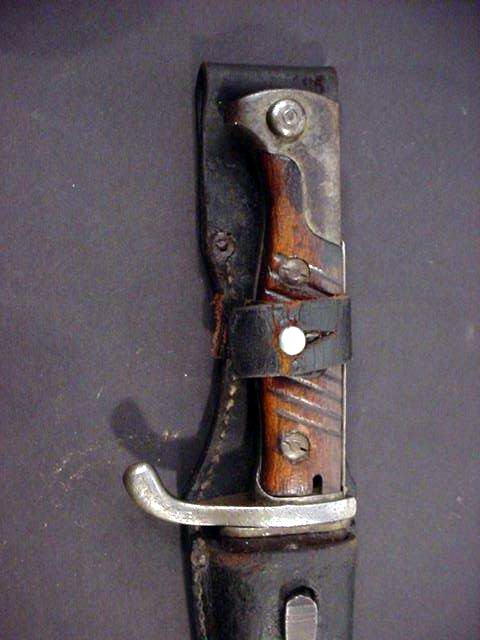
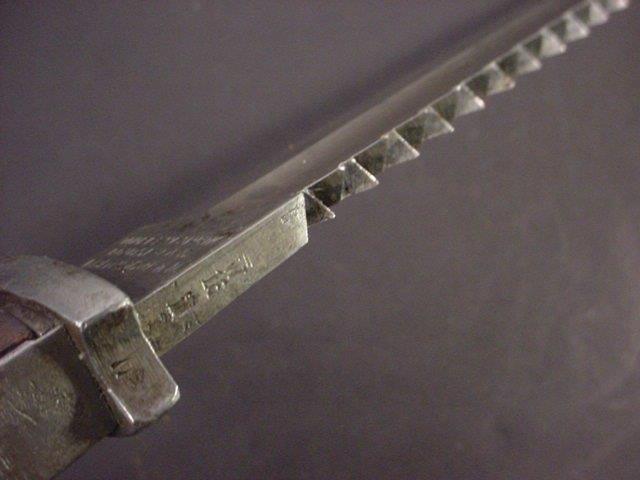
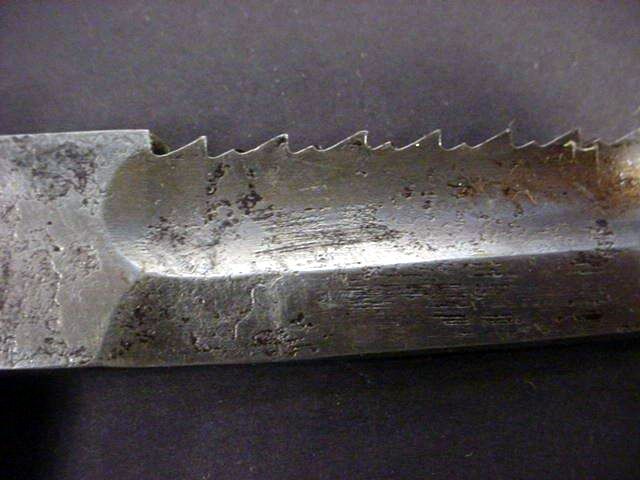
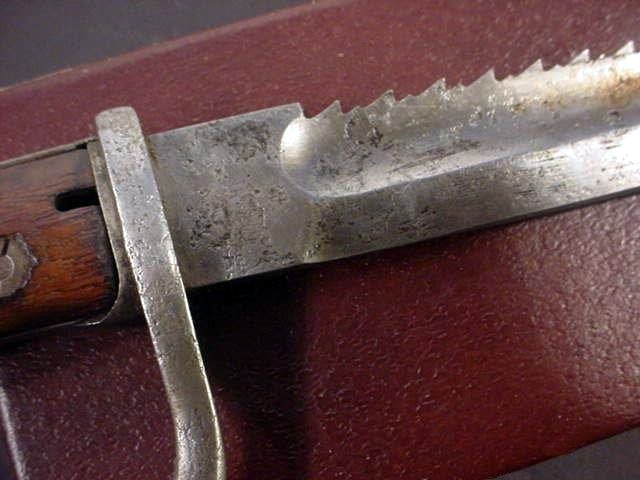
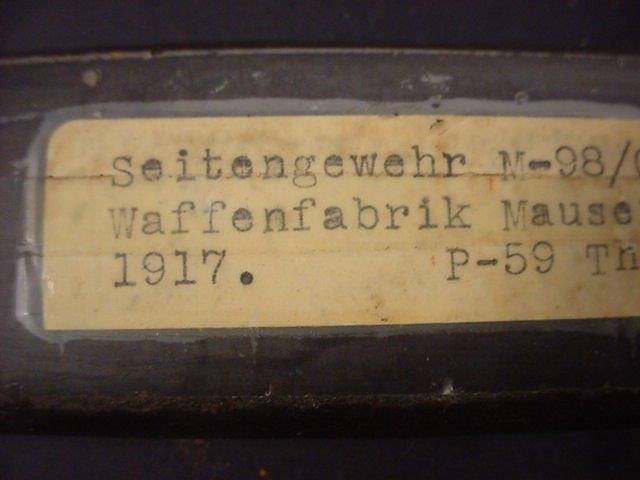
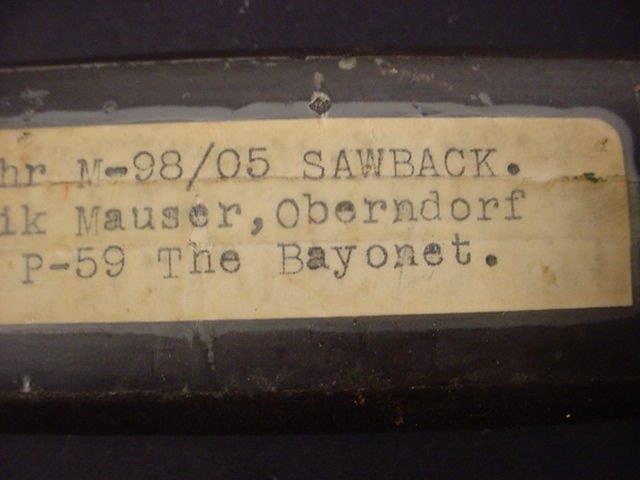
RARE German WWI M-98/05 Saw-back Bayonet by “Waffenfabrik Mauser Oberndorf” in 1916 (Item WWI 12-21; KWEP 5-11a) |
|
DESCRIPTION: This weapon has a 14 1/2-inch blade with a bit of pitting around the ricasso and quillion. It has grooved wooden grips and a steel sheath with black-leather frog, and is marked “Sohn 1941” on a museum label. Overall length is 20 1/2 inches and is in very good condition. The saw-back bayonet was developed as a general-usage utility tool as well as a weapon. The teeth were meant to facilitate the cutting of wood for various defensive works such as barbed wire posts as well as for butchering livestock. It was initially adopted by the German states in 1865, lasted to the middle of WWI, and issued usually to engineers. To some considerable extent the bayonet aspect was secondary to the tool aspect. The German army discontinued use of the saw-back bayonet in 1917 after numerous protests that the serrated blade caused unnecessary severe wounds when used as a fixed bayonet. It’s rarely found today and in an Internet search I found only one that was in poor condition and minus a scabbard, as well as a few reproductions and about three saw-backs with the serrated-teeth section removed. Ours is intact and a prime example and the most desirable would of course be by Mauser Oberndorf with its teeth all there. This is a textbook example and you surely would not find a better one, if at all!
PRICE: $850.00 |
|
|
|
|
|
|
|
|
|
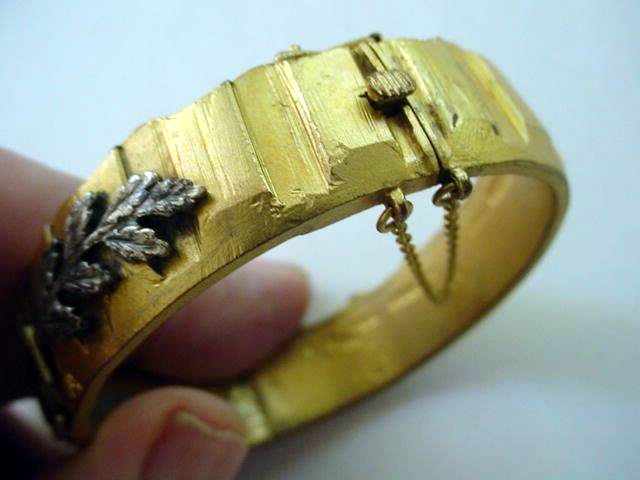
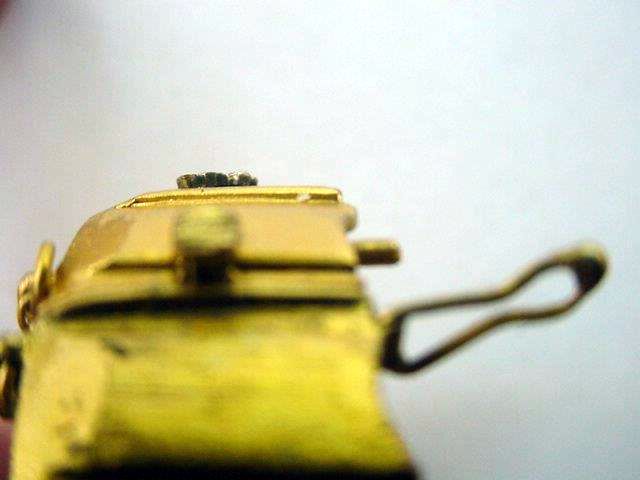
Patriotic Bracelet Made from Artillery Shell from World War 1 (Item WWI 12-22; KJEWELRY 2-31) |
|
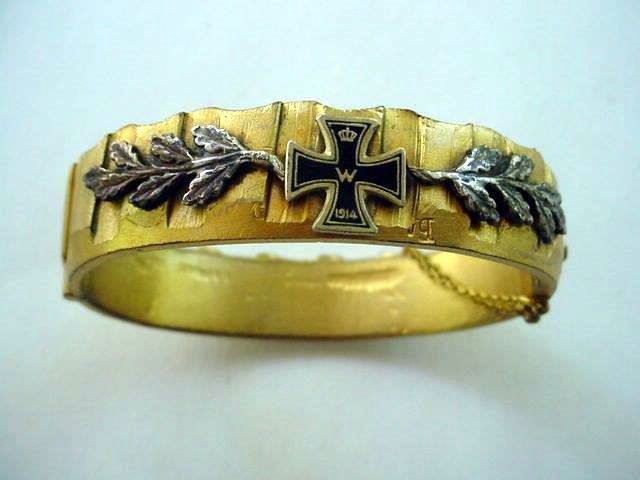
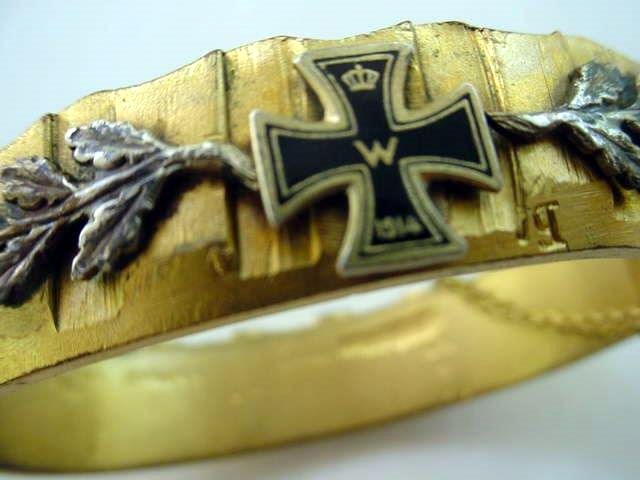
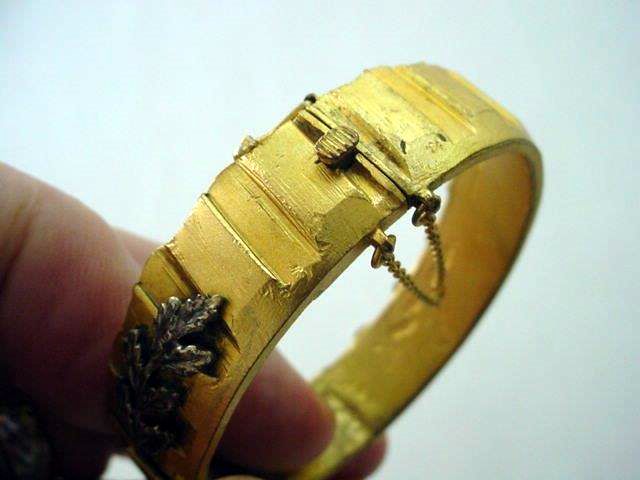
DESCRIPTION: Here is an absolutely beautiful bracelet featuring the WWI Iron Cross in enamel flanked by genuine-silver oak leaves. What makes this so unusual is that it is constructed from an actual German brass artillery shell as a remembrance of service in the war and was probably given to a wife or sweetheart by a soldier who had it made possibly by a jeweler in an occupied territory? The piece is put together in the finest of jewelry technique; an examination of the images will reveal the wonderful snap catch and chain with button for attachment or removal and the safety device also nicely installed.
This is far from the average souvenir sent from the Front. The presenter most probably was a soldier of officer rank because from the look of it this neat little bauble was undoubtedly expensive even in its time. This a wonderful remembrance of the war to end all wars!! Right?
PRICE: $285.00 |
|
|
|
|
|
|
|
|
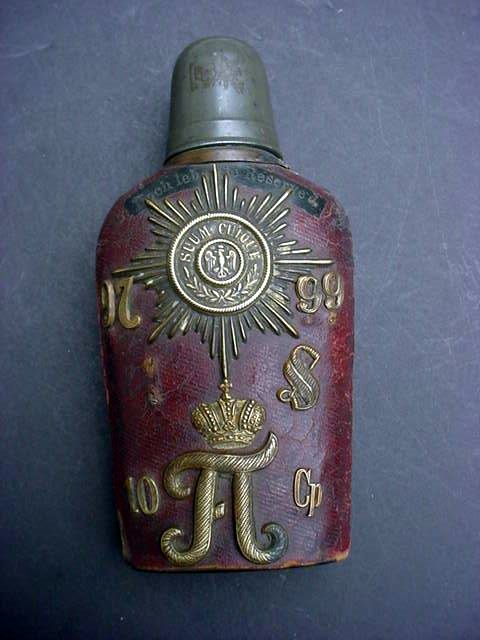
Decorative Schnapps Flask WWI (Item WWI 12-23) |
|
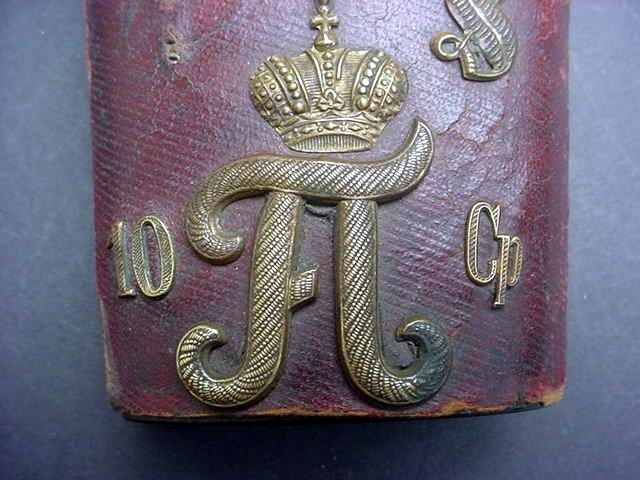
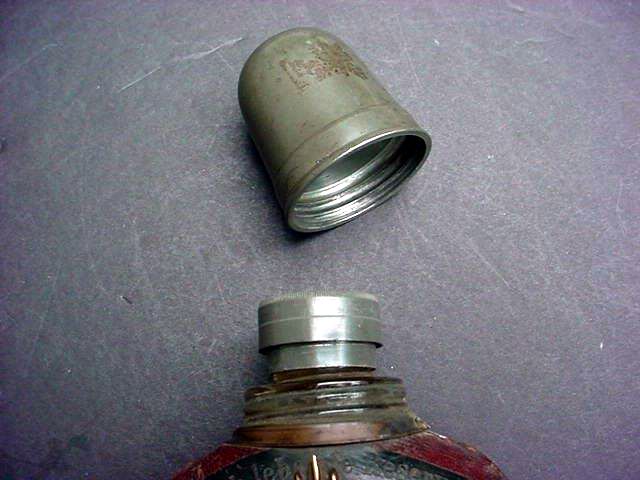
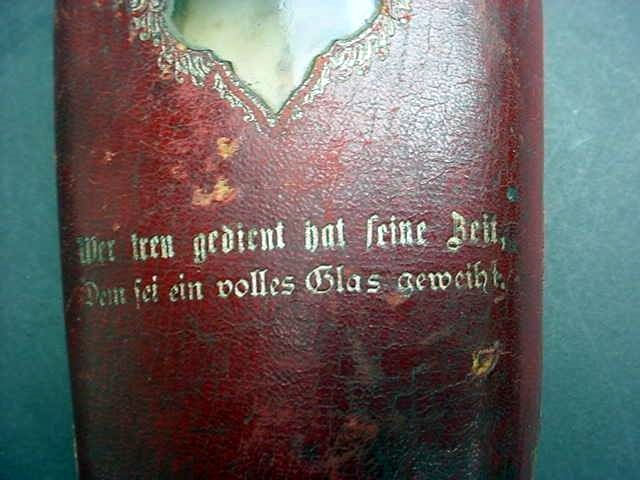
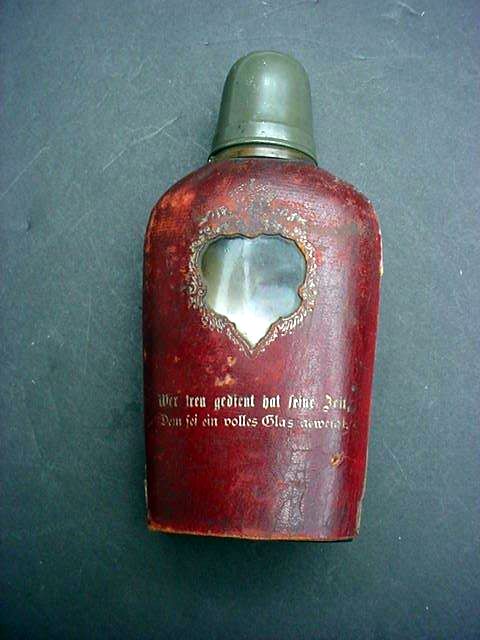
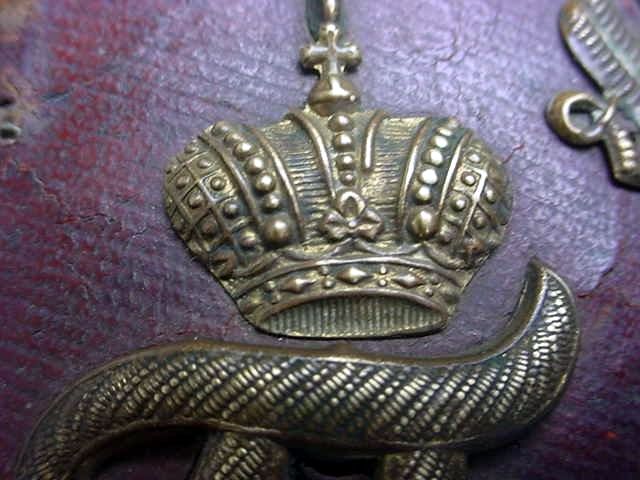
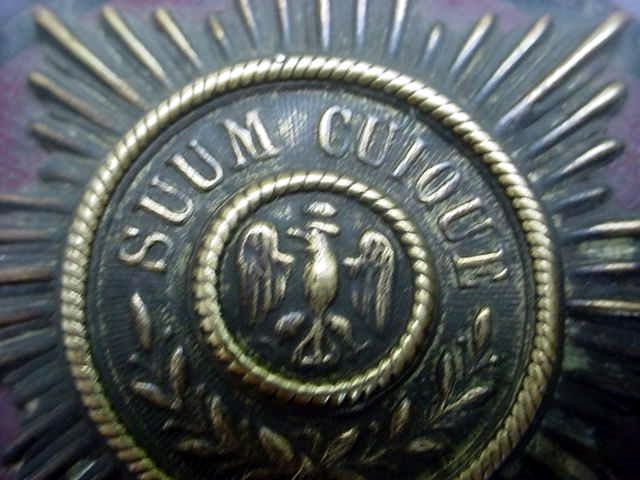
DESCRIPTION: Here is a flask from one of the most elite regiments of the Royal Prussian Army and it was essentially a Guard Grenadier Regiment and an infantry regiment, as well. The tradition of royal guard units dates back to 1626 when Elector George William of Brandenburg had a standing mercenary unit established during the Thirty Years’ War to defend the borders of his margraviate. The First Grenadier Regt. was formed after the Napoleonic Wars of Liberation on 17 October 1814, by order of King Frederick Wilhelm III of Prussia and it was named in honor of Tsar Alexander I of Russia, who was also its first colonel in chief. Parts of the formation had distinguished themselves in the 1807 Siege of Kolberg. Most of its officers had been decorated with the Iron Cross or the order Pour le Mérite. The regiment was elevated to the rank of Royal Guard on 18 February 1820, and was first based near Alexanderplatz in Berlin. About 1900, the garrison moved into larger barracks near Friedrichstrasse station, which later, until 1990, was occupied by the Friedrich Engels Guard Regiment of the East German National People’s Army. The former parade ground today is the site of the Friedrich-Ludwig-Jahn-Sportpark. After WWI, the regiment was demobilized on 27 November 1918, though volunteers were still employed by the Weimar government in the Silesian uprisings and against the Bavarian Soviet Communist Republic. Officially disbanded with effect of 31 December 1920, the remaining forces formed the 9th and 12th company of the Infantry Regiment 9 Potsdam, carrying the Alexander tradition further in the new Reichswehr military organization. The Flask The flask is covered in leather and the guard star and other metal items were applied back in 1897 through 1899, the years that the soldiers served in the regiment. The Guard Star is bright in brass with the Latin words “Suum Cuique” meaning “To each his own” and was always the motto on the Order of the Black Eagle of Prussia. Guard regiments used it on swords, belts, and such items as this flask. On each side of the star you see the date of service “97-99.” Below is a letter “S” on the right, but on the left you can see that there was another letter (missing). These letters were probably the initials of the former owner. Below this is a large brass letter “A” surmounted by the Russian Tsarist Royal Crown. The “A” is flanked on each side with the characters “10 Cp” and I would surmise that this stands for 10th company. The “A” is done in the style of Russian Cyrillic lettering and is the exact formation used in the style used by Tsar Alexander. On the back of the flask is a heart-shaped window and it is cloudy with age, but when you look closely you can see the image of a beautiful young Fraulein inside. Under the heart window there were words that translate to: “We are in true service for this time and fully class distinguished.” The glass inside is unbroken. The lid unfortunately is missing what was probably an eagle (broken off). The lid cap screws off to reveal an inner cap that when screwed off reveals the slight odor of Schnapps long ago consumed by a “happy” soldier. This is an extremely rare relic from the elite of the elite of the Prussian military tradition and Kaiser Wilhelm’s most-favored of his royal guard regiments. PRICE: $250.00 |
 |
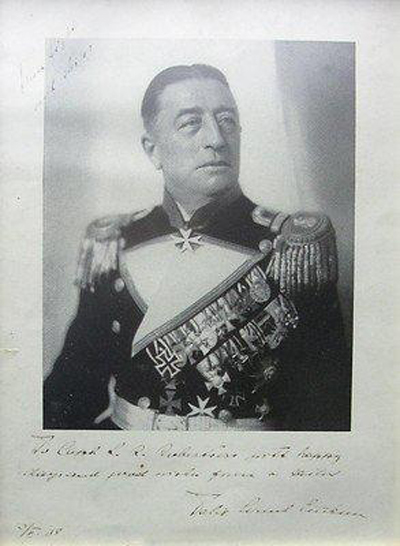
 Picture with Dedication |
 |
 |
 Another signed picture sold years ago at auction |
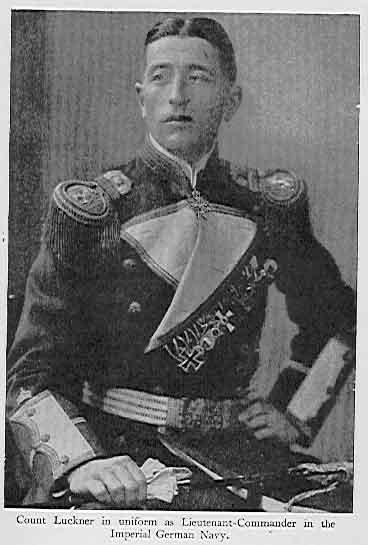 Early picture of the Count |
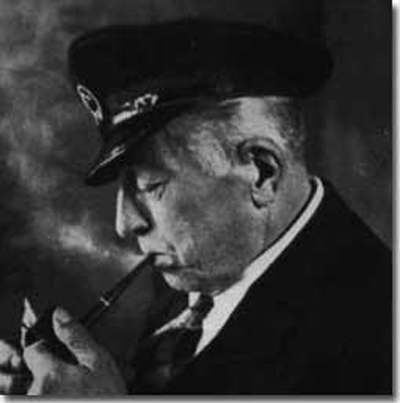 The Count in a relaxed moment |
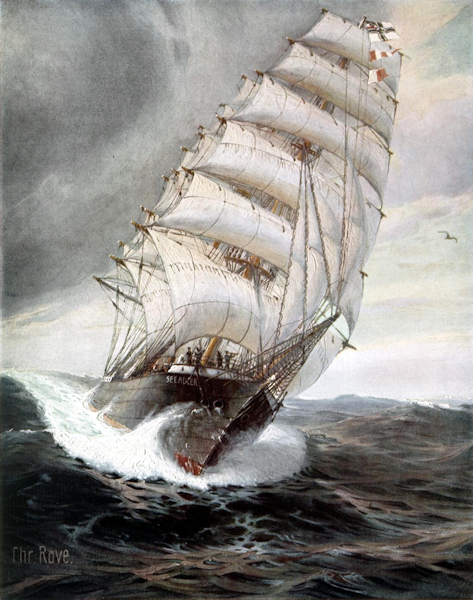 Von Luckner's ship, Sea Eagle |
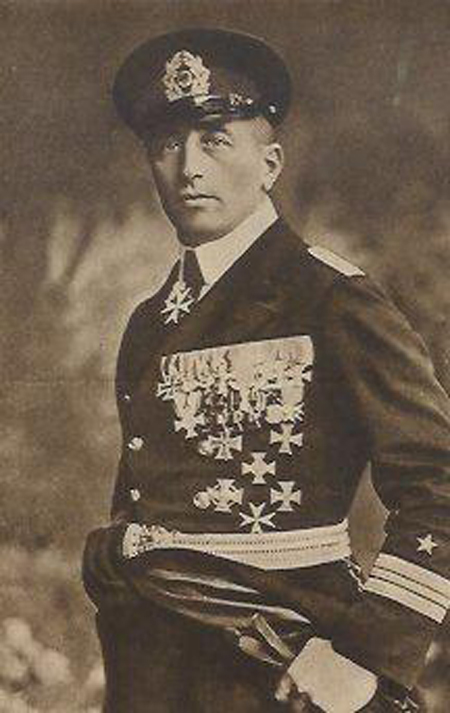 Count von Luckner in WWI gear |
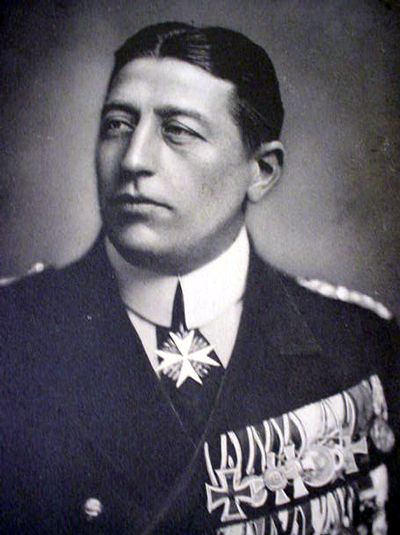
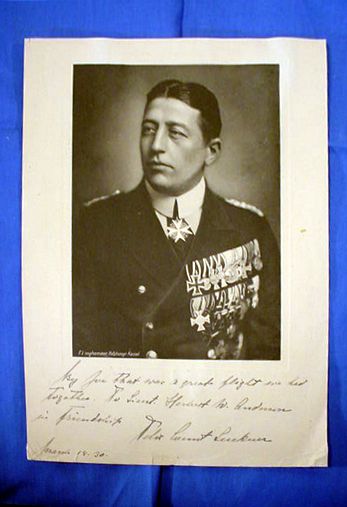
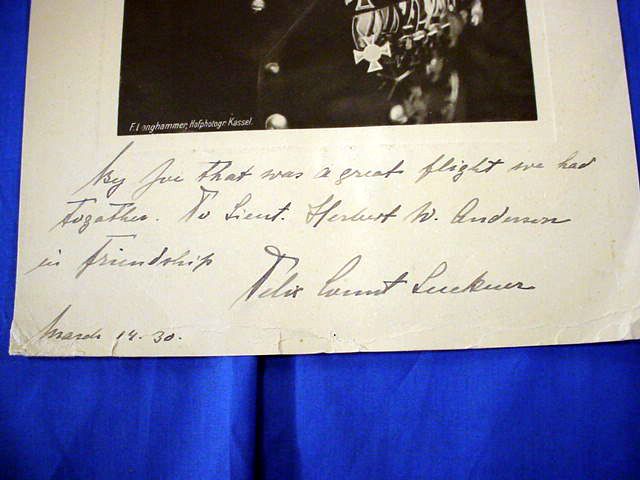
Portrait Suitable for Framing of the “Sea Devil” (Signed) Graf Luckner (Item WWI 12-23a) |
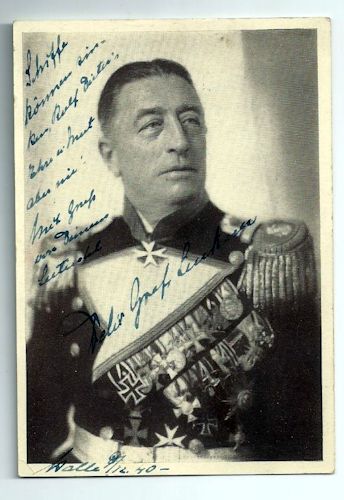
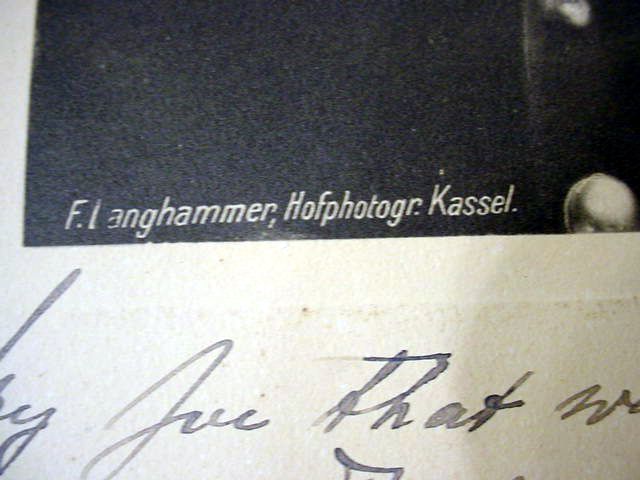
DESCRIPTION: This portrait of Count Felix Graf von Luckner was presented to a British comrade (probably a naval officer). The gentleman receiving it was a lieutenant by the name of Herbert W. Anderson. Count Luckner dedicated it to this officer with the words in ENGLISH: “By Joe that was a great flight we had together.” He signs it to: “Lieut. (Anderson) in Friendship Felix Count Luckner March 14/30.” This is particularly meaningful as it illustrates the sense of respect and chivalry that existed between two former enemies for one another recognizing bravery and comradeship of the one for the other because they were warriors each in his own cause. It seems the greatest shame that two Caucasian nations had to try to destroy each other for absolutely no good reason--twice! Size is 8 x 11 inches and is in good condition. PRICE: $500.00 |
|
|
|
|
|
|
|
|
|
|
|
|
|
|
|
|
|
|
|
|
|
|
Book by Felix Graf Luckner Entitled Seeteufel (Item WWI 12-24; KRIEG 10-18) |
|
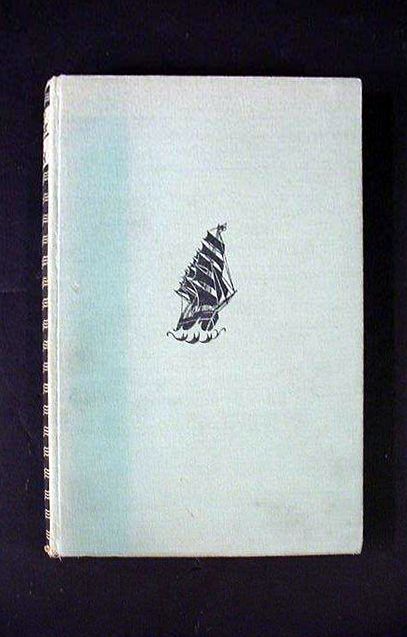
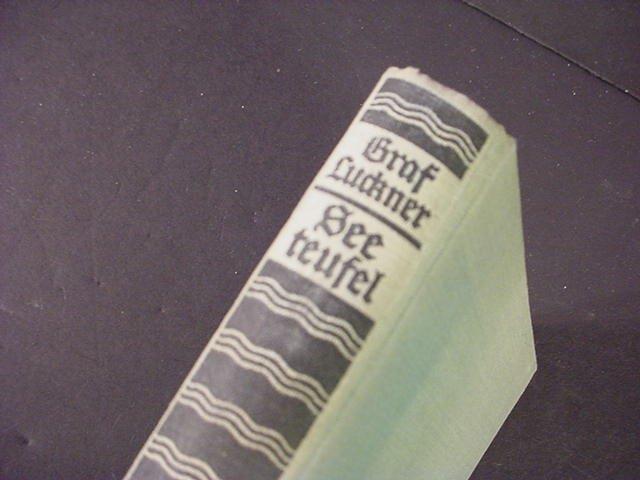
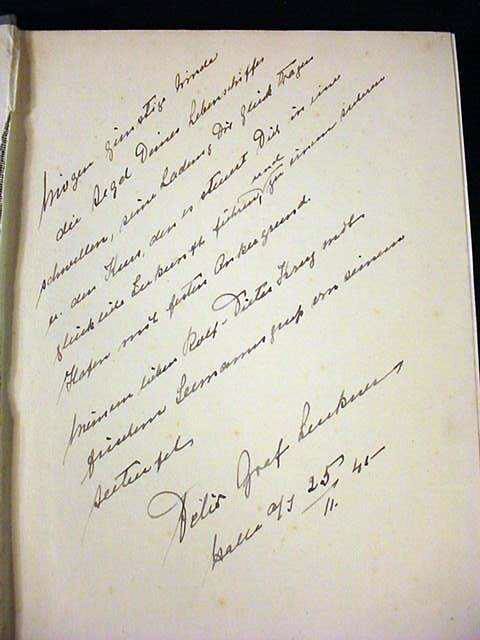
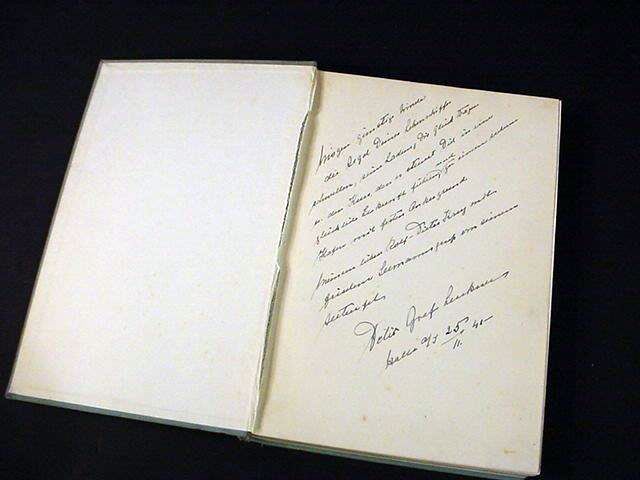
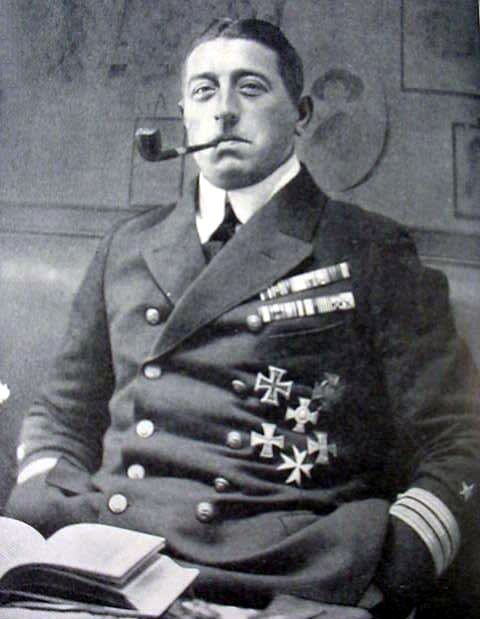
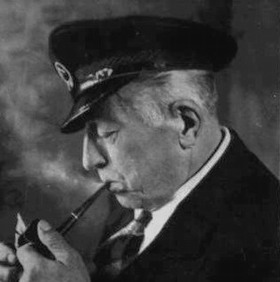
DESCRIPTION: Here signed and dedicated is the book by the famed and celebrated “Sea Devil” Count Felix Graf von Luckner. We have given a capsule review of the life and fantastic career in the description of the photo above. He was a man’s man and a hero beyond any normal human concept. As a much-adored Teutonic warrior of the sea, the epithets “Sea Devil” and “Kaisers’ Pirate” he bore proudly as he faithfully and dutifully served his Deutsches Vaterland. His very countenance as he puffed on his ever-present pipe gave off an aura of not only self-confidence, but that look that seems to portray the demeanor of a super swashbuckler personified. He indeed loved the sea and was one of the greatest luminaries of the annals of the sea and those who heard her clarion call ever sounding on her waves. The Book This volume is named Seeteufel (Sea Devil) and has the subtitle Abenteuer aus Meinen Leben (Adventures of My Life). The book measures 9 x 6 inches and comprises 308 pages with 133 crystal-clear photographs of his ship Seeadler (Sea Eagle) and other pictures of his crew, his adventures, and so many, many others. When the cover is opened the dedication and signature is seen there in the count’s own handwriting. He says (translated): “May the good winds fill the sails of your ship of life and the cargo shall bring you luck. The direction it sails should guide you through a happy life and a harbor with good anchorage. To my beloved Rolf Dieter with a happy sailor greeting from the Sea Devil, Felix Graf Luckner. Halle Nov 25, 1940.” It’s signed by Count Luckner. This is a historical treasure, indeed. The book was published in 1921 in Leipzig. It is in remarkably fine condition with a little loosening in the inside cover across from the dedication. It also has the slightest fraying at the very bottom of the spine. This is a tale of high adventure, daring-do, romance, and sheer courage. The chance today of finding not only an original hand signature plus a wonderful dedication like this would be most fortunate for the archivist or collector. The pictures alone are absolutely great! PRICE: $390.00; Most definitely reasonable |
|
|
Signed and Dedicated Picture of the Famed “Sea Devil” (Item WWI 12-25; KRIEG 10-19; PERS 4-20) |
|
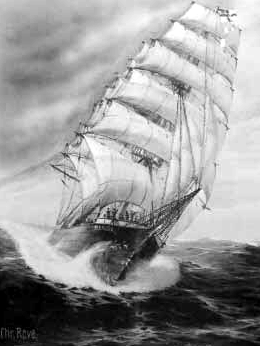
DESCRIPTION: Felix Graf von Luckner (9 June 1881-13 April 1966), sometimes called in English “Count Luckner,” was a German nobleman, naval officer, author, and sailor who earned the epithet “Der Seeteufel” (the Sea-Devil); his crew was known as “Die Piraten des Kaisers (the Emperor’s Pirates). These titles were earned for Luckner’s exploits in command of the sailing commerce raider SMS Seeadler (Sea Eagle) between 1916 and 1917. It was Luckner’s habit of successfully waging war without casualties which made him a hero and a legend on both sides. In the early months of WWI Felix von Luckner saw action at the Battle of Heligoland Bight (1914). At the Battle of Jutland he commanded a gun turret on board the battleship Kronprinz Wilhelm. At the beginning of the war, Germany converted a considerable number of merchant ships into merchant raiders by equipping them with guns and sending them in search of Allied merchant shipping. Most of the armed raiders were not particularly successful, but they did tie up considerable Allied forces in hunting them. By early 1915, most of the armed raiders had been hunted down and sunk or else had run out of fuel and been interned in neutral ports. Hoping to revive commerce raiding, the Imperial German Navy equipped the impounded three-masted British sailing ship Pass of Balmaha (1,571 tons) and equipped her with two 105-mm guns hidden behind hinged gunwales, several machine guns, and two carefully hidden 500 HP auxiliary engines. She was commissioned as the auxiliary cruiser Seeadler ( PRICE: $195.00 |
|
|
|
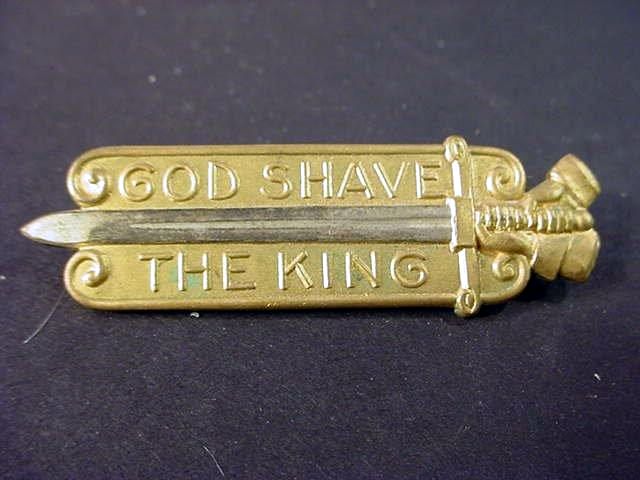
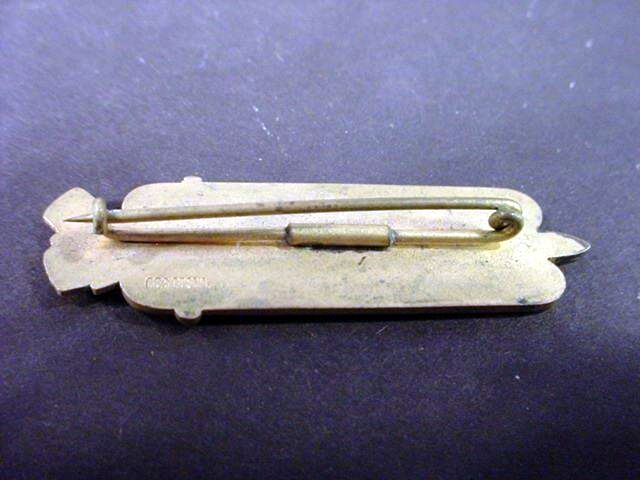
"God Shave the King" (Item WWI 12-26) |
|
DESCRIPTION: This is a German WWI pin that has the humorous saying upon it that says “God Shave the King,” a parody on the British patriotic expression “God Save the King.” Here the Teutonic nationals have shown a sword—presumably razor sharp—suggesting that English King George V should be shaved not so carefully with it and suggestive that England should fall; an idea shared by many countries that had suffered under the Union Jack, but in the end it was the bulldog that suffered the most with the loss of her bloody empire. So it was that she that once ruled the waves witnessed the crows coming home to roost. This is a really great piece of German political satire indeed and historically important!
PRICE: $250.00 |
|
|
|
|
|
|
|
|
|
|
|
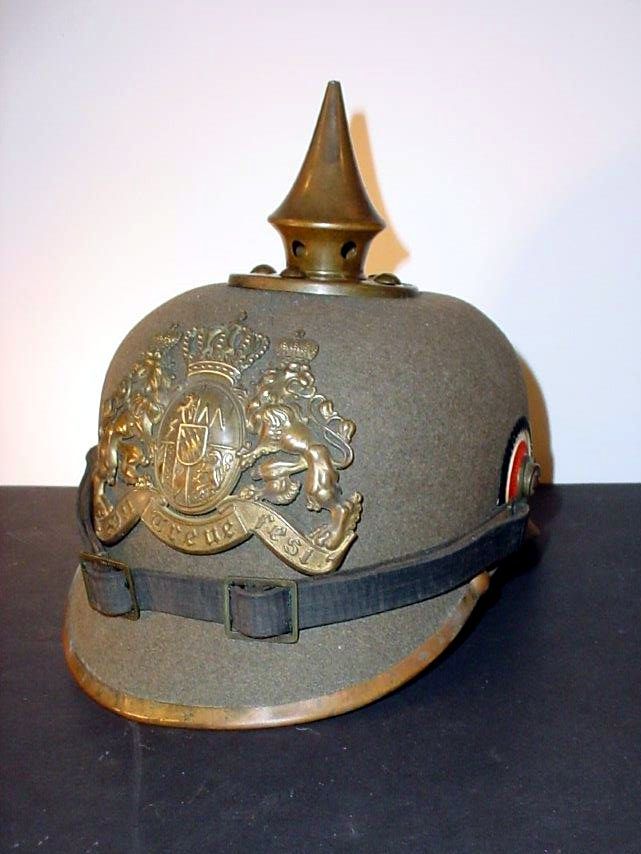
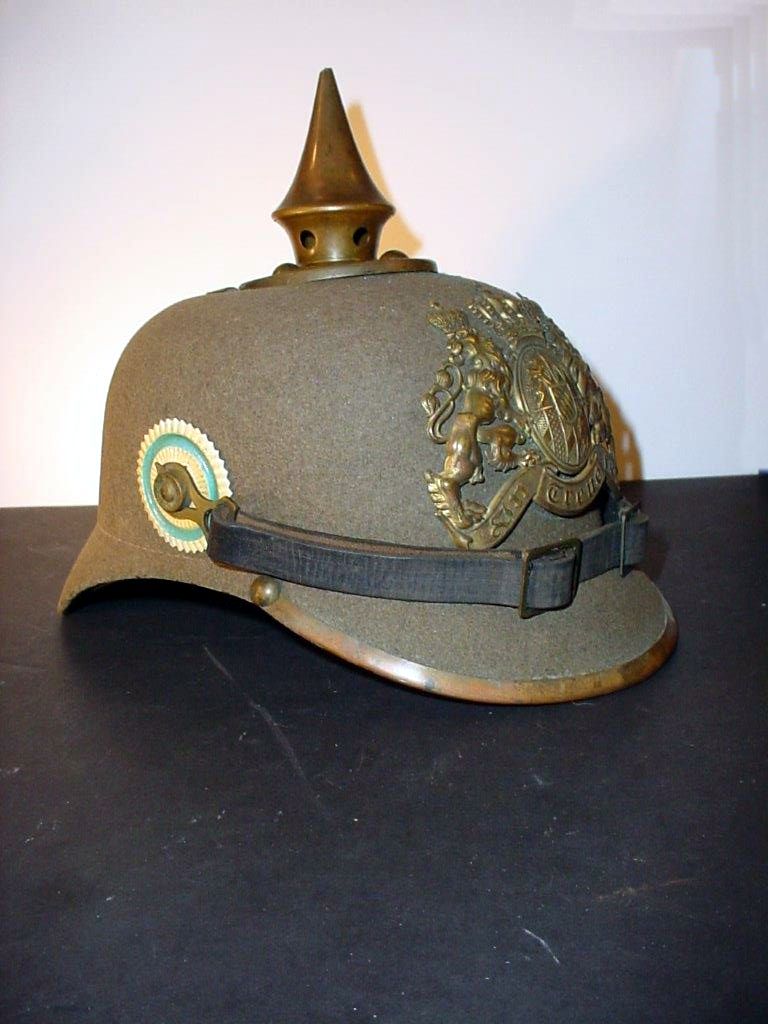
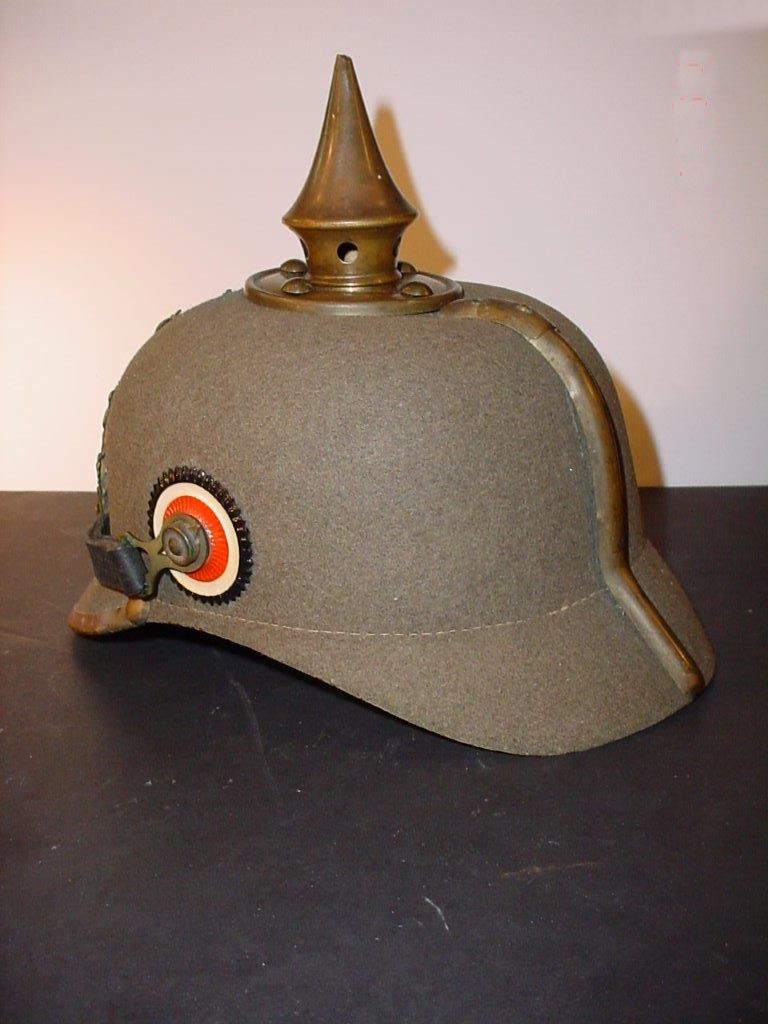
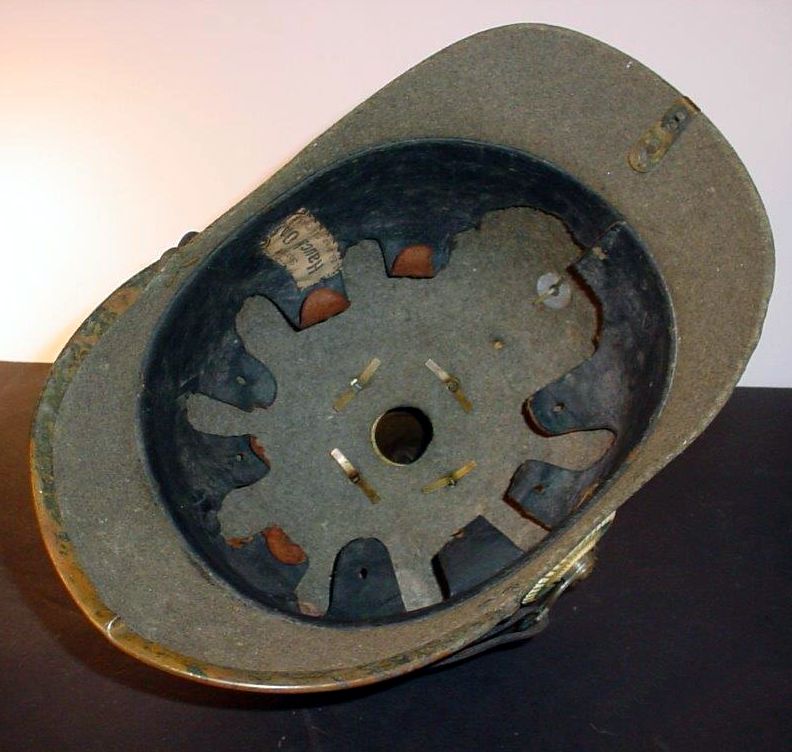
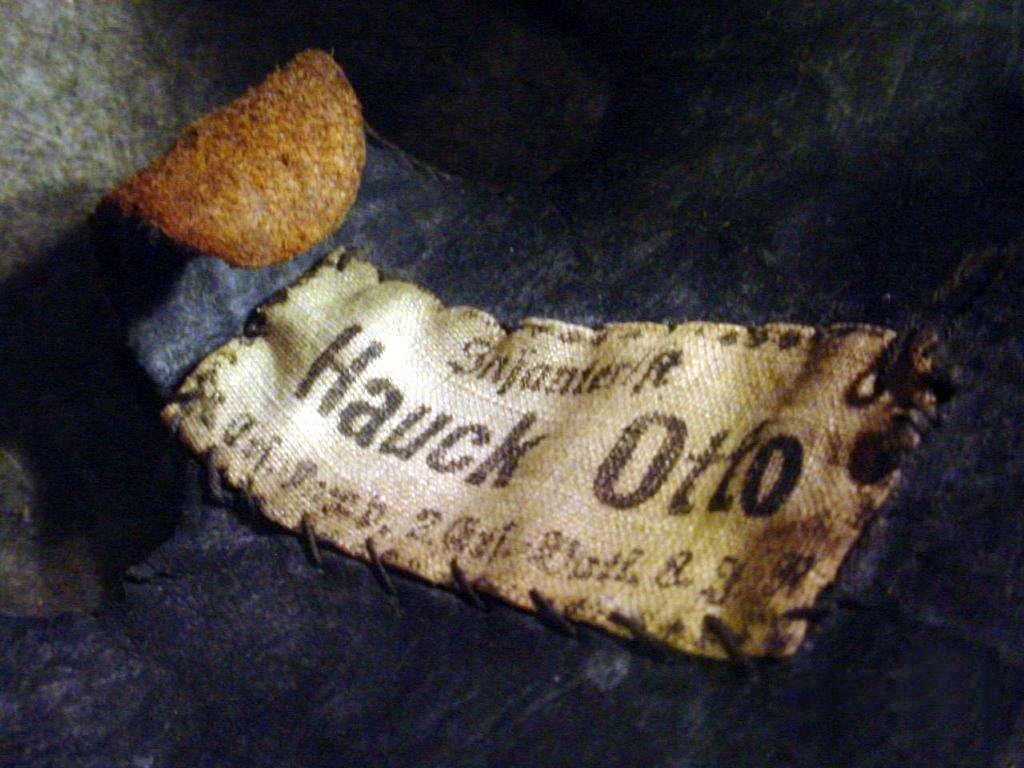
WW I Bavarian Ersatz Felt Pickelhaube (Spiked Helmet) (Extra Rare!) (Item WWI 12-27; KHELMET 2-18) |
|
DESCRIPTION: Here is the finest felt spiked helmet we have ever had or even seen. Because of the material most all of them encountered are pretty much mangled after over 100 years—scuffed, bruised, bashed, etc. But this one for the most part is positively pristine! The leather chin strap is intact and unbroken. The right side nautical color cockade is black, white, and red and the Bavarian cockade is blue and white. Just as they should be. The top of the spike has a little practically unnoticeable dent. The liner is all there and inside is a little label sewn to the liner that reads: “Hauck Otto” followed by some regimental identification. Ersatz helmets in the Bavarian army were adopted in 1915 and ersatz means replacement and these were for sure replacements for the leather ones when the war blockade prevented the importation of cowhide from Argentina to Germany. This helmet has prewar brass fittings that are 100-percent correct. Others we have seen had grey metallic pewter fittings and were not so glamorous looking; however, both sets of fittings would be authentic and correct. This one however is very special in condition and is the one we know you have long sought.
PRICE: $1,875.00; extremely rare, but very reasonably priced considering all |
|
|
|
|
|
|
|
|
|
|
|
|
|
|
|
|
|
|
|
|
|
|
|
|
|
|
|
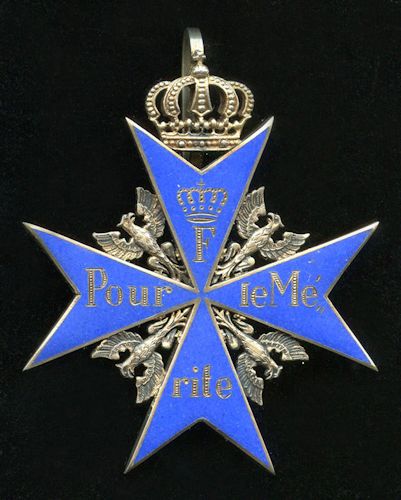
An Amazing and Special Artifact (Item WWI 12-28; KMEDAL 5-10) |
|
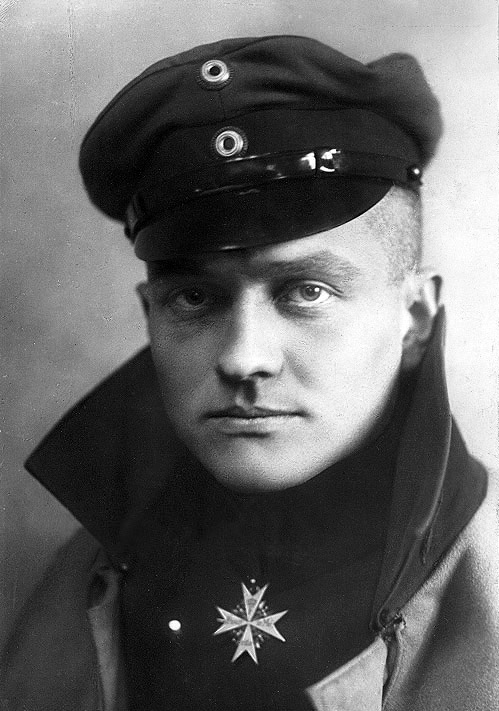
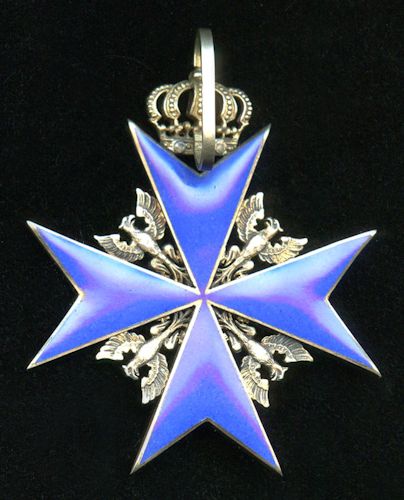
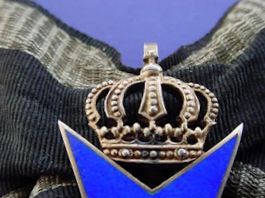
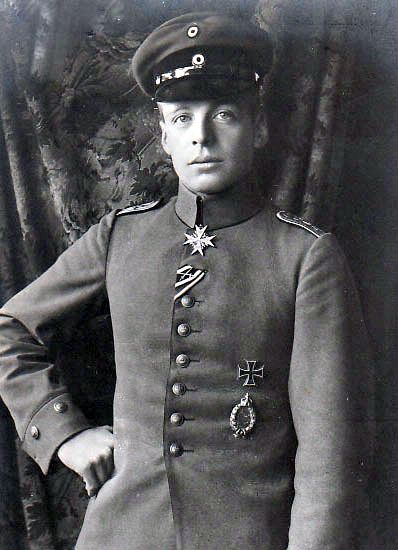
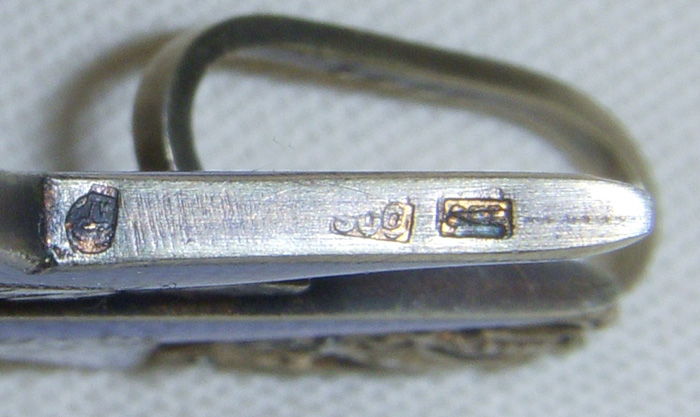
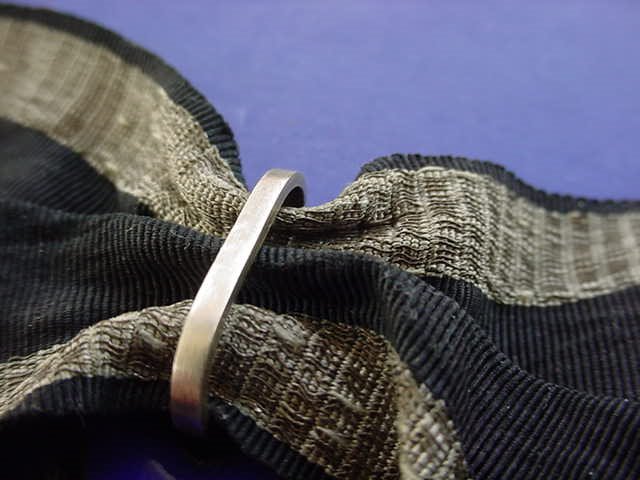
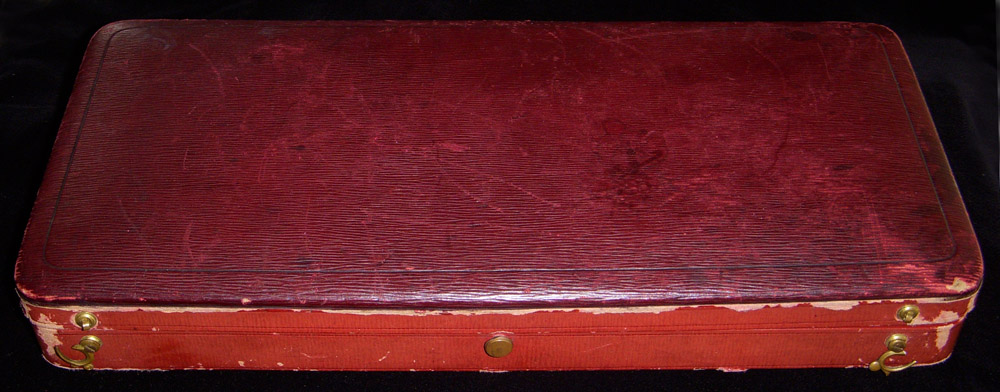
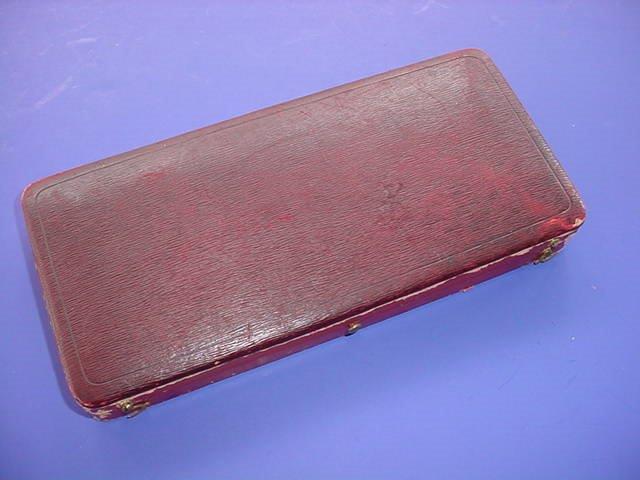
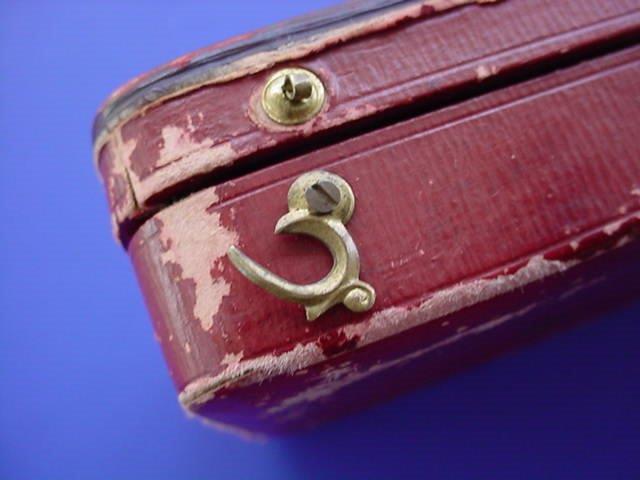
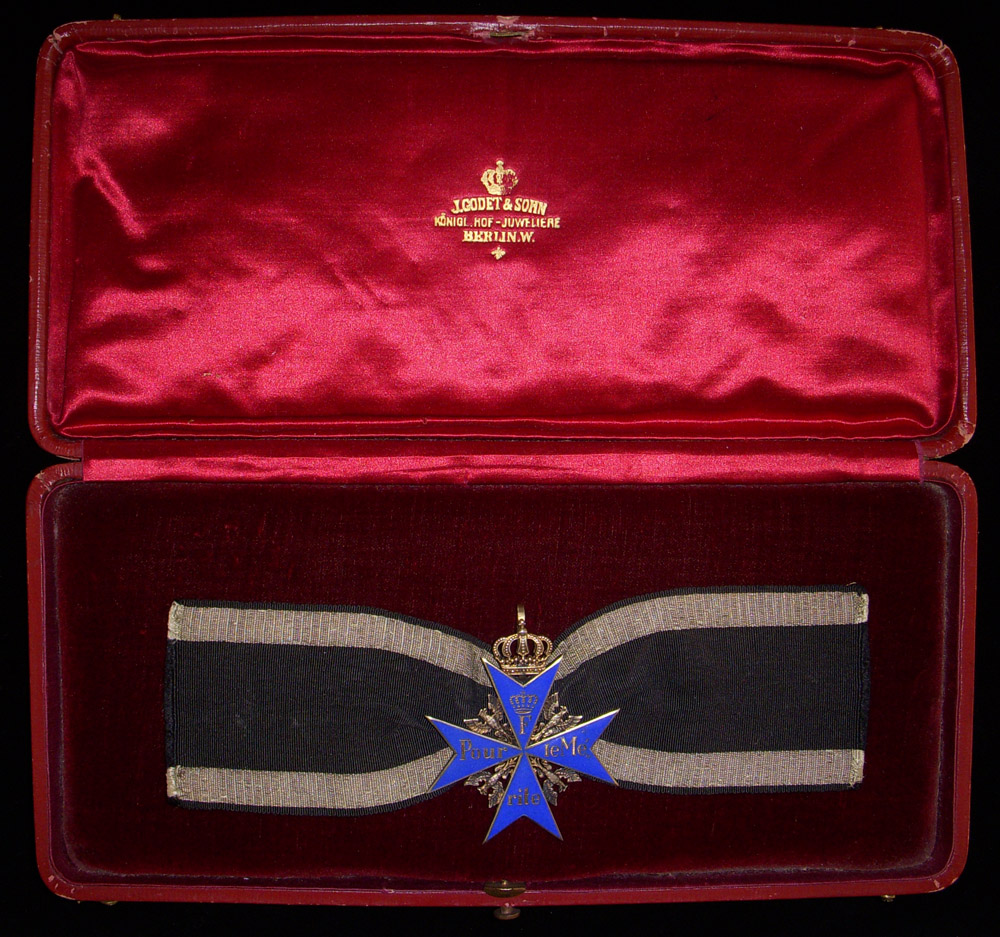
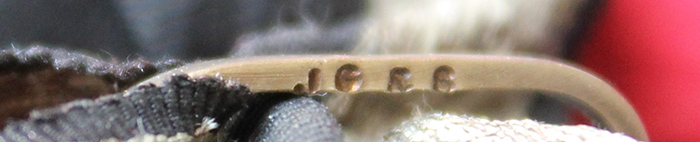
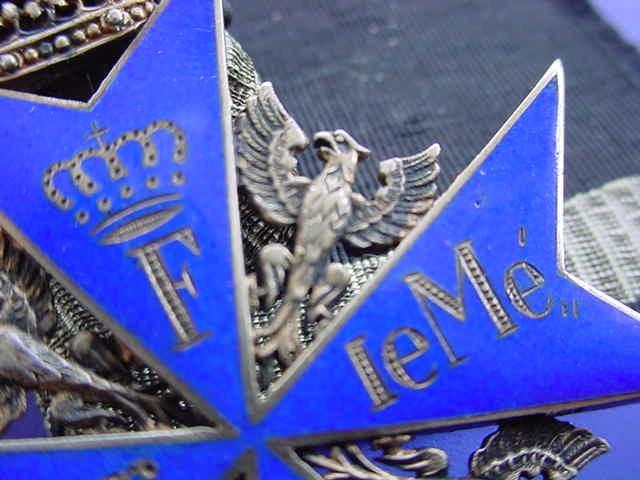
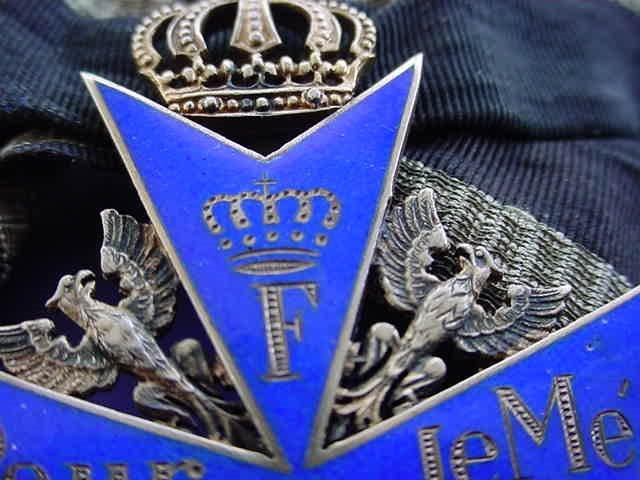
DESCRIPTION: Here, Germania International offers a fantastic example of one of the most coveted medals in all of military collecting: The Pour le Mérite; the BLUE MAX, AND, this is a great variant for beginning or even advanced collectors of the subject. Not just because it has the crown suspension for the 50th Anniversary of the Recipient’s original awarding of the Order, BUT because this PARTICULAR piece is actually a PIECE of ROCK-SOLID EVIDENCE, pinpointing the era of manufacture, and therefore reason for existence of this particular manufacture style of Pour le Mérite. Read on . . . In the area of PLMs, one term that is heard FAR too often is “jeweler’s copy.” While jeweler’s copies were indeed made for recipients for numerous reasons, far too many were made strictly for collectors, and therefore are really JUST copies. Sometimes fakes. Here we have a TRUE jeweler’s copy, which can be PINPOINTED to a period of manufacture, making it most likely to have been produced for a Franco-Prussian War Pour le Mérite recipient who needed a crowned example of the Order as appropriate for the 50th Anniversary of the original awarding of the order. The PLM offered here is marked on one of the arms of the cross with the “900” silver-content marking, and a cartouche with the inner markings obliterated. The markings inside there might well have been the “FR” seen on Rothe & Neffe orders, as the eagles on this cross correspond to eagles on other known orders produced by Rothe. And there is one more mark, down closer to the center of the badge that sheds MUCH light on the piece we have to offer. Down the same arm of the cross that has the “900”and the obliterated cartouche is a small blob of a marking, not crystal clear, but DEFINITELY the post-1921 Austrian silver content mark of the Hoopoe bird in an irregular cartouche! Our PLM is marked on the suspension loop attached to the crown, JG&S for J. Godet & Söhne. Also, our PLM is in the original presentation case, also marked to the firm of J. Godet & Söhne. The WONDERFUL thing about this is that it PINPOINTS manufacture, along with the Austrian silver mark, to 1922-1924! This means, without a doubt, that the PLM we are now offering for sale was manufactured between 1922 and 1924, most likely for a Franco-Prussian War PLM recipient, to show the 50th Anniversary of his original award. The company Gebrüder Godet & Co. (brothers Godet & Co.) was founded 1761 by the goldsmith Jean Godet. The company was one of the first German manufactures of orders and honorary signs in Germany. Godet became the prime royal warrant for orders under the leadership of Jean Frédéric Godet. The company was known as J. Godet & Söhne between 1864 and 1924. The company name then changed to Eugen Godet & Co. The name changed again in the late 1920s or early 1930s to Gebrüder Godet & Co. Why would the “Tiffany” of Germany, Godet, outsource the manufacture of a Pour le Mérit to a firm OUTSIDE of GERMANY??? Let’s look at the economic climate of Germany circa 1923 (the median year in our very small window of possible manufacture). From 1921-1923 Germany experienced hyperinflation. Money was being devalued by the hour sometimes, and it could take millions of Reichsmarks just buy a loaf of bread. Now, the wealthy were still wealthy during these times, having their money safely invested or hidden in forms other than paper currency. So, it only makes sense that when a wealthy client of an exclusive jewelry firm like Godet decided to acquire his proper “crowned” Pour le Mérite for social or political functions he might attend, rather than try to scrounge up silver in a depleted, depressed, and constantly inflating country, Godet turned to a firm in their much more stable neighbor to produce the award, and then have it marked it with their maker mark. It stands to reason that only during this one moment in time might a firm like Godet need to reach out to a firm like Rothe to produce this needed award for a client. And the markings on this PLM Prove the period of manufacture, without a DOUBT. An exceptional and rare offering of a much-coveted order and handmade most likely by the Austrian Jewelers Rothe & Neffe in multiple pieces, the cross is made of two obverse and reverse cross pieces, exquisitely joined (a perfect seam runs around the body of the cross). The eagles are applied separately, and the crown suspension is riveted to a bar at top. The enamel is perfect and of the highest quality. The badge is marked to the firm it was sold by, J. Godet and Söhne of Germany, and comes in a beautiful leather and silk presentation case boldly marked by the firm, as well. This is a wonderful investment-grade Pour le Mérite and a great piece for the beginning collector of this Order, or a wonderful variation for an advanced collector of this Order. VINTAGE: Circa 1922-1924 SIZE: Medal: approximately 2-1/2” in height and 2” in width; case: 10” by 4-3/4” by 1-1/2” CONSTRUCTION/MATERIALS: Enameled 900 silver in two-piece construction (seam is evident); leather-wrapped board, velvet ATTACHMENT: Hook on crown; hinge, hooks and push-release on case MARKINGS: JG&S (J. Godet & Söhne mark) on side of loop; 900, cartouche with obliterated markings and Austrian silver mark, all on side of arm CONDITION: 8 (excellent): The medal is in beautiful condition. I usually shy away from the word “mint,” but I feel compelled to use it this time. PRICE: $7,500.00 |
| Page Twelve |
Please refer to item designator in parentheses in all correspondence.
Please E-mail for any additional information you may need.